Table of Contents
- The Dawn of July 14, 1958: Baghdad on the Verge of Cataclysm
- Iraq under the Monarchy: A Kingdom on Shaky Foundations
- Colonial Shadows and Nationalist Dreams: The Groundwork of Revolt
- The Arab Cold War and Regional Ripples: Context Beyond Borders
- Key Figures of the Revolution: Abd al-Karim Qasim and the Officers’ Brotherhood
- The Military Conspiracy: Planning the Unthinkable in the Heart of Baghdad
- A Thunderclap in the Capital: The Seizure of Power on July 14
- Execution of the Monarchy: The Death of King Faisal II and the End of an Era
- The Overthrowing of the Hashemite Rule: How a Dynasty Fell in a Night
- The Immediate Aftermath: Chaos, Fear, and the New Regime’s First Steps
- The Revolution’s Ideology: Nationalism, Socialism, and the Promise of Change
- Iraq’s Shift Towards Non-Alignment and Soviet Alliances
- Internal Challenges: Tribal Loyalties, Political Factions, and Economic Pressures
- The Decline of British Influence: From Protectorate to Independence Reclaimed
- Regional Repercussions: Shockwaves in the Arab World and Cold War Powers
- The Societal Impact: Voices of Women, Intellectuals, and the Working Class
- The Revolution’s Long Shadow: From Qasim to the Ba’athist Takeover
- Memory and Interpretation: How the 1958 Revolution Shapes Iraqi Identity Today
- Lessons from the July 14 Revolution: Unfinished Revolutions and the Quest for Sovereignty
- Conclusion: The End of One Kingdom, the Birth of a Nation’s Turbulent Quest
- FAQs: Untangling the Threads of the 1958 Iraqi Revolution
- External Resource
- Internal Link
1. The Dawn of July 14, 1958: Baghdad on the Verge of Cataclysm
July 14, 1958, broke over Baghdad with a heavy, humid air hummed by the calls of street vendors and the distant playing of children. But beneath the everyday bustle, a storm was brewing. In the shadows of the city’s grand palaces and ancient mosques, whispers of defiance stirred among the barracks and cafés. By afternoon, this whispered secret would explode into a violent upheaval, shattering a kingdom and reshaping Iraq’s future forever. The streets ran red not just with blood but with the promise of revolution—the end of dynastic rule and the birth of a new republic.
This moment was not just the climax of a coup d’état; it was a violent rupture tearing through decades of colonial entanglement, monarchic stagnation, and simmering nationalist fervor. To understand this seismic event that reverberated through Iraq and across the Arab world, one must first peer into the fragile foundations upon which the Iraqi monarchy was built.
2. Iraq under the Monarchy: A Kingdom on Shaky Foundations
Established in the aftermath of World War I, the Kingdom of Iraq was an artificial construct in many ways, stitched together by colonial powers carving up the Ottoman Empire’s remains. The Hashemite monarchy, installed by the British, found itself ruling a patchwork of ethnicities and sects—Sunni Arabs, Shi’a Arabs, Kurds—with little legitimacy beyond the gunpowder and treaties of foreign powers.
King Faisal II, the last Hashemite monarch, ruled a country that was economically dependent on oil but socially fragmented. The political scene was dominated by elites connected more to Western interests than to the diverse Iraqi populace. Corruption, inequality, and political repression bred resentment among many Iraqis, especially in the military and the educated youth.
3. Colonial Shadows and Nationalist Dreams: The Groundwork of Revolt
British influence cast a long shadow over Iraq. The British maintained airbases and troops, shaping the polity to serve imperial interests. Meanwhile, nationalist movements swelled, inspired by pan-Arabism, anti-colonial resistance, and socialist ideologies from both the left and the Arab world’s radicalized margins.
Young officers in the military, many trained in British academies, had grown disillusioned not only by colonial puppet governance but also by the monarchy’s failure to address social grievances. They saw the monarchy as an anachronism, obstructive to Iraq’s true sovereignty and social justice. The rise of Egypt’s charismatic leader, Gamal Abdel Nasser, and his policies of pan-Arab unity and socialism further ignited revolutionary zeal.
4. The Arab Cold War and Regional Ripples: Context Beyond Borders
The 1950s were years of turbulent ideological conflict in the Middle East, often called the "Arab Cold War." Monarchies aligned with Western powers faced off against republics inspired by socialism and nationalism. The Baghdad Pact, a pro-Western defense alliance that included Iraq, inflamed tensions by provoking nationalist outcry.
Iraq’s geographic and political position made it a critical battleground for influence—between the West and the Soviet Union, between monarchism and republicanism, and between traditional elites and emerging social forces. July 14 was not isolated but a chapter of this broader regional ferment.
5. Key Figures of the Revolution: Abd al-Karim Qasim and the Officers’ Brotherhood
At the heart of the revolution was Brigadier Abd al-Karim Qasim, a complex figure whose charisma and military skill would propel him to the pinnacle of post-monarchy Iraq. Qasim, alongside Colonel Abdul Salam Arif and a clandestine network of nationalist and socialist officers, orchestrated the plot while balancing rival ideologies within their ranks.
Qasim was no mere conspirator; he embodied the frustrations and hopes of a new generation. His vision blended Arab nationalism with pragmatic governance, promising social reform, land redistribution, and an end to foreign domination. The officers' clandestine meetings were charged with debates about Iraq’s future as both a regional power and a socially just society.
6. The Military Conspiracy: Planning the Unthinkable in the Heart of Baghdad
Preparation for the coup was meticulous and clandestine. The conspirators worked under the noses of loyalist commanders and British intelligence, aware that discovery meant death. They secured key military units and communication centers, ensuring control of Baghdad’s arteries would prevent any coordinated defense by the monarchy’s forces.
The night before July 14, officers moved quietly but decisively. The conspirators aimed to minimize bloodshed, though they knew this ideal might be impossible. Baghdad, with its blend of modernity and tradition, was about to be transformed from a royal capital to the cradle of revolution.
7. A Thunderclap in the Capital: The Seizure of Power on July 14
As dawn broke, tanks rumbled into the streets of Baghdad, soldiers loyal to Qasim blocked palace gates while signals blocked official broadcasts. The uprising was swift and brutal—loyalists were overwhelmed, their defenses fragmented. By mid-morning, revolutionary forces stormed the royal palace with shocking determination.
The city awoke in disbelief, as the symbols of monarchy were toppled with dramatic finality. Gunfire echoed from the Tigris River’s banks to the old souks, and the scent of gunpowder mingled with fear and hope in the summer air. Those who had long yearned for change tasted its bitter and intoxicating reality.
8. Execution of the Monarchy: The Death of King Faisal II and the End of an Era
The overthrow culminated in the capture and execution of King Faisal II, Crown Prince 'Abd al-Ilah, and Prime Minister Nuri al-Said by revolutionary soldiers. The palace’s opulent halls that once echoed with royal ceremonies became scenes of grim finality.
This violent extinguishing of the Hashemite dynasty shocked monarchies across the Middle East and marked a definitive rupture in Iraqi history—ending centuries of Hashemite rule and centuries-old notions of divine-right kingship in Iraq.
9. The Overthrowing of the Hashemite Rule: How a Dynasty Fell in a Night
The fall of the Hashemites was not merely a military coup; it was a symbolic dethroning of imperial legacies and feudal privilege. The monarchy’s collapse after nearly four decades was both sudden and inevitable, given the simmering unrest beneath Iraq’s surface.
No amount of luxury or foreign backing could withstand the tide of nationalist fervor and military determination. This revolution was also a statement—no dynasty is permanent when it loses the people’s confidence.
10. The Immediate Aftermath: Chaos, Fear, and the New Regime’s First Steps
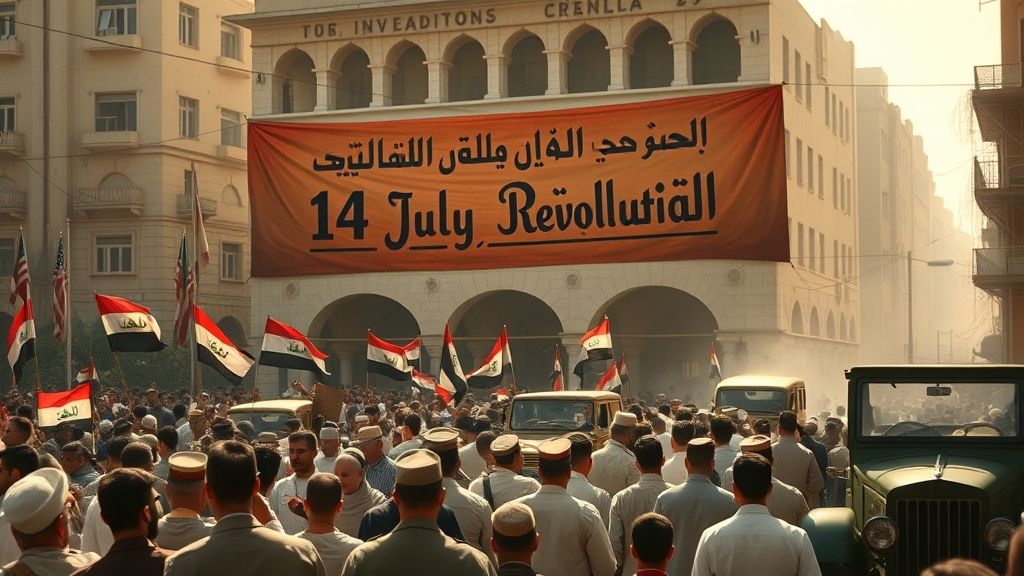
In the days after the revolution, Baghdad was gripped by uncertainty. The streets were alive with triumph and terror—supporters of the monarchy fled or were hunted, while crowds gathered around new symbols: portraits of Qasim, slogans of independence, promises of reform.
At the same time, the new government faced the daunting task of stabilizing a fractured country and negotiating its place amid Cold War rivalries. Security crackdowns and political purges followed as the regime sought to consolidate its power.
11. The Revolution’s Ideology: Nationalism, Socialism, and the Promise of Change
The July 14 revolution was more than a change of rulers; it was an ideological shift. Qasim’s government championed Arab nationalism alongside socialist policies aimed at land redistribution, worker empowerment, and curbing foreign control over resources.
This ideological cocktail inspired hope but also fear—both within Iraq’s diverse communities and among neighboring states wary of revolution spreading. The regime’s challenge was turning revolutionary slogans into tangible social transformation.
12. Iraq’s Shift Towards Non-Alignment and Soviet Alliances
In foreign policy, the revolution marked Iraq’s dramatic pivot away from Western influence. Qasim sought to steer Iraq into the Non-Aligned Movement, forging ties with the Soviet Union and distancing the country from British and American domination.
This realignment had enormous geopolitical consequences, heightening Cold War tensions in the Middle East and causing alarm among Iraq’s traditional allies.
13. Internal Challenges: Tribal Loyalties, Political Factions, and Economic Pressures
Despite initial enthusiasm, the new Iraq was riven by internal strife. Tribal allegiances complicated governance, political factions jostled for influence, and economic hardships worsened as the new regime navigated the difficult transition.
Qasim struggled with both communist elements within his coalition and rival pan-Arab nationalists. This volatile internal landscape sowed seeds for future conflict and instability.
14. The Decline of British Influence: From Protectorate to Independence Reclaimed
The revolution symbolized the end of British protective tutelage. British withdraws accelerated post-1958, marking a profound decline in imperial power in the Gulf.
However, decades of colonial policies had left Iraq with structural dependencies, and disentangling from Britain’s economic and military networks proved a complex and contentious process.
15. Regional Repercussions: Shockwaves in the Arab World and Cold War Powers
The fall of the Iraqi monarchy sent shockwaves across the Arab world. Monarchies in Jordan and Saudi Arabia viewed the revolution with alarm. The United States and Britain scrambled to adjust to the loss of a key ally, while the USSR saw an opportunity to expand influence.
This event intensified the Arab Cold War, fueling a wave of revolutionary and counter-revolutionary movements throughout the region.
16. The Societal Impact: Voices of Women, Intellectuals, and the Working Class
For many ordinary Iraqis—workers, peasants, women—July 14 promised newfound dignity and participation. Women’s groups cautiously hoped for social reforms, intellectual circles debated the revolution’s goals, and labor unions sought recognition.
Yet, the gulf between promises and reality often loomed large, with political repression and social upheaval complicating hopes for empowerment.
17. The Revolution’s Long Shadow: From Qasim to the Ba’athist Takeover
While Qasim initially held power, factionalism and rivalries soon destabilized Iraq’s political landscape. The 1958 revolution planted the seeds for subsequent upheavals, leading to the Ba’athist coups of the 1960s and the eventual rise of Saddam Hussein.
The revolution’s legacy is written both in its bold challenges to monarchy and its contribution to decades of instability.
18. Memory and Interpretation: How the 1958 Revolution Shapes Iraqi Identity Today
In contemporary Iraq, the memory of July 14 is contested but remains a powerful symbol. Some remember it as liberation from tyranny; others as a prelude to chaos. It remains a foundational reference point in Iraqi political discourse and identity.
The revolution continues to spark debate over nationalism, governance, and sovereignty.
19. Lessons from the July 14 Revolution: Unfinished Revolutions and the Quest for Sovereignty
The events of 1958 in Baghdad teach us about the transformative but fragile nature of revolutions. The quest for sovereignty, social justice, and dignity remains unfinished in Iraq’s modern history—reminding us how revolutions can unleash both hope and conflict.
The story of July 14 is both cautionary and inspiring—the power of people to overturn regimes, and the complexities of forging new national paths.
20. Conclusion: The End of One Kingdom, the Birth of a Nation’s Turbulent Quest
The July 14, 1958 revolution was a cataclysmic rupture that reshaped Iraq’s history. From the ashes of monarchy, a republic emerged, laden with promise and peril. The events that unfolded that day in Baghdad were not the end but the beginning of a long, turbulent journey toward defining Iraq’s place in a rapidly changing world.
It was a moment soaked in blood and hope, a narrative of impossible aspirations and human drama—a story that still echoes in Iraq’s streets and hearts.
Conclusion
The July 14 Revolution in Iraq was a turning point of profound magnitude, a dystopian crescendo that ended dynastic rule and challenged global alignments. Yet, beyond the politics and power struggles, it was a deeply human story—a clash between tradition and modernity, repression and liberation, colonial legacies and nationalist dreams.
The insurgent officers who toppled the monarchy gave birth to a new Iraq, but also unleashed contradictions and conflicts that would haunt the country for decades. As we look back, we see a kaleidoscope of hope and tragedy, ambition and pitfall. The revolution reminds us of the fragile promise of change, the price of upheaval, and the enduring courage of those who dare to imagine a different future.
FAQs
1. What caused the July 14 Revolution in Iraq?
The revolution was caused by widespread dissatisfaction with the Hashemite monarchy’s corruption, inequality, and submission to British colonial interests, combined with rising nationalist and socialist ideologies among military officers and intellectuals.
2. Who was Abd al-Karim Qasim and what role did he play?
Qasim was the leading figure of the revolution, a military officer who orchestrated the coup and became prime minister. His policies aimed to establish a republican regime, end foreign influence, and implement social reforms.
3. How did the revolution affect Iraq’s international relations?
The revolution marked Iraq’s pivot away from Western alliances toward non-alignment and stronger ties with the Soviet Union, straining relations with Britain, the US, and neighboring Arab monarchies.
4. What happened to the Iraqi monarchy after the coup?
The monarchy was violently overthrown. King Faisal II, Crown Prince 'Abd al-Ilah, and Prime Minister Nuri al-Said were executed, effectively ending Hashemite rule in Iraq.
5. What were the immediate social consequences within Iraq?
The revolution raised hopes for social justice, land reform, and increased political participation. However, it also triggered political purges, factionalism, and instability affecting various ethnic and social groups.
6. How did the revolution influence the broader Middle East?
It intensified the Arab Cold War between republics and monarchies, inspired other nationalist movements, and caused concern among Western Cold War powers.
7. Why is the July 14 Revolution still significant today?
It remains a foundational chapter in Iraq’s modern history, shaping national identity, memory, and political discourse, symbolizing both liberation and the complex challenges of state-building.
8. Did the revolution succeed in building a stable government?
No, while it ended monarchy, political infighting and social divisions soon led to further coups and instability, culminating in the rise of the Ba’ath party and later authoritarian regimes.