Table of Contents
- The Dawn of Turmoil: Constantinople on the Brink
- Seeds of Revolution: The Ottoman Empire at the Turn of the Century
- The Rise of the Committee of Union and Progress
- The 1908 Young Turk Revolution: A Promise of Change
- Brewing Discontent: Reactionaries and Radicals Collide
- The Forces Align: Islamists, Conservatives, and the Sultan's Allies
- Night of Turmoil: The 31 March Incident Unfolds
- The Attempted Counter-Revolution in the Heart of Constantinople
- The Role of the Army and the Third Army Corps
- The Siege of the Ottoman Parliament and the Siege on Reform
- Key Figures: Sultan Abdul Hamid II, Mehmed Talaat, Mahmud Shevket Pasha
- The Counterattack: The Challenge of the Action Army
- Suppressing the Revolt: From Chaos to Restoration
- The Deposition of Abdul Hamid II: An Empire's Turning Point
- The Aftermath: Political Upheaval and the Fate of the Ottoman State
- The Impact on Ottoman Society and Minorities
- The International Reaction to the 31 March Incident
- Legacy of the Incident: Lessons and Warnings from History
- The Road to World War I: Continuity and Rupture
- Remembering 31 March: Memory and Historical Interpretations
The Dawn of Turmoil: Constantinople on the Brink
It was a cool spring evening in Constantinople, the air thick with tension and uncertainty. The city's narrow streets whispered rumors, the mosques’ call to prayer resonating like a solemn drumbeat echoing the unrest beneath the surface. The year was 1909, and the Ottoman Empire was caught in the throes of a violent struggle between forces demanding reform and those desperate to preserve an old order rapidly crumbling into history.
On April 13th, 1909, according to the Gregorian calendar (31 March in the Rumi calendar used by the Ottomans), an armed rebellion burst forth in the heart of the empire’s capital. This was no mere spontaneous uprising but a carefully orchestrated attempt to roll back the revolutionary changes unleashed by the Young Turks one year earlier. The event that came to be known as the “31 March Incident” would shake the empire to its core, bringing chaos, bloodshed, and ultimately a dramatic reconfiguration of power.
Yet, beyond the gunfire and the street battles, the incident was a poignant symptom of a sprawling crisis—a civilization wrestling with modernity, identity, and survival amid the shadows of imperial decline. The echoes of that night still resonate today, offering a window into an empire’s last breaths and the fierce hopes and fears that accompanied them.
Seeds of Revolution: The Ottoman Empire at the Turn of the Century
To understand the 31 March Incident, one must first travel back to the long 19th century, when the Ottoman Empire, once the dominant power across southeastern Europe, western Asia, and northern Africa, was increasingly beset by internal decay and external threats. Nicknamed the “sick man of Europe,” the empire faced a fragmentation fueled by nationalist uprisings, economic stagnation, and the insidious erosion of central authority.
At the heart of this decay was a conservative autocracy that maintained rule through the sultan, Abdul Hamid II. His reign, beginning in 1876, was marked by repression and a distrust of reformers. Despite early promises of a constitution and parliament — suspended in 1878 — Abdul Hamid consolidated power through an extensive spy network and censorship, all in an effort to stave off disintegration.
Yet, beneath the surface of silenced dissent, the tide of modernity surged. From the salons of Salonika to the coffee houses of Constantinople, reformist ideas took root, inspired by European nationalism, liberalism, and secularism. The Committee of Union and Progress (CUP), a secret society founded in the 1880s by disgruntled army officers and intellectuals, became the nucleus of this movement. They dreamed of revitalizing the empire through constitutionalism, Turkish nationalism, and military strength.
The Rise of the Committee of Union and Progress
The Young Turks, as members of the CUP came to be known, operated clandestinely for years, spreading their message among the Ottoman army and educated elites. By the late 1900s, they had grown into a formidable political force, recognized for their ability to blend ideology with practical military and bureaucratic support.
Their goal? The restoration of the 1876 constitution and an end to Abdul Hamid II’s absolutist rule. This was not merely a local political gambit but a struggle over the empire’s identity: would the Ottoman state modernize and embrace constitutional nationalism, or would it be doomed to fade away under autocracy and foreign domination?
The 1908 Young Turk Revolution: A Promise of Change
The revolution of 1908 exploded like a sudden earthquake beneath the empire’s foundations. In July of that year, confronted with growing unrest and military revolts, Abdul Hamid II reluctantly restored the constitution and reconvened the parliament. The CUP swiftly became the de facto governing party, promising reform, rule of law, and equality among the empire’s diverse peoples.
But promises are fragile, especially in a mosaic empire riddled with sectarian divisions and economic disparities. The restoration of constitutional rule unleashed hopes but also ignited fierce resistance. Conservative Islamists, loyalists to the sultan, and ethnic minorities all viewed the changes with suspicion and fear.
By 1909, fractures deepened. Some sought more radical transformations; others yearned for a return to the old regime. The stage was set for an explosive confrontation.
Brewing Discontent: Reactionaries and Radicals Collide
Opposition to the Young Turks did not emerge overnight. The restoration of constitutional government challenged the foundations of imperial power and an established social order.
The religious establishment, for one, saw constitutionalism as a threat to the caliphate’s authority, held by the sultan himself. Many conservative Muslims feared that secular nationalism would erode Islam’s venerable place in governance and society. On the other hand, Armenian, Greek, and Arab minorities, while initially supportive of constitutional promises, grew wary as the CUP increasingly emphasized Turkish nationalism.
Meanwhile, rural unrest heightened tensions. Peasants and soldiers, poorly paid and disillusioned, became pawns in a larger game. The empire’s military was split between reformist officers loyal to the CUP and others who remained loyal to the sultan and conservative values.
The Forces Align: Islamists, Conservatives, and the Sultan's Allies
The 31 March Incident was not a mere military mutiny but a coalition of disaffected forces. Religious fundamentalists, conservative ulema (Islamic scholars), and elements of the palace aligned with officers and soldiers alarmed by rapid reforms and the CUP's growing dominance.
Their motives were manifold: restore Islamic order, preserve the privileges of religious elites, and recover the sultan’s authority. The faithful of Constantinople’s mosques whispered prayers for divine intervention, while conspiracy simmered in shadowy corners of the city.
This was a movement bearing the symbolic weight of defending tradition but also the desperation of those who felt left behind by history’s relentless march.
Night of Turmoil: The 31 March Incident Unfolds
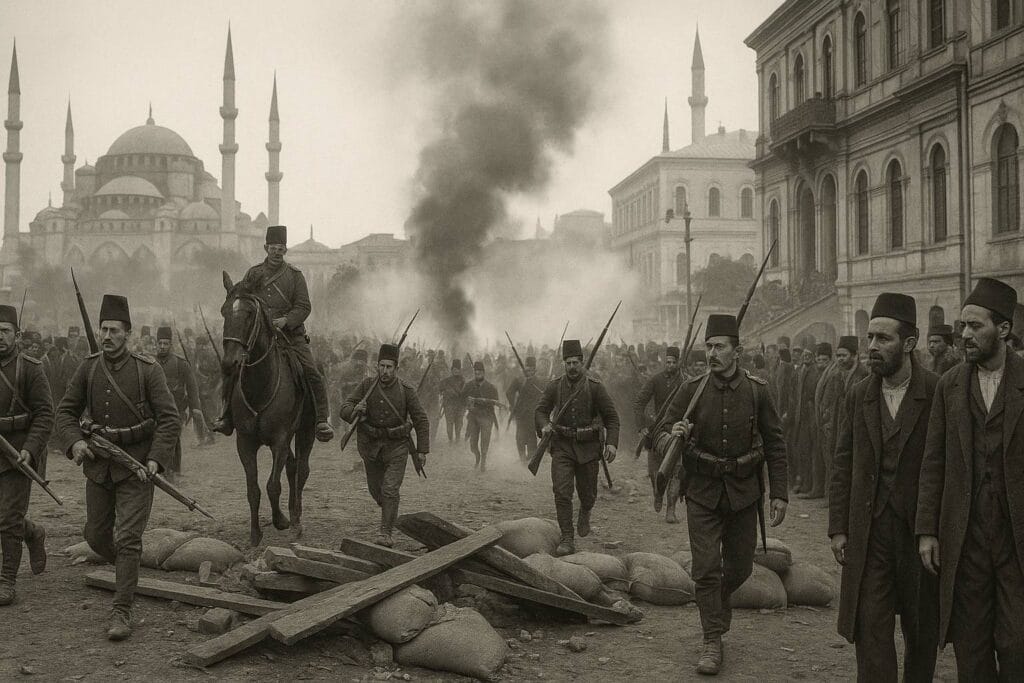
The events of the night of 31 March 1909 began quietly. In several military barracks in Constantinople, units revolted against their officers loyal to the CUP. Soldiers marched to the city center, converging on government buildings and the parliamentary palace.
The insurgents issued demands to dissolve parliament, reinstate authoritarian rule, and revoke the constitution. They seized control of strategic points, including the interior ministry and key communication hubs. Reports flooded in of violence against reformists and members of minority communities suspected of sympathizing with the Young Turks.
Streets once bustling with life became battlegrounds. Clashes erupted between rebel soldiers and loyalist defenders; the capital was enveloped in fear and chaos.
The Attempted Counter-Revolution in the Heart of Constantinople
At the movement’s core was a counter-revolution that sought to undo the fresh revolution, to restore the sultan’s absolute power clothed in the mantle of Islamic legitimacy. Abdul Hamid II, initially detained under house arrest by CUP leaders, was quietly supported by conspirators, although his precise involvement remains debated.
The rebels proclaimed themselves defenders of Islam and tradition. The Sultan's loyalist police and religious figures rallied the people to their cause. Demands to revert the empire’s political clock were loudly proclaimed from minarets and coffeehouses alike.
However, the movement suffered from poor coordination and conflicting leadership. Certain factions sought to use it as a stepping stone for seizing power themselves, while others genuinely desired restoration of the status quo ante.
The Role of the Army and the Third Army Corps
The crucial turning point in suppressing the rebellion was the intervention of the so-called “Action Army,” commanded by General Mahmud Shevket Pasha, stationed in Salonika (modern Thessaloniki), a stronghold of the CUP.
The Action Army, composed of troops loyal to the constitutional government and the CUP, marched on Constantinople with precision and determination. Unlike the rebels, who were disorganized and carried the weight of reactionary fervor, this army represented disciplined military power committed to preserving the revolution.
Their arrival on April 24, 1909, spelled the beginning of the end for the mutiny.
The Siege of the Ottoman Parliament and the Siege on Reform
Throughout the uprising, the Ottoman parliament found itself under siege not only physically but symbolically. Messages of defiance and calls for tranquility echoed from the benches while shells and gunfire threatened the very edifice of emerging democracy.
The rebels aimed to paralyze governance by holding hostage the institutions of reform, while the loyalists endeavored to protect the nascent constitutional order.
Behind this siege was a larger battle for the empire’s soul—whether it would emerge as a constitutional parliamentary monarchy or revert to absolutist clerical rule.
Key Figures: Sultan Abdul Hamid II, Mehmed Talaat, Mahmud Shevket Pasha
The human dimension of the incident is illuminated by the clashing personas of its pivotal figures.
Abdul Hamid II, aged and increasingly isolated, symbolized the old autocracy. His feared intelligence services and religious authority underpinned his rule, but by 1909 his influence was waning, and he struggled to navigate the tumultuous waters stirred by his opponents.
Mehmed Talaat, a rising star within the CUP, embodied the reformist drive. Charismatic and resolute, he led efforts to stabilize the government and consolidate power after the revolt was crushed.
Mahmud Shevket Pasha’s military leadership was critical. A respected general, his march from Salonika to Constantinople was swift and resolute, demonstrating the power of the army aligned with reformist ideals.
The Counterattack: The Challenge of the Action Army
The Action Army’s advance was methodical. As they approached Constantinople, shooting intensified, and a palpable fear gripped the city. Loyalist forces and citizens who had hosted rebels found themselves in peril.
The conflict was tragically brutal in places, with accusations of summary executions and reprisals on both sides. The army’s arrival restored order, but at a high cost—both in human lives and political trust.
By early May, the rebellion was effectively neutralized.
Suppressing the Revolt: From Chaos to Restoration
With the defeat of the 31 March insurgents, the CUP reasserted its dominance. Abdul Hamid II was deposed in what was essentially a palace coup, replaced by his brother Mehmed V. This symbolized a definitive break from the old regime.
Many of the revolt’s participants were arrested, exiled, or executed. The constitutional government sought to cleanse the bureaucracy and army from reactionary elements. Yet the process was far from smooth.
The Deposition of Abdul Hamid II: An Empire's Turning Point
The forced abdication of Abdul Hamid II marked a landmark moment. The “Red Sultan,” as he was known, had ruled for over thirty years, overseeing some of the most turbulent times in Ottoman history.
His removal signified an endorsement of constitutional monarchy but also foreshadowed instability. It underscored that personal rule was no longer tolerated, yet deeper questions remained about the empire’s future direction, unity, and viability.
The Aftermath: Political Upheaval and the Fate of the Ottoman State
The victory of the CUP after suppressing the coup did not usher in immediate peace. Political rivalries intensified; ethnic nationalist tensions deepened; and the empire’s administration struggled to implement necessary reforms in the face of mounting external pressures.
The Ottoman state entered a period of rapid change and crisis, leading to further military interventions, political assassinations, and ultimately its fateful entry into the First World War.
The Impact on Ottoman Society and Minorities
The rebellion exacerbated existing social cleavages. Ethnic minorities, especially Armenians and Greeks, lived in fear of reprisals. The brief but intense violence of the incident deepened suspicions and hardened identities.
Conversely, segments of Turkish society galvanized around nationalism, with attitudes hardened by the suppression of what many portrayed as a religious insurrection.
The fragile pluralism that the 1908 revolution had hoped to nurture thus suffered a severe blow.
The International Reaction to the 31 March Incident
European powers watched the Ottoman turmoil with a mix of anxiety and opportunism. The empire was still strategically vital, controlling access between Europe and Asia.
Foreign governments generally supported the preservation of constitutional order but remained wary of the CUP’s rising power and Turkish nationalism. The incident reinforced perceptions of Ottoman instability, underpinning future interventions and treaties.
Legacy of the Incident: Lessons and Warnings from History
The 31 March Incident stands as a powerful example of the complexities involved in political modernization under an empire’s pressure. It highlights how reforms can provoke fierce, even violent, backlash when embedded in multi-ethnic, religiously charged, and tradition-rooted societies.
It also demonstrates the limits of constitutionalism under a fragile state and the critical role of the military in shaping political destiny.
The Road to World War I: Continuity and Rupture
In many ways, the 31 March Incident was a prelude to the greater calamities that would engulf the Ottoman Empire in the coming years. The internal struggles weakened the empire’s ability to resist external pressures and fostered the rise of a more aggressive nationalism that would align the empire with the Central Powers in World War I, leading to further turmoil and eventual dissolution.
Remembering 31 March: Memory and Historical Interpretations
Today, the event holds a contested place in Turkish and Ottoman historiography. Some view it as a noble defense of Islam and tradition, others as a reactionary assault on progress.
Modern historians interpret it as a crucial turning point in the empire’s final decades, a vivid reminder of the human costs of political transition and the volatile intersection of ideology, religion, and power.
Conclusion
The 31 March Incident was more than a military rebellion or a palace coup; it was the dramatic manifestation of an empire’s struggle to define itself amid the advancing tides of modernity and tradition. Constantinople’s streets ran with the blood of a conflicted generation, caught between hope for renewal and the inexorable pull of its past. The suppression of the revolt reaffirmed constitutionalism, yet also exposed the fragility of reforms imposed atop deep social fractures.
The fall of Abdul Hamid II and the triumph of the Young Turks set the Ottoman Empire on a tumultuous path, a road riddled with war, disintegration, and rebirth in different forms. The 31 March Incident remains a powerful story of resistance and transformation, a cautionary tale about the costs and possibilities embedded in moments of history where old worlds collide with new dreams.
FAQs
Q1: What triggered the 31 March Incident?
The incident was triggered by reactionary forces opposed to the Young Turks’ 1908 constitutional reforms, including conservative Islamists, soldiers loyal to the sultan, and palace allies seeking to restore absolute monarchy and traditional Islamic governance.
Q2: Who were the main leaders of the rebellion?
The rebellion was mainly led by conservative military officers and religious figures; while Abdul Hamid II’s exact role remains ambiguous, General Mahmud Shevket Pasha led the government forces that suppressed the revolt.
Q3: Why was the incident called the "31 March Incident"?
Because it began on 31 March 1325 in the Rumi calendar used by the Ottoman administration, which corresponds to April 13, 1909, in the Gregorian calendar.
Q4: What were the immediate outcomes of the suppression?
The revolt was crushed by the Action Army, Abdul Hamid II was deposed, and the constitutional government of the CUP solidified control, making Mehmed V the new sultan.
Q5: How did the incident affect ethnic minorities in the empire?
Ethnic minorities faced violence and heightened suspicion during and after the incident, worsening intercommunal relations and raising fears of persecution.
Q6: What role did the military play in the Ottoman political life after the incident?
The military emerged as a decisive political actor, representing reformist and nationalist factions, further entrenching its involvement in governance and power struggles.
Q7: How is the 31 March Incident remembered in modern Turkey?
It remains a contentious historical event, symbolizing either a reactionary uprising against progress or a defense of tradition, depending on the interpretive lens.
Q8: Did the 31 March Incident contribute to the fall of the Ottoman Empire?
It weakened the political cohesion of the empire, intensified nationalist tensions, and contributed to the instability that preceded World War I and the empire’s eventual collapse.