Table of Contents
- The Morning Tremor: Dawn of June 26, 1941
- Geological Stage: The Tectonic Might Beneath the Andaman and Nicobar Islands
- The Precarious Arc: A Volcanic and Seismic Hotspot in the Indian Ocean
- Colonial Shadows: The British Raj and the Islands’ Strategic Importance
- The Jolt Felt Across Seas: Earthquake Mechanics Unleashed
- Immediate Aftermath: Chaos, Confusion, and the First Tidal Wave
- Human Lives Torn: Stories from Island Inhabitants and Mariners
- Waves of Destruction: The Tsunami and Its Coastal Devastation
- Scientific Endeavors: Early Seismological Observations in the 1940s
- The Military Angle: World War II’s Intertwining with the Disaster
- Communication Breakdown and Relief Efforts
- Mapping the Impact: Extent of Damage Across the Bay of Bengal
- Cultural Memory and Oral Histories of the Earthquake
- Lessons Learned: How the 1941 Event Shaped Future Disaster Preparedness
- Geological Legacy: Shifts in Earth Science and Tsunami Studies
- The Andaman-Nicobar Archipelago Today: Echoes of 1941
- Comparative Perspective: Other Major Earthquakes in the Region
- Conclusion: The Resonating Tremor of 1941 in Historical Perspective
- FAQs: Unveiling the Many Layers of the 1941 Andaman-Nicobar Earthquake
- External Resource: Wikipedia Entry on the Andaman-Nicobar Earthquake
- Internal Link: Visit History Sphere
The Morning Tremor: Dawn of June 26, 1941
Before the first rays of sun could fully pierce the dense tropical canopy of the Andaman and Nicobar Islands, the earth beneath these remote outposts shuddered violently. On June 26, 1941, an ominous rumble roared through the Indian Ocean’s waters — a seismic awakening that would leave an indelible mark on the region’s history and heartbeat. The inhabitants, many still rubbing sleep from their eyes, soon found themselves thrown into chaos by a force far beyond their comprehension. The very ground seemed to convulse, as if the earth was warning of deeper unrest to come.
This was not merely an isolated tremor; it was the harbinger of a disaster that would combine raw geological power with the vulnerabilities of a war-torn world. The Andaman–Nicobar earthquake, registering an estimated magnitude of 7.7 to 8.1, unleashed both immediate destruction and triggered a tsunami, devastating coastal communities and echoing through scientific and historical memory. But what lay beneath this sudden, violent awakening, and how did the fragile human fabric of these islands endure and respond amid the clouds of global conflict?
Geological Stage: The Tectonic Might Beneath the Andaman and Nicobar Islands
To understand the magnitude and consequences of the 1941 earthquake, one must first gaze beneath the ocean floor and the archipelago’s tropical vegetation. The Andaman and Nicobar Islands sit astride one of the Earth’s most restless zones: the complex meeting point of the Indian, Burmese, and Eurasian tectonic plates. This triple junction is part of the notorious Sunda Arc, where the Indo-Australian plate subducts beneath the Eurasian plate at a rate of several centimeters per year.
Beneath the Andaman Sea, this subduction process creates immense pressures, deforming the earth’s crust and occasionally releasing pent-up energy in the form of earthquakes. The region is a hotbed of seismic activity and volcanic phenomena, a seething cauldron beneath the surface. The Sumatra–Andaman trench—a deep oceanic trench marking the plate boundary—has previously birthed devastating megathrust earthquakes, most famously the 2004 Indian Ocean earthquake and tsunami, but the 1941 quake was among the earliest well-documented events of its type in the modern historical record.
The Precarious Arc: A Volcanic and Seismic Hotspot in the Indian Ocean
The Andaman-Nicobar chain, stretching over 500 kilometers, is formed from a sequence of volcanic islands and submerged peaks, a testament to relentless geological convection below. This volcanic arc is punctuated by active volcanoes like Barren Island, which occasionally breathes fire into the skies, reminding locals and observers alike of the volatile nature of the earth beneath their feet.
These islands have been shaped not only by fire but by wrenching tectonic collisions and episodic earthquakes whose frequencies have increased and decreased in cycles over millennia. The six decades before 1941 were dotted with small tremors, each whispering the earth’s latent restlessness. When June 26 arrived, it was more than a tremor—it was the cumulation of strain stored and finally released in a titanic geological breath.
Colonial Shadows: The British Raj and the Islands’ Strategic Importance
In 1941, the Andaman and Nicobar Islands were under British colonial rule, used primarily as remote penal colonies and strategic outposts. Their isolation rendered them vulnerable but quintessentially important, especially during the growing tensions of World War II.
The British established several small settlements and naval stations to monitor the Bay of Bengal and the approaches to British India. The islands’ dense tropical forests and sometimes inhospitable terrain made them difficult to govern but critical strategically—command over these islands was control over maritime channels and naval routes essential for wartime logistics.
Against this canvas of imperial contest, the natural catastrophe unfolded, adding a dramatic, disruptive layer to geopolitical complexity.
The Jolt Felt Across Seas: Earthquake Mechanics Unleashed
At approximately 11:30 AM local time, the seismic event ruptured a fault along the plate boundary, releasing colossal amounts of energy. Seismographs in distant cities recorded intense waves that revealed a quake of enormous power—likely around magnitude 7.7 to 8.1 on modern scales, powerful enough to cause widespread structural damage on the islands and palpable disturbances felt hundreds of kilometers away.
The earthquake was characterized primarily as a megathrust event along the subduction zone. The sudden downward slip of the Indian plate beneath the Burmese and Eurasian plates caused the seabed to suddenly uplift and drop, pushing ocean water violently outwards and setting the stage for a tsunami.
In an era before modern seismic networks, the event was recorded inconsistently, but local accounts provide vivid narrative fragments describing buildings swaying as if drunk, the earth cracking open, and the sea retreating ominously before roaring back with destructive force.
Immediate Aftermath: Chaos, Confusion, and the First Tidal Wave
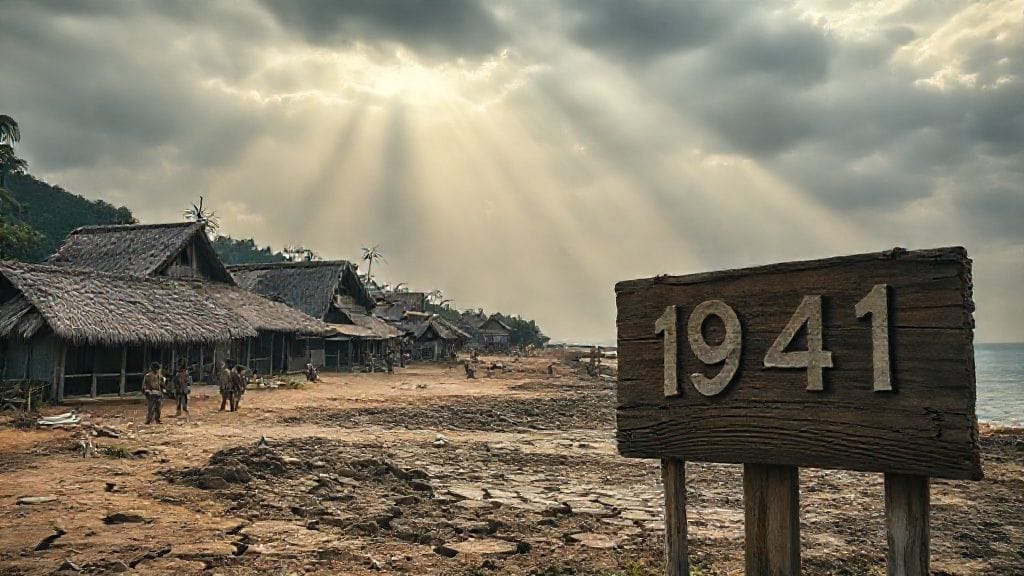
As the shaking subsided, a sinister silence fell—one often followed by the arrival of the tsunami. Coastal villages along the Andaman coast watched in horror as the sea first withdrew from the shore, exposing a barren seabed and fishing boats left high and dry. Moments later, a towering wall of water swept ashore, drowning homes, uprooting trees, and killing inhabitants caught unprepared.
Eyewitnesses recalled scenes of desperate flight, with families grabbing whatever they could and rushing to higher ground. Livestock and wild animals alike fled into the jungle, sensing the danger in an instinct older than humanity itself.
The tsunami devastated many low-lying island shores, but the islands’ rugged topography offered some refuge, preventing the scale of destruction seen in later ocean-wide tsunamis.
Human Lives Torn: Stories from Island Inhabitants and Mariners
Though statistical records remain sparse due to wartime disruptions, oral histories and scattered reports paint a tragedy of loss, resilience, and survival. Indigenous Andamanese, colonial settlers, fishermen, and naval personnel each faced the disaster through different lenses.
One narrative tells of a Nicobari family who, after the quake, found their entire village submerged. With courage and resourcefulness, they built makeshift rafts and found refuge on elevated ridges, a testament to human will confronting nature’s raw fury.
Mariners on nearby ships reported violent rocking that nearly capsized vessels. The psychological impact on sailors and soldiers already strained by war duties cannot be overstated — the earth seemed to betray even the seas that sustained them.
Waves of Destruction: The Tsunami and Its Coastal Devastation
The tsunami that followed the earthquake struck with a force that toppled structures, eroded coastlines, and reshaped the islands’ geography. Waves measuring up to several meters surged inland, flooding freshwater sources with saltwater and decimating agricultural plots crucial to subsistence.
Small fishing communities, reliant on the sea yet vulnerable to its moods, bore the brunt of the disaster. The tidal waves washed away homes built close to the beach, forcing survivors to reconsider the delicate balance between life and location.
The event alerted regional powers to the dangers of the shallow Andaman Sea basin and the vulnerabilities of coastal habitation, themes that would resonate significantly decades later.
Scientific Endeavors: Early Seismological Observations in the 1940s
Though the global scientific community was distracted by the unfolding Second World War, a handful of pioneering geologists and cartographers scrambled to understand the 1941 earthquake. British colonial surveyors collected data, and research emerged focusing on mapping fault lines and analyzing seabed deformations.
In subsequent years, seismologists recognized this event as an important case study in subduction-zone earthquakes, helping to refine understanding of plate tectonics at a time when the theory itself was still gaining ground.
The quake contributed to the incremental buildup of knowledge that would eventually enable early tsunami warning systems and more sophisticated hazard assessments in the region.
The Military Angle: World War II’s Intertwining with the Disaster
The 1941 earthquake occurred against the grim backdrop of escalating global conflict. World War II was reshaping alliances, territorial controls, and military strategies, especially across Asia.
The Andaman and Nicobar Islands, remote yet critical, became contested ground. Just two years later, in 1943, they fell under Japanese occupation, illustrating the strategic tug-of-war played out with nature as an unwelcome intervener.
For military commanders, the earthquake and tsunami represented a natural disruption to supply lines and communications, complicating wartime logistics. It also underscored the fragile nature of colonial outposts in the face of both human and natural adversities.
Communication Breakdown and Relief Efforts
In 1941, the islands’ communication networks were rudimentary at best. The earthquake decimated telegraph lines and offset the fragile infrastructure, isolating communities and delaying aid.
Relief efforts were complicated not only by the islands’ remoteness but by wartime restrictions and the slow mobilization of colonial administrative apparatus. Local populations often had to rely on indigenous coping mechanisms and communal solidarity.
Though official records of aid missions are scarce, later reflections indicate that recovery was slow, punctuated by shortages of food, shelter, and medical supplies, compounding the human toll of the disaster.
Mapping the Impact: Extent of Damage Across the Bay of Bengal
The earthquake’s reach extended beyond the islands—tremors reportedly were felt in parts of Burma (modern Myanmar), Thailand, and the eastern coasts of India. Coastal flooding affected regions bordering the Bay of Bengal, where the unusual nature of the event drew attention to a previously underestimated risk zone.
Damage reports varied widely, with islands suffering cracked foundations, fallen trees, and uprooted infrastructure, while mainland coastal areas mostly faced tidal waves of lesser intensity than the archipelago.
Mapping these impacts laid groundwork for recognizing the regional vulnerability to seismic events originating from the Andaman subduction zone.
Cultural Memory and Oral Histories of the Earthquake
Among the Andamanese and Nicobarese communities, the 1941 earthquake entered the realm of legend, passed down in stories that blend natural disaster and spiritual meaning.
Elders recounted the earth’s voice, the greedy sea, and the gods’ anger, intertwining geological facts and cultural symbolism. These narratives emphasized respect for nature’s power, and the need for communal bonds to weather existential threats.
Such oral histories complement the sparse written records, offering rich insights into the human experience of the quake beyond statistics and scientific analysis.
Lessons Learned: How the 1941 Event Shaped Future Disaster Preparedness
Though overshadowed by the global turmoil of WWII, the earthquake underscored pressing needs for better monitoring and preparation against seismic hazards.
Post-war authorities gradually incorporated lessons from 1941 to improve early warning capabilities, particularly following the even more catastrophic 2004 tsunami which revisited the region with greater fury.
The event emphasized the importance of integrating local knowledge with scientific insight, enabling more resilient communities in this volatile corridor.
Geological Legacy: Shifts in Earth Science and Tsunami Studies
Geologically, the 1941 Andaman–Nicobar earthquake reinforced theories of plate tectonics, coastal uplift, and subduction-related seismicity. It contributed to the nascent field’s understanding of how plate movements manifest as surface deformation and hazards.
Its occurrence predated and foreshadowed better-known seismic disasters, acting as an important archaeoseismological marker for geologists studying long-term recurrence intervals and tectonic strain.
Today, it remains a touchstone case in seismological research, reminding the scientific community of the hidden threats lurking beneath the Indian Ocean.
The Andaman-Nicobar Archipelago Today: Echoes of 1941
Modern visitors to the Andaman and Nicobar Islands hear little of the 1941 earthquake outside academic circles, yet the event’s shadow lingers in infrastructure design, community awareness, and the constant vigilance of modern seismological stations.
The islands have become a symbol of natural beauty and resilience, their history—violent movements of the earth included—a silent lecture on fragility and fortitude.
Comparative Perspective: Other Major Earthquakes in the Region
Placing the 1941 event alongside other seismic disasters—such as the 2004 Indian Ocean earthquake or the 1881 Nicobar quake—highlights patterns and shifts in geological behavior.
Each catastrophe offers increments in knowledge and preparedness, illuminating the immense pressures continually sculpting this part of the world.
The 1941 quake, though less globally cited, remains a crucial link in this chain of natural events and human responses.
Conclusion: The Resonating Tremor of 1941 in Historical Perspective
The Andaman–Nicobar earthquake of June 26, 1941, is more than a mere geophysical footnote. It is a story of earth’s relentless power meeting human vulnerability in a complex dance of nature and history. Amid the currents of World War II and colonial reach, the islands endured a catastrophe that reshaped their landscape and consciousness.
Beyond physical destruction, the quake illuminated the fragile ties that bind humans to their environment—how ancient tectonic forces, invisible but inexorable, can rupture everyday life and demand new understandings and adaptations.
Even as the islands have healed and transformed, the tremor of 1941 continues to echo, a reminder of the latent forces that shape worlds both natural and human.
FAQs: Unveiling the Many Layers of the 1941 Andaman-Nicobar Earthquake
Q1: What caused the Andaman-Nicobar earthquake of 1941?
A1: The earthquake was caused by tectonic activity along the subduction zone where the Indian Plate dives beneath the Eurasian Plate near the Andaman-Nicobar region. Pressure buildup along this plate boundary led to a megathrust earthquake.
Q2: How powerful was the earthquake and tsunami in 1941?
A2: The earthquake is estimated to have had a magnitude between 7.7 and 8.1. The associated tsunami caused significant flooding, especially on low-lying islands, with waves reaching several meters high.
Q3: What was the human impact of the disaster?
A3: The earthquake and tsunami caused loss of life, destruction of homes, disruption of livelihoods, and psychological trauma among island inhabitants, fishermen, and military personnel. Precise casualty numbers are unknown due to sparse records.
Q4: How did World War II affect the response to the earthquake?
A4: The ongoing war limited communication, relief efforts, and resource allocation. The islands’ strategic importance also complicated administration, delaying and hampering effective disaster management.
Q5: Did the 1941 earthquake influence scientific understanding?
A5: Yes, it contributed valuable early data about subduction zone earthquakes in the region and helped lay the foundation for modern seismology and tsunami science.
Q6: Are the Andaman and Nicobar Islands still at risk of earthquakes and tsunamis today?
A6: Absolutely. The region remains highly active tectonically, with ongoing seismic risk. Modern monitoring and preparedness programs have been implemented to mitigate future disasters.
Q7: How is the 1941 earthquake remembered culturally on the islands?
A7: It survives primarily in oral histories and indigenous narratives that blend natural phenomena with spiritual interpretations, emphasizing resilience and respect for nature’s power.
Q8: What lessons from 1941 remain relevant for disaster preparedness?
A8: Key lessons include the importance of early warning systems, community education, resilient infrastructure, and integration of local knowledge with scientific monitoring.