Table of Contents
- A City Shattered: The Morning of May 27, 2006
- The Restless Land: Indonesia’s Seismic Crossroads
- Earth Beneath: The Geology of Java and the Indonesian Archipelago
- The Build-Up: Preceding Tensions and Seismic Warnings
- The Moment of Impact: 5:54 a.m. and the 6.3 Magnitude Shake
- Collapse and Chaos: The Human Tragedy Unfolds
- Voices from the Rubble: Personal Stories and Survival
- The Response: Local Heroes, Rescue Efforts, and International Aid
- Indonesia’s Government and Global Community: Coordination Amidst Crisis
- The Hidden Crisis: Infrastructure, Education, and Health Systems in Peril
- Religion and Ritual: Coping with Loss in a Deeply Spiritual Society
- The Role of Media: Reporting the Disaster and Shaping Global Sympathy
- Aftershocks: Physical and Psychological Tremors that Followed
- Rebuilding Lives: The Challenge of Reconstruction and Recovery
- Lessons Unearthed: Preparedness and Policy Reformation Post-Disaster
- The Earthquake’s Legacy: Long-Term Socioeconomic and Cultural Effects
- Memorials and Memory: Honoring the Dead, Remembering the Day
- Scientific Advances: How Yogyakarta Changed Earthquake Research
- The Human Spirit Tested: Resilience Among Ruins
- Indonesia Today: Reflections on Disaster Readiness Twelve Years On
On the morning of May 27, 2006, as the first hues of dawn painted the skies above the Indonesian city of Yogyakarta, few could have imagined the earth beneath them was preparing to roar. At precisely 5:54 a.m., a violent tremor shook the city and the surrounding regions of Central Java with a devastating force, ripping open the soil and shattering lives in an instant. The 6.3 magnitude earthquake abruptly ended the calm, birthing chaos from the quiet suburban streets and rural villages where families clung to the fragile sense of peace brought by the early morning light. It was a moment that would be etched forever in the collective memory of a nation and send ripples beyond its borders.
For many, the earth seemed to fracture not just physically, but in the very fabric of their lives—homes, schools, hospitals, and markets crumbled; families were torn apart; futures were cast into uncertainty. Yet, amidst the rubble and the dust, the human spirit endured, weaving stories of survival, solidarity, and hope that would come to define this tragic episode. But to understand fully the 2006 Yogyakarta earthquake’s profound impact, one must delve beneath the surface — into the history, geology, and the resonant aftershocks of human fate that rippled far beyond the initial tremor.
The Restless Land: Indonesia’s Seismic Crossroads
Indonesia is no stranger to the restless forces of nature. Nestled at the intersection of several tectonic plates, the archipelago is a volatile arena where the earth’s lithospheric segments collide, subduct, and grind against one another. The country forms part of the Pacific “Ring of Fire,” a volatile chain of volcanic arcs and earthquake zones circling the Pacific Ocean. Its 17,000 islands have been shaped and reshaped for millennia by these violent geodynamic processes.
Among these islands, Java stands as a densely populated heartland, home to over 140 million people. Yet beneath the hum of bustling cities and verdant rice terraces lies a brewing menace: the convergence of the Indo-Australian Plate and the Eurasian Plate. It is here that enormous seismic pressure accumulates, occasionally released in the form of earthquakes—some barely felt, others catastrophic.
Yogyakarta, in particular, rests near the southern slopes of the Merapi volcano and above several complex fault systems. Its proximity to these natural fault lines has made it an area historically vulnerable to seismic events. The earthquake of 2006 was a brutal reminder of the region’s volatile underbelly.
Earth Beneath: The Geology of Java and the Indonesian Archipelago
The geology beneath Yogyakarta reveals a story millions of years in the making. The Indo-Australian Plate is slowly pushing northward, subducting beneath the much larger Eurasian Plate at a rate of 6–7 cm per year—a slow but relentless force. This subduction process causes immense strain along fault lines and fractures, which gradually release energy in sudden jolts — earthquakes.
The epicenter of the May 27 quake was located near the southern part of Yogyakarta at a relatively shallow depth. This shallow focus meant that the shaking was more severe and widely felt. The quake’s magnitude, though moderate on a global scale, held extraordinary destructive power in an area so densely inhabited and with many buildings vulnerable to collapse.
Historically, the region has experienced numerous quakes, but the 2006 event was uniquely devastating because of its timing, location, and the poor seismic resilience of much of the housing infrastructure.
The Build-Up: Preceding Tensions and Seismic Warnings
Geoscientists had long monitored the seismic activities in Central Java, but seismic prediction remains a remarkable challenge. Unlike volcanic eruptions, earthquakes provide little clear warning. There were small tremors in the days leading up to May 27, but nothing that suggested the scale of impending disaster. This lack of predictability rendered warnings ineffective, and millions woke up completely unaware of what was about to unfold.
Some communities had local knowledge and traditional practices related to natural disasters, but they rarely sufficed against a modern earthquake of such force. The fact that it struck early on a Saturday morning meant many people were still at home, asleep, increasing the event’s human toll.
The Moment of Impact: 5:54 a.m. and the 6.3 Magnitude Shake
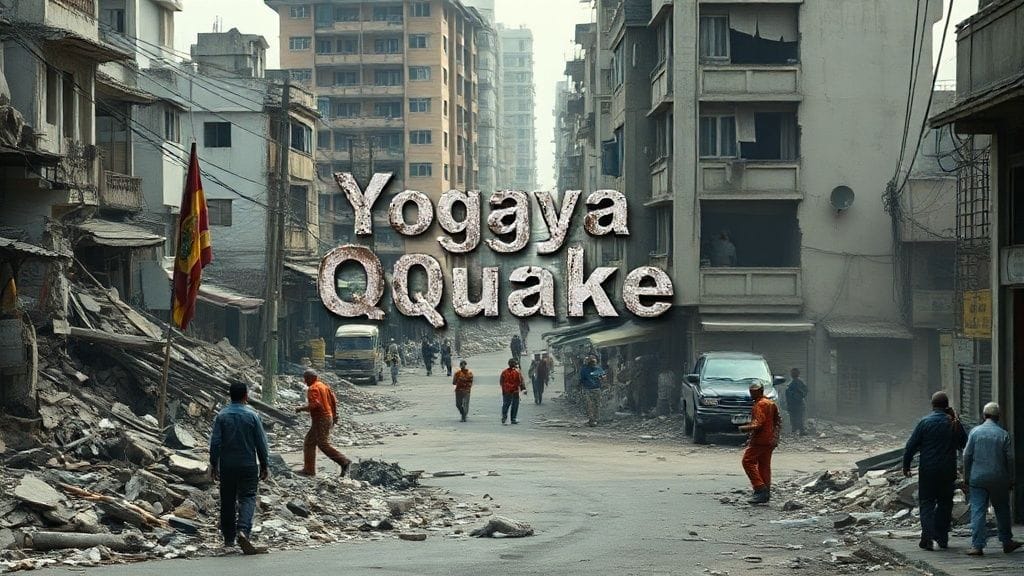
At 5:54 a.m. local time, the earth around Yogyakarta convulsed violently. Buildings swayed and groaned as the ground ruptured beneath them, bricks crumbled, wooden frames splintered, and concrete collapsed. The creaking, roaring sound was followed by an ominous silence punctuated by cries for help.
The quake lasted less than a minute, but within that fleeting moment, thousands of lives were irrevocably altered. Entire neighborhoods were reduced to piles of rubble, roads cracked open, and lifelines such as electricity and water systems were severed.
Survivors later described the shaking as a terrifying, all-consuming force that gripped the city. One woman recounted, “The walls moved like waves, the floor felt like a boat caught in a storm. I barely got out before the ceiling caved in.”
Collapse and Chaos: The Human Tragedy Unfolds
The quake devastated five districts in Central Java, with Yogyakarta and Bantul among the hardest hit. Official figures would soon reveal nearly 6,000 dead, more than 37,000 injured, and over 600,000 displaced. The numbers themselves are staggering, but behind them lie countless stories of heartbreak: children buried beneath buildings, families torn apart, homes and schools destroyed.
Hospitals struggled to cope with the influx of injured, many facilities themselves damaged or destroyed. The chaos extended to rural areas where access was difficult and communications disrupted. For days, many survivors were isolated without clean water, food, or shelter.
Voices from the Rubble: Personal Stories and Survival
Among the ruins were stories of extraordinary courage and will. A young boy trapped under debris for 48 hours was rescued, alive but weakened. An elderly woman sheltered neighbors in her fractured home, sharing what little food she had. Volunteers, many with no formal training, rushed into disaster zones to search for survivors with bare hands and makeshift tools.
One poignant story tells of a father who lost his entire family but continued to dig through rubble to help neighbors, finding in his grief a reason to serve his community.
These personal narratives gave a face to the catastrophe, reminding the world that loss is measured not only in numbers but in human lives intersected by fate.
The Response: Local Heroes, Rescue Efforts, and International Aid
In the immediate aftermath, local responders and civilians were the first to initiate rescues. Police, military, and firefighters arrived amid difficulties caused by damaged infrastructure. The Indonesian government quickly declared a state of emergency.
International organizations soon answered the call. NGOs, the United Nations, and various countries dispatched aid teams, supplies, and medical expertise. The global response was swift but challenged by logistical constraints. Temporary shelters were erected; food and medicine distributed, but the scale of destruction made relief efforts Herculean.
Indonesia’s Government and Global Community: Coordination Amidst Crisis
The earthquake tested Indonesia’s emergency response mechanisms. Coordination between government agencies, local leaders, and international partners proved complicated but crucial. The government faced criticism for delays and resource management issues, prompting reforms in disaster management policies later.
Nevertheless, the solidarity shown across communities and nations demonstrated a shared commitment to saving lives and rebuilding. It became a symbol of international humanitarian cooperation in the face of natural disasters.
The Hidden Crisis: Infrastructure, Education, and Health Systems in Peril
Months after the quake, secondary crises emerged. Schools, many destroyed or unsafe, forced children to study in makeshift tents or under poor conditions, impacting education in Central Java for years. Health services grappled with treating injuries and preventing disease outbreaks among displaced populations living in refugee camps.
Critical infrastructure had been damaged: roads, water supply networks, and electricity distribution required extensive repair. The economy suffered as businesses were disrupted and agricultural lands damaged.
These challenges spotlighted the vulnerability of developing regions and the need for integrated disaster risk reduction.
Religion and Ritual: Coping with Loss in a Deeply Spiritual Society
Indonesia’s societal fabric is deeply intertwined with spiritual and religious practices. In the aftermath, mosques and prayer gatherings became not only places of mourning but also hubs of community organization and healing.
Traditional rituals honoring the dead mingled with prayer vigils and charity drives, weaving a pattern of resilience rooted in faith. Many survivors attributed their endurance to spiritual strength, illustrating how cultural context profoundly shapes responses to tragedy.
The Role of Media: Reporting the Disaster and Shaping Global Sympathy
Media coverage of the Yogyakarta earthquake played a pivotal role. Both Indonesian and international news organizations broadcast images of destruction and human suffering, galvanizing worldwide empathy.
Social media was nascent but growing, allowing families to search for missing relatives and share information rapidly, a precursor to later disaster communication trends.
Media narratives balanced the stark reality of loss with stories of hope, anchoring the disaster in global consciousness.
Aftershocks: Physical and Psychological Tremors that Followed
The earthquake was followed by numerous aftershocks, some strong enough to cause additional damage and panic. These successive jolts prolonged the trauma and complicated rescue and rebuilding efforts.
Beyond physical tremors were the invisible psychological aftershocks. Survivors reported nightmares, anxiety, and post-traumatic stress that lasted for years, underscoring the need for mental health support in disaster zones.
Rebuilding Lives: The Challenge of Reconstruction and Recovery
Reconstruction was a colossal undertaking. Government-led programs and international aid focused on rebuilding homes to higher seismic standards, improving infrastructure, and restoring public services.
Communities participated actively in restoration, balancing the preservation of traditions with modernization demands. Rebuilding schools, hospitals, and places of worship took priority.
Though progress was made, many families faced years of displacement and hardship, reminding us that disaster recovery extends far beyond bricks and mortar.
Lessons Unearthed: Preparedness and Policy Reformation Post-Disaster
The Yogyakarta earthquake became a catalyst for regional and national change in disaster preparedness. Indonesia invested in better early warning systems, public education on earthquake safety, and more rigorous building codes.
It also highlighted the importance of local knowledge and community involvement in disaster risk reduction. The disaster spurred NGOs and governments to focus on resilience rather than mere response, a paradigm shift crucial for future catastrophes.
The Earthquake’s Legacy: Long-Term Socioeconomic and Cultural Effects
Years after the initial tremor, the earthquake’s legacy remains palpable. Economically, it delayed development and amplified poverty for affected vulnerable populations.
Socially, it altered migration patterns, family structures, and community dynamics. Culturally, it reinforced solidarities and challenged identities, as people rebuilt both homes and hope.
Politically, the quake exposed governance challenges but also demonstrated the will to overcome adversity.
Memorials and Memory: Honoring the Dead, Remembering the Day
Across Yogyakarta and Bantul stand memorials and monuments dedicated to those lost. Annual commemorations keep memories alive, serving both mourning and educating new generations.
These sites, often simple and poignant, symbolize a collective resolve to remember and prepare, transforming tragedy into communal strength.
Scientific Advances: How Yogyakarta Changed Earthquake Research
The 2006 event provided valuable data that enriched geophysical research. Studying fault ruptures, aftershock patterns, and soil liquefaction phenomena advanced understanding of earthquake mechanics in complex geological settings.
This knowledge contributed to refining predictive models and informed urban planning, not just in Indonesia but globally.
The Human Spirit Tested: Resilience Among Ruins
Above all, the earthquake’s story is one of human resilience. Despite the devastation, survivors rebuilt homes, restarted businesses, returned to school, and reclaimed normalcy.
Communities came together, grief transformed into collective action, and a shattered city found strength in its people’s enduring spirit. This intangible, deeply human element remains the greatest legacy of the disaster.
Indonesia Today: Reflections on Disaster Readiness Twelve Years On
More than a decade later, Indonesia reflects on its journey from that fateful day. While challenges persist, systems are more robust, awareness higher, and disaster response improved.
The memories of May 27, 2006, serve as a cautionary tale and a source of inspiration — a testament to nature’s power and humanity’s capacity to endure, learn, and rebuild.
Conclusion
The Yogyakarta earthquake of May 27, 2006, was not merely a geological event — it was a profound human cataclysm that shattered lives and landscapes in an instant, only to reveal the indomitable spirit dwelling beneath the ruins. As the earth twisted and cracked, families lost everything, yet the survivors’ resilience sowed seeds for renewal. Their stories, interwoven with sorrow and courage, remind us that disaster is never only about destruction but also about the capacity to heal, rebuild, and forge forward.
In reflecting on this tragedy, we see how nature’s unpredictable power coexists with human fragility and strength. The earthquake's legacy persists in better preparedness, profound lessons in solidarity, and a deepened understanding of our shared vulnerability on this restless earth.
The tale of Yogyakarta is a call — to remember, to learn, and above all, to rise.
FAQs
1. What caused the Yogyakarta earthquake of 2006?
The earthquake was caused by the sudden release of accumulated stress along a fault near Yogyakarta, due to the subduction of the Indo-Australian Plate beneath the Eurasian Plate, common to the seismic activity of the region.
2. How many people were affected by the earthquake?
Approximately 6,000 people lost their lives, over 37,000 were injured, and around 600,000 were displaced by the earthquake and its aftermath.
3. What were the most affected areas during the quake?
The hardest-hit areas included Yogyakarta city and the Bantul district in Central Java, where infrastructure and housing suffered severe damage.
4. How did Indonesian authorities respond to the disaster?
The government declared a state of emergency, coordinated rescue efforts, mobilized military and police, and worked alongside international aid organizations to provide relief and begin reconstruction.
5. In what ways did the earthquake impact Indonesian society and culture?
Beyond physical destruction, the quake influenced social dynamics, religious practices, and cultural resilience, with communities relying on faith and tradition to cope with loss and rebuild.
6. What changes in disaster preparedness occurred after the earthquake?
Indonesia enhanced its early warning systems, improved building regulations, promoted public education on earthquake safety, and integrated community-based disaster risk management strategies.
7. How has scientific research benefited from the Yogyakarta earthquake?
The event offered valuable data on shallow-focus earthquakes, fault mechanics, and aftershock sequences, contributing to advances in seismic hazard assessment and urban planning.
8. What is the current state of Yogyakarta regarding earthquake preparedness?
Yogyakarta and surrounding regions have improved infrastructure resilience, regularly conduct disaster drills, and maintain robust emergency response frameworks, though challenges remain due to population density and geological complexity.