Table of Contents
- The Quiet Dawn before Ruin: Morning of December 31, 1703
- Japan in the Early Edo Period: A Nation on the Brink
- The Veiled Threat of the Sagami Trough: Geological Forces at Play
- The Great Genroku Earthquake Unleashed: A Tremor Felt Across the Land
- The Earth Roars: The Shattered Coastline of Sagami Bay
- Tsunami Terror: Waves Engulf the Shores of Edo
- Flames amid Ruins: Firestorms Following the Quake
- Human Stories from the Wreckage: Survival and Sorrow
- Tokugawa Ieyoshi’s Challenge: Political Upheaval Amid Disaster
- Emergency Response in 1703: Feudal Japan’s Struggle to Rebuild
- Mapping the Disaster: From Historical Records to Modern Seismology
- The Death Toll and the Unseen Casualties
- Economic Aftershocks: How Markets Recovered or Crumbled
- Cultural Reflections: Art, Literature, and the Genroku Earthquake
- The Earthquake’s Role in Shaping Modern Japan’s Disaster Preparedness
- The Legend and Memory of Genroku: Oral Histories and Myths
- Scientific Investigations: Unlocking the Seismic Past
- Comparisons with Later Earthquakes: Lessons Learned and Forgotten
- The Genroku Earthquake in Global Context: 18th Century Disasters Worldwide
- The Long Shadow of 1703: Enduring Lessons for Humanity
The Quiet Dawn before Ruin: Morning of December 31, 1703
It was a frigid winter morning, the last day of a year fraught with promise, as the people of Edo prepared for the New Year’s celebrations. Streets buzzed quietly under a pale sun—merchants displaying their wares, children wrapped in cedar bark, samurai walking silently amid packed townsfolk. No one sensed the impending horror lurking beneath the earth. Then, without warning, a sudden, violent jolt tore through the city and the surrounding provinces. The ground convulsed as if the very bones of Japan were fracturing. Houses collapsed, bridges shattered, and the earth burst open in a cacophony of destruction that would become seared into history as the Great Genroku Earthquake.
That tremor on December 31, 1703, near the Sagami Trough, was not just a seismic event — it was a cataclysm that reshaped landscapes, lives, and the very psyche of Edo-period Japan. The roaring tsunami that followed swallowed villages whole, and firestorms ravaged what the earth had spared. To this day, the echoes of that calamity warn us of the ceaseless power of nature—and the fragile resilience of humanity.
Japan in the Early Edo Period: A Nation on the Brink
The early 18th century in Japan was a nation firmly under Tokugawa shogunate rule, basking in a forced peace and internal stability known as the Edo period. A rigid social order separated samurai, merchants, artisans, and peasants, while the country remained closed off to much of the outside world under sakoku policies. Economically, Japan prospered in agriculture and trade within its coasts, with Edo — modern Tokyo — swelling into one of the world's largest cities.
Yet, beneath this veneer of calm, tensions simmered. The population growth led to urban crowding and increased pressure on resources. The latent threat of natural disasters loomed—earthquakes, floods, and typhoons were regular if dreaded visitors. The very geography of Japan—with its location on the volatile Pacific Ring of Fire—made it prone to seismic activity, especially in regions like Sagami Bay and the adjoining Sagami Trough, where tectonic plates meet in restless contention.
The Edo regime had little understanding beyond the spiritual cause-and-effect of such catastrophes; disasters were often interpreted as signs of divine wrath or displeasure. The sudden, brutal nature of earthquakes contrasted sharply with the prevailing social order’s yearning for control and harmony.
The Veiled Threat of the Sagami Trough: Geological Forces at Play
The Sagami Trough is a conspicuous submarine trench located south of Honshu, where the Philippine Sea Plate plunges beneath the Eurasian Plate. This subduction zone is a notorious source of powerful megathrust earthquakes. Its shifting plates strain the earth’s crust until the accumulated energy snaps free, unleashing seismic waves and disturbingly large tsunamis.
The 1703 Genroku Earthquake originated along this fault, a geographic villain hidden beneath the ocean’s deceptive calm. While Japan’s later seismic history is well documented, the understanding of the Sagami Trough’s role in the Edo period was non-existent—uji and shogunate records describe only the aftermath, not the geological underpinnings.
People of the time had no inkling of plate tectonics but knew all too well that the earth’s fury could strike without warning—or mercy.
The Great Genroku Earthquake Unleashed: A Tremor Felt Across the Land
At precisely dawn on December 31, the earth convulsed with an estimated magnitude of about 8.0, making it one of the largest quakes ever recorded in Japanese history. The shaking was felt as far as Kyoto and even the northern parts of Honshu. In Edo itself, the city’s wooden buildings—densely packed and poorly built against earthquakes—shuddered and subsided.
Officials recorded that the primary shock lasted for over a minute, a seemingly endless convulsion as the ground heaved and cracked, tearing roads apart and toppling pagodas. The earth underfoot was no longer steady; people were thrown off their feet, and sleep turned instantly into despair.
The Earth Roars: The Shattered Coastline of Sagami Bay
The earthquakes’ epicenter beneath Sagami Bay caused catastrophic underwater landslides and extensive ruptures. The very shoreline was reshaped as cliffs crumbled and beaches swallowed whole villages. Fishing communities were devastated; boats were smashed against rocks, and lives were lost before the tsunami even arrived.
Eyewitness accounts speak of “the sea withdrawing like a great beast inhaling” before rebelling violently. The devastation along the coast was immediate and brutal—a prelude to the waves of death that would follow.
Tsunami Terror: Waves Engulf the Shores of Edo
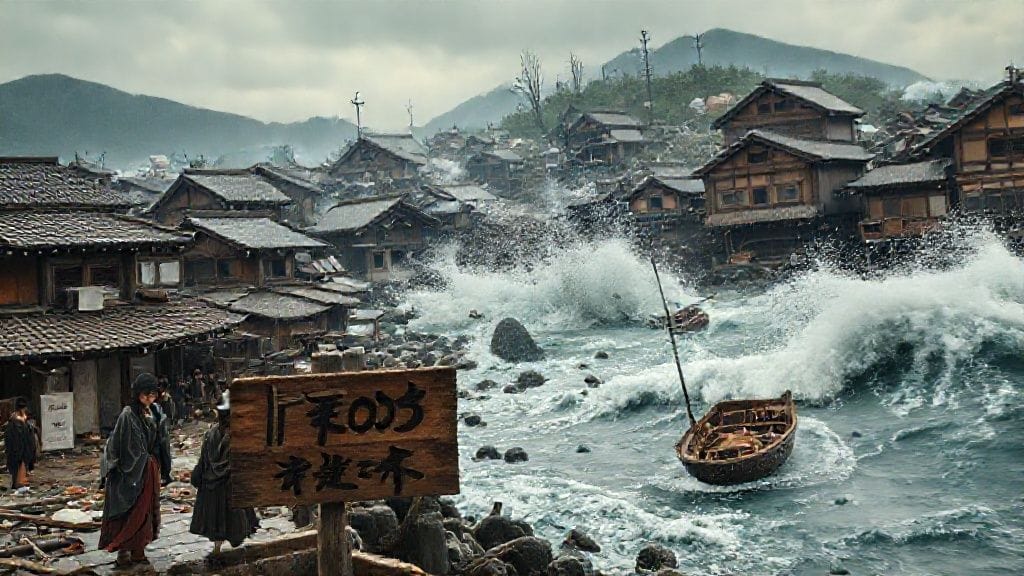
Perhaps the most harrowing legacy of the Genroku Earthquake was the tsunami that surged after the ground settled. Towering waves, some reportedly reaching heights of 10 meters or more, crashed onto the shores of Edo Bay and other coastal zones. These waves uprooted enormous trees, swept away entire fishing fleets, and drowned thousands, sparking panic and chaos.
The tsunami obliterated villages whose inhabitants had nowhere to run, erasing centuries-old communities in moments. Survivors spoke of water turning streets into rivers, homes floating away like paper boats, and indescribable cries for help swallowed by the sea’s roar.
Flames amid Ruins: Firestorms Following the Quake
As if earth and water had not wrought enough havoc, firestorms ignited in Edo and surrounding areas shortly after the quake. With wooden buildings collapsed and fires ignited by overturned earthen stoves, the blazes spread quickly, fueled by strong winter winds.
Entire districts burned for days, consuming food stores, temples, and homes. The conflagration compounded human suffering—rescue efforts stalled, supplies were destroyed, and the desperation of residents increased. Contemporary observers called it the “fire of sucide and despair.”
Human Stories from the Wreckage: Survival and Sorrow
In the midst of this chaos, personal stories emerged—of bravery, loss, and resilience.
One samurai, Masanobu Hayashi, recorded in his diary how he carried his elderly mother through collapsing streets to high ground, only to witness their home reduced to ashes. A fisherwoman from Kamakura recounted how she watched her husband swept away by the first wave, holding their infant girl close.
Across Edo, commoners and nobles alike were forced to confront the fragility of their existence. Mourning was everywhere; in temples, where monks chanted prayers amid rubbles; in marketplaces transformed into shelters. Yet, within sorrow bloomed solidarity.
Tokugawa Ieyoshi’s Challenge: Political Upheaval Amid Disaster
Though Tokugawa Ieyoshi would only rise centuries later, in 1703, the shogunate leadership was under Tokugawa Tsunayoshi. His government faced an overwhelming trial: managing relief and reconstruction without modern bureaucratic structures.
The quake’s devastation threatened the shogunate’s legitimacy, as it struggled to maintain order and supply. The disaster invigorated opposition voices and fueled rumors of divine punishment for corruption or misrule.
Yet Tsunayoshi’s administration pulled together a multi-pronged response, mobilizing lords and samurai to assist refugees, distribute rice, and rebuild vital infrastructure—foundations of early disaster governance.
Emergency Response in 1703: Feudal Japan’s Struggle to Rebuild
In the absence of central disaster agencies, Edo’s response relied on local communities, temples, and samurai retainers. Relief involved rationing food, erecting temporary shelters, and public works to clear debris.
The logistics were daunting: roads, bridges, and ports were destroyed, making aid delivery difficult. Yet, the communal spirit survived. Volunteers dug wells, rebuilt embankments, and constructed wayside inns for travelers displaced by the quake.
These efforts laid, so to speak, the groundwork for Japan’s future approach to natural disasters, emphasizing local initiative supported by state authority.
Mapping the Disaster: From Historical Records to Modern Seismology
Long after the earth stilled, scholars pieced together the earthquake’s footprint through historic maps, diaries, and official records. Modern seismologists have retroactively estimated the quake’s magnitude and pinpointed epicenters using geological surveys.
The Genroku Earthquake remains a key study, highlighting the Sagami Trough’s dangerous potential. It helped scientists forecast possible repeat events, such as the feared Tokai Earthquake, and informed Japan’s highly advanced quake early warning systems today.
The Death Toll and the Unseen Casualties
Casualty estimates vary, but historians approximate upwards of 100,000 deaths—a staggering figure for the period. Beyond the immediate loss, many perished afterward due to starvation, disease, and exposure.
Mass graves and damaged burial sites reveal that the disaster’s shadow extended long beyond the shaking. Families vanished; social fabric was torn, leaving communities struggling with trauma in ways often left unspoken in official chronicles.
Economic Aftershocks: How Markets Recovered or Crumbled
The Genroku Earthquake disrupted trade routes, agricultural production, and urban commerce. Edo’s marketplaces closed for weeks, and rice prices soared as crops along the coast were decimated.
Yet, economic revival followed, spurred by reconstruction demand and Tokugawa-led market regulation. Merchants adapted, and guilds mobilized resources to stabilize prices and supply chains.
Still, rural areas felt the impact longer, with impoverishment and emigration increasing, quietly reshaping demographic and geographic patterns.
Cultural Reflections: Art, Literature, and the Genroku Earthquake
The disaster left deep marks in Japanese cultural memory. Edo-period poets and painters captured the quake’s terror and resilience, intertwining nature’s wrath with Buddhist themes of impermanence.
Ukiyo-e prints illustrated dramatic scenes of destruction and salvation, becoming popular narratives. The earthquake inspired tales recounting both human frailty and stoicism, forming a cultural lens through which later generations interpreted natural calamities.
The Earthquake’s Role in Shaping Modern Japan’s Disaster Preparedness
Even centuries later, the Genroku Earthquake’s lessons resonate. Japan’s meticulous approach to disaster mitigation, early warning systems, and urban planning trace back to cumulative experiences beginning with such calamitous events.
The quake underscored the necessity for resilient infrastructure, community awareness, and government coordination—principles written into national policies, technology, and education.
The Legend and Memory of Genroku: Oral Histories and Myths
In villages along the coast, oral histories preserved by local elders weave the earthquake into folklore. Tales of deities punishing hubris, or heroic monks calming the seas, imbue the event with a mythic dimension, blending history with spirituality.
These narratives preserved the memory and imparted cultural values—humility before nature, the importance of community care—passed down through generations.
Scientific Investigations: Unlocking the Seismic Past
Modern researchers use sediment analysis, underwater sonar, and archival cross-referencing to reconstruct the Genroku quake’s physical impact. Such work bridges centuries to understand seismic cycles and improve prediction models.
Current geological studies have even identified submarine landslide deposits linked to the 1703 event, providing clues to tsunami genesis and warning possibilities.
Comparisons with Later Earthquakes: Lessons Learned and Forgotten
Japan's history is punctuated by powerful quakes—the Ansei (1855), the Great Kanto (1923), the Tohoku (2011). The Genroku event is often compared with these to examine response evolution, societal impact, and technological progress.
What remains striking is humanity’s repeated vulnerability and capacity for adaptation—each quake a sobering reminder that no society is invulnerable.
The Genroku Earthquake in Global Context: 18th Century Disasters Worldwide
Globally, the early 1700s witnessed multiple natural disasters: earthquakes in Sicily (1693), volcanic eruptions in Iceland, and tsunamis in the Indian Ocean. While distant, the Genroku Earthquake fits into a period marked by planet-wide environmental volatility.
This era challenged contemporary worldviews, sparking emerging scientific inquiries and cross-cultural exchanges about natural phenomena.
The Long Shadow of 1703: Enduring Lessons for Humanity
Almost 320 years later, the Genroku Earthquake lives in the stones and souls of Edo’s successor city, Tokyo. It is a testament to the earth's power and a mirror reflecting human vulnerability, courage, and the quest to coexist with nature’s tempests.
From those devastated shores to today’s metropolis, the earthquake’s imprint endures—not only in memorials or textbooks but in Japan’s collective consciousness and ongoing battle to anticipate and withstand what lies beneath.
Conclusion
The Genroku Earthquake of 1703 was more than a cataclysmic rupture in the earth—it was a pivotal event that tested the very foundations of Japanese society, culture, and governance. The waves of destruction extended beyond the physical, sweeping through the heart of Edo, unraveling lives and societal norms, yet also sowing seeds of resilience and renewal.
This disaster reminds us that history is not merely the chronicle of rulers and wars, but the story of people facing overwhelming forces, confronting mortality with spirit and solidarity. As we reflect on December 31, 1703, we grasp the intertwined fate of humanity and the planet, urging vigilance, humility, and compassion in the face of nature’s enduring might.
FAQs
Q1: What caused the Genroku Earthquake of December 31, 1703?
A: The earthquake was caused by the movement along the Sagami Trough, a subduction zone where the Philippine Sea Plate dives beneath the Eurasian Plate, releasing powerful seismic energy.
Q2: How strong was the Genroku Earthquake?
A: Retrospective estimations place the quake at approximately magnitude 8.0, making it one of the largest in Japan’s recorded history.
Q3: What were the immediate effects of the earthquake?
A: The immediate impacts included massive ground shaking, structural collapses in Edo and surrounding provinces, extensive fires, and a devastating tsunami hitting the coastal areas.
Q4: How many people died as a result of the earthquake and the tsunami?
A: Historical sources estimate approximately 100,000 deaths, including those who perished during the quake, tsunami, fires, and subsequent hardships.
Q5: How did the Tokugawa shogunate respond to the disaster?
A: The shogunate mobilized feudal lords and local communities to provide relief, distribute food, rebuild infrastructure, and maintain order despite limited governmental structures.
Q6: What legacy did the Genroku Earthquake leave on Japanese culture?
A: It inspired numerous works of art, literature, and folklore reflecting on human vulnerability, impermanence, and resilience, influencing cultural perceptions of natural disasters for centuries.
Q7: How does the Genroku Earthquake influence modern disaster preparedness in Japan?
A: The lessons learned over centuries, starting with events like Genroku, shaped disaster response policies, emergency systems, urban planning, and public education that characterize Japan’s advanced preparedness today.
Q8: Are there any myths or legends associated with the Genroku Earthquake?
A: Yes, many local oral traditions personify the quake and tsunami as divine retribution or the work of gods, blending history with spirituality and morality tales passed through generations.