Table of Contents
- The Earthquake that Shook East Africa: Introduction to the 1910 Lake Tanganyika Disaster
- The Rift Valley's Fiery Heart: Geological Backdrop of Lake Tanganyika
- East Africa in the Early 20th Century: Politics, People, and Place
- December 13, 1910: The Morning of Catastrophe
- The Tremors Beneath the Lake: Sequencing the Earthquake’s Shocks
- Villages Shaken, Lives Shattered: Immediate Human Impact
- The Natural Marvel and Menace of Lake Tanganyika: Ecology Disrupted
- The Colonial Lens: German East Africa’s Response to Crisis
- Communication in Crisis: Challenges of News and Aid in 1910s East Africa
- Earthquake Aftershocks: Social, Economic, and Environmental Ripples
- Scientists and Explorers: Early Understanding of Rift Valley Seismicity
- The Hidden Scars: Long-Term Effects on Local Communities
- Legacy in the Landscapes: Lake Tanganyika’s Geological Evolution Post-1910
- Earthquake Memory and Oral Traditions Among Lake Tanganyika’s Peoples
- Comparing Rift Valley Earthquakes: 1910 in the Context of East African Seismic History
- Lessons Learned: From 1910 to Modern Earthquake Preparedness in East Africa
- The 1910 Lake Tanganyika Earthquake in Historical and Geological Scholarship
- Nature’s Fury and Human Resilience: Reflection on a Century-Old Disaster
- Conclusion: Remembering the Lake That Roared
- FAQs: Common Questions About the 1910 Lake Tanganyika Earthquake
- External Resources
- Internal Link to History Sphere
The Earthquake that Shook East Africa: Introduction to the 1910 Lake Tanganyika Disaster
On a crisp December morning in 1910, far from the epicenters of global turmoil and far beyond the sprawling metropolises of the Western world, a deep rumble surged beneath the placid waters of Lake Tanganyika. It was a silent terror in a land rarely known to roil from such forces—a massive earthquake that would forever alter both the physical landscape and the human geography of East Africa’s great rift valley. Imagine the stillness of the mist lifting over the lake at dawn, fishermen poised with nets, children playing along the shores, suddenly interrupted by an earth-shattering tremor that would churn the ancient lake into an uneasy, trembling beast.
This earthquake, reverberating through time and tectonics alike, was not merely a geological phenomenon but a crucible of human endurance, colonial challenge, and scientific intrigue. What happened beneath those waves on December 13, 1910, holds a story both extraordinary and sobering—a tale of nature’s raw power manifested in East Africa, an often-overlooked region yet profoundly shaped by the restless crust below.
This article embarks on a journey across time and earth, recounting how the 1910 Lake Tanganyika earthquake unfolded, its causes and aftermath, and the threads of memory and science it wove into the fabric of modern understanding.
The Rift Valley's Fiery Heart: Geological Backdrop of Lake Tanganyika
Nestled within the western arm of the East African Rift, Lake Tanganyika is one of the world’s oldest and deepest freshwater lakes—an immense body of water stretching nearly 700 kilometers between the present-day countries of Tanzania, the Democratic Republic of Congo, Burundi, and Zambia. But beneath its tranquil blue surface lies a restless fault line, a great scar where continental plates are splitting apart.
The East African Rift System is among the planet’s most active geological features, marking a slow unzipping of the African continent—one that began millions of years ago and continues at a glacial pace, causing intense seismic activity. This tectonic drama is responsible for dramatic landscapes: towering escarpments, deep valleys, and lakes that have shaped human settlement and ecosystems alike.
Lake Tanganyika itself occupies a remarkable rift basin formed by faulting in the earth’s crust—this constant tension means the region is prone to frequent earthquakes, landslides, and volcanic activity. However, the earthquake of 1910 stood out as a particularly significant event in this volatile geological saga.
East Africa in the Early 20th Century: Politics, People, and Place
At the dawn of the 20th century, the shores of Lake Tanganyika straddled territories woven into the fabric of European colonial ambitions. German East Africa, a vast colony administered by Berlin, wrapped around the eastern lakeshore, while Belgian Congo lay across the western bank. The local populations, including the Haya, Bembe, Nyamwezi, and others, lived with rich traditions that intertwined closely with the lake’s riches.
Yet, colonial exploitation, forced labor, and infrastructural projects were transforming societies. Railways, plantations, and trading forts punctuated the landscape—symbols of modernity and control but also roots of tension and disruption. Scientific exploration of the region was ongoing but still in its infancy when the earthquake struck.
December 13, 1910: The Morning of Catastrophe
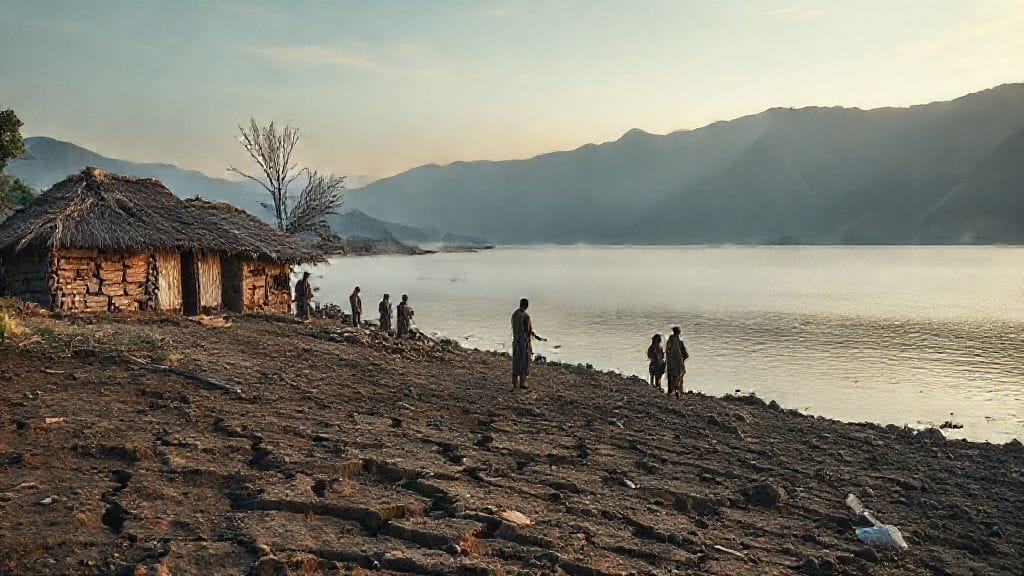
That day, residents around Lake Tanganyika were caught unaware. Eyewitness reports, gathered much later through oral histories and colonial records, describe a sudden, thunderous roar beneath the earth, followed by violent shaking. The lake’s surface undulated in unnatural waves, sending cascades of water over the shoreline and triggering landslides along steep escarpments.
Imagine the chaotic scene: wooden huts trembling, fishing boats capsizing, and the ground cracking beneath frightened feet. For many, the shaking lasted several tense minutes—an eternity when the earth itself seems intent on breaking apart. Daylight turned uneasy with dust clouds stirred by landslides and the sharp tang of disrupted soil.
The Tremors Beneath the Lake: Sequencing the Earthquake’s Shocks
Seismological technology in 1910 was rudimentary, and East Africa’s distant wilderness did not boast scientific stations capable of precise measurements. Nevertheless, contemporary analysis utilizing modern geology and retrospective seismology estimates that the earthquake’s magnitude was roughly between 6.5 and 7.2 on the Richter scale—a powerful tremor capable of widespread damage.
The epicenter was traced to faults beneath the lake’s southern basin, with aftershocks rippling for days afterward. The shaking’s uneven intensity reflected the complex interaction of the rift fault system portioning beneath the waters. Some villages experienced severe destruction, while others were spared the worst by sheer geological fortune.
Villages Shaken, Lives Shattered: Immediate Human Impact
The immediate aftermath was grim. Though the region was sparsely populated relative to today’s standards, those living near the epicenter bore the brunt of the disaster. Huts and homes, mostly constructed with mud and thatch, were especially vulnerable to collapse. Reports also mention casualties, though exact numbers remain unclear, lost to time and the sparse colonial documentation.
Communities were cut off as landslides blocked pathways, and the flooding of lakeshores imperiled crops and freshwater access. Fishermen lost their livelihoods as the lake’s ecology was disturbed. Relief efforts, slowed by both geography and limited colonial infrastructure, struggled to reach the hardest-hit areas.
The Natural Marvel and Menace of Lake Tanganyika: Ecology Disrupted
Lake Tanganyika, a biodiversity hotspot, houses numerous endemic species unique to its deep waters. The 1910 earthquake disrupted this delicate ecological balance. Sediment stirred from landslides settled in the lake’s depths, impacting fish populations and water clarity.
Fisher populations noticed shifts in fish availability in the months afterward, altering traditional fishing patterns that sustained local diets and economies. The ecology’s fragility highlighted a critical human-environment relationship, one where geological upheavals could have cascading effects on cultural survival.
The Colonial Lens: German East Africa’s Response to Crisis
Under German colonial administration, disaster response was hampered by logistic challenges and limited governmental resources. Records reveal slow mobilization of medical aid and supplies, as attention was often diverted toward maintaining colonial order and economic extraction.
Officials documented damage primarily with respect to infrastructure—roads, bridges, telegraph lines—but gave less attention to relief for indigenous populations. Yet some missionary groups and local leaders took initiative to assist victims, reflecting a patchwork response amid the vast terrain.
Communication in Crisis: Challenges of News and Aid in 1910s East Africa
News of the earthquake barely traveled beyond the region for weeks. The remoteness of Lake Tanganyika’s southern shores, combined with rudimentary communication networks, meant that colonial capitals in Dar es Salaam and Brussels heard of the disaster only belatedly.
Field reports had to be couriered by foot or boat across difficult terrain. This delay inhibited timely external support and underscored the isolation of many East African communities from global humanitarian networks—a stark contrast with today’s instant information flows.
Earthquake Aftershocks: Social, Economic, and Environmental Ripples
As aftershocks continued, social structures strained beneath uncertainty. Food insecurity intensified due to damaged farmland, and displaced families sought refuge in neighboring villages. Economic activities stagnated, with trade routes disrupted by damaged roads.
Migratory patterns shifted temporarily as people moved to less vulnerable areas, reshaping local demographics. Environmentally, landslides altered watershed flows, while sediment deposits created new challenges for agriculture.
Scientists and Explorers: Early Understanding of Rift Valley Seismicity
The 1910 earthquake caught the attention of geologists studying the East African Rift. Though few scientists were stationed on-site at the time, subsequent expeditions pieced together evidence of the lake’s seismic volatility.
Notably, German geologists such as Hans Reck, active in East Africa during this period, documented fissures and land deformation caused by the quake, contributing to early theories on continental rifting. These studies laid groundwork for modern plate tectonics understanding long after the quake.
The Hidden Scars: Long-Term Effects on Local Communities
For generations, survivors recounted the "great shaking" in stories passed orally—a living memory of loss and endurance. Some villages never fully recovered, abandoned or relocated due to landslide damage or persistent fear of aftershocks.
The earthquake influenced settlement patterns, local economies, and cultural perceptions of the lake as both life-giver and potential destroyer. This duality shaped relationships with the environment in a complex, evolving narrative.
Legacy in the Landscapes: Lake Tanganyika’s Geological Evolution Post-1910
Geologically, the earthquake altered fault lines beneath Lake Tanganyika, subtly reconfiguring its basin’s contours. These changes may have influenced lake levels and sedimentation patterns in the subsequent decades.
Continued seismic activity in the region is a direct extension of this long-term fault evolution, reminding us that the 1910 event was but one chapter in an ongoing geological saga.
Earthquake Memory and Oral Traditions Among Lake Tanganyika’s Peoples
For the local communities around Lake Tanganyika, the earthquake transcended mere disaster; it became a symbol woven into lore. Elders spoke of the great rumble shaking the earth as a warning from ancestral spirits or nature’s fury demanding respect.
These oral histories serve as important cultural archives, preserving impressions of the earthquake long before written records emerged, bridging science and storytelling in a uniquely human response to catastrophe.
Comparing Rift Valley Earthquakes: 1910 in the Context of East African Seismic History
Though the East African Rift is active, catastrophic earthquakes are relatively rare compared to other global hotspots. Yet 1910 was not an isolated incident. Other significant quakes—in places like Uganda, Kenya, and Ethiopia—have marked the region’s history.
Comparing these events highlights patterns of tectonic stress distribution and varying social responses, contributing to a richer understanding of East Africa’s seismic risk profile.
Lessons Learned: From 1910 to Modern Earthquake Preparedness in East Africa
A century later, East Africa has developed improved seismic monitoring and disaster management frameworks, though challenges remain. The 1910 earthquake’s lessons emphasize the urgent need for resilient infrastructure, community education, and early warning systems.
International collaborations now support research and preparedness efforts, hoping to mitigate the human cost when the earth decides to shake again.
The 1910 Lake Tanganyika Earthquake in Historical and Geological Scholarship
Despite its regional importance, the earthquake remains relatively under-studied in global seismic literature, overshadowed by events on more industrialized continents. Recent decades have seen a resurgence of interest, integrating geological data with historical records and oral testimonies, enriching the narrative.
This interdisciplinary approach honors both the science and the human dimension of the earthquake, acknowledging that history is not only about dates and magnitudes but about lives shaken.
Nature’s Fury and Human Resilience: Reflection on a Century-Old Disaster
The 1910 Lake Tanganyika earthquake is a poignant reminder of nature’s untameable power and humanity’s fragile foothold on a dynamic planet. Yet amid destruction, stories of resilience emerge—of communities rebuilding, societies adapting, and science advancing.
It invites us to marvel at the earth’s forces beneath our feet and to cherish the human spirit that confronts them with courage across time.
Conclusion
The morning of December 13, 1910, remains etched in the annals of East African history as a day when the earth’s restless heart revealed itself with unparalleled force beneath Lake Tanganyika. From the rumbling depths to the trembling shoreline, the earthquake was a visceral demonstration of nature’s might in a world often forgotten by global history.
But beyond the tremors and destruction lay a far richer story—of ecosystems disrupted, colonial administrations challenged, and communities transformed. The legacy of that event resonates still: in the landforms that bear its mark, in the cultural memories passed down through generations, and in the scientific insights that have deepened our understanding of one of the world’s great rift systems.
In remembering the 1910 earthquake, we reclaim a fragment of East Africa’s past that speaks not only of catastrophe but of continuity, adaptation, and the eternal dialogue between earth and human life.
FAQs
Q1: What caused the 1910 Lake Tanganyika earthquake?
A1: The quake was caused by tectonic movements along the East African Rift, where the African continent is slowly splitting apart. Stress accumulation along faults beneath Lake Tanganyika led to a significant seismic event.
Q2: How severe was the earthquake in terms of magnitude and damage?
A2: Estimated between 6.5 and 7.2 in magnitude, it caused widespread shaking, landslides, and flooding. Exact damage is uncertain but included destruction of villages, casualties, and disruption to economies and ecology.
Q3: How did colonial authorities respond to the disaster?
A3: The German colonial administration’s response was limited and delayed, focusing mostly on infrastructure rather than extensive humanitarian aid. Missionary groups and local communities provided much of the relief.
Q4: What long-term effects did the earthquake have on the region?
A4: Beyond immediate destruction, it altered settlement patterns, ecological balances in the lake, and influenced cultural perceptions. It also contributed to scientific study of rift seismicity.
Q5: Is Lake Tanganyika still seismically active today?
A5: Yes, the East African Rift remains an active seismic zone with ongoing tectonic activity, though catastrophic earthquakes remain infrequent.
Q6: How is the 1910 earthquake remembered by local communities?
A6: Through oral traditions and stories describing the “great shaking,” it remains part of cultural memory, blending scientific reality with spiritual interpretation.
Q7: Has this earthquake influenced modern disaster preparedness in East Africa?
A7: It underscored the need for better monitoring and response systems, influencing gradual improvements in regional disaster management.
Q8: Why is the 1910 Lake Tanganyika earthquake not widely known globally?
A8: Its remote location, limited colonial documentation, and overshadowing by larger events elsewhere contributed to its relative obscurity outside specialized circles.