Table of Contents
- The Morning of May 7, 1842: A City Awakens to Disaster
- The Geographical Stage: Hispaniola's Volcanic Heart
- Colonial Legacies and Social Strains in 19th Century Haiti
- The Volcano Speaks: Eruptions Preceding the Tsunami
- The Sea’s Wrath: The Tsunami Strikes Cap-Haïtien
- Witnesses and Survivors: Voices from the Ruins
- The Death Toll and Destruction: Assessing the Human Cost
- Haiti’s Fragile Recovery: Immediate Responses to Catastrophe
- The Geological Explanation: Earthquakes, Landslides, and Tsunami Genesis
- Political Turmoil Amid Natural Disaster
- Haiti’s Ports and Trade Impacted: An Economic Shockwave
- The Cultural Memory of the 1842 Tsunami in Haitian Society
- Comparative Analysis: 19th Century Caribbean Natural Disasters
- The Global Scientific Response: Understanding Tsunami Risks
- Lessons for the Future: How 1842 Shapes Modern Disaster Preparedness
- Conclusion: Tragedy, Resilience, and the Spirit of the Haitian People
- FAQs: Answering Key Questions about the 1842 Hispaniola Tsunami
- External Resource
- Internal Link
1. The Morning of May 7, 1842: A City Awakens to Disaster
The dawn of May 7, 1842, broke uneasily over the northern coast of Hispaniola, where the bustling port city of Cap-Haïtien awoke to an ominous calm. The Caribbean sun had barely begun to paint the sky in soft pinks and golds when the earth beneath the city trembled, a precursor to chaos few could comprehend. For many, it was a mere curiosity—a natural shiver of the land that held little promise of the horror to come. But as the fragile harmony between land and sea shattered, a devastating tsunami surged forth, transforming a day of promise into a tale of suffering, survival, and stark awakening.
The waters, once a source of life and commerce, morphed into a merciless force, swallowing homes, uprooting families, and redrawing the very coastline in less than an hour. The eruption of fury from the sea was a brutal reminder of the untameable power that nature wielded, especially in a land still healing from political wounds and social upheaval.
This catastrophe, now known as the Hispaniola Tsunami of 1842, rocked not only the physical foundations of Haiti but also cracked open the fragile veneer of its young republic’s strength. To understand the full magnitude of this event, one must journey through the converging tides of geology, history, and human endurance.
2. The Geographical Stage: Hispaniola's Volcanic Heart
Hispaniola, the island shared today by Haiti and the Dominican Republic, is a land sculpted by fiery volcanoes, deep fault lines, and restless seismic plates. Situated along the boundary of the North American and Caribbean tectonic plates, it is inherently vulnerable to earthquakes, volcanic eruptions, and tsunamis. The northern coast of Haiti, where Cap-Haïtien sits, fronts the Atlantic Ocean and faces the tumultuous lifeblood of the Caribbean Sea.
Beneath the island’s surface, the Enriquillo-Plantain Garden fault system groans with accumulated stress—a tectonic heartbeat that has shaped both the island’s geography and history. The dramatic mountain ranges and fertile valleys attest to this volatile genesis, their beauty shadowed by the latent danger lurking underground.
Understanding the 1842 tsunami requires this geological lens—a theater where the restless earth and ocean played roles no human hand could control. But geography alone does not tell the entire story; history and humanity complicate the scene with layers of meaning.
3. Colonial Legacies and Social Strains in 19th Century Haiti
By 1842, Haiti was barely four decades removed from its revolutionary birth. The world’s first Black republic, forged in blood and defiance during the Haitian Revolution (1791-1804), was a beacon and an exile all at once. The struggle for independence had shattered colonial chains but left society fragile and fractured.
Cap-Haïtien, once known as Cap-Français under French colonial rule, was a city of contrasts: a wealthy port and a symbol of colonial excess haunted by the ghosts of slavery and upheaval. The abolition of slavery, the introduction of new trade dynamics, and painful efforts to stabilize governance underscored a republic that was politically unstable and economically challenged.
Sociopolitical tension simmered beneath the surface—power struggles, shifting alliances, and regional rivalries shaped everyday life. In this charged atmosphere, nature’s onslaught could hardly have come at a worse moment.
4. The Volcano Speaks: Eruptions Preceding the Tsunami
In the weeks leading to May 7, tremors and volcanic activity were reported in northern Hispaniola, unsettling coastal villages and heightening fears among the population. The sound of distant rumbling from the Piton du Nord and related volcanic vents sent whispers of warning, though scientific understanding at the time was limited.
On the morning of the disaster, eyewitnesses described thick clouds of ash rising from the horizon, while the sea appeared strangely still. This silence from the ocean—nature’s own warning—foreshadowed the calamity as energy accumulated beneath the waves.
The interplay between volcanic activity and the seismic shock below was crucial. It is now understood that underwater volcanic shifts or landslides dislodged enormous volumes of water, triggering the tsunami that would devastate Cap-Haïtien and its surroundings.
5. The Sea’s Wrath: The Tsunami Strikes Cap-Haïtien
Suddenly, the ocean retreated—a terrifying withdrawal that revealed the seabed and ships stranded helplessly on sand. Locals watching might have seen this unnatural phenomenon and feared the worst, though no one could have predicted the magnitude.
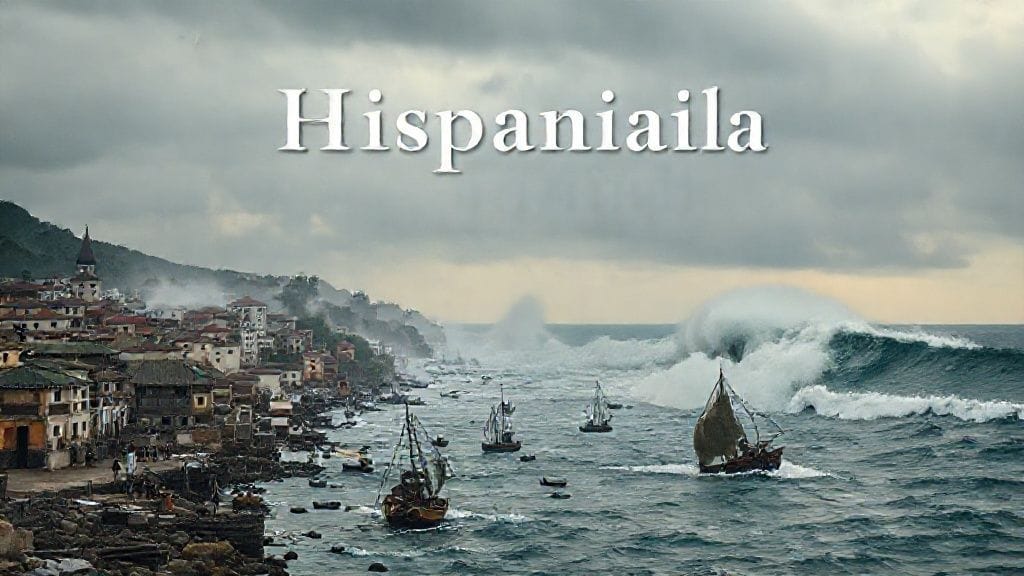
Moments later, with a roar that echoed across the horizon, a towering wall of water surged back onto the northern shore. This was no gentle tide; it was a monstrous wave that swept across ports, docks, and neighborhoods, carrying debris, boats, and people in a blanket of destruction.
Homes made of wood and stone were swept away as if mere toys. The tsunami advanced with relentless speed, drowning the hopes and livelihoods of thousands. The port—a heart of commerce tightly linked to Haiti’s survival—was obliterated.
6. Witnesses and Survivors: Voices from the Ruins
Diary fragments, letters, and later testimonials give us glimpses into the trauma inflicted that day. Marie-Jeanne, a young woman from Cap-Haïtien, would later recall to historians how “the earth groaned beneath our feet, and the sea’s fury was unlike anything we had ever seen… our church was destroyed, and more than a hundred souls vanished in moments.”
Others spoke of heroic acts amid despair: fishermen who braved the rolling surf to rescue neighbors, families huddled on higher ground, and strangers united by shared tragedy. These human moments give flesh to the statistics and remind us that a tsunami is not only a geological event but a profound human ordeal.
7. The Death Toll and Destruction: Assessing the Human Cost
Estimates of the dead vary, but historians agree that several hundred, perhaps over a thousand, perished in the tsunami and related earthquakes. The destruction went far beyond loss of life; Cap-Haïtien’s infrastructure was devastated. Warehouses, administrative buildings, and homes lay in ruins, while the port facilities essential for Haiti’s trade were crippled.
The damage in outlying villages extended the tragedy beyond the city limits. Crops were ruined, wells contaminated, and roads destroyed, compounding the suffering of survivors.
As the dust settled, the enormity of the event was clear—a natural disaster striking a nation already struggling for stability and recovery.
8. Haiti’s Fragile Recovery: Immediate Responses to Catastrophe
In the chaotic aftermath, Haitian authorities scrambled to organize relief efforts amid political turmoil and limited resources. Ships from neighboring islands and some European interests arrived with aid, though logistics were hampered by destroyed ports.
Local communities rallied, supported by religious institutions and mutual aid networks that had sustained Haitians since colonial times. Temporary shelters arose; food and water distribution began under difficult circumstances.
Yet, the disaster deepened existing inequalities. The poorest suffered disproportionately, with little means to rebuild homes or relocate from devastated areas.
9. The Geological Explanation: Earthquakes, Landslides, and Tsunami Genesis
Modern science sheds illuminating light on the forces that combined to trigger the 1842 event. The earthquake along the Enriquillo fault generated violent ground shaking, destabilizing underwater slopes.
This caused massive submarine landslides that displaced ocean water en masse—a primary mechanism behind the tsunami. Volcanic activity likely exacerbated ground instability, adding to the seismic energy released.
Today, seismic models confirm that the epicenter lay off Haiti’s northern coast, a region still under careful watch by geologists who warn that history may yet repeat itself.
10. Political Turmoil Amid Natural Disaster
The tsunami struck during a period of intense political rivalry in Haiti. President Jean-Baptiste Riché’s government was fragile, facing opposition and factionalism. The disaster added a layer of urgency and crisis management to a leadership already challenged by legitimacy and power struggles.
Opposition leaders used the tragedy to criticize the government’s preparedness and response, while the population’s despair sometimes gave way to unrest.
External powers observed with interest; Haiti’s vulnerability raised geopolitical questions in a Caribbean theater still marked by colonial ambitions and trade rivalries.
11. Haiti’s Ports and Trade Impacted: An Economic Shockwave
Cap-Haïtien was more than a city—it was a critical node connecting Haiti to Atlantic and Caribbean trade routes. The tsunami’s destruction of docks, warehouses, and merchant fleets disrupted commerce for months, choking off vital imports and exports.
Agricultural goods, especially coffee and sugar, were delayed or lost. Merchants faced bankruptcy, and overall economic output contracted sharply.
This blow hindered national recovery efforts, as revenues declined and the government’s ability to fund reconstruction weakened.
12. The Cultural Memory of the 1842 Tsunami in Haitian Society
Despite the devastation, the 1842 tsunami has faded somewhat from collective memory in Haiti, overshadowed by political upheavals and other natural disasters like the 2010 earthquake.
Yet, among coastal communities, oral traditions and stories persist—warnings transmitted through generations about the sea’s dangers. These narratives shape cultural attitudes toward nature and disaster preparedness, blending spiritual beliefs and practical knowledge.
Religious interpretations often framed the tsunami as divine punishment or a test, influencing how communities understood and coped with trauma.
13. Comparative Analysis: 19th Century Caribbean Natural Disasters
The 1842 tsunami fits a pattern of frequent natural catastrophes in the Caribbean during the 19th century—hurricanes, volcanic eruptions, and earthquakes regularly imperiled the region.
Neighboring islands suffered similar fates, with disasters influencing migration patterns, economic shifts, and colonial policies.
Haiti’s tsunami, though less famous than some hurricane tragedies, serves as a case study of how vulnerable emerging nations are to natural forces compounded by political and social fragility.
14. The Global Scientific Response: Understanding Tsunami Risks
In the decades following, international scientific communities began to investigate tsunamis seriously, spurred by events like the 1842 Hispaniola disaster.
Though early research was rudimentary, it laid foundations for modern seismology and oceanography. The Caribbean’s position on major fault lines drew attention and contributed to the development of early warning concepts.
Today, monitoring systems deploy sensors and satellites to detect underwater earthquakes and displacement, an evolution rooted partly in lessons from tragedies like Cap-Haïtien’s.
15. Lessons for the Future: How 1842 Shapes Modern Disaster Preparedness
The 1842 tsunami is more than a historical footnote—it is a stark reminder of the enduring intersection between nature’s forces and human vulnerability.
Haiti, and the wider Caribbean, continue to face seismic risks—and yet infrastructure resilience and emergency planning remain challenged by economic and governance issues.
Incorporating traditional knowledge, enhancing scientific capabilities, and fostering regional cooperation stand as key strategies influenced by past disasters. Recognizing the past helps chart a safer path forward.
16. Conclusion: Tragedy, Resilience, and the Spirit of the Haitian People
The tsunami that engulfed Cap-Haïtien on May 7, 1842, was a cruel testament to the power of nature and the fragility of human existence. Yet, amid destruction and loss, stories of survival, solidarity, and courage endure.
Haiti’s struggle with this calamity reflects the resilience of a people who have repeatedly faced adversity—both natural and man-made—and yet continue to rebuild, remember, and hope.
History does not merely record the devastation but also honors the unbreakable spirit rising from the waves.
Conclusion
The 1842 Hispaniola tsunami remains a poignant chapter in Haiti’s complex history. More than a natural disaster, it was a crucible testing the young republic’s endurance, unity, and capacity to recover. Its lessons echo into the present, urging vigilance and preparedness in a land where the earth and sea meet with unpredictable fury.
Through this lens, the 1842 event is a narrative of human courage, cultural memory, and the enduring dialogue between humanity and the natural world—a story that continues to resonate across time.
FAQs
Q1: What caused the 1842 tsunami in Haiti?
A1: The tsunami was triggered by a strong earthquake along Haiti’s northern fault lines, which caused underwater landslides and possibly volcanic activity, displacing massive amounts of water that surged onto the coast.
Q2: How many people died in the 1842 tsunami?
A2: Estimates vary, but several hundred to possibly over a thousand deaths occurred, mostly in Cap-Haïtien and surrounding coastal areas.
Q3: What was the political situation in Haiti during the disaster?
A3: Haiti was politically unstable, with factional divisions under President Jean-Baptiste Riché. The disaster compounded existing tensions and challenged the government's ability to respond.
Q4: How did the tsunami affect Haiti’s economy?
A4: The destruction of Cap-Haïtien’s port disrupted trade routes, damaged infrastructure, and caused significant financial losses, slowing the nation’s fragile economic recovery.
Q5: Is the 1842 tsunami remembered in Haitian culture today?
A5: While overshadowed by other events, oral traditions and local stories keep the memory alive, often framed within spiritual or cautionary narratives about nature’s power.
Q6: How does this event inform current disaster preparedness?
A6: The 1842 tsunami highlights Haiti’s vulnerability and the need for robust monitoring, community education, and international cooperation to mitigate future risks.
Q7: Were there any international responses to the disaster at the time?
A7: Aid arrived from neighboring islands and some European sources, but limited infrastructure hindered large-scale relief efforts.
Q8: Has scientific understanding of tsunamis changed since 1842?
A8: Greatly. Modern seismology and oceanography have developed systems to monitor seismic activity and provide early warnings, reducing the risks of similar catastrophes.