Table of Contents
- The Dawn of Tranquility: Oman’s Coastal Landscape Before the Tsunami
- November 28, 1945: The Day the Sea Rewrote History
- The First Tremor: An Unseen Earthquake Beneath the Arabian Sea
- The Unfolding Horror: Waves Racing Towards Oman’s Shores
- Surging Waters: The Anatomy of the 1945 Oman Coast Tsunami
- Villages Engulfed: Stories of Loss and Survival Along Oman’s Coastline
- The Human Toll: Lives Shattered and Communities Displaced
- A Silent Cataclysm: Why the 1945 Tsunami Was Overlooked for Decades
- Scientific Awakening: How the Event Redefined Indian Ocean Tsunami Awareness
- Oral Histories: Preserving Memory Through Omani Storytelling
- The Geological Puzzle: Understanding the Seismic Origins of the Tsunami
- International Response: The Global Community’s Late Recognition
- From Tragedy to Preparedness: Oman’s Modern Tsunami Warning Systems
- The Cultural Aftershock: Impact on Omani Coastal Traditions and Livelihoods
- Environmental Aftermath: Changes in Marine and Coastal Ecosystems
- Connecting the Dots: The 1945 Event in the Context of Arabian Sea Seismology
- Lessons Learned: How 1945 Shapes Global Tsunami Research Today
- The Forgotten Disaster: Why Some Catastrophes Fade From Global Memory
- Modern-Day Warnings: Oman’s Role in Regional Tsunami Preparedness
- The Living Memory: Commemorating the 1945 Oman Coast Tsunami
On a quiet November morning in 1945, the azure expanse of the Arabian Sea mirrored a calmness that belied the invisible forces gathering beneath its surface. Along Oman’s serene coastline, fishermen set out to sea under gentle skies, unaware that nature was preparing to thunderously rewrite the history of this ancient land. In the blink of an eye, a monstrous surge of water—born from a colossal underwater earthquake—would surge ashore, engulfing villages, altering lives, and etching a somber chapter into the region’s memory. This was the Oman Coast Tsunami of November 28, 1945: a cataclysm cloaked by time, awaiting rediscovery.
The Dawn of Tranquility: Oman’s Coastal Landscape Before the Tsunami
Before the terrifying waters crashed, Oman’s coast was a place of harmony and tradition—a mosaic of fishing communities, pearl divers, and traders who had for centuries thrived along the Arabian Sea’s edge. With the rising sun casting a golden glow over palm-fringed beaches and rugged cliffs, life followed the slow rhythms of the ocean and the desert. The sea was both a giver and taker, a familiar backdrop to daily toil and ancient stories.
In the 1940s, Oman was a land on the cusp of quiet transformation, still largely isolated yet carrying the weight of its history as a crossroads of maritime trade routes. The people were intimately attuned to the sea’s moods, but nothing could prepare them for the wrath concealed beneath the waves on that November day.
November 28, 1945: The Day the Sea Rewrote History
At approximately midmorning, the ocean’s surface began to betray subtle anomalies—an unusual recession far beyond the normal tidal range. In coastal villages, elders noted the eerie retreat of water with growing unease, murmuring warnings rooted in local folklore about the sea’s sudden withdrawal.
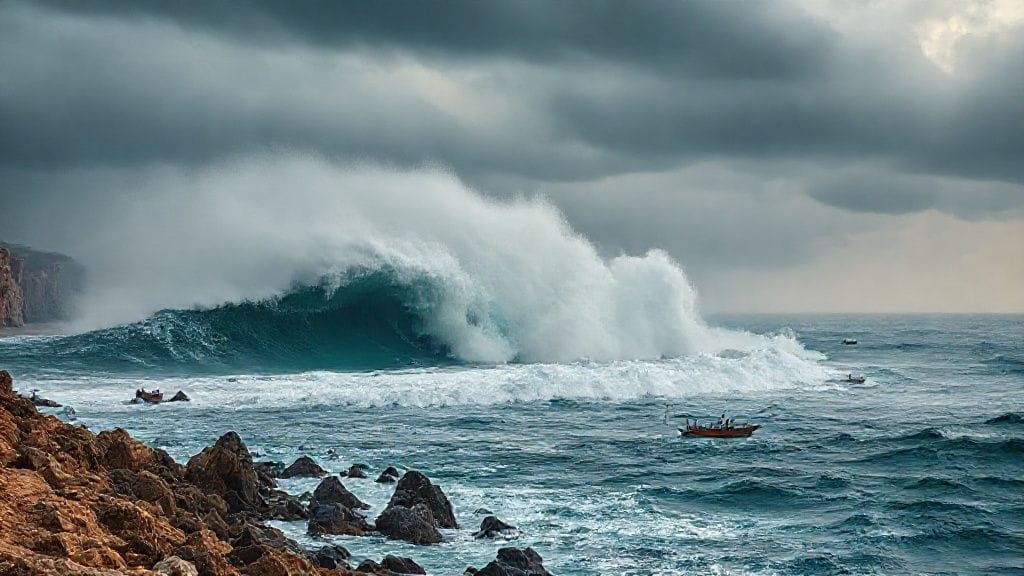
But these ominous signs escalated rapidly: moments after the water vanished, a colossal wall of foaming ocean surged forward with terrifying speed. What followed was a violent tsunami, whose waves crashed onto Oman’s shores with devastating force. Boats were smashed like twigs, homes were swept from their foundations, and entire families found themselves trapped in an unfamiliar nightmare.
The First Tremor: An Unseen Earthquake Beneath the Arabian Sea
This calamity was sparked by a powerful undersea earthquake, a tectonic upheaval of the Arabian Plate where it meets the Indian Ocean’s shifting crust. Seismologists later estimated the quake’s magnitude to be around 7.5 on the Richter scale, originating from a deep fault line hitherto little understood.
From the perspective of the coastal Omani communities, the earth did not give advance warning—no rumbling roar nor shaking ground preceded the tsunami’s arrival, adding to the deafening sense of helplessness. The ocean itself, however, had become a harbinger, signaling from deep below that the earth had cracked in ways human eyes could not see.
The Unfolding Horror: Waves Racing Towards Oman’s Shores
The tsunami’s first wave crashed ashore moments after the water withdrew, a surge reaching heights estimated to be between three to six meters in different locations. The sheer velocity of these towering walls of water left no time for escape. Coastal settlements, many of them small and vulnerable, stood defenseless against this natural onslaught.
The agony of those caught in the waves is captured in harrowing accounts passed down through generations—fishermen dragged far from shore, children torn from their parents’ grasp, entire neighborhoods washed away in the blink of a storm.
Surging Waters: The Anatomy of the 1945 Oman Coast Tsunami
Unlike Pacific tsunamis often triggered by the well-studied “Ring of Fire,” the 1945 Oman event stemmed from the relatively lesser-known seismic dynamics of the Arabian and Indian Ocean plates. When the seabed abruptly rose and fell, it displaced billions of gallons of water, producing waves that raced across the sea’s surface faster than a jet plane.
Scientists today piece together eyewitness descriptions with oceanographic data to model the tsunami’s behavior—its devastating surge followed by powerful undertows that complicated rescue efforts and wrought prolonged suffering for survivors.
Villages Engulfed: Stories of Loss and Survival Along Oman’s Coastline
In the small fishing village of Sur, where generations relied on the sea’s bounty, the tsunami wrought unimaginable tragedy. Entire families vanished beneath the waves; homes were reduced to rubble. Yet amid the grief, stories of survival shine—like that of an old pearl diver who clung to driftwood for hours until rescue, and a mother who, miraculously, found her children alive amid the wreckage.
These narratives transformed the tsunami from a mere natural phenomenon into a deeply human story—a tale of love, loss, resilience, and the unpredictable mercy of fate.
The Human Toll: Lives Shattered and Communities Displaced
Though exact death tolls remain uncertain, contemporaneous reports and later research estimate that hundreds, possibly over a thousand individuals, perished. Entire communities along the eastern Omani coast were leveled, leaving thousands displaced in the fragile post-war era.
The psychological trauma rippled through families and altered the social fabric of coastal regions. For many, the sea once a source of livelihood became a symbol of dread; the collective consciousness was forever marked by the scars of this catastrophe.
A Silent Cataclysm: Why the 1945 Tsunami Was Overlooked for Decades
Unlike the monumental Pacific tsunamis that captured global attention, the Oman Coast Tsunami of 1945 remained largely absent from contemporary histories and scientific literature. Multiple factors conspired: the relative geopolitical isolation of Oman at that time, limited communication channels, and the overshadowing events of the post-World War II landscape.
The region’s sparse documentation and lack of technological capacity to measure and record the event contributed to its near invisibility on the world stage for decades. It was a disaster known intimately but quietly, whispered through Omani oral traditions rather than loudly proclaimed in international fora.
Scientific Awakening: How the Event Redefined Indian Ocean Tsunami Awareness
It was only in the late 20th and early 21st centuries that scientists revisited historical seismic data and anecdotal evidence to recognize the 1945 tsunami’s significance. This recognition reshaped understanding of the Indian Ocean’s seismic dangers, challenging the outdated assumption that tsunamis were rare in this region.
The 1945 event became a key case study—one that augmented tsunami preparedness strategies and inspired deeper regional cooperation in monitoring earthquake activity beneath the Arabian Sea.
Oral Histories: Preserving Memory Through Omani Storytelling
While absent from many textbooks, the event survived vividly in Omani communities through storytelling, poetry, and song. Elders recounted the sea’s fury to younger generations, embedding lessons about respect for nature’s unpredictable violence.
These oral histories remain invaluable, offering researchers rich emotional insight and grounding abstract scientific findings in deeply human experience. They remind us that history is not just dates and data, but the lives and memories of those touched by its tides.
The Geological Puzzle: Understanding the Seismic Origins of the Tsunami
Geologists studying the Arabian Sea’s undersea faults have uncovered a complex picture of tectonic tension and release. The 1945 earthquake likely resulted from a sudden slip along a strike-slip fault—where the earth’s crustal plates grind horizontally past one another.
Unlike subduction zones common around the Pacific, this mechanism created unusual tsunami behaviors, with waves propagating in unexpected directions. This geological nuance adds layers of complexity to regional hazard assessments today.
International Response: The Global Community’s Late Recognition
In contrast to the immediate international responses following Pacific tsunamis, the 1945 Oman disaster stirred little global alarm at the time. However, post-2004 Indian Ocean tsunami tragedies prompted retrospectives that illuminated the overlooked risks in this part of the world.
Today, Oman is recognized as a vital partner in international tsunami warning networks, marking a shift from neglect to proactive engagement rooted partly in the lessons learned from 1945.
From Tragedy to Preparedness: Oman’s Modern Tsunami Warning Systems
Driven by memory and scientific insight, Oman has developed robust coastal monitoring and early warning systems. Sophisticated seismic sensors and ocean buoys work in tandem to detect abrupt undersea movements and possible tsunami formation.
Community education initiatives also seek to empower coastal populations, teaching evacuation protocols and hazard awareness. These efforts stand as a testament to how devastating loss can catalyze resilience and safety innovation.
The Cultural Aftershock: Impact on Omani Coastal Traditions and Livelihoods
The tsunami’s impact extended beyond physical destruction; it altered cultural practices tied to the sea. Some coastal communities shifted or abandoned traditional fishing techniques deemed too risky. Others embraced new livelihoods or fortified homes against future threats.
The disaster shaped Omani identity subtly but indelibly—a narrative of respect for nature’s power and an enduring commitment to coexist with the unpredictable ocean.
Environmental Aftermath: Changes in Marine and Coastal Ecosystems
Cataclysmic tsunamis not only devastate human settlements but also transform environments. The 1945 waves uprooted mangrove forests, reshaped shorelines, and disrupted marine habitats critical for fish and other wildlife.
For some species, the sudden change meant population shifts or declines, stressing the intricate balance between the land, sea, and their inhabitants. Long-term ecological studies have begun to unravel these effects, emphasizing the intertwined fate of nature and humanity.
Connecting the Dots: The 1945 Event in the Context of Arabian Sea Seismology
The 1945 tsunami serves as a crucial piece in the evolving puzzle of Arabian Sea seismic activity. It underscores the presence of active faulting capable of generating destructive tsunamis, contradicting earlier beliefs that the region was benign.
Understanding this event provides essential context for interpreting other seismic phenomena and informs risk assessments for neighboring countries bordering the Indian Ocean.
Lessons Learned: How 1945 Shapes Global Tsunami Research Today
Beyond Oman’s borders, the 1945 tsunami has informed broader scientific methodologies: integrating historical narratives, geological evidence, and modern technology to reconstruct undocumented disasters.
It champions a holistic approach to hazard assessment, blending human memory with empirical data, inspiring international efforts to chart and prepare for the vast ocean’s threats.
The Forgotten Disaster: Why Some Catastrophes Fade From Global Memory
The Oman Coast Tsunami’s relative obscurity highlights how some disasters slip through cracks of collective remembrance. Factors such as geopolitical isolation, lack of media coverage, and absence of immediate global impact contribute to this phenomenon.
Recognizing and reviving the memory of such events is crucial—not only to honor the victims but also to ensure lessons are not lost to time.
Modern-Day Warnings: Oman’s Role in Regional Tsunami Preparedness
Today, Oman stands at the forefront of tsunami preparedness in the Arabian Peninsula. Its investment in monitoring technology, public education, and regional cooperation reflects a commitment rooted in the haunting memories of 1945.
Serving as both a guardian and a teacher, Oman’s experience enriches the collective arsenal against one of nature’s most devastating forces.
The Living Memory: Commemorating the 1945 Oman Coast Tsunami
While no large-scale memorial exists, efforts to document and commemorate the 1945 tsunami persist through local museums, oral history projects, and academic research. These initiatives keep the memory alive, fostering reflection on human vulnerability and endurance.
As new generations engage with this history, the tsunami remains a powerful symbol of the sea’s ambivalent role—both life-giver and ruthless destroyer—on Oman’s shores.
Conclusion
The Oman Coast Tsunami of November 28, 1945, is more than a distant geological event; it is a timeless story etched into the lives and landscapes of a resilient people. For decades, this disaster lurked in the shadows of history, overshadowed by more documented tragedies and geopolitical silence. Yet, through the resilience of memory, the persistence of scientific inquiry, and the courage of survivors and historians alike, the tsunami’s legacy has surfaced.
It reminds us that the earth and sea are intertwined in a fragile dance, capable of sudden fury that challenges human endurance. From heartbreak and loss, Oman has forged a path of vigilance and preparedness—transforming trauma into knowledge, isolation into collaboration. This event, once forgotten, now serves as a beacon: illuminating the need for humility before nature and unity in the face of shared vulnerability.
In the end, the Oman Coast Tsunami is not just a story of water and earth — it is a profound narrative of humanity grappling with the unpredictable vastness that surrounds and sustains us.
FAQs
1. What caused the Oman Coast Tsunami of 1945?
The tsunami was triggered by a powerful undersea earthquake along a fault line beneath the Arabian Sea, estimated at magnitude 7.5. The tectonic shift displaced massive amounts of water, generating the waves that devastated Oman’s coast.
2. How many people were affected by the tsunami?
Exact numbers are uncertain, but estimates suggest hundreds to over a thousand deaths, with many communities heavily damaged or destroyed, and thousands displaced.
3. Why was the disaster overlooked internationally for so long?
Limited communication in 1945, Oman’s geopolitical isolation, and the post-World War II focus elsewhere contributed to the event’s obscurity in global discourse and scientific literature for decades.
4. How did the tsunami impact Omani culture and livelihoods?
The tsunami disrupted fishing communities, altered coastal traditions, and instilled a lasting awareness of natural hazards linked to the sea, influencing both daily life and cultural expressions.
5. What role does Oman play today in tsunami preparedness?
Oman has developed sophisticated monitoring systems, participates in regional warning networks, and educates its population on tsunami risk and response, reflecting lessons learned from the 1945 event.
6. How is the 1945 tsunami discussed in scientific circles now?
It is recognized as a crucial event that expanded understanding of seismic risks in the Arabian Sea, encouraging integrated research approaches combining geology, oceanography, and oral history.
7. Are there memorials or commemorations for the tsunami victims?
While no large official memorial exists, local initiatives, museums, and oral history projects work to preserve the memory and honor those affected.
8. What can modern society learn from the 1945 Oman Coast Tsunami?
Above all, it teaches humility towards natural forces, the importance of historical memory in disaster preparedness, and the need for global collaboration to mitigate future tragedies.