Table of Contents
- The Calm Before the Wave: Rhodes and the Dodecanese in the Early 20th Century
- Geological Secrets Beneath the Aegean Sea
- The Day the Earth Trembled: June 26, 1926
- First Signs of Disaster: The Earthquake That Shook Rhodes
- The Birth of the Tsunami: Waves Racing Across the Sea
- Chaos at the Shore: How the Tsunami Unfolded in Coastal Villages
- Human Stories amid the Flood: Survivors’ Voices and Memories
- The Immediate Aftermath: Rescue, Relief, and Destruction
- Political Shadows: The Dodecanese under Italian Rule and the Disaster Response
- Economic Toll: Fishing, Trade, and Livelihoods Swept Away
- The Scientific Awakening: Lessons Learned About Tsunamis in the Mediterranean
- The Cultural Impact: How the Disaster Shaped Local Identity
- Comparing Mediterranean Tsunamis: 1926 in Historical Context
- Unseen Scars: Long-Term Environmental Effects on the Dodecanese
- Memory and Commemoration: The Tsunami in Collective Consciousness
- Modern Risk and Preparedness: The Legacy of the 1926 Tsunami Today
- Conclusion: Waves of Time and the Resilience of Rhodes
- FAQs: Unraveling the Mysteries of the 1926 Rhodes-Dodecanese Tsunami
- External Resource: Wikipedia Link to the Event
- Internal Link: Further Reading at History Sphere
1. The Calm Before the Wave: Rhodes and the Dodecanese in the Early 20th Century
Under the shimmering sun of the eastern Mediterranean, the Dodecanese islands basked in tranquil beauty. Rhodes, the largest among them, held a complex story under its ancient stones — a blend of Greek heritage and the rumblings of occupying Italian rulers. In June 1926, life here followed the rhythms of fishing boats returning at dusk, coffee shops filled with animated conversations, and children playing amid ruins that whispered tales of crusaders and empires. The serenity, however, was but a fragile veneer masking deep geological tensions beneath the calm blue waters. Few could have predicted that the very sea surrounding them, source of sustenance and beauty, would soon turn into an agent of destruction.
2. Geological Secrets Beneath the Aegean Sea
The Aegean region is one of the most seismically active zones in Europe, a turbulent meeting point of tectonic plates whose restless energy occasionally spills over into catastrophe. Rhodes and the Dodecanese lie near the juncture between the African and Eurasian plates—a site of immense geological pressure. Subduction, faulting, and underwater landslides are a deadly cocktail waiting to be unleashed. By 1926, seismologists had only begun to comprehend the complexity of the region’s faults, but little was understood about the mechanisms triggering tsunamis here, rare in the Mediterranean but with the power to devastate.
3. The Day the Earth Trembled: June 26, 1926
At 10:30 AM on June 26, 1926, a sharp, violent tremor shattered the placid atmosphere on Rhodes. The earthquake, registering an estimated magnitude of 7.1, was sudden and relentless. Buildings rocked, trees swayed, and terrified inhabitants spilled into the streets as ground shattered beneath their feet. The event was not merely a tremor confined to land — the forces unleashed rippled beneath the ocean depths, destabilizing the seafloor and preparing something far more treacherous: a tsunami. As the earth cracked, water started to recede unnaturally along the coastlines, an ominous prelude to the disaster about to unfold.
4. First Signs of Disaster: The Earthquake That Shook Rhodes
The earthquake itself caused widespread structural damage. Traditional stone houses, cafes, and public buildings—witnesses to centuries of history—were injured or razed. Elderly residents recalled how streets seemed to buckle as if the island itself was breathing through convulsions. Yet despite the palpable destruction, the greatest calamity lay just offshore. Witnesses described an eerie calm just moments after the tremor, with the sea’s surface retreating hundreds of meters, exposing fishing nets, stones, and marine life stranded on the sand. This unnatural withdrawal signaled the tsunami’s arrival, a phenomenon unfamiliar and terrifying.
5. The Birth of the Tsunami: Waves Racing Across the Sea
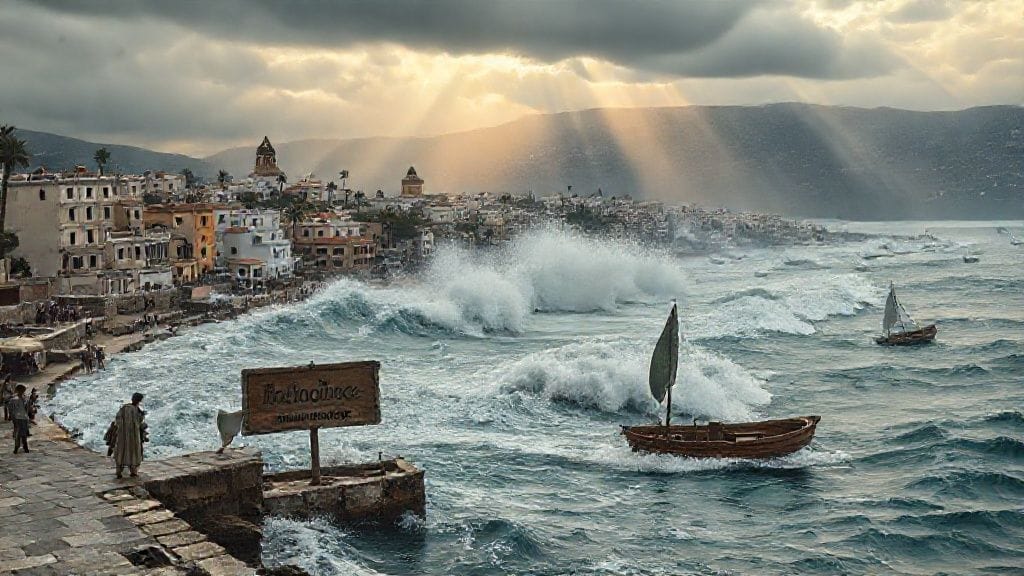
Within minutes, the sea turned from benign to brutal. Towering waves, estimated at 4 to 6 meters high, surged across the coastal villages of the Dodecanese archipelago. The tsunami sped toward the shore with cataclysmic force—engulfing harbors, sweeping boats away, and crashing against fortified walls and humble huts alike. For many inhabitants, what began as a day like any other became an experience of nature’s raw, uncontrollable power. Fishermen standing on the docks were suddenly engulfed; families along the shoreline saw homes torn apart as the sea reclaimed land. The waves struck multiple islands, their timing staggered by distance but equally vicious in impact.
6. Chaos at the Shore: How the Tsunami Unfolded in Coastal Villages
In small towns like Lindos and Ialysos, scenes of panic unfolded. The tsunami did not merely wash the land but hurled debris, uprooted trees, and overturned carts. Survivors’ narratives tell of desperate dashes uphill, clutching children and valuables, eyes fixed on monstrous walls of water. One elderly fisherman recounted how the sea “spoke in a hurled roar” before swallowing his boat and crew. Entire stretches of beach disappeared under surging saltwater, while others were left strewn with wreckage. The chaos was compounded by the fractured roads and collapsed buildings, leaving rescue efforts hobbled.
7. Human Stories amid the Flood: Survivors’ Voices and Memories
Beyond statistics and physical destruction lie the human stories—raw, poignant, and forever etched in memory. Maria, a schoolteacher from Rhodes Town, remembered holding her students outside as the tsunami arrived, evacuating them to higher ground just in time. Another survivor, Giorgos, lost two brothers to the waves but saved his mother by carrying her across treacherous hillsides. These accounts give shape to the tragedy—lives interrupted, families divided, hopes battered but not broken. Remarkably, a number of islanders used folk knowledge of the sea’s strange retreat, guiding others to safety. The memories lingered, passing from generation to generation.
8. The Immediate Aftermath: Rescue, Relief, and Destruction
In the hours and days following the tsunami, the full scope of the disaster became clear. Several hundred people lost their lives; thousands were displaced. Infrastructure lay in ruins—roads, water supply systems, and telegraph lines were severed. Italian authorities, governing the Dodecanese since 1912, mobilized military and civic resources for relief, but communication challenges slowed efforts. International aid was limited; Greece, itself struggling politically and economically, was only beginning to organize external support. Meanwhile, locals banded together, salvaging what they could and burying the dead amidst the rubble.
9. Political Shadows: The Dodecanese under Italian Rule and the Disaster Response
The tsunami struck a politically charged environment. Since the Italo-Turkish War of 1911-12, the Dodecanese had been under Italian administration, a fact that complicated relief operations and heightened tensions. Italians sought to integrate the islands strategically, but Greek cultural identity remained strong. The disaster exposed contrasts between colonial governance and local needs. While Italian engineers undertook reconstruction projects, many islanders felt sidelined in decision-making. The calamity became another layer in the complex narrative of occupation, resistance, and national identity that characterized the interwar period in the region.
10. Economic Toll: Fishing, Trade, and Livelihoods Swept Away
For generations, the Dodecanese economies depended on maritime industries — fishing fleets, shipbreaking yards, and trade routes linking the eastern Mediterranean. The tsunami’s destruction hit the economic fabric hard. Boats were lost or damaged beyond repair; harbors were clogged with wreckage; fish stocks depleted as underwater ecosystems were disrupted. Markets closed, supply chains frayed, and livelihoods vanished in an instant. Agricultural land near coastlines suffered salinization from seawater intrusion. Recovery was slow; many impoverished families found themselves at the mercy of external aid and an uncertain future.
11. The Scientific Awakening: Lessons Learned About Tsunamis in the Mediterranean
The 1926 Rhodes-Dodecanese tsunami was a wake-up call for the scientific community, rare though Mediterranean tsunamis are. It underscored the necessity of seismic monitoring and tsunami awareness in the region. European geologists began to map fault lines more intently, and the event spurred debates about preparedness. Though early warning systems were decades away, the tragedy prompted advances in understanding tectonic hazards and seawater dynamics. “This was not an isolated episode,” noted one early seismologist, “but part of a broader pattern we must heed.” The waves had spoken a language science was finally starting to decode.
12. The Cultural Impact: How the Disaster Shaped Local Identity
The tsunami etched itself into the folklore and cultural consciousness of Rhodes and its sister islands. Local songs tell of the great flood, while annual commemorations honor the lost. Artists, poets, and writers have since captured the event’s haunting beauty and brutality. For communities proud of their island heritage, the tsunami became both a scar and a symbol of resilience—a reminder of their deep connection to the sea’s gifts and risks alike. Oral histories reflect a profound respect for natural forces, intertwined with a stoic hope for renewal.
13. Comparing Mediterranean Tsunamis: 1926 in Historical Context
Though more commonly associated with the Pacific or Indian Oceans, tsunamis have sporadically struck the Mediterranean basin. The 1926 event ranks among the deadliest of the 20th century in this region, comparable to the Messina tsunami of 1908 or the Santorini tsunami centuries earlier. Studying these phenomena reveals patterns of seismic activity in the Mediterranean and highlights fragile coastal communities. Yet each event carries its own uniqueness—geological triggers, wave heights, and social impacts—making the Rhodes disaster a vital chapter in understanding Mediterranean hazards.
14. Unseen Scars: Long-Term Environmental Effects on the Dodecanese
The tsunami’s effects extended beyond immediate destruction. Saltwater intrusion compromised agricultural soils, while sediment displacement altered coastal geomorphology. Coral reefs and marine habitats suffered disruption from underwater landslides triggered by seismic activity. Some beaches were permanently reshaped; wetlands drained or flooded. Ecologists note that recovery took decades, with ripple effects on local biodiversity and fisheries. By examining this environmental aftermath, scientists today piece together the delicate balance between natural disasters and ecosystem resilience in island settings.
15. Memory and Commemoration: The Tsunami in Collective Consciousness
Nearly a century later, the 1926 tsunami remains a potent symbol in Rhodes and the surrounding islands. Memorial plaques and monuments dot the landscape, quiet markers of loss and survival. Community events recount survivor testimonies, and local museums display artifacts salvaged from the waves. Educational programs aim to keep the event alive in public memory, linking past and present concerns over natural hazard preparedness. The tsunami narrative feeds into a broader cultural identity that blends history, myth, and lived experience—a legacy that binds generations.
16. Modern Risk and Preparedness: The Legacy of the 1926 Tsunami Today
The lessons learned from the 1926 disaster resonate today as Mediterranean coastal populations grow and climate change raises the stakes for extreme events. Greek authorities, alongside international partners, have invested in seismic monitoring stations and tsunami early warning systems. Community drills and educational outreach remind residents of the dangers beneath the sea. While the Aegean’s tectonic unrest continues, awareness and preparedness are far more developed than in the early 20th century. The memory of the 1926 tsunami propels modern efforts to safeguard lives and heritage against nature’s unpredictable moods.
17. Conclusion: Waves of Time and the Resilience of Rhodes
The tsunami that struck Rhodes and the Dodecanese on that fateful morning of June 26, 1926, was more than a natural disaster — it was a profound human tragedy and a defining moment for a region perched between histories and seas. From the terror of the waves to the slow rebuilding, the event revealed both vulnerability and an indomitable spirit. Today, as travelers walk ancient streets or fishermen cast nets into clear waters, the echoes of that day still whisper through the islands’ landscapes and hearts. Rhodes and its sister islands endure — shaped by the past, prepared for the future, and forever intertwined with the sea’s caprice.
FAQs: Unraveling the Mysteries of the 1926 Rhodes-Dodecanese Tsunami
Q1: What geological factors caused the 1926 Rhodes-Dodecanese tsunami?
The tsunami was triggered by a significant earthquake (estimated magnitude 7.1) along tectonic faults near Rhodes, caused by the complex convergence of the African and Eurasian plates, which destabilized the seafloor and generated large waves.
Q2: How many people were affected by the tsunami?
Several hundred people were killed, with thousands displaced. The disaster also destroyed homes, infrastructure, and local economies, impacting tens of thousands indirectly.
Q3: What was the political context in Rhodes at the time of the tsunami?
Rhodes and the Dodecanese were under Italian administration, a status that influenced the disaster response and added layers of political tension between colonial authorities and Greek inhabitants.
Q4: Why are tsunamis rare but possible in the Mediterranean Sea?
Tsunamis are less frequent in the Mediterranean due to smaller oceanic basins, but active tectonic zones like the Hellenic Arc can trigger earthquakes and underwater landslides powerful enough to cause tsunamis.
Q5: How did the 1926 tsunami influence scientific understanding in the region?
It spurred increased seismological research and awareness of tsunami risks in the Mediterranean, leading to early studies of seismic hazards and eventually better monitoring systems.
Q6: Are there memorials or commemorations of the tsunami in Rhodes today?
Yes, local communities hold remembrance events, and monuments stand as tributes to victims and symbols of resilience.
Q7: How are modern Mediterranean communities prepared for tsunamis?
Modern monitoring technologies, early warning systems, educational programs, and emergency response plans have been developed, informed by historical events like the 1926 tsunami.
Q8: What environmental impacts did the tsunami leave on the islands?
Long-term environmental consequences include soil salinization, coastal geomorphological changes, and damage to marine ecosystems, which affected local agriculture and fisheries for decades.