Table of Contents
- The Morning of November 1, 1755: A Calm Before the Storm
- The Lisbon Earthquake: Tremors Felt Across the Atlantic
- An Ocean in Turmoil: Spread of the Tsunami Across the Atlantic
- The West Indies on Edge: Early Warnings and Reactions
- Arrival of the Waves: The Tsunami Hits Caribbean Shores
- Port Cities Shaken: Physical Devastation and Human Panic
- The Interplay of Natural Disaster and Colonial Tensions
- Eyewitness Accounts: Voices from the Caribbean Islands
- Economic Ripples: Trade Disruption and Agricultural Losses
- Social Aftershocks: How Communities Rebuilt and Adapted
- The Role of Religion and Interpretation of the Disaster
- Maritime Consequences: Impact on Shipping and Naval Power
- Environmental Changes: Coastal Geography Transformed
- Comparative Impact: Caribbean versus European Damage
- Long-Term Political Effects in the West Indies
- The Disaster in Historical Memory and Literature
- Scientific Curiosity: Early Understandings of Tsunamis in the Caribbean
- Lessons Learned: Caribbean Preparedness for Future Disasters
- The 1755 Tsunami’s Place in Atlantic World History
- Conclusion: Beyond the Waves—Legacy of the Lisbon Tsunami in the Caribbean
- FAQs on the Caribbean Impacts of the Lisbon Tsunami
- External Resource
- Internal Link
On the morning of All Saints’ Day, November 1st, 1755, the vibrant rhythms of the Caribbean pulsed with everyday life—markets bustled, ships prepared for voyages, children played under the tropical sun. Yet, unbeknownst to these islanders, across the vast expanse of the Atlantic, a colossal upheaval was unfolding off the coast of Portugal. The great Lisbon earthquake, one of the most catastrophic natural disasters of the 18th century, had shattered a European capital. But what followed was a menace that transcended continents: an enormous tsunami barreling across the ocean, destined to collide with the shores of the West Indies.
The Morning of November 1, 1755: A Calm Before the Storm
The Caribbean dawned bright and serene, a perfect canvas of blue skies and salty ocean breezes. Islanders, from Barbados to Martinique, were unaware that the ocean’s gentle whisper would soon transform into a monstrous roar. Marketplaces teemed with merchants trading spices, sugar, and tobacco; fishermen cast their nets with hopeful patience; mission churches prepared their holy ceremonies for All Saints’ Day—an unshakable routine as timeless as the sea itself.
Yet, beneath the surface of this calm, subtle changes began. Fishermen noticed unusual tidal rhythms; some sailors remarked at an unaccountable drop in water levels along their docks. Such omens were often brushed aside as caprices of the sea, but, as the day wore on, ominous waves began their inexorable journey westward.
The Lisbon Earthquake: Tremors Felt Across the Atlantic
At precisely 9:40 a.m. local time in Lisbon, the earth shook with unmatched fury. The earthquake, estimated at magnitude 8.5-9.0, unleashed chaos: buildings crumbled, fires ignited, and tens of thousands perished within minutes. The psychological and physical shockwaves radiated beyond Europe—felt faintly but distinctly across the Atlantic as tremors and a sudden drawdown of Atlantic waters informed seafaring men of a distant catastrophe.
The quake was followed shortly by a towering tsunami, triggered as the Atlantic floor shifted violently. At this moment, the Caribbean was silent and distant—but the ocean was moving, carrying death and destruction toward its colonial outposts and trading hubs.
An Ocean in Turmoil: Spread of the Tsunami Across the Atlantic
The tsunami waves took approximately five to seven hours to cross the Atlantic, depending on currents and underwater topography. Traveling at speeds over 500 miles per hour, the destructive force crossed vast stretches of ocean almost invisibly. But the massive water displacement meant that by late afternoon and early evening, alarm bells would ring from island coasts facing east.
What makes this event remarkable is how a seismic event localized in Europe managed to influence territories thousands of miles away with the interconnectedness of colonial empires and their reliance on oceanic passages. The tsunami was nature’s bridge between worlds—one cataclysm sending ripples through all corners of the Atlantic.
The West Indies on Edge: Early Warnings and Reactions
News of the Lisbon earthquake’s devastating power reached elite colonial administrators via transatlantic dispatches within days. However, the immediate physical threat came with terrifying waves. Island governors, traders, and coastal communities understood something was amiss only after spotting unusual sea behavior and feeling ground tremors onboard ships.
On islands like Antigua, St. Kitts, and Dominica, oral warnings spread fast—fishermen rushed inland, communities evacuated low-lying areas, and the atmosphere turned from festive to fearful. Yet, many underestimated the tsunami until the monstrous waves began to render docks and settlements into ruin.
Arrival of the Waves: The Tsunami Hits Caribbean Shores
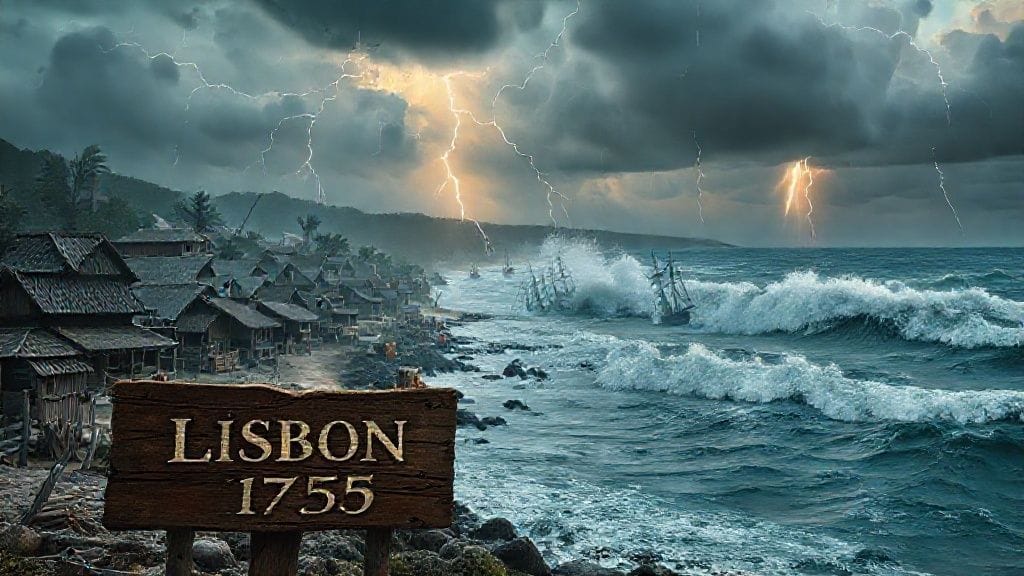
By twilight, the tsunami struck the eastern Caribbean islands with destructive elegance. First, the ocean receded dramatically—the hallmark precursor to the rogue wave—exposing reefs and seabed that were otherwise hidden beneath the turquoise waters. Then the water surged back with ferocious force, obliterating shorelines, pulling ships from moorings, and drowning marine life.
Places like Barbados, Montserrat, and Guadeloupe suffered varying degrees of damage. Some small settlements were completely washed away. In the bustling port of Bridgetown, harbors filled with merchant galleons, the tsunami shattered quays and damaged warehouses, threatening the islands’ important sugar-based economies.
Port Cities Shaken: Physical Devastation and Human Panic
For sentient human beings living within earshot of the roaring sea, the tsunami was apocalyptic. Port cities, nerve centers of colonial commerce, were ill-prepared for such a sudden onslaught. Buildings constructed primarily from stone and wood were reduced to debris—church bells tolled in despair, while panic and chaos reigned.
Many islanders barely escaped with their lives. Accounts speak of families clinging to trees or fleeing to cliffsides as waves flooded their homes. Worst-hit communities faced heavy fatalities, the silence afterward deeply harrowing as survivors emerged from the chaos to tally losses.
The Interplay of Natural Disaster and Colonial Tensions
The tsunami struck at a time when European powers jostled for control over Caribbean territories. French, British, Spanish, and Dutch colonies faced not only nature’s fury but political instability, social stratification, and the complex realities of slavery and indigenous populations.
This convergence intensified the disaster’s impact. Some colonial administrations used the event to tighten control or redistribute resources; others faced unrest amid food shortages and displacement. The tsunami exposed vulnerabilities far beyond the physical—fueling tensions and reshaping power dynamics within the islands.
Eyewitness Accounts: Voices from the Caribbean Islands
Though fewer in number than European records, eyewitness testimonies paint gripping pictures of the tsunami’s arrival and aftermath. One trader in Martinique described, “The sea turned away as if fleeing, leaving fish on the sand, then struck back like the wrath of God, swallowing the docks whole.”
Nearby, a missionary priest recorded in his diary, “The good people were cast to the waves, prayers mingled with cries for mercy, and yet the earth itself seemed to mourn.” These narratives humanize the event—conveying not only destruction but resilience, fear, and hope.
Economic Ripples: Trade Disruption and Agricultural Losses
The tsunami hammered the economic backbone of Caribbean colonies—mostly reliant on sugar plantations, timber, and maritime trade. The destruction of port infrastructure halted exports; saltwater inundation ruined crops; and loss of labor due to deaths strained plantation economies already burdened by slavery and harsh working conditions.
Markets plunged into uncertainty. Merchants delayed shipments, insurance costs soared, and European investors grew wary. The ripple effect slowed economic growth in a region dependent on transatlantic commerce, injecting new fragilities into a fragile colonial system.
Social Aftershocks: How Communities Rebuilt and Adapted
Despite the trauma, Caribbean communities showed remarkable resilience. Reconstruction began swiftly—villagers, freed and enslaved people alike, worked to rebuild homes, churches, and docks. The disaster created moments of shared struggle that, albeit temporarily, bridged social divides.
New architectural designs emerged, favoring sturdier construction. Coastal defenses were improved where possible. Oral traditions began weaving the tsunami into local folklore, embedding the event into collective identity. The trauma was not forgotten but transformed into a source of communal strength.
The Role of Religion and Interpretation of the Disaster
In the deeply religious Caribbean world of the 18th century, natural disasters were often seen as divine judgements or signs. Clergy preached about sin and redemption, interpreting the tsunami as punishment for human vice.
This framing affected societal responses—amplifying fatalism but also spurring renewed religious devotion. Churches became shelters and places for collective mourning. The disaster reinforced the intertwining of faith and daily life, shaping interpretations of natural phenomena for generations.
Maritime Consequences: Impact on Shipping and Naval Power
The Caribbean’s strategic importance as a maritime crossroads meant the tsunami’s damage carried geopolitical weight. Naval vessels were damaged or sunk; supply routes disrupted; and the perceived vulnerability of island ports invited concern among European powers.
This event motivated adaptations in naval strategy and harbor design, changing the way colonial fleets patrolled and protected their interests. It also affected privateering activities during ongoing conflicts, adding a layer of unpredictability on already volatile seas.
Environmental Changes: Coastal Geography Transformed
The force of the tsunami altered coastal landscapes—beaches eroded, mangrove forests uprooted, and new inlets formed. These physical changes had ecological consequences: fish populations shifted, coral reefs suffered damage, and the availability of arable land near coasts fluctuated.
Some islands lost vital natural barriers, increasing their vulnerability to future storms and flooding. These environmental impacts were slow to register fully but had lasting implications for island ecology and human habitation.
Comparative Impact: Caribbean versus European Damage
Though Lisbon suffered the brunt of the earthquake’s initial destruction, the tsunami showcased the interconnectedness of disasters. While Europe’s focus remained on rebuilding after the quake, the Caribbean grappled with a secondary but no less deadly crisis.
The European narrative often overshadowed Caribbean suffering, but recent scholarship highlights how the tsunami’s overseas impact revealed colonial fragility. It was a stark reminder that natural disasters respect no imperial boundaries, and the Atlantic basin was a shared space of risk and resilience.
Long-Term Political Effects in the West Indies
In the wake of destruction, colonial governments adjusted policies—often tightening controls on dissent, reallocating resources to infrastructure, and reconsidering defensive priorities. The disaster also catalyzed inter-colonial cooperation in some instances, as shared vulnerability created new alliances or dialogues.
Nevertheless, social inequalities remained entrenched, and many marginalized groups saw their plight exacerbated. The tsunami thus served as both a catalyst for change and a mirror reflecting systemic issues in colonial governance.
The Disaster in Historical Memory and Literature
Over the centuries, the Caribbean tsunami of 1755 faded from European-centric histories but remained alive in colonial archives, oral traditions, and regional literature. Poets and storytellers invoked the “great wave” as a metaphor for upheaval and endurance.
Modern historians have worked to reinsert this event into broader Atlantic histories, recognizing its profound, if sometimes hidden, footprint on Caribbean society and collective memory. It challenges us to rethink natural disasters as colonial rather than simply geographic phenomena.
Scientific Curiosity: Early Understandings of Tsunamis in the Caribbean
The tsunami spurred some of the earliest scientific inquiries into ocean waves and seismic activity in the Atlantic. Colonial officials, natural philosophers, and learned societies exchanged letters and reports.
Though explanations remained rudimentary, this curiosity paved the way for future progress in disaster science, influencing how the Caribbean and Europe would later prepare for similar catastrophes. It was a moment where observation met wonder and the unknown met the dawn of modern understanding.
Lessons Learned: Caribbean Preparedness for Future Disasters
Though 1755 left a deep scar, it also taught vital lessons. Coastal communities became more watchful of ocean behavior; evacuation plans and early warning practices slowly developed.
However, limitations in technology and colonial priorities often hampered systematic preparation. Still, this event planted seeds for growing awareness of environmental hazards, marking a nascent chapter in Caribbean disaster management.
The 1755 Tsunami’s Place in Atlantic World History
The Lisbon tsunami’s impact on the Caribbean highlights the interconnected dynamics of nature, empire, and society in the Atlantic world. It wasn’t merely a local catastrophe but a transoceanic event with enduring repercussions—an early example of global environmental crisis.
Through this lens, the 1755 disaster can be seen as a precursor to modern discussions on climate, risk, and colonial legacies. A reminder that in history, no shore is truly isolated.
Conclusion
The Caribbean experience of the 1755 Lisbon tsunami is a story of shockwaves—literal and metaphorical—that crossed oceans and empires alike. It reveals a fragility that belies the islands’ lively reputation, a resilience forged in the face of overwhelming natural forces and complex colonial entanglements.
More than a chapter of destruction, this event redefined the Caribbean’s place in Atlantic history, intertwining survival with adaptation, fear with faith, and loss with hope. That morning on November 1st, the waves arrived not just to erode shores but to carve deep marks into the human story of the West Indies—marks that still ripple through memory, culture, and scholarship today.
FAQs
Q1: What caused the tsunami that hit the Caribbean in 1755?
A1: The tsunami was triggered by the massive Lisbon earthquake off the coast of Portugal. The seismic activity caused significant displacement of the Atlantic seafloor, sending waves across the ocean that reached the Caribbean several hours later.
Q2: Which Caribbean islands were most affected by the 1755 tsunami?
A2: Islands such as Barbados, Martinique, Guadeloupe, Montserrat, Antigua, and St. Kitts experienced significant damage due to their eastern coastal positions facing the Atlantic. The extent varied by island depending on geography and preparedness.
Q3: How did the tsunami affect Caribbean economies?
A3: The disaster disrupted trade by damaging port infrastructure, destroyed agricultural lands through saltwater flooding, and caused loss of labor. This slowed exports, particularly sugar, and created economic uncertainty across colonies.
Q4: Did the 1755 tsunami change political dynamics in the Caribbean?
A4: Yes, the disaster intensified existing colonial tensions, led to shifts in governance policies, and in some cases, fostered inter-colonial cooperation. However, it also exposed social inequalities and prompted stricter control in many territories.
Q5: How is the 1755 Caribbean tsunami remembered today?
A5: Though overshadowed by the Lisbon quake in European memory, the Caribbean tsunami remains part of local oral history, regional literature, and increasingly, scholarly research—highlighting its significant impact on the Atlantic world.
Q6: What lessons did Caribbean communities learn from the tsunami?
A6: Communities became more watchful of ocean anomalies, developed early warning practices, and rebuilt with more durable architecture. Despite limited technology, it marked a beginning in regional disaster preparedness.
Q7: Were there any scientific advancements following the tsunami?
A7: The tsunami spurred interest and study into seismic activity and oceanography in both Europe and the Caribbean, laying groundwork for future scientific understanding of tsunamis and earthquakes.
Q8: How did religion influence interpretations of the disaster?
A8: The tsunami was widely seen as divine punishment, shaping social reactions and religious fervor. Churches played central roles in mourning and community support during the crisis.