Table of Contents
- The Night the Earth Roared: December 21, 1946
- Origins Beneath the Waves: The Geological Context of Nankai Trough
- The Calm Before the Tsunami: Japan in the Aftermath of WWII
- The Earthquake That Shook a Nation: The Magnitude 8.1 Event
- The Wall of Water: The Tsunami’s Deadly Arrival
- Coastal Towns Swept Away: Stories of Devastation and Survival
- Voices from the Depths: Eyewitness Accounts and Personal Testimonies
- The Human Toll: Death, Injury, and Displacement
- Government Response: Emergency Measures and Rescue Operations
- Scientific Revelations: Understanding the Nankai Trough’s Fury
- Cultural Impact: Art, Literature, and Memory of the Disaster
- A Pattern of Disaster: Historical Tsunamis of the Nankai Region
- Lessons in Preparedness: How 1946 Changed Japan’s Disaster Policies
- International Ramifications: Early Warning and Tsunami Science Worldwide
- The Nankai Trough Today: Monitoring, Research, and Fear of Repetition
- Remembering 1946: Memorials and Commemoration in Japan
- The Legacy of Resilience: How Communities Rebuilt and Remembered
- Tsunami Myths and Realities in Japanese Culture
- Comparative Disasters: Nankai Tsunami and Other Historic Waves
- The Future of Tsunami Science: Innovations Inspired by 1946
- Conclusion
- FAQs
- External Resource
- Internal Link
The Night the Earth Roared: December 21, 1946
As darkness enveloped the southern coast of Japan on December 21, 1946, the quiet winter night was shattered by a ferocious roar from deep beneath the earth. An earthquake, violent and unrelenting, ripped open the seafloor off the coast of the Nankai region. But the seismic tremors were only the opening act. Moments later, monstrous waves, towering and merciless, surged toward the shorelines, engulfing villages and towns with indifferent destruction. The Nankai tsunami had arrived, forever altering the landscape, the lives of tens of thousands, and the course of Japan’s disaster preparedness and scientific inquiry.
That night, the sea became a voracious predator, swallowing homes, dreams, and lives without warning. The chill December air carried screams, prayers, and the cries of children, while embers of hope flickered amid the ruins. It was a catastrophe that seemed pulled from the pages of myth – a sudden, elemental reckoning between humanity and nature’s overwhelming power.
But this disaster was real. And it was only the beginning of a long journey for recovery, remembrance, and understanding.
Origins Beneath the Waves: The Geological Context of Nankai Trough
To grasp the magnitude of the 1946 Nankai tsunami, one must dive beneath the surface – literally and figuratively – into the dynamic geology of Japan’s southern coast. The Nankai Trough is a vast underwater trench stretching about 800 kilometers, running parallel to Honshu’s southern shores. It forms part of an active subduction zone where the Philippine Sea Plate slides beneath the Eurasian Plate with earth-shaking regularity.
Japan's unique position at the intersection of multiple tectonic plates makes it one of the most seismically active regions in the world. The Nankai Trough, in particular, has witnessed cyclical earthquakes and tsunamis over centuries, often called "Nankai megathrust earthquakes." These seismic events have shaped Japan's landscapes and histories, with records dating back over 1,200 years chronicling tsunami waves and destruction.
This geological reality laid a devastating trap for the coastal populations. The immense pressure built over centuries would periodically release, unleashing both a violent earthquake and the ocean’s wrath.
The Calm Before the Tsunami: Japan in the Aftermath of WWII
In 1946, Japan was a nation still reeling from the cataclysm of World War II. Cities lay in ruins from bombings; survivors struggled with poverty, food shortages, and illness. The country was under Allied occupation, facing profound social upheaval as it sought to rebuild not only its infrastructure but its identity.
For many coastal communities along the Nankai region—the prefectures of Wakayama, Kochi, and Shizuoka especially—life was precarious but carried on with cautious hope. Fishing was a vital livelihood, and the sea was both a friend and, as always in Japan’s history, a potential foe. The long war had drained resources, making disaster preparedness all but neglected amid urgent daily survival needs.
Yet, nature did not pause for human hardship. On that fateful December night, after years of torment and rebuilding, the earth itself would deliver another cruel blow.
The Earthquake That Shook a Nation: The Magnitude 8.1 Event
At approximately 04:19 local time, the earth shuddered violently along the Nankai Trough. Measuring around 8.1 on the Richter scale, this megathrust earthquake was powerful enough to be felt hundreds of kilometers away, from Tokyo to Kyushu. The shaking lasted nearly three minutes—a prolonged nightmare for those caught in its grip.
Buildings toppled, bridges cracked, and roads crumbled under the intense force. The earthquake’s epicenter lay beneath the ocean floor, which meant that it was as much an underwater upheaval as a terrestrial disaster. This undersea disturbance was the trigger for the tsunami that would follow with terrifying speed.
Historical seismologist Kiyoo Mogi later described this as one of the most significant seismic events in modern Japanese history, embodying the terrible potential of subduction zones. But as harrowing as the quake was, the true scale of the disaster unfolded in the minutes that followed, when the ocean turned against the people.
The Wall of Water: The Tsunami’s Deadly Arrival
Witnesses would later recall an eerie silence after the earthquake’s shaking ceased—a deceptive calm. Then, they saw the sea retreat dramatically, revealing what looked like the ocean floor pulled away from the land, exposing marine life and the sandy seabed in a chilling spectacle.
Then, with unimaginable velocity, the tsunami waves — some reaching heights of 10 to 15 meters — crashed onto the shore. They swept across the coasts of Wakayama, Kochi, Tokushima, and beyond, with a force that razed entire towns in seconds. Wooden houses, fishing boats, and people were engulfed and carried inland like debris in a flood.
Communities had little time or means to react. Early warning mechanisms were rudimentary at best, and the memory of previous tsunamis, although ingrained in local folklore, did not translate into practical preparedness. The sea’s assault was merciless and swift—washing away homes, bridges, and thousands of lives.
Coastal Towns Swept Away: Stories of Devastation and Survival
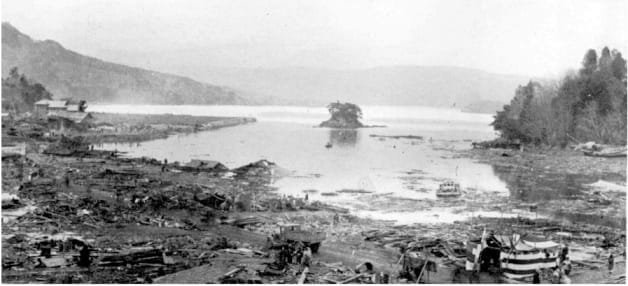
The tsunami’s path of destruction was horrific. Cities like Tanabe in Wakayama, known for their vibrant fishing industry and community life, found themselves transformed into wastelands overnight. Boats were hurled onto streets, fields were inundated with saltwater, and entire families vanished without trace.
Yet among the chaos, tales of survival emerged. Some villagers, hearing the ominous earth tremors and witnessing the strange retreat of the sea, climbed to higher ground just in time to avoid the worst. In places like Kochi Prefecture, community leaders and fishermen’s intuition saved dozens, as they led their neighbors to hills and temples situated above the tsunami's reach.
Still, for many, the wave was an unforgiving death sentence, dragging victims into the depths or trapping them beneath collapsing structures.
Voices from the Depths: Eyewitness Accounts and Personal Testimonies
Oral histories collected in the years following reveal a tapestry of fear, loss, and resilience. One survivor described the moment:
"The earth shook like the heavens were breaking apart. Then the sea pulled away, as if trying to speak a warning we didn’t understand… and before I could run, the water had swallowed everything – my home, my family."
Another recounted the surreal sight of children playing near the shore just before the tsunami's arrival, unaware of the impending doom. These testimonies serve not only as historical records but as human bridges to the past tragedy, carrying the voices that might otherwise be lost beneath statistics and geology.
The Human Toll: Death, Injury, and Displacement
Estimates place the death toll from the Nankai tsunami of 1946 at approximately 1,330 people, with thousands injured and many more displaced. For a country already struggling under the weight of war devastation and poverty, this natural disaster compounded the suffering immeasurably.
Entire families were obliterated, leaving orphans and widows. Economic losses rippled from the destruction of fishing boats and equipment, agricultural lands rendered infertile by saltwater, and the collapse of local infrastructures. The psychological trauma endured by survivors echoed over generations, as communities faced the harrowing task of rebuilding amid grief.
Government Response: Emergency Measures and Rescue Operations
The immediate reaction of the Japanese government and Allied occupation authorities was hampered by the country's general lack of resources. Nonetheless, rescue operations were launched swiftly, involving the military, police, and local community organizations.
Temporary shelters were set up in schools and temples for the displaced. Medical teams contended with injuries complicated by cold winter conditions. Food shortages further intensified the crisis, requiring food aid shipments from less affected areas.
The Nankai tsunami prompted a reevaluation of disaster management policies, highlighting the urgent need for better early warning systems and education — a process Japan would develop comprehensively in subsequent decades.
Scientific Revelations: Understanding the Nankai Trough’s Fury
The 1946 event was a crucial moment in Japan’s scientific study of earthquakes and tsunamis. Researchers like Kiyoo Mogi and others began systematic investigations into the seismic mechanisms that caused the eruption and the resulting tsunami.
The quake's magnitude, combined with the tsunami's height and reach, reaffirmed the catastrophic potential of the Nankai Trough, which scientists identified as a key seismic threat. This research laid foundational knowledge that helped shape Japan’s now-renowned earthquake engineering and tsunami warning programs.
Cultural Impact: Art, Literature, and Memory of the Disaster
In the years following, the Nankai tsunami entered Japan’s collective consciousness. Poems, paintings, and folk songs captured the sorrow and awe evoked by the disaster.
One famous haiku from a survivor reads:
"The sea’s cold hand took all / Yet from salt and sorrow’s womb / New life will bloom again."
Memorials arose in afflicted towns, preserving the memory and warning future generations. The tsunami became more than a natural event; it became a profound symbol of both loss and resilience.
A Pattern of Disaster: Historical Tsunamis of the Nankai Region
The 1946 tsunami was not an isolated phenomenon. Historical chronicles detail major Nankai earthquakes and tsunamis in 684, 887, 1498, 1605, and 1707, each devastating coastal communities.
Japan’s long history of tsunamis thus gave rise to a culture deeply intertwined with the sea’s dual blessings and horrors. Yet, as the 1946 disaster showed, scientific understanding and societal readiness had yet to catch up fully.
Lessons in Preparedness: How 1946 Changed Japan’s Disaster Policies
In the wake of the disaster, Japanese authorities accelerated the implementation of tsunami evacuation drills, education campaigns, and improved communication networks, including sirens and radio warnings.
Civil engineering responded with seawalls and hip-high levees, although some criticized these as insufficient against the tsunami's force. The tragedy also spurred community-based disaster planning, emphasizing local knowledge and rapid response.
These lessons would find severe testing during later tsunamis, including the 2011 Tōhoku disaster, but they originated in moments like those following the 1946 Nankai event.
International Ramifications: Early Warning and Tsunami Science Worldwide
The 1946 tsunami rippled through scientific circles globally. Its timing, close to the establishment of international scientific bodies, contributed to early efforts at global tsunami monitoring and warning systems.
Hawaii's devastating tsunami in April 1946, caused by an Aleutian earthquake, also underscored the need for international cooperation. Japan’s experience added crucial data to a burgeoning understanding of tsunami propagation and coastal vulnerability worldwide.
The Nankai Trough Today: Monitoring, Research, and Fear of Repetition
Today, Japan maintains an extensive network of seismic and tsunami observation points, satellites, and computer models focused on the Nankai region. Scientists warn that the Nankai Trough remains a constant threat, with some predicting the possibility of a megathrust earthquake that could dwarf past disasters.
Concerted efforts are underway to bolster evacuation infrastructure, public education, and technological innovation, all forged in the shadow of 1946’s tragedy.
Remembering 1946: Memorials and Commemoration in Japan
Commemorative events occur annually in towns decimated by the tsunami. Plaques and monuments honor the dead and serve as continual reminders of nature’s power and fragility of human life.
Such memorials play a vital role in cultural memory, ensuring that future generations remember not only the horror but also the lessons hard-won in those dark hours.
The Legacy of Resilience: How Communities Rebuilt and Remembered
Despite the initial devastation, communities demonstrated remarkable resilience. Fishing fleets were gradually restored, homes rebuilt, and broken social fabrics mended.
Survivors’ stories share a common thread of endurance and determination, a testament to human spirit when confronted with overwhelming loss.
Tsunami Myths and Realities in Japanese Culture
Tsunamis appear in Japanese folklore as avatars of divine wrath or nature’s vengeance, often associated with dragons or sea gods. The 1946 disaster, while scientific in its causality, echoed these ancient narratives, blending cultural mythologies with modern reality.
This interplay influences how communities perceive risk and respond emotionally to such disasters.
Comparative Disasters: Nankai Tsunami and Other Historic Waves
While overshadowed internationally by larger disasters, the 1946 tsunami stands as a critical event alongside the 1896 Meiji-Sanriku and 2011 Tōhoku tsunamis. It exemplifies common themes: suddenness, human vulnerability, and the ocean’s unpredictable fury.
Studying these events comparatively deepens understanding of patterns, risk mitigation, and societal impact.
The Future of Tsunami Science: Innovations Inspired by 1946
Today’s early warning systems, real-time seismic data sharing, and community resilience programs all trace part of their origin to the 1946 tragedy. Innovations in geographic information systems (GIS), undersea sensors, and AI modeling are set to further reduce future risks.
The Nankai event remains a somber reminder and critical scientific touchstone in the ongoing battle to coexist with Earth’s restless seas.
Conclusion
The Nankai tsunami of December 21, 1946, was a cataclysm that ruptured the physical and social landscapes of southern Japan, a cruel reminder of nature’s unpredictable force. Yet, amid the rubble and heartbreak, it illuminated profound lessons about preparedness, resilience, and the enduring human spirit.
This disaster pulled back the curtain on the dangers lying beneath the Earth's surface, compelling Japan—and the world—to listen, learn, and act with greater urgency. It is a story both tragic and inspiring, a hyphen between history and future, where memory fuels science, and grief begets hope.
Every wave that crashes on Japan's shores today carries echoes of that terrible night over seventy years ago—an elemental dialogue between past and present, warning and wisdom.
FAQs
1. What caused the 1946 Nankai tsunami?
The tsunami was caused by a magnitude 8.1 megathrust earthquake along the Nankai Trough, an active subduction zone where the Philippine Sea Plate slides beneath the Eurasian Plate. This earthquake triggered the tsunami.
2. How many people were killed in the 1946 tsunami?
Approximately 1,330 people died due to the tsunami, with thousands more injured or displaced.
3. Was Japan prepared for such a disaster in 1946?
Japan’s preparedness was limited at the time, especially given the ongoing post-World War II recovery. Early warning systems and evacuation plans were rudimentary or nonexistent in many coastal towns.
4. How did the 1946 tsunami influence disaster policies in Japan?
The disaster led to an acceleration in tsunami awareness, early warning development, evacuation drills, and building of coastal defenses.
5. Are tsunamis common in the Nankai region?
Yes, the Nankai region has a history of megathrust earthquakes and tsunamis occurring in cycles over centuries.
6. How is Japan monitoring the Nankai Trough today?
Japan employs seismic sensors, ocean buoys, satellite monitoring, and advanced modeling to monitor potential earthquake and tsunami activity in the Nankai region continuously.
7. What role does cultural memory play regarding tsunamis in Japan?
Cultural memory, through stories, memorials, art, and education, keeps the awareness and lessons of past tsunamis alive to prepare current and future generations.
8. How did international tsunami science benefit from the 1946 event?
The event contributed valuable data and urgency to global efforts developing early warning systems and cross-border scientific collaboration on tsunami research.