Table of Contents
- The Day the Sea Rose: July 9, 1958, Lituya Bay
- A Hidden Giant: The Geography of Lituya Bay
- The Forgotten Faultline: Tectonic Tensions in the Region
- The Perfect Storm: Preceding Events and Warning Signs
- The Earthquake That Shook the Shore
- The Massive Rockslide: Nature’s Implacable Force
- Birth of the Mega-Wave: A Wave Like No Other
- Eyewitnesses in Terror: Survivors Speak
- The Path of Destruction: Lituya Bay’s Scorched Earth
- Scientific Discovery: Measuring the Largest Tsunami Wave Ever Recorded
- Tracing the Wave’s Origins: Geological Investigations
- Understanding Mega-Waves: From Local to Global Impact
- The Aftermath: Rescue, Recovery, and Reflection
- Lituya Bay in Popular Culture and Public Imagination
- Tsunami Science Transformed: Lessons from 1958
- Environmental and Ecological Consequences
- The Human Factor: What Could Have Been Done?
- Tsunami Preparedness Today: Echoes from Lituya Bay
- Remembering the Mega-Wave: Memorials and Memory
- The Continuing Legacy of July 9, 1958
- Conclusion: Nature’s Fury and Human Resilience
- FAQs: Unraveling the Mysteries of Lituya Bay
- External Resource
- Internal Link: Visit History Sphere
The Day the Sea Rose: July 9, 1958, Lituya Bay
The morning calm of July 9, 1958, in the remote fjord known as Lituya Bay in Alaska was shattered in an instant by a force of nature so colossal it defied previous human experience. In less than a minute, an earthquake ripped through the mountainside, dislodging an enormous mass of rock that plunged into the icy waters below. The explosion sent a towering wave roaring across the bay—a tsunami with a record-breaking height that would forever etch Lituya Bay into the annals of geological history.
Witnesses, though few, described the scene in stunned disbelief: the waters surged skyward to heights of around 1,720 feet (520 meters). Trees were uprooted and splintered far above the waterline. Shoreline inhabitants faced an onslaught unlike anything recorded. It was not merely a wave — it was a liquid mountain, a hollowing vortex of power and destruction. Understanding what happened that day requires delving into the landscape, geology, and human stories intertwined with this extraordinary event.
A Hidden Giant: The Geography of Lituya Bay
Nestled along Alaska’s rugged southeastern coastline, Lituya Bay is a glacial fjord more than seven miles long but rarely admired for its serenity. Towering cliffs surround its narrow inlet, some rising over 2,000 feet above sea level, forming a natural amphitheater carved by ancient glaciers.
Unlike open ocean shores, Lituya Bay’s funnel-like shape meant its waters were enclosed by rock walls, amplifying waves and storms, yet this setting was obscure and lightly populated. What made this fjord remarkable wasn’t just its beauty, but how its geography predisposed it to unusual natural phenomena: the combination of steep slopes, proximity to seismic zones, and isolated setting laid a hidden trap for disaster.
The Forgotten Faultline: Tectonic Tensions in the Region
Alaska is a land of geologic unrest. It straddles the Pacific “Ring of Fire,” an arc of volcanic and seismic activity surrounding the Pacific Ocean. The boundary where the Pacific tectonic plate dives beneath the North American plate—known as a subduction zone—runs directly offshore from Lituya Bay.
Over centuries, huge stresses accumulated beneath the bay. Shifting plates caused earthquakes, sometimes violent, and loosened unstable rock masses nestled in the fjord’s cliffs. Yet, in the mid-20th century, the risks posed by these geologic forces were poorly understood. The region’s immense tectonic tension was known but underestimated, setting the stage for an unprecedented cataclysm.
The Perfect Storm: Preceding Events and Warning Signs
In the months leading to July 1958, several tremors gently shook the landscape, unnoticed by an isolated few. Locals reported small cracks and rumblings, but no immediate concern arose. The din of everyday life blended with faint echoes of the restless earth.
However, these minor quakes foreshadowed what few could predict—an immense geological disturbance that would shatter the silence. The conditions were a perfect storm: steep rock faces had been weakened by freeze-thaw cycles; the glacier ice retreat was altering slopes’ stability; and seismic tensions were near critical.
The Earthquake That Shook the Shore
On the late afternoon of July 9, at precisely 10:15 PM local time, a massive earthquake measuring approximately magnitude 7.8 jolted the Lituya Bay region. The violent shaking dislodged nearly 30 million cubic meters (around 40 million tons) of rock from a mountainside known as the Gilbert Inlet.
Eyewitnesses, now few and primarily fisherman or forest service personnel, felt the earth convulse beneath them. Trees trembled, the horizon shuddered, and the very air seemed to tighten, an instant before the unimaginable happened.
The Massive Rockslide: Nature’s Implacable Force
The rockslide thundered down the side of Mount Saint Elias with the force of a volcanic eruption but without fire or smoke. As the enormous rocky mass plummeted into the narrow end of the bay, an explosion of displaced water followed.
The sound roared like a thousand waterfalls combined, and in moments, the entire bay transformed from tranquil fjord to an arena of violent natural power. This was not an ordinary landslide but a colossal transfer of energy from earth to sea — the kind of event rare enough to occur once or twice in recorded history.
Birth of the Mega-Wave: A Wave Like No Other
The impact of the rockslide generated what scientists term a "mega-tsunami," an extraordinary wave that surged across the bay at speeds reaching 200 miles per hour. Unlike typical ocean tsunamis caused by underwater quakes spreading across vast distances, this wave was localized but monstrously tall.
The wave’s peak height was estimated at 1,720 feet (524 meters). To visualize this, it’s roughly equivalent to a 160-story skyscraper. The wave swept clean over the cliffs and forests, stripping vegetation and soil far above the shore. The sheer magnitude bewildered the scientific community for decades.
Eyewitnesses in Terror: Survivors Speak
Miraculously, a small number of people survived the tsunami’s wrath. Accounts from fisherman Howard Ulrich, his son, a couple of forest rangers, as well as other nearby observers form the human core of this story.
Ulrich and another fisherman were caught in a boat as the wave struck but were lifted over the towering wall of water and landed strangely intact on the opposite shore. Their survival was nothing short of miraculous — floating through a rapidly changing landscape of destruction and debris as the colossal waters receded.
These testimonies blend shock, awe, terror, and gratitude. Their voices humanize the chaos, transforming statistics into lived experience.
The Path of Destruction: Lituya Bay’s Scorched Earth
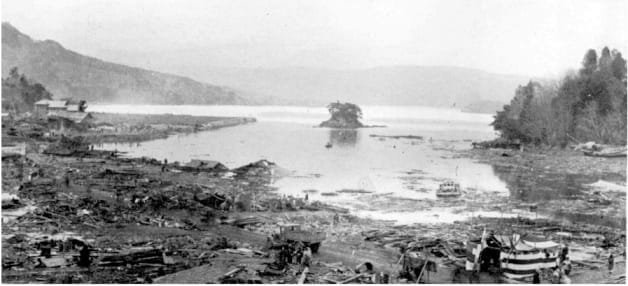
When the waters receded hours later, the devastation was stark. Over 40 million trees were knocked down. Forests previously lush yielded to barren slopes void of soil or vegetation.
Shorelines were scoured clean; fish and wildlife populations were decimated. The impact area was a brutal testament to nature’s raw destructiveness, a landscape reshaped within moments.
Yet, remarkably, this isolated catastrophe resulted in minimal human casualties—only two deaths recorded, a local fisherman and a couple nearby. The remoteness of Lituya Bay spared many potential lives lost.
Scientific Discovery: Measuring the Largest Tsunami Wave Ever Recorded
The Lituya Bay mega-wave challenged scientific beliefs established at the time. Measuring it required triangulation from highmarks on trees, sediment deposits, and eyewitness accounts.
Geologist S. P. Plafker, among the first to study the event, revealed that the 1958 tsunami was the tallest ever documented. Its characteristics differed starkly from oceanic tsunamis, leading to renewed interest in localized mega-waves triggered by massive landslides.
Tracing the Wave’s Origins: Geological Investigations
Subsequent studies investigated the nature of the rockslide and the configuration of the bay, seeking to understand the mechanics that produced such a wave.
Researchers established the interplay between seismic activity and slope instability as a critical factor. The timing was short; the earthquake was the immediate trigger, but long-term geological processes primed the environment.
This work redefined models for mega-tsunamis worldwide and guided hazard assessment for similar fjord and bay regions prone to landslides.
Understanding Mega-Waves: From Local to Global Impact
Lituya Bay’s mega-wave belongs to a category of mega-tsunamis—rare but potentially catastrophic waves generated when large volumes of rock or ice suddenly plunge into isolated bodies of water.
Such waves pose significant risks in many fjord and coastal settings, from Alaska to Norway, even to volcanic islands where flank collapses can trigger localized flooding.
Post-1958 research broadened tsunami science beyond seismic sea waves to account for these colossal but localized disasters. This knowledge is crucial for modern risk mitigation.
The Aftermath: Rescue, Recovery, and Reflection
In the days and months following the event, rescue crews searched for missing persons and assessed environmental damage. The region remained sparsely inhabited, minimizing human tragedy but highlighting the vulnerability of remote communities to natural disasters.
Reflection on the event echoed throughout geological circles and governmental agencies, sparking improved monitoring of seismic and slope stability in Alaska and beyond.
Lituya Bay in Popular Culture and Public Imagination
The astounding nature of the 1958 wave permeated beyond academia. Documentaries, books, and popular science narratives recounted the terrifying spectacle.
It sparked public fascination with extreme natural events, embodying both the beauty and ruthlessness of nature. For some, it became a symbol of respect and awe for Earth’s unpredictable moods.
Tsunami Science Transformed: Lessons from 1958
Prior to Lituya Bay, tsunami science emphasized seismic sea waves traveling across oceans. This event proved that localized waves could be incomparably taller and more devastating within confined bays.
It also emphasized the need for integrating geological, hydrodynamic, and seismic data in hazard prediction. Tsunami warning systems globally now consider the possibility of mega-waves triggered by landslides or volcanic collapses.
Environmental and Ecological Consequences
The mega-wave overturned decades of ecological development in Lituya Bay. Its force stripped away forests, soil layers, and reshaped coastline ecosystems.
Still, nature showed resilience. Over years, evidence of regrowth and returning wildlife echoed broader themes of recovery amid destruction, illustrating dynamic environmental cycles.
The Human Factor: What Could Have Been Done?
Given the event’s rarity and remoteness, human preventive measures were limited in 1958. There were no early warning systems or detailed geological surveys predicting the risk.
Today, satellite mapping, seismic monitoring, and tsunami modeling provide better preparedness, yet Lituya Bay reminds us that some natural forces exceed human foresight.
Tsunami Preparedness Today: Echoes from Lituya Bay
Modern Alaska and other tsunami-prone regions have developed warning networks, evacuation procedures, and public education programs inspired by historical events like Lituya Bay.
Ongoing research into mega-tsunamis fosters better strategies to protect lives, especially among vulnerable coastal communities in fjords and narrow bays worldwide.
Remembering the Mega-Wave: Memorials and Memory
Though sparsely inhabited, Lituya Bay is commemorated by scientists and historians as a natural monument of Earth’s extremes.
Field researchers periodically return to study the site, and the story is preserved in museums, academic lectures, and public documentaries, serving as a warning and testament.
The Continuing Legacy of July 9, 1958
More than six decades later, Lituya Bay remains a focal point in geoscience. Its mega-wave reshaped the understanding of environmental risk and Earth’s geological power.
Each investigation reveals nuances about the planet’s restless nature, inspiring humility and respect towards natural processes that continue to shape our world.
Conclusion
The Lituya Bay mega-wave was nature’s ultimate reminder of its unpredictable and overwhelming power. In mere moments, a tranquil fjord transformed into a theater of destruction and awe, demonstrating forces beyond human control or prior experience.
Yet within this cataclysm lies a story of survival, resilience, discovery, and humility. The wave that rose over a thousand feet tall challenged scientific dogma and deepened our understanding of how Earth’s restless plates, mountains, and waters interact in breathtaking, sometimes terrifying ways.
Lituya Bay is more than a geological curiosity—it is a symbol of nature’s grandeur and humanity’s tenacity to observe, learn, and prepare for the dizzying scale of our planet’s capacity for change.
FAQs
Q1: What caused the Lituya Bay mega-wave in 1958?
A1: A magnitude 7.8 earthquake triggered a massive rockslide that fell into the narrow bay, displacing huge volumes of water and creating a record-breaking tsunami wave.
Q2: How high was the Lituya Bay tsunami wave?
A2: The wave reached an estimated maximum height of about 1,720 feet (524 meters), the tallest ever recorded.
Q3: How many people were affected or killed in the event?
A3: Due to the isolated location, only two deaths were recorded, and a few others survived despite extreme conditions.
Q4: Why was this wave so much taller than typical tsunamis?
A4: The wave was caused by a massive landslide in a confined fjord, concentrating energy into a steep, localized mega-wave rather than a spreading ocean tsunami.
Q5: What did scientists learn from the Lituya Bay event?
A5: It broadened understanding of tsunamis to include landslide-generated mega-waves and improved hazard prediction for similar environments.
Q6: Are mega-tsunamis like Lituya Bay possible elsewhere today?
A6: Yes, similar events could occur in fjords, bays, or coastal areas prone to large landslides or volcanic collapses.
Q7: How has tsunami preparedness changed after the 1958 wave?
A7: Improved seismic monitoring, early warning systems, and public education now consider unusual tsunami causes, especially in vulnerable coastal regions.
Q8: Is Lituya Bay still monitored for geological threats?
A8: Yes, researchers continue geological and seismic monitoring of the area to understand ongoing risks.