Table of Contents
- The Dawn of a Printing Revolution: A World on the Brink
- China circa 1040: Society, Culture, and the Seeds of Innovation
- The Burning Desire for Knowledge: Education and Literacy in Song Dynasty China
- From Woodblocks to Moveable: The Limits of Traditional Printing
- Bi Sheng’s Vision: The Man Behind Movable-Type Printing
- Crafting the First Moveable Type: Materials and Techniques
- Challenges and Triumphs in Early Experiments
- The Spread Within the Song Dynasty: Adoption and Adaptation
- Economic and Social Ripples: How Movable-Type Altered Daily Life
- Movable-Type in the Shadow of the Marketplace: Commerce and Communication
- Cultural Flourishing Fueled by Accelerated Printing
- Exchanges Beyond Borders: Movable-Type’s Influence on Neighboring Regions
- Contrasts and Comparisons: East Asian Printing and the European Renaissance
- Lost and Found: The Fragmented Legacy of Movable-Type Printing in China
- Modern Reflections: Recognizing the Roots of Digital Printing
- Conclusion: The Enduring Echoes of Bi Sheng’s Innovation
- FAQs: Understanding the Movable-Type Printing Revolution
- External Resource
- Internal Link
The Dawn of a Printing Revolution: A World on the Brink
Imagine the world as it stood in the 11th century—an epoch brimming with change, yet shackled by the limitations of communication. In a small corner of the vast Song Dynasty, a revolution was quietly brewing. This was a revolution of the word, of ideas, and of knowledge; it was about how information could be multiplied, preserved, and shared. The year? Around 1040. The place? China. The invention? Movable-type printing.
It is difficult today to grasp just how monumental such a breakthrough was. To witness the birth of movable-type printing is to stand at the crossroads between painstaking manual replication and the dawn of mass communication. This seemingly simple change – crafting individual characters that could be arranged and rearranged to print texts repeatedly – opened pathways not only to literacy but to the diffusion of culture and ideas on an unprecedented scale.
Yet, behind this innovation was not just a mechanical process but a story of human ingenuity, persistence, and vision. This is the tale of Bi Sheng, the man credited with inventing movable-type printing in China, and the ripple effects of his creation through history.
China circa 1040: Society, Culture, and the Seeds of Innovation
The Song Dynasty (960-1279) presided over one of China's most vibrant and sophisticated periods, marked by immense urbanization, commercial growth, and cultural richness. With a population estimated between 100 and 120 million, the state nurtured an educated bureaucratic elite, steeped in Confucian learning and civil service examinations.
This period was no stranger to innovation—the compass, gunpowder, and paper were among Chinese contributions that shaped the wider world. The thirst for preserving knowledge and spreading administrative decrees was vital in a sprawling empire where managing millions demanded efficiency.
Yet challenges abounded. Texts were primarily replicated using woodblock printing, a laborious and time-consuming process requiring entire wooden boards for each page. While woodblock printing had transformed reproduction when first adopted, its limitations increasingly chafed against the growing demand for books, records, and official materials.
The Burning Desire for Knowledge: Education and Literacy in Song Dynasty China
Song China championed education like few other civilizations. The civil service examination system, designed to select government officials based on merit rather than birth, spurred an insatiable appetite for books and written materials. Poets, philosophers, historians, and scientists all contributed to a flourishing literary landscape.
While high literacy was confined mostly to the urban elite, the broader cultural emphasis on learning created a push for more accessible texts. Schools blossomed, academies thrived, and libraries were treasured. Yet cost and time bottlenecks meant books remained precious commodities.
The need for a more flexible and rapid printing method was becoming clear. The possibility to churn out texts more efficiently promised to democratize learning and ease bureaucratic strain.
From Woodblocks to Moveable: The Limits of Traditional Printing
Woodblock printing involved carving an entire page of text in reverse into a wooden block. The process was meticulous and unforgiving; a mistake meant carving anew. Moreover, each new text or edition demanded separate blocks.
Imagine printing multiple books: the craftsman was forced to replicate entire blocks for every page. The process was slow, inflexible, and expensive. This method sufficed for religious texts, canonical classics, and government decrees, but could not truly satiate the Song Dynasty’s burgeoning demand for information.
The idea of making individual characters moveable—a kind of “printing alphabet” – promised radical change. Instead of an entire page block, artisans could assemble pages by arranging separate character blocks, reusing them indefinitely. This was the conceptual leap Bi Sheng sought.
Bi Sheng’s Vision: The Man Behind Movable-Type Printing
Little is known about Bi Sheng’s personal life. Born into a modest family during the Northern Song period, he was more of a craftsman than a scholar, a fact that perhaps informed his practical ingenuity.
Around 1040, Bi Sheng conceived a method to engineer individual characters in porcelain clay that could be positioned to form entire pages. His innovation was revolutionary: not limited to whole pages but modular, flexible, and reconfigurable.
Though the idea of movable characters existed in theory elsewhere, Bi Sheng was the first to realize it practically and systematically. His invention marked a watershed moment in communications.
Crafting the First Moveable Type: Materials and Techniques
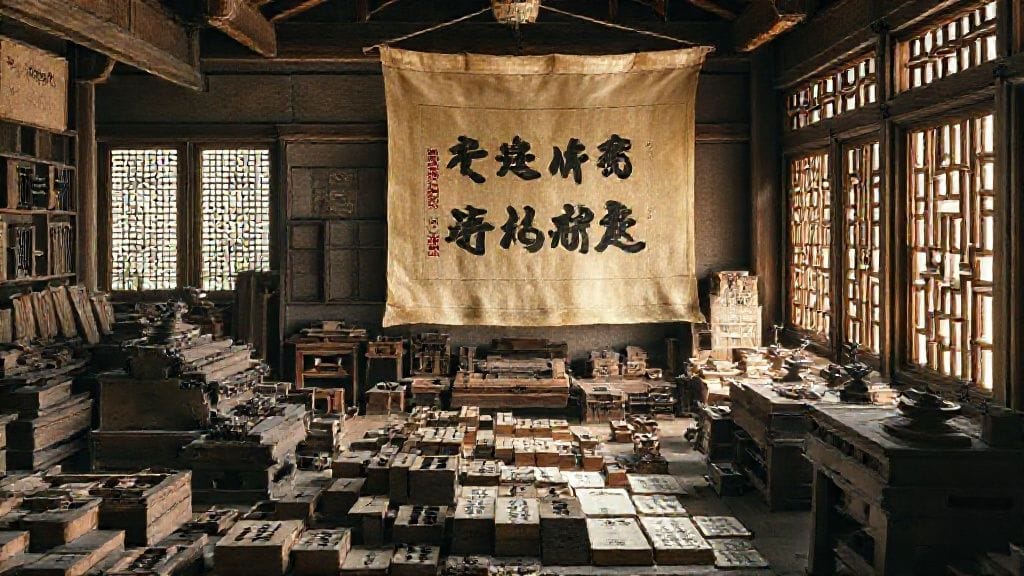
Bi Sheng’s movable type was crafted from baked clay, an ideal material—malleable before firing, durable after. He meticulously carved thousands of Chinese characters into small individual blocks.
These characters could be assembled, locked into frames, and inked before printing onto paper. The process significantly reduced the time and labor compared to carving entire wooden blocks anew.
Yet the vast complexity of the Chinese script, with its thousands of unique characters, posed formidable challenges. Unlike alphabetic systems, each character here was a separate entity, requiring immense craft.
Challenges and Triumphs in Early Experiments
Despite the ingenuity, Bi Sheng’s method initially saw limited adoption. Baked clay, fragile and brittle, sometimes broke under pressure. Additionally, the sheer number of characters in the Chinese writing system made storage and management complicated.
Moreover, societal inertia favored more traditional woodblock printing; bureaucratic systems and artisans were reluctant to embrace new technology that disrupted established workflows.
Nevertheless, the potential was undeniable. Bi Sheng’s technique was a clear departure from earlier methods, planting seeds that would inspire future innovations.
The Spread Within the Song Dynasty: Adoption and Adaptation
Over time, movable-type printing spread, especially in urban centers like Kaifeng and Hangzhou. Later artisans experimented with wooden types and even metals, seeking durability.
While full-scale moveable-type printing did not supplant woodblock methods entirely, it found use in small-scale printing and specialized texts, like calendars or official notices.
This gradual diffusion attested to the technology’s promise, though it remained less dominant than woodblock printing due to structural difficulties.
Economic and Social Ripples: How Movable-Type Altered Daily Life
The traditional view of Bi Sheng’s invention as a niche technological marvel understates its broader effects. Faster printing, even if limited, reduced costs and increased the circulation of printed materials. This subtly transformed education, bureaucracy, and commerce.
Books, previously accessible mainly to elites, began trickling into wider society. Literate merchants, scholars, and officials could access texts that otherwise would have been rare. A new information economy quietly took root.
Movable-Type in the Shadow of the Marketplace: Commerce and Communication
The Song Dynasty’s bustling urban markets and burgeoning print culture intersected with movable-type. Printed advertisements, contracts, and commercial records benefited from more rapid production.
Moreover, official administration improved. Repetitive documents, forms, and tax notices could be printed more quickly and standardized.
This played into the larger commercialization trend of the Song era—a vibrant economy interconnected with cultural production.
Cultural Flourishing Fueled by Accelerated Printing
The printing revolution fed a golden age of Chinese arts and letters. Poetry anthologies, encyclopedic compilations, and instructional manuals proliferated.
Movable-type printing, by lowering barriers to reproduction, accelerated the spread of knowledge in sciences, medicine, and philosophy. It enriched the public sphere and protected cultural memory.
The human toll was profound—accessible education enabled social mobility, while artisans and printers found new vocations.
Exchanges Beyond Borders: Movable-Type’s Influence on Neighboring Regions
China did not exist in isolation. Korean and Japanese scholars soon absorbed and adapted these innovations. Movable-type printing arrived in Korea, where metal movable types were developed centuries earlier than Europe.
Trade and tribute routes spread not only goods but ideas and technology, creating a dynamic cultural dialogue across East Asia.
The ripple effects of Bi Sheng’s invention thus transcended national boundaries and persisted through centuries.
Contrasts and Comparisons: East Asian Printing and the European Renaissance
Not until the 15th century, some 400 years later, did Johannes Gutenberg develop movable-type printing in Europe, using metal type and oil-based inks. His invention propelled the Renaissance and the modern age.
Yet the Asian precedent, especially Bi Sheng’s early ceramic movable type, challenges Eurocentric narratives of printing history.
Differences in script complexity and material choice shaped divergent technological paths. Still, both mark humanity’s relentless quest to spread ideas more efficiently.
Lost and Found: The Fragmented Legacy of Movable-Type Printing in China
Despite its early invention, movable-type printing faded into relative obscurity in China, overshadowed by woodblock printing that remained more practical for complex scripts.
Political upheavals, wars, and changing dynastic controls led to loss and fragmentation. Bi Sheng’s contribution, for centuries, was confined to academic mention, without the widespread impact that later European printing gained.
Nonetheless, modern scholarship resurrects and honors his legacy as a cornerstone of print history.
Modern Reflections: Recognizing the Roots of Digital Printing
Today, the concept of movable-type remains foundational. The very idea of modular, reconfigurable type finds digital heirs in fonts, word processing, and desktop publishing.
Bi Sheng’s principle echoes in every printed page and electronic document—a testament to the enduring human desire to communicate and preserve knowledge.
In the digital age, we stand on the shoulders of countless innovators like Bi Sheng, linking our worlds across time.
Conclusion: The Enduring Echoes of Bi Sheng’s Innovation
There is a quiet majesty in the story of Bi Sheng and his movable-type printing. It speaks of human creativity overcoming constraints, of a solitary artisan whose vision transcended his epoch.
Though his invention did not immediately transform Chinese society or the world in the way Gutenberg’s press would centuries later, it planted the conceptual seed of how knowledge might be democratized and immortalized.
Movable-type printing in 1040 China was not just a technical milestone; it was a profound human achievement—a beacon illuminating the pathway from oral transmission to global literacy that continues into our own time.
FAQs
Q1: What motivated Bi Sheng to invent movable-type printing?
A1: Bi Sheng was driven by the inefficiencies of traditional woodblock printing and the pressing need for a faster, more flexible method to reproduce texts within a society that valued knowledge and bureaucracy.
Q2: Why was movable-type printing less widespread in China compared to Europe?
A2: The complexity of the Chinese script, with thousands of characters, made movable-type more difficult to implement than alphabetic systems. Additionally, woodblock printing remained practical and cost-effective for many uses.
Q3: What materials did Bi Sheng use for his movable type?
A3: Bi Sheng crafted his movable type from baked porcelain clay, a material that was malleable when shaped and hardened through firing but still fragile.
Q4: How did movable-type printing affect literacy and education in Song China?
A4: While limited in early adoption, it helped lower barriers to book production, contributing to the gradual spread of knowledge beyond elite circles and aiding bureaucratic efficiency.
Q5: Did movable-type printing spread beyond China during the Song Dynasty?
A5: Yes, neighboring countries like Korea and Japan learned from Chinese printing technologies and developed their own movable-type methods, including early metal type in Korea.
Q6: How is Bi Sheng’s invention reflected in modern printing or digital technology?
A6: The concept of reusable, modular characters is the foundation of movable type and underpins modern typefaces, desktop publishing, and digital fonts.
Q7: Why did traditional woodblock printing persist despite the invention of movable-type?
A7: Woodblock printing was simpler for complex scripts, cost-effective for large editions, and culturally ingrained, making it tougher for movable-type to fully replace it.
Q8: How is Bi Sheng remembered today?
A8: Although historically overshadowed, modern historians honor Bi Sheng as a pioneer of printing technology and a visionary whose work laid groundwork for global knowledge dissemination.