Table of Contents
- The Dawn of a New Force: London, 1825
- A City on the Brink of Revolution
- The Scientific Spirit that Birthed Innovation
- Unveiling the Electromagnet: The Key Players
- From Concept to Reality: The Early Experiments
- The First Electromagnet: A Marvel of Its Time
- The Electric Current and Magnetic Power: A Symbiotic Dance
- Challenges in Harnessing Electromagnetism
- Public Fascination and Skepticism
- Transforming Industry: Initial Applications
- The Electromagnet’s Role in Communication Breakthroughs
- Power Struggles and Patent Battles
- The Ripple Effect: Influencing Future Scientists
- The Electromagnet in the Wider Context of the Industrial Revolution
- Cultural Reverberations: Magnetism Enters Popular Imagination
- The Human Element: Inventors, Experiments, and Failures
- Persisting Through Doubt: The Triumph of Persistence
- Legacy and Modern Relevance of the Electromagnet
- The Electromagnet’s Global Journey Beyond London
- Reevaluations: How History Remembers this Invention
- The Electromagnet’s Place in the Story of Electricity
- Conclusion: The Pulse of Progress Captured
- FAQs: Unraveling the Mysteries of the Electromagnet
- External Resource
- Internal Link
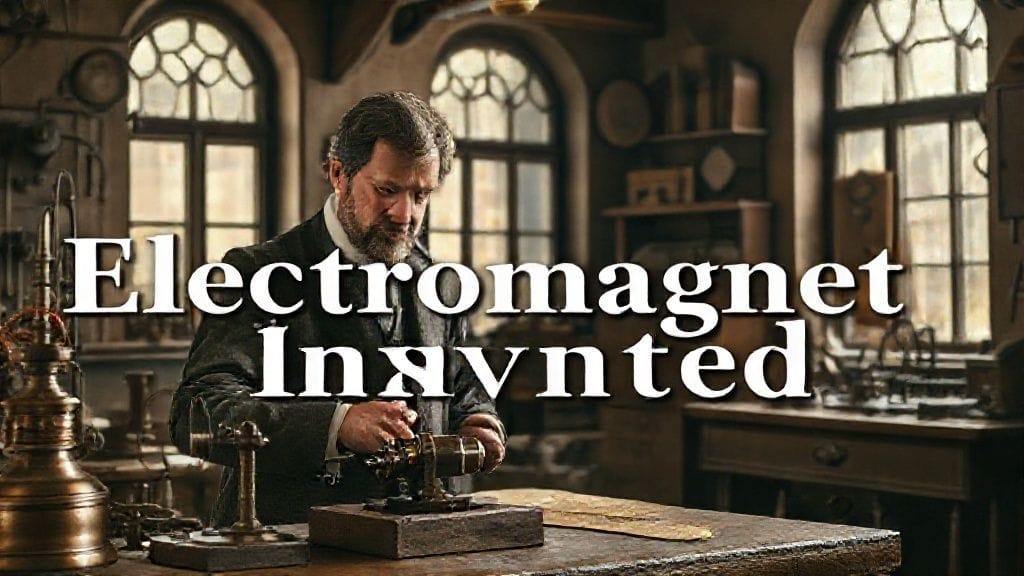
In the humid haze of a London summer, 1825, a peculiar yet electrifying silence hung in the corners of a cluttered workshop. Gas lamps flickered against the grime-streaked windowpanes, casting hesitant shadows on metal coils carefully wound around iron cores. The faint crackle of a nascent electric current coursed through the machinery, pulsing with a promise that would forever change the trajectory of science and industry. This was the birthplace of the electromagnet—an invention that would harness the invisible and mysterious force of magnetism using electricity. Invisible wires, iron clamps, and a faint hum would soon give way to a powerful new phenomenon: magnetism controlled by an electric current.
To many, it was a subtle twitch of the natural world’s grand design; to others, a world-shaking breakthrough that announced the arrival of a new era. The invention of the electromagnet in London, England, 1825, was far more than a technical achievement—it was a moment where human curiosity, persistence, and the growing power of scientific inquiry bled into the veins of history, setting the stage for an electrified future.
The Dawn of a New Force: London, 1825
The year 1825 was not an arbitrary backdrop but a city simmering with industrial energy and scientific ferment. London was a melting pot of ideas, trades, and dreams, where the hum of steam engines mingled with the scratch of pen on paper in laboratories and salons. This was the age of transformation—steam powered locomotives thundered along tracks, factories breathed smoke into the sky, and innovators chased every spark of knowledge to illuminate the modern age.
But even amid this rush, electricity remained a mysterious and elusive phenomenon. Natural magnets were known, their pull enigmatic and seemingly immutable. To control magnetism, to wield it as a tool—this was a vision shared by only the most daring minds. It was into this curious and restless London of 1825 that the electromagnet was born, offering a glimpse into magnetic forces amplified and tamed through electricity.
A City on the Brink of Revolution
London’s physical and intellectual landscape in 1825 was one of contrast and possibility. Streets buzzing with carriages, porters, and traders could not mask the silent tremors of a scientific revolution quietly underway. The Royal Institution, universities, and private workshops buzzed with debate and discovery.
But who could foresee, in the midst of smoke-choked chimneys and clacking looms, that a small coil of wire wrapped around a piece of iron would soon outshine all previous magnetic wonders? The stage was set for a collision of old knowledge and new insight.
The Scientific Spirit that Birthed Innovation
The early 19th century was a decade in which electricity and magnetism began to shed their ancient reputations as mystical curiosities and take shape as fields ripe for systematic inquiry. Following the pivotal discoveries of Hans Christian Ørsted in 1820—who first demonstrated that electric currents create magnetic fields—the scientific community was ablaze with excitement and challenge.
In London, a generation of scientists and tinkerers viewed this revelation as a doorway to practical inventions. The electromagnet was a natural extension of Ørsted’s finding—a way to concentrate and amplify magnetism on demand. Yet, the path was neither clear nor easy.
Unveiling the Electromagnet: The Key Players
While Ørsted’s Danish experiments opened the door, it was the efforts of English scientist William Sturgeon that would unlock its potential. A humble mechanic and inventor, Sturgeon’s restless mind and skill with metal would transform the principles of electromagnetic force into a tangible creation.
Sturgeon was a man driven by curiosity and necessity, working in an era where scientific resources were scarce, and trial was often the only teacher. His breakthrough in 1825—creating an iron core wrapped with insulated copper wire that, when electrified, produced a magnetic field far stronger than any natural magnet—was ingenious in its elegance and revolutionary in its implications.
But the invention of the electromagnet was not a solitary feat; it stood on the shoulders of pioneers like Ørsted, André-Marie Ampère in France, and Michael Faraday. Their restless probing of the invisible forces laid the foundational knowledge without which Sturgeon’s creation might never have come to life.
From Concept to Reality: The Early Experiments
In the cramped confines of his workspace, Sturgeon wound copper wire around a horseshoe-shaped piece of soft iron, creating a loop through which an electric current could be passed. When powered by a battery, the iron suddenly transformed, pulling nails and iron scraps with a magnetic force nearly ten times stronger than any traditional magnet.
Contemporaries marveled at the demonstration. Sturgeon had essentially created a magnet whose power could be switched on and off at will, opening remarkable possibilities for engineering and scientific tools.
Yet this was only the beginning—the initial coils were crude, and the intensity limited. The race to improve the design, increase power, and find practical uses was underway.
The First Electromagnet: A Marvel of Its Time
Contemporary newspapers and journals described the spectacle with a mix of wonder and technical fascination. Here, in 1825 London, was a "magnet of electricity," a new form of magnetic force that sent ripples through scientific circles. It was as if a hidden lever had been found to command one of nature’s fundamental forces.
This electromagnet could lift more than its own weight, attract iron with unseen vigor, and be shaped into different forms depending on the application. Unlike natural lodestones, it could be controlled precisely, responding instantly to electrical impulses.
The Electric Current and Magnetic Power: A Symbiotic Dance
At the heart of the electromagnet lay the elegant dance between electricity and magnetism. The electric current generated a magnetic field, which was concentrated and enhanced by the iron core. The amount of wire, the thickness of the coil, and the strength of the current all influenced the power of the magnetic field.
But mastering this synergy demanded precision, materials, and understanding that would only develop further in years to come. Still, Sturgeon’s invention demonstrated that magnetism could be not just found but engineered.
Challenges in Harnessing Electromagnetism
Despite the excitement, the early electromagnets faced many hurdles. Power sources were limited—batteries were small, expensive, and unreliable. The copper wire insulation was primitive, sometimes leading to short circuits. Heat generated by current flow threatened to damage the coil or its surroundings.
Moreover, skepticism among some scientists and industrialists persisted. The electromechanical processes were new and not immediately viewed as practical or economically justified.
Yet, each challenge invited innovation, leading quicker to improvements that would pave the way for broad adoption.
Public Fascination and Skepticism
Londoners gathered at scientific demonstrations, their imaginations stirred by experiments that seemed to conjure invisible forces into palpable reality. Advertisements for Sturgeon’s lectures drew crowds eager to witness the “magnetic marvel.”
Yet alongside fascination, doubt lingered. For many, the idea that unseen electricity could be harnessed to create controllable magnetism bordered on the incredulous. Rumors and myths about “magnetic magic” mixed with genuine hopes, giving rise to a blend of scientific curiosity and public wonderment.
Transforming Industry: Initial Applications
The electromagnet’s potential was soon recognized beyond the confines of laboratories. Early adopters envisaged uses in telegraph systems, lifting devices, and machinery parts. Factories began exploring how electromagnets could drive new tools, mechanizing tasks that once required brute human force.
While these applications were modest at first, the seed was planted for a technological revolution in manufacturing and communication. The electromagnet was no longer a scientific curiosity—it was becoming an industrial cornerstone.
The Electromagnet’s Role in Communication Breakthroughs
One of the most profound impacts of the electromagnet was its role in the evolution of communication technologies. The urgent 19th-century quest to send messages swiftly—far beyond postal horses and semaphore towers—found one of its enablers in this invention.
Electromagnets became the beating heart of telegraph systems, converting electrical signals into mechanical pulses or clicks. This translated to rapid, long-distance communication, knitting nations and economies closer than ever before.
Power Struggles and Patent Battles
Yet the path of innovation is rarely smooth. As the promise of electromagnets grew, so did disputes over intellectual property. Inventors and entrepreneurs squabbled over patent rights, inventions, and claims of priority.
William Sturgeon faced challenges securing exclusive recognition for his work. Meanwhile, other inventors in Britain, France, and the United States raced to improve the design and apply it commercially. The legal and commercial battles highlighted the immense economic stakes riding on this new technology.
The Ripple Effect: Influencing Future Scientists
The invention ignited a spark far beyond immediate applications. It inspired contemporaries like Joseph Henry in the United States, whose refinements would further increase electromagnet strength and pave the way for electric motors. Michael Faraday, building on this momentum, advanced the understanding of electromagnetic induction, a step toward modern electrical engineering.
Thus, the electromagnet became a crucial link in the chain leading to electricity’s grand unleashing.
The Electromagnet in the Wider Context of the Industrial Revolution
The emergence of the electromagnet must be understood as more than just a scientific milestone—it was a vital thread woven into the vast tapestry of the Industrial Revolution. It symbolized the era’s drive toward harnessing nature’s forces for human ends through technology.
From railroads to factories, from communication networks to early electrical machines, the electromagnet was emblematic of mankind’s growing mastery over invisible powers, a hallmark of the 19th century’s unprecedented technological surge.
Cultural Reverberations: Magnetism Enters Popular Imagination
Beyond science and industry, the discovery fed into the popular imagination. Magnetism became a symbol of mystery and power in literature, art, and folklore. Public exhibitions showcased electromagnets as wonders of modern science—blurring lines between education and spectacle.
The idea of invisible forces bending nature to human will resonated deeply with Victorian society, emblematic of progress but also feeding anxieties about technology’s reach.
The Human Element: Inventors, Experiments, and Failures
Behind the coils of wire and the polished iron cores were real human stories brimming with struggle, frustration, and triumph. Sturgeon’s journey was marked by financial hardship, scientific skepticism, and moments of doubt.
His persistence, bolstered by a passion for discovery and a willingness to tinker in the face of failure, reveals the often untold personal dimension behind major inventions.
Persisting Through Doubt: The Triumph of Persistence
Many inventions in history have stumbled before shining. The electromagnet was no exception. Initial failures and limited power could have suffocated the idea. But the inventor’s vision endured.
Each experimental extension, each refinement of coil and wire, each demonstration to skeptical audiences laid the stepping stones of progress. This perseverance was as essential as the scientific principles themselves.
Legacy and Modern Relevance of the Electromagnet
Today, the electromagnet underpins technologies inconceivable in Sturgeon’s time. From MRI machines scanning bodies in hospitals, to giant cranes lifting scrap metal, from electric motors in appliances to particle accelerators probing the universe—this invention’s fingerprints are everywhere.
Understanding its origins deepens our appreciation of how a modest workshop in 1825 London became the nexus of an invisible yet powerful revolution.
The Electromagnet’s Global Journey Beyond London
While London birthed the first practical electromagnet, its influence crossed oceans quickly. Scientists and engineers in Europe and America adapted and improved the technology, embedding electromagnetism into the fabric of global industrial growth.
The electromagnet’s story is thus also one of international scientific dialogue, competition, and cooperation.
Reevaluations: How History Remembers this Invention
Despite its profound importance, the invention of the electromagnet sometimes remains overshadowed by later electrical discoveries like the dynamo or light bulb. Yet historians now emphasize its critical role as the foundation upon which modern electric technology is built.
The recognition of William Sturgeon and his contemporaries has grown, acknowledging their pioneering insights that tamed a fundamental force of nature.
The Electromagnet’s Place in the Story of Electricity
Electricity’s history is a saga of ideas linking visionaries and experimenters across generations. The invention of the electromagnet is a cornerstone in that narrative, bridging the gap between scientific revelation and practical utility.
As such, it remains a symbol of humanity’s ability to make the invisible visible, the intangible tangible.
Conclusion
In the gritty heart of London, in 1825, a coil of wire wrapped around an iron core came to life with an electric pulse that echoed far beyond its humble workshop. The invention of the electromagnet was a quiet revolution, a moment when electricity and magnetism became partners in the dance of progress.
This invention was more than a technical feat—it was a human story of perseverance, curiosity, and vision. It ushered in an era where invisible natural forces were no longer barriers but tools, transforming communication, industry, science, and culture.
Looking back, the electromagnet stands as a testimony to the power of applied knowledge to reshape societies. Its hum is still felt in every device that moves, communicates, or heals, reminding us that from small sparks rise the brightest flames of human ingenuity.
FAQs
Q1: Who invented the electromagnet and when?
A1: The practical electromagnet was invented by English scientist William Sturgeon in London in 1825, building on earlier scientific discoveries by Ørsted and others.
Q2: How does an electromagnet work?
A2: An electromagnet generates a magnetic field when an electric current passes through a coil of wire wrapped around a ferromagnetic core, such as iron, enhancing the magnetic effect.
Q3: Why was the invention of the electromagnet important?
A3: It allowed magnetic force to be controlled and amplified using electricity, revolutionizing industries like telegraphy, manufacturing, and eventually leading to electric motors and more advanced technologies.
Q4: What challenges did early inventors face with electromagnets?
A4: Early challenges included unreliable power sources, poor wire insulation, heat management, and skepticism from some members of the scientific and industrial communities.
Q5: How did the electromagnet influence communication technologies?
A5: It became fundamental to telegraph systems by converting electrical signals into mechanical responses, enabling efficient long-distance communication for the first time.
Q6: How did this invention fit into the broader Industrial Revolution?
A6: The electromagnet epitomized the Industrial Revolution’s ethos of harnessing natural forces through technology, accelerating the modernization of industries and daily life.
Q7: Are electromagnets still used today?
A7: Absolutely. Electromagnets are used in countless modern devices, including electric motors, MRI machines, maglev trains, loudspeakers, and recycling plant cranes.
Q8: How is William Sturgeon remembered in the history of electricity?
A8: Though less famous than some later inventors, Sturgeon is now recognized as a pivotal figure whose creation of the first practical electromagnet laid groundwork for much of modern electrical engineering.