Table of Contents
- The Glow That Changed the World: A Night at Menlo Park
- The Long Shadow Before the Light: Electricity and Illumination in the 19th Century
- Thomas Edison: The Inventor’s Relentless Quest
- From Darkness to Dawn: The Birth of the Practical Light Bulb
- The Laboratory at Menlo Park: A Hive of Genius and Grit
- Early Experiments and Failures: Learning in the Dark
- The Perfect Filament: The Secret Ingredient of Longevity
- The Breakthrough Moment: December 31, 1879
- The Spectacle of Light at Menlo Park: Reactions and Realizations
- Beyond the Bulb: The Edison Electric Light Company and Commercialization
- Challenges, Competition, and Controversies: The Race to Illuminate
- The Practical Light Bulb’s Ripple Effect on Industry and Society
- Lighting Up Cities: Revolution in Urban Life
- Changing Domesticity: The Impact on Home and Family
- The Economic Boom: Jobs, Manufacturing, and Infrastructures
- Cultural Shifts: Nightlife, Safety, and the Human Rhythm
- The Environmental Costs: Shadows in the Bright Glow
- Legacy of Innovation: How Edison’s Bulb Shaped Modern Technology
- The Myth and Reality of the Light Bulb’s Inventor
- Remembering Menlo Park: Museums, Monuments, and Memory
- Conclusion: How a Spark at Menlo Park Still Illuminates Our World
- FAQs
- External Resource
- Internal Link
The Glow That Changed the World: A Night at Menlo Park
It was a frigid night in late December 1879, the kind of deep winter evening where darkness seems impenetrable. Yet inside a modest lab in Menlo Park, New Jersey, a small filament glowed with a persistent, steady light that refused to fade. In that glow was a promise — one that would forever alter human experience, comfort, and productivity. The birth of the practical light bulb was not simply a scientific achievement; it was an epic human drama of persistence, ingenuity, and vision. On December 31, 1879, Thomas Edison and his team illuminated the future.
The Long Shadow Before the Light: Electricity and Illumination in the 19th Century
Long before Edison’s hands crafted the famous glowing filament, humanity had a fickle relationship with light and darkness. For millennia, fire was the only controllable source of illumination — flickering, smoky, dangerous. The advent of candles, gas lamps, and arc lamps brought progress, but also limitations. Gas lighting, widespread in cities in the early 1800s, was costly, hazardous, and dim at best. Arc lamps, though brilliant, were impractical for homes due to their intense brightness and need for high power. Electricity promised an entirely different future, but domestic and industrial use were still fantasies.
The 19th century was an era of burgeoning electrical discoveries: from Volta’s battery to Faraday’s electromagnetic induction, the puzzle pieces were slowly scattered on the table. Yet, one of the largest unsolved problems remained: how to create a dependable and affordable means of turning electrical current into steady, safe light.
Thomas Edison: The Inventor’s Relentless Quest
Thomas Edison, a man often mythologized in history, was a meticulous experimenter and tireless innovator. Born in 1847, Edison had pursued various inventions — telegraphs, phonographs — but lighting was the endeavor that consumed his resources and soul in the late 1870s. Where others saw failure, Edison saw data; where skeptics doubted, Edison saw opportunity.
His approach was methodical. Unlike romantic tales of sudden flashes of inspiration, Edison’s breakthrough was the product of thousands of tests, incremental adjustments, and vast patience. Edison believed that invention was “1% inspiration and 99% perspiration.” This was true especially in the practical light bulb’s creation.
From Darkness to Dawn: The Birth of the Practical Light Bulb
The phrase “practical light bulb” is deliberate — Edison’s bulb was not the first electric light. Other inventors had created glowing filaments and arcs before. However, their devices failed to last, or required impractical amounts of electricity. The brilliance of Edison’s discovery was in crafting a bulb that could burn steadily for hours, days, even weeks.
The goal was clear: find a filament material that resisted rapid burning and broke no laws of physics or economics. The bulb needed to glow warmly and last long enough to make electric lighting both usable and sellable. This was the hurdle that many had stumbled on, but Edison’s team was inching closer.
The Laboratory at Menlo Park: A Hive of Genius and Grit
Menlo Park was more than a lab — it was a revolution factory. Edison assembled a team of electricians, chemists, glassblowers, and mechanics, working nearby full-time. Open day and night, ideas buzzed as fiercely as the current in the wires.
This was an industrial-scale experiment, a crucible where science met commerce. Tests unfolded on hundreds of filaments — some from cotton, others from bamboo, hemp, or even hair. The air smelled of sulfur, smoke, and hope. It is said that Edison’s workforce sometimes worked 18-hour days, motivated by the vision of the "wizard of Menlo Park" illuminating the world.
Early Experiments and Failures: Learning in the Dark
Failure was the constant companion of Edison’s team. Carbonized filaments burnt out in seconds. Vacuum pumps were imperfect — oxygen sneaking inside would combust the filament instantly. The quest was as much physical as chemical. The team needed to perfect the vacuum inside the bulb, isolate the filament, and regulate current to prevent melting.
This process took months of trial and error, with Edison famously testing over 6,000 plant fibers to find the perfect material. Each failure was a lesson etched deeply into their communal drive. “I have not failed,” Edison said. “I’ve just found 10,000 ways that won’t work.” Such resilience was pivotal.
The Perfect Filament: The Secret Ingredient of Longevity
The breakthrough arrived when the team discovered that carbonized bamboo fiber, treated and processed under precise conditions, burned longer and more steadily than anything tested to date. This was a watershed moment — a filament that could glow for over 1,200 hours.
The choice was practical, but revolutionary. Carbonized bamboo was strong, affordable, and widely available. Paired with improved vacuum pump technology and a stable glass bulb, it was a winning combination. This discovery wasn’t just a technical detail – it was the linchpin of the era’s imminent electrification.
The Breakthrough Moment: December 31, 1879
On that cold final day of 1879, Edison’s team sealed a bulb with a carbonized bamboo filament, connected it to a moderate electrical current from a newly designed power source, and waited. The filament glowed. Seconds became minutes, minutes became hours, and the light persisted.
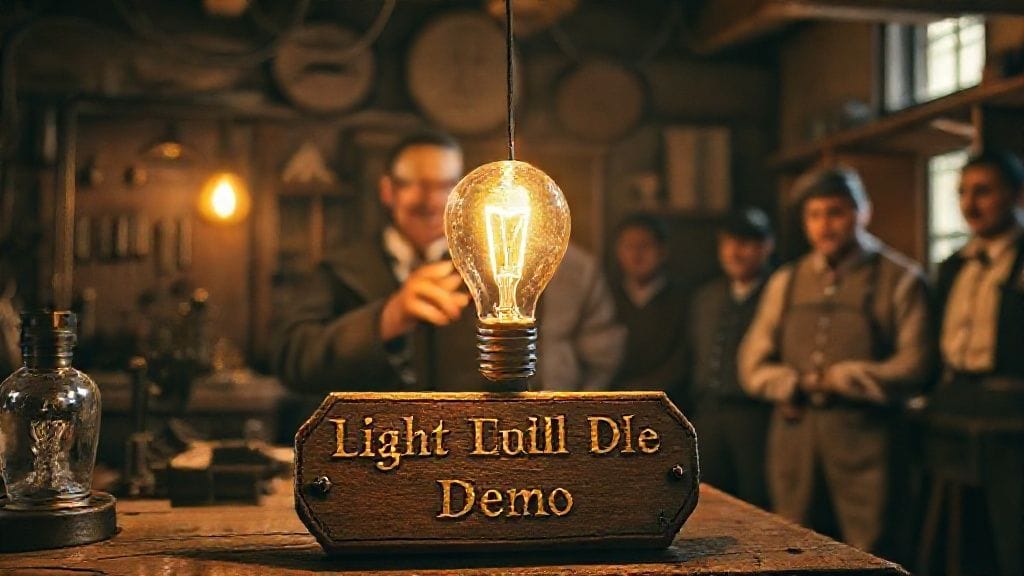
After nearly 13 hours of uninterrupted glow, Edison held a press demonstration, inviting reporters and investors to witness history firsthand. The practical electric light was no longer a dream; it was real, tangible, breathtaking.
The Spectacle of Light at Menlo Park: Reactions and Realizations
The reaction was electric in itself. Witnesses described the light as soft yet brilliant — reminiscent of daylight but steadier, cleaner. Skeptics turned into evangelists, and financiers saw the dawn of a new commercial empire. The Menlo Park event ignited excitement worldwide.
Yet, many did not immediately grasp the scope. The light bulb symbolized a future where streets would never be cloaked in dangerous darkness, where factories and homes could hum with light long after sunset. The cultural and economic ripple effects would be seismic.
Beyond the Bulb: The Edison Electric Light Company and Commercialization
The scientific breakthrough was only the beginning. Edison swiftly moved to patent his discoveries and establish the Edison Electric Light Company to manufacture and distribute his bulbs and electrical systems.
What followed was an industrial boom: building power stations, electrical grids, and distribution infrastructure. Edison’s vision was holistic — he invented not just the bulb but a system to power cities with it. The synergy between technology and business was as essential as the filament itself.
Challenges, Competition, and Controversies: The Race to Illuminate
But the path ahead was far from smooth. Rival inventors like Joseph Swan, Hiram Maxim, and Nikola Tesla were also developing and patenting variants of electric lighting. Patent wars ensued, sometimes violent and complex.
Moreover, initial electrical systems were unstable and costly. The Edison direct current (DC) system competed fiercely with alternating current (AC) technologies championed by Tesla and Westinghouse. This “War of Currents” opened debates on safety, efficiency, and control.
The Practical Light Bulb’s Ripple Effect on Industry and Society
The invention catalyzed the rapid electrification of factories, transforming work patterns. Machines could run through the night, increasing production speeds and volumes. This not only spurred economic growth but also reshaped labor dynamics, urban life, and social relations.
Electric lighting became tantamount to progress — a hallmark of modernity. The social stratification began to shift, as lighting extended work hours but also leisure and education.
Lighting Up Cities: Revolution in Urban Life
Cities around the world gradually began to ban gas lamps and install electric street lighting. Darkness became constrained to rural areas as urban streets, squares, and public buildings were illuminated, transforming the nightscape.
Crime rates in some areas dropped with better street visibility, and nightlife blossomed. The safety and aesthetics of urban areas changed forever, empowering commerce, gathering, and travel after twilight.
Changing Domesticity: The Impact on Home and Family
The electric light bulb altered the home environment in profound ways. Evening chores became easier, reading and studying were liberated from flickering candles. Household routines adjusted; children’s education extended into night hours, and family life evolved around new rhythms.
Experts of the era noticed shifts in social behavior linked to longer waking hours and the psychological impacts of artificial lighting.
The Economic Boom: Jobs, Manufacturing, and Infrastructures
The creation and dissemination of practical electric bulbs sparked wide industries: glass production, filament manufacture, wiring, electrical machinery, and power plants. Facilities created thousands of jobs and nurtured scientific talents.
Municipalities invested heavily in electrical grids, and economies raced to equip themselves with lighting infrastructures, recognizing its centrality to industrial competitiveness.
Cultural Shifts: Nightlife, Safety, and the Human Rhythm
Electric light redefined human circadian rhythms. Previously dictated by natural light phases, human activity expanded into the night. Nightclubs, theaters, and social events thrived, marking a cultural renaissance.
Yet, voices arose warning against estranging humanity from natural cycles. Nevertheless, the electric bulb’s glow became a symbol of progress and modern life.
The Environmental Costs: Shadows in the Bright Glow
Though revolutionary, electric lighting introduced environmental challenges. The massive coal-powered electrical generation contributed to pollution. Light pollution obscured stars and natural rhythms.
The ethical and ecological consequences were only understood decades later, echoing in today’s discussions over sustainable energy and responsible innovation.
Legacy of Innovation: How Edison’s Bulb Shaped Modern Technology
Edison’s practical light bulb stands as a milestone in innovation, education, and entrepreneurship. It inaugurated the modern electrical age — a web of connected homes, industries, and devices.
It directly influenced telecommunications, computing, and contributed to the development of the 20th-century technological world. The bulb encapsulates the spirit of determination and interdisciplinary creativity.
The Myth and Reality of the Light Bulb’s Inventor
Edison’s name is synonymous with the light bulb, but the history is complex. He built upon others’ scientific foundations, and several inventors share credit. Yet, Edison’s genius lay in integration, practical adaptation, and commercialization.
His image as the solitary genius is nuanced when considering his team and the era’s technological ferment. Understanding this human complexity enriches the narrative.
Remembering Menlo Park: Museums, Monuments, and Memory
Menlo Park’s site is commemorated for its place in technological history. Museums exhibit original bulbs, Edison’s tools, and letters, preserving the story of persistence that lit the modern world.
These memorials invite reflection on the power of curiosity and perseverance, inspiring new generations.
Conclusion: How a Spark at Menlo Park Still Illuminates Our World
The practical light bulb’s debut at Menlo Park on that cold December night was not merely about conquering darkness. It was about human hope — the aspiration to transcend nature’s limits through ingenuity. Today, billions of lights battle night’s abyss, a testament to that spark.
Edison’s glow reminds us that progress often emerges from resilience and collaboration — a shared journey from discovery to transformation. The light bulb is both a beacon and a metaphor: an enduring symbol illuminating the path of human innovation.
FAQs
Q1: What exactly made Edison’s light bulb “practical” compared to earlier versions?
A: Edison’s bulb was practical because it combined a long-lasting carbon filament with a reliable vacuum inside the glass bulb, allowing it to glow steadily for over 1,200 hours, making it commercially viable.
Q2: Did Edison invent the first light bulb ever?
A: No, earlier inventors such as Humphry Davy and Joseph Swan worked on electric lights. However, Edison improved upon existing designs to make the light bulb practical in terms of longevity and cost.
Q3: How did the invention of the light bulb affect everyday life?
A: It extended usable hours beyond sunset, improved safety and productivity, enabled nighttime social activities, and transformed home, work, and urban environments.
Q4: What were some major challenges Edison faced in developing the bulb?
A: Key challenges were finding a suitable filament material that could sustain long illumination, creating a strong vacuum inside the bulb, and designing a compatible electrical system to power the bulb sustainably.
Q5: How did Edison’s invention influence the electrical industry?
A: It spurred the creation of power stations, electrical grids, and mass production of electrical appliances, fundamentally expanding the electrical industry worldwide.
Q6: What environmental impacts emerged from the widespread use of electric lighting?
A: Increased coal-powered electricity generation led to pollution, and light pollution disrupted natural ecosystems and human biological rhythms.
Q7: What role did Edison’s team play in the invention?
A: Edison’s team was crucial — a group of scientists, technicians, and workers collaborated intensively, testing filaments, improving vacuum technology, and refining manufacturing processes.
Q8: Where can one learn more about the history of the practical light bulb?
A: A detailed overview is available on the Wikipedia page dedicated to Thomas Edison’s light bulb and related inventions, providing comprehensive background and references.