Table of Contents
- Dawn of a New Era: The Birth of Radar in 1935
- The Shadows of Threat: Europe’s Rising Storm
- The Man Behind the Machine: Robert Watson-Watt’s Vision
- From Idea to Invention: Early Challenges and Breakthroughs
- The Daventry Demonstration: A Moment Frozen in Time
- How the Radar First Demonstration Changed Military Strategy
- The Hidden Orchestra: The Science behind Radar Technology
- The British Government’s Role: From Skepticism to Support
- Reactions in the Scientific Community: Awe and Ambivalence
- International Eyes on Daventry: A New Weapon in the Arms Race
- Radar’s Impact on WWII: The Battle of Britain and Beyond
- The Human Stories: Engineers, Operators, and the Unsung Heroes
- Technical Evolution: From Pulses to Precision
- Spy vs. Spy: Radar in the Shadowy World of Intelligence
- Cold War and Radar: Extending the Legacy
- The Cultural Imprint: Radar in Memory, Media, and Myth
- Post-war Technological Spin-offs and Civilian Applications
- The Ethics of Detection: Surveillance Beginnings
- The Global Ripple Effect: How Radar Shaped Modern Defense
- Reflections and Revelations: Lessons from 1935
- Conclusion: Radar’s Enduring Legacy in a Wired World
- FAQs: Demystifying the First Radar Demonstration
- External Resource
- Internal Link
Dawn of a New Era: The Birth of Radar in 1935
On a cold February morning in 1935, the quiet countryside around Daventry, Northamptonshire, became the stage for a spectacle that was to change the course of warfare and technology forever. The air was crisp, the sky overcast, and the world was teetering on the edge of great upheaval. Amid this uncertain backdrop, a team of British scientists gathered, their equipment humming softly, eyes flickering with anticipation. This was the moment of the radar first demonstration, a groundbreaking proof-of-concept that would alter how nations perceive security, surveillance, and strategy.
As a biplane droned through the mist, invisible to the naked eye at such a distance, an unseen electronic signal swept towards it. Suddenly, blips appeared on a cathode ray tube, confirming what had previously been impossible: to detect an aircraft beyond visual or auditory range using radio waves. It was not just an invention; it was a beacon signaling the future.
But this was no spontaneous breakthrough. It was borne out of anxious times, visionary minds, long nights in laboratories, and the pressing urgency of a world heading towards conflict.
The Shadows of Threat: Europe’s Rising Storm
The early 1930s were years of mounting tension in Europe. The peace wrought after the First World War seemed brittle under the weight of economic depression, resurgent nationalism, and the rise of militant regimes. Germany, under Adolf Hitler’s growing ambitions, was rapidly rearming, and the skies held unknown threats.
Britain’s military strategists were painfully aware of their vulnerability to air attacks. Aircraft were becoming faster, more numerous, and deadlier. Traditional means of detection — spotters, acoustic mirrors, and visual observation — were unreliable during night or inclement weather. The fear of a surprise aerial blitzkrieg sweeping across cities was palpable.
Into this fraught atmosphere entered the notion of a device that could “see” at a distance, in darkness and fog, without eyes, wings, or sound. Such a capability was revolutionary — and the race to develop it became a race for survival.
The Man Behind the Machine: Robert Watson-Watt’s Vision
It is impossible to recount the story of radar’s first bloom without paying homage to Sir Robert Watson-Watt, a man often described as both pragmatic scientist and intuitive inventor. Born in 1892 in Scotland, Watson-Watt initially worked in meteorology before turning his genius to radio physics.
His insight was deceptively simple: if radio waves could be reflected off metal objects, why not detect aircraft by bouncing radio signals off them? The challenge was formidable — early radio technology was cumbersome and imprecise, and the concept was met with skepticism.
Yet, Watson-Watt was persistent. He balanced his scientific intuition with practical application, convincing the Air Ministry that radar was not just a theoretical curiosity but a necessary tool for Britain’s defense. His leadership turned a fragmented idea into a coordinated effort.
From Idea to Invention: Early Challenges and Breakthroughs
In the spring of 1935, Watson-Watt and his colleague Arnold Wilkins began a series of experiments, initially using existing radio equipment improvised for detection. The hurdles were numerous — electrical noise obscured signals, the range was limited, and the apparatus was bulky.
Still, incremental progress was steady. They devised techniques to measure the time delay between emission and reflected signals, the essence of radar. By refining wavelengths and antenna design, the range and resolution estimates improved rapidly.
These developments culminated in an invitation from the Air Ministry to stage a public demonstration. The stage was set — the next chapter would be written on a quiet field at Daventry.
The Daventry Demonstration: A Moment Frozen in Time
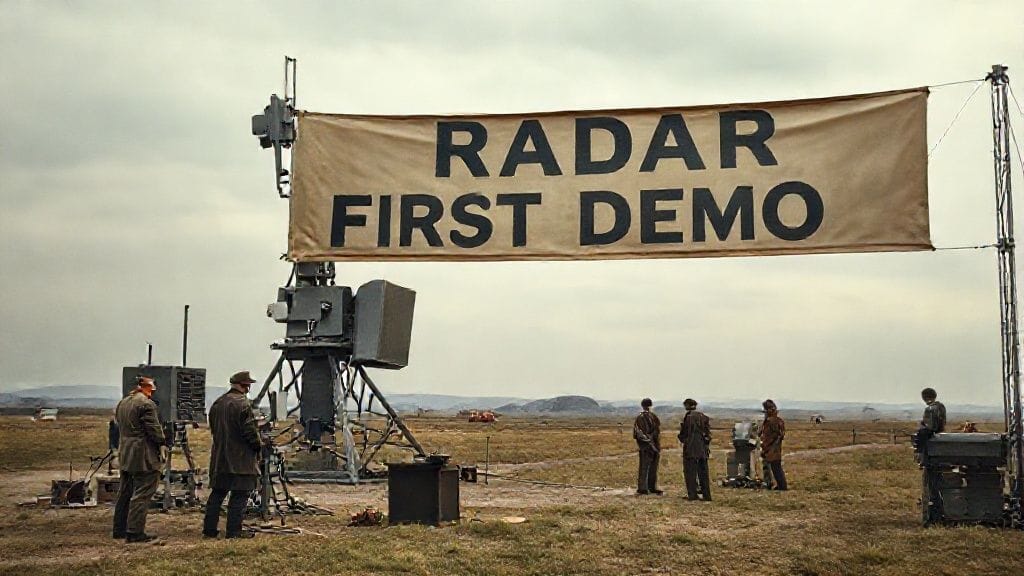
On February 26, 1935, Watson-Watt and Wilkins’ team assembled their equipment, consisting of a 1.5 kW transmitter and a receiver linked to a cathode ray tube, beside the perimeter of RAF Daventry’s airfield. The skies above were gray, with visibility reduced — conditions perfect for demonstrating radar’s night and all-weather capabilities.
A Heyford biplane was directed to fly up to 17 miles away. As it disappeared from view, the team watched intently as the oscilloscope’s screen flickered to life — a returning echo from the aircraft’s metal frame.
The room erupted quietly with restrained excitement. The demonstration was more than a technical proof; it was a validation of an entirely new way to understand and monitor space. The radar first demonstration was headline news in defense circles, although its full significance remained to be grasped.
How the Radar First Demonstration Changed Military Strategy
Radar’s potential was quickly realized. It offered the British military an unprecedented early warning system — an ability to detect incoming bombers well before they could reach targets. This changed defense doctrine by enabling anticipatory action rather than reactive scrambling.
The demonstration validated significant investment into what would become the Chain Home radar network, a series of coastal detection stations stretching across the UK. It laid the groundwork for the integrated air defense system that proved decisive during the Battle of Britain.
No longer reliant solely on human observation, Britain could allocate resources more efficiently, conserving lives and materiel. Radar redefined the geography of warfare, turning the unseen into the visible.
The Hidden Orchestra: The Science behind Radar Technology
Radar (short for Radio Detection and Ranging) operates on the principle of emitting radio waves and timing their reflection off objects. By measuring the time delay and frequency shift of returning signals, it is possible to calculate distance, speed, and direction.
Behind the scenes at Daventry, the scientists had to master complex phenomena — electromagnetic wave propagation, signal attenuation, interference, and Doppler effects. Their ingenuity was not just in engineering but in brilliant problem-solving.
Creating equipment sensitive enough to discern a faint echo amid atmospheric noise was no small feat. The Daventry apparatus, though primitive by modern standards, was a marvel of precision engineering and physics, a testament to human curiosity pushing the frontier of what was thought possible.
The British Government’s Role: From Skepticism to Support
The journey from proposal to prototype was not smooth. Initially, many within the British defense bureaucracy viewed radar with suspicion or disbelief; it seemed almost fantastical amidst conventional military planning.
However, Watson-Watt’s dogged advocacy and the undeniable success at Daventry compelled ministers to fund further research. The Air Ministry’s backing was cautious but growing, motivated by the dual desire to outpace Nazi Germany and protect British skies.
Strategic discussions ensued, balancing secrecy with rapid deployment. The decision to build Chain Home radar stations indicated a turning point, where experimental science was wholeheartedly embraced as a national defense imperative.
Reactions in the Scientific Community: Awe and Ambivalence
Across Britain and internationally, the news of the Daventry demonstration was met with a spectrum of reactions. Some scientists hailed it as a revolutionary leap, akin to the telephone or airplane. Others warned of limitations and potential vulnerabilities.
Practitioners in radio engineering recognized the technical elegance but were mindful of operational complexities. The advent of radar opened new fields of research, stimulating advances in electronics and wave theory.
Its classified nature, however, meant that widespread understanding took years to develop. The radar first demonstration was a ripple that would soon grow into a wave transforming not only warfare but scientific exploration.
International Eyes on Daventry: A New Weapon in the Arms Race
As news of Britain’s radar technology slowly spread—sometimes through espionage, sometimes through scientific conferences—other nations took note. Germany, France, the United States, and the Soviet Union accelerated their own research into detection devices.
The radar first demonstration had effectively reset the technological arms race. It signaled the emergence of electronic warfare as a vital domain, foreshadowing the integration of radio, computing, and intelligence gathering.
In this light, Daventry represented not just a local milestone but a global herald of twentieth-century warfare’s increasing mechanization and sophistication.
Radar’s Impact on WWII: The Battle of Britain and Beyond
Few theaters of World War II showcased radar’s impact more vividly than the summer skies of 1940. As the Luftwaffe launched relentless bombing campaigns against Britain, Chain Home and its successors provided vital intelligence.
Radar operators detected incoming raids early, enabling the Royal Air Force to marshal fighter responses with astonishing efficiency. This technological edge was crucial in the Battle of Britain’s outcome, turning the tide and preserving the island nation from invasion.
Radar’s contributions extended beyond aerial defense — it guided naval operations, intercepted enemy communications, and paved the way for new offensive and defensive tactics throughout the global conflict.
The Human Stories: Engineers, Operators, and the Unsung Heroes
Behind the technology were thousands of individuals whose stories have often been overlooked. From the engineers who labored endlessly in laboratories and workshops, to the radar operators staring at screens for hours through darkened rooms, each played a role in this unfolding saga.
Women, especially, found unprecedented opportunities to participate in technical roles, balancing monotony, anxiety, and the weight of responsibility. Their vigilance saved countless lives.
It’s remarkable, isn’t it? How these seemingly invisible sentinels—fixated on flickering blips—became the unsung guardians of a nation.
Technical Evolution: From Pulses to Precision
Post-1935, radar technology evolved at a dizzying pace. Early radio waves gave way to microwave frequencies, improving resolution and reducing antenna size. The incorporation of magnetrons, klystrons, and eventually digital processing expanded capabilities dramatically.
Radar became not only a military tool but a scientific instrument — assisting weather prediction, astronomy, and air traffic control. The ingenuity that began at Daventry rippled through decades of innovation, transforming industries and opening new frontiers.
Spy vs. Spy: Radar in the Shadowy World of Intelligence
Radar’s emergence added a new dimension to espionage and counterintelligence. Both Axis and Allied forces developed radar jamming, stealth technologies, and deceptive countermeasures.
This invisible chess game of detection and evasion profoundly shaped wartime intelligence and reconnaissance. Radar stations became prized targets, while the secrecy of their locations and technologies was fiercely guarded.
The radar first demonstration, therefore, was not merely a technical milestone but the opening move in a high-stakes battle of shadows and signals.
Cold War and Radar: Extending the Legacy
After 1945, radar remained central to global military and political strategy. During the Cold War, it became part of vast early warning networks designed to detect missile launches and nuclear threats.
The legacy of the Daventry demonstration thus transcended WWII, embedding radar technology at the heart of deterrence and surveillance regimes worldwide. It shaped alliances, fostered technological exchanges, and underpinned the modern doctrine of constant vigilance.
The Cultural Imprint: Radar in Memory, Media, and Myth
Radar, though a technical invention, entered the cultural imagination as a symbol of technological prowess and national resilience. From wartime propaganda posters to films and novels, its presence was woven into the narrative of victory and survival.
Even today, radar stands as a metaphor for detection, insight, and the unseen layers beneath surface realities. The 1935 demonstration became a foundational chapter in this enduring mythology.
Post-war Technological Spin-offs and Civilian Applications
Beyond defense, radar technology led to remarkable civilian advances. Air traffic control systems, meteorological radars tracking storms, marine navigation aids, and even road speed detection owe their existence to principles established at Daventry.
Its versatility illustrates how wartime innovation can seed peaceful progress, sometimes in unexpected ways.
The Ethics of Detection: Surveillance Beginnings
Radar’s power to reveal hidden objects inevitably raises questions about privacy and surveillance. The technology seeded the concept of omnipresent monitoring.
In democratic societies, this opened debates about governmental power, citizen rights, and the balance between security and freedom — debates that continue to resonate in the digital age.
The Global Ripple Effect: How Radar Shaped Modern Defense
From its British origins, radar proliferated, adapted, and integrated into the defense frameworks of nations large and small. Air, land, and sea forces now rely on radar for threat assessment, targeting, and battlefield awareness.
Its strategic importance remains undisputed, and the 1935 demonstration is recognized as a moment when modern defense entered a new epoch.
Reflections and Revelations: Lessons from 1935
Looking back, the radar first demonstration is a story of vision and timing — a tale of how determination, science, and circumstance can intersect to produce change.
It teaches us about the power of innovation amid uncertainty, the necessity of investment in ideas, and the human courage behind technological leaps. It reminds us that sometimes, seeing the invisible makes all the difference.
Conclusion
The radar first demonstration of 1935 at Daventry was more than a technical success; it was a dawn that illuminated the shadows of war and uncertainty. It empowered a nation to face looming threats with clarity and resolve.
Behind the flickering screens and oscilloscopes stood people whose dedication forged a new dawn in human capability — transforming fear into foresight and chaos into order. The legacy of that day echoes still, in every radar sweep guiding planes safely home, every storm tracked with precision, and every quiet moment when technology keeps watch silently, faithfully.
In a world increasingly defined by invisible networks and digital eyes, the 1935 radar demonstration remains a testament to human ingenuity: the power to turn silence and shadow into knowledge and hope.
FAQs
Q1: What prompted the development of radar technology in Britain before WWII?
The mounting threat of aerial attacks, particularly from a rearming Germany, made Britain urgently seek technologies that could provide early warning and surveillance beyond the capabilities of human sight and sound.
Q2: Who was Robert Watson-Watt, and why is he significant?
Watson-Watt was a pioneering British scientist and inventor whose vision and leadership made the radar first demonstration possible. He is credited with transforming theoretical concepts into practical defense tools.
Q3: What was the significance of the Daventry demonstration?
It was the first definitive proof that radio waves could detect aircraft at a distance, validating radar technology and leading to its rapid development and deployment in military defense.
Q4: How did radar influence the outcome of the Battle of Britain?
By providing early detection of incoming Luftwaffe raids, radar allowed the RAF to efficiently deploy fighter planes, significantly contributing to Britain’s defense success.
Q5: Did other countries develop radar at the same time?
Yes, after Britain’s success became known, several nations, including Germany, the US, and the USSR, accelerated their own radar research and development.
Q6: How did radar technology evolve after WWII?
Radar advanced rapidly, incorporating new frequencies, more precise detection capabilities, and integration into air traffic control, weather forecasting, and space exploration.
Q7: What role did radar play in civilian life?
Apart from military use, radar became crucial in aviation safety, maritime navigation, meteorology, and law enforcement.
Q8: Are there ethical concerns tied to radar and detection technologies?
Certainly, radar’s capacity for surveillance raised early debates about privacy, governmental monitoring, and the limits of security — issues that persist in modern technology discussions.