Table of Contents
- The Dawn of a Digital Dream: October 18, 1958
- A Magical Intersection: Physics Meets Entertainment
- The Man Behind the Screen: William Higinbotham
- The Cold War and the Quest for Engagement
- Brookhaven National Laboratory: An Unlikely Birthplace
- The Vision: Creating "Tennis for Two"
- Technical Alchemy: Crafting the First Video Game
- The Oscilloscope: Canvas of a New World
- The Gameplay Experience: Simplicity as Innovation
- Public Reaction: Awe in a Scientific Environment
- Beyond Entertainment: A Message of Accessibility
- The Invisible Legacy: Why "Tennis for Two" Was Forgotten
- Against the Tide: Video Games’ Radical Future
- Tensions and Confusions: The First Video Game vs. Later Inventions
- The Rise of the Industry: From Experiment to Phenomenon
- Cultural Ripples: Gaming as a New Form of Art and Interaction
- The Evolution of Interactivity: From Analog to Digital
- Reflection on Innovation: Creativity Without Commercial Ambition
- Rediscovery and Historical Reassessment
- The Digital Playground Today: Tracing Roots Back to 1958
- Conclusion: From Oscilloscope Sparks to Global Phenomena
- FAQs on the First Video Game
- External Resource
- Internal Link
1. The Dawn of a Digital Dream: October 18, 1958
It was a brisk October day at Brookhaven National Laboratory when something remarkable flickered into existence. Under the dim glow of electronic equipment, a small group of scientists and visitors gathered, eyes fixed on a curious spectacle: a simple game of “tennis” bouncing between two lines of light on an oscilloscope screen. The air was electric with surprise and delight—little did they know they were witnessing the birth of what would eventually evolve into one of the defining cultural phenomena of the 20th and 21st centuries: the first video game.
2. A Magical Intersection: Physics Meets Entertainment
Context is everything, especially in moments of innovation. The late 1950s were an era dominated by the shadow of Cold War anxieties and rapid strides in technology. In a world fixated on scientific progress and military applications, the idea of merging physics demonstrations with playful interaction seemed both radical and refreshing. The air in Brookhaven was heavy not only with the hum of machinery but with a yearning to engage and inspire—a human touch in an otherwise sterile environment.
3. The Man Behind the Screen: William Higinbotham
William Higinbotham, a physicist and an early pioneer in nuclear science, was no stranger to experimentation. Yet, beyond his serious scientific endeavors, Higinbotham nurtured a playful spirit. Known for his humor and approachability, he sought a way to make visitors to Brookhaven's annual open house feel connected to the laboratory’s work—not through dry lectures but through something visceral, interactive, instantly understandable. This impetus birthed “Tennis for Two.”
4. The Cold War and the Quest for Engagement
In the thick of the Cold War, American laboratories focused heavily on nuclear arms development, space race ambitions, and technological supremacy. The public’s perception of these efforts ranged from fascination to fear. Laboratories, often perceived as secretive and intimidating, struggled to keep the public’s trust and interest. It was against this backdrop that Higinbotham envisioned a counter-narrative: science as playful, approachable, even joyful.
5. Brookhaven National Laboratory: An Unlikely Birthplace
Brookhaven was primarily a research hub dedicated to nuclear physics and particle accelerators. It was not a gaming studio or even a tech incubator. Yet, it was here, surrounded by some of the era’s most formidable minds, that Higinbotham’s whimsical side found an outlet. The annual open house was his stage and the laboratory visitors his eager audience, hungry for a break from the sobering realities of atomic age science.
6. The Vision: Creating "Tennis for Two"
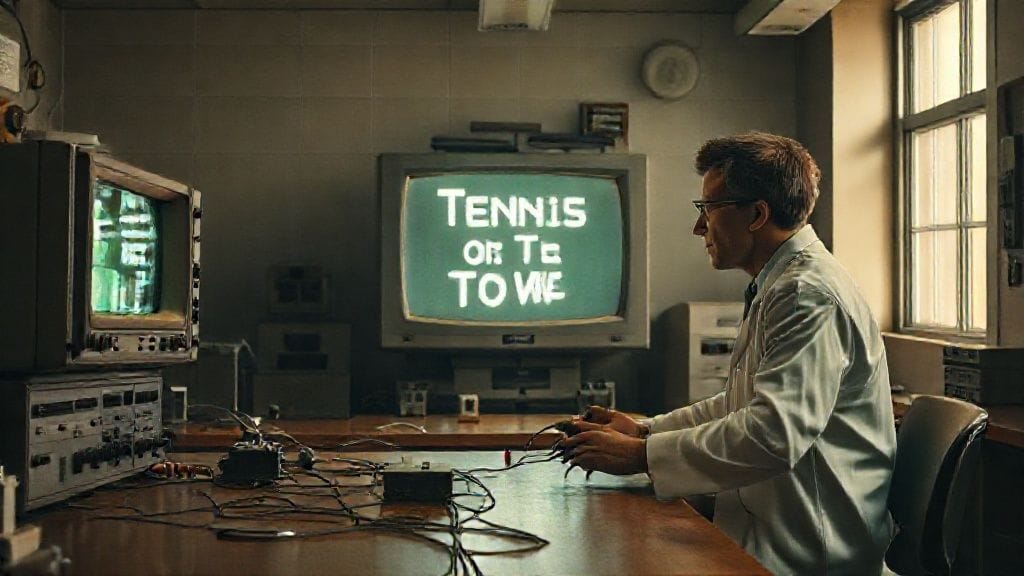
Higinbotham’s idea was deceptively simple: use electronic equipment to simulate a game resembling tennis or ping pong on an oscilloscope. Unlike mere displays of data, this would allow two people to actively engage, controlling the movement of a dot on the screen to “hit” a simulated ball back and forth, mimicking the volley of a real game. It was a manifestation of joy through technology, a synthesis of science education and entertainment.
7. Technical Alchemy: Crafting the First Video Game
In 1958, cutting-edge personal computers did not exist; programming languages were primitive; and complex digital circuits were rare. Higinbotham’s invention relied on analog computing techniques combined with an oscilloscope. Custom circuits created horizontal and vertical deflections to simulate the trajectory of the ball influenced by gravity and velocity. His collaborators helped design joystick-like controllers that allowed players to interact with the system in real time. This fusion of ingenuity and resourcefulness was a technical tour de force in itself.
8. The Oscilloscope: Canvas of a New World
Unlike the pixel-based screens familiar today, the oscilloscope displayed waveforms as light traces on a cathode ray tube, originally intended for analyzing electrical signals. Transforming this technical instrument into a canvas for a moving tennis ball was a stroke of genius. The bright path traced by the ball’s arc captured everyone’s imagination, turning a scientific tool into an inviting interactive display.
9. The Gameplay Experience: Simplicity as Innovation
“Tennis for Two” was not about complex rules or graphics; it was a simple, elegant game involving two paddles, a ball, and a net line. Players adjusted the angle of their shots and watched as the ball reacted realistically to gravity. The novelty was not in complexity but in the embodied interaction: for the first time, people manipulated electrons and signals, translating human input into immediate visual feedback. It was intimate, engaging, direct.
10. Public Reaction: Awe in a Scientific Environment
Visitors at the lab’s open house were charmed. Children who barely understood the technical setting screamed with laughter; adults posed questions not about nuclear physics but about how such “magical” interaction was possible. The game was a beacon in an otherwise austere environment, a human connection not through words but through play. It drew lines between generations, between the present and what technology might offer tomorrow.
11. Beyond Entertainment: A Message of Accessibility
Higinbotham’s motivation was not to commercialize or capitalize; rather, he sought to democratize technology, to make science accessible and engaging. “Tennis for Two” was a medium through which visitors could visualize physics principles—the trajectory of a ball, the concept of gravity—in a way no textbook could match. Such an approach foreshadowed the educational potential video games would later fulfill.
12. The Invisible Legacy: Why "Tennis for Two" Was Forgotten
Despite its groundbreaking nature, “Tennis for Two” quickly faded from public consciousness. It was a one-off demonstration, never patented or mass-produced. The technology was fragile, confined to the laboratory. The world was unaware it had glimpsed something revolutionary. Later inventions like “Spacewar!” (1962) and “Pong” (1972) claimed the spotlight, overshadowing Higinbotham’s creation.
13. Against the Tide: Video Games’ Radical Future
Video games would soon ignite a cultural explosion, evolving rapidly into complex, commercialized entertainment engines. Yet, “Tennis for Two” remained a quiet prologue, a seed buried under decades of technological and economic transformation. It highlighted the tension between play as spontaneous innovation and play as commodity—an issue still debated in gaming communities.
14. Tensions and Confusions: The First Video Game vs. Later Inventions
The debate persists: is “Tennis for Two” truly the first video game? Others point to “OXO” (1952) or “Spacewar!” (1962) as milestones. The difference lies in definitions—what is a video game? Does it require a digital screen, programmable code, or commercial intent? The nuances reveal much about how history categorizes innovation, the fluidity of “firsts,” and the narratives societies construct.
15. The Rise of the Industry: From Experiment to Phenomenon
By the 1970s, video games had morphed into a booming commercial industry. “Pong,” released by Atari, popularized the idea of electronic sports, making “Tennis for Two’s” simple concept a global sensation. Arcades flourished, consoles found places in living rooms, and games became a language for millions, transforming social interaction and leisure in unprecedented ways.
16. Cultural Ripples: Gaming as a New Form of Art and Interaction
Video games blossomed beyond mere entertainment into storytelling, digital art, and virtual social spaces. They became mediums to explore humanity, ethics, and creativity. Today’s billions of gamers owe a subtle debt to the faint traces glowing on that oscilloscope screen in 1958—where technology flirted with imagination for the first time.
17. The Evolution of Interactivity: From Analog to Digital
“Tennis for Two” occupied a unique place: it was analog, tactile, real-time. Its successors embraced digital logic, coding, algorithms. The change from hardware-driven to software-driven games mirrored broader technological shifts, enabling complexity, immersion, and virtual worlds far beyond the simple tether of physics simulation.
18. Reflection on Innovation: Creativity Without Commercial Ambition
Higinbotham’s invention reminds us that innovation often stems from curiosity and generosity rather than corporate drive. His game was a gift to the public, a moment of wonder carved from wires and electrons. It stands as a testament to human creativity—how play and science intertwine to propel society forward.
19. Rediscovery and Historical Reassessment
Historians and enthusiasts gradually revived “Tennis for Two” from obscurity, piecing together documents and testimonies. In recent decades, the game has been acknowledged in museums and scholarly works, recognized for its pioneering role. Such retrospectives emphasize the importance of preserving experimental histories beyond immediate commercial success.
20. The Digital Playground Today: Tracing Roots Back to 1958
Modern video games command multi-billion dollar industries, shape popular culture, and define new social realities. Yet, their essence—the playful interaction between human and machine—traces directly back to that first flickering tennis ball on the oscilloscope screen. It is both humbling and inspiring to consider how far that digital spark has traveled.
Conclusion
The story of “Tennis for Two” is one of humble beginnings and profound impact. Born in the shadow of atomic science and Cold War urgency, it offered a moment of joy, a thread of human warmth woven into cold machines. William Higinbotham’s creation reminds us that innovation is not always heralded by fanfare or immediate fame. Sometimes, it quietly ignites a revolution from within a laboratory, leaving traces in culture, technology, and human experience that only decades later can be fully appreciated.
This first video game was more than a technical curiosity—it was a statement. A statement that technology can serve not just power or profit but also connection, education, and play. And from that echo on an oscilloscope screen, the vast landscape of gaming and digital interaction grew, forever shaping how we imagine, communicate, and entertain.
FAQs on the First Video Game
Q1: What exactly was "Tennis for Two"?
A1: "Tennis for Two" was an interactive electronic game created in 1958 by physicist William Higinbotham. It simulated a simplified tennis match displayed on an oscilloscope, allowing two players to compete by controlling the angle of their shots.
Q2: Why is "Tennis for Two" considered the first video game?
A2: It is often credited as the first because it was the earliest known interactive electronic game with a visual display reacting in real time to player input. Although it was analog, its gameplay resembled what we now understand as video games.
Q3: How did "Tennis for Two" differ from other early games like "OXO"?
A3: "OXO" (1952) was a digital tic-tac-toe game on a computer with a graphical display, but it lacked analog physics simulation and real-time interaction complexity. "Tennis for Two" had a dynamic trajectory and a physical interface designed for human players simultaneously.
Q4: Why was "Tennis for Two" not commercially exploited?
A4: It was designed as a one-time demonstration for the lab’s visitors, without patenting intentions or plans for commercialization. Its technology was also bulky and experimental, making mass production impractical at the time.
Q5: What impact did "Tennis for Two" have on the video game industry?
A5: Directly, very little, since it was forgotten for years, but historically, it laid groundwork for recognizing interactive electronic entertainment as a possibility and inspired later inventors.
Q6: How reliable is the claim that "Tennis for Two" is the first video game?
A6: Debates continue, as definitions of video games vary. However, "Tennis for Two" is widely accepted among historians as a pioneering interactive visual electronic game.
Q7: Where can one see "Tennis for Two" today?
A7: Replicas and exhibits of "Tennis for Two" appear in science museums, including Brookhaven National Laboratory’s own displays and dedicated gaming history exhibitions worldwide.
Q8: How does "Tennis for Two" influence gaming culture today?
A8: It stands as a symbol of innovation, encouraging the fusion of education, play, and technology, and reminding developers and players alike of humble origins when creativity sparked an industry.