Table of Contents
- A Glimpse Into a Darkened Room: The State of Lighting Before 1962
- The Birth of a Revolution: Introducing the LED
- The Man Behind the Light: Nick Holonyak Jr. and His Journey
- The Scientific Foundations: From Semiconductors to Light Emission
- Cold War Science and the Race for Innovation
- The Eureka Moment of 1962: October 9th, A Date Etched in History
- Early Challenges: The Dim Glow of the First LEDs
- Industrial Skepticism and the Slow Dawn of Acceptance
- From Indicator Lights to Global Phenomenon: The Evolution of LEDs
- Economic Shifts Sparked by the LED Revolution
- Environmental Impact: A Greener Light for a Brighter Future
- LEDs and the Digital Age: Lighting Up the Information Era
- The Cultural Shift: How Light Transformed Everyday Life
- The Global Ripple Effect: LED Technology Across Continents
- The Continuing Evolution: From Red LEDs to White Light
- Innovations Inspired by the 1962 Breakthrough
- The Role of Government and Industry Partnerships in Advancement
- Human Stories: How LEDs Changed Lives Worldwide
- Scientific Legacy: How the 1962 LED Revolution Influenced Research
- Controversies and Competing Claims
- The Larger Picture: LEDs in the History of Innovation
- The Future Beckons: Sustainable Lighting and Beyond
- Remembering October 9th: Commemorations and Honors
- Reflections on Innovation: What LED’s Invention Teaches Us
- Conclusion: Illuminating the World, One Photon at a Time
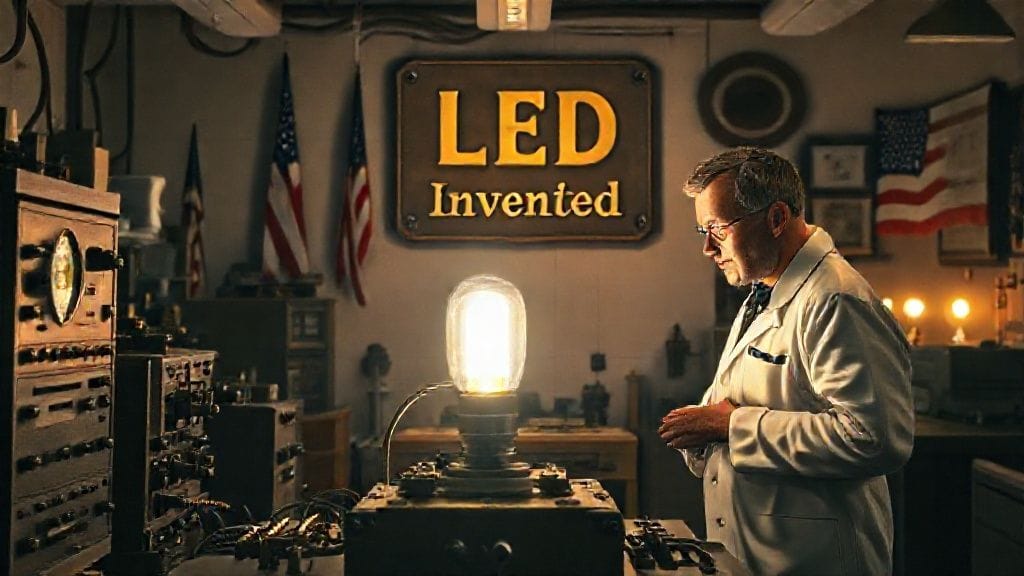
When Nick Holonyak Jr. switched on the tiny semiconductor device on that crisp fall day in 1962, the room did not erupt in a blaze of bright light, yet a quiet revolution had just been born. It was October 9th, and within the glowing red from his creation lay the seeds of a lighting transformation so profound it would alter the course of modern technology. The LED—light-emitting diode—had come to life, not as a mere flicker but as a beacon of infinite potential.
1. A Glimpse Into a Darkened Room: The State of Lighting Before 1962
Before the invention of the LED, humanity’s desire to conquer darkness had long been served by incandescent bulbs and fluorescent tubes. These lights, while revolutionary in their own right during the late 19th and early 20th centuries, suffered from inefficiency, fragility, and significant heat production. Envision homes warmed by the orange glow of Edison’s incandescent bulb—inelegant and energy hungry.
By the mid-20th century, fluorescent lamps, with their harsh light and bulky housings, began replacing incandescents in commercial applications, yet their environmental toll and limited lifespan posed challenges. The necessity for a new, efficient and durable light source was not just a matter of convenience but of monumental importance for industries, transportation, and emerging digital technologies. The search for a solid-state light source—one without filaments or gases—had been ongoing, but success remained elusive.
2. The Birth of a Revolution: Introducing the LED
The LED’s invention did not materialize out of thin air—it was the culmination of decades of semiconductor research. Unlike traditional light sources, LEDs rely on the principle of electroluminescence, where light is produced by the recombination of electrons and holes in a semiconductor material. This was groundbreaking: a device solid-state in nature, compact, robust, and energy efficient.
October 9th, 1962 marked the moment when Holonyak, working under the shadow of giants like William Shockley and facing the turbulence of Cold War science priorities, engineered a visible spectrum LED emitting red light. This diverged from the earlier infrared LEDs that had been discovered but were limited in practical applications. What Holonyak achieved was a visible, controllable light source on a tiny chip—a first step toward a luminous future.
3. The Man Behind the Light: Nick Holonyak Jr. and His Journey
Nick Holonyak Jr.’s story resonates with a perfect mix of talent, timing, and tenacity. Born to Czech and Slovak immigrant parents in 1928, Holonyak’s fascination with electronics began early. Achieving a PhD from the University of Illinois at Urbana-Champaign, the young engineer found himself working at General Electric before being lured to the University of Illinois as a professor.
Mentored by John Bardeen, co-inventor of the transistor, Holonyak was deeply embedded in the vibrant semiconductor research environment. His curiosity was piqued by earlier experiments on gallium arsenide and other III-V semiconductors, and he tirelessly pursued the goal of creating a visible light-emitting semiconductor device. His 1962 breakthrough was as much a personal triumph as it was a beacon of progress for the scientific community.
4. The Scientific Foundations: From Semiconductors to Light Emission
To truly appreciate the LED’s invention, one must delve into the complex world of semiconductor physics. Semiconductors like gallium arsenide phosphide—which Holonyak employed—have unique properties that allow electrons to move between energy bands, emitting photons in the process. This phenomenon of electroluminescence was discovered decades before but had been limited to invisible infrared light.
Holonyak’s genius was in manipulating the material composition to produce red light within the visible spectrum. It was physics brought to life, a material engineered with atomic precision to channel electricity directly into light without heat or wasted energy.
5. Cold War Science and the Race for Innovation
The geopolitical backdrop of the early 1960s shaped scientific priorities aggressively. The United States, engaged in intense technological competition with the Soviet Union, invested heavily in research and development. Breakthroughs in semiconductors, integrated circuits, and materials science were central to military and space race ambitions.
The LED’s invention, although not a weapon, was nevertheless part of the broader push to achieve technological supremacy. Indeed, its initial use in indicator lights on military and aerospace equipment exemplified this connection. Yet beyond politics, it symbolized the intersection of curiosity-driven research and pragmatic utility.
6. The Eureka Moment of 1962: October 9th, A Date Etched in History
That October day Holonyak energized his gallium arsenide phosphide device, it emitted a faint red glow, barely “bright enough to be seen in normal room light,” he later recalled—not a spectacle but a subtle herald of forthcoming transformation. The moment was both humble and monumental, marking the transition from theory to functional prototype.
The room was silent except for tools clinking and cautious optimism. “I knew instantly that it worked,” Holonyak said years later, “but the real work was just beginning.” It was the spark that ignited decades of innovation.
7. Early Challenges: The Dim Glow of the First LEDs
As revolutionary as LEDs were, the earliest iterations struggled with brightness limitations and narrow color ranges. The devices barely compared to incandescent bulbs, and their manufacturing processes were delicate and unrefined. Industrial investors viewed them skeptically, considering their niche application potential.
Yet for engineers and scientists, this was a fresh frontier. They began experimenting with different materials: indium gallium nitride, silicon carbide, aluminum gallium arsenide—each promising new colors and efficiencies. The dim red LEDs were just the beginning.
8. Industrial Skepticism and the Slow Dawn of Acceptance
In the 1960s and 1970s, LEDs found modest roles in digital displays and instrumentation, predominantly as indicator lights on radios, calculators, and control panels. The general public remained unaware of this nascent technology, for whom incandescent and neon lights remained the norm.
Corporations and governments cautiously invested, but it was not until the 1990s that mass production techniques and longer-lasting blue LEDs expanded the scope dramatically. Yet the slow acceptance period underscored the difficulty of displacing established, comfortable technologies.
9. From Indicator Lights to Global Phenomenon: The Evolution of LEDs
Over time, LEDs evolved from simple signaling devices to the core lighting technology in offices, arenas, highways, and homes. The march of progress saw improvements in brightness, efficiency, and the creation of white light LEDs that rivaled traditional sources.
This evolution enabled a host of applications unthinkable in 1962, including immersive display screens, energy-saving street lighting, horticultural lamps, and even advanced medical devices. The LED had escaped the laboratory to illuminate entire societies.
10. Economic Shifts Sparked by the LED Revolution
LED technology catalyzed significant economic shifts. Markets for incandescent bulbs shrank rapidly, forcing industries to innovate or perish. New manufacturing hubs emerged, notably in East Asia, where supply chains specialized in LED components and integrated products.
The LED’s energy efficiency also translated to cost savings on global scales—both for consumers and governments grappling with energy crises and environmental concerns. Its proliferation has driven billions of dollars in global economic activity and innovation.
11. Environmental Impact: A Greener Light for a Brighter Future
One of the LED’s most profound legacies is its contribution to sustainability. Consuming a fraction of the power of incandescent bulbs and lasting tens of thousands of hours longer, LEDs reduced carbon footprints worldwide. They also contain no mercury, unlike fluorescents, making disposal safer.
This environmental benefit resonates deeply as climate change intensified debates and policies on responsible energy use. The 1962 invention sowed the seeds for a more conscious relationship with light and power.
12. LEDs and the Digital Age: Lighting Up the Information Era
The LED's rise coincided with the digital revolution. Their small size, low power consumption, and fast response times made them ideal for displays—watches, calculators, smartphones, and beyond. This synergy accelerated the emergence of our interconnected world.
It is hard to imagine a smartphone without its LED-backlit screen or fiber-optic communication systems relying on LED-related technology. The invention’s fingerprints are embedded in the tapestry of modern life.
13. The Cultural Shift: How Light Transformed Everyday Life
Light shapes human experience, influencing moods, productivity, and aesthetics. The LED’s flexibility allowed new architectural and artistic expressions. Dynamic lighting solutions adapted to circadian rhythms, enhancing wellness.
Moreover, access to affordable lighting revolutionized education and safety worldwide, particularly in developing regions once confined to dim kerosene lamps. The power to illuminate powered hope.
14. The Global Ripple Effect: LED Technology Across Continents
LEDs spread quickly around the globe, embraced by countries with varying economic profiles. They became tools not only of convenience but of development, from solar-powered LED lanterns in sub-Saharan Africa to vast LED-lit mega-cities in Asia.
International collaboration and competition spurred further advancements, illustrating how a 1962 invention could transcend politics and geography.
15. The Continuing Evolution: From Red LEDs to White Light
Following Holonyak’s red LED came green, yellow, and eventually blue LEDs—an invention credited to Isamu Akasaki, Hiroshi Amano, and Shuji Nakamura in the 1990s—which enabled the creation of white LED light.
These advances almost three decades after the original breakthrough expanded the LED’s utility exponentially. The innovation cycle set in motion in 1962 proved indomitable.
16. Innovations Inspired by the 1962 Breakthrough
Beyond lighting, the LED’s principles informed developments in lasers, optical communications, and sensors. The concept of solid-state light sources fostered entire industries around optoelectronics.
Every time a fiber-optic cable beams data across the ocean or a laser surgery restores sight, it echoes back to that first red LED glow.
17. The Role of Government and Industry Partnerships in Advancement
Government funding, university research, and private enterprise intertwined to bring LEDs to market. Agencies like the Department of Energy in the US recognized the technology’s strategic importance.
Public-private partnerships facilitated scaling production and reducing costs, establishing a model for future innovation frameworks.
18. Human Stories: How LEDs Changed Lives Worldwide
The invention's impact is not just technological but deeply human. Consider students studying under affordable LED lamps in rural communities, or emergency responders relying on durable LED flashlights.
The LED is more than a device; it is a quiet partner in human progress.
19. Scientific Legacy: How the 1962 LED Revolution Influenced Research
LED technology spurred broader interest in nanotechnology, quantum dots, and photonics. Researchers continue to push boundaries inspired by Holonyak’s early success.
It’s a beacon guiding new generations of scientists toward unknown horizons.
20. Controversies and Competing Claims
While Holonyak’s role is widely recognized, history includes debates over priority with other inventors and institutions experimenting with electroluminescence. Often overshadowed are earlier contributions by Rubin Braunstein and Oleg Losev.
These stories enrich the narrative, reminding us innovation is rarely solitary.
21. The Larger Picture: LEDs in the History of Innovation
Comparatively, the LED represents a rare moment when fundamental science translated swiftly into practical, world-changing technology. Placed alongside inventions like the transistor or the internet, its significance is monumental.
It illuminates not only spaces but the process of human ingenuity itself.
22. The Future Beckons: Sustainable Lighting and Beyond
Looking ahead, LEDs continue evolving into smarter, more adaptive light sources integrated with AI and IoT. They contribute to sustainability goals and enable new forms of communication and display.
From its 1962 roots, the LED’s potential seems boundless.
23. Remembering October 9th: Commemorations and Honors
Institutions worldwide celebrate the anniversary of the LED’s invention. Holonyak received numerous awards, including the National Medal of Technology, reflecting the enduring respect for his contribution.
These commemorations contextualize how a small chip reshaped the world.
24. Reflections on Innovation: What LED’s Invention Teaches Us
The LED story exemplifies perseverance, interdisciplinary collaboration, and vision. It teaches that significance may start quietly, often overshadowed until the broader world catches up.
Innovation, as this glow reminds us, is often patient and persistent.
25. Conclusion: Illuminating the World, One Photon at a Time
From the dim red flicker of that October day in 1962 emerged a light that would brighten every corner of the earth, transform economies, reduce environmental strain, and touch lives in ways unimaginable. Nick Holonyak Jr.’s LED was not merely a technical marvel but a silent revolution in how we live and connect with the world.
Technology at its best does not just serve function—it illuminates human potential. The LED’s invention is a testament to science’s power to reshape reality, one photon at a time.
Conclusion
The LED’s invention in 1962 is one of those watershed moments in history where science, innovation, and human ambition converged to medium a bright new future. That faint glow from Holonyak’s device was much more than an optical phenomenon—it was a symbol of relentless inquiry, daring to bring the invisible into reality. Over decades, the LED transitioned from a laboratory curiosity to a ubiquitous presence, driving revolutions in energy consumption, technology, culture, and sustainability.
This story imparts a powerful lesson: revolutionary change often begins humbly, illuminated by the persistent work of visionaries who dare to see light where others see darkness. Today, as LED technology continues to evolve and influence new fields, it remains a beacon of possibility—a reminder that one spark of inspiration can indeed light the whole world.
FAQs
Q1: What exactly is a LED and how does it work?
An LED (light-emitting diode) is a semiconductor device that emits light when an electric current passes through it. Electrons and holes recombine in the semiconductor material, releasing energy in the form of photons (light). This process is known as electroluminescence.
Q2: Why is the invention of LED in 1962 significant?
The 1962 LED was the first visible-spectrum LED, created by Nick Holonyak Jr. before then, LED devices emitted only infrared light, invisible to the eye. This breakthrough laid the foundation for modern solid-state lighting and optoelectronics.
Q3: Who was Nick Holonyak Jr., and why is he important?
Holonyak was an American engineer and physicist who invented the first practical visible light LED in 1962. He is often called the "father of the LED" and his work sparked a lighting revolution.
Q4: How did the LED invention impact the environment?
LEDs are highly energy-efficient, durable, and contain no toxic materials like mercury. They consume significantly less power than incandescent or fluorescent lights, substantially reducing greenhouse gas emissions related to energy production.
Q5: When did LEDs become widely used in everyday life?
Although invented in 1962, LEDs were primarily used as indicator lights for several decades. It wasn't until the 1990s and early 2000s, with the development of blue and white LEDs and mass production improvements, that they gained widespread adoption in lighting and displays.
Q6: Are there controversies associated with the LED invention?
While Holonyak is credited with visible LEDs, earlier contributions to infrared LEDs and electroluminescence came from others like Oleg Losev. Disputes occasionally arise over priority, but Holonyak’s 1962 red LED remains a pivotal milestone.
Q7: What industries were revolutionized by LEDs?
Beyond lighting, LEDs revolutionized digital displays, telecommunications (fiber optics), automotive lighting, horticulture, medical devices, and more, due to their efficiency, size, and versatility.
Q8: What is the future of LED technology?
LEDs continue to evolve with smart lighting systems, integration in IoT (Internet of Things), and advances in energy harvesters and communication. Sustainable architects and designers increasingly rely on LEDs for eco-friendly illumination.