Table of Contents
- The Dawn of a Digital Revolution: November 23, 1992
- Beyond the Phone: The Vision Behind IBM Simon
- The Tech Landscape Before the Smartphone Era
- The Architects of Innovation: IBM and BellSouth
- Building the Future: Design and Development of the Simon
- Introducing Personal Mobility: The First Smartphone’s Features
- A Marriage of Communication and Computing
- The Market’s First Encounter: Simon Hits the Shelves
- User Reactions: A Blend of Fascination and Frustration
- The Technical Hurdles and Constraints of Early Smartphones
- Why IBM Simon Didn’t Spark an Instant Revolution
- The Legacy of IBM Simon in the Mobile Industry
- From Simon to Today: The Evolution of Smartphones
- Cultural Ripples: How Simon Changed Perceptions of Personal Tech
- Lessons Learned: Innovation, Timing, and Market Readiness
- The Broader Impact: How Simon Influenced Mobile Computing
- Unearthing Forgotten Stories: Anecdotes from the Simon Era
- Reflections from Pioneers: Voices Behind the Innovation
- The Economic Context: Tech Industry and Consumer Electronics in the Early 1990s
- Counterfactuals: What If Simon Had Succeeded?
- Simon’s Place in the History of Digital Communication
- Concluding Thoughts: The IBM Simon as a Symbol of Forward-Thinking Spirit
- Frequently Asked Questions about the IBM Simon
- External Resources and Further Reading
- Internal Links and Additional Content
The Dawn of a Digital Revolution: November 23, 1992
Imagine the bustling streets of New York City on November 23, 1992. A world still acclimating to the dawn of the internet, where bulky mobile phones clung to ears like bricks and computers remained tethered to desks. Amid this landscape, an unassuming piece of technology emerged, quietly ready to redefine the boundaries of personal communication. In this moment, IBM and BellSouth unveiled the IBM Simon Personal Communicator — not just a phone, but the progenitor of what we now embrace as the smartphone.
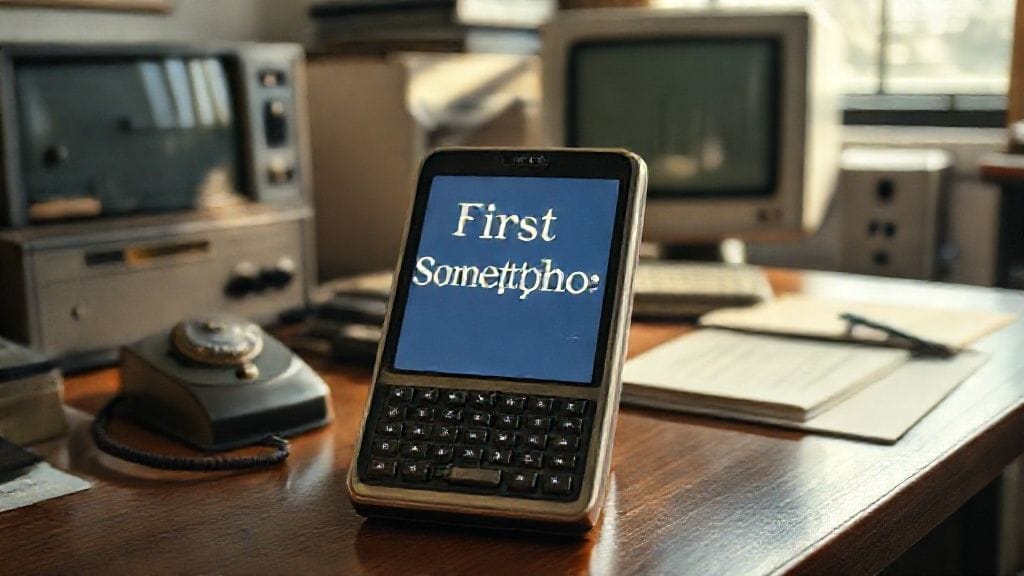
A slab roughly the size of a thick paperback, equipped with a touch screen and a stylus, Simon was a curious hybrid. It promised to blend voice communication, faxing, emailing, and simple computing – functions unimaginable to most mobile users at the time. The IBM Simon smartphone was not just a device; it was a harbinger of the mobile, interconnected life that billions would come to live decades later. And yet, as groundbreaking as it was, Simon's story is one of ambition ahead of its time.
Beyond the Phone: The Vision Behind IBM Simon
To comprehend the significance of IBM Simon, we must peer through the lens of visionary engineers and executives who foresaw a future where communication devices transcended conventional limits. IBM, a titan of computing, and BellSouth, a major telecommunications player, joined forces to make this vision tangible.
In an era where mobile phones were predominantly tools for voice calls and pagers ruled short messaging, the idea of integrating computing capabilities into a handheld communicator was revolutionary. The promise was enticing: what if one could carry a phone that was also a mini personal computer, equipped to send emails, manage contacts, calendars, and even faxes—all in one device?
This vision was ambitious and fraught with risk; the technology was nascent, batteries were limited, and user interfaces for such multifunctional devices were uncharted territory. Nonetheless, IBM Simon emerged as a bold step into the future, setting the stage for the smartphone revolution that was to come.
The Tech Landscape Before the Smartphone Era
Before Simon, mobile communication was starkly different — dominated by analog phones the size of bricks with minimal functionality. The early 1990s saw cell phones primarily as voice devices for business elites; sending a text or email on the go was still a fantasy. Laptops existed but were too bulky and expensive to be daily companions.
On the computing front, personal digital assistants (PDAs) like the Apple Newton or Palm Pilots were just emerging, capable of managing contacts and calendars but lacked telephony features. The idea of merging telephony and computing was in its infancy—calling it a “smartphone” felt both prophetic and somewhat absurd.
Network infrastructure also posed hurdles. Cellular networks were predominantly 1G and early 2G, designed for voice rather than data. The capability to transmit emails or faxes over cellular lines was rudimentary at best. In this context, IBM Simon represented a technological leap mapped onto an infrastructure unprepared to fully support it.
The Architects of Innovation: IBM and BellSouth
IBM’s collaboration with BellSouth was instrumental in the creation of Simon. IBM brought its computing pedigree, having vast experience in hardware and software design. BellSouth contributed its telecommunications expertise and network infrastructure.
Led by a team of engineers passionate about mobile computing, the development process was a marriage of determination and innovation. Key individuals spent months wrestling with the challenge of integrating cellular capabilities, touch-screen technology, and software applications into a single package.
Especially striking was the use of an LCD touch screen with a stylus for input – an innovation before capacitive touchscreens and finger-friendly interfaces were standard. This decision opened new ways of interacting with mobile devices beyond physical keypads, albeit with a steep learning curve for users.
Building the Future: Design and Development of the Simon
It’s incredible, isn’t it? The IBM Simon Personal Communicator was truly ahead of its time in design and concept. Weighing approximately 500 grams (almost a pound), with a 4.5-inch monochrome LCD screen, it looked unlike any phone before it. Its large size was a necessary trade-off due to the technology limitations of the era: battery size, screen size, and the internal electronics.
The software suite ran on the Datalight ROM-DOS operating system, a version of MS-DOS adapted to run handheld applications. Simon’s bundle of apps included phone, address book, calendar, appointment scheduler, notepad, and email software, alongside the ability to send and receive faxes—a nod to the business user’s needs.
Development was no simple feat. Integrating the software and hardware on such constrained resources required engineering creativity. Battery life was a serious concern, with Simon offering a mere hour of talk time and around eight hours of standby. In a world where mobile users were accustomed to several hours, this was a limiting factor.
Introducing Personal Mobility: The First Smartphone’s Features
In technical terms, Simon was a marvel of integration. It sported functionalities unseen in a typical mobile phone of the time:
- Voice calling capability like any mobile phone.
- Fax sending and receiving.
- Email communication, via cellular networks.
- Address book and contact management; calendar with alarms.
- Touch screen interface, operated via stylus, mimicking pen input.
- Appointment scheduler and notepad allowing handwritten notes.
Each feature, taken alone, might be commonplace today, but in 1992, bundled together in one handheld device, this was unprecedented. IBM Simon presaged core concepts still fundamental to smartphones: convergence of communication and computing.
A Marriage of Communication and Computing
What truly set IBM Simon apart was its ambition to marry communication with computing in a handheld wrapper. Unlike traditional phones that focused solely on voice, Simon invited users to engage with data: writing, scheduling, emailing—all within one device.
This idea resonated deeply with professionals, especially in business sectors reliant on organization and rapid communication. It enabled a level of mobility and digital management that desktop-bound computers could not offer. It anticipated tenets that make today’s smartphones indispensable, blending productivity tools with connectivity.
Yet, this fusion was fragile—encountering hardware limitations, software bugs, and network slowdowns in practice. Simon’s story is a reminder that innovation requires more than just vision; it demands practical delivery and user acceptance.
The Market’s First Encounter: Simon Hits the Shelves
In August 1994, almost two years after its unveiling, the IBM Simon was commercially launched through BellSouth Cellular in select U.S. markets. Priced around $899 with a $12.99 monthly service fee—a hefty sum by early 90s standards—Simon was targeted primarily at business professionals and early tech adopters.
The public’s response was mixed. Early enthusiasts admired its capabilities and foresaw its potential, but the average consumer found the device cumbersome and expensive. Its large size, limited battery life, and complex interface were understandable deterrents in a market where simplicity and affordability mattered.
Still, Simon sold approximately 50,000 units—a modest figure but significant for a device that was, in many ways, a prototype for later smartphones. It was a glimpse of the future, albeit one that required further refinement.
User Reactions: A Blend of Fascination and Frustration
Users who dared embrace the IBM Simon encountered an experience both magical and maddening. A New York Times review in 1994 praised Simon’s ambitious design but criticized its sluggish responsiveness and short battery life. Some users marveled at the ability to send an email while on the move, a novelty that felt like science fiction.
Yet, the stylus interface, while innovative, was prone to errors and demanded patience. Network speeds constrained email and fax functions, making some features slow or unreliable. The steep learning curve and erratic performance dampened enthusiasm.
One engineer recalled: “We were trying to pack decades of innovation into a device months ahead of its time. It was thrilling and heartbreaking.” This human angle reveals how innovation is rarely smooth but often a labor of perseverance.
The Technical Hurdles and Constraints of Early Smartphones
The IBM Simon’s ambition was curtailed by the technical ecosystem of its time. The early 1990s cellular networks were not designed for intensive data transmission; they favored analog voice communication. Email and fax required innovative adaptations to work over cellular infrastructure.
Battery technology was another limit. Simon’s lithium-ion battery offered short operational times, a severe inconvenience for users increasingly dependent on mobile connectivity. Processing power and memory severely restricted software complexity and responsiveness.
In addition, the world was not yet ready for touch interfaces in communications devices. The stylus-based input predated capacitive touchscreens and intuitive GUIs by more than a decade, meaning many users found Simon’s interface alien and cumbersome.
Why IBM Simon Didn’t Spark an Instant Revolution
Given its unprecedented capabilities, one might wonder why Simon didn’t instantly redefine mobile technology. The reasons are multifaceted:
- High retail and service costs limited accessibility.
- Battery and performance constraints impaired the user experience.
- Network limitations hindered key functions like fax and email.
- User interface complexity was off-putting to non-expert users.
- The market itself was unaccustomed to merging computing with telephony.
This confluence of factors illustrates a classic truth of innovation: being first does not guarantee success. The world needed infrastructure, user-friendly designs, and price points compatible with mass adoption.
The Legacy of IBM Simon in the Mobile Industry
Despite its commercial shortcomings, IBM Simon’s impact on mobile technology was profound. It planted the seed of the smartphone concept when no comparable devices existed. The term “smartphone” owes much to Simon’s trailblazing role.
Many concepts introduced by Simon—touch screen input, integrated applications, mobile email—became foundational for subsequent devices. Later innovations like Nokia Communicator, BlackBerry, Palm Treo, and ultimately Apple’s iPhone owe a historical debt to Simon’s pioneering blueprint.
Simon demonstrated that mobile communication needed to be more than just voice calls; it had to be a convergent device blending multiple digital functions. It anticipated the mobile, connected life now shared by billions worldwide.
From Simon to Today: The Evolution of Smartphones
The evolution from IBM Simon to today’s smartphones is a saga of technological leaps and changing user expectations. After Simon, the 1990s saw mobile phones become smaller, cheaper, and focused primarily on voice and SMS.
BlackBerry introduced mobile email excellence at the start of the 2000s, while Nokia added PDA-like features. The critical breakthrough came in 2007 with Apple’s iPhone—sleek, powerful, touch-first, and user-centric—delivering the full vision Simon once suggested.
Today’s smartphones—a fusion of powerful processors, high-resolution touchscreens, abundant apps, and constant connectivity—trace their origins back to Simon’s 1992 debut. The story of the IBM Simon is the seed from which the multi-trillion-dollar smartphone industry has grown.
Cultural Ripples: How Simon Changed Perceptions of Personal Tech
Beyond technicalities, Simon began shifting cultural perceptions about personal technology. It proposed that a single, portable device could manage both communication and personal organization, seeding the idea of ubiquitous connectivity.
Simon’s ambition foreshadowed our modern relationships with devices—tools of work, social exchange, entertainment, and identity. It subverted the notion that phones were merely voice devices and expanded expectations towards multifunctionality.
Though its commercial impact was limited, Simon’s cultural echoes endure in how we conceive digital life—always connected, always accessible, always “smart.”
Lessons Learned: Innovation, Timing, and Market Readiness
IBM Simon’s journey provides vital lessons on innovation’s complexity. It demonstrates that visionary technology alone cannot guarantee success without matching market readiness, infrastructure, user acceptance, and cost feasibility.
Simon was a product outpacing the networks, batteries, and user interfaces of its time. Its moderate sales and mixed reception underscore the importance of synchronizing innovation with ecosystem maturity.
More broadly, Simon’s story teaches us to appreciate pioneers who venture beyond contemporary limits. They expand horizons even when immediate rewards are elusive.
The Broader Impact: How Simon Influenced Mobile Computing
Simon catalyzed the trajectory of mobile computing, influencing software developers, hardware manufacturers, telecom companies, and users. Its proof of concept motivated further research and development into integrating computing and telephony.
The push for better mobile operating systems, adoption of touchscreens, and refining of mobile user interfaces finds roots in lessons drawn from Simon. Telecom carriers saw the potential for data-driven services alongside voice, contributing to network upgrades.
In sum, Simon’s ripple effects reached far beyond its modest production run; it helped inaugurate an era where personal communication devices became indispensable, intelligent companions.
Unearthing Forgotten Stories: Anecdotes from the Simon Era
Behind the technical specs lie fascinating anecdotes. The stylus for input was inspired by early pen computing research, sparking months of debate among designers obsessed with balancing precision and ergonomics.
One user reportedly sent a vital fax via Simon while at a conference, astonishing colleagues accustomed to lugging fax machines. Engineers often stayed late troubleshooting network issues, determined to “make the impossible happen.”
IBM’s internal memos described Simon as a “laboratory on wheels,” a testing ground for concepts that would mature decades later. These stories humanize a device that might otherwise seem merely a technological artifact.
Reflections from Pioneers: Voices Behind the Innovation
John Karidis, one of Simon’s key engineers, later reflected: “We knew we were ahead of our time, but that was the thrill—that first step into uncharted territory.” Another team member noted, “People today take smartphones for granted, but back then we were designing magic.”
These testimonies reveal the passion and challenges behind Simon's creation. In their words, we glimpse a human drama of hope, persistence, and occasional frustration mingled with triumph.
The Economic Context: Tech Industry and Consumer Electronics in the Early 1990s
The IBM Simon’s emergence coincided with a shifting economic and technological landscape. Personal computing was growing but still constrained by cost and complexity. Mobile telephony was expanding, but devices remained niche.
Consumer electronics were expensive, and connectivity infrastructure was limited. The early 90s were a transitional era—analog gave way to digital, and consumer demand began to push innovation towards mobility.
In this context, IBM and BellSouth gambled on Simon as a high-end, niche product rather than mass-market device. The economic conditions both enabled innovation and imposed limits on widespread adoption.
Counterfactuals: What If Simon Had Succeeded?
Speculation abounds: what if Simon’s timing had been better—stronger batteries, faster networks, lower prices? Could it have ignited the smartphone revolution a decade earlier?
Had Simon gained mass adoption, entire industries might have shifted sooner—mobile internet, app ecosystems, social media, digital commerce. The digital revolution might have arrived in the 1990s rather than the 2000s.
While fascinating to consider, such counterfactuals illustrate how innovation’s success depends on a delicate balance of multiple factors—not just technical feasibility.
Simon’s Place in the History of Digital Communication
IBM Simon occupies a unique niche as the first true smartphone. It is the forerunner to every touch screen, email-capable phone that followed. In history’s grand narrative, Simon is the daring pioneer who crossed the Rubicon into a new era.
It reminds us that transformative technology often begins as imperfect and niche before blossoming into mainstream necessity. Simon is a monument to human ingenuity and the restless quest for connection.
Concluding Thoughts: The IBM Simon as a Symbol of Forward-Thinking Spirit
IBM Simon’s story is not simply about a first device; it is an emblem of innovation’s pioneering spirit. It teaches us about the power of vision, the pains of being early, and the slow unfolding of revolutionary change.
Simon anticipated a digital tomorrow in a world still getting to grips with analog yesterday. It stood at the crossroads of communication and computation, lighting the path for future generations.
In the end, Simon is a testament to humanity’s relentless drive to create, connect, and transcend boundaries—an enduring symbol of the smartphone revolution’s humble beginnings.
Conclusion
In the annals of technological history, the IBM Simon holds a special, if often overlooked, place. It was a device born not just out of commercial ambition but of genuine visionary foresight—a glimpse into a future where communication would become as multifaceted and personal as human thought. Though its commercial life was short and its impact initially muted, the Simon was unmistakably the progenitor of the smartphone era.
Today, as billions carry sleek, powerful devices that connect us to the world in ways unimaginable in 1992, it’s humbling to revisit the figure of IBM Simon—large, clunky, imperfect, but undeniably transformative. Its story teaches us that innovation often travels a rugged road before becoming seamless, that being first requires bravery, and that the future belongs to those willing to push boundaries even when the world is not yet ready.
IBM Simon was a spark in the evolving fire of technology—a fire that has since ignited global transformation. And for that alone, it deserves to be remembered, studied, and celebrated.
FAQs
Q1: What exactly was the IBM Simon?
IBM Simon was the world’s first smartphone, unveiled in 1992 and commercially released in 1994. It combined a mobile phone with a touchscreen and software applications like email, fax, calendar, and a notepad.
Q2: Why is IBM Simon considered the first smartphone?
Simon was the first device to integrate multiple communication and computing features into one handheld unit, including voice, fax, email, and PDA functions, all controlled through a touchscreen interface.
Q3: What were the major limitations of IBM Simon?
Its major constraints included short battery life, bulky size, high price, slow network speeds, and a complex stylus-based interface that was difficult for average users.
Q4: Who developed the IBM Simon?
The device was a joint venture between IBM and BellSouth, combining IBM’s computing expertise with BellSouth’s telecommunications infrastructure and experience.
Q5: How did the IBM Simon influence later smartphones?
While commercially limited, Simon introduced concepts like touchscreen input and integrated communication applications that paved the way for devices like BlackBerry, Palm Treo, and ultimately the iPhone.
Q6: Why didn’t IBM Simon become a mainstream success?
A combination of factors including immature supporting technologies (network speed, battery life), high costs, user interface difficulties, and market unpreparedness for such a device.
Q7: What does the IBM Simon tell us about innovation?
It exemplifies how groundbreaking inventions may be ahead of their time, highlighting the importance of ecosystem readiness, user experience, and timing in the success of new technologies.
Q8: Where can I learn more about IBM Simon?
The Wikipedia page on IBM Simon offers detailed historical and technical information. (See External Resources below.)