Table of Contents
- A New Era Dawns: December 21, 2015, and the Reusable Rocket Revolution
- The Space Race Reimagined: From Mercury to Mars and Beyond
- The Visionary Behind the Venture: Elon Musk and SpaceX's Bold Dream
- Engineering the Impossible: The Challenge of Rocket Reusability
- The Falcon 9: Anatomy of a Breakthrough
- Early Failures and Setbacks: Trials Before Triumph
- Countdown to History: Preparations for the First Attempt
- The Night the Falcon Landed: A Narration of the First Successful Touchdown
- The Landing Zone: Barriers, Risks, and the Drone Ship Innovation
- Global Reactions: Awe, Skepticism, and The Next Frontier
- How Reusability Threatened and Transformed the Aerospace Industry
- Economics of Space Travel: Cost Reduction and Commercial Prospects
- Technological Ripples: Innovations Spurred by Recovery Techniques
- The Road to Routine: Landing Multiple Rockets and Refinement of Techniques
- Environmental Impacts: Sustainable Spaceflight in the Making
- Cultural and Inspirational Impact: Inspiring the Next Generation
- The Human Element: Teamwork, Grit, and the Spirit Behind the Scenes
- Continuing the Journey: SpaceX’s Next Milestones and Ambitions
- The Broader Context: How SpaceX Fits into 21st Century Space Exploration
- Myths and Misconceptions: Clearing the Space Debris Around Reusable Rockets
- Reflecting on a Paradigm Shift: The Legacy of the First Reusable Rocket Landing
- Conclusion: The End of One Flight—The Beginning of Countless More
- FAQs: Unlocking Curiosities Around SpaceX’s Reusable Rocket Landing
- External Resource: Wikipedia on SpaceX Reusable Rocket Landing
- Internal Link: Visit History Sphere
1. A New Era Dawns: December 21, 2015, and the Reusable Rocket Revolution
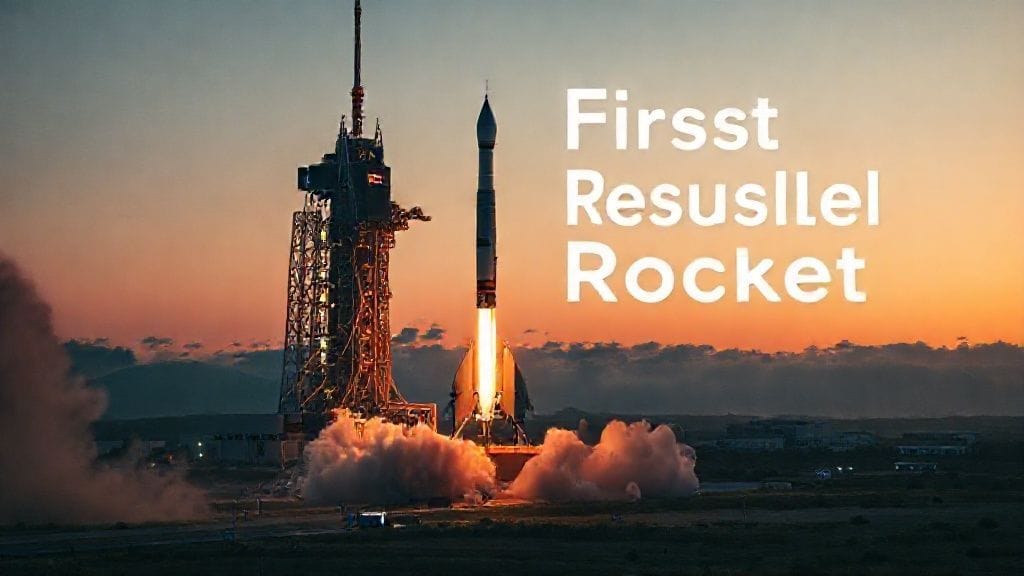
As the cold winter wind bit into the Florida coast on the evening of December 21, 2015, an event unfolded that would ripple across humanity’s collective fascination with the stars. The roar of the Falcon 9 rocket sliced through the quiet, sending aloft 11 satellites to orbit. But this was no ordinary launch. Far below, cameras fixed on a platform floating precariously in the Atlantic Ocean—the Autonomous Spaceport Drone Ship, eerily poised like a lighthouse at sea. Then, with a precision that seemed almost miraculous, the Falcon 9’s first stage descended and touched down gently on the deck, marking the first successful landing of an orbital class reusable rocket.
This moment was not merely a technical milestone. It marked the dawn of a revolutionary chapter in space exploration, an inflection point where the dream of affordable, sustainable spaceflight leapt from science fiction to tangible reality. The SpaceX reusable rocket landing radically altered how humanity envisioned access to the cosmos, promising a future where the sky was no longer the limit.
2. The Space Race Reimagined: From Mercury to Mars and Beyond
For over half a century, space exploration had progressed through titanic bursts—the Mercury missions, Apollo’s moon landings, the Space Shuttle’s mechanical ballet—each advancing technology but always at staggering costs. Rockets were famously “single-use” metal beasts, discarded after their fiery ascent. This approach constrained ambitions, strewing debris and maintaining prohibitive expenses.
The 21st century brought new provocations: Mars colonization, asteroid mining, commercial orbital stations. To dream bigger, humanity needed a profound shift. The idea of reusing rocket stages—once science fiction, briefly toyed with in earlier decades—became imperative. Beyond the Cold War rivalry lay the promise of a sustainable space age, where launchers could be refurbished like airplanes, slashing prices and expanding possibility.
3. The Visionary Behind the Venture: Elon Musk and SpaceX's Bold Dream
At the meeting point of Silicon Valley ambition and aerospace tradition stood Elon Musk, an entrepreneur whose audacity defied norms. Founding SpaceX in 2002, Musk set a radical goal: make spaceflight accessible to those beyond governments, reshape the economics, and put a human on Mars.
Musk’s vision was as much about challenge as it was about innovation. “Why throw away a rocket?” he mused in countless interviews—"Reusability had to be the answer." Under his leadership, SpaceX committed to reinventing the rocket rather than designing incremental improvements. The dream seemed quixotic, but Musk’s relentless drive galvanized a team of engineers and dreamers willing to bet the future of spaceflight on the effort.
4. Engineering the Impossible: The Challenge of Rocket Reusability
At first glance, the concept seems straightforward: save and reuse the rocket’s first stage. But rockets endure intense forces—throttling engines, aerodynamic buffeting, scorching reentry heat. The physical stresses on a stage upon descent can be more punishing than launch itself.
SpaceX’s engineers had to invent new materials, design grid fins for precise atmospheric control, and create landing legs that could deploy within fractions of a second. Perhaps most daunting was the necessity of perfecting autonomous navigation—the rocket returning home to a moving platform in the ocean or a designated land zone, all in the absence of human control.
The Falcon 9’s reusable design was revolutionary not just in hardware but software: integrated sensors, real-time telemetry and flight control algorithms crafted to anticipate and correct every tiny deviation.
5. The Falcon 9: Anatomy of a Breakthrough
Named after the Millennium Falcon from Star Wars and the planet Mars’ ninth moon Phobos, Falcon 9 was built not merely for payload but for endurance and reliability. Two stages stack atop each other: the first responsible for escaping Earth’s gravity, the second propelling payloads to precise orbits.
What set the Falcon 9 apart was the engineering foresight for reusability from inception. Whereas traditional rockets designed with throwaway patterns, Falcon 9 integrated landing legs, grid fins, and throttling engine bell nozzles—all anticipating a controlled, powered descent after separation.
Its nine Merlin engines could be shut down and restarted multiple times, a feature essential for the precise burn required to land on a drone ship hundreds of kilometers from the launch site.
6. Early Failures and Setbacks: Trials Before Triumph
The road to the first successful landing was littered with heartbreaks tempered by lessons. Earlier tests saw rockets plummeting into the ocean, legs failing to deploy, or navigation systems faltering.
In 2013 and 2014, fledgling attempts at soft landings ended with the first stages crashing into the sea after burning through fuel. Each failure taught valuable truths about thermal protection, fuel consumption, and stability.
Public skeptics grew louder. Was the lofty promise of reusable rockets just an expensive folly? Elon Musk admitted the odds were daunting but remained defiantly optimistic: “Sure, we’re trying things no one else has dared. But that’s exactly why it’s worth doing.”
7. Countdown to History: Preparations for the First Attempt
By late 2015, SpaceX was ready for another critical test. The CRS-13 mission to the International Space Station carried important cargo and, beneath its scientific seriousness, harbored the hopes for the ultimate proof of reusability.
Engineering meetings buzzed with technical details; software simulations were run endlessly. Drone ship deployment teams awaited stormless seas. Ground stations prepped for the delicate dance between rocket and ship.
As the countdown ticked down, the world held its breath. Engineers, journalists, space enthusiasts everywhere teased the possibility: could the Falcon 9 really stick the landing this time?
8. The Night the Falcon Landed: A Narration of the First Successful Touchdown
At 20:29 EST, Falcon 9 thundered skyward from Cape Canaveral, piercing the twilight with a plume of orange fire. Minutes later, after rocket stage separation, the first stage executed a series of gimballing thruster burns, using all four of its landing legs to extend outward in a ballet of metal.
Then began the critical final descent: the rocket approached the drone ship “Just Read the Instructions,” 200 kilometers downrange in the Atlantic. Cameras captured the drama in grainy close-up and spectacular wide shots—the rocket swaying, correcting course, then descending slowly as its engines throttled down.
Moments seemed to stretch into eternity before—miraculously—the legs touched the platform with a muted thud. The first stage stood upright, steady and alive.
Cheers erupted at SpaceX headquarters; the live stream shook the web. “History made,” Musk tweeted: “Second-stage still flying.”
9. The Landing Zone: Barriers, Risks, and the Drone Ship Innovation
Landing a rocket on a floating barge seemed as improbable as landing on the moon once did. The drone ship became an innovation in itself—a flat platform, equipped with thrusters for station-keeping, GPS-guided controls, and resilient deck structures designed to absorb touchdown stresses in an unpredictable ocean environment.
The ocean presented many risks: sea states fluctuated, weather could turn violent, and the structure had to survive hundreds of landings moving forward.
This vision of ocean-based landings broke new ground in the aerospace field. It allowed Falcon 9 to launch equatorial and polar orbits without having to reserve the fuel burden to land near the launch site.
10. Global Reactions: Awe, Skepticism, and The Next Frontier
The news of the successful reusable rocket landing spread fast. Media outlets hailed a technological breakthrough; NASA lauded a “game changer” for affordable space access. Space agencies watched with cautious admiration.
Yet, some critics remained skeptical, warning that reusability was still distant from economically viable routine. Could the boosters withstand multiple flights? How would refurbishment costs scale?
Still, for every skeptic, there were throngs inspired by the demonstration of human ingenuity. This was hope reborn—proof that spaceflight could evolve beyond budget-breaking single-use hardware.
11. How Reusability Threatened and Transformed the Aerospace Industry
For decades, traditional aerospace had followed a blueprint set in the Cold War era: expendable launch vehicles meant constant manufacturing, high costs, and long lead times. SpaceX’s achievement challenged giants like ULA, Arianespace, and Roscosmos.
The competitive landscape began to shift. Governments reconsidered contracting models. Private companies worldwide reevaluated their strategies. Reusable rockets became not only a technical ambition but an economic imperative.
This disruption accelerated innovation and competition, pushing the aerospace sector toward a more dynamic and cost-effective future.
12. Economics of Space Travel: Cost Reduction and Commercial Prospects
One rocket launch traditionally cost upwards of $60–70 million. With the possibility of refurbishing and reusing the first stage multiple times, SpaceX projected costs could plummet by as much as 30-40 percent or more.
Commercial satellite operators, space tourism ventures, and even interplanetary colonization efforts recognized that reusability could democratize access to space. Lower costs meant more frequent launches, enabling an ecosystem of services and infrastructures in low Earth orbit.
The reusable rocket landing was the keystone of a new space economy—one built on sustainability, scalability, and unprecedented ambition.
13. Technological Ripples: Innovations Spurred by Recovery Techniques
Beyond the rocket itself, the landing led to technological spin-offs in navigation algorithms, material science, autonomous operations, and remote operations management. Precision landing techniques spilled over into other industries like drones and autonomous vehicles.
The integration of real-time telemetry and adaptive flight control fostered new models of risk management and engineering resilience.
Moreover, engineers developed faster manufacturing techniques with tighter quality controls, pushing aerospace-grade reliability to new heights.
14. The Road to Routine: Landing Multiple Rockets and Refinement of Techniques
The first landing in 2015 was spectacular, but SpaceX did not rest on laurels. The company refined its approach, increasing the cadence of launches and landings.
Multiple successes followed; rockets flew again, some three or more times. Each reuse underscored that the concept was not a one-time stunt but a scalable process.
Repeated flights raised new challenges—wear and fatigue analysis, inspection protocols, engine refurbishment—but SpaceX met them with the same tenacity.
What was once experimental became routine, and routine became revolutionary.
15. Environmental Impacts: Sustainable Spaceflight in the Making
In an age profoundly concerned with sustainability, the question arose: could reusable rockets reduce the environmental footprint of space launches?
The answer was cautiously optimistic. Although rockets burn carbon-based fuels, reusing stages would cut manufacturing emissions, reduce debris, and limit waste.
Furthermore, by driving down costs and increasing access, reusable rockets enable future technologies to develop that might incorporate cleaner propellants and better environmental management.
SpaceX’s successes have prompted industry-wide conversations about “green spaceflight.”
16. Cultural and Inspirational Impact: Inspiring the Next Generation
Images of Falcon 9’s upright landing reshaped the popular imagination. For millions—young students, engineers, dreamers—this was proof that the final frontier was opening up again.
Classrooms integrated SpaceX milestones into curricula. STEM fields saw renewed interest; entrepreneurs found inspiration in Musk’s narrative of resilience and forward-thinking.
The landing taught a deeper lesson: progress is a human story of failure, persistence, and triumph.
17. The Human Element: Teamwork, Grit, and the Spirit Behind the Scenes
Behind the dramatic footage were countless hours of sweat, argument, design sessions, and risk-taking. Engineers, technicians, programmers, analysts: all played a part in the triumph.
Private moments—like the elation and tears in mission control—humanize the event. Musk’s leadership blended vision with demanding expectations. “The harder the problem, the more exciting it is,” he said.
This victory was as much about human courage and collaboration as complex machinery.
18. Continuing the Journey: SpaceX’s Next Milestones and Ambitions
Since 2015, SpaceX has scaled reusability, introduced Crew Dragon missions ferrying astronauts to ISS, launched the Starship prototype for Mars missions, and developed Starlink’s satellite internet constellation.
Each success builds on the reusable rocket landing’s legacy. The vision of colonizing Mars remains alive and shaped by the milestone of that December night.
19. The Broader Context: How SpaceX Fits into 21st Century Space Exploration
SpaceX’s landing fit into a global renaissance in exploration: China’s lunar missions, Artemis moon plans by NASA, and private lunar landers.
The innovation heightened collaboration and competition alike. It altered paradigms, from government monopoly to public-private partnerships.
The reusable rocket landing was a beacon signaling a broadened horizon for humanity.
20. Myths and Misconceptions: Clearing the Space Debris Around Reusable Rockets
Popular myths states that rockets “fall like stones” or that reusability is just marketing hype. In reality, landings are highly controlled, technology-driven endeavors.
Also, concerns about increased space debris need nuance; reuse reduces discarded parts but increases launch frequency, calling for balanced policies.
Understanding these facts is key to appreciating the scope and limits of the achievement.
21. Reflecting on a Paradigm Shift: The Legacy of the First Reusable Rocket Landing
More than a feat of engineering, this moment marks a profound shift in human capacity and aspiration. It represents a new chapter where spaceflight becomes an integrated part of economic, educational, and exploratory narratives.
The first landing was a spark that ignited a pattern of innovation now altering human destiny.
22. Conclusion: The End of One Flight—The Beginning of Countless More
As the Falcon 9 first stage rested on that ocean platform, it signaled that humanity had taken a pivotal step toward the stars. The space frontier shifted from unreachable dream to approachable challenge. A new era of reusable rocket landing was born—a testament to vision, courage, and relentless innovation.
The voyage continues, fueled by hope and the dreams of millions looking skyward.
Conclusion
When the Falcon 9 softly touched down on its drone ship just after sunset on that December evening, it did more than complete a mission; it compressed decades of space ambition into a single, triumphant moment. The SpaceX reusable rocket landing shattered assumptions and opened new pathways to the stars. It taught that reimagining the impossible requires persistence, courage, and a refusal to accept old limitations.
This achievement embodies the human propensity for reinvention—turning setbacks into stepping stones, and bold ideas into concrete progress. In a world beset by challenges, it is a beacon: that through innovation and unity, humanity can reach further, dream bigger, and make the cosmos a part of our shared future.
FAQs
Q1: Why was the SpaceX reusable rocket landing in 2015 so significant?
A1: It was the first time an orbital class rocket successfully landed intact for potential reuse, dramatically reducing costs and changing the economics of spaceflight.
Q2: What challenges made reusable rockets so difficult to develop?
A2: Rockets face extreme forces during ascent and descent, requiring advanced materials, precise control systems, and autonomous navigation to land safely.
Q3: Who was the key figure behind SpaceX's push for reusable rockets?
A3: Elon Musk, whose bold vision and relentless drive spearheaded the project and pushed SpaceX to innovate beyond traditional aerospace limits.
Q4: How did the reusable rocket landing impact the aerospace industry?
A4: It disrupted established business models, forcing legacy companies and governments to reconsider how space launches could be conducted cost-effectively.
Q5: Did the first reusable rocket landing immediately make space launches cheaper?
A5: Not immediately, but it proved the concept, which over time led to significant cost reductions by enabling multiple flights with the same hardware.
Q6: What role does the drone ship “Just Read the Instructions” play in the process?
A6: It serves as a mobile landing platform in the ocean, allowing rockets to land safely after delivering payloads to high-velocity orbits without returning directly to land.
Q7: How has the public reacted to SpaceX's reusable rocket landings?
A7: Mixed at first—skepticism and awe—but over time, it inspired widespread excitement and renewed interest in space exploration and STEM education.
Q8: What are the next milestones for SpaceX following the reusable rocket success?
A8: Continued reusability improvements, crewed spaceflights, the development of Starship for Mars missions, and expanding commercial satellite networks like Starlink.