Table of Contents
- Dawn of a Cosmic Breakthrough: The First Image of a Black Hole
- A Century of Shadows: Tracing the History of Black Holes
- Einstein’s Legacy and the Enigma of Gravity
- Theoretical Predictions Meet Observational Challenges
- The Event Horizon Telescope: A Global Vision Takes Shape
- Collaboration Beyond Borders: Science Without Frontiers
- Preparing to Capture the Invisible: Technology and Technique
- April 10, 2019: The Moment the Universe Gave Up Its Secrets
- Peering into M87’s Heart: Interpreting the Ring of Light
- The Scientific Frenzy: Confirmations and Debates
- How Teams Overcame Doubt and Data Deluge
- Black Hole in the Public Eye: Cultural and Educational Impact
- From Pixels to Paradigm Shifts: The Scientific Legacy
- Expanding Our Cosmic Horizon: What Comes Next?
- The Black Hole Image and the Quest for Fundamental Physics
- Humanity’s Place in the Universe: Reflections on the Discovery
- The Challenges of Visualizing the Invisible
- Voices from the Scientists: Anecdotes and Emotions Behind the Discovery
- The Data Giants: Petabytes and the Power of Computation
- Black Holes in Popular Imagination: From Science Fiction to Reality
- Future Black Hole Images: Toward a Dynamic View of the Cosmos
- Outreach and Education: Inspiring a New Generation of Explorers
- The Global Symphony of Science: Event Horizon Telescope as a Model
- A Lasting Symbol: The First Black Hole Picture as an Icon of Human Curiosity
In the chill of an April morning in 2019, screens around the world flickered alive. For the first time, humanity glimpsed the impossible: a silhouette carved by darkness, a glowing ring of fire wrapped around an unseen abyss. This was no ordinary image—it was the first direct visual proof of a black hole, taken from a galaxy 55 million light-years away. The “first image black hole” captured that day was a triumph etched in pixels, data, and dreams. It was as if we had glimpsed the very heart of the universe—a place where space and time intertwine, where gravity reigns supreme, and where our understanding of reality was to forever deepen.
Dawn of a Cosmic Breakthrough: The First Image of a Black Hole
It was April 10, 2019, and the announcement resonated like thunder through science halls and living rooms alike. After decades of theoretical conjecture and indirect evidence, a network of restaurants-sized radio telescopes worldwide collectively snapped a photo of a black hole’s event horizon. The source was the supermassive black hole at the center of Messier 87 (M87), a gargantuan galaxy in the Virgo Cluster.
What made this achievement extraordinary was not just the image itself—a fuzzy halo of light surrounding a dark shadow—but the sheer complexity of making the invisible visible. Black holes are, by definition, invisible: their gravity swallows light, leaving behind nothing to capture with ordinary telescopes. Yet through ingenious technique, international cooperation, and relentless persistence, this impossible feat was accomplished.
A Century of Shadows: Tracing the History of Black Holes
Black holes began as phantom predictions, lurking in the equations of general relativity, proposed by Albert Einstein in 1915. Even Einstein himself was skeptical of their physical reality. The idea that space could collapse under its own weight into a singularity—a point of infinite density and zero volume—was deeply unsettling. Yet, the seeds were planted by Karl Schwarzschild in 1916, who formulated the first mathematical solution hinting at such an object.
For years, black holes remained theoretical curiosities, their existence debated and doubted. They entered popular culture as cosmic monsters, black voids swallowing stars—yet few dared suggest that these entities could be studied, let alone imaged. The story of the “first image black hole” is the story of humanity transforming the unknowable into the observable.
Einstein’s Legacy and the Enigma of Gravity
Einstein’s general relativity introduced a radical vision: gravity as curvature of spacetime. It shifted our perception from force-mediated interactions to geometry itself shaping the motion of matter and light. But the theory also implied strange, “black” objects whose gravitational pull would not let even photons escape.
Despite its elegance, the mathematics of black holes revealed paradoxes—like singularities where physics breaks down. Their study became a rich field bridging astrophysics, quantum mechanics, and philosophy. The black hole’s event horizon—the ultimate cosmic point of no return—became a key conceptual and observational target.
Theoretical Predictions Meet Observational Challenges
Detecting black holes requires delicate proxies: X-rays from infalling gas, the motion of stars orbiting invisible points, gravitational waves rippling through spacetime. Despite these indirect triumphs, actually seeing a black hole—a direct image—remained out of reach.
The primary challenge was the scale. The black hole in M87 had a shadow north of 40 billion kilometers in diameter, but from Earth, it seemed the size of a grapefruit on the Moon. Achieving the resolution to image this required a telescope of Earth-sized proportions.
The Event Horizon Telescope: A Global Vision Takes Shape
Enter the Event Horizon Telescope (EHT), an ambitious project linking radio observatories across the globe—from Chile’s Atacama Desert to Hawaii’s Mauna Kea, from the South Pole to Spain’s Sierra Nevada.
By synchronizing their observations using atomic clocks and combining data with a technique called very-long-baseline interferometry (VLBI), the EHT acted as one giant telescope. This network transformed Earth into a planet-sized eye, capable of discerning details a thousand times sharper than the Hubble Space Telescope.
Collaboration Beyond Borders: Science Without Frontiers
What made the black hole image possible wasn’t just technology, but collaboration on an unprecedented scale. Over 200 scientists from more than 20 countries pooled efforts, expertise, and dedication.
The project transcended politics and language, uniting communities around a common goal: to open a window into the universe’s darkest mystery. Tweets, press releases, public talks—not just a technical discovery, but a collective human achievement.
Preparing to Capture the Invisible: Technology and Technique
Months prior to April 2017’s observing campaign, teams calibrated ultra-sensitive telescopes, transporting data on thousands of hard drives—because internet speeds were insufficient to transfer petabytes of information.
The raw data demanded supercomputers capable of processing, filtering, and reconstructing images from faint radio signals distorted by Earth’s atmosphere. Software algorithms wrestled with noise, errors, and calibrations, eventually revealing the tell-tale doughnut-shaped glow surrounding the black hole’s shadow.
April 10, 2019: The Moment the Universe Gave Up Its Secrets
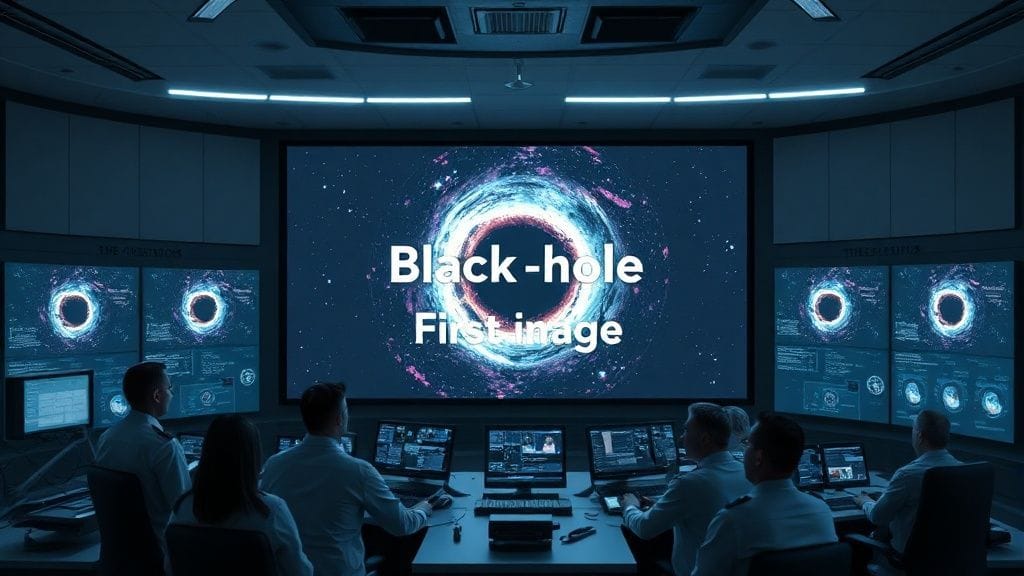
The announcement day was a crescendo. Media outlets worldwide broadcast press conferences simultaneously. Scientists unveiled the blurry, haunting ring: a fiery plasma swirling around an all-consuming darkness.
The image was both simple and profound. It confirmed predictions with stunning accuracy—the size, shape, and brightness of the ring matched theoretical models. This was the event horizon’s shadow, the boundary of no return—a cosmic silhouette cast in radio waves.
Peering into M87’s Heart: Interpreting the Ring of Light
The ring’s asymmetric brightness—more luminous on one side—revealed the black hole’s rotation, bending light through an extreme "gravitational lens" effect. Plasma heated to billions of degrees spiraled around the event horizon, emitting synchrotron radiation detectable from Earth.
This was physics in action: gravity warping space and time so profoundly that light itself was trapped, twisted, and distorted. The image was a portal into extreme conditions impossible to replicate.
The Scientific Frenzy: Confirmations and Debates
In the weeks and months following, scientists worldwide scrutinized the image and methods. Peer-reviewed papers confirmed that the visualization was robust, yet discussions around details and interpretations flourished.
Some debated the black hole’s spin rate, others probed alternative explanations. But the consensus was overwhelming: This was the first direct image of a black hole, a triumph for physics and observational astronomy.
How Teams Overcame Doubt and Data Deluge
Behind the discovery lay years of setbacks: funding struggles, extreme weather at observatories, the challenges of synchronizing instruments on different continents.
The sheer volume of data—five petabytes total—posed logistical nightmares. Every detail—from clock synchronization to atmospheric distortion—required meticulous work, demonstrating human perseverance against cosmic odds.
Black Hole in the Public Eye: Cultural and Educational Impact
The image captured imaginations. It became an icon on social media, featured in museums, and integrated into education curricula worldwide.
Documentaries, books, and exhibitions unpacked its meaning, bringing abstract science into accessibility. The black hole symbolized curiosity and exploration, inspiring new generations to look skyward.
From Pixels to Paradigm Shifts: The Scientific Legacy
Beyond the stunning image, the discovery opened avenues for understanding gravity, matter under extreme conditions, and the limits of physical laws.
It set the stage for future experiments testing Einstein’s theory with unprecedented precision, probing quantum gravity, and investigating the mysteries lurking behind event horizons.
Expanding Our Cosmic Horizon: What Comes Next?
With the first image achieved, plans for dynamic, multi-frequency observations were underway. Capturing black holes in motion—accretion flows, jet formation, and even merging systems—promised to revolutionize astrophysics.
New arrays, expanded baselines, and space-based telescopes are envisioned to sharpen these cosmic portraits.
The Black Hole Image and the Quest for Fundamental Physics
Beyond astrophysics, this breakthrough touched fundamental physics. The event horizon connects with Hawking radiation, information paradoxes, and the search for a unified theory.
It posed profound questions: What happens inside a black hole? How do spacetime and quantum mechanics reconcile at singularities? The image was a beacon lighting a deep scientific frontier.
Humanity’s Place in the Universe: Reflections on the Discovery
Looking at the first image of the black hole is humbling. We, tiny beings on a pale blue dot, have mapped light trapped billions of years ago in a distant galaxy’s heart.
It speaks to humanity’s unyielding desire to understand—to reach beyond limits, to illuminate darkness, literally and metaphorically.
The Challenges of Visualizing the Invisible
This achievement was a masterpiece not only of science, but of imagination. To construct an image of the invisible, scientists had to invent new observational strategies, redefining the idea of “seeing” in astronomy.
It was as much a technological and conceptual leap as any great exploration.
Voices from the Scientists: Anecdotes and Emotions Behind the Discovery
Lead scientist Sheperd Doeleman described the discovery as “the start of a new age of exploration.” Others recounted the moments when data finally converged into a circle of fire—emotions ranging from disbelief to awe.
These human stories remind us science is not cold data, but a passionate quest filled with triumph and collaboration.
The Data Giants: Petabytes and the Power of Computation
Handling five petabytes of data—equivalent to over a million hours of music—required innovative processing methods.
Unprecedented computational efforts exaggerated the scale of modern scientific inquiry, showing how data science and astronomy now interweave.
Black Holes in Popular Imagination: From Science Fiction to Reality
Once relegated to speculative fiction, black holes entered everyday consciousness, inspiring films like Interstellar and countless stories.
Now made tangible, they blur the line between myth and reality, elevating understanding while deepening mystery.
Future Black Hole Images: Toward a Dynamic View of the Cosmos
The first image was but a still frame in a vast cosmic movie. Future observations aim to reveal how black holes consume matter, power jets, and evolve over time.
Watching these enigmatic giants live and breathe will change how we perceive the universe’s architecture.
Outreach and Education: Inspiring a New Generation of Explorers
As educators harnessed this discovery, students found new interest in STEM fields. Initiatives incorporating real data and visualization projects sparked curiosity and empowered young minds worldwide.
The black hole image stands as a beacon for scientific literacy and wonder.
The Global Symphony of Science: Event Horizon Telescope as a Model
The EHT exemplifies how multinational collaboration—through sharing infrastructure, expertise, and vision—can achieve the extraordinary.
It serves as a template for tackling future grand challenges in science and beyond.
A Lasting Symbol: The First Black Hole Picture as an Icon of Human Curiosity
The image is a treasure—etched in memory and culture—as much as in science. It symbolizes the spirit of inquiry: forever pushing the frontier of the unknown, turning the invisible into insight, and illuminating the universal dance of light and darkness.
Conclusion
The first image of a black hole is not merely a photograph; it is a testament to human ingenuity, cooperation, and the relentless pursuit of knowledge. It marks a watershed moment, where centuries of ideas, experiments, and dreams coalesced into a single frame—a cosmic portrait of mystery made manifest. Beyond validating Einstein, black holes, and physics themselves, this discovery invites us all to reflect on our place in the universe: humble observers gazing into the eternal abyss, seeking to understand the forces that shaped everything from the smallest particles to the grandest galaxies. The dark shadows and glowing rings remind us that scientific curiosity is as boundless as the cosmos itself, and that the darkness we fear may one day illuminate our brightest insights.
Frequently Asked Questions (FAQs)
1. What exactly does the first image of a black hole show?
The image captures the silhouette or "shadow" of the black hole’s event horizon, surrounded by a bright ring of superheated plasma swirling around it. It visualizes the boundary beyond which nothing, not even light, can escape.
2. Why was the black hole in M87 chosen for imaging?
M87’s black hole is supermassive—as large as billions of suns—and relatively close (55 million light-years), making its event horizon large enough in the sky to be resolved by Earth-spanning telescopes.
3. How did the Event Horizon Telescope work?
The EHT used very-long-baseline interferometry to combine radio waves collected simultaneously from multiple telescopes worldwide, effectively creating a telescope as large as Earth with unparalleled resolution.
4. How did this discovery confirm Einstein’s theory of General Relativity?
The size and shape of the black hole’s shadow precisely matched the predictions of general relativity for a rotating black hole, providing direct observational confirmation of its core assumptions.
5. What were the biggest challenges faced by the scientists?
Synchronizing telescopes worldwide, handling enormous data volumes, and processing noisy signals distorted by the atmosphere were major hurdles overcome through innovation and relentless collaboration.
6. What impact has this discovery had beyond the scientific community?
The image captured public imagination worldwide, inspiring education, pop culture, science advocacy, and renewed interest in astronomy and physics.
7. Are there plans to image more black holes in the future?
Yes. The EHT will expand and upgrade to capture dynamic images of other black holes, including Sagittarius A*, the black hole at the center of our own Milky Way.
8. What does this discovery mean for our understanding of the universe?
It opens new windows into extreme physics, quantum gravity, and the evolution of galaxies, pushing the frontier of knowledge and highlighting humanity’s capability to explore the cosmos.