Table of Contents
- Dawn of a New Era: The Autonomous Drone Swarm Test in China, 2022
- Shadows of Innovation: The Global Race for Drone Supremacy
- Technological Roots: AI and the Rise of Autonomous Systems
- Unveiling the Swarm: The Scene in the Chinese Desert
- The Architects Behind the Drones: Visionaries and Strategists
- The Test Day: Precision, Chaos, and Coordination
- A Dance of Machines: The Mechanics of Swarming Intelligence
- Data Over the Horizon: Real-Time Autonomy in Action
- The Silent War: Military Implications Beyond the Test Site
- The Human Element: Engineers, Soldiers, and the Weight of Expectations
- International Reactions: Allies Applaud, Rivals Contemplate
- Ethical Storms: Autonomy, Control, and the Question of Responsibility
- Economic Echoes: The Drone Industry Transformed
- From Battlefield to Civilian Skies: Wider Applications and Concerns
- The Legacy Begins: How 2022 Marked a Paradigm Shift
- Challenges Ahead: Reliability, Security, and Escalation Risks
- The Swarm’s Future: Toward Ubiquity or Restraint?
- Voices from the Field: Eyewitness Accounts and Insider Perspectives
- Breaking Boundaries: The Test as a Symbol of Technological Determinism
- Conclusion
- FAQs
- External Resource
- Internal Link
1. Dawn of a New Era: The Autonomous Drone Swarm Test in China, 2022
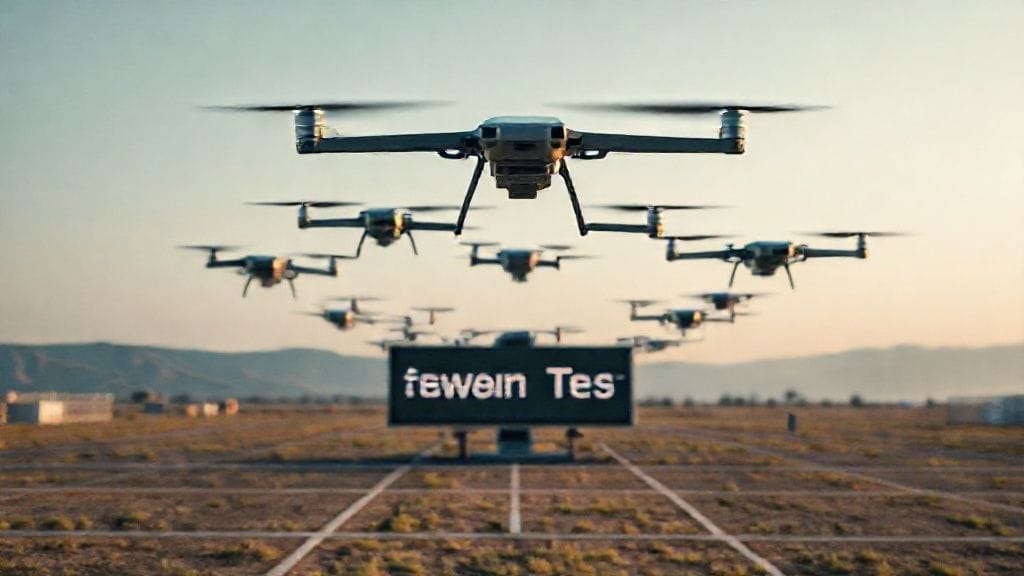
November 2022. The sun dipped low over the barren expanse of the Gobi Desert, casting elongated shadows over a gathering of figures clad in military green and engineering white. Amongst the scattered sand dunes, a silent symphony was about to begin—not orchestrated by human hands alone, but by the collective mind of a drone swarm. Hundreds of compact drones hummed gently, their cameras and sensors gleaming under the twilight. Then, with a subtle cue, the swarm lifted as one. They ascended, ebbed, and flowed in a mesmerizing choreography of relentless precision. This was no longer the stuff of speculative fiction—it was a tangible testament to mankind’s step into autonomous warfare. China’s 2022 autonomous drone swarm test was a watershed moment, signaling a future where machines would think, decide, and act in unison without direct human control.
This wasn’t merely a technological demonstration. It was a bold statement—a heralding of a future shaped by artificial intelligence driving tactical military decisions at speeds beyond human grasp.
2. Shadows of Innovation: The Global Race for Drone Supremacy
Long before the skies turned alive with autonomous drones, the world had been witnessing an accelerating arms race in unmanned aerial vehicles. From the rudimentary reconnaissance drones deployed in the 2000s to the more sophisticated, remotely piloted war machines of the 2010s, the trajectory was clear: drones were the future of warfare. The United States led the early charge, embedding drones deeply into their military framework.
However, by 2020, other global powers, notably China, Russia, and Israel, had shifted their sights toward not just remote operation but full autonomy. The autonomous drone swarm emerged as the holy grail—a system that could overwhelm enemy defenses, adapt on the fly, and execute complex missions with minimal human intervention. China’s program, shrouded in secrecy, had quietly advanced in this domain, making the 2022 test not a spontaneous reveal but the climax of years of intense research, development, and strategic ambition.
3. Technological Roots: AI and the Rise of Autonomous Systems
The test that captured global attention in 2022 was by no means a sudden leap. It owed its existence to decades of progress in machine learning, sensor miniaturization, network communication, and computational power. Autonomous drone swarms are more than just fleets of machines flying in formation; they epitomize distributed artificial intelligence—machines communicating, negotiating, and adapting collectively.
Chinese researchers integrated cutting-edge algorithms mimicking biological swarms—bees, birds, fish—that display decentralized intelligence. This nature-inspired engineering allowed the drones to coordinate without central command, sharing data instantaneously, recalculating paths, and dynamically responding to threats and environmental changes.
The evolution from human-operated UAVs to autonomous systems represented a transformation not just technologically, but philosophically: who controls the battlefield—man or machine?
4. Unveiling the Swarm: The Scene in the Chinese Desert
The chosen setting for the trial was deliberately austere—an isolated sector in Inner Mongolia’s Gobi Desert, far from prying eyes and buzzing satellites. The vast, flat terrain provided a perfect canvas for the drones to demonstrate high-speed maneuvering, obstacle avoidance, and collective target engagement.
On the day of the test, the atmosphere was electric with anticipation. Military officials, robotics scientists, and government observers stood poised as the ground control systems initiated the launch sequences. The drones emerged from their bays, gleaming sleekly against the sky. Their ascent was at first hesitant but quickly morphed into a fluid ballet, a swarm moving as one organism.
The complexity of the formation, in which hundreds of autonomous units avoided collisions while tracking dynamic targets, stunned even the most seasoned observers, signaling a leap well beyond current Western counterparts.
5. The Architects Behind the Drones: Visionaries and Strategists
Behind the swarm was a coalition of visionary scientists and military tacticians, led by Dr. Li Huan, a robotics prodigy hailed within China’s defense circles. Her team, part of the larger Aviation Industry Corporation of China (AVIC), had labored in secrecy for years to bridge the gap between academic AI research and battlefield-ready technology.
Dr. Li consistently emphasized the hybrid nature of the project—not simply a military tool, but a platform for future autonomous systems. “We are teaching machines to think not as individuals, but as a collective mind. It is evolution at a mechanical scale,” she explained during a rare post-test briefing.
Meanwhile, strategists envisioned the drone swarm not merely as weapons but as force multipliers—able to perform reconnaissance, overwhelm enemy air defenses, and provide real-time intelligence with unprecedented speed.
6. The Test Day: Precision, Chaos, and Coordination
November 15th, 2022. As dawn broke, the desert air was tinged with a chill and anticipation. The autonomous drone swarm test commenced with a countdown tone over secure communication channels. Once airborne, the drones dispersed rapidly, scanning their virtual operating environment.
What followed was a masterclass in organized chaos. The swarm split into smaller “squads,” executing coordinated search patterns, detecting simulated enemy threats, and converging for strike simulations. Each drone processed sensor inputs individually yet responded synergistically, an orchestration so fluid it resembled a living organism.
Observers noted how the swarm adapted instantly to changes—one “drone” simulated malfunction and the swarm immediately recalibrated, rerouting tasks and compensating effortlessly. It was not perfect—swarms are inherently unpredictable—but the overall success was undeniable. For the first time, a nation-state had showcased an operational autonomous drone swarm at such scale and complexity.
7. A Dance of Machines: The Mechanics of Swarming Intelligence
At the core of the swarm’s success lay intricate algorithms inspired by natural swarms. Drones utilized distributed consensus models, reinforced learning protocols, and real-time data fusion to maintain formation integrity and mission dynamism.
Unlike traditional command hierarchies, the swarm operated without a single point of failure—every drone was an intelligent node, sharing situational awareness and adjusting behavior continuously. This decentralized control made the swarm highly resilient against electronic warfare and cyberattacks.
Physically, the drones weighed under five kilograms, equipped with advanced optical sensors, radar, and lightweight edge computing units, enabling onboard decision-making. The challenge was synchronizing all units at high speeds—akin to hundreds of dancers moving to an unheard rhythm but in perfect harmony.
8. Data Over the Horizon: Real-Time Autonomy in Action
The operational autonomy showcased was coupled with secure, low-latency communication links enabling real-time data relay to command centers thousands of miles away. This connectivity meant commanders could issue high-level objectives, but the drones determined precise tactics in real time.
This capability allowed the swarm to process battlefield conditions independently—allocating resources, identifying threats, and adapting missions mid-flight. For the first time, human operators ceded tactical control of an air operation to machines, trusting AI’s rapid calculations over human reflexes.
The consequences extended beyond the battlefield: the swarm was a mobile, autonomous sensor network capable of relaying intelligence instantaneously, potentially transforming information warfare and strategic command.
9. The Silent War: Military Implications Beyond the Test Site
Although the test was conducted under strict confidentiality, word leaked swiftly through intelligence channels worldwide. For military establishments, the demonstration was a clarion call—future wars might be fought not by manned aircraft squadrons but by autonomous swarms capable of outmaneuvering defenses en masse.
China’s test indicated strategic ambitions to gain air dominance through disruptive swarming tactics capable of rapid, precise strikes and surveillance. The era of solitary drone strikes seemed eclipsed by the collective power of these mechanical legions.
This posed profound challenges: countermeasures against such swarms remain nascent and the risks of escalation increased, as autonomous systems might operate at speeds and scales that outpace human decision cycles.
10. The Human Element: Engineers, Soldiers, and the Weight of Expectations
Behind the slick technology stood a web of human narratives—engineers who sacrificed sleep for months, military personnel anxious to validate years of training, and political leaders betting on a technological edge.
The autonomy introduced discomfort alongside excitement. Some officers privately questioned if ceding control to AI diminished the moral responsibility of war decisions. Engineers faced ethical dilemmas, aware that the codes they wrote could unleash deadly automated tactics.
Yet, the prevailing sentiment was clear: the future belonged to those who harnessed autonomous systems first and best. The weight of this responsibility bore heavily on those present at the test.
11. International Reactions: Allies Applaud, Rivals Contemplate
News of the test sent ripples through global capitals. Allies of China lauded technological prowess, envisioning domestic uses ranging from disaster relief to agricultural monitoring. On the other hand, rival nations saw the demonstration as a threat, catalyzing debates on arms control and the militarization of AI.
U.S. defense officials publicly confirmed awareness of the test but downplayed immediate concerns—yet intelligence assessments suggested intensified research funding to counter autonomous drone swarms.
Meanwhile, international bodies grappled with the question: should autonomous weapon systems be regulated? Amid calls for restraint, the test underscored the urgency of global frameworks to address emerging warfare technologies.
12. Ethical Storms: Autonomy, Control, and the Question of Responsibility
The 2022 test reignited ethical debates surrounding autonomous weapons systems. Critics warned of “killer robots” operating independently, potentially denying humans the crucial pause for moral judgment.
China’s program claimed humans maintained strategic control, with AI handling tactical maneuvers. However, as systems grow more autonomous, defining the line becomes tenuous.
Philosophers and ethicists questioned whether machines could ever understand the complexities of human conflict, the value of life, and proportionality. The test amplified this discourse, demanding urgent discussions on accountability, legal parameters, and the role of conscience in automated warfare.
13. Economic Echoes: The Drone Industry Transformed
Beyond military corridors, the autonomous drone swarm test fueled a surge of investment and innovation in China’s drone industry. Startups specializing in swarm AI thrived, and government funding accelerated the integration of such technologies into commercial sectors.
The demonstrable success in military contexts promised markets for autonomous logistics, surveying, and infrastructure inspection. Yet, it also raised concerns about dual-use technologies proliferating globally, potentially falling into non-state hands or illicit operations.
The 2022 demonstration unlocked an economic storm, entwining security ambitions with entrepreneurial dynamism.
14. From Battlefield to Civilian Skies: Wider Applications and Concerns
Though designed for war, swarm drone technology harbors expansive civilian potential. Disaster management—such as coordinated search and rescue—benefits from rapid, autonomous capability.
Yet, with great power comes great uncertainty: privacy advocates voiced fears over mass drone surveillance, while urban planners debated airspace management. The technology threatens to reshape how societies interact with automated machines daily.
The 2022 test was thus both an energy release for militarization and a bellwether for technological shifts touching everyday lives.
15. The Legacy Begins: How 2022 Marked a Paradigm Shift
In the annals of military innovation, 2022 will be remembered as the year autonomous drone swarms moved from theory to practiced reality. This test planted flags on the frontier of AI-driven warfare, denoting a turning point where machines increasingly take tactical initiative.
Its legacy is multifaceted: technological mastery, strategic recalibration, ethical reflection, and global competition all converged. The implications will echo in strategy rooms and human minds for decades.
16. Challenges Ahead: Reliability, Security, and Escalation Risks
Despite the test’s success, major hurdles remain. Autonomous systems must prove reliable in chaotic combat zones riddled with electronic warfare and cyber threats. Sabotage, hacking, or malfunction could produce unintended escalation or catastrophic failure.
Moreover, command and control doctrines must evolve to integrate such systems safely, ensuring humans retain ultimate decision authority without hampering operational fluidity.
Managing these challenges will determine whether autonomous drone swarms stabilize or destabilize future conflicts.
17. The Swarm’s Future: Toward Ubiquity or Restraint?
Looking forward, the trajectory suggests continued advances and mushrooming deployment of swarm technologies across militaries worldwide. However, international treaties, ethical norms, and technological safeguards may enforce constraints.
Whether the autonomous drone swarm becomes ubiquitous as a standard military asset or remains bounded by control mechanisms depends on global consensus—an elusive but vital endgame.
18. Voices from the Field: Eyewitness Accounts and Insider Perspectives
One of the engineers, Mei Zhang, remarked, “Watching the swarm lift felt like releasing a thousand tiny soldiers with minds of their own. It was thrilling, and terrifying.” A military officer reflected, “For the first time, I feared being outrun by a machine that doesn’t sleep, doesn’t falter, and doesn’t hesitate.”
These personal testimonies humanize a technology often perceived as cold and mechanical, revealing the profound emotional stakes intertwined with innovation.
19. Breaking Boundaries: The Test as a Symbol of Technological Determinism
Ultimately, the 2022 autonomous drone swarm test crystallizes the dialectic of technology shaping society and conflict. It symbolizes an epoch where human ingenuity crafts not mere tools but autonomous agents—agents that may forever alter the calculus of war, peace, and power.
Conclusion
The autonomous drone swarm test in China, 2022, was far more than a demonstration—it was a pivotal moment in human history. It showcased a convergence of artificial intelligence, robotics, and military ambition, opening doors to new forms of conflict and coexistence with intelligent machines. This chapter forces humanity to confront profound questions about control, responsibility, and the future of warfare. For while machines now fly together as one, it is ultimately human wisdom and conscience that must guide their wings.
FAQs
Q1: What is an autonomous drone swarm?
An autonomous drone swarm is a group of drones controlled by AI systems capable of independent decision-making and coordinated action without direct human piloting.
Q2: Why was China’s 2022 test significant?
It marked the first public demonstration of a large-scale, complex, and functional autonomous drone swarm, highlighting China’s advancement in AI-driven military technology.
Q3: Who led the research behind this technology?
Dr. Li Huan and a team under the Aviation Industry Corporation of China (AVIC) orchestrated the development.
Q4: What are the potential military applications of drone swarms?
They can overwhelm enemy defenses, conduct surveillance, execute precision strikes, and operate as resilient sensor networks.
Q5: What ethical concerns does this technology raise?
Concerns revolve around delegating lethal decisions to machines, accountability, and the potential for accidental escalation.
Q6: How did the international community respond?
Reactions ranged from strategic concern and calls for regulation to interest in civilian applications.
Q7: What challenges need to be addressed moving forward?
Ensuring reliability in combat conditions, securing systems against hacking, and maintaining human control over lethal actions are key challenges.
Q8: Could this technology be adapted for civilian uses?
Yes, including disaster response, environmental monitoring, and logistics, though it carries privacy and regulatory challenges.