Table of Contents
- The Dawn of a New Era: MRI and the First Human Scan
- The Scientific Landscape Before MRI
- Raymond Damadian: The Visionary Behind the Machine
- The Technical Challenges in Building the First MRI Scanner
- The First Patient: From Theory to Reality
- The Night of July 3, 1977: The First Human MRI Scan
- Early Images and Their Impact on Medicine
- Skepticism and Resistance from the Medical Community
- The Parallel Race: Paul Lauterbur and Peter Mansfield’s Contributions
- How MRI Changed Diagnostic Medicine Forever
- The Technology’s Evolution: From Static Images to Functional MRI
- The Cultural and Ethical Questions Raised by MRI
- MRI in Pop Culture and Public Imagination
- Economic Implications: Costs, Accessibility, and Healthcare Systems
- Global Spread and Adaptation of MRI Technology
- Training the Next Generation: Education and Research in MRI
- The Personal Stories Behind the Machine
- How MRI Influenced the Neurosciences
- MRI and the Human Brain: Opening New Windows
- Modern Innovations: Beyond the First Human Scan
- The Continuing Debate on Patents and Commercial Rights
- Lessons Learned and the Future of MRI
- Remembering July 3, 1977: Commemorations and Legacy
- MRI’s Place in Medical History: A Revolution in Imaging
- The Unseen Scans: MRI’s Broader Impact Beyond Medicine
The summer evening of July 3, 1977, in the United States would become a landmark moment in medical history—a night when science fiction blurred into reality, and an invisible world within the human body was captured for the first time in stunning detail. The air was thick with anticipation and cautious hope inside the research facility that housed the newly built magnetic resonance imaging (MRI) machine. This wasn’t just another clinical experiment; it was a revolution quietly unfolding in the shadows of a quiet laboratory. The first human MRI scan was more than a technical achievement; it was a transformative leap that promised to redefine medicine’s relationship with the human body.
The Dawn of a New Era: MRI and the First Human Scan
In the decades leading to 1977, medical imaging had undergone remarkable progress: X-rays offered glimpses beneath skin, ultrasound painted living organs in motion, and CT scans introduced the concept of slicing the body layer by layer. Yet, these modalities came with limitations—ionizing radiation, low contrast for soft tissues, or limited resolution. Enter MRI, a modality promising non-invasive, radiation-free images with unprecedented clarity, particularly for the brain, spinal cord, joints, and soft tissues.
The story of the first human scan begins not with machines but with atoms—the atoms inside the human body and how they respond to magnetic fields and radio waves. This curious intersection of physics and biology ignited imaginations, but it would take years of persistence, trial, and error to turn theory into practice.
The Scientific Landscape Before MRI
Before MRI entered the scene, the world of diagnostic imaging was dominated by X-rays and ultrasound, both remarkable in their way but constrained by physical and biological limitations. Wilhelm Röntgen’s discovery of X-rays in 1895 had revolutionized medicine by unveiling bones and certain internal structures. Yet its use involved ionizing radiation, raising long-term safety concerns. Ultrasound provided safe, real-time imaging but was best suited for fluid-filled or soft tissue structures, falling short in brain or joint imaging.
By the mid-20th century, physicists and engineers hunted for alternatives that could reveal the body’s inner workings without invasive procedures or radiation exposure. Magnetic resonance, a quantum phenomenon observed in nuclear spin, emerged as a promising candidate. The underlying principles had been known since the 1940s, with Felix Bloch and Edward Purcell’s Nobel Prize-winning work on nuclear magnetic resonance (NMR), but its application to human body imaging remained elusive.
Raymond Damadian: The Visionary Behind the Machine
At the heart of the MRI’s inception stood Raymond Damadian, a physician and scientist whose determination bordered on obsession. In the late 1960s, Damadian made a breakthrough: discovering that cancerous tissue and normal tissue responded differently to magnetic resonance signals, hinting at clinical applications for early cancer detection.
Damadian’s work was pioneering but faced skepticism. His concept of scanning the human body using magnetic resonance was complex and fraught with technical hurdles. His early patent filings conflicted with academic norms, stirring controversy, yet he pressed on. His vision wasn’t just academic curiosity—it was personal, driven by a commitment to saving lives through early detection.
The Technical Challenges in Building the First MRI Scanner
Building the first MRI scanner was an engineering odyssey. The machine required a powerful, highly uniform magnetic field to align nuclear spins, sophisticated radiofrequency coils to excite and detect signals, and computer systems capable of decoding raw data into images.
One prominent challenge was patient accommodation. The scanner had to be large enough to fit a human, yet stable and safe. Cooling systems were essential to prevent superconducting magnets from overheating, and algorithms were needed to translate the complex signals into ordered images.
Damadian and his team constructed the “Indomitable,” an early prototype housed in a Kentucky laboratory. Its operation was slow and noisy—the first scans took hours—but the machine embodied human ingenuity and scientific courage.
The First Patient: From Theory to Reality
The first human subject for an MRI scan symbolized a leap from experimental physics to clinical medicine. The patient was a volunteer, a young man whose role was critical in turning the promise of MRI into a tangible reality.
In this quiet, technical environment, the anticipation was palpable. Would the invisible patterns of hydrogen atoms within the body be captured as envisioned? Would the images reveal anything meaningful?
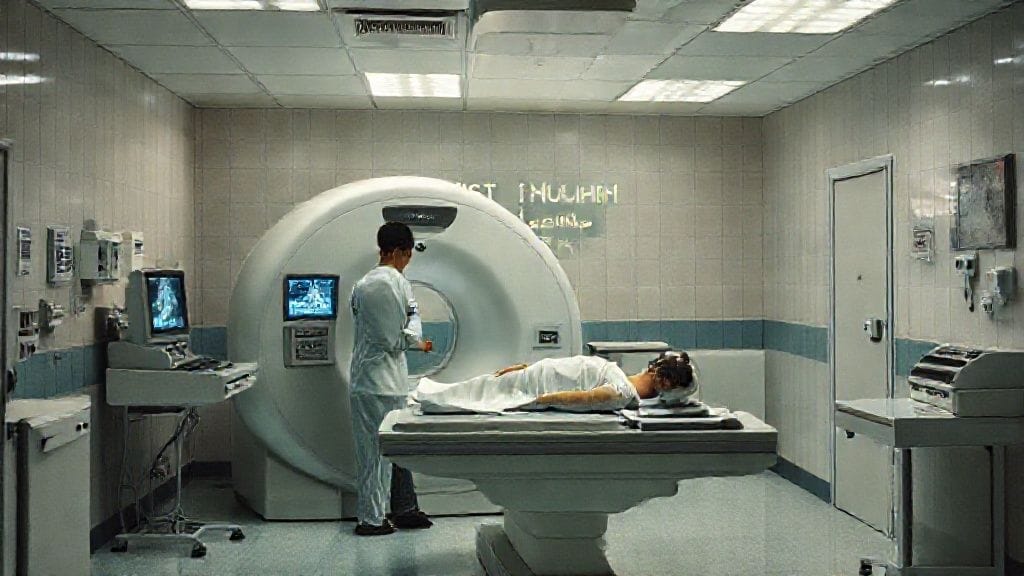
The process was painstakingly slow. The patient lay amid the colossal machine emitting loud vibrations and magnetic pulses. Minutes stretched into hours—a test of patience and trust. Yet, as the scan was completed and data processed, the first images emerged, grainy yet unmistakably detailed portions of the human anatomy.
The Night of July 3, 1977: The First Human MRI Scan
July 3, 1977, was much like any summer day—unremarkably warm, humidity hovering low—but inside the research room, an extraordinary event was about to rewrite the medicine textbooks. The scanner hummed with life, circuits thrumming, magnetic fields stabilizing as the first human subject entered its magnetic embrace.
The room was silent except for the rhythmic pulse of the equipment and the faint murmur of technicians. The patient’s body became the object of intense scrutiny, not with scalpels or radiation beams, but with the subtle interplay of nuclear spins danced to a magnetic symphony.
Hours later, shapes and textures materialized on screens—the first MRI images of a living human being. They revealed not just bones or shadows, but soft tissues with depth and contrast unseen before.
The exhilaration was tempered by the slow pace and technical imperfections, but the promise was undeniable.
Early Images and Their Impact on Medicine
Though primitive by today’s standards, the early MRI images astonished physicians and radiologists alike. For the first time, soft tissues such as the brain's gray and white matter, spinal cord, muscles, and joints could be discerned clearly, without the fog of overlapping structures.
Clinicians began envisioning new diagnostic possibilities: detecting tumors with higher precision, understanding neurological disorders, and avoiding invasive exploratory surgeries.
Yet, these were still early days. The images required interpretation, and skepticism lingered as the medical community balanced optimism with evidence.
Skepticism and Resistance from the Medical Community
Introducing a radically new technology into clinical practice invariably evokes both enthusiasm and resistance. MRI was no exception.
Traditional radiologists questioned the practicality of this slow, cumbersome, and expensive machine. Some doubted its clinical value, citing lack of immediate results and the unclear diagnostic advantages over established imaging.
Adding to the tension was continuing debate over patents and credit, with Damadian’s claims contested by other researchers.
Nevertheless, early adopters who saw beyond initial limits championed MRI’s potential—paving the way for clinical trials and expanded research.
The Parallel Race: Paul Lauterbur and Peter Mansfield’s Contributions
While Damadian spearheaded the first human MRI scan, others raced forward independently. Paul Lauterbur introduced the concept of magnetic field gradients to encode spatial information, turning NMR signals into images rather than simple spectrums.
Peter Mansfield optimized techniques for rapid image acquisition and developed mathematical methods to analyze MRI signals.
These two scientists, along with Damadian, shared the limelight in advancing MRI technology, though controversies about credit and invention persisted.
Lauterbur and Mansfield were later awarded the Nobel Prize in Physiology or Medicine in 2003 for their contributions, sparking debates about the recognition of Damadian’s role.
How MRI Changed Diagnostic Medicine Forever
MRI’s emergence reshuffled the deck of diagnostic medicine. No longer dependent on ionizing radiation, physicians had a tool to see organs in exquisite detail safely, repeatedly, and non-invasively.
MRI became indispensable in neurology, oncology, orthopedics, and cardiology. It revealed brain tumors, spinal cord injuries, joint disorders, multiple sclerosis lesions, and subtle anatomical abnormalities with diagnostic precision.
MRI’s flexibility, combined with its lack of side effects, transformed patient management, reducing diagnostic surgeries, and enabling earlier interventions.
The Technology’s Evolution: From Static Images to Functional MRI
The 1977 first human scan was static and anatomical, but the future would hold dynamic promises. By the 1990s, researchers developed functional MRI (fMRI), capturing changes in blood flow linked to neural activity, effectively mapping the living brain in action.
This extended MRI’s reach from structure to function, revolutionizing cognitive neuroscience, psychology, and brain surgery planning.
New pulse sequences and faster machines further improved resolution and speed, expanding clinical and research applications.
The Cultural and Ethical Questions Raised by MRI
With unprecedented access to the body’s inner world came profound cultural and ethical questions. Who owns the images and the data they reveal? How should incidental findings be handled?
MRI forced society to rethink privacy around medical information and raised concerns about the commercialization of health technologies.
Moreover, the accessibility and expense of MRI created disparities between regions and populations, prompting debates about equity in healthcare.
MRI in Pop Culture and Public Imagination
MRI’s marvel soon permeated popular culture. Documentaries, films, and media portrayed the machine as a window into the unseen—symbolic of medical progress, human understanding, and even the mind’s mysteries.
This visibility helped foster public support but sometimes inflated expectations about what MRI could deliver instantly.
Economic Implications: Costs, Accessibility, and Healthcare Systems
MRI scanners initially were prohibitively expensive — hundreds of thousands to millions of dollars — limiting their availability to wealthy hospitals in developed countries.
Their costs spurred discussions on healthcare resource allocations, insurance reimbursements, and cost-benefit analyses.
Over time, technological improvements and manufacturing scale reduced costs, increasing accessibility, yet financial barriers remain in many parts of the world.
Global Spread and Adaptation of MRI Technology
Following the pioneering efforts in the US, MRI technology spread globally. Hospitals and research centers across Europe, Asia, and beyond adopted and adapted the technology to local needs.
Collaborations between engineers, physicists, and clinicians worldwide accelerated innovations, and regulatory agencies established standards for safety and effectiveness.
Developing nations faced challenges in import costs and infrastructure, but several MRI centers emerged, contributing to global health improvements.
Training the Next Generation: Education and Research in MRI
The complexity and promise of MRI fostered a new multidisciplinary field combining radiology, physics, engineering, and computer science.
Training programs specialized in MRI operation and interpretation became cornerstones in medical education, enabling continuous innovation and clinical excellence.
Research continues still, propelled by curiosity and technology, exploring new contrasts, imaging techniques, and AI integration.
The Personal Stories Behind the Machine
Beyond patents and technical articles, many personal stories animate the MRI saga. Patients whose tumors were detected early, scientists who sacrificed years of their careers, and families impacted—each human story enriches this history.
One can only imagine the courage of that first patient lying within the machine’s magnetic embrace, unknowingly making history.
How MRI Influenced the Neurosciences
MRI transformed neuroscience, enabling non-invasive studies of brain anatomy and function.
It revealed neural connectivity, pathologies, and brain plasticity, reshaping concepts of brain disorders and leading to better therapies.
From depression to epilepsy, MRI informed diagnosis, prognosis, and treatment monitoring.
MRI and the Human Brain: Opening New Windows
The capacity to see inside the living brain changed our self-understanding. MRI exposed physical substrates of cognition, emotion, and illness, bridging biology and psychology.
It demystified conditions once relegated to speculation, fostering compassion and scientific rigor.
Modern Innovations: Beyond the First Human Scan
Today’s MRI machines are faster, more powerful (7 Tesla and above), and capable of multidimensional imaging—combining anatomy, physiology, biochemistry, and molecular information.
Techniques like diffusion tensor imaging (DTI) illuminate neural pathways, and real-time MRI captures dynamic physiology.
The first human scan’s humble images were but a prologue.
The Continuing Debate on Patents and Commercial Rights
The race to pioneer MRI was also a race for intellectual property. Damadian’s early patents clashed with those of Lauterbur and Mansfield, igniting decades of legal and ethical debates.
These controversies underscore tensions between scientific collaboration and proprietary interests, influencing how innovations are shared or commercialized.
Lessons Learned and the Future of MRI
The MRI story teaches resilience, interdisciplinary collaboration, and vision. It shows that pioneering breakthroughs often face skepticism but can transform the way humanity perceives itself.
Looking forward, MRI may integrate with personalized medicine, nanotechnology, and AI-based analysis, deepening its impact.
Remembering July 3, 1977: Commemorations and Legacy
July 3, 1977, remains a milestone commemorated by scientists and physicians worldwide. It marks not just a technological feat, but a human achievement—a promise that curiosity and perseverance can unlock hidden worlds.
Annual conferences, museum exhibits, and digital archives honor this history, inspiring future generations.
MRI’s Place in Medical History: A Revolution in Imaging
MRI stands alongside other imaging milestones as a monumental leap—lifting the veil on the human body's inner architecture with safety and precision.
It continues to save countless lives and expand scientific horizons, rooted in that first unforgettable scan.
The Unseen Scans: MRI’s Broader Impact Beyond Medicine
Beyond healthcare, MRI technology influenced materials science, archaeology, and even food industry quality control, showcasing the transformative power of an innovation born from curiosity and rigor.
Conclusion
The first human MRI scan on July 3, 1977, was not merely the activation of a machine; it was the awakening of a new lens through which humanity would come to know itself. This moment signified a bridge between abstract physics and compassionate medicine, between the invisible quantum dance of atoms and the tangible hope of healing.
At a time when images were dark silhouettes on lighter backgrounds, the MRI introduced a new narrative—a story of transparency, safety, and unprecedented detail. Behind the science stands the enduring spirit of human curiosity and perseverance, embodied in researchers like Raymond Damadian and the many unsung technicians, patients, and collaborators.
As MRI continues to evolve, shaping diagnostics, therapies, and even philosophical questions about the human self, July 3, 1977, remains a beacon—a date when the unseen within us was finally seen with clarity, care, and wonder.
This story is a testament to the endless interplay between human ingenuity and the mysteries of life.
FAQs
Q1: What exactly did the first human MRI scan reveal?
The first human MRI scan produced images of the soft tissues inside the body, particularly showing organs and anatomical structures like muscles and parts of the brain, with much clearer contrast than previous imaging techniques, without using harmful radiation.
Q2: Who was responsible for the invention of the MRI?
Raymond Damadian is credited with discovering that cancerous tissues emit different magnetic resonance signals than normal tissues and built the first MRI scanner. However, Paul Lauterbur and Peter Mansfield made essential contributions to image formation and speed, and all played critical roles in MRI development.
Q3: Why was the first human MRI scan such a monumental achievement?
Because it represented the first non-invasive method to visualize soft tissues with high resolution indefinitely, without radiation exposure, changing the scope and safety of medical diagnosis forever.
Q4: How long did the first MRI scan take?
The initial human MRI scans were very slow, often taking hours to acquire a single image due to technical limitations and the need for stable machine operation.
Q5: What were the immediate reactions from the medical community to the MRI?
There was enthusiasm but also skepticism due to expensive machines, slow imaging speed, and uncertainty about clinical usefulness. Many radiologists required further validation.
Q6: How has MRI technology changed since 1977?
MRI has evolved to include functional imaging, faster acquisition times, better resolution, specialized contrast agents, and applications ranging from brain mapping to cardiac imaging.
Q7: Are there controversies associated with MRI’s invention?
Yes. There have been disputes over patents and credit among early MRI pioneers, especially regarding Raymond Damadian's role versus Lauterbur and Mansfield.
Q8: What is the significance of MRI beyond medicine?
MRI principles and equipment have been applied to physics, materials science, archaeology, and food safety inspections, demonstrating broad interdisciplinary impact.