Table of Contents
- A New Dawn Above the Clouds: The Launch of OAO-2
- Gazing Into the Unknown: The Dawn of Space-Based Astronomy
- Pioneers on Earth: The Minds Behind the First Space Telescope
- From Dream to Reality: The Race to Build OAO-2
- The Payloads and Instruments: Eyes Beyond the Atmosphere
- Countdown to History: The December 7, 1968 Launch
- OAO-2’s First Light: Unlocking the Ultraviolet Universe
- Overcoming Early Setbacks: Challenges Beyond Earth’s Grip
- Revolutionary Discoveries: The Ultraviolet Portrait of the Cosmos
- Changing Astronomy Forever: The Impact on Science and Technology
- Collaboration Amid Cold War Shadows: Science Transcending Politics
- Human Stories: The Scientists, Engineers, and Astronomers of OAO-2
- The Legacy of OAO-2: Inspiring a New Generation of Space Telescopes
- The Path from OAO-2 to Hubble: Lessons Learned and Innovations Adopted
- Broader Cultural Ripples: How the First Space Telescope Captured Public Imagination
- The Telescope’s Final Days and Enduring Data
- Charting the Stars: How OAO-2 Changed Our Place in the Universe
- Conclusion: A Visionary Leap That Redefined Exploration
- FAQs About the First Space Telescope
- External Resource
- Internal Link
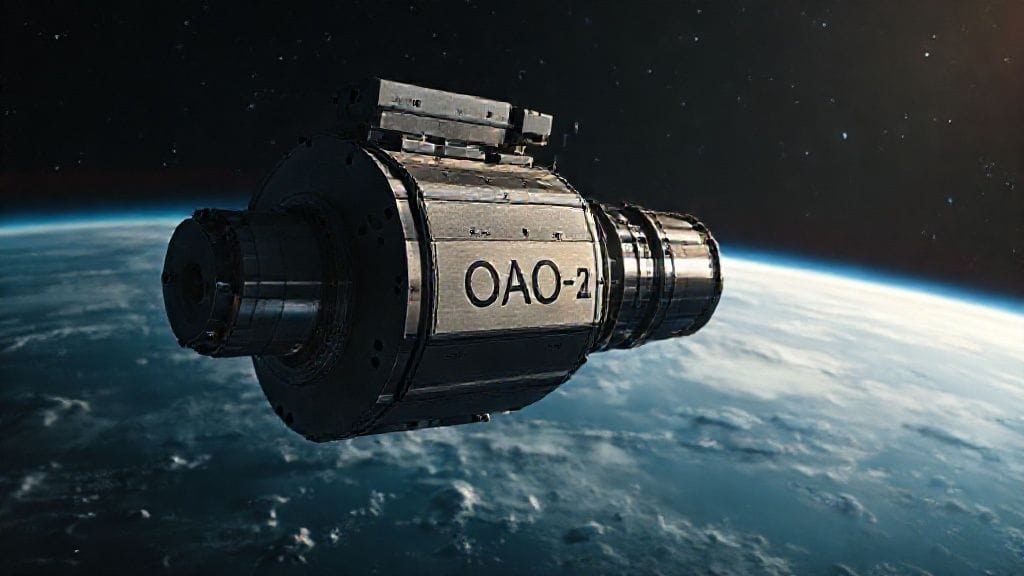
On a cold December morning in 1968, a sleek rocket carrying humanity’s latest mechanical eye soared skyward from Cape Canaveral. It was not a satellite for communication or military reconnaissance; it was something profoundly different: the first space telescope, the Orbiting Astronomical Observatory-2, or OAO-2. As its metal shell pierced the fragile veil of Earth’s atmosphere and settled into orbit, it ushered in a new era for astronomy—one in which the stars could be observed free from the distorting and light-absorbing effects of air.
A New Dawn Above the Clouds: The Launch of OAO-2
The launch of OAO-2 was an almost cinematic moment, but it was far from a mere technological feat. It signified the convergence of decades of scientific ambition, geopolitical urgency, and human perseverance. As bystanders and control-room engineers stared transfixed, the telescope began its silent mission, speeding around the Earth every 90 minutes. For countless millennia, humanity had gazed at the firmament through the haze of its atmosphere, limited by the twinkling lights they could see with the naked eye or the restricted sensitivity of ground-based telescopes. Now, with OAO-2, the ultraviolet universe—hidden from terrestrial instruments—was finally coming into focus.
Gazing Into the Unknown: The Dawn of Space-Based Astronomy
The idea of placing telescopes in space was once deemed fantastical. Before the mid-20th century, astronomy depended solely on observatories perched on mountaintops or in remote deserts. While these sites reduced some atmospheric interference, they could not eliminate it. The ultraviolet (UV) wavelengths, in particular, are almost completely absorbed by oxygen and ozone, making UV astronomy impossible from the Earth’s surface.
The solution was simple in theory but monumental in execution: send a telescope high above the atmosphere. This radical shift promised to open a new window onto the cosmos. The ultraviolet radiation emitted by stars, galaxies, and other celestial objects holds clues about their composition, temperature, and lifecycle—information inaccessible from below.
Pioneers on Earth: The Minds Behind the First Space Telescope
At the heart of this revolutionary project was a constellation of brilliant scientists and engineers. Principal among them was Dr. George Carruthers, a young astrophysicist whose work in ultraviolet rocket astronomy had paved the way for OAO-2. Supported by NASA and the U.S. Air Force, these pioneers faced a Herculean task—designing instruments that could survive the rigors of spaceflight and still operate with the precision needed to collect data across invisible light spectra.
A remarkable collaboration rallied universities, research centers, and industrial partners from across America. They were united by a shared vision to "see the unseen" and forever change our understanding of the stars.
From Dream to Reality: The Race to Build OAO-2
OAO-2’s development was a race against not just time, but rapidly evolving technology and geopolitical pressures. Throughout the 1960s, space exploration was dominated by the Cold War rivalry, with the United States seeking scientific supremacy alongside its lunar ambitions. This context propelled rapid innovation, pushing boundaries with relentless intensity.
The telescope had to be compact yet powerful; it needed complex detectors capable of capturing faint ultraviolet signals; and importantly, it had to operate autonomously, traveling thousands of kilometers above Earth with no way to be repaired once deployed. Numerous prototypes were tested, and setbacks were frequent. But these obstacles only deepened the determination of the teams.
The Payloads and Instruments: Eyes Beyond the Atmosphere
OAO-2 carried some of the most advanced ultraviolet detectors of its time, notably two spectrometers and one ultraviolet telescope called the Celescope. The Celescope alone had four different UV cameras that could photograph the sky in wavelengths between 135 and 255 nanometers—a range invisible to human eyes and inaccessible from the ground.
The spacecraft’s instruments were cooled to ensure noise-free data collection, and their sensitivity was unprecedented. This technical marvel could identify the composition of distant stars’ atmospheres, detect interstellar gases, and observe the birthplaces of stars with clarity lost to prior technologies.
Countdown to History: The December 7, 1968 Launch
The day of the launch was fraught with tension and hope. After multiple delays and system checks, the Delta rocket lifted OAO-2 into orbit at precisely 10:48 a.m. EST. For the NASA team, it was the culmination of years of painstaking work. Mission control was abuzz, monitoring the spacecraft's health and communication relays.
Upon successful deployment, OAO-2’s solar arrays unfurled, and instrumentation came to life. The first images and spectrum readings were transmitted back to Earth, promising a treasure trove of data that astronomers had only dreamed of before.
OAO-2’s First Light: Unlocking the Ultraviolet Universe
The moment OAO-2 turned its eyes to the heavens was nothing short of miraculous. Suddenly, the invisible ultraviolet light emitted by celestial bodies was laid bare. The telescope painted detailed portraits of bright stars such as Vega and Rigel, revealing their ultraviolet brightness and the interstellar materials that surrounded them.
These early observations confirmed theories about stellar radiation and the interstellar medium. Spectral lines of previously unknown particles were detected, and the dynamic processes fueling stars' creation and destruction became clearer. It was a scientific revelation: stars were no longer silent points of light but active, complex systems.
Overcoming Early Setbacks: Challenges Beyond Earth’s Grip
But space is unforgiving. Shortly after its launch, OAO-2 experienced several instrument anomalies, including detector noise spikes and temporary loss of communication. The ground teams worked tirelessly to recalibrate sensors remotely and diagnose issues.
These challenges underscored the novelty of the mission; no one had ever operated a fully autonomous ultraviolet observatory in space before. But each problem solved was a triumph of human ingenuity and perseverance. Ultimately, OAO-2 functioned far beyond its expected lifetime of one year, operating until early 1973.
Revolutionary Discoveries: The Ultraviolet Portrait of the Cosmos
The scientific harvest from OAO-2 was staggering. For the first time, astronomers could classify stars not just by visible color but by their ultraviolet signature, revealing physical properties such as temperature and chemical composition with greater precision.
OAO-2’s data deepened our understanding of stellar winds, star formation rates, and the distribution of hot gases in galactic environments. One landmark finding was the observation of UV radiation penetrating star-forming regions, providing clues about the earliest stages of stellar birth.
The mission also cataloged hundreds of ultraviolet sources, setting the groundwork for subsequent space-based observatories. The telescope's contributions were published in dozens of papers, reshaping key astrophysical theories.
Changing Astronomy Forever: The Impact on Science and Technology
OAO-2 did more than just add a few new data points; it revolutionized astronomical methodology. By proving that space-based observatories could operate successfully, it inaugurated an era where orbit became the preferred vantage point for cosmic surveyors.
The mission accelerated development in detector technologies, spacecraft stability systems, and remote data transmission. Moreover, it expanded the scope of observational wavelengths accessible to telescopes, inciting new fields like ultraviolet and X-ray astronomy.
Its success emboldened NASA to invest in even more ambitious projects, including the landmark Hubble Space Telescope decades later.
Collaboration Amid Cold War Shadows: Science Transcending Politics
Though embedded in the tense Cold War environment, OAO-2 represented a rare zone of peaceful scientific endeavor. Researchers from allied institutions shared findings openly and cooperated closely on challenges and discoveries, showing that the pursuit of knowledge could transcend geopolitical divides.
The project also demonstrated the strategic importance of space science, subtly reinforcing American technological leadership. Yet, it remained a mission motivated fundamentally by curiosity, not conquest.
Human Stories: The Scientists, Engineers, and Astronomers of OAO-2
Behind the gleaming metallic body of OAO-2 were individuals whose passion infused every bolt and circuit. From Dr. George Carruthers’ youthful vision for ultraviolet astronomy to the flight engineers’ sleepless nights troubleshooting telemetry, the mission was shaped by human dedication.
Anecdotes abound of late nights poring over data tapes, moments of doubt when instruments faltered, and triumphs that rekindled hope. Their work laid the foundation for generations of astronomers and engineers, reminding us that great breakthroughs are built on countless small acts of devotion.
The Legacy of OAO-2: Inspiring a New Generation of Space Telescopes
OAO-2’s legacy resonates to this day. It sparked a paradigm shift towards multi-wavelength space astronomy, informing future missions such as the International Ultraviolet Explorer, Copernicus satellite, and ultimately the Hubble. Beyond technology, it changed how we conceptualize the universe’s vast, invisible aspects.
Academic curricula were updated, and young scientists inspired by these early space telescope images pursued careers that propelled astrophysics into the 21st century. The mission proved that looking beyond Earth’s constraints was not just possible—it was indispensable.
The Path from OAO-2 to Hubble: Lessons Learned and Innovations Adopted
The knowledge harvested from OAO-2 informed every aspect of subsequent space telescopes. Engineers improved guidance and control systems, while scientists refined UV detectors based on OAO-2's performance.
Mistakes during OAO-2’s mission highlighted the need for in-orbit servicing—a wish fulfilled decades later by the Hubble servicing missions. This lineage underscores a crucial truth: pioneering is iterative, built on trial, error, and persistent refinement.
Broader Cultural Ripples: How the First Space Telescope Captured Public Imagination
The images and discoveries from OAO-2 reached beyond scientific circles. They stirred public imagination, making headlines in newspapers and magazines, and fostering a sense of wonder about the cosmos during a decade already electrified by the Apollo moon missions.
This cultural impact bred support for funding future astronomical projects and deepened humanity’s collective cosmic consciousness—the timeless allure of glimpsing the stars anew.
The Telescope’s Final Days and Enduring Data
OAO-2 operated successfully until early 1973, with its instruments gradually succumbing to space radiation and wear. But its treasure trove of ultraviolet data continued to inform researchers for years. Decades later, archival OAO-2 datasets still provide valuable comparative material and historical baselines for modern studies.
Its physical remains—an early artifact of orbital science—quietly orbit Earth, a sentinel of a transformative moment in human history.
Charting the Stars: How OAO-2 Changed Our Place in the Universe
By unveiling a cosmos rich in ultraviolet light, OAO-2 altered not just technical understanding but the philosophical poise of humanity. We ceased to be mere stargazers bound by earthly limitations, becoming explorers equipped to perceive the universe on its own wavelengths, vast and multifaceted.
The mission inspired the conviction that curiosity coupled with daring innovation can expand the horizons of knowledge, enriching our place in the grand tapestry of existence.
Conclusion
The launch of OAO-2, the first space telescope, on December 7, 1968, stands as a testament to human curiosity, ingenuity, and the restless desire to transcend earthly bounds. It was not solely a technological milestone but an awakening—a moment when humanity first truly lifted its gaze beyond the atmosphere, revealing hidden layers of the cosmos.
Though seemingly modest compared to its successors, OAO-2 holds a revered spot in history. It bridged dreams and realities, overcoming technical and political challenges to open an unseen universe. Its movement from concept to reality exemplifies how scientific vision can inspire generations, shaping our understanding of the heavens.
In the glow of its ultraviolet discoveries, we glimpse our future—a boundless cosmic journey, sparked by the simple act of looking upward with new eyes.
FAQs
Q1: Why was the first space telescope focused on ultraviolet astronomy?
Because Earth’s atmosphere absorbs most ultraviolet light, making it impossible to study UV wavelengths from ground-based telescopes. Ultraviolet observations reveal vital information about the composition and behavior of stars and celestial gases that visible light cannot provide.
Q2: What were the main technological challenges in building OAO-2?
The challenges included designing sensitive ultraviolet detectors capable of operating in space, ensuring spacecraft stability, cooling instruments to reduce noise, and developing autonomous systems since repairs in orbit were impossible.
Q3: Who were some key figures in the OAO-2 mission?
One of the leading scientists was Dr. George Carruthers, whose pioneering work in ultraviolet rocket astronomy led to OAO-2’s development. NASA engineers and university researchers collectively formed the backbone of the mission’s success.
Q4: How long did OAO-2 operate in space?
Initially intended to work for about one year, OAO-2 remained functional until early 1973, surpassing expectations and providing ongoing valuable data.
Q5: What were some of the major discoveries made by OAO-2?
OAO-2 produced the first detailed ultraviolet images and spectra of stars, detecting phenomena such as the composition of stellar atmospheres, interstellar gases, and star formation regions, which had been invisible to previous observatories.
Q6: How did OAO-2 influence later space telescopes like Hubble?
Its mission demonstrated the feasibility of space-based ultraviolet astronomy, highlighting the need for improved instruments, spacecraft design, and servicing capabilities. These lessons informed the design and operation of Hubble and other successors.
Q7: Did the Cold War affect the mission?
While the Cold War framed the context and urgency for scientific advancement, OAO-2 was primarily a peaceful pursuit of knowledge that fostered collaboration among academic and government institutions, setting an example of science transcending politics.
Q8: Is OAO-2 still in orbit today?
Yes, though nonfunctional, the OAO-2 spacecraft remains in Earth orbit as historical space debris, a silent witness to a pioneering chapter in space exploration.