Table of Contents
- A Flicker in the Darkness: The Dawn of the First Neon Lamp
- The Age of Illumination: Preludes to a Neon Revolution
- Georges Claude: The Alchemist of Light
- Neon’s Early Science: From Discoveries to Dreams
- 1910 Paris: A City on the Verge of Transformation
- The Birth of the First Neon Lamp: A Night to Remember
- The First Neon Sign: Art, Commerce, and Spectacle
- Public Awe and Skepticism: Paris Reacts to Neon’s Glow
- Behind the Glass: The Chemistry and Physics of Neon Lamps
- Neon Across the Atlantic: Early International Impact
- Neon vs. Incandescence: Lighting the Twentieth Century
- Commercial Explosion: Neon and Urban Advertising
- Cultural Reverberations: Neon in Art and Popular Imagination
- The Technological Struggles: Challenges in Early Neon Production
- Neon’s Role in Shaping Modern Nightscapes
- Wartime Shadows: The Neon Industry through Global Conflicts
- From Paris to Las Vegas: The Global Diffusion of Neon
- Environmental and Economic Legacy of Neon
- Neon in Contemporary Memory: Museums and Nostalgia
- Lessons from Neon’s Glow: Innovation, Risk, and Vision
- Conclusion: Illuminating the Past to Brighten the Future
- FAQs on the First Neon Lamp and Its Legacy
- External Resource
- Internal Link
1. A Flicker in the Darkness: The Dawn of the First Neon Lamp
Paris, December 1910. The streets, wrapped in the humid breath of a winter evening, simmered with anticipation. It was a night when darkness itself seemed poised to contest its ancient dominion. On the rooftop of the Palais de l’Optique at the Exposition of the Gas Industry, a lone tube began to glow—crimson, ethereal, unyielding. This slender glass sculpture, with its delicate curves and electrified breath, cast the world’s first true neon light. It was as if a new element of the urban soul had been born. The first neon lamp was not merely a technical breakthrough; it was an awakening, a promise that the city’s nights would never again be silent or shadowed in the old way.
The glow, warm yet otherworldly, invited both curiosity and awe. Passersby paused, bewildered by this alabaster red ribbon—that could otherwise have passed for a simple experiment. But inside that thin glass tube, the future pulsed with the radiant heart of neon.
2. The Age of Illumination: Preludes to a Neon Revolution
Long before Georges Claude’s triumphant unveiling, the world had been caught in a restless dance with light. The flicker of candles gave way, a century earlier, to the incandescent filament of Edison and Swan, promising brighter nights and new possibilities. Yet, these early light sources, warm and familiar, were constrained by limitations—bulky bulbs, high heat, and a somewhat muted glow.
Nevertheless, societies clamored for ever more luminous streets, theaters, and advertisements. The competition among lighting technologies was fierce. Gas lighting remained widespread, electric arc lamps dwarfed by their brusque and blinding intensity, and incandescent bulbs heralded modernity but left much to be desired in terms of efficiency and spectacle.
The stage was set for something revolutionary—a light source that could combine visual poetry and functional brilliance. Neon offered that promise. But the road to its birth was paved with scientific curiosity stretching across the 19th century.
3. Georges Claude: The Alchemist of Light
Few names are as entwined with the story of neon as Georges Claude. A French engineer and inventor, Claude was a man both obsessed and gifted. Inspired by the glow of rare gases in evacuated tubes, and driven by a vision of urban transformation, he dedicated years to mastering the art of light.
Claude’s genius lay not only in understanding the behavior of gases under electrical excitation but also in his sense of spectacle. His work stemmed from a mixture of rigorous chemistry, an engineer’s precision, and an artist’s flair.
Born in 1870 in Paris, Claude’s fascination with physics and innovation formed in an era energized by scientific breakthroughs. Yet, unlike many contemporaries, he saw beyond pure science—envisioning neon not just as a laboratory curiosity but as a canvas for creativity and commerce.
4. Neon’s Early Science: From Discoveries to Dreams
The story of neon lamps begins with the discovery of neon itself. In 1898, Scottish chemist Sir William Ramsay and English chemist Morris W. Travers isolated neon from liquefied air, noting its eerie reddish-orange glow when electrified.
This noble gas joined a new family of inert elements whose properties bewildered and fascinated researchers. Neon was practically invisible in daylight but came alive under the stroke of electrical excitation.
However, the practical usage of neon for illumination was not immediate. Early experiments involved high-voltage tubes filled with various gases; neon’s characteristic glow was distinct but needed mastery in electrical engineering and glasswork to harness properly.
Georges Claude’s pivotal innovation was to combine the rare gas with a novel method of electrical excitation, encapsulated within slender, brilliantly crafted glass tubes – a method that could be mass-produced and commercialized.
5. 1910 Paris: A City on the Verge of Transformation
Paris in 1910 was a city vibrant with creativity and industrial promise. The Belle Époque, though waning, still cast a shimmering glow over the arts, sciences, and urban life. Café terraces hummed with debate. The Eiffel Tower, only two decades old, was a beacon of modern engineering.
But beneath the surface, this dazzling city sought new means to express itself. Commerce was booming, and with it, the need for advertising that captivated passersby. Electricity infrastructure was expanding rapidly, becoming the backbone of an emerging metropolitan life.
In this context, Georges Claude’s neon lamp was more than an invention — it was a symbol of modernity itself. The Exposition of the Gas Industry, where the lamp first shone, was a showcase of progress and innovation, a perfect stage for unveiling a new chapter in illumination.
6. The Birth of the First Neon Lamp: A Night to Remember
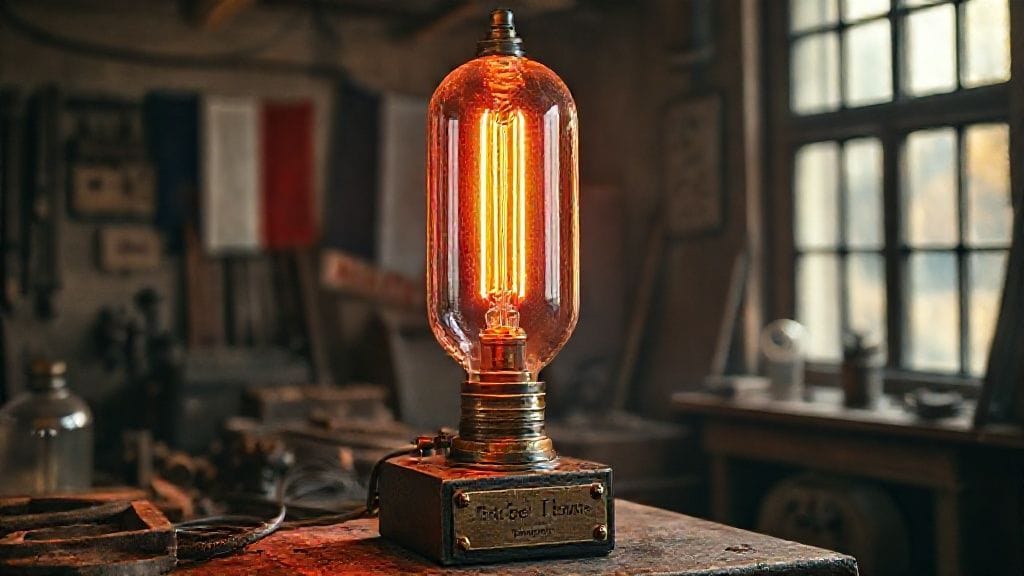
On December 11, 1910, Claude’s invention stepped from theoretical possibility into radiant reality. The first practical neon tube—a simple, elegant glass lamp charged with neon gas—was installed atop the Palais de l’Optique. When energized by electricity, it emitted a deep red light, intense and hypnotic.
This was more than a scientific demonstration; it was an event. The glowing tube was elegantly bent to spell “Lumière” (light), an emblematic choice that captured the essence of what neon promised: a new way to illuminate human experience.
Eyewitnesses recalled the spectacle with rapt attention as the crimson light penetrated the Parisian night like a meteor cutting through darkness. For some, it was magical; for others, unsettling to see an artificial light so different from the comforting glow of an incandescent bulb.
Yet, the message was clear: light could be sculpted and controlled in ways never before imagined.
7. The First Neon Sign: Art, Commerce, and Spectacle
Claude wasted no time demonstrating neon's commercial potential. By 1912, the first neon sign was commissioned for a barber shop in Paris, delivering a glowing promise to potential customers that transcended the static printed sign.
Neon was no longer a mere light source but an instrument of marketing psychology and aesthetic innovation. The fluidity of the tubes allowed for creative typography and designs, transforming urban nights into visual feasts.
This first sign, glowing red against the gray Parisian walls, heralded the age of electrically animated advertisements. The sign's enduring impact was both practical and symbolic: city life would become a spectacle of light, drawing people and commerce into a new rhythm after sunset.
8. Public Awe and Skepticism: Paris Reacts to Neon’s Glow
The reception to neon was variegated. While many were mesmerized by the strange colors born from the glass tubes, some critics greeted the neon tubes with suspicion. Was this new light too artificial? Would it disturb the natural beauty of the night?
Articles appeared in newspapers, some extolling neon’s artistic possibilities, others fearing it would herald an over-commercialized, gaudy, and intrusive urban environment. Old Parisian sensibilities wrestled with the new luminosity.
Yet, the public’s fascination generally outweighed skepticism. The neon’s distinct red glow became a source of nightly amusement and wonder for Parisians and visitors alike.
9. Behind the Glass: The Chemistry and Physics of Neon Lamps
Neon lamps operate on an elegant dance of atoms and electrons. When an electric current is passed through a sealed glass tube filled with neon gas at low pressure, the neon atoms become excited and emit light as they return to their resting state.
The characteristic red-orange glow is unique to neon, distinguishing it from other noble gases like argon (blue) or krypton (white). Claude's innovation rested not only on harnessing this effect but also on perfecting the glass bending and vacuum technology to ensure durability and intensity.
Interestingly, the simplicity of this principle belied the complexity of manufacturing challenges. Precision in gas purity, tube sealing, and electrical supply were crucial to achieving a reliable neon lamp.
10. Neon Across the Atlantic: Early International Impact
Though neon lamps were born in France, their influence quickly crossed the ocean. By the 1920s, American entrepreneurs recognized neon’s potent advertising appeal. At the 1929 National Electrical Exposition in New York, neon signs dazzled audiences with colors and designs unknown before.
In 1923, neon arrived in the United States, pioneered by Claude's company licensing technology to entrepreneurs such as Earle C. Anthony in Los Angeles. The neon glow soon spread across major cities, transforming streetscapes from Seattle to Miami.
Neon’s arrival symbolized a larger global trend: urban modernity fueled by electricity and consumer culture.
11. Neon vs. Incandescence: Lighting the Twentieth Century
While incandescent bulbs were the mainstay of household lighting, neon lamps offered distinct advantages—color vibrancy, energy efficiency, and versatility in shape. Incandescent bulbs produced a warm, albeit limited spectrum of light, confined to spherical bulbs.
Neon, by contrast, was suited for signage and artistic applications but less for direct illumination of spaces. This distinction mattered: neon carved a niche that would redefine nocturnal environments, turning urban nights into kaleidoscopes of animation shimmering amid the darkness.
12. Commercial Explosion: Neon and Urban Advertising
Between the 1920s and 1950s, neon transformed from novelty to necessity for commerce. American cities embraced neon-lined theatres, restaurants, and casinos, eager to capture consumer attention under the cloak of night.
The glowing signs became synonymous with entertainment districts—Times Square, Broadway, and Los Angeles's Sunset Boulevard. Neon lighting spurred new industries, employing artists, glassworkers, electricians, and advertisers.
The glow of neon lamps was not only functional but seductive, invoking desire, curiosity, and excitement.
13. Cultural Reverberations: Neon in Art and Popular Imagination
Neon lighting seeped beyond commerce into the realms of culture and art. Writers, filmmakers, and painters found in neon a potent symbol—of modernity, alienation, urban romance, and nocturnal energy.
Films noir used neon shadows to underscore mystery and suspense. Poets wrote of the “electric poetry” emitted by glowing tubes. Later, pop artists would appropriate neon light as an icon of consumer culture and modern aesthetic.
Thus, the neon lamp transcended its physical form, becoming an emblem of the 20th century’s hopes and anxieties.
14. The Technological Struggles: Challenges in Early Neon Production
The path to neon’s widespread adoption was fraught with obstacles. Early tubes were fragile, costly, and required skilled labor to produce.
Maintaining gas purity was essential; contaminants could quench the glow or shorten life spans. Electrical equipment needed to be reliable and safe.
Competition for patents and market dominance led to tensions. Georges Claude fiercely defended his discoveries, winning court battles that helped cement neon’s commercial future but also exposed the sometimes harsh realities of industrial innovation.
15. Neon’s Role in Shaping Modern Nightscapes
Perhaps the deepest impact of the first neon lamp was in remaking how cities lived after dark. Until the early 20th century, nights were largely subdued—streets dim, shadows dominant.
Neon lights changed this. Urban nights became spectacles of color and animation, reshaping social life and rhythms. Night-time economies surged. Social and cultural life no longer slept with the sun.
The shape and design flexibility of neon lighting became critical in defining the look of modern urban environments, with many cities becoming iconic for their neon-lit streets.
16. Wartime Shadows: The Neon Industry through Global Conflicts
World War I interrupted the momentum of neon expansion as resources were diverted to the war effort, and industrial focus shifted.
However, after the 1920s, neon flourished again. World War II then brought new challenges—material shortages, electrical rationing, and strategic restrictions.
Yet, neon remained a symbol of resilience and recovery, illuminating cities rebuilding in the war’s aftermath.
17. From Paris to Las Vegas: The Global Diffusion of Neon
The journey from the first neon lamp on a Paris rooftop to the blinding spectacle of Las Vegas’s Strip epitomizes the global diffusion of innovation.
Las Vegas turned neon into a cultural phenomenon, integrating it into the identity of the city’s casino culture, entertainment, and spectacle in a way unthinkable in 1910.
This diffusion was not only technological but also cultural, showing how neon adapted to different social and economic contexts worldwide.
18. Environmental and Economic Legacy of Neon
Neon lighting, though glamorous, was not without costs. The production and disposal of neon tubes involved hazardous materials. Energy efficiency, while better than incandescent in some contexts, was eventually outpaced by LEDs.
Yet, neon’s economic impact was undeniable—supporting numerous industries, urban economies, and creative sectors.
Understanding neon’s environmental footprint invites reflection on the balance between innovation and sustainability.
19. Neon in Contemporary Memory: Museums and Nostalgia
Today, neon holds a nostalgic charm. Museums dedicate exhibitions, vintage signage is collected and preserved, and artists incorporate neon in new works.
Restoration projects in cities like New York and Paris preserve neon signs as cultural heritage, capturing the spirit of eras past but never forgotten.
The first neon lamp’s glow continues to inspire fascination and affection, a testament to its enduring legacy.
20. Lessons from Neon’s Glow: Innovation, Risk, and Vision
The story of the first neon lamp embodies the timeless dance of science, art, ambition, and commerce. Georges Claude’s vision transformed a scientific curiosity into a cultural beacon.
Neon’s success teaches us about the power of risk-taking, meticulous craftsmanship, and believing in ideas others might dismiss as fanciful.
Conclusion: Illuminating the Past to Brighten the Future
From a singular flicker of crimson light above a Parisian roof in 1910 emerged an extraordinary revolution in how humanity perceives and uses light. The first neon lamp was far more than a new source of illumination—it was a promise of urban transformation, artistry, and technological progress.
This incandescent thread connects generations, bridging scientific discovery and human desires. Neon’s glow continues to remind us that innovation often begins with a fragile idea, a spark in the dark—waiting to burst brilliantly into life.
FAQs on the First Neon Lamp and Its Legacy
Q1: Who invented the first practical neon lamp?
A1: Georges Claude, a French engineer and inventor, created and publicly unveiled the first practical neon lamp in 1910.
Q2: What distinguishes neon from other types of lighting?
A2: Neon emits a distinct red-orange glow when electrified due to its atomic structure, unlike incandescent bulbs or other gas lights that produce white or other colors.
Q3: How did the first neon lamp impact urban landscapes?
A3: It transformed nightscapes into vibrant, colorful arenas, influencing advertising, art, and cultural perceptions of night.
Q4: Was neon lighting immediately accepted by the public?
A4: No, it initially sparked both fascination and skepticism due to its novel and intense appearance.
Q5: How did World Wars affect the development of neon lamps?
A5: Wars interrupted production and innovation but post-war periods saw a resurgence and broad adoption of neon lighting.
Q6: What industries benefited most from neon technology?
A6: Advertising, entertainment, glass manufacturing, and electrical engineering sectors all prospered thanks to neon.
Q7: Is neon lighting still relevant today?
A7: While largely replaced by LEDs for practical lighting, neon retains cultural and artistic significance worldwide.
Q8: How is the first neon lamp remembered today?
A8: Through museum exhibitions, restoration projects, and its influence in art and urban culture, the first neon lamp remains an icon of invention and spectacle.