Table of Contents
- A Winter Morning in Chartres: Setting the Stage for a Contested Crown
- From Bourbon Prince to Reluctant Heir: The Road to the French Throne
- War, Faith, and Fractured Kingdom: France Before 1594
- Conversion and Calculations: “Paris Is Worth a Mass”
- A Crown Without a Cathedral: Why Chartres, Not Reims?
- The Eve of the Ceremony: Rumors, Fears, and Preparations
- The Morning of 27 February 1594: Processions Through a Watching City
- Oil, Sword, and Scepter: Inside the Coronation Ritual
- The Absent Holy Ampulla and the Problem of Legitimacy
- Reactions in France: Joy, Rage, and Sullen Silence
- Paris Opens Its Gates: From Enemy Stronghold to Royal Capital
- The Catholic League’s Decline and Spain’s Waning Influence
- From War King to Peace Broker: The Long Echo of the Coronation
- Symbols, Myths, and Memory: How Historians Read the Coronation
- Lives Behind the Ceremony: Ordinary People in an Extraordinary Moment
- From Chartres to the Edict of Nantes: Toleration Born of Bloodshed
- The King’s Image: Art, Pamphlets, and Propaganda After 1594
- The Coronation of Henry IV in Modern Scholarship and Popular Imagination
- Conclusion
- FAQs
- External Resource
- Internal Link
Article Summary: On a cold February day in 1594, far from the traditional cathedral of Reims, the coronation of Henry IV unfolded in the smaller city of Chartres, reshaping the fate of France. This article traces the long and violent road that led Henry of Navarre, a former Huguenot leader, to the throne of a kingdom torn apart by religious wars. It explores why the coronation of henry iv had to take place in exile from custom, how the absence of the Holy Ampulla challenged his legitimacy, and how carefully staged ritual, symbolism, and compromise were used to silence doubts. We follow the reactions of Paris, the Catholic League, Spain, and ordinary French subjects as they weighed the meaning of this fragile new monarch. The narrative connects the coronation to later milestones such as the recapture of Paris and the Edict of Nantes, showing how ceremony translated into political authority. Throughout, historians’ debates about faith, pragmatism, propaganda, and myth help us see that the coronation of Henry IV was both an ending to decades of bloodshed and the beginning of a new kind of French monarchy. By the time the crown rested firmly on Henry’s head, the kingdom had begun, slowly and painfully, to imagine peace again.
A Winter Morning in Chartres: Setting the Stage for a Contested Crown
The winter light over Chartres on 27 February 1594 must have seemed uncertain, half-hopeful and half-threatening, as if the very sky were undecided about the future of France. Snow still clung in pale ribbons along the roofs, and the air was sharp enough to sting lungs and eyes. In the narrow streets, people pressed against shuttered windows or crowded into doorways, straining for a glimpse of the man who claimed to be their king. The coronation of Henry IV was about to take place—not in glorious Reims, with its towering Gothic nave and millennial prestige, but here, in this smaller cathedral city, at the edge of a civil war that had bled the kingdom for nearly four decades.
Messengers had preceded him, spreading fragments of news, rumors, and lies. Some whispered that he was a false king, a heretic disguised as a Catholic, a man who had shed allies and beliefs with alarming ease. Others muttered that he was the only possible savior of France, that without him the crown of the Valois and Capetians would crumble into the hands of fanatics and foreign powers. Merchants worried about trade, widows about their sons, priests about their flocks. Soldiers, their boots caked with frozen mud, eyed each other across tavern rooms—some wearing the white scarf of the Bourbon cause, others quietly loyal to the Catholic League.
At the center of this fragile stage stood Henry of Navarre himself, a man who had spent much of his adult life in armor or on horseback. The coronation of henry iv was the culmination of a journey marked by sieges, ambushes, massacres, and broken oaths. He had fought at Coutras, survived the St. Bartholomew’s Day massacre by outwardly renouncing his faith, and outlived three sons of Henry II. Now he was the last viable male heir in a line that had nearly extinguished itself. But a bloodline alone would not be enough to convince a fractured kingdom. He had to be anointed, crowned, and seen.
Yet behind the approaching ceremony lay a burning question: could ritual heal a country whose wounds were not only physical but spiritual, ideological, and deeply personal? The banners, the incense, the trumpets, and the sacred oils would attempt to answer that question. Chartres, with its labyrinth etched into the floor of its cathedral—once walked by pilgrims on their knees—might have seemed an appropriate metaphor: a complicated path toward a center whose meaning was both sacred and political. On that February day, the labyrinth was not just stone. It was France itself.
From Bourbon Prince to Reluctant Heir: The Road to the French Throne
Henry was not supposed to be king of France. Born in 1553 in Pau, in the rugged kingdom of Navarre at the foothills of the Pyrenees, he was a prince of the minor Bourbon-Vendôme line, more closely associated with the Protestant faith and the turbulent southwest than with the shining courts of Paris and Fontainebleau. His mother, Jeanne d’Albret, was a fiercely committed Huguenot leader, and his early formation was steeped in the Reformed tradition. It is astonishing, isn’t it, to imagine this rough-edged provincial prince emerging as the center of one of Europe’s most sophisticated monarchies?
The Valois dynasty, however, was already tottering. Henry II’s death in a jousting accident in 1559 set off a chain of short, troubled reigns: Francis II, Charles IX, and Henry III, each shadowed by religious conflict and court intrigue. As uncles, cousins, and favorites jockeyed for influence, the Bourbon branch found itself inextricably drawn into the struggle for the soul—and crown—of France. Henry of Navarre rose as a key leader of the Huguenot cause, both military and symbolic, a “king of the faithful” in the eyes of his co-religionists.
In 1572, the young Henry traveled to Paris for what should have been a gesture of reconciliation: his marriage to Marguerite de Valois, sister of King Charles IX. Instead, the city erupted into the St. Bartholomew’s Day massacre, a slaughter of Protestants that shocked Europe. Henry escaped death by accepting Catholicism under duress and living under surveillance at the royal court. Yet his inward loyalty to the Reformed faith remained, at least for a time. From that moment, he learned that in France, religion and politics were inseparable—and that survival demanded flexibility as well as courage.
When violence flared again, Henry escaped the court, returned to Protestantism, and resumed his role as Huguenot leader. He became king of Navarre in 1572 upon the death of his mother, but his real realm was war itself. Continually on campaign, he forged alliances, commanded armies, and acquired a reputation for bravery, humor, and robust appetites. The “good king Henry” of later legend, jovial and close to his soldiers, began here, in the mud and smoke of civil war battlefields. Yet this soldier-king hardly fit the mold of the pious Catholic monarch the French tradition held dear.
Everything changed in 1584, when the king’s brother, François, Duke of Anjou, died without leaving an heir. Under Salic law, which excluded women from the line of succession, Henry of Navarre moved into first place after the reigning monarch, Henry III. The unexpected elevation of a Protestant prince as heir presumptive threw France into panic. The powerful Catholic League, led by the House of Guise and supported by Spain, refused to accept such a prospect. The decades ahead would revolve around this paradox: the rightful heir to the throne was unacceptable to a large part of the kingdom. The coronation of Henry IV, years later in Chartres, would be the dramatic resolution of a crisis that had begun with that single death in 1584.
War, Faith, and Fractured Kingdom: France Before 1594
To understand why the coronation of Henry IV in 1594 mattered so profoundly, we must return to the broken landscape of late sixteenth-century France. Since 1562, the kingdom had been ravaged by a rolling series of conflicts collectively known as the Wars of Religion—eight official wars, countless skirmishes, uprisings, and massacres. Towns changed hands repeatedly; crops burned; churches were sacked or seized; nobles changed sides as often as they changed clothes.
At their core, these wars were contests over authority: who held the right to define true religion, and what role the king should play in enforcing or moderating that truth. Catholics insisted that the faith of their ancestors—Roman, sacramental, and hierarchically ordered—was inseparable from the identity of France itself, frequently repeating the formula “une foi, une loi, un roi” (one faith, one law, one king). Huguenots, though a minority, believed that their understanding of the Gospel was purer, more authentically Christian, and that conscience could not be coerced by royal edict or clerical threats.
Between them stood the monarchy, its authority gradually eroded by successive crises. The crown tried various solutions: limited toleration edicts, royal marriages, showpiece reconciliations, and fierce crackdowns. Each, in turn, satisfied no one for long. Behind the religious language lurked dynastic ambition. Great noble houses such as the Guises, Montmorencys, and Bourbons vied for advantage, sometimes cloaking old feuds in the language of piety.
By the late 1580s, the situation sharpened into what historians call the War of the Three Henrys: Henry III, the embattled Valois king; Henry of Guise, charismatic leader of the Catholic League; and Henry of Navarre, Protestant heir to the crown. Paris itself turned against Henry III, forcing him to flee the capital. Under pressure from the League, he had Henry of Guise murdered in 1588, only to be himself assassinated the following year by a fanatical Dominican friar. With Henry III’s dying breath, he acknowledged Henry of Navarre as his legitimate successor—if only the country would accept him.
It did not. At least, not easily. In 1589, when Henry of Navarre assumed the title of Henry IV, much of France, and especially Paris, refused to recognize him. The League proclaimed a rival claimant, a Habsburg-inflected fantasy of an ultra-Catholic monarchy. Spain intervened, hoping to push its influence over the Pyrenees and perhaps even place an archduke or infanta on the French throne. The kingdom was, in effect, at war with itself and its neighbors. Against this chaotic background, the future coronation of Henry IV at Chartres was not merely a ceremony of succession; it was an attempt to close a deadly fracture that had opened beneath the very idea of France.
Conversion and Calculations: “Paris Is Worth a Mass”
Henry IV spent the first years of his contested reign in a blur of swift campaigns and uneasy truces. He won important victories—Arques in 1589, Ivry in 1590—where his charisma and tactical boldness shone. At Ivry, according to tradition, he rode into battle with a white plume in his helmet, urging his troops to follow it as a beacon amid smoke. Yet even his triumphs were incomplete. He could defeat League armies in the field, but he could not force Paris, that great, turbulent city, to acknowledge him. Paris was besieged in 1590, half-starved and despairing, but still refused to surrender to what many saw as a heretical king.
Henry faced a grim arithmetic. Without Paris, his kingship lacked its central stage; without Catholic recognition, he risked perpetual rebellion. His Protestant allies abroad could not supply the legitimacy that French tradition demanded. Moreover, a king clearly aligned with Protestantism would risk turning the entire kingdom into a battleground for the hidden war between Spain and the Protestant powers of Europe. In this matrix of threats and opportunities, Henry’s most famous political decision took shape: his conversion to Catholicism.
In 1593, at Saint-Denis, Henry publicly renounced his Reformed faith and embraced Catholicism. The famous phrase “Paris vaut bien une messe” (“Paris is well worth a Mass”), though probably apocryphal, crystallizes how later generations read this act: as a calculated, pragmatic step to win over a majority Catholic population. Historians such as Mack P. Holt have emphasized the blend of conviction and expediency, noting that by late sixteenth-century standards, religious identity could be more fluid than we sometimes imagine, especially among rulers forced to navigate deadly confessional fault lines.
Critics denounced him as a chameleon, a man whose beliefs were tools. Some Huguenots felt betrayed, while hardline Catholics suspected the conversion was shallow, a mask rather than a transformation. The papacy hesitated before lifting excommunication, wary of endorsing a king whose earlier life was marked by Protestant leadership and alliances with heretical powers. Yet, for many weary French subjects, the conversion was a relief. If the rightful heir was now Catholic, perhaps God’s anger might be appeased; perhaps the kingdom could begin to heal.
The coronation of henry iv, however, could not follow conversion immediately. Henry had to move carefully, consolidating support among moderate Catholics (the so-called Politiques), negotiating with the papacy, and slowly bridging the chasm between legal right and moral acceptance. When Chartres was chosen as the site for his anointing, it symbolized this uneasy compromise: a Catholic ceremony, but outside the traditional cathedral; a sacred ritual, but one shadowed by doubts and lingering enemies. Conversion opened the door; the coronation would attempt to close it behind him.
A Crown Without a Cathedral: Why Chartres, Not Reims?
For centuries, French kings had been crowned in Reims, their heads bowed beneath the vaulted stone where Saint Remigius had once, according to tradition, baptized Clovis. Reims was more than a place: it was an argument. To be crowned there was to insert oneself into an unbroken line stretching back to the very origins of Christian France. The holy oil of the Sainte Ampoule, believed to have been brought by a dove from heaven, conferred not just legitimacy, but a kind of sacral potency that made the king a quasi-priestly figure in the realm of politics.
In 1594, however, Reims was firmly in the hands of the Catholic League and hostile to Henry IV. Its cathedral, its canons, and its civic elites were aligned with forces that considered him an usurper. He could not simply march an army to the city and demand access without transforming his coronation into an act of war. The entire symbolic weight of the ceremony would implode if it were staged under siege or threat. Henry needed another solution.
Chartres emerged as that solution—less prestigious, but accessible and loyal enough. Its cathedral, already venerated for its miraculous stained glass and its relics of the Virgin, offered a deeply sacred setting, even if it lacked the specific coronation tradition of Reims. Chartres was also geographically significant: close enough to the heartland of the kingdom to project authority, yet not so deep in League territory as to risk disruption.
The choice of Chartres was a gamble. Some observers grumbled that a king crowned anywhere but Reims would forever be a sort of “half-king.” Others sensed the political message: Henry was willing to bend tradition to save the kingdom. The coronation of Henry IV in Chartres thus became a deliberate rewriting of ritual geography. By turning this cathedral into a coronation site, the king and his advisers were, in effect, asserting that legitimacy could be relocated—that what mattered was the act of anointing and recognition, not the particular stones underfoot.
Behind the scenes, negotiations with cathedral clergy, local elites, and royal officers shaped every detail. Which bishop would preside? Which relics would be displayed? How would the absence of the Sainte Ampoule be explained or compensated? Every gesture would speak to friends and enemies alike. The road to Chartres was not only physical; it was a carefully choreographed journey along the thin line between tradition and necessity.
The Eve of the Ceremony: Rumors, Fears, and Preparations
On the evening before the coronation, Chartres was a city in a state of taut anticipation. Inns were overflowing; soldiers bivouacked in courtyards and along the outer walls; merchants did a brisk trade in candles, bread, wine, and scraps of cloth in Bourbon colors. Tailors worked late into the night to repair torn uniforms and adjust ceremonial garments for courtiers who had arrived travel-worn from campaign. The cold seeped into every room, yet the streets buzzed with energy.
Rumors ran faster than the wind between the cathedral square and the lower quarters. Some swore that Spanish agents had infiltrated the city and were plotting to assassinate the king before, during, or immediately after the ceremony. Others whispered that the Holy Ampulla of Reims had been secretly smuggled in, that a miraculous sign would appear in the sky at the moment of anointing, or that God would strike Henry dead if his conversion were insincere. Fear and hope braided together in these stories, each reinterpreting the coming day through the lens of private anxieties.
Inside the cathedral, the clergy and royal officers checked and rechecked the arrangements. Candles were placed in precise rows; vestments were laid out; the great organ stood ready, its pipes like a metal forest against the stone. The nave, which had seen so many processions before, would now host a different kind of drama. The choir rehearsed chants, and the officiating prelate reviewed the liturgical order that would transform a contested claimant into a consecrated king.
Henry, lodged in a nearby residence, was no doubt exhausted. He had spent years in the field, living and sleeping among soldiers, yet now he had to submit to etiquette, to stillness, to being looked at rather than charging forward. Memoirs of contemporaries portray him as restless, alternately buoyant and pensive. He understood that the coronation of henry iv would not instantly win over every opponent. Still, it marked a turning point: once crowned, he could more forcefully claim obedience in the name of tradition and divine sanction.
Advisers visited him late, discussing speeches, oaths, and gestures. How much emphasis should he place on his Catholic identity? How should he address the suffering of his subjects, the divisions of the past, and the threats of the present? In that nocturnal council, the line between genuine remorse and political calculation blurred. Yet behind rhetoric lay a man who had seen enough blood to last a lifetime. If he played his part well tomorrow, it might begin to dry.
The Morning of 27 February 1594: Processions Through a Watching City
Dawn arrived pale and reluctant, as if the sun itself mistrusted the claims being made in its light. But the streets of Chartres filled nonetheless. Trumpets blared, drums rolled, and a slow, ordered procession formed, threading its way from the royal lodging toward the cathedral. Banners bearing the royal arms—three golden fleurs-de-lis on azure—fluttered against the winter sky, their colors a sharp contrast to the grey stone and frosty air.
Henry rode at the heart of this moving tableau, dressed in ceremonial finery but unmistakably the seasoned warrior. His face, tanned from campaigns, bore lines carved by sleepless nights and hard decisions. Around him walked grand officers of the crown, nobles who had cast their lots with him, and ecclesiastics who had chosen reconciliation over continued rebellion. The people watched in silence, with occasional shouted cries: some of “Vive le roi!” others muttered prayers or insults under their breath.
Children clambered onto barrels and window ledges for a better view. Elderly men and women, who had known only war and rumor of war for more than thirty years, pressed their hands together as Henry passed, unsure whether to bless him or cross themselves against a possible usurper. In the crowd were also foreign observers—spies, diplomats, merchants from neighboring realms—trying to read the mood, to determine whether this coronation would stick or dissolve into more conflict.
At the cathedral doors, the procession slowed. The symbolic threshold between outside world and sacred space loomed large. Here, the king-to-be paused, acknowledging his need for the Church’s blessing before entering fully into his office. The great bronze or wooden doors, worn by centuries of hands and weather, opened slowly, revealing the shadowed interior. Incense smoke drifted out, mingling with the cold morning air like a visible prayer—or, to some, like a faintly suffocating veil.
Inside, the choir’s voices soared, the words of the liturgy wrapping themselves around stone and soul alike. As Henry stepped under the dim, colored light of the stained glass windows, he crossed not only a physical threshold, but a conceptual one. From this moment forward, the conflict over his legitimacy would be framed differently. Opposition to him would mean opposition to a consecrated monarch. Whether that would be enough to silence the guns remained uncertain, but the stage was fully set.
Oil, Sword, and Scepter: Inside the Coronation Ritual
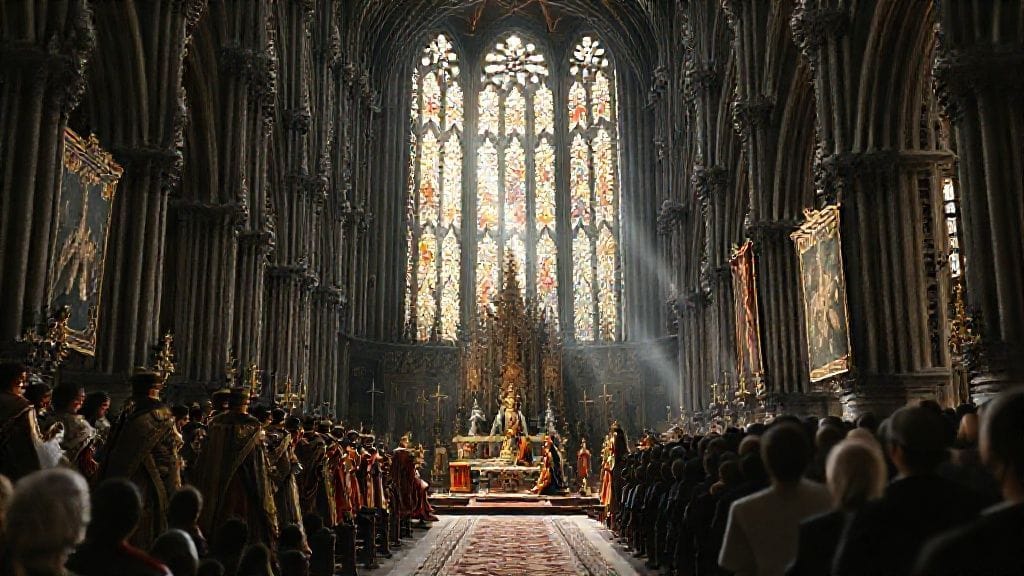
The interior of Chartres Cathedral on that morning was a theater of overlapping meanings. Gothic columns rose like a stone forest toward a ceiling lost in shadow, while shafts of colored light fell on altars, carved saints, and flickering candles. The smell of incense thickened the air as choristers chanted, their voices twining around Latin antiphons that had accompanied coronations for generations—even if not in this exact place.
Henry advanced toward the choir, where the high clergy awaited. There, he would swear oaths: to defend the Catholic faith, to protect the Church, to do justice to his subjects, to preserve the laws and customs of the realm. Each promise echoed against his complicated past—a one-time Protestant champion now pledging to uphold Catholic orthodoxy. Some in attendance must have wondered how sincerely these words sat in his heart; others perhaps felt that sincerity mattered less than stability after decades of chaos.
Central to the ceremony was the anointing. Stripped of certain outer garments to reveal the humanity beneath the royal splendor, Henry knelt as sacred oil was applied to his body—traditionally on the head, chest, shoulders, and other key points. This act linked him to biblical kings such as David and Solomon, emphasizing that monarchy was not merely hereditary but sacramental. The coronation of henry iv, in this moment, pressed upon the idea that God, through the Church, was selecting and sanctifying this man despite all doubts.
The crown was then placed upon his head, the weight of metal and jewels both physical and symbolic. Alongside the crown came the regalia: the scepter, symbol of temporal authority; the hand of justice, emblem of judicial power; the sword of state, signifying both protection of the people and punishment of wrongdoers. Each object was lifted, blessed, and given with words that reminded Henry that kingship was an office, not personal property.
When he rose, now visibly transformed in the eyes of many, acclamations rang through the cathedral. The cry of “Vive le roi!” began within the clerical and noble ranks and rolled outward, sometimes uncertainly taken up by others. The organ thundered. Bells began to peal from the towers. Outside, the noise spilled into the streets, where those who could not see the ceremony felt its tremors nonetheless. Ritual had done its work: a man argued over in pamphlets and battlefields had been enfolded into a sacred narrative of continuity.
Yet behind the celebrations, questions lingered. Could oil and Latin chants erase years of sermons that painted Henry as a heretic and enemy of the true faith? Could a single morning of ceremony outweigh thousands of dead in the wars that had brought him here? The ceremony did not answer these questions directly. Instead, it changed the grammar of politics, offering Henry new claims and his opponents new risks. To resist him now was not merely to oppose a claimant, but to stand against a consecrated sovereign.
The Absent Holy Ampulla and the Problem of Legitimacy
Even as the ritual unfolded with impressive dignity, an absence haunted the ceremony: the Holy Ampulla of Reims, the small vial of oil that tradition claimed had been used for centuries to anoint French kings. Its physical absence symbolized the deeper rupture between Henry IV and the customary path to legitimacy. The League still controlled Reims and the sacred relic, ensuring that no dove-borne oil would touch Henry’s brow.
To modern eyes, this might seem a minor detail, mere superstition. But for many contemporaries, the Holy Ampulla was a cornerstone of royal ideology. It tied each new monarch to a miraculous past and insisted that France enjoyed a special covenant with God. Without it, Henry’s enemies argued, he could not be a true “Most Christian King.” His coronation, they claimed, was a counterfeit, the theatrical dressing of an illegitimate regime.
Henry’s supporters responded creatively. They emphasized the universality of Christian anointing rather than the particularity of the Reims vial. The oil used at Chartres was blessed, they argued, by legitimate bishops performing legitimate rites. The power of the sacrament did not depend on one fragile container in a rebel-held city. In this debate, ritual met theology, and both met propaganda. Pamphlets and sermons turned the question of oil into the centerpiece of a broader battle over who owned the story of France’s sacred monarchy.
Some historians, such as Jacques Le Goff and later early modern specialists like Arlette Jouanna, have argued that this moment marked a subtle shift in the sacrality of kingship. By successfully claiming full legitimacy without Reims and without the Sainte Ampoule, Henry IV and his advisers, perhaps unintentionally, loosened the monopoly of a single site and object over royal sacrality. The coronation of Henry IV at Chartres thus became a precedent for a more flexible, politically negotiated understanding of divine right.
Still, in 1594, such theorizing remained latent. For ordinary observers, the absence of the Holy Ampulla was more gut-level: either a disturbing break with tradition or a regrettable but necessary compromise. In taverns and parish churches alike, people debated whether God had truly accepted this king. Time, more than arguments, would decide. If Henry’s reign brought peace and prosperity, many would later read that as a form of divine endorsement. If it failed, his enemies would say the missing oil had been the warning sign.
Reactions in France: Joy, Rage, and Sullen Silence
The news of the coronation spread outward from Chartres like ripples on water, carried by messengers, merchants, and wandering preachers. In towns aligned with the royal cause, bells rang and Te Deums were sung. Church choirs rehearsed hastily convened services of thanksgiving. City councils issued proclamations hailing Henry as their legitimate, consecrated monarch. In these places, weary citizens allowed themselves a cautious hope that an end to the wars might be within reach.
Elsewhere, the reaction was colder. In strongholds of the Catholic League, preachers mounted pulpits to denounce the ceremony as a sacrilege, a profanation of the sacred rites of kingship by a man whose conversion they refused to believe. Spain’s agents distributed broadsheets and letters arguing that a king without the Reims anointing could not be recognized by faithful Catholics. Some towns remained stubbornly neutral, refusing to sing in joy but also hesitating to escalate their defiance.
In Paris, still controlled in early 1594 by the League and Spanish influence, reactions were particularly fraught. On the one hand, the city’s ruling bodies knew they could not ignore the event; on the other, to acknowledge it was to implicitly accept Henry’s growing legitimacy. Seditious songs alternated with prayers for peace. Ordinary Parisians, hungry and battered by years of siege and hardship, listened as conflicting rumors reached them: that Henry was planning to march on the city in force, that he would pardon all if they opened the gates, or that he would exact terrible revenge if resisted.
Among Protestants, feelings were mixed. Some saw Henry’s coronation, following his conversion, as a terrible compromise: their former champion now presided over a Catholic ceremony, backed by bishops who had once preached against their faith. Others, more pragmatic, believed that only a king strong enough to command Catholic loyalty could ever secure lasting toleration for the Reformed minority. For them, the coronation of henry iv was less a betrayal than the precondition for future negotiations.
This mosaic of reactions reveals how fragile Henry’s position remained, despite the solemnity of Chartres. Ceremony could confer titles and symbols, but hearts and minds would turn slowly, if at all. The coronation closed one chapter—the question of whether Henry could be crowned—but left open the larger narrative: would France accept him not just as a legal king, but as the embodiment of its identity and hopes?
Paris Opens Its Gates: From Enemy Stronghold to Royal Capital
In the weeks following the coronation, Henry moved decisively toward the heart of the matter: Paris itself. The capital, with its dense population, powerful guilds, and strategic location on the Seine, was more than a city—it was the nervous system of the kingdom. Without it, Henry was a king on paper; with it, he would become a king in fact. The coronation of Henry IV at Chartres strengthened his hand in negotiations. Now, when he approached Paris, he did so not as an uncrowned warlord but as a consecrated sovereign.
In March 1594, the delicate balance within Paris tipped. Many of the League’s most radical leaders had fled or lost influence. The Spanish garrison, though a formidable presence, could not forever block the changing politics of the city. Moderates within the city’s elites began to argue that continued resistance to Henry would only prolong suffering and invite even deeper foreign interference. They reached out cautiously to the king, exploring terms.
Henry, advised by counselors who understood the theater of politics, promised clemency. He knew that a brutal conquest of Paris would only reignite resistance elsewhere and confirm the worst fears of his opponents. Instead, he offered pardons, guarantees for certain privileges, and assurances concerning the Catholic character of the city. The details were complex and involved intense backchannel communication, but the overall effect was a slow untying of knots rather than a clean sword stroke.
On 22 March 1594, Paris effectively opened its gates to Henry. He entered the city not as a conqueror but as a reconciler, riding through streets that had once hated and feared him. Crowds watched as he made his way to Notre-Dame for a solemn Te Deum. Here, the symbolism of Chartres was reinforced: the anointed king now reclaimed the capital that had long denied him. Bells that had tolled for League victories now rang for the Bourbon monarch.
The psychological shift was immense. Once Paris fell into line, other towns and nobles began to reassess their positions. While some pockets of resistance persisted, the general trend moved toward accommodation. The path from coronation to control of the capital illustrates how ritual and realpolitik worked together. The oil and crown of Chartres gave moral cover to what was, ultimately, a brilliant campaign of persuasion and pressure in Paris.
The Catholic League’s Decline and Spain’s Waning Influence
For the Catholic League, the months after the coronation and the recapture of Paris were a long, painful unwinding of a cause that had once seemed unstoppable. What had begun as a movement to defend Catholic orthodoxy against heresy and royal weakness gradually fractured under the twin pressures of Henry’s growing legitimacy and exhaustion among its own supporters. Leaders who had dreamed of reshaping France into an ultra-Catholic bastion found themselves outmaneuvered by a king they had dismissed as heretical and weak.
Spain, too, saw its grand designs fade. Philip II had hoped to use the League to extend Habsburg influence while containing Protestantism. A fractured France served his interests; a stable, Catholic, but independent Bourbon monarchy did not. Yet by 1594, realities on the ground forced a reconsideration. Spanish troops still occupied key fortresses, but their moral claim to intervention weakened as Henry consolidated his Catholic image and royal authority.
Some League nobles sought separate deals with the king, exchanging their allegiance for offices, pensions, or renewed lands. Others fled abroad, unable to reconcile themselves to a monarchy that had once seemed the enemy. Pamphleteers who had once written fiery tracts about the illegitimacy of Henry IV now either fell silent or cautiously recalibrated their rhetoric. The coronation of henry iv had not destroyed the League in one blow, but it had radically altered its narrative. The movement could no longer claim to defend France against a heretical usurper; it now looked increasingly like a faction resisting a lawful, anointed sovereign.
The slow erosion of the League’s power opened space for Henry to negotiate broader peace. It also deprived Spain of reliable proxies within France. Over the next years, the king would balance limited confrontation with careful diplomacy, eventually culminating in the Treaty of Vervins (1598) with Spain. Chartres and Paris had set the stage; treaties and edicts would write the final acts.
From War King to Peace Broker: The Long Echo of the Coronation
In the popular imagination, Henry IV would later be remembered less as a warlord and more as a bringer of peace: the king who dreamed of a chicken in every pot, who rode among his people with easy familiarity, who gave France the relative stability of the early seventeenth century. This image, burnished by royal propaganda and later nostalgia, tends to soften the hard edges of his earlier career. Yet the transformation from war king to peace broker did not happen overnight. It unfolded over years, and the coronation at Chartres marked a significant pivot.
Once securely on the throne and established in Paris, Henry began to shift his energy from campaigns to reconstruction. The kingdom’s finances were in ruins; roads and bridges lay in disrepair; trade routes had been severed by decades of conflict. Appointing capable ministers such as the Duke of Sully, he set about restoring royal revenues, reducing corruption, and encouraging agriculture and commerce. Royal edicts sought to reinvigorate industry and regulate taxes more effectively, even if the burden on the peasantry remained heavy.
Politically, Henry pursued a policy of moderation. He knew that blatant favoritism toward either confessional side could reignite civil war. His own conversion had already signaled a leaning toward Catholic identity, but he resisted calls to crush the Huguenots entirely. Instead, he prepared the ground for a more lasting compromise: legal toleration within a Catholic kingdom. In this light, the coronation of Henry IV appears as the starting point of a new kind of royal authority—one that combined sacral trappings with pragmatic flexibility.
Socially, the long echo of the coronation reached into villages and towns as rumors of stability transformed into observable changes: more secure markets, fewer passing armies, slowly declining levels of banditry. It did not transform daily life overnight, and famine or local conflicts still flared. But the sense that the future might be less bloody than the past began to germinate. For a generation raised amid massacre and siege, that was no small psychological shift.
Symbols, Myths, and Memory: How Historians Read the Coronation
Over time, the coronation of Henry IV became a touchstone for historians trying to understand the nature of early modern monarchy and religious politics. Was this event the triumph of royal authority over factionalism, or the victory of political pragmatism over religious conviction? Was Henry a cynic cloaked in piety, or a believer whose faith genuinely evolved? Different scholars have answered these questions in sharply different ways.
Some, especially in older historiography, celebrated Henry as the quintessential “good king,” a moderate whose coronation symbolized the triumph of reason over fanaticism. In this reading, Chartres becomes the stage on which a wise monarch accepts the necessary rituals of Catholicity in order to save his people from endless bloodshed. Others, particularly influenced by confessional or ideological lenses, have been more critical, presenting the coronation as the crowning of opportunism. They point to his previous Protestant identity and subsequent policies as evidence of a cold calculus beneath the mantle of sacral kingship.
More recent work, such as that by Mack P. Holt and Barbara Diefendorf, tends to emphasize complexity. Rather than asking whether Henry was “sincere,” historians explore how religious identity, political necessity, and personal experience intertwined in ways that defy simple categories. The coronation is not viewed simply as the end of the Wars of Religion, but as one critical moment in a longer process of religious and political negotiation—a process that includes Henry’s earlier conversion and later edicts like Nantes.
Memory has played its own tricks. In the centuries after his assassination in 1610, Henry IV’s legend grew. Painters depicted his coronation with imaginative flourishes, sometimes reintroducing elements that had actually been absent, such as the Holy Ampulla of Reims, as if to retroactively normalize the event. Popular histories smoothed over tensions, turning Chartres into just another glorious step in a national story rather than the precarious gamble it really was. Today, historians sift these layers of memory, trying to reconstruct the moment as contemporaries experienced it—uncertain, dangerous, and far from inevitable.
Lives Behind the Ceremony: Ordinary People in an Extraordinary Moment
Grand narratives of kings and battles often obscure the lives of those who watched from below: the artisans, peasants, servants, and lesser clergy whose fates were bound to decisions made in distant chambers. The coronation of henry iv, like any royal ritual, was both a spectacle imposed upon them and a rare point of access to the drama of power. If we look closely, we can glimpse their presence in chronicles, parish records, and the margins of official reports.
Consider the innkeepers of Chartres, suddenly inundated with guests on the eve of the coronation. For them, the ceremony meant profit, but also risk: rowdy soldiers, unpaid bills, the possibility of violence if rival factions clashed in the streets. Or think of the cathedral’s craftsmen—masons, carpenters, candle-makers—who had to prepare the church, repair any damage, ensure that nothing failed at the crucial moment. Their invisible labor underpinned the visible ritual.
For ordinary believers, the ceremony posed theological puzzles as well as emotional ones. A devout Catholic who had once heard fierce sermons against Henry might now see bishops blessing him as legitimate king. How did they reconcile this? Perhaps some concluded that the Church’s decision indicated God’s will had shifted; others may have harbored private doubts or adopted a cautious wait-and-see stance. Huguenot villagers, learning of the coronation weeks later, might discuss it after Sunday worship, weighing whether this Catholic king, once their champion, might yet protect their fragile churches.
The war’s legacies were written on human bodies: widows whose husbands had died in service to one side or the other; orphans growing up with stories of atrocities; men crippled by wounds. For them, the meaning of Chartres was brutally simple: would this king bring fewer soldiers marching through their fields? Would next winter’s harvest be theirs to eat and sell, or would it be taken for yet another campaign? Emotional responses to the coronation thus oscillated between suspicion and desperate hope that, at last, the arc of history might be bending away from fire and steel.
From Chartres to the Edict of Nantes: Toleration Born of Bloodshed
The line from the coronation in 1594 to the Edict of Nantes in 1598 is neither straight nor smooth, but the connection is undeniable. Coronation gave Henry the authority and symbolic capital necessary to impose, or rather propose, a solution to the confessional conflict. Without being recognized as a legitimate, consecrated king, he could hardly issue an edict that demanded obedience from both Catholic and Protestant subjects. Chartres, in this sense, was the platform from which policy could be launched.
In the four years that followed, Henry engaged in painstaking negotiations with Huguenot leaders and Catholic authorities, seeking a framework that would simultaneously uphold the primacy of Catholicism and guarantee enough rights to Protestants to prevent renewed rebellion. The resulting Edict of Nantes granted Huguenots limited freedom of worship, access to certain offices, and fortified places where they could feel secure. It was, by the standards of its time, a remarkably pragmatic and generous compromise, though hardly full religious liberty in the modern sense.
Some Catholic hardliners saw the edict as a betrayal of the king’s coronation oaths to defend the “true religion.” They argued that an anointed monarch should not tolerate heresy. Huguenot extremists, for their part, felt the edict did not go far enough. Yet a tired majority in both camps recognized the necessity of compromise. The coronation of Henry IV, by making him the uncontested arbiter of the realm, allowed him to endure these criticisms and insist on the edict’s enforcement.
Toleration in France was thus born not of abstract philosophy, but of bloodshed and exhaustion. The ritual at Chartres sacralized the authority required to broker that toleration. One can imagine Henry, recalling his kneeling at the altar, balancing his promises to uphold Catholicism with his lived knowledge of Protestant faith and suffering. This dual perspective, anchored in a consecrated kingship, shaped his famous role as a peacemaker-king.
The King’s Image: Art, Pamphlets, and Propaganda After 1594
In the decades after the coronation, Henry’s regime invested heavily in crafting an image of the monarch that would resonate across social and confessional lines. Paintings, engravings, medals, and pamphlets depicted him as a vigorous, paternal figure, often emphasizing his accessibility and humanity as much as his majesty. The narrative of the coronation of henry iv became one of several key episodes used to frame his reign: alongside his military victories, his entry into Paris, and the Edict of Nantes.
Artists portrayed the coronation with an almost liturgical nostalgia, sometimes enhancing its sacral atmosphere. The cathedral’s interior might be depicted more grandly than reality; the clergy more uniformly devoted; the crowd more clearly joy-filled. Such images helped overwrite the memory of controversy and doubt. The absent Holy Ampulla was quietly downplayed or, in some representations, suggested through generic anointing scenes that blended Reims and Chartres into a single, idealized picture.
Printed texts echoed these visual strategies. Official histories commissioned by the crown framed the coronation as the divinely guided resolution of long civil strife. Henry’s conversion and anointing were portrayed as a providential turning point, confirming God’s mercy toward France. Even some former opponents, seeking favor or forgiveness, began to write in this tone, retroactively smoothing their own hesitations in the face of his legitimacy.
At the same time, critics did not entirely disappear. Radical Catholic circles, both in France and abroad, continued to circulate accounts that cast Henry as a turncoat and Chartres as a sham coronation. Some Protestant memoirists, too, preserved a more skeptical view, recalling the pain of watching their onetime champion embrace the Catholic ritual that underpinned a still-hostile majority faith. These dissenting voices remind us that propaganda worked by competing with alternative memories, not erasing them entirely.
The Coronation of Henry IV in Modern Scholarship and Popular Imagination
Modern readers encounter Henry IV’s coronation filtered through centuries of scholarship, national myth-making, and even popular culture. Textbooks often compress the story into a single neat line: “In 1594, Henry IV, having converted to Catholicism, was crowned king at Chartres, thereby ending the Wars of Religion.” The reality, as we have seen, is far richer and more precarious.
Academic studies delve into the intricate interplay of ritual, power, and belief. For instance, early modern historians use the coronation as a case study in how ceremonies function as “performances of legitimacy,” borrowing concepts from anthropology and sociology. They examine who stood where, who spoke, who was excluded, and how choreography reflected and shaped real political hierarchies. The coronation of Henry IV becomes less a static event and more a living script, negotiated by its participants in real time.
Popular imagination, meanwhile, often focuses on more colorful anecdotes: Henry’s reputed saying that “Paris is worth a Mass”; his later reputation as a loving, slightly roguish king; his tragic assassination by Ravaillac. Films and novels sometimes depict the coronation in sweeping cinematic style, with soaring music and simplified conflicts, using Chartres as a visually striking but emotionally straightforward scene of triumph over fanaticism. Such portrayals flatten the anxieties, doubts, and risks that made the event so charged for contemporaries.
Yet even in simplified form, the story exerts a powerful fascination. It encapsulates perennial questions: How far may a ruler compromise faith for peace? Can ritual heal a country’s divisions? Is legitimacy bestowed from above, from tradition and God, or constructed from below, by the consent (or exhaustion) of the governed? Each retelling, whether in a scholarly monograph or a brief classroom sketch, answers these questions differently, keeping the coronation of Henry IV alive as a subject of debate.
For further exploration, works like Mack P. Holt’s The French Wars of Religion, 1562–1629 and Barbara B. Diefendorf’s Beneath the Cross: Catholics and Huguenots in Sixteenth-Century Paris offer richly detailed analyses of the religious and social context around Henry’s rise. They remind us that Chartres was not an isolated marvel, but one act in a long and painful drama of violence, negotiation, and fragile reconciliation.
Conclusion
On that cold February day in 1594, as oil touched Henry’s skin and the crown settled onto his head, few in Chartres could have fully grasped the long-term implications of what they were witnessing. The coronation of Henry IV did not magically erase decades of bloodshed, nor did it instantly convince every subject to embrace him. But it marked a decisive shift in the story of France, turning a contested Protestant warlord into a consecrated Catholic king and reframing the very terms of political and religious debate.
Through ritual, symbol, and carefully orchestrated spectacle, the ceremony at Chartres demonstrated the enduring power of monarchy as an idea—even amid gunpowder, pamphlets, and theological polemic. It negotiated a new balance between tradition and necessity, between the sacral aura of Reims and the hard realities of civil war. The absent Holy Ampulla, the choice of a different cathedral, the mixed reactions across the kingdom—all of these underline how precarious and yet how effective this act of legitimation was.
From Chartres flowed a series of transformations: the peaceful entry into Paris, the gradual collapse of the Catholic League, the Edict of Nantes, and the slow reconstruction of a shattered realm. In retrospect, the coronation appears as both culmination and beginning—a bridge between the apocalyptic fears of the Wars of Religion and the more stable, if still fragile, Bourbon order that followed. Historians continue to dissect its meanings, but one truth stands out: without that ceremony, and the authority it conferred, Henry could not have steered France toward a less violent future.
In the labyrinth of French history, the coronation of henry iv at Chartres is a turning in the path, a moment where the kingdom stepped away from the precipice of disintegration. It did so not in a blaze of pure triumph, but through compromise, ambiguity, and the fraught marriage of faith and politics. That blend of ideal and expedient, hope and calculation, is precisely what makes the story of 27 February 1594 still resonate today.
FAQs
- Why was Henry IV crowned in Chartres instead of Reims?
Henry IV could not be crowned at Reims because the city and its cathedral were controlled by the Catholic League, which rejected his claim. Chartres offered a loyal, accessible alternative cathedral where the full coronation liturgy could be performed without military confrontation, even though it broke with long-standing tradition. - How did Henry IV’s conversion to Catholicism affect his coronation?
His conversion in 1593 was a crucial precondition for the coronation, making it possible for Catholic clergy and many subjects to accept him as king. Without converting, he would have remained a Protestant claimant trying to rule a predominantly Catholic kingdom, and a Catholic coronation would have been unthinkable. - What was the significance of the missing Holy Ampulla?
The Holy Ampulla of Reims symbolized the sacred continuity of French monarchy, and its absence at Chartres gave Henry’s enemies a powerful argument against his legitimacy. Supporters countered that legitimate anointing did not depend on one relic, and over time Henry’s successful reign helped overshadow the controversy. - Did the coronation immediately end the French Wars of Religion?
No, the coronation did not end the wars overnight. It strengthened Henry’s claim and helped him gain control of Paris and weaken the Catholic League, but sporadic fighting and political resistance continued. The conflict’s effective resolution came only with measures like the Edict of Nantes in 1598 and the Treaty of Vervins with Spain. - How is the coronation of Henry IV viewed by modern historians?
Modern historians see it as a complex act of political theater and sacral ritual that helped reconstruct royal authority after decades of civil war. Rather than a simple triumph of moderation, they emphasize the negotiations, compromises, and lingering tensions that surrounded the ceremony and shaped Henry’s subsequent reign.

