Table of Contents
- A Winter Morning in Frankfurt: The Empire Awaits a New King
- The Crumbling Glory of the Holy Roman Empire Before 1440
- From Graz to the German Thrones: The Early Life of Frederick
- Princes, Electors, and Intrigue: How a King of the Romans Is Chosen
- The Empty Throne: Death, Crisis, and the Search for a Successor
- Cloisters and Council Halls: Negotiations Behind Closed Doors
- The Electors Assemble in Frankfurt: Rituals of Power
- February 2, 1440: Frederick III Crowned as King of the Romans
- What Kind of King? Character, Temperament, and Reputation
- The Shadow of the Hussites, the Turks, and a Fractured Christendom
- Frederick and the Habsburg Project: Dynasty Before Empire
- The Long Road to Imperial Coronation in Rome
- Cities, Peasants, and Princes: Everyday Life Under Frederick’s Rule
- Alliances, Marriage, and the Future: The Union with Eleanor of Portugal
- Maximilian and the “House of Austria”: Long-Term Consequences of 1440
- Chroniclers, Critics, and Defenders: How History Judged Frederick III
- Echoes of Frankfurt: Memory, Ceremony, and the Idea of Empire
- Conclusion
- FAQs
- External Resource
- Internal Link
Article Summary: On a cold February morning in 1440, the princes of the Holy Roman Empire gathered in Frankfurt to choose a new ruler, and their decision elevated a relatively quiet Habsburg duke to become Frederick III King of the Romans. This article traces the winding path that led to that election: the decaying authority of the late medieval empire, the rivalries of the German princes, and the shadow of foreign threats pressing on its borders. It explores Frederick’s upbringing in the Austrian lands, his reserved personality, and the political calculations that made him an acceptable, if hardly dazzling, candidate to the electors. From the ritual of the Frankfurt election to the later coronation in Rome, the narrative follows how this moment reshaped the destiny of the Habsburg dynasty and, in time, of Europe itself. Yet behind the ceremonial splendor lie stories of fragile alliances, discontented cities, ambitious princes, and subjects who barely noticed the change of king even as it altered their future. The article also examines the social and economic realities of fifteenth-century life, where war, trade, faith, and fear of the unknown world intertwined with high politics. It concludes by considering how historians have reevaluated Frederick’s supposedly “weak” reign and how the title King of the Romans helped preserve the idea of empire in a fragmenting Europe.
A Winter Morning in Frankfurt: The Empire Awaits a New King
On the second day of February in the year 1440, Frankfurt am Main awoke under a pale, wintry sky. The cold tightened around the city like a girdle; frost clung to the half-timbered houses and turned the rooftops into a scattered field of white. Smoke clambered from chimneys and drifted above the river, where thin sheets of ice edged the waters like broken glass. Inside the city walls, however, the chill could not silence the murmurs: the Holy Roman Empire was about to receive a new King of the Romans.
Merchants in the Römerberg square paused at their stalls, eyeing the mounted retinues that clattered over the cobblestones: armored men bearing the colors of Saxony, Brandenburg, Trier, Cologne, and Mainz. In cramped inns and ecclesiastical guesthouses, servants rushed to prepare rooms for princely visitors who had not come to haggle or pray, but to decide the fate of a realm that sprawled from the North Sea to the Alps. The phrase rex Romanorum—King of the Romans—echoed through legal charters and church litanies, but here in Frankfurt it was no abstraction. It meant power, taxes, soldiers, and above all, the right to be recognized as the future emperor of a troubled Christendom.
Among the many names that circulated in whispers, one did not stir awe so much as a cautious curiosity: Frederick of Habsburg, a man in his mid-thirties, Duke of Styria, Carinthia, and Carniola, a ruler of the Austrian circle of lands. Yet by the end of this day, he would be proclaimed frederick iii king of the romans, the chosen sovereign of an empire whose glory had long outlived its genuine might. It is astonishing, isn’t it, how often world-changing decisions are made in cramped council chambers, by men worried more about their neighbors than about the sweep of history.
Frankfurt had long been the stage for imperial elections, a city written into the constitutional memory of the empire. The golden bull of 1356, that foundational law issued by Emperor Charles IV, prescribed that kings of the Romans be chosen here. And so in 1440, as the city bell tolled across the frozen air, the princes marched toward their designated spaces, their cloaks rustling, the iron of their armor whispering against leather. They were not there to applaud greatness; they were there to safeguard their own interests in an age of fractures and encroaching dangers.
To the people on the streets, the identity of the next king mattered only faintly compared to the cost of bread or the security of trade routes. But to bishops and dukes, to city councils and foreign chancelleries, this election was a turning point: the man they chose would negotiate with the papacy, face the Ottoman Turks pressing on the southeastern frontiers, and mediate endless disputes among the empire’s hundreds of lords and communities. In Frankfurt’s cold light, as banners fluttered above the heads of the electors, the question was not who deserved the crown, but who could safely wear it without threatening the delicate balance of power.
Frederick, far away from this frosty stage, had not been born to such a role. His rise from a regional Habsburg prince to King of the Romans was the product of dynastic maneuvering, reputational caution, and the weariness of an empire that no longer sought shining heroes, but manageable rulers. This was the moment when a slow, patient, and often underestimated man began to shape the silent foundations of what would become a Habsburg Europe.
The Crumbling Glory of the Holy Roman Empire Before 1440
To understand why the choice of frederick iii king of the romans mattered, one must first step back into the fading light of the late medieval empire. The Holy Roman Empire had once claimed to be the heir of ancient Rome, a Christian commonwealth led by a sacral monarch crowned by the pope. In reality, by the fifteenth century, it had become a patchwork of duchies, bishoprics, free imperial cities, counties, abbeys, and knightly territories, each jealously guarding its rights.
The long thirteenth century had seen the Hohenstaufen emperors—Frederick II most of all—battle the papacy for supremacy, only to fall, leaving a vacuum known as the Great Interregnum. Since then, imperial authority had waxed and waned, negotiated rather than imposed, often dependent on personal charisma and military might. The Golden Bull of 1356 codified not only the election process, but also the privileges of the seven prince-electors, making them near-sovereigns within their own lands. From then on, any King of the Romans ruled at their pleasure.
By 1440, the empire resembled a map drawn by a nervous hand: jagged boundaries, overlapping jurisdictions, and enclaves nestled within the domains of others. The emperor’s direct lands were modest; most power lay in the hands of territorial princes like the Wittelsbachs of Bavaria, the Luxembourgs of Bohemia, and, increasingly, the Habsburgs in the Austrian archduchies. The empire’s western regions were bound to the trade networks of the Rhine, the North Sea, and the Low Countries, while the east looked toward Hungary, Poland, and the ever-looming Ottoman frontier.
The previous decades had shaken Europe profoundly. The Black Death in the mid-fourteenth century had killed perhaps a third of the population in many regions. Wars—local and large—had scarred the land: from feuds between nobles and cities to the wider conflicts that embroiled England, France, and Burgundy. Religious tensions simmered; the Hussite movement in Bohemia had already erupted into violent wars, challenging both papal and imperial authority. At the same time, the papacy itself had been damaged by the Great Schism, when rival popes reigned in Rome and Avignon.
In this fractured world, the empire’s pretensions to universal authority seemed hollow. Yet its symbolic weight remained. Imperial charters conferred prestige; the idea of an emperor as the secular arm of Christendom still resonated in legal theory and liturgical ceremony. As historian Peter Moraw once observed, the late medieval empire was “weak in power but strong in symbols,” a phrase that captures the paradox at the heart of 1440. The princes wanted a king who would protect those symbols without turning them against their own independence.
The House of Luxembourg, which had furnished several recent kings and emperors, was in decline. Internal conflicts, dynastic misfortune, and the Bohemian Hussite upheavals had eroded its influence. New forces—especially the Habsburgs and the emerging power of the House of Hohenzollern in Brandenburg—sought to fill the gaps. The electoral princes, eyeing each other warily, were determined not to let any one dynasty dominate the way the Hohenstaufen once had.
Amid all this, the very concept of the King of the Romans was changing. Once, the title had almost automatically led to a Roman imperial coronation in Italy. Now, the journey across the Alps was costly and perilous, contested by Italian city-states, French ambitions, and papal politics. A king might never become a crowned emperor in Rome, yet still rule as the recognized head of the empire. That was the political landscape into which Frederick of Habsburg would be thrust.
From Graz to the German Thrones: The Early Life of Frederick
Frederick was not born in Frankfurt’s gilded council halls but in the more modest, rough-edged world of the eastern Alpine lands. Born in 1415 in Innsbruck, or possibly in one of the Habsburg residences in the Austrian territories, he grew up in regions where power was less ceremonial and more immediate: castles on hilltops, mountain passes to defend, small towns and monasteries clinging to river valleys. He belonged to the Leopoldian branch of the Habsburgs, a house that had seized the Austrian duchies in the fourteenth century and then subdivided them among its heirs.
His father, Duke Ernest of Austria—nicknamed “the Iron”—was a man of firm will and martial posture. Ernest strove to maintain Habsburg authority over Styria, Carinthia, and Carniola in the face of rebellious nobles and encroaching neighbors. It was in this environment of persistent struggle that young Frederick learned one of his defining traits: caution. He saw the high cost of hasty decisions and the fragility of dynastic gains. After Ernest’s death in 1424, Frederick, still a child, came under the regency of relatives and advisors, learning to navigate the internal politics of a family that was not yet the towering dynasty it would become.
Reports from contemporaries paint Frederick as reserved, slow to speak, and carefully deliberate. He did not dazzle with brilliant speeches or knightly exploits. Instead, he calculated, waited, and rarely abandoned a position once he had decided upon it. Later critics would call him indecisive, even lethargic; admirers would praise his patience and long-term vision. Both interpretations had their truths, and both shaped how the electors in 1440 assessed him.
By the 1430s, Frederick had taken up the governance of Inner Austria—Styria, Carinthia, and Carniola—struggling with fractious nobles, urban elites, and the persistent question of how to fund a princely government without alienating his subjects. His financial situation was often precarious; like many princes of his age, he pawned rights and lands, bargained for revenue, and sought advantageous marriages and alliances. He lacked the opulent courtly splendor of the Burgundian dukes or the military fame of the Hungarian king.
Yet Frederick had one crucial quality that would matter deeply in 1440: he seemed safe. He did not possess large contiguous territories that threatened to overshadow the other electors. His domains lay in the southeastern corner of the empire, away from the densely contested Rhine and Main regions. He had few personal enemies among the princes north of the Alps, and his reputation for caution suggested he would not embark on wild adventures to expand his power.
Another factor was lineage. Despite their still-modest holdings, the Habsburgs claimed an illustrious past, and they had been steadily weaving themselves into the fabric of European nobility. Frederick could present himself as a scion of a house with imperial potential, yet without the immediate capacity to dominate: a compromise between grandeur and manageability. It was precisely this combination that made frederick iii king of the romans a palatable prospect to men who feared both chaos and tyranny.
Princes, Electors, and Intrigue: How a King of the Romans Is Chosen
The title King of the Romans was not inherited automatically; it had to be won in a highly choreographed political theater. Since the thirteenth century, the German princes had asserted their right to elect the king who would then seek imperial coronation in Rome. The Golden Bull of 1356 formalized this process, establishing seven electors: three ecclesiastical— the Archbishops of Mainz, Trier, and Cologne—and four secular: the King of Bohemia, the Count Palatine of the Rhine, the Duke of Saxony, and the Margrave of Brandenburg.
These men, collectively, wielded immense influence. Each had significant territories, their own courts, armies, and diplomatic networks. When a king died or was deposed, it was they who convened—usually in Frankfurt—to choose his successor. Candidates courted them with promises of privileges, territorial confirmations, and favorable offices. Behind official ceremonies lay a dense web of letters, private negotiations, and sometimes outright bribery.
The election was as much about preventing dominance as about selecting talent. No prince wanted a king who could crush him; they needed an arbiter, not a conqueror. They also had to consider religion and relations with the papacy, for a king who defied Rome too blatantly risked plunging the empire into chaos. At the same time, the princes wanted a ruler capable of defending Christendom’s eastern frontiers, where the Ottoman Turks had already taken large portions of the Balkans.
In theory, the electors acted for the whole realm; in practice, they defended their own interests first. Their assemblies were accompanied by streams of envoys, scribes, and legal experts. They drew up electoral capitulations—contracts the king-elect had to sign, promising respect for the electors’ rights and laying out specific obligations. In later centuries, these capitulations would become elaborate constraints; already in 1440, they were significant political tools.
When we imagine the election that would produce frederick iii king of the romans, we should not picture a single climactic vote, but a series of carefully measured moves: who arrived when, who met in which cloistered room, what messages were whispered behind tapestries or carried by messengers on icy roads. The public face of the election was ritual, but the real decisions were brewed in the shadows.
The Empty Throne: Death, Crisis, and the Search for a Successor
The immediate cause of the 1440 election was the death of King Albert II, a member of the House of Habsburg and Frederick’s cousin. Albert had been King of the Romans since 1438 but reigned only briefly. He also held the crowns of Hungary and Bohemia through dynastic marriages, forming a personal union that made him a formidable figure in central Europe. Yet his power rested on fragile foundations; he struggled against the Hussites in Bohemia and the encroaching Ottomans in Hungary.
In 1439, while campaigning against the Turks, Albert fell ill—likely from dysentery or another disease endemic in military camps—and died near Neszmély on the Danube. His death left not only the King of the Romans’ throne vacant but also created a succession crisis in Hungary and Bohemia. His only son, Ladislaus the Posthumous, had not yet been born when his father died; the child entered the world into turmoil, a king’s heir without a king’s protection.
The electors could not ignore these circumstances. They needed a ruler who could, at least in theory, mediate among those crowns and manage the eastern crisis. Yet they were reluctant to elect someone so closely tied to Hungarian and Bohemian politics that he might drag the empire into their conflicts. Some among them considered other dynasties—the Wittelsbachs, perhaps a Luxembourg claimant—but each candidate carried baggage.
The empire itself was not in flames, but it smoldered. Feuds between noble families could erupt into localized warfare; urban leagues defended their interests against both lords and bandits; Knights and lesser nobles guarded their prerogatives with a mixture of pride and violence. In such a context, a period without a recognized King of the Romans risked emboldening those inclined to ignore imperial law.
Moreover, the Council of Basel, convened in 1431 to pursue church reform, continued to challenge papal authority, creating a tense environment in which the religious and political orders intertwined uncomfortably. A weak or absent king could not effectively arbitrate between council and pope or defend the empire’s rights within the broader church. The electors knew they needed to act.
And so the stage was set: a dead king, a posthumous heir, contested crowns in neighboring realms, and an empire whose princes were wary of one another. Into this mixture stepped Frederick of Habsburg, unexpected yet increasingly plausible as the next King of the Romans.
Cloisters and Council Halls: Negotiations Behind Closed Doors
Before any bell rang in Frankfurt, the election was already underway in private. Envoys crisscrossed the empire, bearing letters sealed with wax, carrying proposals, requests, and veiled threats. The Archbishop of Mainz, traditionally the leading figure among the electors, consulted with his colleagues. The Palatine, the Saxon duke, the Brandenburg margrave—each weighed his options like a merchant eyeing a risky investment.
Frederick himself was not yet the obvious choice. He governed his Austrian lands with a careful, sometimes plodding hand, dealing with local disputes and the constant need for funds. But he had allies. Some ecclesiastical princes saw in him a man respectful of church interests, unlikely to challenge their spiritual and temporal power. Others simply perceived a ruler distant enough that he would not immediately interfere in their affairs.
Negotiations unfolded in monasteries where thick stone walls muffled voices, in castle chambers lit by flickering candles, in townhouses where civic elites listened intently for hints about which way the political winds were blowing. Promises multiplied: confirmations of territorial privileges, assurances of non-interference in certain disputes, hints of lucrative offices or judicial positions in the imperial court.
One can imagine a winter evening in late 1439 or early 1440: two envoys seated at a heavy wooden table in a Benedictine cloister, parchment spread before them. Between them stands a candle, its light dancing in drafts of cold air seeping under the door. They speak quietly of Frederick—his habits, his loyalties, his weaknesses. Is he pliable? Is he trustworthy? Will he ally too closely with the papacy, or resist reforms that favor the princes? Every word, every rumor, becomes a tiny stone in the edifice of the future.
In these conversations, Frederick’s perceived limitations became his strengths. He was not a charismatic war leader likely to lead bold campaigns without consent; he was not burdened with too many overlapping crowns like Albert II. He seemed a man who would move slowly, consult extensively, and rarely provoke outright confrontation. For electors fearful of both anarchy and royal overreach, this was appealing.
As the decision coalesced, Frederick’s name emerged as the candidate who could command sufficient agreement, if not enthusiasm. The great lords of the empire were choosing not a savior, but a manager of decline—a steward of an old order that still clung to its claims of universal authority.
The Electors Assemble in Frankfurt: Rituals of Power
By early 1440, the electors or their representatives traveled to Frankfurt, accompanied by retinues of knights, servants, and counselors. The city, perched on the Main River and sustained by vibrant trade fairs, was accustomed to such gatherings. Yet every election brought a heightened sense of ceremony and danger: so many armed men in one place always risked unintended clashes.
Inns encrusted with frost became centers of deliberation. Churches hosted solemn masses where the fate of the empire was placed before God. The city council balanced hospitality with firm watchfulness, ensuring that no prince overstepped his bounds within the urban jurisdiction. Food, fodder, and firewood were in high demand; prices likely spiked, as they so often did when courts descended upon a town.
The electoral assembly followed established rituals and procedures. First came the formal recognition of the vacant throne. Speeches might be given—tedious to some, sacred to others—reiterating the duties of a King of the Romans: to protect the church, uphold the empire’s laws, defend the realm against pagans and heretics, and ensure peace among its subjects. Then the princes or their envoys would withdraw to deliberate.
It is here that one must resist the temptation to picture a modern ballot. Votes were shaped by previous agreements; disputes about precedence and ceremony could delay proceedings for hours or days. Medieval politics loved protocol. Who sat where, who spoke first, who held which symbolic object—each detail communicated status and intention.
In cloistered chambers, the electors weighed the names before them. There might have been initial proposals for alternative candidates, raised more to test reactions than with any real hope of success. Gradually, consensus hardened around Frederick of Habsburg. He had already been informally canvassed; his suitability was no surprise, but the formal process gave a veneer of deliberation to what had been largely arranged beforehand.
Outside, the people of Frankfurt did what people always do in moments of high politics: they speculated. Tavern conversations likely mixed real information with wild rumors. Would the next king come from Bavaria, Bohemia, or Austria? Would he levy new taxes? Would he march against the Turks or instead spend his reign quarrelling with the pope? For most, the identity of the new King of the Romans would become fully real only when proclaimed from the city’s public spaces.
February 2, 1440: Frederick III Crowned as King of the Romans
On 2 February 1440, the Feast of the Purification of the Virgin—also known as Candlemas—the decision reached its ceremonial climax. Candlemas, with its processions of lights symbolizing Christ as the light of the world, provided a fitting backdrop for the proclamation of a new monarch in a Christian empire. The proximity of liturgy and politics was no accident; kingship, in this age, was framed as a sacred office, even if its exercise was relentlessly practical.
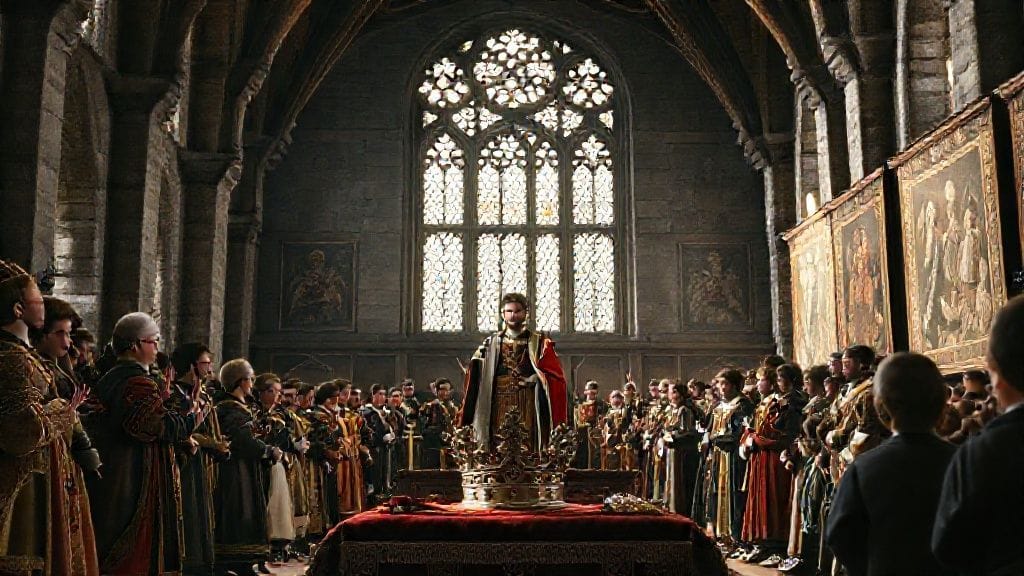
Within Frankfurt’s main church—likely the Bartholomäuskirche, later known as the Frankfurt Cathedral—the electors gathered, their robes heavy with fur, their breath visible in the cold air. The clergymen intoned prayers, incense curled upward, and the altar glowed with candles. Somewhere in this solemn space, Frederick was named: Duke Frederick of Habsburg, to be henceforth Frederick III, King of the Romans.
Chroniclers describe such ceremonies with a blend of awe and formula. A later account might have noted how the electors affirmed their choice, how the archbishop placed the symbols of office upon Frederick: the banner, the sword, perhaps a crown symbolic of his new dignity. The people gathered in and around the church would have seen a man not especially imposing in stature, but now transformed by the weight of ritual. In one stroke, he became the anointed head of the empire—at least in name.
After the ecclesiastical rites came the secular affirmations. Heralds proclaimed the new king’s title in the city squares. Trumpets sounded, drums rattled, and banners unfurled in the chilly air. The assembled crowds responded with cheers or polite murmurs; for some, this was a moment of genuine pride in their city’s role as the empire’s electoral heart. For others, it was another turn of the wheel, another distant ruler whose face they barely knew.
Frederick’s own feelings are unrecorded, but we can imagine the tension. He knew what this title implied: years of negotiation, conflict, and travel; attempts to reconcile the conflicting demands of princes and cities, popes and councils. He also knew the fragility of his position. The electors had chosen him because he seemed safe; any attempt to transcend that role would invite resistance.
Nonetheless, the title frederick iii king of the romans carried immense prestige. It filled his name with sacral echoes of Charlemagne and Otto the Great, even if his actual powers bore little resemblance to theirs. As the ceremonies ended and the feasting began—tables groaning under roasted meats, bread, and wine—the empire had a new king. Whether he would be merely a caretaker of decline or the architect of a renewed order remained to be seen.
But this was only the beginning. The journey from Frankfurt to Rome, from election to imperial coronation, would take years. Along the way, Frederick would confront rebellious subjects, foreign threats, and the slow, grinding reality of governing a realm whose ideal unity existed mostly in parchment and prayer.
What Kind of King? Character, Temperament, and Reputation
Frederick’s contemporaries struggled to pin down his character. Unlike flamboyant princes whose deeds filled songs and chronicles, he moved slowly, speaking little, often lost in his own calculations. Some described him as pious and modest; others as stubborn, secretive, and doggedly persistent. He was not a knight-errant, nor a scholarly prince steeped in humanist learning; he was, above all, a survivor.
One later comment, preserved by the humanist Aeneas Silvius Piccolomini—who would become Pope Pius II and knew Frederick personally—captured the mixed view of the king. Piccolomini observed that Frederick “did nothing remarkable, but he reigned very long,” a remark often cited by historians. It seems faint praise, yet it underscores a crucial reality: in an age of brief, tumultuous reigns, longevity itself could be a kind of power.
Frederick had a minimalist style of rule. He avoided bold initiatives unless forced, preferred negotiation to war, and displayed an almost uncanny capacity to outwait his opponents. His motto, A.E.I.O.U.—inscribed on buildings and documents—has been interpreted as “Austriae est imperare orbi universo” (“It is Austria’s destiny to rule the whole world”) among other readings. This suggests a quiet belief in his dynasty’s grand future, even if his own actions seemed cautious in the extreme.
To the imperial princes, this temperament was both comfort and frustration. They could rely on Frederick not to launch sudden campaigns against them, yet they often found him maddeningly slow to settle disputes or enforce decisions. City councils, too, complained of delays, as legal appeals to the imperial court languished while Frederick pondered or delegated.
Frederick’s physical presence, according to surviving depictions, was unremarkable: a thin face, somewhat austere, framed by the fashion of the time. He did not command a room with charismatic flair, but his silence could be a weapon. Those who met him could not easily discern his thoughts; he gave little away. This opacity became a tool of survival amid the swirling intrigues of the fifteenth century.
As frederick iii king of the romans settled into his new role, he brought this character with him. He would not be a warrior-king leading crusades against the Turks, nor a reforming monarch reshaping the empire’s institutions. Instead, he would gradually knit together what he could of Habsburg lands, defend his prerogatives where necessary, and let time work in his favor. Posterity, especially nineteenth-century historians looking for national heroes, would be harsh in its judgment. Yet modern scholars, more attuned to the quiet mechanisms of state-building, have begun to reassess his reign in a more nuanced light.
The Shadow of the Hussites, the Turks, and a Fractured Christendom
The empire Frederick now ruled faced not one, but several crises. To the east and southeast, the Ottoman Turks advanced steadily. After the fall of large swathes of the Balkans, they pressed against Hungary, threatening the gateway to central Europe. The memory of the catastrophic defeat at Nicopolis in 1396 still haunted Christian nobles, a warning of what ill-prepared crusades could bring. Albert II’s last campaign, which ended with his death, had been part of this ongoing struggle.
Meanwhile, the Bohemian crown was scarred by decades of upheaval. The Hussite movement, inspired by the reformist preacher Jan Hus—burned at the Council of Constance in 1415—had organized both a spiritual and military challenge to the traditional church. Radical and moderate factions alike had taken up arms, defeating several crusading armies and forcing the empire and papacy to negotiate. Even by 1440, the religious and political tensions in Bohemia were far from resolved.
Within the empire’s western and central regions, the so-called “Landfrieden”—peace agreements meant to reduce private war—were often more honored in the breach than the observance. Noble feuds, raids by robber barons, and skirmishes between cities and lords punctuated daily life. Local diets and leagues tried to impose order, but they needed imperial backing to give their measures weight.
Frederick inherited not only these specific conflicts but also a broader crisis of legitimacy. The schisms within the church, the conciliar movement embodied by the Council of Basel, and the long memory of papal-imperial conflicts all weakened traditional authority. Many princes, cities, and even lesser nobles toyed with the idea that power should be more shared, more contractual, less hierarchical than before.
In theory, frederick iii king of the romans was the supreme secular guardian of Christendom in the empire. In practice, he could do little without the cooperation—and funding—of the very princes who had elected him. Raising armies required negotiation with estates; launching campaigns risked opposition or indifference from rulers more concerned with their own lands.
Frederick’s answer to this multiform crisis was not sweeping reform or dramatic war, but cautious management. He convened diets, issued proclamations, and occasionally supported military initiatives, particularly against the Turks. Yet he preferred to conserve resources, avoid overcommitment, and, above all, protect and gradually enhance the position of his house. Some saw this as a dereliction of imperial duty; others, perhaps more realistically, recognized that the empire lacked the cohesion for grand ventures.
Frederick and the Habsburg Project: Dynasty Before Empire
If there was one arena in which Frederick showed persistent strategic purpose, it was the consolidation of Habsburg power. When he became King of the Romans, the Habsburg lands were divided among several branches and marred by disputes. Over the course of his long reign, Frederick worked steadily, if slowly, to gather these pieces into a more coherent whole.
He took guardianship of his young cousin Ladislaus the Posthumous, heir to the Albertine branch of the Habsburgs, which controlled the core Austrian lands. This guardianship brought the boy—and thus his inheritance—under Frederick’s influence. When Ladislaus died unexpectedly in 1457, without legitimate heirs, Frederick stood in a prime position to claim or at least assert strong rights over those territories. Through legal arguments, political maneuvering, and sheer persistence, he managed to secure substantial portions of the Austrian heartlands for his own line.
Frederick also sought to stabilize his southeastern territories—Styria, Carinthia, and Carniola—making them a secure base for Habsburg expansion. Though constantly short of money, he invested in fortifications, administrative reforms, and the symbolic assertion of dynastic identity. The repeated use of the motto A.E.I.O.U., inscribed in places like the Burg in Graz and the Hofburg in Vienna, signaled his belief that Austria, and thus the Habsburgs, had a providential role.
Over time, Frederick’s strategy bore fruit. By the time of his death in 1493, the Habsburg lands were more unified than they had been for generations, and his son Maximilian stood poised to expand further through marriage and war. In this light, the election of frederick iii king of the romans appears less as a random choice and more as a critical step in the long story of Habsburg ascent.
Frederick did not neglect imperial symbolism, but he often subordinated it to dynastic advantage. When opportunities arose to press Habsburg claims in other realms—such as the Burgundian inheritance later tied to his son’s marriage—he supported them, not primarily as imperial ventures, but as extensions of his house’s influence. The empire, vast and unwieldy, offered prestige; dynastic lands, more compact and inheritable, offered real power.
The Long Road to Imperial Coronation in Rome
Being King of the Romans did not automatically make Frederick an emperor. For that, he needed coronation by the pope in Rome, an event steeped in symbolism and fraught with political risk. Many of his predecessors and successors would never make the journey or would content themselves with coronation in Germany or Italy without papal involvement. Frederick, however, persisted in seeking the full imperial rite.
The path was not straightforward. The papacy, emerging from the turmoil of the Great Schism and threatened by conciliar movements like the Council of Basel, had its own agendas. Frederick needed to balance his role as protector of the church with the interests of princes who supported conciliar reform. Negotiations dragged on as each side weighed the benefits and costs of cooperation.
Finally, in the early 1450s, the moment came. Frederick traveled to Italy, a journey that was both an assertion of imperial tradition and a test of endurance. The roads south of the Alps were dangerous; Italian city-states like Venice, Florence, and Milan monitored any foreign prince with suspicion. Yet the old dream of being crowned in the Eternal City still held a powerful allure.
On 19 March 1452, in Rome, Pope Nicholas V placed the imperial crown on Frederick’s head, making him Holy Roman Emperor Frederick III. This was the last time in history that a Holy Roman Emperor would be crowned in Rome by a pope. The ceremony, rich with liturgical splendor, reconnected Frederick’s title to the deep well of Roman and Christian symbolism. For a moment, the fractured empire could pretend that its ruler still embodied the universal majesty of a bygone age.
During this Italian journey, Frederick also secured another crucial element of his dynastic strategy: his marriage to Eleanor of Portugal, which we will explore shortly. The imperial coronation and the marriage alliance were woven together, each reinforcing the other. While the German princes might grumble about Frederick’s absences and his cautious governance, they could not deny that he had restored, however briefly, the imperial image in its most ancient form.
Yet behind the celebrations, the reality remained: the empire over which Frederick now reigned as emperor was no more centralized than before. His new title did not give him additional armies or revenues. What it provided was enhanced prestige, a stronger platform from which to negotiate, and, crucially, a heightened aura of legitimacy for Habsburg ambitions.
Cities, Peasants, and Princes: Everyday Life Under Frederick’s Rule
While chronicles focused on diets, coronations, and wars, the vast majority of the empire’s inhabitants experienced Frederick’s reign in quieter, more immediate ways. For peasants, life revolved around the agricultural year: plowing in spring, harvest in late summer, the endless cycle of tending fields and livestock, paying rents and dues to lords and monasteries. The distant figure of the King of the Romans—or even the emperor—barely entered their daily thoughts, except when taxes were levied in his name or war rolled across their lands.
In the cities, however, imperial authority mattered more tangibly. Free imperial cities like Frankfurt, Nuremberg, and Regensburg enjoyed charters placing them directly under the king’s protection, bypassing local lords. These cities used their status to expand trade, refine urban law, and defend their autonomy. They appealed to Frederick for confirmation of their privileges, for support in conflicts with neighboring nobles, and for recognition of guild regulations and commercial rights.
Frederick’s cautious nature often worked in the cities’ favor. He rarely embarked on broad programs to curtail urban freedoms; instead, he acted case by case, weighing petitions and issuing charters. This allowed cities to continue flourishing as centers of commerce and craftsmanship, weaving the economic fabric that bound the empire together. Fairs in Frankfurt and other towns facilitated the movement of goods—from Flemish cloth to Italian spices, from Baltic grain to Alpine metals.
For the lower nobility and knights, Frederick’s reign was more ambiguous. Some saw in the emperor a distant arbiter who could confirm their rights against encroaching princes and cities. Others resented his occasional attempts to enforce “Landfrieden,” those public peace measures that restricted private warfare and feuding. In regions like the Rhineland and Swabia, new leagues formed—of nobles, of cities, or of mixed interests—to manage conflicts and present a united face to higher authority.
Religious life, too, carried on beneath the umbrella of imperial rule. Monasteries and convents continued their rhythms of prayer, study, and work. Pilgrimages drew people to shrines and holy sites. Yet new currents stirred: the memory of Jan Hus and the Hussites lingered, and early humanist scholars began to question old traditions and copy ancient texts. The empire under frederick iii king of the romans was no static world; it was a place in transition, where medieval structures persisted even as early modern changes—urban growth, print culture, new learning—hovered on the horizon.
In this complex mosaic, Frederick’s greatest contribution may have been his refusal to push too hard in any direction. His slow, often frustrating governance inadvertently created space for local communities to adapt, negotiate, and evolve on their own terms. The empire muddled through, neither collapsing into chaos nor transforming into a centralized monarchy. For people on the ground, that sometimes meant hardship, but it also meant a surprising degree of local resilience.
Alliances, Marriage, and the Future: The Union with Eleanor of Portugal
Dynastic marriage was the quiet engine of medieval and early modern politics, and Frederick understood its power. His own marriage, concluded during his Italian journey in 1452, was to Eleanor of Portugal, the daughter of King Edward of Portugal. At first glance, this match seems unexpected: a central European ruler and a princess from the far western edge of Christendom, whose kingdom faced the Atlantic rather than the Danube or Rhine.
Yet the alliance made sense. Portugal, engaged in maritime exploration along the African coast, was gaining prestige and wealth. Its monarchy enjoyed relative stability compared to some other European courts. By wedding Eleanor, Frederick connected the Habsburgs to a rising power, one with strong ties to the papacy and a reputation for Christian zeal in overseas ventures.
The wedding itself, celebrated in Rome, was both a personal union and a carefully staged piece of political theater. The newly crowned emperor taking a bride from a distinguished royal house underscored his legitimacy and the international standing of his dynasty. Eleanor brought not only a rich dowry but also a circle of Portuguese courtiers and cultural influences that enlivened Frederick’s sometimes dour court.
Their marriage produced several children, most notably Maximilian, born in 1459. In him, Frederick’s patient dynastic work would find its heir. Maximilian would inherit not only the Habsburg territories his father had laboriously consolidated, but also the imperial crown and the possibilities opened by earlier alliances. When Maximilian later married Mary of Burgundy, he would unite a vast swath of European lands under Habsburg influence, fulfilling in part the expansive vision hinted at by Frederick’s A.E.I.O.U. motto.
Eleanor’s presence softened Frederick’s reputation in some eyes. She was described as energetic, pious, and generous, qualities that contrasted with her husband’s reserve. At court, she patronized religious institutions and may have played a role in mediating disputes. Her early death in 1467 was a personal blow to Frederick and removed a vibrant figure from the imperial stage.
Still, the effects of their union rippled across generations. The story of frederick iii king of the romans cannot be told without acknowledging how his marriage connected the Habsburgs to a broader European web of dynastic ties. In later centuries, the saying “Bella gerant alii, tu felix Austria nube” (“Let others wage war; you, fortunate Austria, marry”) would encapsulate the Habsburg strategy. Frederick’s reign, and his Portuguese marriage, were important early chapters in that narrative.
Maximilian and the “House of Austria”: Long-Term Consequences of 1440
When Frederick died in 1493 after a remarkably long reign, he left behind a very different landscape from the one he had entered in 1440. The empire’s structural weaknesses remained, but the position of his own house had been transformed. Through patient consolidation, legal maneuver, and strategic marriage, he had turned a divided collection of Habsburg territories into a more unified “House of Austria” poised for expansion.
His son Maximilian inherited not only the imperial crown—first as King of the Romans, later as emperor-elect—but also a set of opportunities that Frederick’s caution had preserved. Maximilian was everything his father was not: energetic, chivalric, fond of tournaments and bold political experiments. Where Frederick hesitated, Maximilian charged ahead. Yet he did so from a platform Frederick had constructed: a credible dynastic power base, the prestige of imperial rule, and a growing network of alliances.
Maximilian’s marriage to Mary of Burgundy in 1477, arranged while Frederick still lived, connected the Habsburgs to one of Europe’s richest territories: the Burgundian Netherlands and the Free County of Burgundy. This union, fraught with conflict and resistance from the French crown, turned the Habsburgs into a truly European power straddling the Alps, the Rhine, and the North Sea. It is no exaggeration to say that without the earlier election of frederick iii king of the romans and the subsequent imperial legitimization of Habsburg claims, Maximilian’s achievements would have been far less secure.
In this way, 1440 appears as a hinge in the history of the empire and Europe. The electors, seeking a safe and controllable monarch, inadvertently chose the man who would anchor the Habsburg rise. Frederick’s reign may have seemed uneventful to impatient observers, but its consequences unfolded explosively in the next generation. By the early sixteenth century, under Maximilian and his grandson Charles V, the Habsburgs would hold lands in Spain, the Low Countries, Italy, and the Americas, their dynasty intertwined with the fate of the Reformation and the very survival of the empire.
This long arc casts a different light on Frederick’s slow, often criticized style. What looked like passivity can also be read as preservation: he kept options open, avoided catastrophic losses, and bided his time until circumstances favored his house. While the empire’s internal problems festered, the Habsburg dynasty quietly shifted from one family among many to the dynasty of Europe.
Chroniclers, Critics, and Defenders: How History Judged Frederick III
Frederick’s reputation has see-sawed over the centuries. Early chroniclers, especially those frustrated by imperial inaction, painted him as lethargic and miserly. They complained that he failed to respond decisively to threats, that he left grievances unresolved, that he seemed to enjoy the trappings of office more than the burdens of leadership. A famous modern historian, Karl-Friedrich Krieger, noted how Frederick was long considered the “sleeping emperor,” present but ineffective.
Yet not all voices were critical. Some contemporaries appreciated the stability his long reign provided. In a world wracked by sudden wars, assassinations, and dynastic collapses, the continuity of an emperor who reigned for over fifty years had real value. Certain city chroniclers praised his protection of urban privileges; some churchmen valued his support for moderate reform and his ultimate loyalty to the papacy.
As historical scholarship evolved, particularly in the late twentieth century, historians began to reassess Frederick’s role. Rather than judging him by the standards of centralized monarchies like France or England, they examined the constraints of the imperial constitution. From this angle, Frederick appears less as a failed absolutist and more as a pragmatic negotiator operating within a system that rewarded patience over daring. One could cite the work of historians such as Heinrich Koller, who highlighted Frederick’s deliberate, long-range approach to dynastic politics.
Modern biographers also point to the structural impossibilities of his position. No King of the Romans in the fifteenth century could have easily created a strong, centralized empire; the princes were too powerful, the cities too independent, the church too divided. Frederick’s cautious imperial style, coupled with his quiet but determined dynastic building, seems in retrospect a reasonable strategy for survival and gradual advancement.
Still, the criticisms are not entirely unfair. Frederick’s inaction at times allowed conflicts to fester, and his reluctance to commit resources left some imperial initiatives underfunded or stillborn. His reign did little to address deep structural issues that would later enable religious fragmentation and political paralysis in the sixteenth century. The story of frederick iii king of the romans is therefore a story of trade-offs: stability at the price of reform, dynasty at the expense of imperial coherence.
Echoes of Frankfurt: Memory, Ceremony, and the Idea of Empire
Looking back to that cold day in Frankfurt in February 1440, it is striking how much and how little changed. The city continued to host imperial elections for centuries; the ceremony of choosing a King of the Romans became a ritual touchstone of the empire’s identity. Even as its actual powers weakened, the idea of the empire—as a community of Christian rulers under a sacred crown—retained emotional and symbolic force.
Frankfurt, with its fairs and later its book trade, became a conduit of emerging European thought. The memory of imperial elections mingled with the hum of commerce and, eventually, with the chatter of religious controversy as the Reformation unfolded. The city’s role in 1440 was one episode in a long history of mediating between power and public life.
For the Habsburgs, the echo of that election resonated through their self-understanding. They cultivated the image of themselves as heirs to Roman emperors, guardians of Christendom, and the axis around which European politics turned. Frederick’s reign, with its blend of traditional ritual and practical limitation, became part of the dynastic myth: even in hard times, the House of Austria held the imperial crown.
In our own time, the idea of empire has largely dissolved into nation-states and supranational unions. Yet the memory of the Holy Roman Empire—once famously described by Voltaire as “neither holy, nor Roman, nor an empire”—still intrigues scholars and the public alike. The election of frederick iii king of the romans in 1440 captures a moment when medieval traditions and early modern transformations met, when old rituals tried to contain new realities.
It is easy to dismiss such ceremonies as outdated pageantry. But ceremonies shape expectations, define legitimacy, and create shared memories. The princes who gathered in Frankfurt, the citizens who watched, the scribes who recorded the day’s events—they all contributed to a collective story about how power should be transferred, how communities should be governed, and what it meant to live under a king who, at least in theory, was also the heir of Roman emperors.
Conclusion
The election of Frederick III in Frankfurt on 2 February 1440 was not a thunderclap that shattered the political sky, but a quiet turning of the wheel whose consequences only became fully visible in hindsight. Chosen as a compromise candidate—cautious, distant, and seemingly manageable—Frederick brought to the office of King of the Romans a temperament shaped by the contested valleys and castles of Inner Austria. His reign did not dazzle with spectacular victories or sweeping reforms, yet it marked a pivotal stage in the transformation of both the Holy Roman Empire and the Habsburg dynasty.
In a world beset by the Ottoman advance, religious tensions from Bohemia to Basel, and the incessant conflicts of princes and cities, Frederick opted for endurance over brilliance. He nurtured his dynastic base, pursued strategic marriages, secured an imperial coronation in Rome that was as much about symbolism as about power, and gradually gathered the splintered Habsburg lands. The title frederick iii king of the romans, once granted amid Frankfurt’s winter chill, became a platform from which his successors would launch an unprecedented expansion, turning the House of Austria into the dominant force of early modern Europe.
At the same time, Frederick’s reign exposed the enduring limitations of imperial authority. The princes guarded their autonomy; cities defended their charters; the church remained contested terrain. In this sense, his story is also the story of a polity that could not, and perhaps did not wish to, become a centralized state. Instead, the empire persisted as a loose federation of powers bound together by tradition, law, and the lingering charisma of the imperial idea.
Standing in the imagined chill of Frankfurt’s streets in 1440, watching heralds proclaim the name of the new king, we can sense both the weight of the past and the uncertainty of the future. The people there could not know that this quiet Habsburg would help set in motion centuries of dynastic dominance, religious conflict, and shifting borders. Yet in their cheers, doubts, and simple curiosity lay the raw material of history: human reactions to events whose full meaning only time can reveal.
FAQs
- Who was Frederick III, King of the Romans?
Frederick III was a member of the Habsburg dynasty, born in 1415, who ruled as King of the Romans from 1440 and later as Holy Roman Emperor after his coronation in Rome in 1452. He governed a vast but fragmented realm and focused heavily on consolidating Habsburg territories, laying the groundwork for his family’s later rise to European dominance. - What does “King of the Romans” mean?
The title “King of the Romans” referred to the elected ruler of the German territories of the Holy Roman Empire, recognized as the future or de facto emperor. Traditionally, the King of the Romans would seek coronation by the pope in Rome to become Holy Roman Emperor, though by the fifteenth century this second step was not always achieved. - Why was Frederick III elected in Frankfurt in 1440?
Frederick was chosen after the death of King Albert II left the throne vacant in a time of political and military uncertainty. The electors sought a candidate who would not threaten their own power yet could provide stability, and Frederick’s cautious temperament, relatively distant territories, and Habsburg lineage made him an acceptable compromise. - How powerful was Frederick III as ruler of the Holy Roman Empire?
His formal titles were impressive, but in practice his power was limited by the autonomy of the princes, cities, and church authorities within the empire. Frederick relied on negotiation, legal authority, and symbolic prestige rather than direct control, and he often moved slowly in resolving conflicts or initiating large-scale reforms. - Did Frederick III actually become emperor in Rome?
Yes. In 1452, Frederick traveled to Italy and was crowned Holy Roman Emperor by Pope Nicholas V in Rome, the last emperor to receive such a coronation in the Eternal City. This event enhanced his prestige, though it did not significantly increase his practical authority over the empire. - What role did Frederick play in the rise of Habsburg power?
Frederick focused on consolidating Habsburg territories, securing inheritance claims, and arranging strategic marriages, including his own union with Eleanor of Portugal and, later, his son Maximilian’s marriage to Mary of Burgundy. These moves turned the Habsburgs from a regional power into a dynasty with continental reach. - How did Frederick III handle external threats like the Ottoman Turks?
Frederick supported defensive efforts and occasionally promoted crusading ideas, but he tended to avoid large-scale, risky wars. Limited resources and the need for cooperation from territorial princes constrained his actions, leading him to prioritize preserving his own lands and status over ambitious military campaigns. - What was everyday life like in the empire during Frederick’s reign?
For most people—peasants, townsfolk, artisans—daily life centered on agriculture, trade, and local obligations. While imperial decisions affected taxes, legal protections, and security, the distant figure of the King of the Romans was often overshadowed by more immediate lords, city councils, and ecclesiastical authorities. - How do historians view Frederick III today?
Earlier historians often criticized him as weak and indecisive, but more recent scholarship offers a nuanced view, emphasizing the constraints of the imperial system and his long-term success in strengthening Habsburg power. He is now frequently seen as a cautious but effective dynastic strategist rather than a failed would-be absolutist. - Why is the 1440 election in Frankfurt historically significant?
The election of Frederick III in 1440 marked a turning point where the Habsburgs secured the imperial crown in a durable way, enabling them to dominate the empire’s leadership for centuries. It also highlights how the Holy Roman Empire balanced symbolic unity with practical fragmentation at the twilight of the medieval world.
External Resource
Internal Link
Other Resources
- Encyclopaedia Britannica – general search for the exact subject
- Google Scholar – academic search for the exact subject
- Internet Archive – digital library search for the exact subject

