Table of Contents
- On a Road Between Castles: The Day Thirty Men Changed a War
- Brittany in Turmoil: The Succession Crisis Behind the Duel
- France, England, and a Restless Duchy: The Broader Hundred Years’ War
- Josselin and Ploërmel: Two Fortresses, One Bitter Frontier
- Bemborough and Beaumanoir: Faces and Fates of Two Captains
- The Proposal of a Strange Chivalric Game
- Choosing the Thirty: Knights, Squires, and the Question of Honor
- Morning of 26 March 1351: The Field is Marked and Oaths are Sworn
- The First Clash: Lances Shatter, Horses Fall, and the Fight Turns Savage
- From Mounted Combat to Fighting on Foot: Axes, Swords, and Desperation
- Water, Blood, and the Famous Cry of Beaumanoir
- Death of Bemborough and the Breaking of the English-Breton Line
- Aftermath on the Field: Ransoms, Mercy, and the Counting of the Dead
- Legend in the Making: Chronicles, Songs, and the Birth of a Chivalric Myth
- Chivalry and Propaganda: How the Combat Served French and Breton Agendas
- Beyond Romance: Violence, Class, and Those Left Outside the Circle of Honor
- From Local Duel to European Memory: The Long Echo of the Combat of the Thirty
- Modern Commemorations: Statues, Tourism, and Historical Debate
- Conclusion
- FAQs
- External Resource
- Internal Link
Article Summary: On 26 March 1351, in the war‑scarred heart of Brittany, two bands of roughly thirty men each met between the castles of Josselin and Ploërmel in what history remembers as the combat of the thirty. This extraordinary episode, part pitched battle and part ritualized duel, unfolded in the middle of the War of the Breton Succession, itself a violent chapter of the wider Hundred Years’ War. Led by Jean de Beaumanoir for the Franco‑Breton Montfortain opposition and Robert Bemborough for the English‑aligned forces, the fighters turned an ordinary frontier skirmish into a symbolic contest of honor, courage, and political allegiance. The article traces the intricate backdrop of feudal loyalties, foreign intervention, and regional identity that produced this singular encounter. It then reconstructs the hours of brutal, close‑quarters struggle, from shattered lances to the famous plea for water and Beaumanoir’s legendary reply. Moving beyond legend, it explores how chroniclers shaped the memory of the combat of the thirty, why later generations romanticized it as a pure expression of chivalry, and how it was used as propaganda by both French and Breton interests. Finally, the narrative examines the event’s human cost, its echoes in literature and national myth, and the ways modern Brittany still remembers, questions, and reinterprets that day when sixty men stepped forward and claimed to fight for the honor of an entire country.
On a Road Between Castles: The Day Thirty Men Changed a War
They met not upon a grand, open plain, but on a rough Breton road between two stone fortresses—Josselin and Ploërmel—on a day that should have been like any other in a long, grinding war. Instead, 26 March 1351 became a date that would lodge itself in the memory of Brittany and, through the pens of chroniclers, in the imagination of Europe. The combat of the thirty was an anomaly: neither a full-scale battle nor a simple duel, but something in between, a carefully arranged clash between two small companies whose struggle would symbolize the honor and destiny of larger armies and greater powers.
On one side stood Jean de Beaumanoir, a Breton knight fighting in the name of Charles of Blois and his French allies, weary of raids and ambushes, but unbroken. Opposite him, Robert Bemborough—often styled as Bambro or Brandebourch in the old French texts—commanded a garrison loyal to John of Montfort and backed by the power of England. Between their fortresses stretched a contested frontier, scarred by burned farms, pillaged villages, and the unremarked graves of peasants and soldiers alike. Yet on that morning it seemed, at least to the noble participants, that the cruelty of war might pause, if only for a few hours, to allow a more “honorable” test of arms.
In the early accounts, armor glints in the cold Breton light as the two groups approach, banners snapping idly in a restless wind. Men adjust their harness, test the straps of their helmets, and whisper brief prayers. Many are Bretons, some are English, several are German or other mercenaries drawn by pay and plunder. They have ridden and fought before, but the combat of the thirty is something different: a contest proposed openly, accepted publicly, and watched by chosen witnesses. It carries, they believe, the weight of their reputations and perhaps the fate of the region itself. Yet behind the clangor of steel and the rhetoric of honor lie harsher realities: a duchy torn by succession, great kingdoms locked in rivalry, and common people who will never be invited to such chivalric games.
This was the world into which the combat of the thirty burst like a vivid flare. To understand why thirty men on each side could matter so profoundly, one must step back from that cramped road and look across the fields of Brittany and beyond, to Paris and London, to the courts where kings argued over crowns—and to the farms where villagers tried simply to survive.
Brittany in Turmoil: The Succession Crisis Behind the Duel
The combat did not arise from a vacuum. It emerged from the War of the Breton Succession, a brutal and confusing conflict that erupted after the death of Duke John III of Brittany in 1341. The duke left no legitimate heirs, only bitter family disputes and a duchy that suddenly became a prize for foreign powers. Two main claimants staked their future on Brittany’s ducal coronet: Joan of Penthièvre, known as Jeanne de Penthièvre, married to Charles of Blois, and John of Montfort, the half-brother of the late duke.
Joan’s claim came through strict hereditary rights. She was the daughter of Guy of Brittany, John III’s younger brother. By the principles of primogeniture, she could argue that, though a woman, she stood next in line. Charles of Blois, a pious and determined French prince, married her and took up the cause with royal French backing. Their supporters would become known as the Blois or “French” faction, though many were in fact Bretons first and foremost, proud of their identity but ready to lean on France for support.
John of Montfort, on the other hand, relied less on legal niceties and more on swift action and English help. He seized several Breton strongholds, including the vital city of Nantes, and declared himself duke by virtue of being the male relative closest to John III. His adherents, the Montfortists, were likewise drawn from Breton nobility and gentry, but they quickly welcomed the alliance—and military muscle—of King Edward III of England. With the Hundred Years’ War already raging, Brittany became one more chessboard upon which French and English monarchs maneuvered, sacrificing the lives of local people for strategic advantage.
Thus the countryside around Josselin and Ploërmel filled with garrisons, patrols, and mercenaries. Villages felt the shock of taxation, requisition, and retreating armies. Men were pressed into service, food was taken, fields were trampled. The War of the Breton Succession produced formal sieges, brutal sackings, and messy skirmishes that rarely found a place in official chronicles. But the combat of the thirty, because it was staged, witnessed, and easily described, offered a neat episode for writers to latch onto, a scene that seemed to stand above the chaotic violence swirling around it.
The issue was not only who would wear the ducal coronet but what kind of Brittany would emerge from the conflict. Would the duchy be closely tied to France, perhaps even absorbed, or would it maintain a more independent, anglicized, or at least Anglo-friendly character under the Montforts? Each castle, each river crossing, each fortified town embodied that question. To the peasants who worked the land, however, the war often meant only uncertainty, hunger, and fear. They had no say in whether the combat of the thirty occurred, no seat among the spectators. Their world shrank to the demands of survival while nobles rode out to fight for honor and inheritance.
France, England, and a Restless Duchy: The Broader Hundred Years’ War
To appreciate why sixty men could so captivate contemporaries, one must also glance beyond Brittany’s borders to the decades-long storm known as the Hundred Years’ War. In 1337, Edward III of England had claimed the crown of France through his mother, Isabella of France, directly challenging the legitimacy of the Valois dynasty. The conflict that followed was not a continuous blaze, but a series of campaigns, truces, naval battles, chevauchées—those terrifying mounted raids—and sieges that shattered towns from Flanders to Gascony.
Brittany’s position, jutting into the Atlantic, rich in ports and sailors, made it strategically valuable. Its harbors might shelter English fleets or French squadrons; its nobility could provide cavalry and infantry to whichever side they chose. For French kings, a friendly or dependent Brittany reduced the threat of an English wedge on the western flank. For English monarchs, a Brittany allied to them would make a convenient base for incursions into the French interior and a bargaining chip in peace negotiations.
Thus, when the Breton succession crisis erupted, both crowns rushed to support “their” candidate. Charles of Blois, a nephew of King Philip VI of France, naturally fell under French patronage. John of Montfort, outmatched in raw resources, made the only move open to him: he crossed the Channel and offered his loyalty to Edward III, receiving, in return, English troops, gold, and recognition. Brittany ceased to be merely a local battleground and became interlaced with the grand strategies of two kings.
The frontier between Montfortist and Blois territory was therefore not only a local division but a frontier between English and French influence. Fortresses such as Ploërmel, held for the Montfort-English alliance, and Josselin, aligned with the Blois-French side, were not mere castles of stone: they were symbols of political alignment. When small raiding parties rode out from these strongholds, they did so under banners whose colors spoke of larger loyalties—three golden lions of England, the fleur-de-lis of France, and the black and white ermine of Brittany. It is astonishing, isn’t it, that a seemingly “private” duel, the combat of the thirty, unfolded on such a frontier, at once local and international?
In this sense, the combat’s legend reflects a longing for clarity and order in a confusing time. Where grand campaigns blurred into plunder, disease, and scorched fields, a single, contained clash between chosen champions seemed almost reassuring. If thirty men on each side could settle something—if not the war itself, then its moral balance—perhaps the world still held some measure of justice. It was an illusion, but a powerful one, and chroniclers like Jean Froissart would later sharpen it into a near-mythic tale.
Josselin and Ploërmel: Two Fortresses, One Bitter Frontier
The road between Josselin and Ploërmel, where the combat of the thirty took place, was more than a mundane route; it was a corridor of tension. Josselin, partly rebuilt in later centuries but already significant in the fourteenth, stood near the Oust River, its stout walls rising from Breton rock. It lay in territory loyal to the Blois cause and to France, a bastion of resistance against Montfortist advances. Within its keep, men gathered under the leadership of Jean de Beaumanoir, a knight of notable lineage and reputation.
Ploërmel, some twenty kilometers to the east, was held by Montfortist forces supported by English troops. There, the garrison commander Robert Bemborough oversaw raids, foraging expeditions, and military patrols that gnawed at Blois-held lands. The region between the castles became a patchwork of threatened farms and wary hamlets, where peasants might see first a column of English routiers—professional soldiers of fortune—then a detachment of Franco-Breton men-at-arms. Loyalty became a dangerous matter; neutrality, often impossible.
Skirmishes along this road were frequent. Mounted men would ambush supply carts, burn barns, or capture prisoners for ransom, which had become a kind of grim industry in itself. For years, this pattern of harassment repeated, reinforcing hatred and contempt between the opposing garrisons. English and allied soldiers from Ploërmel mocked the Bretons of Josselin, questioning their bravery and resolve. The Bretons, in turn, bristled at foreign presence on their soil and at the arrogance of mercenaries who treated their countryside as a mere hunting ground.
We see, then, why the idea of a formal combat could grip the imagination of both sides. An ordered contest might release, in concentrated form, the frustrations of many small, messy encounters. The road between the castles, once just a dangerous route for convoys, suddenly became a stage. Here, they decided, the courage and prowess of each garrison would be tested in direct, undeniable fashion. It was as though the frontier itself demanded a ritual duel to express the tensions it carried day after day.
Bemborough and Beaumanoir: Faces and Fates of Two Captains
The combat of the thirty is inseparable from the personalities of its two principal captains. Jean de Beaumanoir was a Breton nobleman deeply tied to the local land and its politics. Born into the Beaumanoir family, whose holdings placed them among Brittany’s established elite, he was accustomed to the norms of chivalry: loyalty to liege, defense of honor, and care for reputation. By 1351, he had endured years of conflict, seen fortresses change hands, and watched villages suffer. But the chroniclers depict him as steadfast and pious, a man whose courage was matched by a sense of duty to his side and to Brittany itself.
Robert Bemborough is more elusive in the records. Likely an English knight or captain of some experience, he appears in French chronicles under varying spellings, a sign of the foreignness of his name to Breton and French ears. What is clear is that he commanded English and allied troops in Ploërmel and that he possessed the confidence—perhaps the arrogance—to accept a challenge that placed his honor at stake before both friend and foe. Bemborough had already distinguished himself in frontier warfare; his men trusted him, and his superiors counted on his aggressiveness to keep pressure on Blois-held territories.
Between these two men lay not only personal rivalry but also competing visions of legitimacy. Beaumanoir fought in the name of Charles of Blois and duchess Joan of Penthièvre, backed by the authority of the French king. Bemborough represented John of Montfort’s English-supported claim. If Beaumanoir could defeat Bemborough and his chosen band, it would symbolize, at least in the eyes of partisans, the superiority of the Blois cause. Likewise, a victory for Bemborough would add weight to the Montfortist narrative that English arms and Montfort’s claim offered the stronger path for Brittany.
The chronicler Froissart, writing later with a flair for drama, would lend both men an almost theatrical nobility. Yet their humanity also emerges in the story: Beaumanoir’s exhaustion and thirst, Bemborough’s fatal determination, the camaraderie and fear radiating from their followers. In this sense, the combat becomes not only a clash of banners but a meeting of human wills, each shaped by upbringing, loyalty, pride, and the grim habits of war.
The Proposal of a Strange Chivalric Game
Somewhere in the ebb and flow of raids and counter-raids, perhaps after an especially bitter skirmish or cutting insult, the idea was born: why not test matters in a formal combat? According to later accounts, it was Bemborough who first issued the challenge, taunting the Bretons of Josselin about their courage. Jean de Beaumanoir, angered and unwilling to see his men mocked, stepped forward to accept. What they conceived was not a single duel but a group encounter—a clash of chosen champions.
The number would become famous: thirty on each side. In truth, medieval sources sometimes disagree: some speak of twenty-nine, others of more than thirty, especially once wounded men were replaced in the heat of battle. But the phrase “combat of the thirty” entered memory as a fixed label, an almost magical number evoking symmetry and exclusivity. To be one of the thirty was to be selected among many, singled out as especially brave, skilled, and worthy of risking one’s life for the honor of the garrison and the cause.
It is important to recognize how unusual this arrangement was. Wars of the period did see duels between champions, and small-scale encounters were frequent, but a formal prearranged fight with such a number, witnessed and later celebrated, was rare. The proposal combined elements of judicial combat—where disputes were settled by trial of arms—with the rougher reality of frontier war. There would be no king or duke present to render a legal verdict based on the outcome; instead, the verdict was social and symbolic, drawn by the watching soldiers and, later, by readers of chronicles.
Yet this was only the beginning. For the proposal to become reality, both sides had to agree on rules, place, and time. Honor was at stake, but so were practical considerations: could injured men be replaced? Would combatants fight mounted or dismounted? Would they use lances, swords, axes, daggers? Would any quarter be given? The negotiations that followed were themselves part of the ritual, as each side defended its own sense of fairness while pressing for advantage.
Choosing the Thirty: Knights, Squires, and the Question of Honor
From the vantage point of the castles, the selection of fighters became a moment of high tension. In Josselin, Beaumanoir had to choose among knights, squires, and men-at-arms eager to prove themselves. The same was true at Ploërmel for Bemborough. To be excluded could be felt as an insult; to be chosen as one of the thirty was a badge of esteem. Names preserved in chronicles—such as Geoffroy du Bois, Yves Charruel, and Alain de Tinténiac on the Franco-Breton side, and Richard de la Lande, Croquart, and Hulcon on the English and allied side—offer a glimpse of the web of friendships and rivalries that shaped the lists.
The combat of the thirty was not purely a gathering of high nobility. Several participants were squires or lower-ranking men-at-arms, whose social status was fragile yet whose martial prowess might be remarkable. This mixture reflects the reality of fourteenth-century warfare: the line between noble knight and professional soldier could blur on the battlefield, where skill, strength, and courage outweighed genealogies—at least for the duration of the fight. For some, this combat was a rare chance to win distinction and, perhaps, future patronage or knighthood.
One intriguing question is whether any of the chosen hesitated. To step forward was to face not only the possibility of death, but the certainty of brutal combat at close range, where armor offered no guarantee and where defeat could mean a painful ransom or maiming. Yet the cultural force of chivalry, with its insistence on courage and the dread label of cowardice, must have weighed heavily. Better to die noticeably in a famed encounter than to live with whispered doubts in the hall. Behind every name on the list stood families, perhaps proud, perhaps anxious, watching events they could not control.
On the morning chosen for the combat, the thirty on each side knew that their actions would be observed carefully, that any act of bravery or cowardice might be recounted for years. They were walking into history, though they could hardly know to what extent. What they understood clearly was that they were walking into danger.
Morning of 26 March 1351: The Field is Marked and Oaths are Sworn
As dawn broke over the Breton countryside on 26 March 1351, the air would have carried the chill of early spring. Men in Josselin and Ploërmel rose early, pulling on gambesons and mail, fastening plate armor where they possessed it, strapping on swords. In the yards and halls of the castles, armorers checked rivets; servants fetched helmets; horses were saddled though, as we shall see, the combat would not remain purely mounted.
Some accounts suggest that a rough field or open patch of ground along the road was chosen, large enough to accommodate roughly sixty armored men, their supporters, and a limited number of onlookers. This was no great tournament with grandstands and ladies in bright gowns. It was a war zone. Yet care was taken to mark the boundaries, to define a space that would, for a few hours, become sacred in the eyes of chivalric culture. The ground itself would bear silent witness to every fall and blow.
Before the clash, there were likely prayers. Medieval warriors often attended mass before important engagements, seeking divine favor and absolution for the violence to come. Oaths were sworn—formal or informal—that the combat would proceed according to agreed rules. Captains might have repeated the terms: thirty men on each side; no interference from those not chosen; prisoners to be ransomed according to custom; no killing of those who clearly surrendered. Of course, in the frenzy of battle, such agreements were not always perfectly kept, but they provided a framework, a shared understanding that this fight was, in some sense, special.
Witnesses stood at a distance, perhaps a mix of soldiers not chosen, local civilians daring to watch from afar, and clerics or scribes later cited as sources by chroniclers. It is through them that the story would spread, filtered through memories, loyalties, and the dramatic flair of oral retelling. In that moment, however, they were simply spectators watching men they knew—friends, relatives, commanders—ride or walk into a lethal contest whose outcome no one could predict.
The First Clash: Lances Shatter, Horses Fall, and the Fight Turns Savage
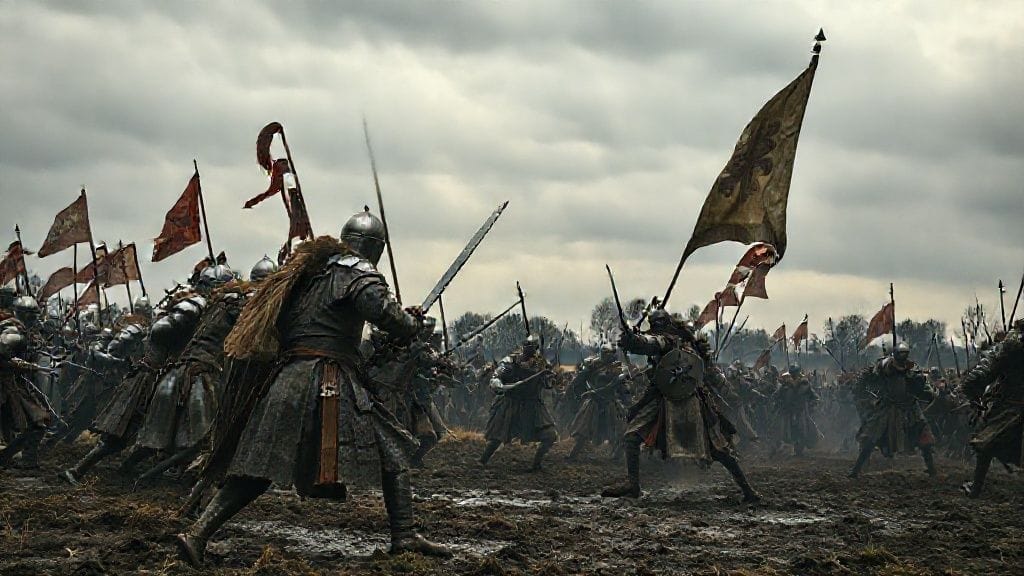
When the two groups finally advanced, banners raised and weapons ready, the sense of ceremony shattered into the roar of impact. The first phase of the combat of the thirty likely involved mounted charges, with lances couched under arm, aimed at unhorsing the enemy. The thunder of hooves on packed earth, the splintering of ash-wood lances, the grunts of men hit squarely in shield or breastplate—all this turned the carefully laid plans into a maelstrom of noise and movement.
Contemporary armor could deflect a lance point, but not always. A man struck with full force might be driven backward in the saddle, knocked senseless, or hurled to the ground. Horses, too, suffered: some skewered or slashed, others throwing their riders in panic. In such close quarters, riders struggled to control their mounts while avoiding the bodies of fallen men and animals underfoot. Dust rose; shouts in French, Breton, English, and perhaps German mingled into an indistinct tumult.
The neat division of “us” and “them” became confused knots of struggling figures. Those first moments were crucial—one side might break or seize the initiative. But the combat of the thirty did not end in a single decisive charge. Instead, as lances broke and casualties mounted, the fight shifted from cavalry charges to brutal, grinding combat on foot. Men dragged themselves up from the ground, drawing swords, axes, and maces. The ritual frame still existed in principle, but within it the reality was that of any battlefield: a desperate struggle to kill or incapacitate the opponent before he did the same to you.
Later romantic depictions often sanitize these scenes, focusing on noble single combats, cleanly-parried blows, and gallant gestures. Yet we must imagine the chaos: blood slicking the ground, men gasping for breath inside heavy helms, teeth rattling with each impact. Combat at this range meant seeing the eyes—or at least the visors—of the man who sought your life, hearing his labored breathing, smelling sweat, leather, and iron-scented blood.
From Mounted Combat to Fighting on Foot: Axes, Swords, and Desperation
Once the horses had either fallen or been deemed more hindrance than help, both sides dismounted fully and formed up on foot. Now the combat of the thirty took on a different character, more akin to an infantry melee. Shields were hefted, lines drawn. Men at arms on both sides likely advanced in loose ranks, trying to maintain some cohesion. Yet as soon as weapons met, formation broke again into smaller knots of fighters pairing off, joining, separating, like a living, lethal tapestry.
Weapons recorded in the sources include swords, daggers, axes, and maces. The axe, with its capacity to deliver crushing blows, could dent or even split helmets and drive through mail. Maces inflicted terrible blunt trauma, breaking bones beneath armor. Swords, though glamorous in art, were often used to stab at weaker points—gaps at the armpit, visor slits, the junctions at joints—rather than to cut through iron. Daggers came into play when opponents grappled, either to deliver a final thrust or to force a surrender.
At this stage, the advantage swung back and forth. One account suggests that the English and allied forces at first gained the upper hand, perhaps because of greater experience with such brutal close-quarters fighting. Several of Beaumanoir’s men fell, others were wounded and pushed back. The Franco-Breton line wavered. Had they broken and fled, the combat of the thirty might have been remembered, if at all, as a mere local defeat. But Beaumanoir and his comrades refused to yield. Rallied by knights such as Geoffroy du Bois, they tightened their ranks, fought defensively when needed, and looked for opportunities to strike back.
The heat of battle inside armor, even in early spring, would have been suffocating. Men fought under heavy helmets, their vision restricted to narrow slits. Breathing required effort; every movement demanded strength. As minutes lengthened into what must have felt like hours, exhaustion weighed as heavily as fear. It was here that character and conditioning mattered: a fighter’s capacity to push past pain and fatigue, to keep his footing on a ground littered with bodies and gear, became as important as pure skill with a blade.
Water, Blood, and the Famous Cry of Beaumanoir
From this grinding phase of the combat of the thirty comes one of the most enduring anecdotes of medieval chivalry. The story, repeated by chroniclers and later writers, tells how Jean de Beaumanoir, sorely wounded and weakened by loss of blood and the heat within his armor, cried out for water. In some versions, he gasped, “I die of thirst!” To which his comrade Geoffroy du Bois—himself fighting fiercely—responded with a line that would echo through French literature: “Drink your blood, Beaumanoir, and your thirst will pass.”
The exact wording may have shifted with retelling, but the message is unmistakable: no weakness, however human, could be allowed to threaten resolve. The reply is brutal, almost cruel, yet it embodies the expectation that a knight must transcend ordinary needs in the pursuit of victory and honor. Over centuries, this exchange has been quoted as a quintessential expression of medieval martial ethos, a single sentence that distills both the harshness and the stark courage of the age.
Was it spoken precisely in that form? We cannot know for certain. Modern historians are rightly cautious, noting that chroniclers like Froissart wrote with a keen eye for memorable lines and dramatic effect. Yet even if the phrase is partly literary, it reveals how contemporaries and later generations wanted to remember the combat: as a crucible of unwavering courage, where even a captain on the brink of collapse could be spurred back into action by a comrade’s ruthless encouragement.
In any case, the anecdote suggests that Beaumanoir did not leave the field; he fought on, bleeding, parched, and driven. Thirst itself becomes a symbol of the bodily cost of chivalry. Water, so basic to life, is denied in favor of a metaphorical draught of one’s own blood—of sacrifice. It is a chilling image, but one that gripped the medieval imagination. In the tale of the combat of the thirty, it stands as the pivot between near-defeat and renewed determination.
Death of Bemborough and the Breaking of the English-Breton Line
As the struggle dragged on, casualties increased on both sides. Men fell wounded or dead; others were taken prisoner, their lives spared in expectation of ransom. Among the most crucial losses was that of Robert Bemborough himself. Accounts describe how the English captain, fighting bravely in the thick of the melee, was eventually slain—struck down by multiple blows, overwhelmed despite his skill and armor. With his death, the cohesion of the Montfortist- English side began to unravel.
The death of a captain in medieval battle was not merely a tactical blow; it was also a symbolic wound. Soldiers drew courage from seeing their leader stand firm; they took direction from his gestures and voice. Once Bemborough fell, his men had to choose whether to continue defiant resistance, risking annihilation, or to seek terms. The Franco-Breton forces, emboldened, pressed their advantage. Several English and allied fighters were forced to the ground, disarmed, or surrounded until surrender was their only option.
Meanwhile, Beaumanoir, though wounded, remained alive and in command. His survival contrasted starkly with Bemborough’s demise and later helped French and Breton chroniclers present the outcome as a kind of moral judgment. God, they implied, had favored the Blois cause and its champions. The death of Bemborough, framed in this way, became almost a divine sentence upon the English and their allies. Yet we should not forget that, for Bemborough’s friends and family, his end was a personal tragedy, not a neat narrative device.
When at last the fighting ceased, the field bore witness to the cost: bodies strewn on the ground, armor dented and stained, weapons broken or lost. The Franco-Breton side emerged victorious, though at a great price in blood. Estimates of the dead vary, but several of the thirty on each side either lay dead or too gravely injured to fight again. The survivors, panting and aching, looked around at what they had done and at what it had cost to win this “honorable” victory.
Aftermath on the Field: Ransoms, Mercy, and the Counting of the Dead
In the silence after the clash, practical matters returned. Wounded men cried out for help; those who could move began to assist comrades or search the fallen for signs of life. A medieval battlefield, even on this relatively small scale, required grim triage. Some fighters could be bandaged and carried off; others were beyond help and received only a final prayer. The smells of sweat and blood were joined by the copper tang of open wounds and the earthy scent of churned soil.
Ransom negotiations started quickly. In medieval warfare among knights and men-at-arms, capturing an opponent of some standing could be more profitable than killing him. Prisoners might be held in castle chambers, treated according to their rank, and eventually released upon payment of a sum negotiated between captor and captive’s family or liege. The combat of the thirty, being formally arranged, likely reinforced this practice. Those who had fought bravely and surrendered could expect, in theory, to be spared and ransomed.
Yet mercy coexisted with brutality. Lower-ranking fighters might not fetch large ransoms and could be left to die of their wounds if resources were scarce. Peasants who strayed too close to the battlefield might be robbed or threatened. The chivalric code, so loudly invoked, had its limits; it extended far more generously to men in armor than to those without. The counting of the dead thus revealed not only the toll in numbers but the hierarchy of whose deaths “mattered” in the eyes of chroniclers.
Still, news of the outcome traveled fast. Messengers and returning fighters carried the story north and south, east and west, into halls where lords weighed every scrap of information about the war. To Blois and French supporters, the victory at the combat of the thirty offered a welcome sign that their cause still possessed vigor and divine favor. To Montfortist and English circles, the defeat was an embarrassment tempered only by the knowledge that it did not decisively change the military balance. Yet behind official reactions stood the personal emotions of families relieved or devastated, of local villagers who might feel, however distantly, that fate had spoken on their soil.
Legend in the Making: Chronicles, Songs, and the Birth of a Chivalric Myth
Almost immediately, the combat began to slip from raw memory into shaped narrative. Chroniclers such as Jean Froissart, writing some decades later, seized on the event as an ideal tale. Here, at last, was a story that combined clear protagonists, an identifiable setting, a dramatic climax, and a morally satisfying conclusion—at least from the viewpoint of French and pro-Blois audiences. Froissart, who traveled widely and valued noble patronage, wrote of the combat of the thirty with admiration, highlighting the valor and steadfastness of the participants.
In Froissart’s Chroniques, the episode becomes almost theatrical. Characters exchange ringing lines; the action unfolds with pacing and tension; the outcome seems almost inevitable in retrospect. It is, of course, a literary construction as well as a record. Froissart himself acknowledged relying on informants and earlier accounts. One can imagine him listening intently in great halls as aging knights or local clerics recounted what they had heard or witnessed: the clatter of arms, the cry for water, the fall of Bemborough. He then wove these strands into a narrative fit for the tastes of his aristocratic audience.
Beyond written chronicles, oral traditions flourished. Stories of the combat of the thirty would have been told and retold across Brittany, perhaps finding their way into poems, songs, or local tales. Names like Beaumanoir and Geoffroy du Bois took on heroic auras. The phrase “Drink your blood, Beaumanoir” became a shorthand for iron determination. Over time, embellishments crept in: exploits exaggerated, details polished, minor figures forgotten or amalgamated.
By the late Middle Ages and into the early modern period, the combat stood as one of the most celebrated chivalric episodes of the Hundred Years’ War. Even though, militarily, it changed little, it provided a moral and symbolic drama that could be quoted in sermons, courtly conversations, and political arguments. The line between history and legend blurred, as it so often does when an event speaks powerfully to the desires and anxieties of those who remember it.
Chivalry and Propaganda: How the Combat Served French and Breton Agendas
The transformation of the combat of the thirty into legend was not politically neutral. For the French crown and Blois supporters, the event offered a precious narrative jewel: a small but shining proof of Franco-Breton valor against English and foreign warriors. In a war marked by devastating defeats such as Crécy (1346) and later Poitiers (1356), the French side needed stories that could sustain morale and national pride. Here was a local victory, fought bravely and won decisively, that seemed to show God’s favor and the superiority of chivalric courage over mere numbers or cunning.
Breton partisans of the Blois cause also found in the combat a symbol of their own identity. Beaumanoir and his men represented, in their eyes, a Brittany aligned honorably with France, defending its soil against foreign intrusion and illegitimate claimants. Even centuries later, Breton writers and patriots would look back on the combat of the thirty as an emblem of regional heroism. It allowed them to say, in effect: “We were not passive victims of larger powers; we too acted, chose, and fought for what we believed in.”
On the English and Montfortist side, the episode was less convenient. It is not that they could ignore it entirely—news of such a dramatic combat spread widely—but they had less incentive to celebrate it. English chroniclers tended to downplay the event or frame it as only a minor local misfortune amid many other engagements. Some may have emphasized the bravery of Bemborough and his men, stressing that they died fighting valiantly and that individual defeat did not reflect on the justice of the Montfortist claim.
In this way, the combat became a tool of propaganda, a story bent to serve competing visions. As modern historian Jonathan Sumption has noted in his multivolume study of the Hundred Years’ War, medieval narratives often functioned as “moralizing mirrors,” reflecting what audiences wanted to see rather than the full complexity of events. The combat of the thirty fit perfectly into the French and Breton need for a clear, uplifting example of chivalric triumph, even while the broader war and the succession crisis dragged on in all their messy ambiguity.
Beyond Romance: Violence, Class, and Those Left Outside the Circle of Honor
To dwell on the rhetoric of honor and chivalry is to risk forgetting those who had no place in the carefully arranged lists of the combat. Outside the circle of sixty chosen men were thousands of ordinary Bretons whose lives were shaped by the same war but who received no mention in Froissart’s pages. For them, the conflict meant heavier taxes, conscription, the burning of barns, the loss of livestock, and the perennial terror of famine and plague—especially in the mid fourteenth century, when the Black Death ravaged Europe.
Even within the combat itself, the code of mercy and ransom largely applied to men of means. A knight taken prisoner could expect relatively courteous treatment; a poor soldier might be stripped of his gear, left to die on the field, or killed without remorse. The shining armor and gallant speeches of the combat of the thirty should not blind us to the broken jaws, crushed limbs, and slow, painful deaths of men whose names we will never know. Chivalry, as historians often note, was a class system wrapped in a moral language. It justified the privileges of warriors by casting their violence as noble and restrained, even when it was anything but.
Moreover, the “game” aspect of the combat—its prearranged nature, its agreed rules—only partly veiled the reality that it was still an exercise in lethal force. Each blow risked shattering a family, leaving widows and orphans behind. Each lost fighter meant one less hand to govern an estate or defend a village. The glamor that later surrounded the combat of the thirty rests, in the end, upon the same foundation of blood as any battle. It is simply more aesthetically packaged, easier to narrate and celebrate.
Recognizing this tension between legend and lived experience does not require us to scorn the courage of Beaumanoir or Bemborough. It merely calls us to hold both truths at once: that they fought with undeniable bravery, and that the social order which made such combats possible was deeply unequal and often indifferent to the suffering of those below the knightly class. The road between Josselin and Ploërmel thus becomes a symbol not only of chivalric splendor but of the sharp divisions in medieval society.
From Local Duel to European Memory: The Long Echo of the Combat of the Thirty
Over the centuries, the combat of the thirty continued to resonate far beyond the modest field where it took place. In France and Brittany, it appeared in histories, moral tales, and even schoolbooks as a shining example of feudal loyalty and martial virtue. The story aligned neatly with evolving national narratives that sought to portray medieval knights as the spiritual ancestors of modern soldiers, their courage a timeless inheritance.
During the nineteenth century, a period obsessed with medieval revival and romantic nationalism, interest in such episodes surged. Writers and historians alike turned again to sources like Froissart, mining them for stirring tales. The combat was retold with heightened color: armor gleamed brighter, speeches rang clearer, motives appeared purer. Painters imagined the scene with dramatic skies and idealized figures. Statues and plaques began to fix the memory in bronze and stone. It is in this era that the combat of the thirty most fully escaped its original context to become an almost allegorical story: the few brave and honorable standing against the many or the foreign, depending on the interpreter.
Yet the combat also found a place in broader European reflection on chivalry. Scholars and readers in England, Germany, and elsewhere encountered the tale as part of the tapestry of the Hundred Years’ War. Some admired the courage of both sides, seeing the event as proof that honor could exist even between enemies. Others criticized the seeming frivolity of staging such a contest amid a devastating war. Each reading told as much about the reader’s own values and era as about the fourteenth century.
In this sense, the combat of the thirty is instructive not only as an event but as a case study in historical memory. It shows how a relatively small-scale clash can, through the workings of narrative, symbolism, and politics, acquire a stature out of proportion to its immediate military impact. The men who fought there could not foresee that later centuries would argue over the meaning of their actions, or that their cries and blows would be reconstructed again and again, always with subtle alterations, always in dialogue with the needs of the present.
Modern Commemorations: Statues, Tourism, and Historical Debate
Today, if one travels to Brittany and follows the old routes between Josselin and Ploërmel, the echoes of that distant day are faint but not entirely gone. Memorials and plaques recall the combat of the thirty; local guides recount the story to visitors; reenactments occasionally attempt to bring its atmosphere to life. Sculptures of armored figures, swords raised, stand as guardians of memory, testifying to the enduring fascination with an event whose participants have been dust for nearly seven centuries.
Historians, meanwhile, continue to probe the sources, asking hard questions. How reliable are the numbers and details? To what extent did chroniclers, writing for noble patrons, exaggerate the chivalric purity of the combat? Did both sides truly adhere to the agreed rules, or were there moments of confusion and broken promises? Some scholars emphasize the propagandistic uses of the story; others explore how it reflects the psychology of warriors who sought to find meaning and dignity within a brutal profession.
Local identity also plays a role. For many Bretons, the combat is part of a broader narrative of regional distinctiveness. It anchors Brittany’s medieval past in a concrete scene of bravery and self-assertion, even as modern politics and culture evolve in new directions. Schoolchildren may hear simplified versions of the story, stripped of some of its bloodier details but retaining the key themes of courage and loyalty. Tourism brochures invoke it as a colorful piece of heritage, a selling point alongside castles, coastlines, and traditional festivals.
At the same time, contemporary sensibilities invite reinterpretation. In an era more sensitive to the costs of war and the voices of the marginalized, some observers emphasize the human suffering underlying chivalric display. They ask what the peasants thought as they watched or heard about the combat; they wonder about the unnamed wounded who faded from the record. In this ongoing conversation, the combat of the thirty remains a living subject, not a dead monument—a story still being told, argued over, and reimagined.
Conclusion
On that March day in 1351, sixty or so men stepped onto a rough Breton field to fight a battle that was, in one sense, small, but in another, immense. The combat of the thirty distilled into a few hours the tensions of a duchy torn between rival claimants, the rivalries of French and English crowns, and the complex ideals of medieval chivalry. Jean de Beaumanoir and Robert Bemborough, with their chosen companions, turned a contested frontier road into a stage upon which courage, loyalty, and violence were displayed with stark clarity.
In the decades and centuries that followed, chroniclers like Froissart transformed their struggle into a legend, honing phrases like “Drink your blood, Beaumanoir” into aphorisms of iron will. French and Breton writers embraced the tale as proof of their heroes’ valor, while English observers treated it more cautiously. The story fed national pride, regional identity, and romantic fascination with the Middle Ages. Yet beneath the emblazoned shields and polished statues lies the reality of broken bodies, grieving families, and a war that continued to ravage Brittany long after the last blow was struck on that field.
To remember the combat of the thirty with honesty is to hold together both its splendor and its shadow. It was, undeniably, an extraordinary episode, one that reveals much about how fourteenth-century warriors understood honor, fate, and themselves. But it was also part of a broader tapestry of suffering and struggle, in which the majority of people had no say in when or how they would be drawn into conflict. By tracing its origins, its course, and its long afterlife in memory, we see not only a single combat, but the enduring human impulse to turn war’s chaos into stories that make sense of sacrifice—and sometimes, perhaps, to make that sacrifice seem more glorious than it truly was.
FAQs
- What was the combat of the thirty?
The combat of the thirty was a prearranged clash on 26 March 1351 in Brittany, during the War of the Breton Succession. Roughly thirty men-at-arms on each side, drawn from the garrisons of Josselin and Ploërmel, fought under the captains Jean de Beaumanoir (for the Franco-Breton Blois faction) and Robert Bemborough (for the English-backed Montfortists). Though small in scale, it became famous as a symbol of chivalric courage. - Why did the combat of the thirty happen?
It arose from ongoing frontier skirmishes and mutual insults between the two opposing garrisons. Rather than continue only with raids and ambushes, the captains agreed to a formalized combat between selected champions to test their courage and, symbolically, the merit of their respective causes. Political rivalry, personal honor, and the culture of chivalry all contributed to the decision. - Who won the combat, and what were the immediate consequences?
The Franco-Breton side led by Jean de Beaumanoir emerged victorious. Robert Bemborough was killed, and several of his men were slain or captured. The result boosted the prestige of the Blois faction and their French allies, but it did not decisively change the broader military situation in the War of the Breton Succession, which continued for years afterward. - Is the famous quote “Drink your blood, Beaumanoir” historically accurate?
The line is attributed to Geoffroy du Bois by later chroniclers, especially Jean Froissart, who recounts that Beaumanoir cried out for water during the fight and was told to “drink his blood” to quench his thirst. While the exact wording may be literary embellishment, most historians think an exchange of this kind likely occurred, and it reflects how contemporaries wanted to portray the iron resolve of the combatants. - How does the combat of the thirty relate to the Hundred Years’ War?
The combat took place within the War of the Breton Succession, which itself was deeply entangled with the Hundred Years’ War. The rival claimants to the duchy—Charles of Blois and John of Montfort—were backed respectively by France and England. Thus, the combat between the garrisons of Josselin and Ploërmel also symbolized the wider struggle between French and English influence in western France. - Were only knights involved in the combat?
No. While several participants were knights of noble birth, others were squires or professional men-at-arms. The lists on both sides included a mix of ranks, reflecting the reality that effective fighters did not always come from the highest aristocracy. Nevertheless, the entire event remained an elite affair, closed to common soldiers and peasants. - How many people died in the combat of the thirty?
Sources vary, but most suggest that several fighters on each side were killed, including Robert Bemborough on the English-Montfortist side. Many more were wounded, and a number were taken prisoner for ransom. Because medieval chroniclers often focused on notable individuals, exact figures for the total dead and injured remain uncertain. - Why has the combat of the thirty become so famous?
Its fame stems largely from the way chroniclers and later writers used it as a model of chivalric warfare. Unlike large, chaotic battles, this combat had clear participants, a defined setting, and dramatic anecdotes that were easy to retell. It offered a seemingly “pure” example of courage and honor, which made it ideal for moral and patriotic narratives in France and Brittany. - How do modern historians view the combat of the thirty?
Modern historians recognize its importance as a cultural and symbolic event but are cautious about taking every detail in the sources at face value. They study the combat as part of the social history of warfare, examining how chivalric ideals, propaganda, and local identity shaped both the event itself and the way it was remembered. The combat is seen less as a decisive battle and more as a revealing window into fourteenth-century mentalities. - Can visitors see the site of the combat today?
While the exact spot of the combat is debated, the general area between Josselin and Ploërmel in Brittany is accessible, and local markers or memorials point to the historic event. Castles, statues, and museum displays in the region often include references to the combat of the thirty, making it a notable element of local heritage and historical tourism.
External Resource
Internal Link
Other Resources
- Encyclopaedia Britannica – general search for the exact subject
- Google Scholar – academic search for the exact subject
- Internet Archive – digital library search for the exact subject

