Table of Contents
- The Emperor’s Last Autumn in the Forest of Bodfeld
- From Salian Scion to Lord of Christendom
- Crowning Glory: Emperor at Twenty-Four
- Piety, Power, and the Making of a Christian Monarch
- Storm over Germany: Dukes, Bishops, and Rebellion
- The Roman Question: Popes, Antipopes, and Imperial Will
- Family, Heirs, and the Fragile Future of the Salian Dynasty
- Ailing in the Harz: The Emperor’s Final Journey to Bodfeld
- Nightfall on 5 October 1056: The Death of a Holy Roman Emperor
- Sobs, Silence, and Strategy: Immediate Reactions to the Emperor’s Death
- A Widow Regent and a Child King: Agnes of Poitou Takes the Helm
- Cracks in the Marble: The Empire Without Its Architect
- The Long Road to Canossa: From Henry III to Henry IV
- Church Reform Unleashed: When the Pope No Longer Waited for the Emperor
- Portrait of an Emperor: How Chroniclers Remembered Henry III
- The Political Geography of Power After Bodfeld
- Echoes Through the Centuries: Legacy of the Emperor’s Final Day
- Conclusion
- FAQs
- External Resource
- Internal Link
Article Summary: On 5 October 1056, in the forested hunting lodge of Bodfeld in Saxony, the death of henry iii emperor brought to an abrupt close the life of one of the most powerful rulers of the Middle Ages. This article traces Henry III’s rise from Salian prince to Holy Roman Emperor, his efforts to rule as a Christian monarch above dukes and bishops alike, and his complex involvement in the reform of the medieval Church. It follows the emperor into his final months, exploring the illness, anxiety, and political calculation that framed his last journey to Bodfeld and culminated in the quiet, devastating death of henry iii emperor far from the great cathedrals of his reign. Yet the story does not end there: the article shows how his passing opened a dangerous vacuum, leaving a child heir and a vulnerable widow to defend an uneasy empire. As the narrative continues, the death of henry iii emperor appears less as a single event and more as the hinge on which the Investiture Controversy and the clash between empire and papacy would swing. Chroniclers, reformers, and later historians all interpreted the death of henry iii emperor in the light of what followed — the dramatic reign of Henry IV and the walk to Canossa. By weaving political analysis with human detail, this article reveals how the death of henry iii emperor in a remote Saxon lodge reshaped the map of medieval power and altered the history of Europe.
The Emperor’s Last Autumn in the Forest of Bodfeld
The autumn woods around Bodfeld in 1056 were already deepening into shades of bronze and shadow when the emperor’s retinue arrived. Horses, carts, clerics in travel-worn vestments, armored guards whose mail glinted between the trees — all descended upon the hunting lodge like a moving camp of iron and silk. Yet at the center of this carefully ordered chaos lay a man who could hardly sit his saddle. Henry III, Holy Roman Emperor, the arbiter of kings and the chosen protector of the Church, had become, in his forty-first year, a figure worn down by fever, gout, and the persistent bite of care. The journey to Bodfeld, a secluded royal hunting seat in the Harz forests of Saxony, was not meant to be a ceremonial tour. It was, in many ways, an escape.
But this was only the beginning of the final chapter. The death of Henry III emperor is often told in a single sentence: “He died at Bodfeld on 5 October 1056.” The simplicity of that line hides the storm that gathered behind it. For more than a decade, Henry had seemed invincible, a ruler before whom dukes knelt and popes were made or unmade. Now he coughed into linen, his feet swollen, his sleep broken by pain and memory. Behind the walls of the timber lodge, attendants softened their steps and nobles whispered in the corners: the emperor was failing, and the empire with him might falter.
Outside, the Harz wind pressed against the shutters. Inside, charred torches left smoky halos on the beams. Agnes of Poitou, the emperor’s queen, moved through the dim corridors like a quiet commander, speaking in low tones with bishops and counselors. Their son, the future Henry IV, was only five years old — a small, solemn boy, perhaps bewildered by the sudden gravity that had settled over his father’s household. It’s astonishing, isn’t it, to imagine Europe’s fate hinging on the labored breaths of a man resting in a hunting lodge far from Rome, far from Mainz, far from the great imperial assemblies.
On that October day, no chronicler stood at the bedside taking careful notes. What we know comes through later recollections, shaped by memory and politics. Yet all agree on the basic outline: Henry’s illness grew worse; the hunts he loved became impossible; councils turned from future campaigns to the question nobody wanted to voice—what would happen when the emperor’s heart finally stopped? By night, the murmur of prayers rose from the chapel, monks chanting psalms for a man who had once decided who wore the Papal tiara. By morning, messengers slipped out toward cathedral cities, their saddlebags carrying not yet the news of death, but the anticipatory anxiety of a realm bracing for loss.
From Salian Scion to Lord of Christendom
To understand why the atmosphere at Bodfeld was so charged, one must step back to the beginning of Henry’s story, long before the death of Henry III emperor transformed imperial politics. Born in October 1017, Henry was the son of Emperor Conrad II, the first of the Salian dynasty, and Gisela of Swabia. The Salian family, based around the Rhineland, was not yet cloaked in the aura of inevitability. They were ambitious nobles who had grasped the crown at a moment when the older ruling lines had died out. Conrad, stern and pragmatic, knew that to hold the empire he would need a capable heir molded carefully from childhood.
Henry grew up amid itinerant courts, fortified palaces, and cathedral schools. He watched his father preside over great assemblies where dukes of Bavaria, Swabia, and Carinthia had to be coaxed or coerced into obedience. Already as a boy, he would have learned that the empire was not a single, monolithic block of power but a mosaic of loyalties, privileges, and jealousies. The imperial court, always on the move, was his classroom. Tutors — clerics steeped in Latin, Scripture, and law — trained him to see himself as God’s chosen ruler, a “rex et sacerdos” in the sense of a king with priestly responsibility, if not priestly orders.
In 1028, when Henry was barely eleven, his father had him crowned King of the Romans at Aachen, the ancient capital of Charlemagne. The boy king, bearing a crown that must have felt impossibly heavy, became the visible pledge of dynastic continuity. Conrad was not content with ruling alone; he wanted the empire to accept the idea that the Salian line would endure, that kingship could be made hereditary in a realm where powerful nobles still believed they had the right to choose the ruler. In the shadow of Aachen’s octagonal chapel, Henry’s childhood was fused with the sacred rituals of monarchy.
Yet behind the celebrations, there were tensions simmering. Some nobles resented the growing centralization of power in the hands of the Salians. Others feared the way bishops, closely tied to the king, were accumulating vast estates and immunities. Henry watched his father struggle with revolts and delicate negotiations, learning that an emperor needed not only anointed legitimacy but also a keen sense for when to bend and when to break a foe. By the time Conrad II died in 1039, Henry had already been ruling alongside him, stepping gradually into the role that would demand every ounce of his strength—and would, in time, consume it.
Crowning Glory: Emperor at Twenty-Four
With Conrad’s death, Henry became King of the Romans in his own right at the age of twenty-one. The transition was smoother than many had expected. The prior co-kingship had helped; the machinery of imperial administration, especially in the Church, was already accustomed to recognizing Henry’s authority. But kingship within Germany was only one step. The true summit of medieval political aspiration lay farther south, in Rome, where the imperial coronation by the Pope transformed a German king into “Romanorum Imperator Augustus” — Holy Roman Emperor.
In 1046, Henry descended into Italy. The peninsula he entered was ravaged by factionalism. Rome itself had become a battleground where aristocratic families — the Tusculani and the Crescentii — thrust their relatives into the papal office, deposed rivals, and sowed scandal. By that year there were three competing claimants to the papacy. For a pious king raised under the ideal of a reformed, orderly Church, the spectacle was appalling. For an astute politician, it was also an opportunity.
At the Synod of Sutri in December 1046, Henry presided over a dramatic clearing of the papal field. The three rival popes — Benedict IX, Sylvester III, and Gregory VI — were one by one set aside. The king, effectively, reset the papacy. He then nominated Suidger of Bamberg, who became Pope Clement II. On Christmas Day 1046, in the Basilica of St. Peter, Clement II placed the imperial crown upon Henry’s head. At twenty-four, Henry III had become the Holy Roman Emperor, master not only of German and Italian politics but, seemingly, of the Church itself.
The coronation was more than a ceremony; it was a powerful image of a world order. Here stood a young emperor, the successor of Charlemagne and Otto the Great, who could stride into the heart of Christendom and impose order on the most sacred institution of the age. Chroniclers loyal to Henry later painted this moment in glowing colors, seeing in it the restoration of harmony after the chaos of factional popes. One could imagine, as the incense curled beneath the vaulted ceiling, that an age of stable, righteous imperial oversight had dawned. Yet the seeds of future conflict were also being sown, for a papacy restored by imperial will would in time demand its own freedom from that same will.
Piety, Power, and the Making of a Christian Monarch
Henry’s reign after 1046 unfolded at the intersection of personal devotion and cold political calculation. He was, by the standards of his age, a deeply pious man. He traveled with relics, attended the liturgy regularly, and supported monastic reform. Many of his charters and decrees stress his responsibility as “rector ecclesiae,” the ruler charged with guiding and protecting the Church. He did not see a contradiction between being the secular head of the empire and an active participant in ecclesiastical reform. In his mind, they formed a single, God-ordained office.
The emperor’s use of bishops and abbots as key pillars of his rule was characteristic of the Ottonian and Salian system. By appointing loyal churchmen to rich sees — Mainz, Cologne, Bamberg — he created a network of princes whose power depended directly on imperial favor. Unlike hereditary dukes, these prelates could not pass their offices to sons; in theory, the emperor could continually refresh the episcopal ranks. This strategy made theological sense in Henry’s ideology: as a Christian monarch, he was elevating worthy servants to care for souls and lands, embodying the unity of Church and empire.
And yet, behind the harmony, questions lurked. How free were these episcopal appointees if their ring and staff came first from an emperor rather than from the Church itself? Henry’s actions did not seem outrageous to his contemporaries — indeed, many welcomed his firm hand in replacing corrupt or ineffective clergy. But later reformers, especially those around the future Pope Gregory VII, would look back and see in Henry’s reign a troubling overreach of lay power into sacred offices.
Henry himself likely did not foresee such a backlash. From Bodfeld’s perspective, years later, as illness gnawed at him, he might have remembered the warmth of monastic welcomes, the chanting of Te Deum when he endowed a church, the letters from popes praising his zeal. His self-image was not that of a tyrant, but of a disciplined, almost ascetic leader who took seriously the moral weight of his crown. Yet power, once tightly held, rarely releases its grip without a struggle, and the struggle would not come fully in his lifetime, but after the death of Henry III emperor left the throne to a child.
Storm over Germany: Dukes, Bishops, and Rebellion
If Henry’s relationship with the Church seemed, for a time, harmonious, his dealings with the great lay magnates of the empire were far more turbulent. The dukes of the empire — of Bavaria, Swabia, Carinthia, Saxony — saw themselves as partners, sometimes rivals, rather than mere subordinates. Henry’s drive to tighten royal authority often put him at odds with them. In the early 1050s, conflicts flared across the German lands, testing the emperor’s patience and resolve.
Saxony, the very region where Henry would later die, was a chronic source of unrest. The great Saxon nobles guarded their ancient rights fiercely and resented the encroachment of royal castles and officials into their territories. Henry’s policy of establishing royal strongholds, garrisoned by his own men, was designed to check local power and secure imperial presence. To Saxon eyes, it looked like a slow strangling of their autonomy. Skirmishes broke out; alliances shifted; at times, the emperor had to march north with an army to remind the region who ultimately commanded the sword.
Nor were the southern duchies any calmer. In Bavaria and Swabia, Henry’s habit of deposing uncooperative dukes and replacing them with men of his choosing — sometimes even holding duchies personally — bred resentment. The emperor, shaped by his father’s example, believed that the crown must remain strong and unchallenged. The dukes, heirs to long lines of aristocratic privilege, believed that their lands were not mere fiefs to be shuffled at a monarch’s whim.
Rebellion, though, was never simply a matter of politics. It was also deeply personal. Family ties, insults, broken promises, and wounded honor swirled beneath the formal language of charters and proclamations. A feast cancelled, a hostage badly treated, a judgment perceived as unfair could set a noble house on a collision course with the throne. Henry answered such challenges with a mixture of military force and calculated mercy. Victorious in the field, he could nonetheless forgive, restoring lands or titles to bring wayward vassals back into the fold. This balance of steel and olive branch was one reason that, by the time of his final illness, the empire, though restless, had not yet fractured into open civil war.
The Roman Question: Popes, Antipopes, and Imperial Will
Henry’s involvement in the affairs of Rome did not end with his imperial coronation. In the years that followed, he continued to exercise a decisive role in papal appointments. After Clement II’s short pontificate (he died in 1047), Henry supported a succession of popes closely tied to his reforming vision: Damasus II, Leo IX, Victor II. These men, many of them originally German or Lotharingian bishops, brought with them ideas of Church renewal that aligned, at least initially, with the emperor’s sense of order. Simony — the buying and selling of ecclesiastical offices — and clerical marriage were targeted as abuses to be eradicated.
The strange paradox of this moment is that the movement later labeled the “Gregorian Reform” partly germinated under an emperor who would have balked at its ultimate implications. Henry III wanted a purified, morally serious clergy, but he did not want a Church that would claim independence from, let alone superiority over, imperial authority. For the time being, however, the goals of emperor and reformers overlapped sufficiently to preserve an uneasy alliance. Leo IX, for example, traveled widely, held synods condemning corruption, and acted with energy that impressed contemporaries. Henry could point to such papal activity as proof that his interventions in Rome had borne righteous fruit.
Yet behind the public unity, a deeper question was brewing: who ultimately held the right to “invest” bishops and popes with their office? Was it the emperor, representing the Christian people and ordained by God to guard the Church? Or was it the clerical hierarchy itself, guided by canon law and the spiritual authority of the papacy? During Henry’s lifetime, this question remained largely theoretical. He held enough prestige, and his chosen popes held him in sufficient respect, that direct confrontation was avoided. But the structure he had built — an empire leaning heavily on its right to shape the Church — would come under intense strain after Bodfeld, when a weaker hand grasped the imperial scepter.
Years later, when the Investiture Controversy erupted under his son, reformers would look back with mixed feelings at Henry III’s legacy. Some, like the monk and chronicler Lambert of Hersfeld, praised his moral seriousness while condemning the way secular power had entangled the Church. The stage on which Gregory VII and Henry IV would clash was, in many respects, constructed by the confident, seemingly unassailable policies of Henry III.
Family, Heirs, and the Fragile Future of the Salian Dynasty
For a medieval emperor, the question of heirs was as vital as any battlefield victory. Henry’s marriage to Agnes of Poitou in 1043 was not only a personal union but also a strategic alliance reaching deep into the aristocratic networks of France. Agnes, descended from the powerful dukes of Aquitaine, brought prestige and connections to the Salian house. She also brought, in time, children — though not all of them survived.
The imperial couple’s first son, also named Henry, died young. His brief life, extinguished before it could acquire political meaning, was nonetheless a warning sign from the perspective of dynastic security. The second son, born in 1050 and likewise named Henry, would live and eventually become Henry IV. The repetition of names in medieval dynasties often carried symbolic weight: to name a child after a deceased sibling was to insist that the dynastic line would not be broken, that the lost future would be reclaimed in a new life.
Beyond sons, there were daughters whose marriages would stitch the empire into the broader fabric of European politics. Yet the central question remained: would the boy Henry live, and would he, when the time came, be strong enough to rule? As his father’s health began to fail in the mid-1050s, this question took on an almost desperate urgency. The death of Henry III emperor without a mature successor would leave not a stable succession but a fragile bridge between generations, held up by the slender shoulders of a child and the political acumen of a widow.
Agnes herself was not a figure to be underestimated. Educated, pious, and politically aware, she had long observed her husband’s handling of nobles and bishops. Yet being a queen consort was different from being a regent. Medieval Europe had known powerful women rulers, but they always walked a narrow path between authority and suspicion. Agnes would soon have to walk that path, and every decision she made would be tested by ambitious nobles eager to expand their own power in the shadow of a child king.
Ailing in the Harz: The Emperor’s Final Journey to Bodfeld
By 1056, Henry’s body was no longer able to keep pace with his ambitions. Illness had begun to dog him. Sources mention fever, possibly a chronic infection, and painful swelling in his limbs that modern historians sometimes associate with gout or a similar inflammatory condition. For a ruler whose authority rested partially on the visible display of vigor — riding at the head of armies, presiding in person at diet and synod — the erosion of physical strength was more than a private misfortune; it was a public vulnerability.
The decision to travel to Bodfeld that year was shaped by multiple motives. The Harz region, rich in game and studded with royal estates, had long been a favorite hunting ground of the German kings. Hunting was not only sport but also political theater: a way to display prowess, reward companions, and move the royal presence through the land. But this time, the emperor’s arrival in Bodfeld carried a different tone. The journey, undertaken despite his worsening condition, may have been intended as a show of normalcy, a declaration that the emperor was still capable of moving through his realm.
Yet behind the facade, those closest to him knew the truth. The emperor tired quickly; his appetite waned; bouts of fever left him sweating through the night. Bishops traveling with the court noted with concern the growing intervals during which Henry withdrew from public affairs. As the entourage reached the wooded seclusion of Bodfeld, there may have been a collective sigh of relief—here, at least, away from the constant pressure of city politics, the emperor could rest, consult quietly with a smaller circle of advisers, and perhaps recover strength.
Inside the timber and stone of the lodge, rooms were quickly adapted to serve as an improvised sick chamber. Doctors, schooled in the humoral theory of the age, would have prescribed changes in diet, bleedings, and herbal remedies. Priests stood ready with the sacraments. The atmosphere was heavy with a mixture of hope and foreboding. News from other parts of the empire still reached Bodfeld, but it came punctuated now by the rhythms of illness: audiences postponed, decisions delayed, documents sealed with a hand that trembled more than it once had.
Nightfall on 5 October 1056: The Death of a Holy Roman Emperor
We do not possess a minute-by-minute account of 5 October 1056, yet the scattered reports allow us to reconstruct the shape of that day with a certain clarity. Henry’s condition worsened in the days leading up to it. The chronicler Frutolf of Michelsberg later wrote that the emperor “was consumed by a long illness and, sensing the approach of death, commended his soul to God and his son to the care of the realm.” Such phrasing fuses piety and politics, as was typical in medieval accounts of royal death.
As morning passed into afternoon, the attendants in Bodfeld would have watched anxiously for any sign of improvement. The emperor might have asked for Agnes, for his small son Henry, for his closest clerical counselors. The sacrament of extreme unction — anointing with holy oil for the dying — would have been administered, the priest’s words mingling with the muffled sounds of weeping. For a man who had so often seen tears in others, as he deposed a duke or pardoned a rebel, to hear such sorrow directed toward himself must have been both consoling and deeply strange.
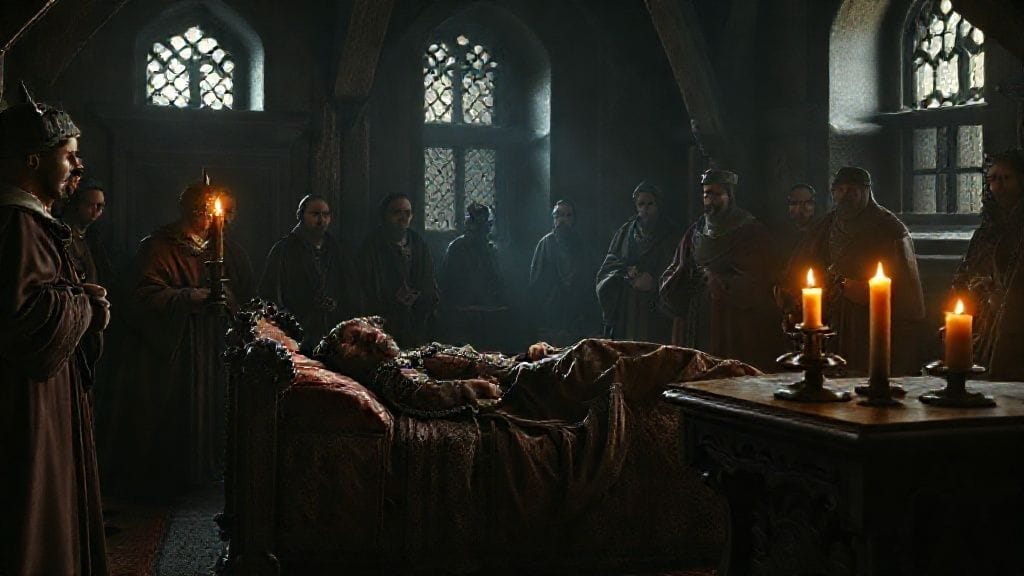
The death of Henry III emperor, when it came, appears to have been relatively peaceful, at least by the brutal standards of medieval mortality. There was no battlefield trauma, no assassination in a darkened hall, no sudden fall from a horse. Instead, there was the slow dimming of a life exhausted by labor and burdened by sickness. As evening shadows lengthened over the Harz forest, the final prayers were said. Sometime around nightfall, the emperor’s chest rose and fell for the last time. In that quiet room, far from the roaring crowds that had greeted him in Rome or Aachen, one of the most powerful men in Europe departed.
The impact, however, was anything but quiet. Almost at once, the people in that chamber — Agnes, bishops, nobles — had to shift from mourning to calculation. Who would be informed first? Which messengers would ride through the Saxon darkness to carry the news to Mainz, Cologne, Rome? The formula of royal death notices was well-established, but each word now also carried a political charge. The emperor is dead; long live the king. But the king was a child, and the realm was vast.
In the hush following the death of Henry III emperor, the lodge at Bodfeld became, for a few charged hours, the center of the known world. Somewhere nearby, the boy Henry slept or wept; sources do not say. Agnes, perhaps still kneeling by the bed, had become, in a single moment, both widow and regent. Outside, guards paced the perimeter, unaware that the master they served had already crossed the threshold from command to memory.
Sobs, Silence, and Strategy: Immediate Reactions to the Emperor’s Death
The first reaction in Bodfeld was grief. Those who had served Henry for years, who had followed him through Italy and Germany, felt the personal blow. Chroniclers emphasize the sorrow of the court, the collective sense that a great protector had been lost. Some of this was no doubt genuine; Henry had been, by most accounts, a just though stern ruler, less capricious than some of his predecessors. His piety inspired respect, even affection, in a number of churchmen who had known him.
But within hours, grief had to share the stage with strategy. The death of Henry III emperor immediately opened a series of urgent questions. The succession itself, in legal terms, was clear: the young Henry IV had already been recognized as heir. Yet the mechanics of governing in his name were far from settled. Agnes would need the backing of key princes and bishops to act as regent. Without their support, her authority might be challenged, her decisions ignored, her son’s crown reduced to a ceremonial trinket.
Councils were convened in hurried whispers. Who among the nobles might pose the greatest threat? Who could be drawn into alliance with offices, territories, or marriages? The bishops closest to Henry, many of whom owed their positions to his patronage, understood that their own fate was tied to the stability of the succession. They could not allow the empire to fracture. At the same time, some perceived that the new situation gave them room to maneuver more freely, to press for autonomy that would have been unthinkable under the watchful eye of Henry III.
Decisions were taken that very night about the transport of the body. An emperor could not lie in state in a hunting lodge. He must be borne to a place fitting his rank and memory. Speyer, the Salian dynastic burial church, was the natural destination. The image of the imperial corpse moving slowly through the realm, escorted by a solemn procession, served both as a ritual of mourning and as a traveling proclamation of continuity: the dead emperor honored, the living king acknowledged.
A Widow Regent and a Child King: Agnes of Poitou Takes the Helm
When dawn broke over Bodfeld the next day, Agnes of Poitou rose not merely as a grieving wife but as the functional head of an empire. The transition from consort to regent was swift and unforgiving. Almost immediately, plans were made for a formal assembly — the diet of Tribur in 1056 and subsequent gatherings — where the princes of the empire would confirm their allegiance to Henry IV and, implicitly, to Agnes as his guardian.
Agnes’s regency was always going to be precarious. Medieval aristocratic culture was profoundly patriarchal; a woman at the helm of imperial politics could easily become a lightning rod for resentment and ambition. Yet Agnes possessed advantages. Her lineage gave her international prestige. Her piety resonated with reform-minded clergy. Her familiarity with Henry’s policies meant she could at least initially maintain continuity.
Still, even before the emperor’s body reached Speyer, noble calculations had begun to shift. The great dukes, especially those whom Henry had previously constrained or displaced, saw in the regency a chance to recover old rights or seize new ones. The Saxons, ever wary of central authority, looked for opportunities to assert their regional autonomy. Bavaria and Swabia, once reshaped by Henry’s firm interventions, now simmered with latent claims.
Agnes responded with a mixture of concessions and reliance on the Church. She leaned on bishops as counselors and supporters, just as her husband had done, but with a key difference: she lacked the same personal authority to appoint or dismiss them with impunity. In time, this reliance would contribute to a subtle shift toward greater ecclesiastical influence in imperial governance. The very mechanisms Henry III had strengthened were now beginning to operate in ways he had not intended, a development made more acute by the vacuum left after the death of Henry III emperor.
Cracks in the Marble: The Empire Without Its Architect
Henry III had often been described by chroniclers as a kind of architect of order, a ruler who carefully balanced the competing forces of dukes and bishops, Germans and Italians, empire and papacy. With his death, the structure he had built did not collapse overnight, but its hidden weaknesses quickly became visible. The regency faced an immediate dilemma: to preserve the centralizing tendencies of Henry’s rule or to accept a partial devolution of power to appease the princes.
The diet at Tribur and subsequent meetings revealed the new pattern. Agnes and her advisers, under pressure, agreed to bestow important duchies on members of the high nobility rather than holding them in the royal hand as Henry had sometimes done. This restored a measure of princely autonomy but at the cost of diluting royal control. In the short term, such concessions bought peace; in the long term, they strengthened the centrifugal forces within the empire.
The Church, too, began to reposition itself. Reformers, emboldened by the death of a strong emperor who had nonetheless supported their moral agenda, now looked increasingly toward the papacy as the primary guardian of ecclesiastical integrity. While Henry III might once have been seen as the “first reformer,” his posthumous shadow was more ambiguous. Some churchmen praised him as a just ruler; others, sensing the changing winds, emphasized the dangers of lay interference in clerical matters.
The empire Henry had left behind thus entered a period of subtle but significant transformation. The marble facade of unity remained, but hairline cracks spread beneath the surface. These fissures would widen under the pressures of a grown Henry IV’s conflicts with Gregory VII, but their origin lies in the years immediately following Bodfeld, when every decision taken by the regent and princes was, consciously or not, a response to the absence created by the death of Henry III emperor.
The Long Road to Canossa: From Henry III to Henry IV
To trace the long arc leading to the dramatic scene at Canossa in 1077, where Henry IV stood barefoot in the snow begging Pope Gregory VII for absolution, is to see how deeply the death of Henry III emperor shaped European history. Henry IV’s childhood and adolescence were marked by power struggles among the princes, ecclesiastical politics, and occasional coups that briefly displaced Agnes from direct regency. The young king grew up in an atmosphere of suspicion, faction, and unstable authority — a stark contrast to the relative solidity of his father’s rule.
When Henry IV finally assumed full personal control of the government in the early 1060s, he inherited both his father’s sense of royal dignity and a much more fragmented political landscape. The imperial-papal relationship, too, had changed character. The papacy, energized by reform, had begun under Nicholas II and then Gregory VII to assert far-reaching claims: that only the Church could invest bishops, that the pope held the authority to depose emperors, that the spiritual power of the keys surpassed any earthly crown.
Would Gregory VII have dared to confront Henry III so directly, to excommunicate him and release his subjects from oaths of loyalty? Historians debate the question, but many suspect the answer is no. It was the combination of a more assertive papacy and a comparatively weaker emperor that made the Investiture Controversy explode so violently in Henry IV’s reign. In that sense, Bodfeld’s quiet death room and Canossa’s snowy courtyard form two endpoints of a single historical arc: the gradual unravelling of a model of sacral kingship in which emperor and Church walked, however uneasily, in tandem.
Lambert of Hersfeld, a critical chronicler of Henry IV, contrasted the “just and pious” rule of Henry III with what he saw as his son’s arrogance and missteps. While his judgment was colored by political and ecclesiastical loyalties, it captures a broader sentiment: that something fundamental had shifted in the empire after 1056. The figure of the emperor was no longer the unchallenged center of Christian order but one actor among several powerful institutions, each claiming divine sanction.
Church Reform Unleashed: When the Pope No Longer Waited for the Emperor
As the memory of Henry III’s commanding presence receded, the reforming movement in the Church began to move beyond anything he might have anticipated. The Lateran councils of the 1050s and 1060s tightened rules against simony and clerical marriage. New norms for papal election, introduced under Nicholas II in 1059, sought to reduce secular influence by granting the cardinal-bishops primary responsibility for choosing the pope. These changes, while couched in spiritual language, had direct political implications: they curtailed the emperor’s traditional role in shaping the papacy.
The reformers’ insistence on freeing the Church from “the control of the laity” was, in part, a reaction against the very system that had flourished under Henry III. What had once seemed a harmonious cooperation between throne and altar now appeared, in their eyes, as a dangerous mingling of the sacred and the profane. Gregory VII’s famous “Dictatus Papae,” a set of propositions recorded in 1075, claimed unprecedented powers for the pope, including the right to depose emperors. One can almost hear, in these bold assertions, an inversion of the world that existed before the death of Henry III emperor, when the emperor could effectively make and unmake popes at Sutri.
This does not mean that Henry III was a simple villain in reformist narratives. Some writers, such as the later twelfth-century historian Otto of Freising, attempted a more balanced view. Otto saw Henry as an earnest, if imperfect, ruler whose alliance with early reformers laid necessary groundwork for the later purification of the Church. Nonetheless, the structural effect of his passing remained the same: without a strong imperial partner, the papacy turned inward and upward, defining itself first and foremost as a spiritual power independent of earthly crowns.
Thus, the waves unleashed by Bodfeld’s death rippled through ecclesiastical as well as secular institutions. The papacy’s shift from imperial client to would-be universal monarch of Christendom is one of the defining transformations of the central Middle Ages — and it unfolded most dramatically after the imperial throne was left to a child in 1056.
Portrait of an Emperor: How Chroniclers Remembered Henry III
The image of Henry III that comes down to us is filtered through the pens of monks, bishops, and later historians, each with their own angle of vision. Some admired him as the “rex iustus,” the just king, whose firm hand kept peace and order. Others saw in his control of episcopal appointments the seeds of worldly corruption in the Church. Modern scholars, drawing on charters, chronicles, and numismatic evidence, have tried to assemble a more nuanced portrait.
Several near-contemporary sources emphasize Henry’s personal moral seriousness. The chronicler Hermann of Reichenau, for instance, described him as “distinguished in piety and justice,” praising his interventions in Church affairs as motivated not by greed but by zeal for reform. Hermann’s account, while sympathetic, also notes the heavy burdens Henry carried, suggesting that his early death was hastened by unrelenting labor for the realm.
Other voices were more critical or ambiguous. Lambert of Hersfeld, writing later in the eleventh century, contrasted Henry III’s rule favorably with that of Henry IV but still hinted that the imperial grip on the Church had become too tight. Still later, the humanist Cardinal Nicholas of Cusa would look back on the eleventh century as a time when relations between empire and papacy began to go awry, with Henry’s reign standing at the hinge point.
From a modern perspective, Henry appears as a transitional figure. He was the last emperor who could, with relative impunity, impose his will on Rome and expect obedience from most of his princes. His authority was not absolute — no medieval king’s was — but it was broad and deeply respected. The tragedy, if one can use that word, lies in the fact that his personal qualities did not fully transmit to his successor, nor did the structures he built prove stable once he was gone. The death of Henry III emperor thus invites reflection on the fragile balance between individual character and institutional design in the making and unmaking of power.
The Political Geography of Power After Bodfeld
The years following 1056 saw the political geography of the Holy Roman Empire subtly reconfigured. Under Henry III, the crown had held several duchies in personal union or under close royal allies. After his death, these territories increasingly returned to the control of powerful noble families. The dukes of Bavaria, Saxony, and Swabia reemerged as formidable regional rulers whose cooperation could no longer be taken for granted.
This decentralization had practical consequences. Royal justice, once vigorously upheld by Henry III through his itinerant court, became more uneven. Local lords asserted greater autonomy in matters of law, taxation, and military recruitment. The emperor’s direct influence in Italy also waned. While Henry III had intervened decisively in Roman politics, his successors found their hands tied by internal German conflicts and the assertiveness of the papacy.
The empire did not dissolve — far from it. It remained a massive and complex polity, stretching from the North Sea to central Italy, from Burgundy to the Hungarian frontier. But its internal cohesion weakened. Where Henry III had often appeared as a single, towering figure at the center of this web, after his death power radiated through multiple nodes: dukes, bishops, abbots, and the ever more independent pope. Each of these actors drew on their own sources of legitimacy, making imperial command a matter of constant negotiation rather than assumption.
In this environment, the young Henry IV’s eventual attempts to reassert centralized authority would provoke fierce backlash. The Saxon revolts of the 1070s and the princes’ opposition during the Investiture Controversy were not sudden eruptions but the culmination of trends set in motion when the stable, if stern, hand of Henry III was removed from the helm.
Echoes Through the Centuries: Legacy of the Emperor’s Final Day
Standing at the edge of the Harz forest today, near the historical site of Bodfeld, it is difficult to imagine the weight of the decisions and destinies that converged there in October 1056. No grand cathedral marks the spot; no monumental tomb rises over the place where the emperor breathed his last. And yet, in the quiet of the trees, one might sense the lingering echo of that moment when the greatest secular ruler of Latin Christendom left the world, and a new, more uncertain era began.
The death of Henry III emperor has often been overshadowed in popular memory by more dramatic episodes: the clash between Henry IV and Gregory VII, the humiliation at Canossa, the later struggles of Frederick Barbarossa against the Lombard communes and the papacy. But without Bodfeld, there would have been no Canossa in quite the same way. The line from one to the other is not straight, but it is undeniable.
Henry’s passing also invites reflection on the nature of medieval rulership. His reign demonstrated the heights that a disciplined, devout, and politically skilled emperor could reach: decisive influence over the papacy, broad control over the German princes, respect across Europe as a stabilizing force. Yet his death revealed the limits of a system so heavily dependent on a single, exceptional individual. Lacking robust institutions to ensure continuity, the empire faltered when the emperor fell.
Historians have debated whether the Holy Roman Empire’s future conflicts were inevitable, the result of structural tensions between spiritual and temporal power, or whether a longer-lived Henry III, presiding over a mature Henry IV, might have guided Europe along a less confrontational path. Such counterfactuals cannot be answered definitively. What can be said is that the particular alignment of forces at mid-century — a strong emperor, a reforming but not yet radical papacy, a still-subdued nobility — ended on 5 October 1056 in Bodfeld.
The echoes of that day carried far: into the decrees of reforming councils, the manifestos of rebellious princes, the sermons of preachers who questioned imperial sin, and the minds of later thinkers who sought to understand how divine and human authority should intersect. In this sense, the quiet room in Bodfeld is one of the hidden turning points of European history, a place where the Middle Ages took a subtle but decisive turn toward the conflicts and transformations that would define the centuries to come.
Conclusion
The story of Henry III, Holy Roman Emperor, arcs from the promise of a carefully groomed Salian prince to the solemnity of a middle-aged ruler dying in a Saxon hunting lodge. Along the way, we see a man who sought to embody the ideal of a Christian monarch: pious yet commanding, a patron of reform and a guardian of order. He tamed rebellious dukes, reshaped the map of episcopal power, and for a brief moment held the papacy itself within the orbit of imperial will. His successes were real and impressive, and contemporaries rightly saw in his rule a high point of medieval imperial authority.
Yet the death of Henry III emperor revealed the fragility beneath that apparent strength. The empire depended heavily on his personal qualities and on a political balance that he alone could maintain. With his passing at Bodfeld in 1056, a child took the throne, a widow assumed the regency, and the great lords of the realm began to renegotiate the terms of their obedience. At the same time, the reforming Church, no longer checked by a dominant imperial ally, advanced doctrines that would challenge the very foundations of lay authority over ecclesiastical offices.
From Bodfeld, the line runs forward to the Investiture Controversy, to Canossa, and to the long medieval debate over whether popes or emperors held the higher power in Christendom. Henry’s legacy is thus double-edged. He stands as both the last of the universally commanding emperors of the early Middle Ages and the unwitting herald of an age in which his model of sacral kingship would come under sustained attack. In the end, his life and death illuminate how much of history turns on the convergence of personality, belief, and circumstance — and how a single October evening in a forest lodge can ripple outward to reshape a continent’s destiny.
FAQs
- Where and when did Henry III, Holy Roman Emperor, die?
Henry III died on 5 October 1056 at Bodfeld, a royal hunting lodge in the Harz forest in Saxony. His final days were marked by serious illness, and his death occurred far from the great ceremonial centers of his reign, lending a quiet, almost understated atmosphere to a moment of enormous historical consequence. - How old was Henry III at the time of his death?
Henry III was thirty-eight or thirty-nine years old when he died, having been born in October 1017. Despite his relatively young age by modern standards, he had already ruled for many years and carried the accumulated burdens of intense political and military activity, which likely contributed to his early death. - What caused the death of Henry III emperor?
Contemporary sources describe Henry III as suffering from a prolonged illness involving fever and painful swelling, often associated by modern scholars with gout or a chronic inflammatory disease. While the exact medical diagnosis remains uncertain, it is clear that his health had been declining for some time, and the cumulative strain of ruling a vast empire likely weakened his resilience against disease. - Who succeeded Henry III as ruler of the Holy Roman Empire?
Henry III was succeeded by his son, Henry IV, who was only about five years old at the time of his father’s death. Because of his youth, Henry IV did not immediately rule in his own right; instead, his mother Agnes of Poitou acted as regent, overseeing imperial affairs on his behalf until he came of age. - Why is Henry III considered an important emperor?
Henry III is regarded as one of the most powerful and effective Holy Roman Emperors of the eleventh century. He exercised decisive influence over the papacy, promoted Church reform, and asserted strong royal authority over the German dukes. His reign represents a high point of imperial control in Central Europe before the later conflicts of the Investiture Controversy weakened the emperor’s position. - How did Henry III’s death contribute to the Investiture Controversy?
The death of Henry III emperor removed a strong, experienced ruler who had maintained a relatively cooperative, if asymmetrical, relationship with the reforming Church. His successor, Henry IV, inherited a more fragmented empire and faced a much more assertive papacy. The combination of a less secure imperial position and escalating ecclesiastical claims created the conditions for the Investiture Controversy, in which emperor and pope clashed over control of episcopal appointments. - What role did Agnes of Poitou play after Henry III’s death?
After Henry III died at Bodfeld, Agnes of Poitou assumed the regency for her young son Henry IV. She managed imperial affairs, negotiated with princes, and relied heavily on bishops as advisers. While she succeeded in preserving the formal continuity of the dynasty, her regency also involved concessions to powerful nobles that weakened central control and contributed to the more fractured political environment her son would later face. - Where was Henry III buried?
Henry III was buried in Speyer Cathedral, the dynastic burial church of the Salian emperors. Speyer, with its monumental Romanesque architecture, symbolized the grandeur and continuity of the Salian line, and Henry’s interment there linked him visually and spiritually to his predecessors and successors. - How did contemporaries view Henry III’s involvement in Church affairs?
Many contemporaries, especially reform-minded clergy early in his reign, welcomed Henry III’s efforts to remove corrupt or scandalous bishops and to resolve the papal schism of the 1040s. Chroniclers such as Hermann of Reichenau praised his piety and sense of justice. Over time, however, some churchmen came to see the close control of the Church by secular rulers as problematic, a view that would strongly influence later reformers like Gregory VII. - Did Henry III’s policies have a lasting impact on the Holy Roman Empire?
Yes. Henry III’s centralizing policies, his reliance on bishops as royal agents, and his assertive role in papal appointments all left a deep imprint on the empire. Even though some of these structures weakened after his death, they shaped the context in which later emperors and popes operated. His reign stands as a key reference point in debates about the proper balance between imperial and ecclesiastical power in medieval Europe.
External Resource
Internal Link
Other Resources
- Encyclopaedia Britannica – general search for the exact subject
- Google Scholar – academic search for the exact subject
- Internet Archive – digital library search for the exact subject