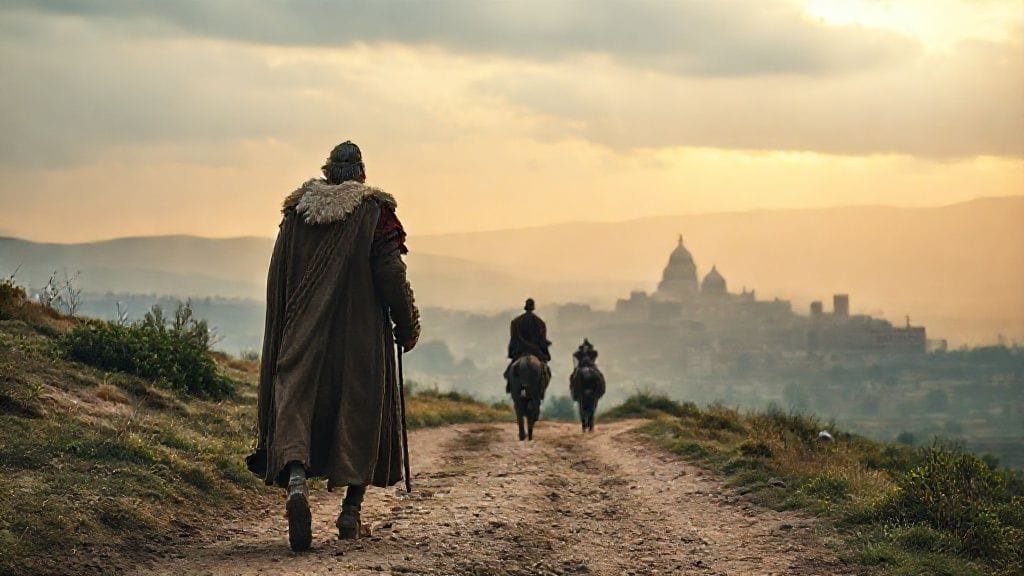
Table of Contents
- A Winter King at the Edge of the World
- The Making of a Warrior Prince in a Broken Island
- Exile, Restlessness, and the Road Back to Power
- Seizing Wessex: Blood, Oaths, and the Sword
- Conquest Across the Channel: The Savage Campaign in Sussex
- The Isle of Wight and the Shadow of Holy War
- Kings, Bishops, and Faith: Cædwalla Between Paganism and Christianity
- The Turning of the Tide: Wounds, Weariness, and Growing Piety
- Why a King Lays Down His Crown: The Decision to Abdicate
- Preparing for the Long Road to Rome
- Crossing the Continent: Cædwalla’s Pilgrimage Through Frankish Lands
- Rome in 689: The Eternal City Meets a Barbarian King
- Baptism at the Threshold of Death: Easter in St Peter’s
- A Grave Among the Apostles: Death, Burial, and Epitaph
- The Shockwave in Wessex: Power Vacuum and Political Reordering
- From Sword to Cross: How Cædwalla Helped Christianize the South
- Memory, Legend, and Debate: How Historians See Cædwalla
- Echoes of a Pilgrim King in Modern Imagination
- Conclusion
- FAQs
- External Resource
- Internal Link
Article Summary: In the late seventh century, the Anglo-Saxon warlord known as caedwalla king of wessex fought his way from exile to rule over a fractured kingdom, only to relinquish his crown at the height of his power. This article follows his journey from a turbulent youth in the wild borderlands of Wessex to his blood-soaked conquests in Sussex and on the Isle of Wight. It then traces the remarkable transformation that led him from the battlefield to the road of pilgrimage, ending not in Winchester or London but in the heart of Christian Rome. Through narrative storytelling and historical analysis, we explore his decision to abdicate, his final journey across the continent, and his death soon after baptism. The article also examines how his reign reshaped the political map of southern England and accelerated its Christianization, even as his methods remained brutally pagan in spirit. Drawing on sources such as Bede and later chroniclers, it weighs legend against evidence to understand why his short career left such a lasting imprint. In doing so, it asks what it meant, in 689, for a king to trade a throne for a tomb beside the apostles.
A Winter King at the Edge of the World
The story of Cædwalla begins, fittingly, in a season of cold and uncertainty. We are in the far reaches of the seventh century, in a landscape that to later generations would seem half-buried in fog: a patchwork of small kingdoms, shifting loyalties, wooden halls lit by smoky fires, and the thin bell-notes of newly risen churches. In this world, caedwalla king of wessex would rise like a storm front, blazing across the political sky of southern England, only to fade as suddenly, vanishing into the distance on the road to Rome.
In 689, when news reached the halls of Wessex that their warrior king had laid down his crown and set out for the Eternal City, many must have struggled to comprehend it. Cædwalla was not an old man; indeed, by the standards of the age he was in his fighting prime, probably still in his late twenties. His reputation was built on ferocity, relentless ambition, and a restless energy that had torn apart the fragile balance of power in the south. Yet now he was leaving behind the carved wooden high seat, the warband that had won him glory, the hoards of plundered silver and gold, and the raw authority of kingship. He would cross seas, ride through foreign kingdoms, and arrive as a supplicant in a distant city whose language he could not speak.
To understand why this happened, we must see Cædwalla’s life as his contemporaries might have seen it—against a backdrop of omens and crosses, sword-edges and reliquaries. The island of Britain, once the northwestern frontier of the Roman Empire, lay fragmented after centuries of migration and conquest. The native Britons had been driven west into Wales and Cornwall, or north into the lands beyond Hadrian’s Wall. In their place, Germanic-speaking peoples—Angles, Saxons, Jutes, and others—had carved out new realms with names that would outlast them: Kent, Mercia, Northumbria, East Anglia, and Wessex.
Wessex, Cædwalla’s homeland, stretched from the upper Thames valley down to the chalk hills and forests that fell away towards the Channel coast. It was not yet the undisputed power it would become two centuries later under Alfred the Great and his descendants, but it was ambitious and hungry. Its kings, often entangled in blood-feuds and rival claims, sought to expand westward into British-held territories and eastward into rival Saxon lands. Into this furnace of violence and opportunity, sometime around the 660s, a boy named Cædwalla was born—a name echoing the British “Cadwallon,” suggesting a lingering echo of the old island peoples in the bloodlines of the new.
Yet this was only the beginning of the paradox. For that boy would grow to be both a destroyer and a renewer: a pagan-hearted conqueror under the sign of the cross, a king whose hands were red with the blood of his enemies yet who would end his days in a white baptismal robe in Rome. The journey from one to the other is the journey this article follows, from the cold fields of Wessex to the marble floors of St Peter’s.
The Making of a Warrior Prince in a Broken Island
Cædwalla’s early years are shrouded in the usual mists that cling to seventh-century lives. No chronicler sat at his cradle, and no poet of his own time left us record of his youth. Yet we can infer some of the contours of his upbringing from what we know of Wessex and its royal house. The West Saxon kings traced their lineage back to the god-like figure of Cerdic, whose arrival on British shores, whether legendary or historical, symbolized the birth of their people’s power. By the mid-seventh century, this royal line had branched and tangled; rival kinsmen, each claiming descent from Cerdic, contested for control of the throne. Cædwalla was one of these descendants, a prince by blood if not yet by power.
The world into which he was born was one in transition. Christianity, brought by missionaries like Augustine of Canterbury and Aidan of Lindisfarne, had reached many Anglo-Saxon courts. Kings now listened, in their smoky halls, not only to the song of the scop but to the Latin murmurs of priests describing a single God, a crucified savior, a promise of life beyond the grave more certain than the old, misty tales of Valhalla or the halls of the ancestors. In Wessex, the faith had been planted but not deeply rooted; royal conversions were sometimes followed by reversion or by indifferent successors who saw the new religion more as a political adornment than a personal conviction.
As a child, Cædwalla would have watched warriors drill in the courtyard of whichever hall sheltered him: leather and chainmail, spears and round shields painted with simple patterns, the scuffle of boots in packed earth. He would have learned to ride, to hunt in the forests that still covered much of Wessex, to wield a spear and sword. He would also have listened—perhaps more intently than others—to the stories of kings displaced and restored, of exiled princes who gathered bands of desperate men in the wild places and returned in fury. In a world where rule was rarely peaceful or secure, exile and comeback formed a familiar pattern, almost a rite of passage.
We can imagine that the young prince, like other aristocratic boys of his era, played at war long before he lived it. Wooden swords, mock charges, games of pursuit through thickets and along riverbanks laid down the muscle memory of future raids. But political realities were no game. The throne of Wessex during his youth passed between kings like Cenwalh, Seaxburh, and Centwine, amid periods of internal instability. Such turbulence often spilled into the lives of collateral branches of the royal family; safety could never be taken for granted.
Religion, too, wove its way through his early experiences in ambiguous ways. Priests or monks may have moved in and out of the royal household, bearing books and relics, lighting candles before small wooden crosses, intoning prayers in an alien language. It is possible that one or more of Cædwalla’s guardians were sympathetic to Christianity, or even partially instructed him in its beliefs. Yet the ethos that shaped him most deeply appears to have been that of the warrior aristocracy: honor, vengeance, loyalty to one’s warband, and the relentless pursuit of victory. When later writers such as the Venerable Bede described him as “still a heathen” during part of his reign, they were likely reacting to this ethos as much as to any formal religious affiliation.
Exile, Restlessness, and the Road Back to Power
Cædwalla’s first great turning point came not with coronation but with dispossession. At some point in his youth—perhaps late adolescence or early manhood—he was driven out of Wessex. The sources are painfully terse. Bede tells us only that he was “a young man of great vigor from the royal family of the Gewisse,” the old name for the West Saxons, who spent time in exile before seizing the throne. Behind those few words lies a story of violence, flight, and hardening resolve.
Exile in seventh-century England was not a gentle retirement. To be cast out from one’s homeland meant losing not only land and status but the protective web of kin and clientage. In a world where law was weak and the sword often the final argument, an unprotected noble was a tempting target. Fleeing Wessex, Cædwalla seems to have taken refuge in more marginal spaces: perhaps on the Welsh borderlands, perhaps among disaffected warbands in the south, anywhere that a dispossessed prince might find men willing to follow him in the hope of future reward.
It was during this period that the character of caedwalla king of wessex, as later recognized by his enemies and admirers alike, was forged. Stripped of his birthright, he had only his charisma, his courage, and his promise of plunder to bind men to his cause. Exiled princes became, in effect, war-leaders of small, semi-independent bands. They raided, harried, and tested defenses. They offered their services as mercenaries to neighboring rulers—or turned on them when opportunity beckoned. Life on the margins was a harsh school, but it sharpened a man’s instincts, taught him to read fear and loyalty in the eyes of others, and taught him when to strike and when to bide his time.
We see a distant echo of this life in the way Cædwalla later commanded his men. His campaigns in Sussex and on the Isle of Wight were marked by swift, brutal action, little patience for half-measures, and a clear understanding that terror could sometimes achieve what mere occupation could not. These are the methods of those who have lived close to desperation, who know that power once seized must be used decisively before circumstances can shift again.
Yet exile also brought Cædwalla into contact with new ideas and people. Moving across borders, relying on the hospitality or uneasy alliance of foreign courts, he may have come into closer contact with the church than he otherwise would have. The Christianization of the south was advancing most rapidly in Kent and among the Franks across the Channel, and their influence radiated outward through missionaries and diplomatic envoys. The young exile might have heard priests condemn the blood-feud ethic he still embraced, or heard of kings who combined military might with spiritual patronage. It is impossible to pinpoint when the seed of his eventual journey to Rome was first planted, but it is not hard to imagine that it was during these wandering years.
What is clear is that by the time he felt strong enough to bid for the throne of Wessex, Cædwalla had become a figure of real consequence. He commanded a following of battle-hardened warriors, owed allegiance by personal bond rather than by the more diffuse obligations of subject to king. He had tested himself and survived. And he had built within himself a furnace of determination: he would not remain a footnote, a forgotten exile. He would return, and the island would remember his name.
Seizing Wessex: Blood, Oaths, and the Sword
When Cædwalla finally moved to seize Wessex, the kingdom he attacked was not a monolithic state but a fragile assemblage of territories and loyalties. Its existing ruler, King Centwine, had himself come to power in a tangled succession and, according to later tradition, may have abdicated and retired to a religious life. Whether Cædwalla forced his withdrawal or simply stepped into a vacuum is unclear, but the transition was anything but peaceful.
To take a throne in the seventh century was to gamble with lives and destinies. Any rival claimant from the royal line could inspire opposition; warbands might shift their loyalty if offered better prospects; local leaders along the borders could test the new king’s grip by withholding tribute or refusing musters. Cædwalla’s answer to all this was as simple as it was harsh: overwhelming force. The chroniclers describe him as a man of great vigor, and we can imagine him riding at the head of his men, hair flying, shield arm raised, a banner bearing some ancestral device snapping in the wind over his head.
Among the first tasks of a new king was securing recognition from the church, whose approval increasingly mattered for legitimacy. Yet here we see one of the central paradoxes of caedwalla king of wessex. Bede says that during much of his rule he was still “a heathen,” though he favored Christians and promised gifts to churches. Perhaps he saw the church as a powerful ally, its bishops and abbots as useful mediators of royal authority, its God as one more divine force to be courted. Or perhaps he was, even then, internally divided—drawn to the discipline and promise of Christianity but unable or unwilling to abandon the warrior ethos that defined him.
In any case, Cædwalla made sure that the bishops of his realm understood the terms of coexistence. He granted lands to monasteries, a common way for rulers to display piety and secure prayers for their souls. He may have attended church feasts, listened (or at least appeared to listen) to sermons. But he did not allow ecclesiastical objections to moderate his campaigns. His rule over Wessex was a prelude to something larger: the extension of his power over neighboring peoples. The throne, once seized, became a launching pad.
And so the thunder of hooves and the creak of leather harnesses rolled eastwards, towards the smaller, vulnerable kingdom of Sussex and the independent, stubbornly pagan communities of the Isle of Wight. Cædwalla’s aim was not merely to secure the borders of Wessex but to dominate the entire south, to write his name across the map of Britain with fire and sword.
Conquest Across the Channel: The Savage Campaign in Sussex
To the southeast of Wessex lay the kingdom of the South Saxons—Sussex—a land of chalk cliffs, dense woodland, and scattered settlements clustered near rivers and shorelines. Its people shared linguistic and cultural ties with the West Saxons, yet politically they were competitors. For a king with Cædwalla’s ambitions, Sussex was both an obstacle and an opportunity.
The South Saxons had a history of instability and misfortune. Earlier in the century, according to Bede, famine had driven some of them to desperate measures before the Northumbrian missionary Wilfrid helped reorganize their agriculture. Christianity had taken root there but remained tenuous, easily threatened by political upheaval. When Cædwalla turned his armies against Sussex, he was not entering a unified, well-defended kingdom but a patchwork of local rulers, some more Christian, some less, all vulnerable to a determined invader with a disciplined warband.
The campaign that followed was remembered for its brutality. Cædwalla swept into Sussex with the momentum of a man who had fought his way back from nothing. Villages burned. Local leaders who resisted were cut down or forced to flee. Some were likely drawn into his service, compelled to switch allegiance under threat of annihilation. The monks and priests who had begun to weave fragile networks of Christian practice among the South Saxons must have watched in terror, uncertain whether the invader would respect or ravage their communities.
Yet, paradoxically, the conquest of Sussex would ultimately help entrench Christianity more firmly there. By subjugating the region to Wessex, Cædwalla tied its fate to that of a larger political unit increasingly under the influence of Christian kingship. He also appears to have cooperated at times with Wilfrid, the restless and politically astute bishop who had his own complex history of exile and return. Their alliance—if such we may call it—became an instrument for remaking the religious landscape of the south, even if in the short term it rode on waves of blood and charred thatch.
The human cost of Cædwalla’s campaign in Sussex is largely unrecorded, but we can imagine it. Families driven from lands they had held for generations; captives led away to serve as slaves on distant estates; the young men who had trusted their local lords cut down in the hedgerows and fields trying to repel the invader. For such people, the arrival of caedwalla king of wessex was no divine visitation but a catastrophe. Yet for his followers it was triumph: more plunder, more land, more proof that their war-leader was favored by whatever powers ruled fate.
Politically, the conquest of Sussex marked a decisive step toward West Saxon hegemony in the south. With Sussex subdued, Cædwalla’s eyes turned toward another nearby prize, one that would soon grant him both notoriety and a strange sort of spiritual legacy: the Isle of Wight.
The Isle of Wight and the Shadow of Holy War
The Isle of Wight in the seventh century lay off the southern coast like a small, self-contained world: fertile, strategically placed, and stubbornly clinging to older religious ways. Its inhabitants were, according to Bede, still predominantly pagan, their rites and gods surviving the spread of Christianity that had begun to transform the mainland. For a man like Cædwalla, whose ambitions combined conquest with a growing, if inconsistent, interest in the new faith, the island offered both a challenge and an opportunity.
The campaign against the Isle of Wight has come down to us in the sources as an episode of stark, almost shocking violence. Cædwalla does not seem to have been content with mere political subjugation. Instead, he sought to eradicate the ruling line of the island’s native dynasty. Bede recounts how, after killing the king of the Isle of Wight, Cædwalla ordered the systematic pursuit and execution of his kinsmen in an effort to extinguish the royal blood. Two young princes, however, were secretly removed by compassionate courtiers and brought to a Christian teacher, Cynebert, to be baptized before their inevitable martyrdom.
In this story we see, crystallized, the contradictions of caedwalla king of wessex. On one hand, he was behaving like a classic early medieval conqueror: exterminating a rival lineage to secure his hold on the territory. On the other, his campaign acquired the overtones of a religious purge. Whether Cædwalla himself saw it in such terms is uncertain, but Bede, writing with the hindsight and priorities of a Christian monk, framed it as an episode in the Christianization of the south. The baptized princes, dying soon after their baptism, are presented almost as saints, their brief embrace of the new faith shining all the more brightly against the dark background of their fate.
Cædwalla, meanwhile, took control of the Isle of Wight and redistributed its lands, giving a portion to the church—specifically, to Wilfrid, that indefatigable bishop who had by now become his close religious adviser. Here again, the politics of war and the politics of the soul intertwined. Conquest provided lands to endow monasteries; monasteries, in turn, legitimized conquest by presenting it as part of a providential plan for the spread of Christianity.
Yet we must not romanticize what happened. For the ordinary inhabitants of the Isle of Wight, the arrival of West Saxon rule meant upheaval, loss of autonomy, and likely the suppression of their old ways. Those who clung to pagan rituals found themselves increasingly marginalized or pressured to accept baptism. Those who cooperated might gain security and perhaps even new opportunities as the church established footholds. But beneath it all lay the memory of slaughter: a king killed, princes hunted, the line of traditional leadership severed by foreign swords.
Was Cædwalla troubled by this? We cannot know. But it is striking that his reign, so marked by ruthless campaigns like those in Sussex and on the Isle of Wight, would end with an act of extraordinary personal humility and vulnerability: his abdication and journey to be baptized in Rome. Somewhere between these shores and that city, between the smoke of burning halls and the incense swirling under the domes of basilicas, something within him shifted.
Kings, Bishops, and Faith: Cædwalla Between Paganism and Christianity
To understand that shift, we must pause and consider Cædwalla’s religious position more closely. Bede’s verdict—that he was a heathen king who nevertheless favored Christians—is both clear and puzzling. How can a man be “pagan” and yet endow churches, protect bishops, and ultimately seek baptism with such determination that he would cross half of western Europe to receive it in Rome?
Part of the answer lies in how fluid religious identity could be in this transitional age. Conversion was not always a sudden epiphany; it could be a slow, uneven process, marked by half-beliefs, compromises, and tactical accommodations. A king might allow himself to be baptized for diplomatic reasons without immediately abandoning old sacrificial practices. He might invoke Christ in one breath and the old gods in the next, hedging his bets in a world where divine favor seemed precarious.
Cædwalla’s relationship with Bishop Wilfrid is particularly revealing. Wilfrid, a Northumbrian by origin, had been exiled more than once from his own homeland due to political and ecclesiastical disputes. During one of these exiles, he found refuge in the south, preaching in Sussex and spending time at the courts of southern kings, including that of Cædwalla. The two men, both driven, both accustomed to reversal and restoration, seem to have formed a bond. Wilfrid may have seen in Cædwalla a potential instrument for the expansion of Roman Christianity; Cædwalla may have seen in Wilfrid a guide to the spiritual and political networks that radiated from Rome and Canterbury.
Under Wilfrid’s influence, and that of other churchmen, Cædwalla began to act more like a Christian ruler in some respects. He granted land for monasteries, supported missionaries, and made vows to God and the saints. Yet Bede’s insistence that he remained unbaptized throughout these deeds suggests that he either delayed formal admission to the faith or retained certain attachments that prevented a full commitment. One possibility, sometimes raised by historians, is that he wished to undergo baptism in a dramatic, almost theatrical way—at the end of his life, in the holiest place he could reach, in the presence of the pope himself.
Such a strategy was not unheard of. In the late antique Roman world, some emperors and elites delayed baptism until late in life, hoping to wash away as many sins as possible at once. Baptism was seen by many as a kind of spiritual reset that could only be used once; to squander it early might leave one’s later sins less securely absolved. Cædwalla, a man whose reign left a trail of blood across the south, might have found this logic appealing. Better, perhaps, to let the stain of war accumulate and then seek a single, decisive immersion that would cleanse everything.
And yet there is something more personal here as well. When we look ahead to his final days—his decision to renounce power, his willingness to die in a foreign city rather than cling to life back home—we sense that his journey was not only calculated but also sincere. The same intensity that had driven him on campaign began, slowly, to turn inward. The sword-arm grew heavy. The warrior-king, who had reshaped a corner of the world by force, started to grapple with the invisible realm of sin, grace, and salvation.
The Turning of the Tide: Wounds, Weariness, and Growing Piety
Somewhere in the late 680s, between the crowning victories of his campaigns and his departure for Rome, Cædwalla’s life took a more somber turn. It is during this period that we hear of a serious wound he suffered—likely in battle, though the context is lost to us. Bede notes that he was “sorely wounded” while still unbaptized, and that he made vows to God during his convalescence.
In a culture where physical scars were badges of honor, this particular wound seems to have gone deeper than the flesh. Perhaps it brought him close to death; perhaps the pain lingered, weakening the once-unstoppable king. For a man conscious of his unfinished baptism, the prospect of dying unshriven, without the seal of the new faith, must have been terrifying. The battlefield, once a familiar arena where he wielded control, suddenly became a reminder of his vulnerability.
It is in moments like this that we can imagine Cædwalla lying in a darkened chamber, torchlight flickering against the wooden beams overhead, the murmur of men outside the door, and within, the quiet voices of priests praying over him. They described heaven not as the mead-hall of heroic legend but as a place of pure light and peace, where no enemy could ever threaten, no exile could ever begin again. They spoke of a God who could forgive even the worst sins—yes, even the slaughter of princes and the burning of pagan shrines—if only the sinner humbled himself and sought baptism.
Did Cædwalla weep as he listened? Did he rage at his weakness? Or did he lie in silence, counting in his mind the battles he had won, the enemies he had destroyed, the kings he had overthrown—and wondering, perhaps for the first time, what they had all truly gained him? We do not know. But his subsequent actions suggest that the experience marked him profoundly. From that time on, his interest in baptism was no longer theoretical. He began to speak of Rome.
Rome, to an Anglo-Saxon in the late seventh century, was both a real city and a symbol. It was the seat of the pope, successor of St Peter, keeper of the keys of the kingdom of heaven. It was also the half-ruined ghost of the empire that had once ruled the world. For a barbarian king like Cædwalla, to be baptized there was to place himself within a story far larger than the feud-ridden struggles of Wessex and Sussex. It was to stand in continuity with emperors and martyrs, to acknowledge an authority higher than any in Britain.
His wound, then, was not only an injury of the body but a blow to his previous sense of invincibility. It opened a crack through which new light could enter, and in that light the glitter of his crown perhaps began to look dimmer. The king who had spent his youth in exile and his adulthood in conquest now started, slowly, to prepare for a different kind of journey: a pilgrimage that would end not with the capture of a rival’s hall, but in the quiet of a Roman tomb.
Why a King Lays Down His Crown: The Decision to Abdicate
Abdication, even today, carries a sense of drama and rupture. In the seventh century, it was almost unthinkable. Kings died in battle, were murdered by rivals, succumbed to illness, or were quietly sidelined by palace coups—but rarely did they choose to set aside the crown of their own accord. When they did, it was usually to enter a monastery within their own realm, retreating into a semi-sacred status that shielded them from political interference.
Cædwalla’s decision was different and more radical. He did not retire to a monastery in Wessex to live out his days in relative safety, surrounded by compatriots. Instead, he resolved to abandon his throne entirely and make the long, hazardous journey to Rome, there to receive baptism and, as it turned out, to die. To his contemporaries, this must have seemed both astonishing and deeply unsettling.
What forces pushed him to this step? On one level, the explanation is straightforward: his severe wound, his fear of dying unbaptized, and his desire for the strongest possible guarantee of salvation. But beneath this lay a more complex weave of motives. Power, for all its allure, had brought him endless conflict. To remain on the throne was to remain entangled in vendettas, border disputes, and the inescapable need to project military strength. Every rival killed had kin who might seek revenge. Every land seized bred resentment among the dispossessed.
The spiritual counsel he received from bishops and priests likely reinforced this sense of weariness. They would have reminded him that “the whole world lies under the power of the evil one,” as Scripture said, and that a man who ruled by bloodshed could never entirely escape moral danger while still holding the sword of kingship. To step away from power was to step away from certain temptations and to turn, at last, toward the inner warfare of repentance.
There may have been political calculations as well. By the late 680s, new figures were emerging in the southern English political landscape. Ine, who would soon succeed Cædwalla as king of Wessex, came from another branch of the royal house and may already have been a prominent leader. An orderly, voluntary transfer of power to a designated successor reduced the risk of civil war upon Cædwalla’s death or incapacitation. In abdicating, he may have hoped to secure a measure of stability for the realm he had struggled so hard to expand.
Nonetheless, the personal cost was immense. To walk away from the throne was to relinquish not only authority but identity. A king was not simply a man who wore a crown; he embodied the hopes and fears of his people. Stepping down meant becoming, in some sense, ordinary again—a pilgrim among many, a supplicant in foreign churches. Cædwalla, who had once commanded armies and overthrown kings, would soon be received not as a ruler but as a sick man seeking the mercy of God.
Preparing for the Long Road to Rome
Once the decision was made, practicalities followed. The journey from Wessex to Rome in 689 was long and perilous. It involved sea crossings vulnerable to storms and piracy, overland routes through foreign territories, and the constant risk of illness or attack. For a man already weakened by wounds, it was no small undertaking.
Cædwalla would have needed to assemble a retinue substantial enough to ensure his safety but not so large as to burden his hosts. Trusted warriors, perhaps a few high-ranking nobles, interpreters familiar with Frankish and Latin, and clerics who could manage the spiritual and diplomatic dimensions of the trip—all these would be essential. Provisions had to be gathered, gifts prepared for the rulers and churchmen he would encounter along the way. Letters of recommendation, carried by his envoys or bishops like Wilfrid, would precede him to foreign courts, announcing the approach of a king who had laid down his crown in pursuit of baptism.
Financial arrangements also came into play. A traveling king, especially one bound for such a renowned destination, was expected to distribute alms and offerings. Gold, silver, and precious objects taken in earlier campaigns would now be reallocated as tokens of piety and instruments of diplomacy. The same treasures that had once rewarded warriors would now glint on altars and in reliquaries along the pilgrimage route.
Emotionally, the preparation must have been wrenching. Cædwalla was not merely going on a trip; he was saying farewell. Farewell to the great hall where he had feasted with his men, to the familiar hills and rivers of Wessex, to the burial mounds of his ancestors. Farewell, perhaps, to family members he would never see again. The chroniclers are silent on his personal relationships, but it is hard to imagine that a king of his age and status had no close kin, no wife or children. If they existed, they too would have watched him depart, uncertain whether to see his journey as a glory or a loss.
On the eve of departure, the hall might have held one last feast. Not the triumphant revel of a victorious campaign, but a more subdued gathering, half celebration, half wake. Cups would pass, songs might be sung, and yet an undercurrent of unease would run beneath the noise. For the first time, perhaps, those who had followed caedwalla king of wessex into battle would watch him take up another kind of weapon: a pilgrim’s staff, a cross around his neck, the humility of one who seeks rather than commands.
Crossing the Continent: Cædwalla’s Pilgrimage Through Frankish Lands
The journey from the coasts of southern England to Rome typically began with a Channel crossing, likely from a friendly port in Kent or the south to the shores of Neustria or Flanders in the Frankish kingdom. Once ashore, Cædwalla and his party would find themselves in lands both alien and strangely familiar. The Franks, like the English, were Germanic in origin, yet they had adopted Latin as the language of the church and administration. Their rulers had long been Christian; their bishops wielded considerable influence at the courts of kings like Theuderic III and the rising mayors of the palace.
Along the established pilgrimage routes, Cædwalla would have encountered hostels and monasteries accustomed to sheltering travelers bound for Rome or Santiago. The sight of an Anglo-Saxon king among these pilgrims must have attracted attention. Monks would listen in awe as interpreters explained that this was a ruler who had voluntarily abandoned his throne to seek baptism in the city of the apostles. Some would no doubt have seen in him the living embodiment of the Gospel’s call to renounce worldly wealth and follow Christ.
Yet the journey was no romantic procession. The roads were rough, the weather unpredictable. Cædwalla’s wounds, healing perhaps but still tender, would have ached in the cold and damp. Nights spent in crowded lodgings, breathing the close air of strangers, increased the risk of infection. Banditry, though curbed by the presence of strong kings and bishops, had not disappeared. Every mile traveled was paid for in fatigue and vulnerability.
There were consolations as well. The churches of Gaul held relics that dazzled the barbarian imagination: bones of martyrs, fragments of the True Cross, shimmering reliquaries studded with gemstones. For a man raised in the simpler sacred landscapes of Wessex, these shrines would have seemed like portals into a different order of reality, where heaven touched earth in glittering, tangible ways. Priests might have placed such relics briefly on his wounded body, praying for healing, encouraging him that his sufferings were a share in Christ’s own.
At every major city—perhaps at Rouen, at Tours, at Lyon—Cædwalla’s party would have paused, to rest, to honor local saints, and to present offerings. News of his progress may have preceded him along the route; local bishops would be prepared to receive him. The journey thus became not only a personal ordeal but a moving theater of penitence and faith, carrying the story of this strange pilgrim-king from court to cloister across western Europe.
Rome in 689: The Eternal City Meets a Barbarian King
At last, after weeks or months of travel, the pilgrim’s road dipped toward the Tiber valley, and the distant silhouette of Rome rose on the horizon. For Cædwalla and his entourage, the first sight of the city must have struck with the force of legend made flesh. This was the place whose name had lingered in the sagas and stories of their ancestors, the city from which emperors had once ruled the world. It was also, now, the heart of Latin Christendom, where the successor of St Peter held court over bishops and abbots from across the West.
The Rome of 689 was a city of contrasts. Many of its ancient monuments stood half-ruined or repurposed; the Colosseum, the forums, the sprawling baths bore the scars of time and neglect. Yet interspersed among them, and sometimes built within them, were the splendid basilicas of the Christian age: St Peter’s on the Vatican hill, St Paul’s outside the walls, St John Lateran, and others. Pilgrims climbed the worn steps, kissed the shrines, and gazed up at mosaics that glittered in the candlelight like windows into heaven.
Pope Sergius I, who occupied the papal throne at the time of Cædwalla’s arrival, would have been informed in advance of the king’s coming. For the papacy, welcoming such a figure was both a pastoral duty and a moment of quiet triumph. Here was a tangible sign that the distant peoples of the north, once feared as barbarians, were not only embracing Christianity but seeking its fullness at the feet of Peter’s successor. The scene, as later described in various sources, has an almost cinematic quality: a tall, war-scarred Saxon, still bearing the traces of royal bearing, humbly kneeling before the aged pope in the aula of the Lateran or in the shadow of St Peter’s.
For Cædwalla, Rome was more than a destination; it was a revelation. In its streets and churches he saw a scale of history and piety that dwarfed anything in Wessex. Processions of clergy, chanting in Latin, moved through colonnaded courtyards past marble sarcophagi carved centuries before the Saxon kingdoms had even existed. The tombs of martyrs lay beneath his feet. The sense of standing at the center of a vast, sacred narrative—a narrative that reached back to the time of the apostles and forward, he believed, into eternity—must have pressed upon him at every turn.
Yet he did not have long to savor it. His health, already weakened, continued to decline. The journey had taken its toll. And so, as the shadows lengthened and the liturgical calendar rolled toward Easter, preparations were made for the ceremony that had drawn him here: his baptism.
Baptism at the Threshold of Death: Easter in St Peter’s
Easter of 689 in Rome unfolded with the usual splendor. Pilgrims and citizens alike thronged the basilicas, candles flared in the dim interiors, and Latin chants wove among the pillars like incense made sound. Among the catechumens—those preparing to enter the church through baptism—one figure stood out: Cædwalla, former king of Wessex, now a penitent clad not in royal garments but in the simple white robe of a baptismal candidate.
Bede, writing some decades later, records the essentials of what happened: that Cædwalla received baptism from Pope Sergius himself in the church of St Peter the Apostle, that he was given the baptismal name “Peter” in honor of the saint, and that, still wearing his white garment, he fell ill and died within days. The image is haunting. The man who had once ridden at the head of armored columns now stood, vulnerable and unarmed, at a marble font, water trickling down his brow as Latin prayers were spoken over him.
To be baptized at Easter was to enter directly into the heart of the church’s imagination. The liturgy emphasized death and resurrection, the passage from darkness to light. Cædwalla, already hovering near death, enacted that symbolism with almost painful literalness. When he went down into the water—or if, as some scholars suggest, water was poured over his head due to his weakness—he was renouncing not only sin but the old identity that had shaped him: warrior, conqueror, ruler. Rising from the font, he emerged as Peter, a new man, albeit one whose eyes were already turned toward the grave.
The choice of name was significant. Peter, the fisherman turned apostle, had himself known fear and failure, denying Christ before ultimately dying for him in Rome. To bear his name was to align oneself with that story of weakness and restoration. For caedwalla king of wessex, whose life had been marked by exile and ruthless return, the resonance must have been powerful. In some sense, he was now enacting one final, ultimate comeback—not to a throne of wood and gold, but to a kingdom “not of this world.”
Those who witnessed the ceremony—Roman clergy, fellow pilgrims, perhaps a few of his surviving companions from Wessex—could not have missed the poignancy of the moment. The pope, laying his hands on the head of the dying barbarian king; the sound of water; the echoing nave; the knowledge, murmured among the congregation, that this new Christian might not live to see another sunrise. It was as if all the conflicts and contradictions of an age in transition had converged in a single ritual act.
A Grave Among the Apostles: Death, Burial, and Epitaph
Cædwalla’s death came swiftly after his baptism, sometime in April 689. He had traveled hundreds of miles, crossed seas, survived a serious wound, and wrestled with the weight of his own past, only to die in a foreign city, far from the green hills of Wessex. Yet in another sense, he died exactly where he wished to be: within sight of the shrine of St Peter, under the care of the church he had come to embrace.
His burial in St Peter’s Basilica speaks volumes about the regard in which he was held. To be interred within that sacred space was a rare honor, usually reserved for popes, bishops, and prominent martyrs or benefactors. For an Anglo-Saxon king—especially one whose previous life had been so marked by violence—to be accorded such a place testified both to his dramatic final conversion and to the political importance Rome attached to it. His tomb stood near the great altar that marked Peter’s own resting place, placing the former king of Wessex, in death, at the very center of Latin Christendom.
We know something of how his contemporaries framed his life because they composed an epitaph for his tomb. Bede quotes it in his history, noting how it praised Cædwalla’s royal lineage, his renunciation of earthly power, and his pilgrimage across the sea to receive baptism. The epitaph, in elegant Latin verse, cast his story as a model of Christian virtue: a man who, though born to rule, chose instead the humility of the pilgrim and the cleansing of the font.
The irony, of course, is that this saintly framing could only be achieved by smoothing over much of the roughness of his earlier reign. The massacres in Sussex and on the Isle of Wight, the hunted princes, the burnt shrines—all these vanish into a pious summary of a soul reclaimed for God. This is not hypocrisy so much as the logic of early medieval hagiography, which frequently sought in the final acts of a life the key to its ultimate meaning.
Still, the physical reality of his tomb anchored the memory of caedwalla king of wessex in stone and space. For centuries, pilgrims coming to St Peter’s could read his epitaph and ponder the path that had brought an island king to lie among the apostles. When later Anglo-Saxon rulers and churchmen visited Rome, they would have seen in that grave a reflection of their own connection to the wider Christian world, a reminder that their island was no longer a distant, pagan frontier but an integral part of a spiritual commonwealth.
The Shockwave in Wessex: Power Vacuum and Political Reordering
While Cædwalla lay dying in Rome, the kingdom he had left behind faced its own moment of reckoning. The voluntary abdication of a powerful king, followed by his death abroad, could easily have plunged Wessex into chaos. That it did not erupt into immediate, devastating civil war is due in part to the emergence of a capable successor: Ine, who would go on to rule Wessex for over three decades.
Ine was of royal blood, though from a different branch than Cædwalla. It is likely that he had already been positioned as heir or co-ruler before Cædwalla’s departure, smoothing the transition. Even so, he inherited a realm in flux. The territories Cædwalla had so recently conquered—Sussex, the Isle of Wight, and lands along the southern coast—might be tempted to test their new master. Local nobles, sensing an opportunity, could rally disaffected elements. Moreover, the church, which had invested so much hope in Cædwalla’s final journey, now needed to recalibrate its alliances.
Ine approached these challenges with a different style from his predecessor. Where Cædwalla’s mark on history is that of a brutal conqueror turned pilgrim, Ine’s legacy is more that of a lawgiver and organizer. His reign is associated with one of the earliest surviving English law codes, reflecting a concern for the regulation of social and economic life. Under Ine, Wessex began to move from being merely a successful war machine toward a more coherent kingdom with defined legal and administrative practices.
Yet Ine could not entirely escape the shadow of caedwalla king of wessex. The boundaries of his realm, in large part, were those that Cædwalla had carved out. The church institutions he worked with had been strengthened by Cædwalla’s grants and the prestige of his Roman connection. Even his conception of kingship—firmly Christian in tone, but never wholly divorced from the realities of force—owed something to the pattern set by his predecessor.
In the south as a whole, the vacuum left by Cædwalla’s departure also affected neighboring powers like Kent and Mercia. Mercia, a formidable kingdom in the Midlands, was always alert to opportunities to extend influence over the south. The relative stability achieved by Ine, however, limited such encroachments. In this sense, Cædwalla’s careful—or at least not entirely reckless—choice of successor helped preserve the core of what he had built.
Still, among the people of Wessex, memories of the pilgrim king must have lingered. Old warriors who had ridden under his banner could tell tales by the hearth of campaigns in Sussex and the Isle of Wight. Young monks, copying manuscripts in scriptoria, might pause over Bede’s account of Cædwalla’s final days and glance up at the wooden beams, imagining Rome’s marble vaults. The king who had left them had not returned, yet his absence had given Wessex something intangible: a connection to the sacred center of their new faith.
From Sword to Cross: How Cædwalla Helped Christianize the South
When historians assess the Christianization of England, names like Augustine of Canterbury, Aidan of Lindisfarne, and Theodore of Tarsus often dominate the narrative. Yet kings, too, played a decisive role, and Cædwalla stands among those whose political actions inadvertently advanced the new faith—even when their motives were mixed or their methods brutal.
In Sussex, his conquest broke the independence of a kingdom that had long struggled with famine and fragile faith. By subordinating it to Wessex, he tied its fate more closely to a regime increasingly aligned with Christian norms. Monasteries founded or supported in the wake of his campaigns became centers of literacy, agriculture, and spiritual life. Over time, these institutions would reshape the culture of the South Saxons, gradually turning them from peripheral converts into integral participants in English Christianity.
On the Isle of Wight, the effect was even more striking. Prior to Cædwalla, the island remained a stronghold of pagan practice. His invasion, with its near-eradication of the local royal line and subsequent endowment of church lands, created an opening for missionaries to operate with unprecedented freedom. Bede emphasizes how the baptism and martyrdom of the two rescued princes helped sanctify the island’s transition, casting its painful conquest in a redemptive light. It is a grim but undeniable fact that the extinction of one dynasty made room for the rise of another, more thoroughly Christian order.
Beyond his direct actions, Cædwalla’s dramatic end in Rome functioned as a powerful story that radiated influence back into England. The very fact that an Anglo-Saxon king had gone to Rome for baptism and been honored with burial in St Peter’s became part of the imaginative world of the English church. It helped normalize the idea of pilgrimage to Rome, a practice that would become increasingly common among English kings and nobles in the centuries that followed. The twelfth-century historian William of Malmesbury, for instance, later recalled Cædwalla’s journey as a turning point, showing how England’s rulers came to see themselves as part of a wider Christian community.
Thus, while caedwalla king of wessex may not have been a saint in the strict sense—his early reign was too stained by blood for that—his life nonetheless altered the religious map of southern England. The cross that finally rested on his grave in Rome cast a long shadow back across the Channel, touching the churches and monasteries that had grown, directly or indirectly, from his reign.
Memory, Legend, and Debate: How Historians See Cædwalla
Our understanding of Cædwalla rests on a thin but evocative set of sources. Chief among them is the Venerable Bede’s Ecclesiastical History of the English People, completed in 731, which devotes several passages to his reign and pilgrimage. Bede, writing from the distant monastery of Jarrow in Northumbria, never met Cædwalla, but he corresponded with churchmen who had, and he had access to records sent from Rome. His account is shaped by theological concerns—he is interested in Cædwalla as a trophy of grace, a powerful sinner redeemed at the end—but he is also careful with facts, and modern historians generally treat him as a reliable witness within his chosen frame.
Later writers, such as Anglo-Saxon chroniclers and medieval historians like William of Malmesbury, elaborated on Bede’s foundation, sometimes adding colorful details or interpretive flourishes. William, for instance, writing in the twelfth century, viewed Cædwalla through the lens of his own monastic and royal ideals, praising his ultimate piety while glossing over some of the harsher aspects of his conquests. These later accounts, while not always strictly factual, reveal how Cædwalla’s image evolved over time—from a troubling, ambiguous figure into a more clearly edifying example of royal repentance.
Modern scholarship, by contrast, tends to emphasize the paradoxes. On the one hand, Cædwalla appears as a quintessential warrior-king of the early Anglo-Saxon period: ruthless, ambitious, and willing to employ extreme violence to secure power. On the other hand, his genuine-seeming dedication to receiving baptism in Rome and his readiness to abandon the throne set him apart from many contemporaries. Some historians argue that his case exemplifies the complex and often uneasy fusion of Germanic warrior values with Christian ideals during this transitional era. As one modern study puts it, “Cædwalla’s life shows that the road from the sword to the cross was neither straight nor bloodless.”
Debate also continues over the precise nature of his “paganism.” Was he truly a devotee of the old gods, or was his lack of baptism more a matter of timing and personal hesitation than active religious resistance? Given his close association with churchmen like Wilfrid and his generous support of monasteries, some scholars suggest that he should be seen less as a heathen king in any simple sense and more as a liminal figure, standing on the threshold of Christian identity for much of his reign.
What is clear is that the story of caedwalla king of wessex forces us to resist easy categorizations. He was neither a purely secular warlord nor a straightforwardly pious monarch. He was, instead, a man of his time: shaped by exile and opportunity, by swords and sermons, by pagan echoes and Christian promises. It is precisely this complexity that keeps historians returning to his brief but consequential career.
Echoes of a Pilgrim King in Modern Imagination
In the modern world, where Rome can be reached in a few hours by plane and kingship is often constitutional rather than absolute, it can be hard to grasp the emotional force of Cædwalla’s story. Yet when we strip away the distances of time and culture, certain elements still resonate powerfully. The idea of a leader walking away from ultimate worldly power in search of a deeper truth remains compelling, even unsettling.
Novelists and dramatists drawn to the early medieval period often find in Cædwalla a ready-made protagonist: a fierce young exile who fights his way to a throne, leaves a trail of devastation in his wake, and then, unexpectedly, chooses the path of renunciation and pilgrimage. His life reads almost like a script for a historical epic, complete with dramatic set-pieces—the burning of Sussex, the baptism of the doomed Wight princes, the wound that changes everything, the long road to Rome, the final, luminous baptism in St Peter’s.
In popular histories and documentaries, he tends to appear as a fascinating side figure in the broader narrative of England’s Christianization. Visual reconstructions place him in fur-lined cloaks and chainmail, on windswept cliffs or in candlelit basilicas. Archaeologists, though they have found no confirmed physical remains of his presence in Wessex beyond the usual material culture of the age, speculate about the halls where he might have feasted, the churches he endowed, the graves of those who fell in his wars.
For theologians and spiritual writers, Cædwalla provides a case study in late-life conversion and the complex relationship between repentance and restitution. Can a single act—however dramatic—at the end of a life of violence truly wipe the slate clean? How should we weigh the comfort that Cædwalla evidently found in his baptism against the irreversible suffering he caused? These questions echo down the centuries, forcing us to confront the tensions at the heart of doctrines of forgiveness.
Even in Rome, traces of his memory persist. Though major reconstructions of St Peter’s in the Renaissance disrupted many medieval burials, records of his epitaph and tomb location survive, allowing scholars to map, in part, where the king from Wessex once lay. Pilgrims today, walking through the vast, echoing spaces of the modern basilica, can still pause and imagine the frail figure of an Anglo-Saxon king, clutching at life and faith as water is poured over his head.
In these ways, the echo of caedwalla king of wessex can still be heard—faint, perhaps, but distinct—whenever we consider how power, faith, guilt, and hope intersect in the lives of those who rule and those who are ruled.
Conclusion
Cædwalla’s life, though brief and imperfectly documented, forms a vivid thread in the tapestry of early English history. Born into a fractured, half-Christian world, he fought his way from exile to the throne, reshaped the map of southern England through relentless campaigns, and left behind both devastation and a strengthened framework for the spread of the church. His reign demonstrated the harsh realities of early medieval kingship: the constant interplay of ambition, violence, and precarious legitimacy.
Yet it is his ending that most captures our imagination. The same man who once ordered the eradication of a royal line on the Isle of Wight would later abandon his own crown and cross the continent in search of baptism. We cannot fully disentangle calculation from conviction in his motives, but the picture that emerges is of a ruler who, confronted by mortality and haunted perhaps by his past, chose to step outside the normal script of kingship. In doing so, he offered a powerful, if troubling, witness to the transformative pull of the Christian message in his age.
Historically, the impact of Cædwalla’s choices rippled outward. Under his successor Ine, Wessex matured into a more stable and law-governed kingdom, while the regions he had conquered gradually integrated into a Christian south. Spiritually and symbolically, his burial in St Peter’s anchored the English church within the broader orbit of Rome, prefiguring the deep ties that would bind the island’s faith to the continent for centuries. When we speak of the making of Christian England, his name, for all its shadows, deserves a place among the architects.
In the end, Cædwalla stands as a reminder that history is rarely neat. A brutal conqueror can become a humbled pilgrim; a man whose hands are stained with blood can still long, desperately, for cleansing. The journey from Wessex to Rome in 689 was more than a physical pilgrimage. It was the final act of a life lived between worlds—between pagan past and Christian future, between the sword’s glitter and the font’s clear water, between the shifting halls of earthly kings and the eternal courts he hoped, in the mercy of God, at last to enter.
FAQs
- Who was Cædwalla, King of Wessex?
Cædwalla was a late seventh-century Anglo-Saxon ruler who seized the throne of Wessex after a period of exile. Known for his fierce military campaigns in Sussex and on the Isle of Wight, he expanded West Saxon power across much of southern England. Despite his brutality, he cultivated strong ties with the Christian church and ultimately abdicated to seek baptism in Rome. - Why did Cædwalla abdicate the throne of Wessex?
Cædwalla appears to have abdicated primarily because of a severe wound and his fear of dying unbaptized. Influenced by churchmen such as Bishop Wilfrid, he resolved to receive baptism in Rome from the pope himself. Abdication freed him from the demands of kingship and allowed him to undertake the arduous pilgrimage that ended with his baptism and death in 689. - Was Cædwalla a pagan or a Christian during his reign?
According to Bede, Cædwalla was still technically a heathen during much of his rule, since he had not yet been baptized. Nevertheless, he supported Christian institutions, granted land to monasteries, and worked closely with influential bishops. Many historians view him as a transitional figure whose personal faith developed gradually, culminating in his dramatic baptism in Rome. - What role did Cædwalla play in the Christianization of southern England?
Cædwalla’s conquests, particularly in Sussex and the Isle of Wight, created new openings for Christian missions. By subordinating these regions to Wessex and endowing church lands there, he helped embed Christian structures in formerly resistant areas. His own pilgrimage and burial in St Peter’s also reinforced the symbolic link between the English church and Rome. - How do we know about Cædwalla’s life and journey to Rome?
Most of our information comes from Bede’s Ecclesiastical History of the English People, written in the early eighth century, which includes accounts sent from Rome and from southern English churchmen. Later chroniclers, including William of Malmesbury, added details and interpretations. These texts, while not complete, offer a coherent narrative of his reign, abdication, and death. - What happened to Wessex after Cædwalla’s death?
After Cædwalla died in Rome, the throne of Wessex passed to Ine, a capable ruler from another branch of the royal house. Ine consolidated the gains Cædwalla had made, issued one of the earliest English law codes, and further strengthened both royal authority and the church. Under Ine and his successors, Wessex moved steadily toward becoming the dominant kingdom in England.
External Resource
Internal Link
Other Resources
- Encyclopaedia Britannica – general search for the exact subject
- Google Scholar – academic search for the exact subject
- Internet Archive – digital library search for the exact subject

