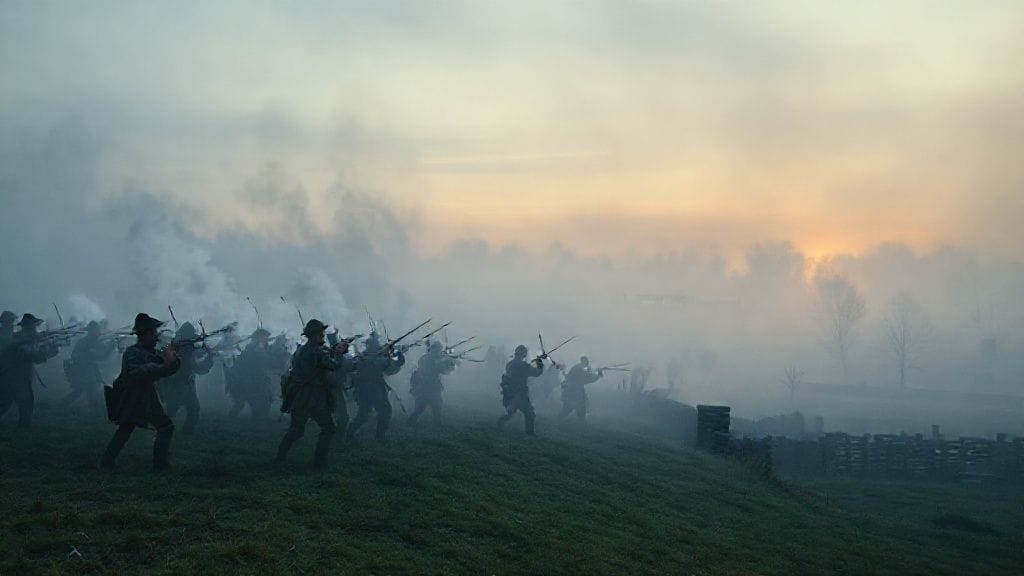
Table of Contents
- Midnight on the Edge of Revolution
- An Empire and Its Restless Colonies
- Plans in the Dark: Gage, the Orders, and the March to Concord
- Messengers of Alarm: Paul Revere, William Dawes, and the Midnight Ride
- Before Dawn at Lexington Green
- “The Shot Heard Round the World”
- From Lexington to Concord: The British Column Pushes West
- The Fight at the North Bridge
- The Long Bloody Road Back to Boston
- Women, Families, and Civilians in the Path of War
- Rumors, Reports, and the Birth of Revolutionary Propaganda
- From Skirmish to Siege: The Encirclement of Boston
- Political Shockwaves in London and Philadelphia
- Myths, Memories, and the Making of Revolutionary Heroes
- Race, Slavery, and the Forgotten Fighters of April 19
- Tactics, Terrain, and the Changing Nature of War
- Commemorating the First Day of the American Revolution
- Echoes Across the Centuries
- Conclusion
- FAQs
- External Resource
- Internal Link
Article Summary: In the gray light of an April morning in 1775, ordinary farmers and shopkeepers in Massachusetts met British regulars on the village greens of Lexington and Concord, transforming protest into open revolution. This article retraces the battles of lexington and concord as lived experience: the fears of British officers, the defiant resolve of colonial militiamen, and the anguish of families caught between retreating and advancing armies. Moving from imperial tensions to the crack of musket fire, it shows how a secret British expedition became a day-long running battle that exposed the fragility of imperial control. It explores how contested memories—who fired first, who led, who died—shaped early American identity and propaganda. The broader consequences of the battles of lexington and concord unfold in political chambers from London to Philadelphia, where leaders grasped that compromise was slipping away. By weaving in the voices of lesser-known participants, including women and men of color, the narrative reveals a more complex first day of the American Revolution. Finally, it considers how these battles continue to be commemorated, reinterpreted, and argued over, reminding us that the meaning of April 19, 1775, is still being written. Through this long view, the battles of lexington and concord emerge not as a single instant of gunfire, but as a chain of irrevocable decisions that changed the world.
Midnight on the Edge of Revolution
On the night of April 18, 1775, Massachusetts lay under a suffocating tension that no one could quite name, though everyone could feel. The countryside around Boston was quiet in the way that precedes a storm: barns shut tight, hearth fires lowered, but minds wide awake, listening for hooves on the road or the distant clatter of oars on the Charles River. For a decade the colonies had argued, petitioned, and resisted imperial measures, but the battles of lexington and concord still belonged to an unimaginable future, something feared, whispered about, perhaps even dreamed of by hotheads—but not yet real. That night, however, as lantern light flickered in the Old North Church and horses were saddled in haste, the line between political dispute and armed conflict began to dissolve.
In Boston, General Thomas Gage—commander of British forces in North America and military governor of the restive province—faced a problem no imperial officer truly wanted: how to reassert royal authority over subjects who increasingly refused to see themselves as subjects. The colony’s militias had been drilling openly. Provincial congresses met in defiance of the king’s government. Arms and powder vanished from royal storehouses and reappeared in hidden barns and town arsenals. For Gage, the battles of lexington and concord were not yet a phrase; instead he saw a web of seditious committees, shadow governments, and men with muskets, all orbiting around nearby towns like Lexington and Concord, places that were fast becoming symbols of resistance.
That night, the British plan was simple on paper and treacherous in practice: dispatch a strong column of regulars to seize or destroy colonial munitions gathered at Concord, arrest prominent agitators if practicable, and return to Boston before the countryside could fully mobilize. Officers might have consoled themselves that this was a police action, not a battle. But in the taverns of Boston and the farmhouses of Middlesex County, colonists had been preparing for precisely such a move. Muskets were cleaned and stacked near doors. Powder horns were kept full. Grain was put up so men could leave the plow in the furrow at a moment’s notice. They did not yet know that the next day would be remembered as the opening clash of the American Revolution, but they suspected that something irreversible was coming. It was only a question of when—and who would fire first.
An Empire and Its Restless Colonies
To understand why that nervous April night mattered, one must look back more than a decade, to an empire that had just won a vast war and suddenly found itself unsure how to pay for its own triumph. The Seven Years’ War (known in the colonies as the French and Indian War) had ended in 1763 with Britain triumphant over France, its red-coated soldiers having fought from the Caribbean to Canada, from the Atlantic coast deep into the Ohio Valley. Victory, however, brought a swelling debt and new imperial responsibilities, including the defense and management of freshly acquired territories. Parliament’s answer was logical from its perspective: the colonies, which had benefited immensely from British military protection, should shoulder a greater share of the imperial burden.
New taxes and regulations followed—the Sugar Act, the Stamp Act, the Townshend duties—each defended in London as a reasonable assertion of parliamentary sovereignty and each received in America as a fresh encroachment on the traditional rights of Englishmen overseas. Massachusetts, with Boston at its fiery center, became a proving ground for these disputes. Riots, boycotts, and pamphlet wars ensued. British troops were dispatched to keep order, and the streets of Boston acquired a new, uneasy rhythm: drums and fifes at dawn, soldiers drilling on the Common, colonists glowering from windows and stoops. The Boston Massacre of 1770, when nervous redcoats fired into a jeering crowd, left five colonists dead and seared the image of red-coated oppression into colonial memory.
By the early 1770s, the conflict had outgrown questions of tariffs and legal technicalities. It was increasingly about who held ultimate authority: Parliament or the colonial assemblies, backed by the informal networks of Committees of Correspondence. The Tea Party of December 1773, during which colonists disguised as Mohawks dumped chests of East India Company tea into Boston Harbor, brought a furious imperial response. The “Intolerable Acts” closed the harbor, altered the Massachusetts charter, and effectively placed the colony under military rule. General Gage arrived not merely as a general but as governor, tasked with breaking what British leaders now called a “rebellious spirit.”
Yet the more the imperial grip tightened, the more local institutions slipped out from under it. Town meetings continued in defiance of the new rules. The Massachusetts Provincial Congress began to function as an alternate government, collecting arms and training militias that would evolve into the famed minutemen—ordinary men pledged to be ready for military service at a minute’s warning. The battles of lexington and concord, though still in the future, were being prepared in the language of rights and duties, in Sunday sermons invoking both scripture and Locke, and in the quiet decision of thousands of colonists that they would sooner stand with their neighbors than submit to distant decrees.
Plans in the Dark: Gage, the Orders, and the March to Concord
By April 1775, Gage’s patience had worn thin. Intelligence reports—some accurate, some exaggerated—insisted that the countryside west of Boston was studded with rebel supplies: cannon, shot, powder, and muskets secreted in barns and meetinghouses. Concord emerged as a particular concern, not only for its stores but as a symbol of this parallel political order. Gage had received private instructions from London urging firmness and, if possible, the arrest of “principal actors and abettors” of the colonial resistance. Among those names were Samuel Adams and John Hancock, both believed to be in or near Lexington. He had balked at wholesale arrests, fearing they would ignite a general uprising. But a strike at military supplies seemed defensible, almost routine.
On April 18 he acted. Around 10 p.m., orders went out: roughly 700 light infantry and grenadiers, elite companies drawn from several regiments, would assemble on Boston Common and then be ferried across the Charles River to begin a night march to Concord. Lieutenant Colonel Francis Smith would command the expedition, with Major John Pitcairn—an experienced marine officer—leading the advance. Their mission: to proceed quietly, surprise the towns, and destroy any munitions that could sustain resistance. Gage tried to cloak the operation in secrecy, but the very act of concentrating troops in such a small town could scarcely be hidden.
Boston’s patriots were watching. For months, men like Dr. Joseph Warren had cultivated sources within the British command, including—so later accounts claim—the wife of General Gage himself, Margaret Kemble Gage, an American-born woman sympathetic to the colonial cause. Whether or not she truly betrayed her husband’s plans, warnings quickly reached Warren that something large was afoot. As British boats slid into the river and the night filled with the muffled splash of oars, Warren realized that this was the move they had been dreading: a march on the countryside that could lead to arrests, seizures, or bloodshed.
The decision was immediate. Messengers had to ride.
Messengers of Alarm: Paul Revere, William Dawes, and the Midnight Ride
Shortly before 11 p.m., Dr. Warren dispatched two riders by separate routes to carry the alarm: Paul Revere by way of the river crossing, and William Dawes over the Boston Neck, the narrow land bridge connecting the town to the mainland. Revere, a silversmith turned political operative and courier, would become immortalized in Henry Wadsworth Longfellow’s 19th-century poem, but in the cool air of that April night he was simply one more man risking arrest—or worse—to move information faster than marching boots.
Revere crossed the Charles River under the noses of British warships, slipping past patrols and landing on the Charlestown shore. There, patriot allies had already seen the prearranged signal: two lanterns in the steeple of the Old North Church, indicating that the regulars were moving “by sea,” that is, across the river, rather than marching out of Boston by land. Mounting a swift horse, he galloped into the countryside, stopping at houses along the way to rouse local leaders and militia captains. Contrary to the later romantic version, he did not shout “The British are coming!”—most colonists still called themselves British—but warned that “the regulars are out.”
Dawes rode a longer, rougher route, avoiding the more heavily watched areas, and like Revere, he left a trail of awakened households in his wake. Bells began to toll in some villages; in others, drums beat the alarm. Militia captains like John Parker of Lexington roused their men, who groped for clothing and weapons in the dark. Powder horns were slung across shoulders, flints checked, cartridge boxes filled with lead balls and folded paper charges. The night, which had begun in an uneasy quiet, now vibrated with energy: horses pounding down dirt roads, dogs barking, shutters banging open as voices called into the smoky interiors of farmhouses.
Near midnight, Revere and Dawes both reached Lexington, where Samuel Adams and John Hancock were staying at the parsonage of Reverend Jonas Clarke. There, in a scene that would be told and retold, they delivered the news: an armed British column was on the move. It was still unclear whether the main objective was Concord’s stores or the arrest of Adams and Hancock themselves, but the implication was clear enough. The conflict that had raged in newspapers and town meetings was now approaching on the road. The battles of lexington and concord, as later generations would call them, were not yet inevitable—but men were already loading guns.
Before Dawn at Lexington Green
In the small hours before dawn on April 19, Lexington’s village green—an open triangle of grass bordered by homes and the meetinghouse—became the stage on which the American Revolution would take visible form. Captain John Parker, a veteran of earlier imperial wars and a man wracked by tuberculosis, mustered his company of militia. They were not soldiers in the professional sense: farmers, blacksmiths, shopkeepers, men with families sleeping only steps away. Their weapons varied in condition and type; some muskets were old, others well kept, a few men likely carried fowling pieces. Yet they had drilled for months and had come to think of themselves as a unit “of this town and for its defense,” bound by local loyalty as much as abstract principle.
Parker’s orders, as remembered by several militiamen, were cautious and restrained. “Stand your ground,” he reportedly told them, “don’t fire unless fired upon, but if they mean to have a war, let it begin here.” Historians debate the exact wording, but the essence rings true: a firm insistence on their right to stand armed in their own village, coupled with a sober awareness that a single volley could change everything. The battles of lexington and concord were not sought for their own sake. Men like Parker knew the power of the British Empire. They did not imagine toppling it in a day. But they also believed that their dignity as free subjects required that they not scatter at the mere sight of troops.
As the sky paled toward gray, the British advance under Major Pitcairn approached the town. The regulars had already been marching for hours, their boots thudding in painful rhythm along the rutted roads. They were elite companies, better trained and more disciplined than most soldiers in the army, but fatigue and frustration gnawed at them. They had been promised a swift, secret march; instead, they found lanterns in windows and the tolling of bells wherever they went. The countryside was clearly alerted. Some officers muttered about “damned rebels.” Others wondered how such information had leaked out so quickly.
By the time the British column entered Lexington around sunrise, the conditions for disaster were set: armed regulars, nervous and tired, under orders to maintain control; a small band of local militia, equally nervous, determined not to be overawed. On both sides, men were about to face something they had never truly experienced: firing on fellow subjects of the British crown in open formation.
“The Shot Heard Round the World”
The exact sequence of events on Lexington Green remains one of the most fiercely debated moments in early American history. British officers later claimed that they ordered the militia to disperse and that a few colonists began to withdraw while others remained, muskets in hand. Some testified that a shot came from behind a stone wall or from the direction of the meetinghouse, perhaps from an unseen rebel or a panicked bystander. Colonial accounts, in contrast, insist that the British fired first—without justification—on a small company that was already dispersing. Somewhere in the confusion of shouted orders, pounding hearts, and jostling formations, a trigger was pulled.
A single shot cracked the morning air. No one could be certain then—and no one can be certain now—who fired it. But its impact far exceeded the small puff of gunpowder that produced it. Muskets on both sides went off, some in volleys, some fired individually. British regulars, trained to respond to gunfire with decisive action, unleashed a scattered but deadly barrage. Militiamen fell; others fled into the nearby woods and fields. Witnesses recalled bodies on the grass, blood pooling on the cold ground. Eight colonists lay dead or dying, ten more wounded. Only one British soldier was injured, perhaps by a spent ball or a ricochet.
In less than a minute, it was over. Smoke drifted above the green, mingled with the last echoes of gunfire. The British troops re-formed, the discipline of drill reasserting itself over the sudden violence. Some officers attempted to rein in their men, who, anger surging after the unexpected resistance, had reportedly cheered and fired without clear orders. For the villagers of Lexington, the green was no longer just the communal space where they held meetings and musters; it was a battlefield, and the cost was measured in neighbors’ names.
It is astonishing, isn’t it, how that “shot heard round the world,” a phrase later given immortal form by Ralph Waldo Emerson in his 1837 “Concord Hymn,” began as something so murky, so contested, so utterly human in its confusion? The battles of lexington and concord did not commence with a formal declaration, a trumpet’s call, or even a clear command. They began instead with fear, miscommunication, and the impossible split-second choice of whether to fire or hold. Historians like David Hackett Fischer have combed through depositions, diaries, and military reports, trying to reconstruct those seconds, but perhaps the most haunting truth is that no definitive reconstruction is possible. What is possible—and inescapable—is to trace the consequences of that first exchange of fire as they rippled outward, changing the course of an empire.
From Lexington to Concord: The British Column Pushes West
After the smoke cleared at Lexington, Colonel Smith faced a difficult decision. His orders were to reach Concord, not to engage in pitched battles along the way. He had already lost precious time, and the fire on the green had surely alerted the entire countryside. Yet turning back now, with only a small skirmish behind him and his men still in good order, would have been unthinkable in military and political terms. To retreat would signal weakness and invite outright rebellion. So the column re-formed and pushed on, trudging the additional miles toward Concord along roads now empty of ordinary travelers but alive with invisible eyes watching from distance.
Along the way, more militia companies gathered on hills and behind stone walls, uncertain whether to risk an attack on a moving column of regulars that outmatched them in training and fire discipline. Most held back, preferring to shadow the British and wait for a better moment. In houses along the road, women and children listened anxiously to the growing thunder of boots, shutters cracked open just enough for a glimpse of the king’s soldiers. Livestock were driven into woods; valuables hidden. The landscape itself, with its winding roads, scattered farms, and woodlots, seemed to hold its breath.
In Concord, word of the approach had already arrived long before Smith’s column came into view. The town’s alarm bell had summoned men from surrounding farms; the militia and minutemen, under leaders like Colonel James Barrett, did what they could in the time remaining. Some wagons had already borne cannon and powder away to more distant hamlets, but not everything could be moved in time. The question facing Concord’s defenders was similar to that which had faced Parker in Lexington: should they assemble visibly, risking a violent clash, or adopt a more prudent stance and withdraw, trusting that their supplies would be hidden or defended elsewhere?
They chose a middle course. Militiamen assembled on a ridge overlooking the town, then moved back to Punkatasset Hill across the Concord River, ceding the main settlement to the British in order to avoid a direct confrontation on unfavorable terms. If Lexington had been marked by close-quarter confusion on an open green, Concord’s engagement would be shaped by distance, terrain, and the strategic use of bridges.
The Fight at the North Bridge
When the British entered Concord, they divided their forces. While some companies remained in the town to search for arms—breaking open barrels, smashing gun carriages, and setting small fires to destroy stores—others moved toward key locations like Colonel Barrett’s farm, where more supplies were believed to be hidden. It was a methodical process, carried out in streets that only hours earlier had seen ordinary morning routines. Now soldiers knocked down doors, peered into lofts, and rifled through outbuildings. To the inhabitants, the sight was alarming, even humiliating; to the soldiers, it was a necessary duty in a rebellious district.
Meanwhile, on the heights across the river, militia companies from Concord, Lincoln, Acton, and other towns gathered in increasing numbers. Among them was Captain Isaac Davis of Acton, a gunsmith known for the excellent condition of his men’s weapons. “I have not a man who is afraid to go,” he reportedly said when called upon to lead the advance guard—a quiet but profound statement in a moment when any step forward might be a step into history or into the grave. When smoke was seen rising from Concord—caused by the burning of gun carriages near the meetinghouse, though from a distance it looked as if the whole town might be aflame—the mood among the colonists hardened. If their homes were to be destroyed, better to fall fighting than to watch in helpless anger.
The decision was made to march toward the North Bridge, the key crossing that connected their position to the town. British light infantry under Captain Walter Laurie held the bridge, a small but strategic structure spanning the cold spring river. As the colonial column advanced, fife and drum playing, they moved in regular order rather than as a mob. It was an unmistakable sign that they meant to assert not just their rights as individuals, but their capacity to act as a disciplined military force.
The confrontation at the bridge unfolded with an eerie sense of déjà vu: opposing lines, shouted orders, nervous hands on muskets. Again, the crucial question was who would fire first. British soldiers, seeing the colonists advance, began to pull up planks and ready themselves. Shots erupted—later accounts suggest that a few British soldiers fired a warning volley, hitting two colonists. The militia, now under fire, responded in kind. A ragged but determined volley burst from their line, and this time the casualties fell heaviest among the king’s troops. Two or three British soldiers were killed outright, others wounded, and the light infantry companies at the bridge broke, retreating back toward Concord.
This brief engagement at the North Bridge marked the first time that colonial forces had stood, fired, and driven back British regulars in open combat. Emerson’s famous line about the “shot heard round the world” was written with this moment especially in mind, the instant when “embattled farmers” proved they could do more than die bravely—they could also win. The battles of lexington and concord thus acquired a second focal point: not just the tragic losses on Lexington Green, but the victorious stand at the bridge in Concord. Together they formed a narrative arc of suffering, resistance, and triumph that would be retold in schoolbooks and speeches for generations.
The Long Bloody Road Back to Boston
By late morning, the nature of the British expedition had changed entirely. What had begun as a covert march to seize arms had turned into a series of firefights, culminating in a stinging setback at the North Bridge. Colonel Smith now faced a countryside fully awake and increasingly armed. Militia companies from dozens of towns were converging, less worried now about firing on regulars, emboldened by news of the successful stand at Concord. If Smith lingered, his entire force might be surrounded and cut to pieces. Around noon, he ordered a retreat back toward Boston.
Retreat, however, did not mean safety. The road eastward wound through rolling countryside, alternating between open fields and wooded stretches, bordered in many places by stone walls and thickets that provided perfect cover for ambush. Colonial militiamen, familiar with every bend and rise, used the terrain to their advantage. They did not line up for set-piece battles on open ground. Instead, they harried the column relentlessly, firing from behind walls, trees, and houses, then melting away before the regulars could mount a coordinated response.
For the British soldiers, the march turned into a grueling ordeal. They were tired, hot, and laden with equipment. Each crack of a musket from the roadside could mean another comrade wounded or dead. Attempts to flush out the attackers often resulted in only brief pauses in the incessant sniping. Villages that had seemed docile during earlier patrols now bristled with armed men. At places like Meriam’s Corner, the Bloody Angle, and along the narrow stretch near Lincoln and Menotomy (present-day Arlington), the road became a killing zone.
Smith’s column might indeed have been destroyed had it not been for the arrival of reinforcements under Lord Hugh Percy. A relief brigade of about 1,000 men with artillery marched out from Boston earlier that day, spurred by alarming reports of the fighting. Meeting the battered advance troops near Lexington, Percy formed a defensive square so shattered units could pass through to safety. His cannon dissuaded close attacks, buying time to rest and reorganize. Even so, the retreat from Lexington back to Boston remained a running battle, lasting the rest of the afternoon and costing many more lives.
By the time the combined British forces stumbled into the relative safety of Charlestown at dusk, they had suffered roughly 73 killed, 174 wounded, and 26 missing—nearly 300 casualties in all. Colonial losses, while lower, were not insignificant: about 49 killed, 39 wounded, and 5 missing. The road behind them was littered with the debris of battle: bloodstained bandages, smashed muskets, dead horses, blackened patches where homes and barns had burned. The battles of lexington and concord had become, over the span of a single day, a brutal initiation into modern war for farmers and soldiers alike.
Women, Families, and Civilians in the Path of War
The traditional telling of April 19, 1775, often focuses on marching men and battlefield positions, but war, even at this early stage, did not spare civilians. Women, children, the elderly, and enslaved people experienced the battles of lexington and concord not as abstract entries in a chronology, but as sudden terror in their dooryards and fields. As the alarm spread through the night, women packed what they could, hiding family silver in wells, burying valuables, and preparing, if necessary, to flee. Some sent children to relatives farther from the roads; others chose to stay, unwilling to abandon their homes.
During the running battle back from Concord, houses along the road became both shelters and targets. British soldiers, desperate for water and rest, sometimes forced their way into homes, while colonial snipers used upper windows and attics as firing positions. In the crossfire, civilians were injured and even killed. In Menotomy, one of the deadliest stretches of the retreat, a fierce house-to-house struggle left several inhabitants dead, including the elderly Jason Russell, who tried to defend his home and was shot and bayoneted. His blood on the floorboards provoked outrage and hardened local resolve.
Women, too, took direct part in the day’s events, though their contributions often entered the record only indirectly. Some molded bullets, rolled bandages, or carried water to the militiamen. Others managed farms and families alone when husbands and sons marched off with their muskets. Diaries and letters reveal a mix of pride and fear. One Concord woman later wrote of seeing “the smoke of battle rising over the town” and feeling both horror at the danger and a fierce hope that her neighbors would “withstand the insult.” Their emotional labor—the fear, the worry, the resolve—was as much a part of the revolutionary moment as the crack of muskets.
Rumors, Reports, and the Birth of Revolutionary Propaganda
Even as muskets were still being cleaned and the dead buried, another kind of battle began: the struggle to define what had happened and who was to blame. In an age without telegraphs or instant communication, news traveled by horse, ship, and word of mouth. Yet colonial leaders moved with remarkable speed to shape the narrative of the battles of lexington and concord. Within days, committees in Massachusetts collected depositions from eyewitnesses, carefully recording sworn statements that emphasized British aggression and colonial restraint.
These documents were rushed to the Continental Congress in Philadelphia and then forwarded to London, where colonial agents hoped they would counter British accounts painting the provincials as unruly rebels who had ambushed loyal troops. “They fired first at us, contrary to our orders not to fire unless fired upon,” many colonial testimonies insisted, echoing Captain Parker’s remembered instructions. The aim was clear: to present the colonists as law-abiding subjects driven unwillingly into resistance by imperial violence.
On the British side, officers penned their own reports, some of which reached London before the colonial depositions could fully circulate. They spoke of being attacked from all sides by hidden foes, of being forced to return fire to protect themselves against an armed insurrection. Newspapers in Britain and America seized upon these documents, and soon dueling narratives ricocheted across the Atlantic. Was Lexington a massacre or a justified response? Was Concord a rebellion or an act of self-defense?
The facts of the day were complex, but the uses of those facts were relatively straightforward. Samuel Adams, a master of political communication, understood that winning the sympathy of other colonies—and of potential European allies—required more than bravery on the field. It required a compelling story in which the colonists appeared as victims turned reluctant warriors. So the battles of lexington and concord became early exercises in what we might now call propaganda: selective truth-telling in the service of a political cause. The power of this narrative would echo long after the smoke had blown away.
From Skirmish to Siege: The Encirclement of Boston
By the morning of April 20, 1775, the world around Boston had changed irrevocably. No formal declaration had yet been made, but in practical terms the war had begun. Militia units from across New England converged on the city, not for a parade or a protest, but to contain the British troops now effectively trapped in Boston and Charlestown. Within days, an improvised but determined army ringed the town, cutting off most land access and turning Gage’s base of operations into a beleaguered garrison.
This new reality—often called the Siege of Boston—grew directly out of the battles of lexington and concord. Militiamen who had tasted combat on April 19 were joined by fresh volunteers drawn by news of British bloodshed. The forces surrounding Boston swelled to more than 15,000 men, an astonishingly rapid mobilization for a society still predominantly rural and agrarian. They came with their own officers, their own habits of discipline (sometimes lax by European standards), and their own understandings of what they were fighting for.
Life in the encampments was rough, especially in the early weeks before better organization took hold. Tents and huts dotted the hills. Food supplies, initially haphazard, gradually stabilized as provincial congresses took on the task of provisioning. The siege lines were not continuous fortifications so much as a network of strongpoints and positions that made any British breakout risky. Skirmishes flared occasionally, but for the most part the siege became a grim waiting game, broken only two months later by the shocking carnage of Bunker Hill.
Inside Boston, the mood oscillated between fear, anger, and boredom. Loyalist families who had fled the countryside now found themselves crowded into a city under siege. Prices soared, and tensions between soldiers and civilians simmered. For Gage and his officers, the events of April 19 had shattered any illusion that a quick, decisive display of force would cow the province. They were now the ones confined, watching from the town’s edges as rebel entrenchments crept closer.
Political Shockwaves in London and Philadelphia
The news of the battles of lexington and concord moved with astonishing speed along the colonial communication networks. Riders carried packets of depositions, letters, and resolutions southward, changing horses and hands at taverns and relay stations. In Philadelphia, delegates to the Second Continental Congress, already planning to reconvene in May, began receiving word of the fighting even before all the details were clear. Rumor and fact swirled together: hundreds of colonists killed, Boston in flames, British regiments decimated—or so some accounts claimed.
On May 10, 1775, when the Congress officially assembled, it did so in a world in which blood had already been shed. Some delegates, like John Adams and Patrick Henry, interpreted the battles as proof that reconciliation was rapidly becoming impossible. Others still clung to the hope that a petition, a new round of negotiations, might pull the empire back from the brink. Yet even the most moderate voices had to reckon with the reality that New Englanders had formed a de facto army and were besieging the king’s regulars. Talk turned quickly to questions of supply, command, and legitimacy: Could this motley host become a “Continental Army,” and if so, who should command it?
In London, the shock was profound but filtered through distance and political division. When official dispatches finally arrived, members of Parliament debated not simply the colonial behavior but the fundamental nature of imperial authority. Some, like Edmund Burke, urged conciliation, arguing that America’s growing sense of its own rights must be acknowledged and accommodated if the empire were to remain whole. Others demanded stern punishment for what they saw as open rebellion. King George III, informed of the bloodshed, would eventually declare the colonies in a state of rebellion, paving the way for a full-scale war that neither side had truly envisioned in 1765 when the first protests over taxation began.
The battles of lexington and concord therefore functioned as both a military and a political threshold. They made it far harder for men in power—whether in London or Philadelphia—to pretend that the crisis was merely a matter of poor communication or transient unrest. Once subjects had fired on soldiers and soldiers on subjects, once men lay in graves dug hurriedly in New England soil, the language of petitions and remonstrances began to sound thin. Within fourteen months, the Continental Congress would adopt the Declaration of Independence, but its emotional roots ran back to that April dawn when compromise died on a village green.
Myths, Memories, and the Making of Revolutionary Heroes
As the years turned into decades, the living memory of April 19, 1775, gradually receded, replaced by stories retold around hearths, in local orations, and eventually in printed histories and poems. The battles of lexington and concord, complex and chaotic in reality, became smoother in memory, their rough edges worn down by repeated telling. Certain figures stepped into the limelight: Paul Revere, for example, whose famous ride was given dramatic shape in Longfellow’s 1860 poem. Longfellow’s version, written on the eve of the American Civil War, emphasized solitary heroism and clear-cut patriotism, compressing multiple riders and networks of alarm into a single iconic figure.
Other heroes emerged as well: Captain Parker, calm and resolute despite sickness; Isaac Davis, who fell at the North Bridge after proclaiming his men unafraid; the nameless “embattled farmers” of Emerson’s verse, whose plowshares seemed to transform effortlessly into muskets. These stories served vital cultural functions in the young United States. They offered a pantheon of secular saints—ordinary men elevated by extraordinary circumstances—who could embody the virtues of courage, sacrifice, and republican simplicity.
Yet myth-making always involves omission. Complexities that did not fit the narrative were quietly downplayed or ignored. The confusion over who fired first at Lexington, the instances of revenge and cruelty on both sides during the retreat, the presence of Loyalist colonists who sided with the Crown—these details complicated the clear moral lines that patriotic memory preferred. As historian Pauline Maier once observed, revolutions need stories as much as they need victories; those stories, even when based on real events, inevitably select and shape.
In local commemorations, however, a more textured memory often persisted. Town records, family letters, and oral histories preserved small anecdotes that never reached national fame: the elderly man who loaded muskets for his grandsons; the woman who hid a wounded British soldier in her barn to spare him from angry neighbors; the Loyalist shopkeeper who closed his doors to avoid choosing sides. These lesser-known tales remind us that while the battles of lexington and concord have become national symbols, they were also deeply local experiences, lived by people whose names rarely appear in textbooks.
Race, Slavery, and the Forgotten Fighters of April 19
Among the participants in the day’s events were men whose presence long went unrecognized in the dominant narratives: free Black and Indigenous militiamen who turned out with their neighbors, and enslaved people whose service was claimed as the property of their owners. The battles of lexington and concord, like the wider Revolution they helped to spark, unfolded in a society where liberty and slavery coexisted in tense proximity.
One of the best-documented Black participants was Prince Estabrook, a slave from Lexington who served in Captain Parker’s company. He was wounded on the green, spilling blood for a vision of rights that the laws of his colony denied him. His name appears in some town records and later commemorations, but for generations his story was overshadowed by that of white militiamen. Similarly, at Concord and along the road, other men of African descent took up arms, some hoping that military service might bring emancipation, others simply responding to a communal emergency alongside white neighbors.
Indigenous men, too, were present, though their stories are even harder to recover from fragmentary sources. For Native communities in New England, British rule and colonial expansion had long been twin forces of disruption. Aligning with either side in the coming conflict carried risks. Some Native individuals chose to fight in colonial militias that day; others watched events unfold with wary detachment, aware that whichever side won, the pressure on their lands would likely continue.
By foregrounding these often-overlooked participants, we gain a fuller picture of what the opening day of the Revolution truly looked like. The cry of liberty that echoed from the battles of lexington and concord resonated differently in the ears of those who were enslaved or dispossessed. For them, the promise of “all men created equal” remained distant, sometimes bitterly ironic. And yet, they fought. Their presence complicates any simple tale of a united people rising as one, but it also deepens the moral stakes of that April day, reminding us that revolutions are rarely as tidy as their later commemorations imply.
Tactics, Terrain, and the Changing Nature of War
From a military perspective, April 19, 1775, revealed significant shifts in how war might be fought in the New World. British officers had been trained in the European style of linear warfare: disciplined troops advancing in formation across open ground, volley fire controlled by officers, bayonet charges to decide the day. Their initial deployment at Lexington and Concord followed this model. Yet the long retreat to Boston exposed the vulnerability of such tactics in a landscape crisscrossed by stone walls, forests, and narrow roads—and against opponents who refused to play by the expected rules.
Colonial militiamen used what military historians call “irregular tactics”: ambushes, harassment from cover, rapid dispersal before a counterattack. They did not need to annihilate the British column; they needed only to sting it repeatedly, turning every bend in the road into a potential hazard. Some British officers dismissed such methods as ungentlemanly or cowardly, but the casualty lists made clear their effectiveness. The battles of lexington and concord thus anticipated the kind of partisan warfare that would recur throughout the Revolution, especially in the southern campaigns.
At the same time, it would be a mistake to imagine the colonists as purely irregular fighters. At Lexington and especially at the North Bridge, they stood in ranks and fired volleys in a manner recognizable to any European officer. What distinguished them was not a complete rejection of conventional tactics but a flexible combination of formal and informal methods. This adaptability, honed by years of frontier conflict and militia training, would serve them well in the coming years, particularly under commanders like Nathanael Greene and Daniel Morgan.
For the British high command, the lesson was sobering. A war in America would not be a simple matter of marching from one major town to another, defeating a few field armies, and declaring victory. It would require occupying and pacifying vast stretches of countryside filled with armed civilians who knew the land intimately. The empire had won the Seven Years’ War by projecting power across oceans; now it faced the challenge of sustaining that power in the face of a dispersed, determined, and increasingly politicized population—one whose sense of identity had been sharpened by the events of a single April day.
Commemorating the First Day of the American Revolution
From the earliest years of the new republic, local communities in Massachusetts began to mark April 19 with ceremonies, speeches, and parades. Lexington and Concord each claimed pride of place as the true birthplace of American liberty, a friendly rivalry that sometimes flared into sharp disputes over monuments and wording on plaques. Was the Revolution born in the blood spilled on Lexington Green or in the victorious volley at the North Bridge? The battles of lexington and concord had become touchstones for local pride as well as national identity.
By the 19th century, elaborate commemorations drew crowds from across New England. Aging veterans of the Revolution, some bent with years but still eager to wear their old uniforms or display their muskets, were paraded as living links to the founding moment. Orators invoked not only the events of April 19 but the broader sweep of American progress, drawing a line from embattled farmers to steam engines and expanding frontiers. Monuments rose: obelisks on greens, statues of minutemen poised with muskets and plows, stones marking where particular men fell.
These commemorations were never purely about the past. They spoke also to the concerns of each generation that organized them. In the years before the Civil War, northern abolitionists invoked the memory of Lexington and Concord to argue that resistance to slavery was in the true spirit of the founders. During World War I and World War II, speakers linked the battles of 1775 to contemporary struggles against foreign tyranny. Each time, the image of farmers standing against armed might served as a potent metaphor, even when the realities of modern warfare had moved far beyond muskets and village greens.
In more recent decades, commemorations have grown more reflective and inclusive. Historical reenactments still draw crowds, with men and women in period dress marching along the same roads the regulars and militiamen once trod. But alongside the thrilling crack of blank musket fire, there are also museum exhibits and public talks that highlight the roles of women, Black and Indigenous participants, and Loyalists. The story has not been discarded; it has been complicated. And in that complication lies a richer, more honest understanding of what the battles of lexington and concord truly were: not a simple morality play, but the messy, human beginning of a long struggle over the meaning of liberty.
Echoes Across the Centuries
Today, when visitors stand on Lexington Green or at the North Bridge in Concord, the scene can feel deceptively peaceful. Cars hum softly on nearby roads; joggers pass by; school groups cluster around guides who gesture toward monuments and read from well-rehearsed scripts. It takes an effort of imagination to strip away the paved streets and trimmed lawns, to see instead barefoot boys carrying cartridges, women herding children away from the sound of gunfire, and red-coated soldiers stumbling under the weight of their gear as shots ring from unseen angles.
Yet those echoes are still there, carried in the names and phrases that have entered our political vocabulary. When people speak of a “shot heard round the world,” they are unconsciously invoking April 19, 1775, even if they apply the phrase to other events. When citizens debate the right to bear arms, the image of minutemen—already mythologized in the early republic—hovers in the background. When movements for civil rights or against perceived tyranny look for historical analogies, they often turn back to the small towns of Massachusetts where a local dispute became a global turning point.
The resonance of the battles of lexington and concord also lies in the human dilemmas they encapsulate. How far should people go in resisting a government they believe has overstepped its bounds? At what point does loyalty to authority give way to loyalty to conscience, to neighbors, to a different vision of justice? Those questions, which animated the sermons and town meetings of the 1770s, have not disappeared. They surface whenever citizens confront the limits of obedience and the costs of defiance.
Perhaps the most enduring lesson of that April day is that history rarely announces its turning points in advance. To the men who mustered before dawn in Lexington, it was not yet “the first battle of the American Revolution.” It was a summons to defend their town. To the British soldiers trudging along the road, it was not yet a war destined to redraw the map of the world. It was an unpleasant assignment in a troublesome province. Only in retrospect did their footsteps trace the opening line of a new chapter. Remembering that contingency—that sense that things might have turned out differently—keeps the story from hardening into legend and reminds us that our own present may, in time, be seen as just such a hinge.
Conclusion
The battles of lexington and concord began in the murky light of an April dawn and ended in the exhausted dusk of a long, bloody day, but their echoes have never fully faded. What started as a secret British march to seize arms in a rebellious countryside became a cascade of encounters—Lexington Green, the North Bridge, the ambushes along the road—that tested both the resolve and the restraint of ordinary people suddenly thrust into extraordinary roles. Farmers, artisans, enslaved men like Prince Estabrook, women watching from doorways, British regulars trained for European battlefields—all found themselves caught in a drama whose ultimate consequences none could foresee.
Out of that tangled day emerged more than casualties and tactical lessons. A siege encircled Boston, and with it a new sense of collective purpose took shape among the colonies. In Philadelphia and London alike, leaders were forced to confront the reality that a political quarrel had ignited into open war. Over time, memory would simplify and sanctify the story, celebrating heroes and smoothing away contradictions. Yet when we return to the testimonies, the letters, the scattered musket balls still occasionally unearthed from New England soil, we rediscover the complexity of that first day: the uncertainty, the fear, the neighborly bonds that impelled some to stand and others to flee.
To study the battles of lexington and concord is to witness a society crossing an invisible threshold. Before April 19, many colonists still thought of themselves as aggrieved but loyal subjects; after it, increasing numbers embraced the identity of Americans engaged in a struggle for self-government. The empire, too, crossed a threshold, from uneasy dominance to embattled occupation. In between those two understandings lies the space of choice, of human agency, where a captain’s order, a militiaman’s twitching finger, a rider’s decision to take one road instead of another—each played its part.
Looking back from our own unsettled age, the story challenges us not to romanticize violence or to imagine that revolution is a neatly scripted affair. Instead, it invites us to see how principles become real only when individuals act on them, sometimes without fully knowing where their actions will lead. On that April morning, across the greens and bridges of Massachusetts, people chose. In their choices we can hear, faint but enduring, the first notes of a new political world.
FAQs
- What were the battles of Lexington and Concord?
The battles of Lexington and Concord were the first armed clashes between British regular troops and colonial militia in the American Revolution, fought on April 19, 1775, in Massachusetts. They began with a brief, deadly confrontation on Lexington Green and escalated into a larger fight at Concord’s North Bridge and a running battle along the road back to Boston. - Why did the British march to Concord?
The British, under General Thomas Gage, marched to Concord to seize and destroy colonial military supplies—such as gunpowder, muskets, and cannon—that local committees had gathered in defiance of royal authority. They also hoped, if possible, to arrest leading patriots, though no major political figures were captured during the expedition. - Who fired the first shot at Lexington?
The identity of the person who fired the first shot at Lexington remains unknown and is still debated by historians. British officers later claimed it came from the colonial side or from behind a wall, while colonial witnesses insisted the regulars fired first. What is clear is that a single, uncertain shot triggered a short but deadly exchange of musket fire. - How many people were killed and wounded?
Across the entire day, British forces suffered about 73 killed, 174 wounded, and 26 missing. The colonial militia and minutemen lost roughly 49 killed, 39 wounded, and 5 missing. These numbers include casualties from Lexington Green, the fight at Concord’s North Bridge, and numerous engagements along the road back to Boston. - What role did Paul Revere play?
Paul Revere was one of several riders who carried the alarm that British regulars were marching into the countryside. On the night of April 18, 1775, he crossed the Charles River, rode through Charlestown and nearby towns, and reached Lexington to warn Samuel Adams, John Hancock, and local militia leaders. He was later detained before reaching Concord, but by then the alarm network was fully activated. - Were the minutemen and militia the same thing?
Minutemen were specially selected members of local militia companies who pledged to be ready for service at a minute’s notice. The broader militia included a wider range of able-bodied men. On April 19, both minutemen and regular militia units turned out, often fighting side by side in the same formations. - How did these battles lead to the American Revolution?
The fighting at Lexington and Concord transformed a political crisis into an armed conflict. After blood was shed, colonial assemblies moved quickly to support the Massachusetts militia, and a de facto army besieged Boston. The violence made reconciliation with Britain far less likely and set the stage for the Continental Congress to take on military leadership and, ultimately, to declare independence. - Did any women or people of color participate?
Yes. Women played crucial roles by spreading alarms, managing households under threat, and caring for the wounded; a few directly supported fighting men with supplies and ammunition. Several Black men, including Prince Estabrook of Lexington, fought in the militia, and Indigenous men were also present. Many of these participants were long overlooked in traditional accounts but are increasingly recognized by modern scholarship. - What tactical lessons came out of the battles?
The day demonstrated the effectiveness of combining traditional linear tactics—in formations on the green and at the bridge—with irregular methods like ambush and harassment from behind cover. British commanders discovered that conventional European tactics were vulnerable in the New England landscape against a dispersed, locally organized opponent. - Can I visit the battle sites today?
Yes. Key locations such as Lexington Green and Concord’s North Bridge are preserved, many within Minute Man National Historical Park in Massachusetts. Visitors can walk the Battle Road Trail, see reconstructed and original buildings, and attend ranger talks and reenactments that interpret the events of April 19, 1775.
External Resource
Internal Link
Other Resources
- Encyclopaedia Britannica – general search for the exact subject
- Google Scholar – academic search for the exact subject
- Internet Archive – digital library search for the exact subject

