Table of Contents
- A Dying Empire on a Sweltering Roman August Day
- From Obscurity to the Purple: The Rise of Libius Severus
- Ricimer’s Puppet: Power Behind a Fragile Throne
- A Court Besieged: Politics, Intrigue, and the Shadow of Ravenna
- The Wider World in 465: Vandals at Sea, Goths at the Gates
- The Hot Summer of 465: Omens, Whispers, and Growing Tensions
- The Final Days: Illness, Poison, or Political Murder?
- The Death of Libius Severus: A Quiet End to a Noisy Crisis
- Rome Reacts: Senators, Soldiers, and Ordinary People in Mourning
- The Eastern Court’s Cold Silence and the Problem of Legitimacy
- Ricimer Without a Puppet: The Interregnum and the Search for a New Emperor
- The Vandal Question: Geiseric’s Leverage Over a Leaderless West
- Coins, Chronicles, and Silence: How We Know What We Know
- Human Lives in the Ruins: Daily Existence After Severus’s Passing
- Patterns of Collapse: What the Death of Libius Severus Revealed About the Empire
- From Severus to Anthemius: The Last Flickers of Roman Unity
- Memory, Misery, and Myth: Later Views of Severus’s Reign
- Echoes in the Twilight: The Death of Libius Severus in Long-Term Perspective
- Conclusion
- FAQs
- External Resource
- Internal Link
Article Summary: On 15 August 465, in a city already haunted by memories of sack and humiliation, the death of Libius Severus passed almost quietly, yet it marked a critical turning point in the last decades of the Western Roman Empire. This article traces his improbable rise from provincial obscurity to a disputed throne, his dependence on the powerful magister militum Ricimer, and the political fractures that made his rule so fragile. Through a blend of narrative and analysis, it explores how the death of Libius Severus deepened the crisis of legitimacy that had long plagued the West, emboldened barbarian kings like Geiseric, and left Rome drifting without a recognized emperor. We examine the diplomatic cold war with the Eastern court, the silent testimony of coins and chronicles, and the lives of ordinary people who lived amid these imperial convulsions. The death of Libius Severus is presented not as an isolated event but as a revealing episode in the slow unravelling of Roman authority in the West. In following the story from Severus’s coronation to the rise of Anthemius, the article shows how his short, shadowy reign illuminated deeper structural weaknesses. Ultimately, the narrative invites us to see the death of Libius Severus as both a symptom and a symbol of an empire nearing its end.
A Dying Empire on a Sweltering Roman August Day
On 15 August 465, the air above Rome hung heavy and unmoving, a sheet of heat pressed over the crumbling city. The Tiber glimmered dull and brown in the sun, its banks littered with the debris of overcrowding and abandonment. What had once been the proud capital of a world-spanning empire now felt more like a wounded veteran, living on reflex and memory, its spine broken yet still breathing. It was on such a day—oppressive, quiet, and uneasy—that the emperor of the Western Roman Empire, Libius Severus, slipped from life into history.
The death of Libius Severus did not arrive with the majestic spectacle that might have attended the passing of an Augustus in centuries past. No triumphant armies lined the streets, no waves of messengers galloped out from the city with proclamations of mourning in gilded script. Instead, rumor moved first, murmured among palace servants, soldiers guarding half-empty barracks, and clerics hurrying between basilicas. An emperor was dead—again—and the empire, fractured and exhausted, scarcely knew how to respond.
To understand the quiet drama of that August day, one must place it within a broader, darker tapestry. The Western Roman Empire in 465 was already a ghost of itself. Africa, its richest province and its breadbasket, had been in the hands of the Vandal king Geiseric for decades. Gaul was fragmented, contested between Roman generals, Burgundians, Visigoths, and local warlords. Spain, once marshaled from the bureaucratic calm of Tarraco, was now partitioned by Sueves and federate troops. Italy itself was not safe; it was merely the last shell the idea of Rome could hide within.
At the center of that shell sat Libius Severus, an emperor whose name was scarcely recognized beyond Italy and whose legitimacy was openly questioned in Constantinople. His reign had been uncertain from the beginning; his death, in a sense, only confirmed what many had always suspected—that he was a placeholder in a game played by others. Yet behind the apparent insignificance of the death of Libius Severus lay a moment of profound significance. His passing removed the thin, ceremonial veil that still covered the raw power of his kingmaker, Ricimer, and intensified the already simmering crisis between the Eastern and Western courts of the Roman world.
It is astonishing, isn’t it, how history can hinge on figures so faint they barely cast a shadow on the records that survive? Libius Severus was no Julius Caesar or Constantine; he did not rewrite the world. But his life and death illuminate, with piercing clarity, the machinery of a disintegrating empire. On the day he died in Rome, the West did not simply lose an emperor—it lost another fragile claim to continuity, another thread in the already fraying fabric of Roman statehood.
Yet this was only the beginning of the story. To reach that overheated August afternoon when Libius Severus breathed his last, we must curl backward through his unlikely ascent, the machinations of Ricimer, the skeptical gaze of Constantinople, and the ordinary fears of Romans who sensed, with increasing dread, that the age of the emperors was nearing its end.
From Obscurity to the Purple: The Rise of Libius Severus
Libius Severus did not begin his life as a man whom destiny seemed to favor. He was, by all indications, a provincial Italian aristocrat, probably of Lucanian origin from the south of the peninsula. The surviving sources are thin—painfully thin. His family lineage is disputed, his early career obscured behind the veil of lost archives and destroyed inscriptions. But what we can say with some measure of confidence is that he was a senator, a man of some local standing but no imperial reputation, when fate, or rather Ricimer, drew him into the tangle of high politics.
The empire had already seen stranger things. A few decades earlier, the usurper Maximus had briefly seized control of the West after orchestrating the murder of Valentinian III. Avitus had risen from the Gallic aristocracy, Majorian from the ranks of the army, and each, in turn, had fallen. The imperial court had migrated between Ravenna and Rome like a wounded animal seeking shelter; authority, once solid and enduring, had become fragile and transient.
In 461, after the forced abdication and execution of Majorian, Ricimer, the all-powerful magister militum of barbarian origin, needed a new emperor—someone harmless enough not to threaten his dominance yet Roman enough to provide a veneer of legitimacy. Libius Severus, obscure, pliable, and respectable, fit the role. On 19 November 461, he was elevated to the purple in Ravenna, hailed as Augustus, and presented to a weary world as the latest embodiment of Roman sovereignty.
Yet from the beginning, his reign wobbled on uncertain ground. The Eastern emperor Leo I refused to recognize him, regarding the deposition of Majorian as illegitimate and the elevation of Severus as an act of usurpation orchestrated by Ricimer. The imperial college—traditionally a pair of emperors in East and West acknowledging one another—was shattered. In law and ceremony, there was still only one empire; in practice, the man claiming the Western throne was a provincial elevated without agreement from Constantinople.
Severus, we can imagine, walked through the marble halls of Ravenna or Rome with a mixture of astonishment and foreboding. He had achieved what countless aristocrats had only dreamed of: he wore the purple, his image appeared on coins, his name in the formal lists of consuls and emperors. But he must have sensed, with each decree he signed and each ceremony he attended, that he was surrounded by invisible bars. Real power lay elsewhere, in the hands of the general who had chosen him.
It is important to recognize how extraordinary this situation was, even for an age familiar with palace coups. Earlier emperors had faced powerful generals, ambitious ministers, and rebellious provinces. But Libius Severus ascended to a throne already emptied of its core strength. The Western government’s revenue had collapsed with the loss of Africa; its armies were more federation than force, a patchwork of Gothic, Burgundian, and other barbarian contingents bound by shifting oaths. The senate in Rome still debated, advised, and occasionally resisted, but its influence had waned. In this precarious world, an emperor like Severus was as much a symbol of imperial memory as a holder of genuine authority.
And yet, for four brief years, he governed—or, more precisely, he reigned. Laws were promulgated in his name, treaties signed, and coins struck bearing his thin, solemn profile. To the poor in Rome who still received occasional grain distributions, to provincial landowners who still hoped for imperial favor, he was “the emperor,” however weakened his grip might be. His journey from provincial anonymity to the throne perhaps gave him a quiet resilience, a determination to play the role history had unexpectedly granted him. But the currents surging beneath his feet were stronger than any personal resolve.
Ricimer’s Puppet: Power Behind a Fragile Throne
To speak of Libius Severus without speaking of Ricimer is to miss the essential structure of power in the mid-fifth-century West. Ricimer, a man of Suevic and Gothic descent, stood at the center of this empire in twilight. He could not be emperor himself, for his barbarian ancestry and Arian Christian faith barred him from the purple in the eyes of many Romans. But he could make emperors—and unmake them.
Before Severus, Ricimer had risen under Majorian, only to orchestrate his downfall when the emperor tried to assert independence. The army obeyed Ricimer; the finances of Italy flowed through officials he selected; alliances with barbarian kings were negotiated according to his needs. In such a system, an emperor had two choices: challenge Ricimer and risk a violent end, or accept a diminished, ceremonial existence.
Libius Severus chose, or was forced into, the latter path. The surviving chronicles are curt, but the pattern emerges in their silence as much as in their words. Major military campaigns during Severus’s reign are attributed to Ricimer or his associates. The eastern chronicler Malchus, writing later, saw Severus less as a sovereign than as a façade. One cannot help but picture audiences in the imperial palace where Ricimer, standing slightly behind the throne, drew all eyes despite the emperor’s presence.
And yet, the word “puppet” can oversimplify. Severus may have had moments—perhaps small, perhaps temporary—of resistance or negotiation. Emperors in such positions often navigated with subtlety, leveraging the dignity of their office and the remnants of Roman law to carve out modest spheres of influence. A rescript here, a senatorial appointment there, the arbitration of a dispute—these were still the prerogatives of the man in the purple. But when it came to the crucial matters of war, foreign policy, and succession, Ricimer’s hand lay heavy on every decision.
This arrangement was unstable by its very nature. The Eastern court looked upon Ricimer with deep suspicion, viewing him as a barbarian warlord in all but name. The Vandal king Geiseric, observing from Carthage, exploited this dualism, playing East against West while raiding their coasts. Within Italy, some senators chafed at the dominance of the generalissimo, while others sought his favor, seeing in him the true arbiter of survival.
For Libius Severus, every day in office was a balancing act. He had to embody continuity without challenging the real power structure. His official portraits, stamped on coins from mints like Ravenna and Milan, showed the traditional signs of Roman authority: the diadem, the laurel wreath, the stiff but dignified pose. But anyone looking beyond the gleam of metal could see the reality. The West now functioned as a kind of military principate with a ceremonial emperor at its apex—almost an echo, twisted and diminished, of the empire of Augustus and Tiberius, where power also rested more with the army than with the senate.
Yet behind the arrangements and titles lay a human reality: a man who, late in life, found himself raised above all his peers while knowing that in the final analysis he was never safe. It is not difficult to imagine moments of private anxiety—sleepless nights in the imperial residence, apprehensive glances at courtiers whose loyalties might shift with the winds of fortune. In that context, the eventual death of Libius Severus invites a troubling question: did his ending, too, bear the fingerprint of the man who had shaped his reign?
A Court Besieged: Politics, Intrigue, and the Shadow of Ravenna
The imperial court of the West in the mid-fifth century was more a theater of anxiety than a center of confident rule. For decades, Ravenna had served as the capital, its marshes and lagoons offering protection from invasion. Rome, though still symbolically potent, had been repeatedly humbled—sacked by Alaric in 410, then plundered again by the Vandals in 455. During Libius Severus’s reign, the court seems to have oscillated between Ravenna and Rome, two cities that together embodied the dual reality of the empire: defensive retreat and nostalgic grandeur.
In the corridors of these palaces, politics crackled like static. High-ranking officers, often of mixed Roman and barbarian descent, jockeyed for position. Senators from ancient families navigated shifting loyalties, trying to preserve their estates and privileges in an environment where a royal favor or military requisition could mean the difference between survival and ruin. Bishops moved with increasing confidence, Christian leadership having stepped into many roles once occupied by civic magistrates.
Amid these overlapping spheres of influence, Libius Severus had to maintain the protocol of imperial rule. He presided over ceremonies, endorsed laws, and accepted embassies, including, at times, those from barbarian kings whose territories had once been administered as Roman provinces. The Notitia Dignitatum, though compiled earlier, still reflected a world of offices and dignities that Severus nominally controlled—counts of the sacred largesses, masters of the soldiers, praetorian prefects. But behind those fading titles, the material capacities of the state had thinned dramatically.
Intrigue thrived where authority was blurred. Ricimer’s dominance meant that any coalition opposing him had to choose between targeting the general or undermining the emperor who served as his political shield. Rumors no doubt coursed through the palace kitchens and barracks: was there a senator seeking Eastern support for a change of regime? Was another ambitious general gathering sympathy among the troops? The court had become an echo chamber of half-truths and carefully crafted appearances.
In such an atmosphere, even friendship was suspect. Historians like Hydatius, writing from far-off Gallaecia in Spain, glimpsed only the distant outlines of what was happening in Italy, but he sensed the turbulence. In one entry, he noted how rapidly emperors came and went, almost as if the purple itself had become toxic. To be close to power in this world was to live with the constant risk that tomorrow one’s patron might fall and one’s property—and life—would be forfeit.
For Libius Severus, presiding over this besieged court, there must have been moments of surreal disconnection. The ceremonies of empire continued with their choreographed dignity: acclamations, distributions of largesse when possible, consular games where finances allowed. And yet, outside the palace walls, highways were unsafe, tax registers incomplete, and border fortifications neglected. The court, in a sense, performed a play called “The Roman Empire” while the sets and props crumbled around it.
The Wider World in 465: Vandals at Sea, Goths at the Gates
The death of Libius Severus cannot be understood without stepping beyond the palace into the broader landscape of the Western Mediterranean. By 465, the geopolitical map bore only a passing resemblance to the empire of Trajan or even Theodosius. The Vandals, under their cunning and relentless king Geiseric, controlled North Africa, Sardinia, Corsica, and the Balearic Islands. Their fleets, lean and swift, menaced the Italian coast and even the approaches to Constantinople.
In Gaul, the Visigoths, centered around Toulouse, had long since evolved from federate allies into quasi-independent rulers. The Burgundians carved out their own kingdom in the Rhône valley. Roman generals such as Aegidius and his successor Syagrius maintained “Roman” enclaves, but their authority was more personal than institutional, their territories shrinking islands in a rising barbarian sea.
Spain, once studded with prosperous cities and villas, was a patchwork of Suevic power in the northwest, Gothic forces in the east, and tenuous Roman authority in the south. Even the Alps, once a defensive bulwark, had become less a frontier and more a porous passage through which migrating peoples, warbands, and desperate refugees flowed.
In this fractured world, the Western emperor—any Western emperor—was less a master of territories than a claimant to prestige. The Eastern court under Leo I still considered the West part of a single, if troubled, empire, but every year made that claim harder to sustain. Diplomacy between Ricimer’s regime and Constantinople was fraught. The East refused to recognize Libius Severus, effectively branding him an internal Italian solution to a larger imperial problem.
One sees in this refusal a chilling preview of the future. When the death of Libius Severus occurred, there was no automatic mechanism to ensure continuity at a universal level. Instead, the question of who should rule the West became an arena in which the East, barbarian kings, Italian generals, and the Roman senate all had competing preferences. Geiseric favored candidates he could manipulate. Leo I sought someone loyal to Constantinople. Ricimer wanted a pliable figure who would leave the military command in his hands.
Ordinary people across this disrupted landscape must have viewed these contests with a mixture of confusion and indifference. For a farmer near Arles or a merchant in Carthage, the identity of the Western emperor mattered less than whether the local count or king could keep roads open, secure harvests, and limit pillaging. The imperial center’s weakening meant that for millions, the empire had already become a memory, even before its legal structures collapsed.
And yet, symbolism retained power. The title “emperor” still commanded reverence—especially in Italy, where ruins of the glorious past surrounded every daily errand. The death of Libius Severus, though hardly noticed in distant provinces, would have carried deep psychological weight in the regions where the fiction of a unified empire still clung most tenaciously to life.
The Hot Summer of 465: Omens, Whispers, and Growing Tensions
The summer of 465 did not announce itself as a turning point in any official record, but the atmosphere in Italy was charged. People in late antiquity, steeped in both Christian and older pagan sensibilities, often read meaning into the weather, the stars, and the behavior of animals. A prolonged drought, a sudden storm, or an eclipse could be interpreted as divine commentary on imperial fortunes.
We do not have detailed weather logs for that year, but we know enough about Mediterranean summers to imagine the heat and dust that filled the air. Crowded quarters in Rome suffered under the dual pressures of limited water supplies and the sweltering climate. Disease always stalked the city in such conditions—malaria from the marshes, fevers spread in cramped insulae, intestinal illnesses from contaminated cisterns.
In this environment, rumors would have multiplied. Some whispered that the emperor was ill; others argued that he had fallen out of favor with his own general; still others speculated that the Eastern emperor Leo might soon send an army or a candidate of his own to displace Libius Severus. The lack of clear, trusted information made gossip a kind of desperate strategy—people attempting to interpret their own vulnerability through whatever scraps of news they could gather.
At the same time, the tension between Italy and Geiseric’s Vandal kingdom intensified. Vandal raids, always a threat, could devastate coastal communities in a single night, carrying off prisoners to be sold in the markets of Carthage. The Western court, aware of its limited naval capacity, was often forced into uneasy compromises and diplomatic maneuvers that highlighted its weakness. Every new incursion further undermined the aura of Roman security.
Within the senate, debates must have grown sharper. Some members likely urged closer accommodation with the East, arguing that only a recognized emperor, perhaps sent from Constantinople, could bring stability. Others, more wedded to Italian independence, feared trading the rule of an unrecognized Severus—who at least was their Severus—for a more assertive eastern-backed ruler. This was not merely a question of personal preference; it was a contest over what “Roman” still meant in a world where the empire was no longer a single, coherent system.
In the midst of these currents stood Libius Severus, already aging, perhaps increasingly infirm, aware that his position was precarious. Was he haunted at night by premonitions of his fate? Did he sense that forces beyond his control were converging upon him? We cannot know his thoughts, but we can feel, reading backward through time, the tightening coil of tension that made his final weeks so consequential.
The Final Days: Illness, Poison, or Political Murder?
When we come at last to the death of Libius Severus itself, the sources retreat into vagueness. We know that he died on 15 August 465, probably in Rome, though some traditions place him in Ravenna. We also know that his passing was sudden enough and suspicious enough that later historians and chroniclers began to murmur the word that hangs over so many late Roman emperors: poison.
The most suggestive testimony comes from later writers who hint, rather than declare, that Ricimer had a hand in his emperor’s demise. In a political system where imperial succession depended as much on military favor as on law, the temptation to remove an inconvenient or no-longer-useful emperor was ever-present. Some modern historians, like J.B. Bury in his study of the late empire, have considered the possibility that Severus did not die a purely natural death, though they admit the evidence is circumstantial.
What is beyond doubt is that his death served the political interests of Ricimer. Severus had become a liability in one crucial sense: the Eastern emperor Leo I refused to acknowledge him and thus refused to cooperate fully with the Western regime. The lack of recognition undermined attempts at joint military operations against the Vandals and complicated any hope of broader imperial consolidation. With Severus gone, Ricimer was free to negotiate with Leo for a new candidate, one who might bridge the widening gap between East and West.
Still, we must be cautious. Illness, especially in a world without modern medicine, was a constant predator. Libius Severus, already advanced in years when crowned, may simply have succumbed to disease—fever, stroke, or some other natural affliction. The sweltering conditions of that Italian summer would have strained even robust constitutions, and court life, with its banquets and close quarters, spread contagion rapidly.
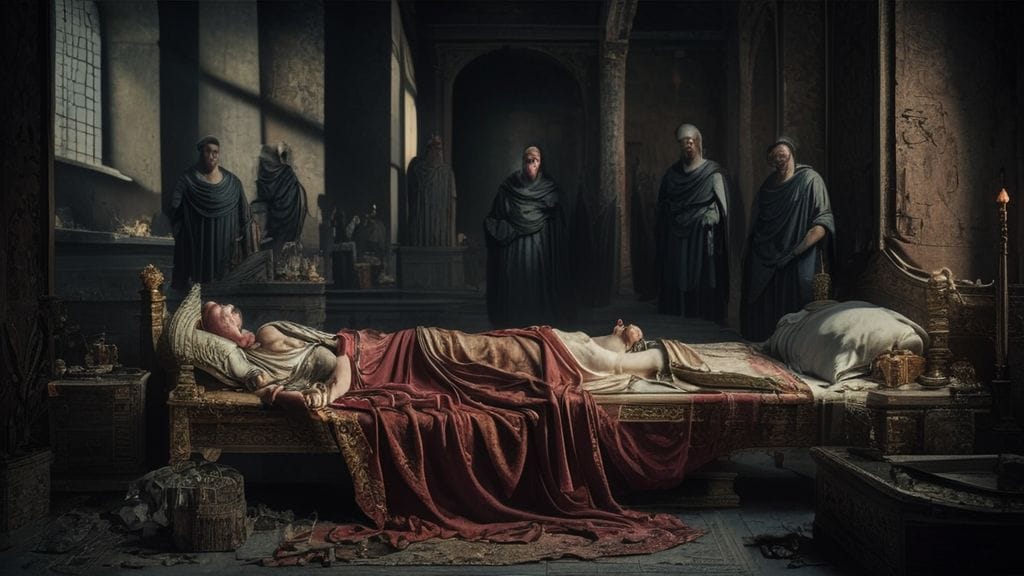
Imagine, for a moment, the emperor in his final days. Perhaps he lay in a shaded chamber, within hearing of the distant clatter of the city—hooves on stone, vendors shouting, the chant of psalms from a nearby church. Priests would have been summoned, Christian prayers murmured over him, oil applied, rites performed. Courtiers drifted in and out, offering carefully measured words of comfort while privately calculating their own futures in a post-Severus world.
And Ricimer? One pictures him waiting, not too close, not too distant. If he had indeed ordered the emperor’s death by poison, that act would have been carried out by intermediaries—a cup-bearer, a cook, a physician. If instead he simply watched nature take its course, he could still not have missed the political advantage that the death of Libius Severus would bring. In either case, when the emperor’s breath finally stilled, it was Ricimer’s future, more than Severus’s, that suddenly opened into new possibilities.
The Death of Libius Severus: A Quiet End to a Noisy Crisis
The moment itself passed, as most deaths do, in private. There was no crowd gathered outside the imperial residence at the instant his life ended; no herald cried out the news in the forum as he exhaled his last. The death of Libius Severus unfolded behind closed doors, in hushed tones, with only a handful of attendants and perhaps a few relatives or household staff present.
But word traveled quickly. First through the palace: servants whispering to one another, guards alerted to increased security, scribes summoned to prepare official notices. Then into the city: a senator informed by a trusted slave, a bishop notified to arrange liturgical responses, the commanders of local troops briefed to prevent unrest. In a Rome accustomed to upheaval, another imperial death surprised few; yet each such event chipped away at the lingering belief that the empire’s institutions still possessed enduring strength.
Officially, the passing of an emperor demanded ritual. The body would likely have been washed, anointed, and clothed in imperial garments. Though the grandest forms of imperial funerals—those in which emperors were carried in procession and deified in elaborate ceremonies—had faded, echoes remained. The Church now presided over death rites, replacing the older pagan apotheosis with Christian prayers for the soul’s salvation.
We can imagine a service held in one of Rome’s great basilicas, perhaps St. Peter’s or the Lateran, the air cool even in summer shadows, incense rising like faint memory toward the vaulted ceilings. Bishops, robed in solemn vestments, chanted psalms over the coffin of a man who had once been hailed as Augustus but who in this last moment was simply another Christian soul entrusted to God’s mercy. Senators would have attended, along with officers and members of the royal household, all careful to show proper respect yet already adjusting their allegiances for the new political landscape.
The death of Libius Severus, however quiet it seemed, reverberated in ways not immediately visible. For the first time since the elevation of Avitus in 455, the Western Empire found itself without a sitting emperor and without any obvious successor selected from within Italy. The interregnum that followed was not just an administrative gap; it was a void into which competing visions of Roman identity surged. Was the West now merely a fragment awaiting reabsorption into an Eastern-led empire, or did it still possess a distinct destiny?
Somewhere in the city, ordinary Romans heard the news and shrugged, or crossed themselves, or muttered that emperors came and went while taxes and hunger remained. Children asked their parents what it meant, and the answers were hesitant: “It means there will be a new emperor soon,” or “It means Ricimer will decide,” or perhaps, from the more cynical, “It means nothing changes.” Yet in the long view of history, the death of Libius Severus was more than just another imperial obituary. It marked the moment when the illusion of autonomous Western sovereignty took one more fatal step toward dissolution.
Rome Reacts: Senators, Soldiers, and Ordinary People in Mourning
In the wake of the emperor’s passing, Rome itself became a mirror, reflecting the fractured nature of loyalty and identity in 465. Among the senatorial aristocracy, responses likely ranged from genuine sorrow to quiet relief. Some had pinned hopes on Severus as a stabilizing figure, a man of Italian stock who might protect their interests and preserve the old ways. Others saw him as merely another stopgap in a series of short-lived regimes, his death an opportunity for new alignments.
The senate, that venerable body whose history stretched back to the earliest days of the Republic, retained a measure of ceremonial significance. It might issue messages of condolence, commission public works in the emperor’s memory, or sponsor games and distributions in his honor—though the financial strain of the times made such gestures increasingly difficult. Still, senatorial speeches would have been delivered, praising Severus’s piety, moderation, and service to the res publica, even if those virtues had been exercised mostly within tight constraints.
In the barracks and along the city walls, soldiers absorbed the news with a more practical eye. An emperor’s death raised immediate concerns: Would pay be delayed? Would there be unrest in the chain of command? Would Ricimer, whose authority over the army was paramount, face challenges during the transition? These men, many of them of non-Italian origin, were tied less to the persona of Severus and more to the structures of patronage and discipline that maintained their livelihoods.
For ordinary Romans—the shopkeepers in the Forum, the artisans in cramped workshops, the poor in the city’s insulae—the emperor had become a distant, half-abstract figure long before Libius Severus took the throne. They knew his image from coins and the occasional public ceremony, but his policies and decrees reached them only indirectly. The death of Libius Severus may have stirred a fleeting curiosity: would there be a remission of taxes in the name of a new ruler, or a donation of grain to mark the next emperor’s accession? People who lived on the edge of subsistence measured imperial change not in titles or genealogies but in bread, rent, and the risk of violence.
The Church, by contrast, perceived the moment with a different sensitivity. Bishops in Rome and other Italian cities had learned, over the preceding decades, that imperial instability often increased their responsibilities. They became negotiators with barbarian kings, caregivers during famines, and moral voices in the face of social breakdown. The loss of a Christian emperor, even one as constrained as Severus, meant a new phase of delicate relationship-building with whoever would next claim the Western throne.
Thus, mourning was uneven and stratified. In some homes, candles burned for the departed emperor’s soul; in others, the day passed unnoticed, swallowed by the pressing urgency of daily survival. Yet taken together, these scattered human reactions give texture to the seemingly impersonal fact recorded in chronicles: “On the Ides of August, Libius Severus died.” Behind that single line lay a city and an empire once more forced to confront the question of what it meant to live without clear leadership.
The Eastern Court’s Cold Silence and the Problem of Legitimacy
No less important than Rome’s reaction was that of Constantinople, the Eastern capital that increasingly saw itself as the true guardian of Roman continuity. To Leo I and his advisors, the entire reign of Libius Severus had been a kind of legal fiction. They had never recognized his elevation, considering it the product of Ricimer’s unilateral maneuvering rather than a properly coordinated imperial decision.
This refusal had practical consequences. Without recognition, Severus’s name did not appear in Eastern legal formulae or in many official lists. Eastern officials were instructed to consider the Western situation irregular. Diplomatic dealings with Italy were carefully phrased to avoid granting what Leo’s court saw as undeserved legitimacy. When eastern and western forces might have cooperated against the Vandals, this rift undercut their efforts, each side wary of conceding supremacy or validation.
When news of the death of Libius Severus reached Constantinople, the reaction was thus layered. On one level, there was a human response: another emperor dead, another sign of the West’s apparent curse of instability. On a political level, however, Leo’s government may have perceived the event as an opening. With the contested emperor gone, there was now an opportunity to impose, or at least propose, a candidate acceptable to the East—someone whose rule might mend the fractured image of imperial unity.
Here we see the deepening problem of legitimacy that defined the late empire. For centuries, an emperor’s authority rested on a blend of tradition, military acclaim, senatorial acceptance, and, increasingly, Christian sanction. By the mid-fifth century, this mixture had become volatile. An emperor could be proclaimed by troops in one region, rejected by elites in another, accepted by bishops in a third, and ignored by foreign kings entirely. The criteria for who “counted” as a real emperor shifted according to circumstance and perspective.
In the case of Severus, the Eastern court’s cold silence effectively wrote him out of its official memory even before his body cooled in Rome. Later historians drawing heavily from eastern sources would treat his reign as anomalous or marginal. Yet, as some modern scholars note, this asymmetry between East and West reveals as much about Constantinople’s growing self-confidence as it does about Severus’s fragility. The death of Libius Severus offered Leo an occasion to assert that future Western emperors would only be legitimate if the East said so.
It was a profound shift. In the time of Diocletian or Constantine, imperial power had been shared, contested, and sometimes violently disputed, but no single center could casually dismiss the claim of another emperor recognized in one half of the empire. Now, the scales had tipped. The West, impoverished and militarily constrained, could not force recognition; the East could withhold it. The struggle over who would succeed Severus thus became not only an Italian drama but a test of whether the West remained an equal partner in imperial leadership or was sliding into a junior, dependent role.
Ricimer Without a Puppet: The Interregnum and the Search for a New Emperor
Once the emperor was gone, Ricimer stood exposed. For years, he had shielded his extraordinary influence behind the nominal authority of Libius Severus. Now he was, in effect, the ruler of the Western territories without any living august presence to legitimize his decisions. This interregnum, lasting more than a year, was one of the most revealing episodes of the late Western Empire.
Ricimer’s position was both powerful and perilous. He controlled the army and the chief levers of administration in Italy, but without an emperor his rulings lacked the traditional stamp of legality. Moreover, any extended delay in appointing a successor risked provoking unrest among elites who still valued the continuity of imperial symbolism. Senators might fear that the empire was becoming, in all but name, a military dictatorship. The Church, too, would have been uneasy about the vacuum at the top.
Negotiations with Leo in Constantinople now took on urgent importance. Ricimer understood that the West could ill afford another emperor unrecognized by the East; he also understood that accepting a candidate too closely tied to Leo might undermine his own pre-eminence. The months following the death of Libius Severus thus became a period of delicate bargaining, conducted through envoys and letters crossing the Adriatic.
In Carthage, Geiseric watched carefully. For the Vandal king, a divided or leaderless West was a strategic gift. He could intensify raids, press for recognition of his preferred candidates, or simply wait while his enemies weakened one another. Some sources suggest that Geiseric had his own nominee in mind for the Western throne, a puppet through whom he could formalize Vandal gains. Ricimer had to consider not only Leo’s preferences but also the danger of antagonizing Geiseric too openly.
Meanwhile, in Italy, the machinery of daily government limped onward. Taxes were collected—where they could be. Local disputes were adjudicated by governors still in office. The law did not stop because an emperor had died; it merely operated with a sense of suspension, as if waiting for the next name to which documents would be dated. In that liminal space, people felt both the continuity and the fragility of Roman rule more acutely than ever.
Ultimately, the solution would come in the person of Anthemius, an eastern general and son-in-law of a former Eastern emperor, sent west by Leo and married into Ricimer’s family. But that settlement belonged to the future. In the months immediately after the death of Libius Severus, the West lived in an uneasy pause, its fate balanced between the ambitions of generals, the calculations of distant courts, and the unyielding realities of territorial loss.
The Vandal Question: Geiseric’s Leverage Over a Leaderless West
No actor exploited Western weakness more astutely than Geiseric, the Vandal king who had seized Carthage in 439 and turned the old Roman grain fleets into the backbone of his naval power. By the time of Libius Severus’s death, Geiseric had experienced, and helped cause, a succession of Western emperors—each less capable than the last of reclaiming Africa or challenging Vandal supremacy at sea.
For Geiseric, the absence of an emperor in Italy was not merely a curiosity; it was an opportunity. The death of Libius Severus removed a contested but still functional node of Roman resistance. In the fluid months that followed, Vandal raids may well have increased in frequency and daring, targeting poorly defended coasts and trade routes. We know from various sources that Geiseric routinely used hostage-taking, piracy, and diplomatic pressure to secure advantages, and a West adrift without a monarch offered him maximal leverage.
Geiseric also understood the symbolic value of emperors. His spectacular sack of Rome in 455, carried out under the pretext of defending the rights of his daughter-in-law Eudocia, had shown how he could cloak aggression in the language of dynastic legitimacy. It is likely that in the wake of Severus’s death, Vandal envoys made it clear that not every candidate for the Western throne would be acceptable to Carthage. Geiseric, like Leo, wanted an emperor he could influence or at least predict.
The Western elites had few good options. They could try to appease Geiseric with treaties and concessions, but such agreements tended to be temporary and fragile. They could invest heavily in naval construction, but the loss of African revenues made that a daunting prospect. Or they could seek Eastern support for a joint campaign—a path blocked as long as the East refused to acknowledge their chosen emperor. Here again, we see how the death of Libius Severus, by clearing the board, could paradoxically open a path toward the larger but risky project of imperial reconsolidation under Anthemius.
In the meantime, coastal communities throughout the central Mediterranean lived with the constant fear that Vandal sails might appear on the horizon. Farmers hesitated to store too much wealth in easily pillaged estates; merchants calculated the risk of shipping goods along known raiding routes. The empire’s inability to guarantee maritime security eroded confidence not only in its military capacity but in its very reason for being. Rome, once the guarantor of trade and safe travel, now struggled even to protect its own shores.
Thus, the consequences of the death of Libius Severus extended far beyond court politics. They altered the balance of power on the sea, encouraging a Vandal strategy that treated Roman weakness as a resource to be mined, raid by raid, treaty by treaty.
Coins, Chronicles, and Silence: How We Know What We Know
If Libius Severus seems elusive, that is because the sources that might have illuminated his life and death are scattered and fragmentary. Historians reconstruct his story from a patchwork of evidence: thin chronicles, later narratives colored by hindsight, and above all, coins—the small metal discs that once passed from hand to hand across the Western world.
Numismatics plays a crucial role here. Coins bearing Severus’s image and name confirm the years of his reign, the titles he claimed, and the mints still operating under his authority. Their distribution helps trace the shrinking geographical reach of Western imperial influence: Italy, parts of Gaul, and outposts elsewhere that still accepted his coinage as legitimate. When his coins abruptly cease and those of his successors appear, it signals shifts in power more reliably than many texts.
Written accounts are sparse and often terse. The chronicler Hydatius, writing in distant Gallaecia, mentions Severus but focuses more on the upheavals in his own region. Later historians like Jordanes and Procopius, writing in the sixth century, look back on the mid-fifth century through the lens of subsequent events, their narratives shaped by an awareness that the Western Empire would soon vanish entirely. A modern scholar once observed, “In the twilight of the West, the silence of our sources is itself a form of testimony,” a line that captures the eerie, half-lit quality of this era.
Then there is the legal record. The Theodosian Code and later collections contain laws issued during Severus’s reign, though fewer than for earlier emperors. These documents reveal concerns about administration, taxation, and religious matters, but they rarely expose personal motives or behind-the-scenes struggles. They show us the empire as it wished to see itself: orderly, Christian, still committed to justice—even as reality diverged further and further from this ideal.
The very uncertainty about the cause of the death of Libius Severus—whether from illness or poison—is a powerful reminder of the limits of our knowledge. In an earlier age, the death of an emperor might have been commemorated in panegyrics, monumental inscriptions, or detailed court histories. By 465, resources for such projects were scarce, and the will to produce them weaker. The “official story” of Severus’s life and reign was never fully written or has been lost, leaving modern historians to infer much from gaps and silences.
Yet these gaps do not render his story meaningless. On the contrary, the thinness of the record forces us to read more deeply into what remains—to consider not only the words that survive but the structures, patterns, and absences that frame them. In doing so, we see how the death of Libius Severus becomes a lens through which the broader decline of Western Roman institutions comes into unexpectedly sharp focus.
Human Lives in the Ruins: Daily Existence After Severus’s Passing
History often privileges rulers and battles, but the significance of the death of Libius Severus can also be traced in the quieter, less documented lives that continued in its wake. For the residents of Rome and other Italian cities, imperial death and succession formed part of a background rhythm that framed, but did not dominate, their immediate concerns.
In Rome’s hills and valleys, people still woke at dawn to tend shops, bake bread, haul water, and repair crumbling structures. The collapse of long-distance trade and imperial subsidies had hurt the urban poor most severely. Grain distributions, once a defining feature of Roman citizenship, were irregular or drastically reduced. The death of one emperor and the accession of another might bring a temporary largesse—a ceremonial distribution of coin or food to curry favor—but such windfalls were unpredictable.
Artisans felt instability as fluctuating demand. A sculptor might find occasional work restoring statues for a senatorial patron keen to advertise continuity with Rome’s illustrious past. A mosaicist might be hired by a bishop renovating a church or by a wealthy family seeking to display piety and status. Yet overall, the commissioning of grand works had declined; maintenance and patchwork repair replaced the confident construction of new monuments.
In the countryside, peasants and landowners alike faced changing tax regimes, shifting military requisitions, and the occasional terror of raids. Even in central Italy, comparatively protected compared to frontier regions, rumors of barbarian incursions could trigger waves of panic. Landowners sometimes armed their retainers, blurring the line between private estates and micro-fortresses. The imperial absence after Severus’s death added a further layer of anxiety: if there was no clear emperor, who ultimately guaranteed law and order?
The Church’s growth offered some counterweight to despair. Christian communities provided support networks—alms for the poor, care for the sick, burial for the dead—that partially compensated for the state’s waning capacity. Bishops might invoke the death of Libius Severus in sermons as a reminder of the transience of earthly power and the permanence of divine authority. For ordinary worshippers, such messages were both comforting and sobering. If emperors themselves could rise and fall so swiftly, perhaps salvation lay elsewhere than in the emperor’s favor.
Children born in the years after 465 would grow up with almost no memory of a time when the West possessed confident leadership or secure borders. For them, imperial names—Severus, Anthemius, Olybrius—would blur into one another, markers of political eras rather than figures of genuine awe. In their world, the death of Libius Severus was one thread among many in a tapestry of gradual transformation: from a Roman Mediterranean to a patchwork of successor kingdoms, each claiming, in its own way, to preserve fragments of the old order.
Patterns of Collapse: What the Death of Libius Severus Revealed About the Empire
Taken in isolation, the death of Libius Severus might appear to be a modest event: the passing of an elderly, weakly empowered emperor whose reign had done little to alter the course of the West’s decline. Yet in context, his death offers a window into deeper patterns that defined the empire’s terminal phase.
First, his contested legitimacy highlighted the growing divergence between East and West. When earlier emperors died, succession struggles could be fierce, but they usually occurred within a broadly shared framework of imperial identity. By refusing to recognize Severus and by maneuvering to install a preferred candidate after his death, the Eastern court signaled that it now viewed the Western throne almost as a subordinate office, not a fully equal partner in rule.
Second, the heavy hand of Ricimer revealed the militarization and personalization of power. The West had always relied on its armies, but in previous centuries the office of emperor held at least formal supremacy over generals. In Severus’s time, that balance was inverted. The emperor served at the pleasure of the generalissimo, not the other way around. The death of Libius Severus, whether natural or induced, underlined the precarity of anyone who wore the purple without commanding the sword.
Third, the geopolitical context of his death underscored the empire’s loss of strategic depth. With Africa in Vandal hands, Gaul and Spain fragmented, and Italy increasingly isolated, the West no longer had the resources to absorb shocks. Each imperial death, each succession crisis, reverberated more dangerously because there were fewer stabilizing structures to distribute the impact. The passing of one emperor in Ravenna or Rome could now unsettle a much wider territory, not because his personal rule had been strong, but because the system had become so brittle.
Finally, the fading record of his life and reign illustrates the erosion of imperial self-documentation. Rome had once been prodigious in its production of histories, panegyrics, inscriptions, and monumental art celebrating emperors. The comparative silence surrounding Libius Severus’s death signals not just a decline in wealth but a decline in the confidence that imperial narratives still mattered. When a state no longer invests in telling its own story, its institutional soul is already weakened.
Seen through these lenses, the death of Libius Severus appears less as a footnote and more as a case study in late imperial fragility. It captured, in one moment, the intertwined crises of legitimacy, militarization, territorial loss, and cultural exhaustion that would soon culminate in the formal end of the Western Roman Empire a mere eleven years later, in 476.
From Severus to Anthemius: The Last Flickers of Roman Unity
The interlude after Severus’s death did not last forever. In 467, after protracted negotiations, a new arrangement emerged. Leo I in Constantinople selected Anthemius, a distinguished general with strong dynastic connections, as the man who would restore order in the West. Ricimer agreed to this choice and sealed the settlement by marrying Anthemius’s daughter, Alypia, thereby intertwining his own fortunes with those of the new emperor.
This moment has often been seen by historians as one of the last serious efforts to revive Western power. The plan was bold: a coordinated Eastern–Western campaign against the Vandals, backed by a reconstructed fleet and a renewed sense of common purpose. In the background stood the memory of Libius Severus, whose unrecognized reign had symbolized disunity. His death cleared the way for an emperor whose legitimacy rested on both eastern endorsement and western installation.
The campaign that followed, however, ended in disaster. In 468, the joint expedition against Geiseric failed catastrophically off the coast of Africa. Vast resources were lost, including much of the Eastern fleet. The defeat shattered any realistic hope of reconquering Africa and with it the economic foundation necessary for long-term Western recovery. The failure also destabilized Anthemius’s position, souring relations with Ricimer and setting the stage for yet another civil conflict.
In retrospect, the sequence from Severus to Anthemius reads like a tragic crescendo. Severus represented an attempt by the West to manage its own affairs with minimal Eastern involvement—an attempt undermined by lack of recognition. Anthemius, by contrast, represented a renewed Eastern–Western partnership, undermined by military failure and internal distrust. In both cases, the underlying structural problems proved stronger than individual good intentions or clever diplomacy.
The death of Libius Severus thus stands at the threshold of this final phase of serious restoration attempts. Without his passing, Leo might not have found the opening to send Anthemius; without Anthemius’s eventual failure, the path to 476 and the deposition of Romulus Augustulus might have unfolded differently. Yet the end result, in broad terms, seems to have been overdetermined. The West was running out of time, territory, and tools. Severus’s death did not cause the collapse, but it formed one of the stepping stones along the path to it.
Memory, Misery, and Myth: Later Views of Severus’s Reign
In the centuries after the Western Empire’s formal end, the figure of Libius Severus faded into relative obscurity. Medieval chroniclers, when they mentioned him at all, often did so as a name in a list, a brief station in the procession of emperors who presided over Rome’s fall. The absence of dramatic stories or heroic exploits made it easy to overlook his reign.
Yet obscurity is itself revealing. The mythologizing of Rome’s decline often focuses on more flamboyant figures: the boy-emperor Romulus Augustulus, the barbarian king Odoacer, or the Gothic ruler Theoderic. Against such vivid personalities, Libius Severus appears colorless. But modern historians have increasingly recognized that the less spectacular reigns can tell us as much about systemic decay as the dramatic ones. A scholar of late antiquity once noted that “the quiet emperors mark the loudest silences in our sources,” emphasizing how their very forgettability reflects institutional exhaustion.
In later imaginings, the misery of the late empire—the sacked cities, the famines, the invasions—often gets compressed into a single narrative of “barbarian hordes” overrunning Rome. The granular reality of Senate debates, church councils, and imperial negotiations disappears. In such simplified retellings, the death of Libius Severus would mean little. But a closer reading restores complexity: we see that his reign and death were embedded in a dense web of political calculation, social anxiety, and spiritual searching.
Historians from Edward Gibbon to more recent specialists have used Severus’s story as part of larger arguments about decline and transformation. Gibbon, in his Enlightenment prose, tended to see late emperors as degenerate or weak, contributing to what he famously called “the decline and fall.” Later scholars, more sympathetic to the resilience shown by many Roman institutions, emphasize adaptation rather than simple collapse. From this perspective, the death of Libius Severus illustrates the limits of adaptation when key resources and territorial anchors have already been lost.
Thus, while Severus never became a figure of legend, his faint outline remains an essential piece of the mosaic. His reign shows us an empire not yet dead, but undeniably dying; a state still capable of issuing laws and holding councils, but no longer able to compel obedience across its old domains. His death punctuates this condition, a quiet full stop in a sentence that had once stretched across continents.
Echoes in the Twilight: The Death of Libius Severus in Long-Term Perspective
Looking back from our vantage point, it is tempting to treat 465 as just another date on the long slide from imperial grandeur to medieval fragmentation. But to do so would flatten the lived experience of those who inhabited that moment. For them, the death of Libius Severus was not “inevitable”; it was immediate, uncertain, and layered with possibility.
In the long arc of history, his death marks one of the last times a Western emperor died in office in a Rome that still, however tenuously, claimed to be the heart of an empire. Within a decade, emperors would be imposed and deposed by barbarian generals with even less pretense of senatorial or eastern collaboration. Within twenty years, the very office of Western emperor would vanish, leaving only the Eastern line in Constantinople and a scattering of kings and warlords in its wake.
The echoes of this twilight continued to resonate for centuries. Byzantine emperors would claim to be the sole legitimate Roman emperors, inheritors not only of Constantine and Theodosius but of Severus as well. The papacy, based in the same city where Severus died, would gradually expand its temporal authority, filling spaces that once belonged to imperial administrators. Frankish, Gothic, and Lombard rulers would consciously adopt Roman symbols and legal forms, trying to graft their own power onto the still-potent stump of Roman legitimacy.
In all of these later developments, the memory of figures like Libius Severus lingered, if only as dim constellations in a fading sky. The fact that his death could pass with relatively little fanfare, yet still carry such far-reaching implications, reminds us that history often turns not on grand spectacles but on quiet transitions. An old man dies in a palace; outside, the city goes on with its business; far away, ships change course, armies reconsider campaigns, and kings recalculate their strategies.
To tell the story of the death of Libius Severus is thus to tell the story of how empires end—not in a single cataclysmic moment, but in a long series of adjustments, miscalculations, and exhausted compromises. His final breath on that August day in 465 did not bring the Western Empire crashing down, but it did help to loosen another stone in a structure already riddled with cracks. The collapse, when it came, would seem sudden to some; yet for those who had watched emperors like Severus flicker and fade, it must have felt like the culmination of a process that had been unfolding for a lifetime.
Conclusion
The story of Libius Severus, from obscure Italian senator to contested Western emperor, and finally to a quiet death in Rome on 15 August 465, is a narrative stitched from fragments, silences, and retrospective insight. We see him dimly, framed by the stronger silhouettes of Ricimer, Leo I, and Geiseric; yet through that dimness, a larger picture emerges. His reign encapsulates the dilemmas of a late empire struggling to reconcile tradition with military necessity, to balance regional autonomy with the ideal of imperial unity, and to sustain authority without the material foundations that had once made Rome invincible.
The death of Libius Severus crystallized several long-term trends: the growing dominance of military strongmen, the estrangement between East and West, the emboldened opportunism of barbarian kingdoms, and the increasing difficulty of sustaining imperial image in the face of institutional decay. Whether he died of illness or by poison, naturally or at the instigation of those who had raised him up, his passing marked a transition point. The interregnum that followed and the eventual rise of Anthemius were not new beginnings so much as last attempts to repair an edifice already compromised beyond easy repair.
And yet Severus’s story is not only about decline. It also reveals continuity—the persistence of law, ceremony, and civic identity in a time of crisis. Even as emperors came and went, people still prayed, traded, married, and buried their dead under the shadow of venerable walls and within churches built on older foundations. The empire did not simply vanish; it transformed, its elements redistributed among new powers and new forms.
In tracing the arc from his unexpected coronation to his almost unnoticed death, we gain a clearer understanding of how the Roman world moved from ancient empire to medieval plurality. The death of Libius Severus stands as one of those quiet hinge moments when a civilization, caught between memory and transformation, took another step toward a future it could not yet name.
FAQs
- Who was Libius Severus?
Libius Severus was a Western Roman emperor who reigned from 461 to 465. Likely of Italian senatorial background, he was elevated to the throne by the powerful general Ricimer after the deposition of Majorian. His rule was largely confined to Italy and some adjacent regions, and he was never recognized by the Eastern emperor Leo I, which greatly weakened his broader legitimacy. - When and where did the death of Libius Severus occur?
The death of Libius Severus took place on 15 August 465, probably in Rome, though some traditions suggest Ravenna. Contemporary records are sparse, but the date is preserved in later chronicles that list the succession of Western emperors. His passing left the Western Empire without an emperor for more than a year. - Do we know the cause of his death?
The exact cause of Libius Severus’s death is unknown. Some later sources and modern historians have suggested the possibility of poisoning, potentially at the instigation of Ricimer, who benefited politically from his removal. However, there is no definitive evidence, and he may simply have died of natural causes, given his age and the disease-prone conditions of the time. - Why did the Eastern Empire refuse to recognize Libius Severus?
Eastern emperor Leo I regarded the elevation of Libius Severus as illegitimate because it followed the forced removal and execution of Majorian by Ricimer. From Constantinople’s point of view, Severus was essentially Ricimer’s puppet, chosen without proper consultation. As a result, Leo withheld formal recognition, which undermined Severus’s standing outside Italy and hindered coordinated imperial policies. - How did the death of Libius Severus affect the Western Roman Empire?
The death of Libius Severus intensified the Western Empire’s crisis of legitimacy and leadership. It created an interregnum during which Ricimer ruled without an emperor, highlighting the dominance of military strongmen over the imperial office. His death also opened the way for Eastern intervention in Western succession, culminating in Leo I’s decision to send Anthemius as a new, recognized emperor in 467. - What role did Ricimer play in his reign and death?
Ricimer, the magister militum, was the kingmaker who selected Libius Severus as emperor and effectively controlled Western policy during his reign. Severus depended on Ricimer for military support and political survival. While some accounts imply that Ricimer may have been involved in the death of Libius Severus, this remains conjectural. What is clear is that Ricimer quickly exploited the emperor’s death to renegotiate the terms of Western leadership with the Eastern court. - How did Libius Severus’s death relate to the eventual fall of the Western Roman Empire?
His death was not the direct cause of the empire’s fall in 476, but it formed part of a chain of events that weakened Western resilience. The unrecognized nature of his reign, the power vacuum that followed his death, and the failed attempt at restoration under Anthemius all contributed to an environment in which the Western imperial office became increasingly fragile. By exposing structural weaknesses—especially in succession and East–West cooperation—the death of Libius Severus helped pave the way for the final collapse. - What sources do historians use to study Libius Severus and his death?
Historians rely on a combination of late antique chronicles (such as those of Hydatius), later narratives from authors like Jordanes and Procopius, surviving imperial laws, and numismatic evidence from his coinage. Because the written record is sparse and sometimes contradictory, much of our understanding comes from careful interpretation of these limited materials and comparison with broader patterns in late Roman politics and society. - How did ordinary people experience the death of Libius Severus?
For most inhabitants of Italy and the remaining Western territories, the death of Libius Severus likely registered as just another change in a distant and increasingly abstract imperial hierarchy. Some may have noticed official mourning, church services, or adjustments in coinage and tax collections, but their daily struggles with poverty, insecurity, and local power shifts mattered far more. The event’s deeper significance lay in its long-term impact on governance and security rather than in immediate, visible upheaval.
External Resource
Internal Link
Other Resources
- Encyclopaedia Britannica – general search for the exact subject
- Google Scholar – academic search for the exact subject
- Internet Archive – digital library search for the exact subject