Table of Contents
- A River in Ireland and the Echo of July 1690
- Europe in Flames: The Wider War Behind the Boyne
- Two Kings, One Crown: James II and William III on a Collision Course
- Ireland Before the Storm: Land, Faith, and Fear
- Raising the Banners: The Road to the Boyne
- Choosing the Ground: Why the Boyne River Became a Battlefield
- Eve of Battle: Camps, Councils, and Quiet Dread
- Dawn at the Ford: The Battle of the Boyne Begins
- Kings Under Fire: William Wounded, James Watching
- Turning of the Tide: Retreat, Rout, and the End of the Fight
- Blood, Numbers, and Myths: Casualties and Contested Memories
- From Boyne to Limerick: The War That Did Not End
- Winners Without Peace: Protestants, Catholics, and the Penal Future
- The Boyne in Orange Memory: Parades, Banners, and Songs
- A Jacobite Lament: The Lost Cause of James II
- Historians at the River: Rethinking the Boyne
- The Boyne in Modern Ireland: From Battlefield to Heritage Site
- Symbol, Warning, Mirror: What the Boyne Tells Us Today
- Conclusion
- FAQs
- External Resource
- Internal Link
Article Summary: On the banks of the Boyne River in Ireland, in July 1690, two kings and two futures for Britain and Ireland collided in what would become known as the battle of the boyne. This article follows the story from the courts of Versailles and Whitehall to the hedgerows and muddy fords where Dutch, Danish, French, Irish, Scottish, and English soldiers fought and died. It explores the religious and political tensions that turned a local Irish struggle into a theatre of European war, while tracing how this single day became a towering symbol in Protestant and Catholic memory. Moving chronologically—from preparations to the clash itself, to its far-reaching consequences—it shows how the outcome helped secure the Protestant succession in England and shaped the harsh Penal Laws in Ireland. The narrative then follows the war beyond the Boyne, through sieges and treaties, to the long legacy of division and identity that persisted into the 20th century. Along the way, it considers myths, contested casualty figures, and the enduring image of William of Orange on his white horse. Finally, it asks how a 17th-century battle still haunts politics, culture, and commemoration, and what it means to remember such a conflict in a modern, more fragile peace.
A River in Ireland and the Echo of July 1690
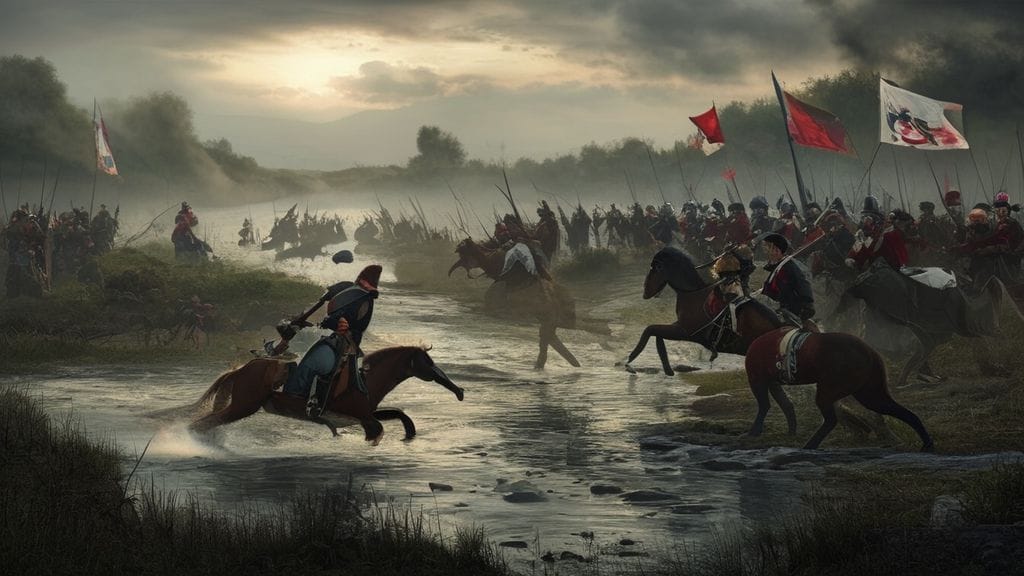
On a summer morning in 1690, mist lay low over the bends of the Boyne River in eastern Ireland. The air was thick with the smell of wet grass, horse sweat, and powder. A ribbon of water, broad and deceptively gentle, separated two armies drawn from almost every corner of Europe. On the north bank, regiments in blue, red, and gray stood in ordered lines, their banners snapping in the breeze, the gold and orange standards of their commander rising above them. On the south bank, Irish infantry, French professionals, and cavalry in worn but proud uniforms clustered around the white flags of the exiled Stuart king. Within a few hours, the river would no longer be just part of the Irish landscape; it would become a line in history—the stage for the battle of the boyne.
Standing back from the water’s edge, the story looks almost simple: a deposed Catholic king, James II, trying to reclaim his throne with French help; his son-in-law and rival, the Dutch Protestant William of Orange, now William III of England, pressing forward to secure his rule. But once we follow the river upstream through the past, its course twists through decades of religious strife, land seizures, colonial experiments, and continental war. Ireland in 1690 was not simply a backdrop. It was a prize, a battleground, and a wounded country where loyalties had been shaped by plantation, rebellion, and bloody repression.
Yet for the men who tightened their belts that morning, whose boots sank into the churned mud, the grand causes boiled down to something simpler and sharper: fear for their lives, hope for pay, loyalty to commanders, hatred of the enemy, and—above all—the sense that the outcome of the day would alter their world. Some were Irish Catholic tenants dreaming of land restored, others Ulster Protestants defending precarious gains. There were Dutch Calvinists who had followed their prince from the marshes of the Low Countries, Danish mercenaries accustomed to shifting European fronts, and French officers who considered this Irish field just one more theatre of Louis XIV’s vast ambitions.
When the guns finally opened, and the first soldiers stepped into the water, they stepped into a story that has been retold, reshaped, and argued over for more than three centuries. But this was only the beginning. To understand what happened on that July day—and why it still matters—we must first step away from the Boyne itself and look outward to the crowded map of late 17th-century Europe, where kings fell, alliances shifted, and confessional lines hardened like battle formations.
Europe in Flames: The Wider War Behind the Boyne
The battle of the boyne cannot be understood without the wider European war in which it was entangled. In the late 1680s and early 1690s, Europe was a continent of anxious courts and brittle truces. Louis XIV of France, the so-called Sun King, sought to extend his borders and his influence, reshaping the map to suit French power. Against him stood an often-fractious coalition of states—Dutch, English, German principalities, Spanish territories—held together by necessity and fear.
The Dutch Republic, small but wealthy and fiercely defended, lay at the front line of Louis’s ambitions. Its leader, William of Orange, was the architect and lynchpin of a grand alliance aimed at containing France. To the east, the Holy Roman Empire grappled with its own threats, from Ottoman pushes into central Europe. Across the Channel, England was in the midst of its own succession crisis, one that would open the door to William’s intervention and eventually draw Irish soil into the clash.
In 1685, James, Duke of York, the younger brother of Charles II, ascended the English throne as James II. Unlike his brother, James was an openly practicing Catholic, ruling over a dominantly Protestant kingdom that remembered the religious turmoil of the previous century with pain and suspicion. His efforts to ease restrictions on Catholics and Protestant dissenters were read by many as a project of “popish” subversion, a step toward absolute monarchy modeled on the French example.
Louis XIV watched with interest, sensing an opportunity: a Catholic England might overturn the balance of power and weaken the Dutch-led coalition against him. William of Orange, by contrast, saw in James’s rule a brewing disaster. If England aligned with France, his small republic would be trapped between two sea powers.
In 1688, the crisis reached a critical point. James II’s second wife, the Catholic Mary of Modena, gave birth to a son, James Francis Edward Stuart. For Protestant elites in England and Scotland, the arrival of a Catholic male heir signaled that the kingdom might remain under Catholic rule for a generation or more. Political maneuvering turned to conspiracy. A group of English notables invited William of Orange, who was married to James’s Protestant daughter Mary, to land with an army and “rescue” English liberties and religion.
William accepted. His fleet crossed the Channel in November 1688, landing at Torbay. James’s support crumbled with surprising speed. Key officers defected; popular resistance did not materialize on the scale the king needed. By December, James fled to France, where he was received by Louis XIV as a useful ally in exile. England’s so-called “Glorious Revolution” proclaimed William and Mary joint monarchs. On paper, the revolution was almost bloodless; in reality, its violence was simply displaced—to Scotland, to the colonies, and above all, to Ireland.
Two Kings, One Crown: James II and William III on a Collision Course
The struggle that culminated in the battle of the boyne was at its core a duel between two men whose temperaments, beliefs, and fates could hardly have been more different. James II, born in 1633, had survived civil war, exile, and restoration. A younger son during his father Charles I’s turbulent reign, he had watched the monarchy fall and then be resurrected. His conversion to Catholicism in the 1660s deepened his sense of embattlement, imbuing his rule with a stubborn, almost fatalistic quality. He believed his kingship to be divinely appointed and non-negotiable.
William of Orange, born in 1650 just days after his father’s death, was a child of crisis. The Dutch Republic into which he was born was under constant threat, especially from Louis XIV. William’s education was political and military from the beginning. Reserved, austere, and often cold in manner, he was nonetheless a skilled diplomat and a dogged commander. In the 1670s, he had already faced French invasion and helped preserve the Dutch state from collapse. Religion for him was both personal conviction—he was a committed Calvinist—and a powerful glue for the anti-French coalition.
Both men carried the weight of dynastic expectation and religious identity. For James, the throne of England, Scotland, and Ireland was his by birthright; losing it, he felt, was an affront to God’s order. For William, accepting the English throne was an extension of his lifelong struggle against French power and Catholic absolutism. When English and Scottish parliaments accepted William and Mary as joint sovereigns, they did more than invite a foreign prince into their monarchy; they rewrote the rules of kingship, subordinating the crown to parliamentary choice.
James refused to accept this rewriting. From his base at Saint-Germain-en-Laye outside Paris, he and his Jacobite followers—named from the Latin “Jacobus” for James—prepared to fight back. Louis XIV, ever calculating, saw in Irish soil a chance to pin down William’s forces, weaken the new Anglo-Dutch regime, and possibly restore a Catholic ally to the English throne. James would lead a campaign in Ireland; if he could secure it, he might use the island as a springboard to invade England or at least threaten it enough to undermine William’s continental campaigns.
Thus the personal collision of James and William became a node in the much larger struggle for European dominance. Ireland, already scarred by earlier wars and plantations, became their chosen battlefield. It is astonishing, isn’t it, how the lives of ordinary farmers, tradesmen, and laborers in Meath and Louth would be turned upside down by decisions made in Versailles and The Hague?
Ireland Before the Storm: Land, Faith, and Fear
To understand why so many Irish Catholics rallied to James and why so many Irish Protestants clung to William’s cause, we must look at the Ireland James entered in 1689. The island had endured a century of upheaval: the Tudor conquest, the confiscations and plantations of the early 1600s, the great rebellion of 1641, and the merciless Cromwellian campaigns that followed. Each wave had shifted land ownership further away from Catholic Gaelic and Old English families into the hands of Protestant settlers, particularly in Ulster.
By the late 17th century, the majority Catholic population worked land increasingly owned by members of a Protestant minority who drew their security from English military and political backing. Memories of massacres and reprisals from the 1640s still hovered like ghosts in the countryside. For Protestants, the specter of a Catholic rising—another 1641—was their deepest nightmare. For Catholics, stories of dispossession, of families driven from ancestral lands, fuelled anger and hope for restitution.
Religious differences overlapped with ethnic and social divides, but never perfectly. There were Catholic nobles who had tried to navigate loyalty to the English crown, and Protestant traders who had married into older Irish families. Still, in political terms, the categories had hardened. When James II ascended the throne, many Irish Catholics saw an opening. His Catholic officers gained positions in the Irish administration; Catholic gentry hoped for the reversal of some confiscations. Meanwhile, Protestants—especially in Ulster—felt the ground slipping beneath their feet.
In 1689, as James landed in Kinsale with French support, Ireland was already sliding toward war. The Protestant stronghold of Derry (Londonderry) refused to admit James’s forces, slamming its gates in a now-famous act of defiance. The ensuing siege, which lasted 105 desperate days, became a foundational story of Protestant resistance. Further south, the Jacobite-dominated Parliament in Dublin passed acts attempting to restore land to Catholics and solidify support for James. The island’s divisions hardened into military lines.
Thus, when William later marched into Ireland, he was not merely intervening in a dynastic dispute. He was stepping into a long-simmering colonial conflict in which land, faith, and memory were combustibly intertwined. This context gives the battle of the boyne a dual character: a central episode in a European war, and at the same time an intensely local reckoning between communities who had lived uneasily alongside one another for generations.
Raising the Banners: The Road to the Boyne
James II arrived in Ireland in March 1689, greeted with enthusiasm by much of the Catholic population. He set up his court in Dublin, nominally ruling as king over Ireland while planning to use it as a base for wider reconquest. French advisers and officers accompanied him, and Louis XIV supplied troops, money, and arms—but never quite enough, and always with his own priorities in mind. James’s Irish army, commanded in large part by Richard Talbot, Earl of Tyrconnell, was brave but unevenly trained and poorly supplied.
Early Jacobite success fuelled hopes. Much of Ireland, especially the southern and western regions, fell under James’s authority. Yet crucial strongholds remained in Protestant hands. The sieges of Derry and Enniskillen in the north became defining struggles. The relief of Derry by an English fleet was a serious blow to Jacobite morale, as was the victory of Protestant forces at Newtownbutler. Still, James and his supporters believed that if they could hold Ireland and perhaps secure a Scottish rising, time might be on their side.
Meanwhile, William was occupied on multiple fronts. He had to secure his hold over England and Scotland, manage his Dutch responsibilities, and keep the anti-French alliance intact. Only in mid-1690 did he finally commit to personally leading a campaign in Ireland. Up to that point, Williamite forces in Ireland had been led by others, achieving mixed success: the capture of Carrickfergus, the gradual push south from Ulster, the occupation of Dublin’s outskirts still a distant goal.
William landed at Carrickfergus on 14 June 1690 (Old Style calendar), accompanied by a coalition army: Dutch, English, Scottish, Danish, and other contingents. Estimates of his strength vary, but many historians place his total force at around 36,000 men. James’s army may have numbered roughly 23,000–25,000, bolstered by experienced French units but hampered by shortages and discipline issues among some Irish levies. These figures, though debated, convey the basic imbalance.
The two armies moved slowly toward each other, probing and maneuvering. James’s forces shadowed William’s advance as he pushed south from the north-east. The exiled king had to decide where, if anywhere, he would risk a pitched battle. He could withdraw toward the natural defensive line of the Shannon River and the fortified town of Limerick, trading space for time. Yet pride, pressure from supporters, and perhaps a lingering confidence in his divine right inclined him to make a stand earlier.
He chose the Boyne River—broad, shallow in places, winding through gently rolling terrain north of Dublin. It was a decision shaped by advice, terrain, and perhaps by James’s own misjudgment of William’s capacity and determination. For William, who wanted to bring the matter to a decisive head before returning to the continent, the opportunity was welcome. The stage was set, and the river that had quietly threaded through Irish history was about to be inscribed in European memory.
Choosing the Ground: Why the Boyne River Became a Battlefield
The Boyne sits roughly 30 miles north of Dublin, flowing eastward to the Irish Sea near Drogheda. In 1690, its banks were edged with meadows, hedgerows, and occasional wooded rises. The river was not overly deep, but in many stretches its current was strong, and its banks could be boggy. For an army defending the south bank, it offered natural advantages: attackers would have to cross in the face of fire, then climb up from low ground to higher positions beyond.
James’s camp formed around the town of Oldbridge and the slopes rising south of the river. The Jacobite army stretched along the southern bank, with cavalry massed at key fords and infantry posted where they could fire on any crossing attempts. French troops, better trained and equipped, were ideally placed to hold firm lines, while Irish units—some seasoned, others scarcely drilled—filled out the rest. James’s guns were positioned to sweep likely fording points.
William approached from the north, his army encamped around the villages and fields facing Oldbridge. Surveying the ground, he saw both danger and opportunity. The Boyne’s multiple fords meant he could attempt crossings at several points, confusing his opponent. Horses could swim or wade across certain stretches; infantry could ford at low tide where mud and stone offered precarious footing.
On 30 June (Old Style), the two kings came within sight of one another across the water. William, mounted and wearing his characteristic grey coat, rode forward to inspect the Jacobite lines. An enemy cannon, perhaps guided by a keen-eyed French gunner, seized the opportunity. A ball struck the ground nearby, sending up stones and debris. One fragment hit William on the shoulder, briefly unhorsing him. For a tense moment, rumors of his death ran along both armies’ lines, suggesting the battle of the boyne might be decided before it began. But William, bruised rather than mortally wounded, remounted his horse. The incident would become one of those almost-mythic brush-with-death stories retold for generations.
That evening, both camps readied themselves. James convened councils, debating whether to fight here or withdraw toward the Shannon. His French advisers, notably the Comte de Lauzun, urged caution, favoring a strategic retreat that would preserve the army. Others, including many Irish officers, wanted to stand and fight, eager to demonstrate their courage and fearing the blow to morale and authority that a withdrawal would bring. James, indecisive and perhaps unnerved by William’s near miss, wavered—but in the end he stayed at the Boyne.
Eve of Battle: Camps, Councils, and Quiet Dread
Night fell softly over the river. On the Williamite side, fires dotted the darkness, lines of tents glowing faintly. Soldiers cleaned muskets, sharpened swords, and whispered prayers in half a dozen languages: English, Dutch, German, Danish, French Huguenot French, and Irish among auxiliary units. Chaplains moved through the ranks, reminding men of their cause—defending Protestant liberty, securing the new king, halting the spread of French-style absolutism.
Across the water, in the Jacobite camp, the mood was more mixed. Many Irish Catholic soldiers saw the coming day as a chance to reclaim honor for a people long subjugated. They had endured stereotypes of cowardice and disorder, yet here they stood on ground of their choosing with a king of their faith at their head. French officers and troops, veterans of Louis XIV’s wars, were less sanguine. They had studied the enemy’s strength and knew the odds. Still, they prepared with professional diligence, checking gunpowder supplies, placing pickets, and reinforcing positions.
Somewhere in the darkness, James II tried to sleep, perhaps tormented by memories of his earlier flight from England and by the knowledge that this battle might be his last real chance to reverse his fate. William likewise lay down with the weight of more than his own crown on his shoulders. The Anglo-Dutch coalition, the Protestant succession, the entire balance of power in Europe—these lofty phrases were, for him, real stakes. If he fell or failed here, Louis XIV would rejoice, and the carefully woven web of alliances might tear.
For the common soldiers, the horizon was much narrower: survive the next day, obey orders, maybe snatch some plunder. Yet behind their personal fears lay a quieter dread: that defeat might mean not just their own deaths but reprisals against their families, confiscations of land, forced exile. The river, glinting faintly in the moonlight, divided more than two armies. It separated two visions of Ireland’s future and two versions of monarchy.
Some accounts from the period, though colored by later memory, describe a tense stillness before dawn. Dogs barked in nearby farmsteads. A church bell sounded from Drogheda. Then, as the first light tinged the eastern sky, drums began to beat on the Williamite side. Orders were shouted. The armies stirred. The last quiet moments before the battle of the boyne ebbed away like the river’s own tide.
Dawn at the Ford: The Battle of the Boyne Begins
At first light on 1 July 1690 (Old Style), William put his plan into action. He intended to stretch the Jacobite forces along the river and throw them into confusion by attacking in more than one place. A substantial detachment under the Duke of Schomberg and the young Count of Solms moved upriver to attempt a crossing at Roughgrange and Rosnaree. Their aim was to turn James’s right flank, threatening the Jacobite line of retreat toward Duleek and the west.
James, misreading the scale of this movement, believed it might be the main attack. He shifted significant forces to counter it, weakening the central sector near Oldbridge where William himself planned to push across. The river here curved in a broad loop; the fords around Oldbridge offered a perilous but passable route for infantry and cavalry.
As the sun rose higher, William’s artillery opened fire across the river, softening Jacobite positions. The thunder of cannon echoed off the slopes, mingled with the crackle of musketry as skirmishers traded shots. Then came the decisive order. Regiments of infantry—Dutch Blue Guards among them—stepped into the Boyne’s water, muskets held high, colors fluttering above their ranks. Cavalry followed, horses floundering and splashing, riders urging them on.
Jacobite musketeers and artillery unleashed volleys. Men pitched forward into the water, disappearing beneath the surface. Horses reared or fell, dragged down by the current or by injuries. But the attackers kept coming, wading, stumbling, sometimes swimming. The sight must have been extraordinary: lines of men in bright coats and battered armor, flags streaming wet, bullets striking the water in little fountains as they closed the gap.
On the southern bank, Irish cavalry charged into the shallows, sabres raised. For a moment, the battle swirled in chaos: horses colliding chest to chest, men grappling in waist-deep water, gun smoke hanging low over the river. Williamite forces forced a foothold on the south bank, clinging to small pockets of ground under intense fire. Some were driven back, others dug in behind hedgerows and ditches.
Upstream, the flanking force encountered more resistance than expected. The ground there was more difficult, the Jacobite positions stronger. Maneuvers bogged down, with confusion over orders and terrain. Yet even an incomplete threat to James’s flank compelled him to keep troops pinned away from the central fight. The result was an uneven, stretched Jacobite line forced to face multiple dangers at once.
Kings Under Fire: William Wounded, James Watching
As fighting raged along the fords, William remained conspicuously close to the action. He rode among his troops, rallying faltering units, pointing out positions, and exposing himself to enemy fire in a way that alarmed some of his commanders. Contemporary observers, even those not sympathetic to his cause, commented on his personal courage. At one point, according to several accounts, he had to be restrained from leading a cavalry charge himself.
James, by contrast, kept his distance. Stationed on higher ground, he watched the battle unfold, relying heavily on reports from subordinates. His perspective offered a broad view, but it also placed a psychological barrier between him and his soldiers’ experience. As the day progressed, his officers urged various courses of action—counterattacks here, withdrawals there. James’s responses were often hesitant. By mid-battle, the contrast between the two kings was already feeding narratives that would outlive them: William the warrior-king, James the reluctant commander.
Still, the result was not foreordained. At several points, Jacobite cavalry, especially the Irish horse under leaders like Patrick Sarsfield, fought with determination and skill, launching vigorous charges that threw Williamite units into confusion. The French infantry, too, held firm in places, executing disciplined volleys that exacted a toll. Williamite casualties mounted as they tried to consolidate their bridgeheads across the river’s southern bank.
One of the day’s more poignant episodes came when the veteran Duke of Schomberg, William’s trusted lieutenant and a distinguished soldier in his seventies, rode forward to steady faltering Huguenot regiments. Many of these French Protestant exiles were fighting against fellow Frenchmen in Jacobite service, a bitter twist of Europe’s religious wars. In the swirl of battle, Schomberg was struck down—whether by enemy cavalry or friendly fire remains unclear. His death shocked William’s forces. Yet they pressed on, driven by momentum and the knowledge that retreat through the river under fire would be worse than any advance.
As the hours passed, it became clear that William’s army was gaining the upper hand. More of his regiments successfully crossed, turning the Jacobite positions. The uphill ground beyond Oldbridge, contested fiercely at first, gradually fell under Williamite control. Jacobite contingents began to yield, some in good order, others in disarray. From his vantage point, James saw the line bending, then fraying.
Turning of the Tide: Retreat, Rout, and the End of the Fight
The decisive moment came when the Jacobite leadership recognized that staying in place risked encirclement. William’s forces, now firmly established on the south bank at several points, were pushing outward, seeking to cut off the Jacobite route west. If James’s army were trapped against the river, it could be destroyed or captured wholesale. The survival of the force—more than the holding of this particular ground—suddenly took precedence.
Orders to retreat began to circulate, though not always clearly or consistently. Some units pulled back in relatively good order, maintaining formation as they fell back toward Duleek and the road to the Shannon. Others, especially those already battered and demoralized, broke. In several sectors, what began as an organized withdrawal dissolved into rout: men throwing down arms, horses bolting, wagons turned over in the rush. Civilians attached to the army—camp followers, families, suppliers—added to the chaos as they scrambled to escape.
Yet this was not a massacre. Contrary to later triumphalist depictions, the battle of the boyne did not result in catastrophic Jacobite casualties. Most modern estimates suggest fewer than 2,000 men were killed on both sides combined, a relatively modest figure by the standards of the age, though each death, of course, was a world lost. William, perhaps mindful of the larger strategic picture, did not press a frenzied pursuit that might have annihilated James’s army. He needed men and resources for future campaigning, not a field clogged with corpses.
James himself fled the field early in the retreat, riding hard toward Dublin and from there eventually to the French ship that would carry him back to exile. His departure, ahead of many of his troops, quickly became notorious. Irish wags later summarized his conduct with bitter wit: “Séamus a’ chaca”—“James the sh-t”—a king who “lost three kingdoms for an Irish crown, and then left it behind.” In the Jacobite camp, the sense of abandonment bit deep.
By late afternoon, the din of battle had faded. The Boyne’s banks were strewn with bodies, broken equipment, and the torn flags of shattered companies. Surgeons and priests tended to the wounded as best they could. The river flowed on, stained in places with blood but indifferent to the passions that had raged above it. William’s troops, exhausted, began to make camp on ground they had paid for dearly in sweat and lives.
On that day, William had achieved what he needed: not the utter destruction of his enemy, but a clear and undeniable victory. He now controlled the road to Dublin and possessed the political momentum to claim Ireland—at least in theory. Over the next weeks, Jacobite forces would continue to resist, and the war was far from finished. But symbolically and strategically, the Boyne marked a turning point, one that would be remembered far more vividly than later, bloodier clashes.
Blood, Numbers, and Myths: Casualties and Contested Memories
In the immediate aftermath, rumors swirled wildly about the battle’s toll. Some accounts, especially those with propagandistic aims, inflated enemy casualties and minimized their own. Later Orange tradition delighted in tales of swarms of Jacobites cut down at the water’s edge, while Jacobite lore emphasized heroic stands and treacherous retreats. Modern scholarship, sifting sparse and biased sources, offers more sober estimates: perhaps 1,000–1,500 Jacobites killed, with Williamite losses somewhat lower, perhaps 500–1,000.
Compared to other great European battles of the era, such as Blenheim or Malplaquet, these numbers are not monumental. Yet numbers alone cannot capture the impact. For communities on both sides of Ireland’s sectarian divide, the battle of the boyne quickly took on a symbolic weight far beyond its casualty count. It was remembered as a climactic victory or a crushing loss, a divine judgment or a bitter injustice, depending on who was telling the story.
Myth-making began almost immediately. William’s near-fatal wounding by cannon fire the day before battle was recast as providential deliverance. His successful river crossing under fire was seen by his supporters as proof of God’s favor on the Protestant cause. Conversely, Jacobites framed their defeat as a trial permitted by God, a temporary setback in a longer providential story whose end would be Stuart restoration. The image of James riding away would be alternately mocked and mourned—mocked by opponents, mourned by loyalists who saw in his fall the collapse of a wider Catholic hope.
One 18th-century commentator, reflecting on the flood of partisan accounts, confessed that “in this affair, truth has been so mingled with zeal, that it is no easy task to distinguish the one from the other.” That observation, though written decades later, remains apt. Each generation reinterpreted the Boyne through its own lenses: Georgian Protestants intent on justifying penal laws, Victorian empire-builders celebrating Protestant ascendancy, 19th-century nationalists crafting a counter-narrative of resistance and martyrdom.
The basic facts—a Williamite victory, Jacobite retreat, modest casualties—never changed. But the story’s meaning was endlessly revised. In the process, the battle became less a military episode and more a moral parable, one in which nuance and complexity were often sacrificed for clarity and emotional force. Myths, it turns out, can be more durable than musket balls.
From Boyne to Limerick: The War That Did Not End
Despite the resounding political shock of the Boyne, the Irish Williamite War did not end on 1 July 1690. James’s army, minus desertions and disorganization, remained in being and fell back toward the natural defensive barrier of the River Shannon. Towns like Athlone and Limerick, with their fortifications and river crossings, became the next focus. William marched into Dublin, welcomed by many Protestants and eyed warily by Catholics who now feared what his victory would mean.
Determined to press his advantage before returning to the continent, William advanced on Limerick later that summer. The siege that followed demonstrated that the Jacobite cause still possessed teeth. Under the determined leadership of men like Patrick Sarsfield, the defenders repelled William’s assaults, inflicting serious losses. A daring raid by Sarsfield’s cavalry destroyed Williamite siege artillery in transit, forcing a withdrawal. The failure to capture Limerick in 1690 showed that the battle of the boyne, for all its resonance, had not yet shattered Jacobite resistance.
Over the next year, the struggle continued. Battles like Aughrim in July 1691—arguably bloodier and more decisive in purely military terms than the Boyne—further eroded Jacobite capability. Aughrim’s carnage left thousands dead and effectively broke organized Jacobite resistance in the field. Only then did besieged strongholds like Limerick finally negotiate surrender. The Treaty of Limerick, signed in October 1691, formally ended the war, at least on paper.
The treaty’s terms promised relatively generous conditions for Catholics, including protection of property and a measure of religious tolerance. It also allowed those Jacobite soldiers who wished to depart—to “take service” with the French king—to do so. This exodus, remembered in Irish lore as the “Flight of the Wild Geese,” sent thousands of Irish soldiers to continental armies, where they would fight in foreign wars with Irish names and memories in their ranks.
Yet, as later events would show, the promises made at Limerick were frail. Within a few years, the Irish Protestant-dominated parliament in Dublin and the Westminster authorities began systematically rolling back Catholic rights, enacting harsh Penal Laws that would shape Irish life for generations. In retrospect, some historians see the entire arc from the Boyne to Limerick as a grim pivot: from a war that still allowed for compromise to a settlement that laid the groundwork for an unforgiving regime of religious and political exclusion.
Winners Without Peace: Protestants, Catholics, and the Penal Future
William’s victory assured his rule over the three kingdoms and secured Protestant succession in England, but it did not bring true peace to Ireland. Instead, it opened the way for a new order—one in which the Protestant minority, anchored by English power, sought to lock in its dominance through law and economic control. The fear that had haunted Protestant settlers before the war—that Catholics, once in power, would reverse land transfers and exact revenge—now turned inside out. Victors, consumed by new anxieties, chose repression over reconciliation.
From the 1690s through the 18th century, a series of Penal Laws hemmed in Irish Catholics (and to a lesser extent Protestant dissenters) in almost every sphere. Catholics were restricted in owning or inheriting land; in some cases, property had to be divided among all sons unless one converted to Protestantism. Catholics were barred from sitting in parliament, holding senior office, entering certain professions, or openly educating their children in their faith. Catholic bishops were banished; priests were required to register and were subject to surveillance.
The result was a Protestant Ascendancy—a relatively small elite, often Anglican, who commanded most of the land and political offices. For many among this elite, the battle of the boyne became a foundational myth justifying their status. Annual commemorations and toasts evoked William’s victory as the moment when providence had decisively favored Protestants and placed Catholics in their “proper” subordinate place. The Boyne’s memory was woven into the very fabric of their political identity.
For Catholics, the same event began to signify something very different: the opening of an era of systematic dispossession and humiliation. Over time, living memory of the battle faded, but its consequences were felt daily in the form of rents, legal disabilities, and social stigma. A Catholic peasant evicted in the 1740s might not know the details of William’s march or James’s retreat, but he lived in the social architecture those events helped construct.
It is here that the historical and the symbolic intertwine most tightly. The battle itself, with its relatively modest casualties, might have remained a military footnote. But because it coincided with, and helped cement, a larger shift in power and law, it became a shorthand for a whole system of rule. In Protestant toasts to “the glorious, pious, and immortal memory” of William III, and in Catholic prayers whispered for deliverance, the Boyne lived on—not as a map coordinate, but as an emotional landscape.
The Boyne in Orange Memory: Parades, Banners, and Songs
By the 18th and 19th centuries, especially in Ulster, the battle of the boyne had become a central ritual object for Protestant communities organized in societies and lodges. The Orange Order, founded in 1795 amid rural tensions and sectarian clashes, made 12 July—the commemoration of the Boyne under the New Style calendar—one of its most important annual celebrations. Each summer, drums and flutes would lead processions of “Orangemen” through towns and countryside, banners held high, portraits of King William on his white horse dominating the iconography.
These parades were never purely backward-looking. They were statements about present power and future anxiety: reminders of Protestant unity, warnings against perceived threats from Catholic emancipation, agrarian agitation, or, later, Irish nationalism. Songs and slogans celebrated “King Billy,” casting him as a kind of Protestant saint of victory. Stories about his bravery, his piety, and his deliverance at the Boyne circulated widely, often smoothing over his more complex and sometimes unpopular policies elsewhere.
Catholics, for their part, often experienced these displays as provocative and triumphalist. To walk beneath a draped arch honoring a king whose victory had ushered in a century of disability was, understandably, a bitter experience. In many mixed towns, the marching season became a flashpoint, sparking riots or confrontations. Apprehensions about the future of Ireland—especially during moments like the 1798 rebellion, the campaign for Catholic emancipation, or the Home Rule debates—were mapped back onto the 1690 battlefield. The Boyne became an argument in the street as much as an episode in the past.
The imagery itself told a story. William is almost always depicted mounted, steady, and commanding, often with a Bible or sword raised, while James, if present at all, tends to appear in positions of weakness or flight. The river in the background is calm, its horrors submerged. These images, reproduced on banners, murals, and even household items, shaped generations of Protestant self-understanding: besieged yet victorious, small yet chosen, surrounded by enemies yet protected by divine favor. As one 19th-century Orange sermon put it, “At the Boyne, God marked His people, and we must not forget the mark.”
A Jacobite Lament: The Lost Cause of James II
While Protestant memory elevated William into near-legend, Jacobite tradition turned James’s defeat into a broader story of loss and yearning. Across Ireland, Scotland, and parts of England, Jacobitism persisted as a political and cultural current long after the battlefield smoke had cleared. In Ireland, especially among the Catholic gentry and displaced aristocracy, the cause of the “King over the Water”—James and then his son and grandson—remained a melancholy hope.
Songs and poems lamented the fall of the Stuarts and the harshness of the new order. “Seán Ó Duibhir an Ghleanna” and other Irish-language laments wrapped political bitterness in the cloak of romantic sorrow. The Boyne itself, though not always named, haunted these verses as the moment when fortune turned. Later Jacobite risings in Scotland in 1715 and 1745 would stimulate fresh waves of such expressions, but for many Irish Catholics the roots of their dispossession ran back to 1690–91.
Interestingly, some Jacobite narratives were less forgiving of James than of the cause he represented. They criticized his timidity at the Boyne, his failure to lead from the front, and his hasty flight to France. Yet these criticisms seldom undermined the legitimacy of the Stuart claim itself. The king might have been weak, they implied, but the divine and hereditary right he embodied remained. In this way, the battle of the boyne became a kind of original wound in Jacobite consciousness: a moment of both martyrdom and mismanagement.
Continental courts, especially in France, cultivated Jacobite exiles for their own purposes. Louis XIV housed James and his family, occasionally deploying Jacobite rhetoric as a weapon against Britain. Irish “Wild Geese” regiments, bearing names like Dillon or Clare, fought in French service from Flanders to Spain. In their camps, around foreign fires, tales of the Boyne and Limerick mingled with new memories of siege and march. For them, the river in Ireland was both distant and ever-present, the place where the path of exile had begun.
Historians at the River: Rethinking the Boyne
Over the centuries, scholars have tried to strip away layers of myth from the battle of the boyne and situate it more carefully within military, political, and social history. Early accounts, often written by participants or near-contemporaries, are rich in detail but heavy with bias. Later historians, particularly in the 19th century, tended to echo nationalist or unionist narratives of their time, turning the Boyne into a moral drama of virtue and vice.
In the 20th and 21st centuries, a more critical, comparative approach emerged. Historians like J. G. Simms and more recently scholars of the Williamite War have emphasized the European dimension, seeing the Boyne as part of the Nine Years’ War and the broader struggle against Louis XIV. As one modern historian has observed, “1690 on the Boyne cannot be detached from 1688 in England or from 1692 at La Hogue; it is a chapter in the same continental book.” Such perspectives remind us that Irish fields were also European battlefields.
Military historians have reexamined tactics, logistics, and command decisions. They note William’s competent use of multiple crossings, the importance of river terrain, and the limited yet real contribution of French professional units on the Jacobite side. Some have argued that James’s greatest failure was not on the day of the battle—where his options were constrained—but in his broader strategic approach to the Irish campaign: his reluctance to fully mobilize Irish resources, his deference to French advisers, his failure to coordinate more effectively with potential risings in Scotland.
Social historians, meanwhile, have looked beyond kings and generals to the experiences of civilians and common soldiers. They have traced how news of the victory or defeat traveled through villages, market towns, and across the Irish Sea; how property changed hands in its wake; how memory of the event shaped local identities. The Boyne, in their telling, is both a military clash and a social earthquake, its tremors registered in parish registers, court records, and oral traditions.
This newer scholarship does not erase the emotional power of the battle of the boyne. If anything, by showing how complex the event really was—how many different experiences it contained—it deepens our understanding of why it became such a potent symbol. Behind every painted image of William on his horse lies a messier, more human reality: frightened farm boys in ill-fitting uniforms, villagers hiding in woods, officers arguing over maps, and a river that cared nothing for who claimed to own it.
The Boyne in Modern Ireland: From Battlefield to Heritage Site
In the late 20th century, especially after the outbreak of the Troubles in Northern Ireland in the late 1960s, the battle of the boyne took on renewed, often fraught significance. For many in the Protestant unionist community, it remained a touchstone of identity and historical justification. For many nationalists, the annual celebrations, especially when routed through sensitive areas, symbolized an unwillingness to let go of triumphalism. The 12th of July could be a day of parades and pride—or of conflict and curfew.
Yet even amid tension, a quieter transformation was underway. The actual battlefield landscape, long used as farmland and largely unmarked, began to receive more systematic attention. Archaeologists, local historians, and state agencies in the Republic of Ireland worked to identify key sites—fords, camp areas, vantage points—and to preserve them. A visitor center at Oldbridge Estate was developed, offering exhibits, guided tours, and re-enactments aimed at presenting the battle in a balanced, historically grounded way.
This approach reflected a broader shift in Irish historical culture. Rather than treating the Boyne as a purely “unionist” or “Orange” memory, historians and cultural institutions in both parts of Ireland started to frame it as a shared, though contested, past. Exhibitions highlighted the multinational composition of both armies, the European context, and the human costs. Interpretive panels sought to explain not only what happened, but how it had been remembered differently by different communities.
Symbolically, one important moment came in 2010, when Queen Elizabeth II of the United Kingdom and Irish President Mary McAleese jointly visited the battle of the boyne site. Their presence, side by side, acknowledged both the fracture and the possibility of reconciliation. It was an attempt—partial, fragile—to move from a zero-sum memory to a more complex, shared understanding.
Today, visitors to the Boyne can walk along quiet paths where cannon once boomed, watch historical re-enactors demonstrate 17th-century muskets, and read plaques that try to do justice to a deeply entangled past. Children on school trips gaze at models of the battle lines, trying to imagine cavalry splashing through the shallow water. The river, glinting in the sun, looks as it must have looked to those soldiers in 1690. But the way we talk about it has changed, at least in some circles: less as a trophy, more as a warning and a question.
Symbol, Warning, Mirror: What the Boyne Tells Us Today
More than three centuries after the cannon fell silent, why does the battle of the boyne still matter? Part of the answer lies in its role as a hinge in British and Irish constitutional history. William’s victory stabilized the 1688–89 settlement, helping to secure parliamentary supremacy and Protestant succession in London. This, in turn, shaped the political culture that would later oversee the growth of the British Empire, the Act of Union with Scotland, and the union with Ireland in 1801. In that sense, the Boyne is one of the distant roots of the modern United Kingdom.
Another part of the answer lies in memory and identity. For centuries, communities in Ireland used the Boyne as raw material for stories about themselves: stories of deliverance, chosenness, betrayal, endurance. Those stories, while powerful, often left little room for the other side’s experience. Yet behind the banners and bonfires were always human beings whose lives were warped by forces far beyond their control. The battle thus stands as a cautionary tale about how easily real suffering can be turned into simplistic narratives for political ends.
At the same time, the Boyne reminds us that history is seldom neatly divided into heroes and villains. William could be both the defender of parliamentary liberty in England and the architect of a harsh regime in Ireland. James could be both a champion of Catholic rights and a monarch whose inflexibility helped plunge multiple kingdoms into war. Irish Catholics who fought for James did so for many reasons—faith, land, loyalty, fear—just as Irish Protestants who fought for William carried their own mix of conviction and self-interest.
In our own time, when questions of identity, sovereignty, and historical justice remain potent—especially in debates about Brexit, the Irish border, and constitutional futures—the story of 1690 offers a kind of mirror. It shows how decisions taken in distant capitals can inflame local divisions, how religious language can mask power struggles, and how victories built on exclusion sow the seeds of later conflict. It also suggests that remembering together, however difficult, may be better than remembering apart.
To stand by the Boyne today is to hear echoes: the tramp of boots, the crack of muskets, the cheers of parades, the quiet murmur of guides and schoolteachers. It is to realize that the river has carried many meanings, and that none of them is inevitable. The battle of the boyne will never be just a neutral fact—it is too woven into living identities for that. But it can be a story told with empathy as well as pride, with critical thought as well as emotion. In that telling, perhaps, lies a small hope that old battles need not endlessly script new ones.
Conclusion
The Boyne River on that July day in 1690 was more than a line of water; it was a crossroads where European power politics, dynastic rivalry, and Ireland’s aching internal divisions collided. The battle of the boyne pitted James II’s fragile Jacobite coalition against William III’s broad European alliance, and even though the casualty figures were modest by contemporary standards, its consequences were immense. William’s victory helped consolidate the “Glorious Revolution,” anchored Protestant succession, and reinforced a British state that would dominate these islands for centuries. In Ireland, however, the same outcome ushered in an era of Protestant Ascendancy and Penal Laws that deepened the suffering and resentment of the Catholic majority.
Over time, the memory of the battle hardened into symbols: William on his white horse, Orange banners, Jacobite laments of exile and defeat. Those symbols fueled parades, politics, and conflicts well into the modern era, shaping how communities saw themselves and one another. Recent scholarship and evolving public history have begun to reframe the Boyne as a shared and complex past rather than a single-sided triumph or tragedy. Yet its emotional charge has not disappeared; it still resonates in debates about identity, sovereignty, and historical justice across Ireland and Britain.
To trace the story from Versailles and The Hague to Oldbridge and Limerick is to see how people and places far from the centers of power were swept into struggles they did not choose. It is also to understand how quickly a battle can become a myth, and how those myths can outlast the people who created them. In the end, the Boyne asks us not only what happened in 1690, but how we choose to remember it now: as a weapon, a warning, or an invitation to look more honestly at a shared, difficult history.
FAQs
- What was the Battle of the Boyne?
The Battle of the Boyne was a major engagement fought on 1 July 1690 (Old Style) along the Boyne River in eastern Ireland between the forces of the deposed Catholic king James II and the army of his son-in-law and rival, the Protestant king William III. It formed part of the wider Williamite War in Ireland and the broader European conflict against Louis XIV of France. - Why did the Battle of the Boyne happen?
The battle occurred because James II, ousted in the 1688 “Glorious Revolution,” sought to regain his thrones of England, Scotland, and Ireland with French support, using Ireland as his main base. William III, leading a coalition opposed to Louis XIV, needed to defeat James decisively in Ireland to secure his own rule and stabilize the Protestant, parliamentary settlement in England. - Who won the Battle of the Boyne and what was the outcome?
William III’s forces won the battle, forcing James’s army to retreat westward and opening the road to Dublin for the Williamites. The victory greatly strengthened William’s political position, helped to secure the new regime established in 1688–89, and marked a turning point in the Irish war, although fighting continued until the Treaty of Limerick in 1691. - How many soldiers fought and died at the Boyne?
Exact numbers are disputed, but most historians estimate that William had around 36,000 troops and James roughly 23,000–25,000. Casualties were relatively low for the period: probably under 2,000 killed in total on both sides, with additional wounded. Despite this, the battle’s symbolic and political impact was far greater than the raw casualty figures suggest. - Why is the Battle of the Boyne still remembered today?
The battle is remembered because it helped secure Protestant rule in Britain and underpinned the later Protestant Ascendancy in Ireland. For many Protestants, especially in Ulster, it became a symbol of deliverance and identity, commemorated annually in Orange Order parades. For many Catholics, it came to signify the start of a harsh era of Penal Laws and exclusion, making it a lasting point of contention and memory. - Was the Battle of the Boyne mainly about religion?
Religion played a central role—pitting a Catholic king and many Catholic supporters against a Protestant king backed by Protestant states—but the conflict was also about political power, dynastic succession, and control of land. James’s alliance with Louis XIV and William’s leadership of the anti-French coalition show that the battle was part of a larger European struggle, not a purely religious or purely Irish affair. - Did the Battle of the Boyne end the war in Ireland?
No. Although it was a decisive political victory for William, the war in Ireland continued for another year. Jacobite forces retreated to the west, defended strongholds like Limerick, and fought major battles such as Aughrim in 1691. Only with the Treaty of Limerick in October 1691 was the conflict formally brought to a close. - What were the Penal Laws that followed the Boyne?
The Penal Laws were a series of statutes enacted mainly in the late 17th and 18th centuries that restricted the rights of Catholics (and some Protestant dissenters) in Ireland. They limited land ownership, barred Catholics from parliament and many offices, curtailed religious practice and education, and entrenched the political and economic dominance of the Protestant Ascendancy, developments closely linked to Williamite victory. - Is it possible to visit the Battle of the Boyne site today?
Yes. The main battlefield area near Oldbridge, County Meath, in the Republic of Ireland is preserved as a heritage site, with a visitor center, interpretive displays, walking trails, and occasional re-enactments. It aims to present the history of the battle in a balanced way, acknowledging both the local Irish context and the wider European dimensions. - How do historians view the Battle of the Boyne now?
Most modern historians see the battle as an important but not uniquely decisive military event, whose significance lies in its political and symbolic consequences. They emphasize its role in the Europe-wide struggle against Louis XIV, its impact on the constitutional settlement in Britain, and its central place in shaping long-term social and religious divisions in Ireland. Contemporary scholarship tends to challenge simplistic triumphal or victim narratives and stresses the complexity of motives and outcomes on all sides.
External Resource
Internal Link
Other Resources
- Encyclopaedia Britannica – general search for the exact subject
- Google Scholar – academic search for the exact subject
- Internet Archive – digital library search for the exact subject

