Table of Contents
- A Winter Morning in Constantinople, 528
- The Empire Justinian Inherited
- Laws without Order: The Chaotic Legal World before the Codex
- Justinian’s Ambition to Remake the Roman World
- Gathering the Minds: The codex justinianus commission 528
- Tribonian: The Relentless Architect of Roman Law
- Inside the Scriptorium: How the Codex Was Built
- Silencing the Past: Repeals, Omissions, and Imperial Power
- Law in the Streets: How Ordinary People Met the New Code
- The Codex and the Church: Law under the Sign of the Cross
- Crisis and Confidence: Nika, Fire, and Reconstruction
- From First Codex to Corpus Juris Civilis
- Echoes in the West: The Codex Rediscovered in Medieval Europe
- Shaping Civil Law Traditions across Continents
- Human Stories behind the Clauses and Titles
- Debates, Dissent, and the Darker Side of Justinianic Law
- Remembering 528: How Historians Reconstruct the Commission
- Conclusion
- FAQs
- External Resource
- Internal Link
Article Summary: On a cold February day in 528, in the ceremonial heart of Constantinople, Emperor Justinian I established a commission that would reshape the legal and political life of Europe: the codex justinianus commission 528. This article follows that moment from the echoing halls of the imperial palace to the dusty law courts and crowded markets where imperial edicts met everyday lives. Through narrative and analysis, it traces why the commission was created, who served on it, and how it wrestled centuries of Roman laws into a single authoritative Codex Justinianeus. It explores the tensions between Christian morality and Roman pragmatism, between imperial control and provincial diversity, and shows how the codex justinianus commission 528 became the backbone of the even wider Corpus Juris Civilis. Across the centuries, the article follows the Codex as it slumbered in monastic libraries, resurfaced in medieval Bologna, and quietly shaped modern civil law systems from France to Latin America. Along the way, human stories—of petitioners, jurists, widows, merchants, and slaves—reveal how abstract laws carved into parchment changed destinies. In closing, the narrative assesses how that single act in 528, the codex justinianus commission 528, still whispers in contemporary courtrooms and constitutions, making a distant imperial project strangely familiar to our own legal world.
A Winter Morning in Constantinople, 528
The February wind blew hard off the Bosporus, funneling through the colonnaded streets of Constantinople and curling beneath the eaves of the Great Palace. The city, the proud capital of the Eastern Roman Empire, stirred awake beneath a winter sky that was more lead than light. Fishermen hauled their boats in the harbors of the Golden Horn, merchants rolled open wooden shutters along the Mese—the great ceremonial avenue—and, in the distance, the half-built dome of a church that would one day be called Hagia Sophia glimmered with frost.
On 13 February 528, within the palace complex rising above the Hippodrome, a small group of men were summoned to appear before the emperor. They passed through courtyards lined with marble statues, past guards in polished armor, and entered a chamber where the air was thick with incense and anticipation. Accounts do not preserve their exact thoughts, but we can imagine the mixture of dread and ambition in their hearts. To be called before Justinian I was always a serious affair; the emperor was known for the intensity of his gaze, his tireless energy, and his unshakable belief that God had chosen him to restore the glory of Rome.
This was the day on which the codex justinianus commission 528 was formally established—a body of jurists and officials charged with nothing less than reorganizing centuries of Roman law. The task was staggering. Imperial rescripts, senatorial decrees, juristic opinions, scattered constitutions of a dozen emperors: these lay in scrolls and codices across the empire, often contradicting one another, frequently obsolete, and maddeningly disordered. Judges and advocates fumbled through them, scholars argued over them, and subjects suffered under them.
Yet this day began not in the abstractions of jurisprudence, but in the texture of the city itself. Carts rattled along stone pavements, carrying grain from Egypt, silk from the East, and wine from the Aegean. In crowded tenements, families heated thin porridge over small charcoal braziers. The chants of monks drifted from monasteries perched on the city’s hills. Somewhere, a scribe woke up to another day of copying edicts he barely understood. None of them knew that, inside the palace, an imperial decree was being read aloud that would ultimately influence legal systems far beyond the walls of Constantinople and the lifetime of Justinian himself.
But this was only the beginning. The act of establishing the codex justinianus commission 528 was both a legal decision and a statement of identity: a declaration that this emperor intended to gather the fragmented past, cleanse it, and weld it together into a single instrument of power and order. To understand why this moment mattered so deeply, we must first step back and look at the empire Justinian inherited—and the legal legacy he hoped to tame.
The Empire Justinian Inherited
When Justinian ascended to the throne in 527, the Eastern Roman Empire was a contradictory creature—resilient yet fragile, ancient yet in flux. For nearly a century, it had survived the political storms that shattered the Western Empire. Rome itself had fallen to barbarian kings, but Constantinople still called itself “New Rome” and crowned emperors in dazzling ceremony. From the Balkans to Syria, from Egypt to the Black Sea, imperial tax collectors, soldiers, and bishops threaded a complex web of authority.
Yet the empire was far from secure. To the east, the Sasanian Persians pressed on its frontiers, waging recurring and costly wars. To the north, Slavic and other tribal groups probed the Danubian borders. Within, deep social tensions simmered in the great cities, where rival chariot factions—the Blues and the Greens—could turn from sporting associations into political mobs in a matter of hours. The economy remained rich but uneven, weighed down by heavy taxation and regional inequalities.
Above all of this loomed a religious landscape as fractured as the empire’s frontiers. The Council of Chalcedon in 451 had proclaimed a formula of Christ’s dual nature, but it did not settle the matter. Instead, entire provinces were riven between Chalcedonians, Miaphysites, and local variations. Theology and politics were tangled; bishops and monks could be as formidable as generals. An emperor in Constantinople, if he hoped to be more than a figurehead, had to navigate these crosscurrents carefully.
Justinian, nephew and adopted son of the aged Emperor Justin I, was not a man to accept limits lightly. Born in the Balkans, likely of humble or at best modest origin, he had risen through military and administrative ranks. He was deeply pious, spending long hours in prayer, yet also intensely practical. His marriage to Theodora, a woman of scandalous past and formidable intellect, scandalized parts of the aristocracy and delighted others. Together, they formed a partnership that would leave a mark on history.
For Justinian, the imperial diadem signified more than continuity. It was an opportunity to restore what had been lost and to reshape what remained. His foreign policy aimed at reconquering the western provinces from so-called barbarian rulers—Italy from the Ostrogoths, North Africa from the Vandals, parts of Spain from the Visigoths. His building projects, most famously the later reconstruction of Hagia Sophia, sought to embody in stone the glory of Christian Rome. His fiscal policies, much criticized by contemporaries like Procopius, were directed toward funding wars and monuments that would proclaim his name.
Yet an empire does not hold together by armies and architecture alone. Between the emperor and his subjects lay a dense forest of laws—rules that defined property and marriage, crime and punishment, the duties of officials and the rights of cities. That forest had grown wild. If Justinian was to be, in his own words, a “law-giver,” he would need to hack a path through its thickets and plant a new, ordered grove in its place. The codex justinianus commission 528 would be his axe and his plow.
Laws without Order: The Chaotic Legal World before the Codex
To a modern reader, accustomed to neatly printed codes or searchable databases, the legal world of the early sixth century can seem almost incomprehensible. Roman law, once the pride of the empire, had become a scattered mosaic. Laws were everywhere, and yet certainty was nowhere.
For centuries, emperors had issued “constitutions”—binding legal pronouncements, often in response to specific petitions. Some were rescripts addressing a particular case; others were general decrees meant to apply throughout the empire. These documents accumulated in archives, were copied into private collections, and sometimes organized into partial compilations. The Theodosian Code of 438 had attempted to bring order to this mass by arranging imperial laws since Constantine by subject and emperor. But even that ambitious work was limited in scope, incomplete in coverage, and already dated by Justinian’s day.
Alongside these imperial enactments stood the massive heritage of classical juristic writings—opinions and systematic works by illustrious Roman jurists like Ulpian, Paulus, Gaius, and Papinian. Their texts, written in high Latin centuries earlier, circulated in law schools and among learned advocates, shaping legal reasoning and court practice. Yet they too were fragmentary, scattered, disputed. Later additions, glosses, and abridgments had altered texts in ways that were often hard to trace. Conflicting opinions multiplied.
The result was confusion. A judge in Antioch, faced with a dispute over inheritance, might consult old rescripts held in the city’s archive, a copy of the Theodosian Code, local collections of constitutions, and whatever juristic writings he could access. Another judge in Alexandria might rely on different copies, different compilations, different commentaries. Provincial governors issued rulings based on their understanding, which might conflict with past decisions. Petitioners wrote anxiously to the imperial court, hoping for clarifications that only added new layers to the legal palimpsest.
Lawyers, as lawyers often do, profited from the complexity. Those with well-stocked libraries and elite educations could navigate the chaos, citing this or that authority to support their clients’ interests. But for ordinary people, the law felt arbitrary and distant. A widow might not know which rule governed her dowry. A landowner might fear that some forgotten decree could suddenly invalidate his title. A city might discover, to its shock, that a distant ruling from a past emperor still technically applied to its tax obligations.
Moreover, much of this law remained embedded in a pagan past. Imperial pronouncements before Constantine had reflected a religious and social world that Justinian’s Christian empire had left behind. Slavery, family hierarchy, the status of women, the rights of non-citizens—these had all evolved over centuries, partly under the pressure of Christian ethics, partly through pragmatic adaptation. Yet the texts were not harmonized. A Christian judge might find himself relying on a legal text framed in entirely different values.
It is astonishing, isn’t it? An empire that prided itself on its legal tradition was, in practice, governed by a patchwork of overlapping, sometimes contradictory rules. For Justinian, who saw in law both a reflection of divine order and a tool of imperial will, this was intolerable. He needed clarity, unity, authority. It was in this environment that the idea of a new codification—one that would supersede, restructure, and purify the legal past—began to take shape in his mind.
Justinian’s Ambition to Remake the Roman World
Justinian did not think small. From the moment he secured the throne, his policies radiated a single, relentless ambition: to restore the Roman Empire to its former greatness in both territory and spirit. Part of this was military, visible in the campaigns that would soon send Belisarius and other generals westward. But another, quieter part was juridical—a desire to become a new Moses, a Christian lawgiver whose name would be linked forever with a harmonious, authoritative body of law.
In imperial rhetoric, this ambition was wrapped in religious and providential language. Justinian believed, and stated bluntly in his prefaces, that God had entrusted him with care of the empire. Law, in this vision, was not merely a human contrivance but a reflection of divine order on earth. If the empire’s laws were disordered, it suggested a deeper spiritual and political disarray. To reorganize them was therefore not a clerical exercise but a sacred duty.
There were also compelling political reasons. A unified legal code would extend imperial control into the everyday dealings of subjects from Carthage to Antioch. It would reduce the autonomy of local traditions, curb the interpretive freedom of judges, and anchor authority in the person of the emperor. “What we have decided,” Justinian would later proclaim, “shall be law.” Behind the pious rhetoric lay a drive to centralize power.
The timing was propitious. The Eastern Empire enjoyed, for the moment, relative internal stability and considerable administrative capacity. Its bureaucracy, though often maligned for corruption, was sophisticated and literate. Its law schools in Constantinople and Beirut trained jurists familiar with the entire spectrum of Roman legal tradition. Its scribes could, with proper supervision, copy and collate vast amounts of material.
There were precedents, notably the Theodosian Code, but Justinian aimed higher. He wanted a code that would include not just Christian emperors but all authoritative imperial constitutions deemed compatible with current policy. He wanted to strip out outdated, conflicting, or redundant provisions. And, crucially, he wanted the resulting compilation to have exclusive legal force, superseding all earlier collections. This was not an anthology but a replacement.
These intentions would soon be crystallized in an official act: the creation of a special committee with extraordinary powers. The codex justinianus commission 528 would be authorized not merely to copy, but to select, alter, and even silently correct the past. In their hands, centuries of law became a raw material, to be melted down and recast into a new imperial alloy.
Gathering the Minds: The codex justinianus commission 528
The imperial decree of 13 February 528, preserved in later collections, announced the creation of a commission to produce a new code of imperial constitutions. This codex justinianus commission 528 was given a clear, formidable mandate: to gather all valid imperial laws, beginning with the reign of Hadrian, and to weave them into a coherent, organized work that would serve as the supreme authority in legal matters.
At its head Justinian placed a man whose name would become synonymous with his legal reforms: Tribonian. Yet Tribonian was only one among a group of high-ranking officials and jurists—men whose titles sketched the outline of the late Roman administrative machine. There were magistri officiorum, heads of the complex palace bureaucracy; quaestores sacri palatii, responsible for drafting imperial laws; and distinguished law professors from the empire’s teaching centers.
The commission combined political clout with legal expertise. Some members were seasoned administrators, intimately familiar with practical governance and the needs of provincial officials. Others were scholars steeped in the intricacies of Roman jurisprudence. Together, they formed an elite circle operating close to the imperial person, yet tasked with engaging a past that stretched back centuries and a future that Justinian hoped would be measured in ages.
What made the codex justinianus commission 528 extraordinary was the breadth of its powers. As the emperor’s own instructions made clear, they were not to reproduce earlier texts slavishly. They were authorized to remove redundancies, resolve contradictions, and even alter the original wording of constitutions where necessary to fit contemporary policy. Obsolete provisions—those superseded by later laws, or incompatible with Christian norms—were to be excised. The commission’s decisions, once ratified by the emperor, would not be open to challenge on the basis of the old texts.
Imagine the weight of that responsibility. Scholars who had spent their lives revering the classical jurists and imperial rescripts were now told they could cut, revise, and silence them. The law, once conceived as a cumulative tradition, became a field for radical pruning. Yet the work of the codex justinianus commission 528 was not destructive alone. It was creative, rearranging the surviving constitutions by subject into topical books and titles: adultery here, inheritance there, municipal duties in another place, and so on.
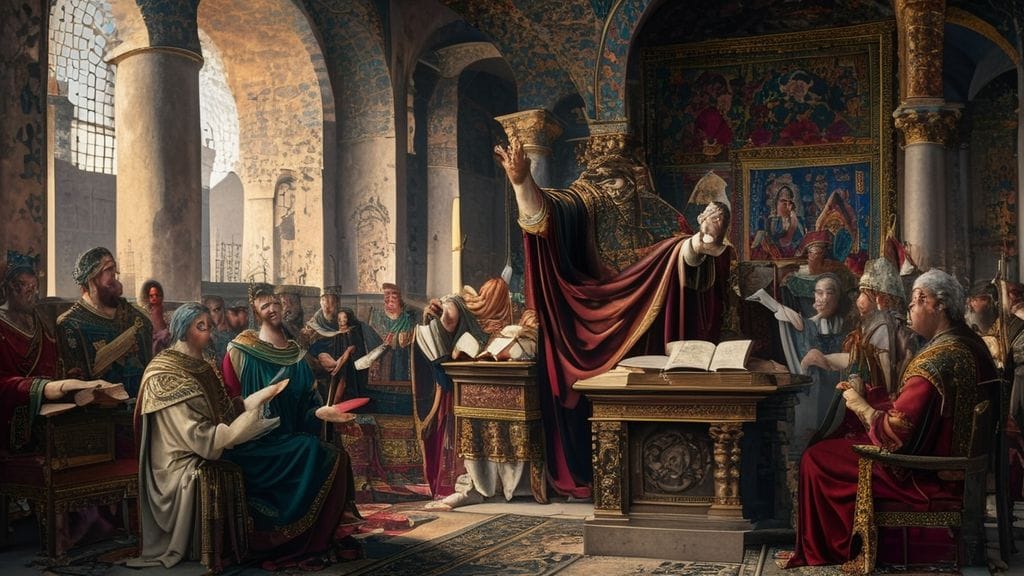
In the imperial chamber where the commission was first assembled, one can picture Tribonian and his colleagues listening as the decree was read aloud. Some may have felt exhilaration; others, anxiety. But there was no mistaking the emperor’s intent. This was not an advisory group. It was an instrument of policy, the spearhead of a new legal order that would soon press into every corner of the empire.
Tribonian: The Relentless Architect of Roman Law
Among the names associated with Justinian’s reforms, one stands out with particular brightness and controversy: Tribonian. Born in Pamphylia, in Asia Minor, he rose from provincial obscurity to become quaestor sacri palatii, the empire’s chief legal official, and effectively Justinian’s minister of justice. During the life of the codex justinianus commission 528, and beyond, he functioned as both designer and overseer of the emperor’s legal projects.
Contemporary accounts depict him in sharply diverging colors. Procopius, the brilliant but embittered historian, denounced Tribonian in his Secret History as venal, corrupt, a man who would twist or sell justice for personal gain. Others, less hostile, acknowledged his prodigious energy, breadth of learning, and crucial role in turning Justinian’s hazy ambitions into concrete, usable texts. Modern scholars tend to see him as a complex figure—flawed yet indispensable.
Tribonian’s intellectual world was steeped in law. He had studied in the empire’s best schools, absorbing not only the technical intricacies of Roman jurisprudence but also the rhetorical skills needed to persuade an emperor and navigate the court. He understood that Justinian’s desire for a grand codification, while sincere, required massive organizational effort: gathering manuscripts from across the empire, coordinating teams of jurists and scribes, imposing uniform principles on a mass of conflicting material.
His working style, as far as we can infer, was methodical but flexible. He recruited collaborators from prominent law professors—such as Theophilus of Constantinople and Dorotheus of Beirut—and drew on the bureaucratic apparatus to locate and transmit copies of imperial constitutions. He drafted prefaces in Justinian’s name that set the ideological tone of the reforms, blending piety, Roman pride, and imperial authority into a single voice.
Later, when the codex justinianus commission 528 gave way to even more ambitious projects—the Digest, the Institutes, and a revised Codex—Tribonian remained at the center, orchestrating overlapping teams, smoothing conflicts, and ensuring that the emperor’s deadlines, however unrealistic, were met in outward appearance. He was, in a sense, the project manager of one of the largest legal enterprises in ancient history.
Yet behind his public role lay a human being under relentless pressure. The Nika riots of 532, in which mobs demanded his removal, must have shaken him deeply. Imperial wrath, if aroused, could be fatal. Every decision to include or exclude a legal text carried political as well as scholarly implications. Tribonian’s story reminds us that the codex justinianus commission 528 was not merely an institutional fact, but a network of individuals navigating ambition, fear, principle, and compromise.
Inside the Scriptorium: How the Codex Was Built
What did the actual work of the codex justinianus commission 528 look like, day to day? We can glimpse it only faintly through later references, but the outlines are clear enough to reconstruct a vivid scene.
Imagine a large hall somewhere within the palace precincts or adjacent administrative buildings, its walls lined with shelves bearing scrolls and codices wrapped in leather. Tables are set up beneath oil lamps and narrow windows. Around them sit scribes, pens in hand, sand and pumice at the ready to dry and smooth the ink. On other tables lie piles of older laws—imperial constitutions from Diocletian, Constantine, Theodosius, and lesser-known rulers, some copied decades earlier in distant provinces and now brought to Constantinople for inspection.
At the center of this bustle stand the jurists of the commission, conferring in low voices over disputed passages. They decide, for example, whether a law issued by one emperor but silently ignored by his successors should be treated as abrogated. They note where two constitutions on the same topic contradict one another and determine which better fits Justinian’s policies. Sometimes they paraphrase or abridge, condensing lengthy rescripts into tighter formulations. At other times, they change wording—an act that to a modern legal historian is startling, yet fully authorized by the emperor.
The material is arranged thematically. Laws concerning ecclesiastical matters are grouped together, those on criminal offenses into another set of titles, those regulating property, contracts, marriage, and inheritance into others. This topical organization reflects both the needs of practitioners—who must quickly find relevant law—and the intellectual systematizing impulse of Roman jurisprudence. The resulting work, the Codex Justinianeus, would contain twelve books, each divided into titles and individual constitutions.
The process was painstaking but surprisingly swift. The first edition of the Codex was completed and promulgated by April 529—barely more than a year after the initial commission was established. This speed suggests intense labor by the team and also a willingness to rely on earlier compilations, like the Gregorian and Hermogenian Codes and, above all, the Theodosian Code, as starting points to be corrected and supplemented.
Behind every neat heading in the final codex lay countless small decisions: which words to keep, which to cut, which earlier laws to treat as still valid, which to consign to oblivion. It was here, in this daily labor of selection and editing, that the codex justinianus commission 528 quietly reshaped the Roman legal heritage—preserving some strands, erasing others, and giving later generations a curated, imperial version of their own juridical past.
Silencing the Past: Repeals, Omissions, and Imperial Power
One of the most dramatic aspects of Justinian’s project, and one that reveals much about imperial authority, was the decision to give exclusive force to the new code. When the Codex Justinianeus was promulgated, the emperor declared that it, and it alone, would be the authoritative collection of imperial constitutions. All earlier codes—including the venerable Theodosian Code—were henceforth legally obsolete.
This had profound consequences. A lawyer could no longer cite an old constitution from an earlier compilation if it did not appear in the new codex. A judge, confronted with a claim based on a forgotten edict, was bound to ignore it if Justinian’s code remained silent. The past did not vanish physically; manuscripts continued to exist in libraries. But legally, it was muted. Silence became a form of repeal.
The codex justinianus commission 528 thus performed an act of collective forgetting. Laws deemed unfit for present use—whether for theological, moral, practical, or political reasons—were excluded. Some may have been too favorable to groups the current regime wished to marginalize. Others conflicted with Justinian’s fiscal policy or ecclesiastical alliances. Still others simply reflected an older social order now out of step with Christian imperial ideology.
Not all omissions were nefarious. Many served the legitimate goal of simplifying a bloated legal corpus. But the power to decide was concentrated in very few hands. Tribonian and his colleagues effectively wielded an eraser over centuries of written authority. In later ages, when scholars tried to reconstruct earlier phases of Roman law, they often had to work backward through the Codex, guessing at what had been removed.
One famous example, often discussed in legal history, concerns regulations on religious practice. Laws favoring pagan cults or granting toleration beyond what Christian emperors later accepted were, unsurprisingly, expunged. Instead, the Codex foregrounded constitutions that reinforced the centrality of the Christian church and persecuted heresy. The resulting picture suggested a more linear, inevitable Christianization of law than the messy historical reality truly contained.
As the historian Tony Honoré has observed, the Justinianic compilations present Roman law through what might be called an “imperial lens.” Choices about inclusion, arrangement, and wording shaped not only legal practice in the sixth century but also how later ages would perceive the Roman legal tradition itself. The codex justinianus commission 528 thus exercised a dual power: it regulated the present, and it edited the past.
Law in the Streets: How Ordinary People Met the New Code
For all its learned prefaces and intricate structure, a legal code lives or dies in the everyday encounters between subjects and officials. How did the Codex Justinianeus, born from the deliberations of the codex justinianus commission 528, actually touch the lives of ordinary people?
Consider a hypothetical case drawn from the realities of the time. In a small town in Asia Minor, a widow named Maria disputes with her late husband’s brother over a vineyard. Under older, local customs, the male agnates might have claimed a large share. But in the new code, influenced by prior Christian emperors and classical juristic reforms, rules on inheritance and dowry allow Maria to assert stronger rights to property she brought into the marriage and to a share in the estate. Her advocate, if he has access to the Codex and sufficient training, cites the relevant constitutions from Book 5, navigating their Latin headings and carefully copied Greek translations.
The provincial judge, perhaps educated in Beirut, consults his copy of the Codex, checking the titles on dowry, succession, and guardianship. The decision he renders, even if imperfectly reasoned, now rests on a text directly sanctioned by the emperor, not on a local compilation or uncertain recollection of older laws. Maria’s fate, and that of her vineyard, is intertwined with the work done years earlier in the bustling scriptorium of Constantinople.
In the capital itself, merchants watching the harbor might see other effects. Regulations in the Codex concerning contracts, interest rates, and maritime trade articulate clearer expectations and penalties. Lenders and borrowers, shipowners and insurers, find their dealings increasingly framed by written rules that can be cited and, in theory, enforced in court. Disputes over unpaid debts or damaged cargo no longer rely solely on personal connections; they invoke specific constitutions that bind even well-connected officials—at least in principle.
Of course, there were limits. Many subjects of the empire never saw a physical copy of the Codex, much less read it. Illiteracy was common; legal Latin, even more impenetrable. Knowledge of the law filtered downward through a chain of governors, judges, advocates, notaries, and clergy. In remote villages of Egypt or on the fringes of the Balkans, custom still overlapped and sometimes clashed with written law. Enforcement remained uneven, dependent on the integrity—or venality—of local officials.
Yet over time, the existence of a single, authoritative code changed expectations. Petitioners began to refer to written law more confidently. Bishops, who often acted as mediators in disputes, could appeal to imperial norms as well as scriptural ones. Even those who never heard the name “Codex Justinianeus” might feel its impact in decisions about marriage, taxation, civic duties, or punishment.
Law thus moved, unevenly but steadily, from the palace to the streets. And as it did, the work of the codex justinianus commission 528 ceased to be a courtly project and became part of the everyday choreography of imperial life.
The Codex and the Church: Law under the Sign of the Cross
By Justinian’s time, the Roman Empire was not merely a political entity; it was a Christian commonwealth. The emperor saw himself as basileus kai hiereus, a king and quasi-priest, responsible for defending orthodoxy and disciplining heresy. The Codex Justinianeus, shaped by the labors of the codex justinianus commission 528, reflects this intertwining of secular and sacred concerns.
Entire sections of the Codex are devoted to church matters: the status and privileges of the clergy, the administration of church property, the suppression of heretical groups, the regulation of monastic communities. Bishops are granted judicial functions in certain types of disputes. Ecclesiastical asylum—the right of a fugitive to seek sanctuary in a church—is discussed and bounded by law. The line between civil and canon law blurs.
Justinian’s laws strengthened the position of the church as a landholder and moral authority, yet also bound it tightly to imperial control. Bishops needed imperial confirmation; church councils required imperial sanction. Heresies were defined and punished not only by ecclesiastical pronouncements but also by civil penalties. The law served to inscribe theological victories into the daily fabric of the empire.
This alliance was not without tension. Miaphysite communities in Egypt and Syria, for example, often saw imperial law as an instrument of Chalcedonian oppression. Laws targeting their clergy and property deepened alienation, contributing to long-term estrangement that would later play a role in the region’s willingness to accept new rulers. Here, the Codex—so triumphant in its aspiration to unity—revealed a darker side: law as a tool for enforcing doctrinal conformity at the expense of local identities.
Yet behind the macro-politics lay quieter realities. Churchmen often used the law to protect orphans, widows, and the poor. Endowments for hospitals and xenodochia (guesthouses for strangers) were structured within the legal framework the Codex helped solidify. Monastic communities negotiated their property rights, internal discipline, and relations with wider society using norms that now had clearer imperial backing.
Thus, the Codex was a bridge: between altar and throne, between devotional ideals and worldly constraints. It turned theological controversies into rules with legal teeth, anchoring Justinian’s vision of a Christian Roman order in parchment and ink.
Crisis and Confidence: Nika, Fire, and Reconstruction
Even as the Codex was taking shape and entering into force, Constantinople was shaken by one of the most violent urban uprisings in its history. In January 532, factions of the Hippodrome—the Blues and the Greens—united in fury against the emperor. What began as outrage over executions and grievances against officials like Tribonian escalated into the Nika riots, a week-long convulsion that left much of the city in ashes.
The rioters shouted “Nika!”—“Conquer!”—as they torched churches, mansions, and public buildings. Procopius reports that the old church of Hagia Sophia was consumed by flames, its wooden roof collapsing amid roars of the crowd. The palace itself was threatened. In a dramatic episode, Theodora is said to have stiffened Justinian’s resolve with the words, “Purple makes a fine shroud,” persuading him to fight rather than flee.
Imperial troops, led by Belisarius and Mundus, eventually trapped the rebels in the Hippodrome and slaughtered them. Contemporary estimates speak of tens of thousands killed. The uprising was crushed, but its memory lingered as a sign of how fragile imperial authority could be if popular anger and elite discontent converged.
What did this have to do with the codex justinianus commission 528 and its newborn Codex? In a direct sense, little; the code was already in force. But the Nika crisis formed the emotional and political backdrop for Justinian’s subsequent legal and building programs. In the face of such chaos, law appeared both as a consolation and a weapon: a means to restore order, punish rebels, regulate rebuilding, and reassert the legitimacy of imperial rule.
The reconstruction of the city—most spectacularly the rapid erection of the new Hagia Sophia—was accompanied by a continuing stream of new constitutions. Some laws dealt with urban regulation, property expropriation for public works, and the rights of those displaced by rebuilding. Others sought to reform the administration, reduce corruption, or tighten control over the circus factions. These post-Nika laws would eventually require their own integration into the legal system, leading to the realization that the first Codex, promulgated in 529, already needed revision.
Thus, crisis fed codification. Justinian’s confidence in law as an instrument of renewal did not waver in the face of flames and bloodshed. If anything, the Nika trauma reinforced his belief that only a strong, unified legal order—emanating from the emperor and enforced in every corner of the realm—could contain the passions and conflicts that threatened imperial unity.
From First Codex to Corpus Juris Civilis
The story of the codex justinianus commission 528 does not end with the promulgation of the first Codex in 529. That achievement, impressive as it was, proved to be only the opening phase of a larger juridical project that would culminate in what later scholars called the Corpus Juris Civilis—the “Body of Civil Law.”
Even as the Codex came into force, Justinian and Tribonian turned their attention to the vast body of juristic writings that still guided legal reasoning. In 530, a new commission, again headed by Tribonian, was tasked with compiling a Digest (or Pandects)—an anthology of authoritative excerpts from the classical jurists. This undertaking dwarfed even the codex justinianus commission 528 in scope. The team had to read, select, and sometimes reconcile passages from dozens of juristic works, many of which survived only in partial, sometimes corrupt copies.
The result, completed astonishingly by 533, was a sprawling collection of fifty books, arranged by subject. The Digest became, alongside the Codex, a primary source of law for judges and advocates, giving them not only rules but also the reasoning and interpretive methods of the great jurists. Justinian declared that juristic writings not included in the Digest were no longer to be cited as authoritative—a further narrowing and crystallization of the legal tradition.
To guide students, meanwhile, Justinian ordered the creation of the Institutes, a concise textbook modeled in part on the earlier work of Gaius but updated in content and suffused with imperial prefaces. Issued in 533, the Institutes were granted legal force as well, serving both as an introduction and as binding law in their own right.
All these developments rendered the 529 Codex out of date. New constitutions had been issued; the integration of Digest and Institutes required adjustments. Consequently, in 534 a revised Codex—sometimes called the Codex repetitae praelectionis—was promulgated, replacing the earlier version. It is this later Codex that largely survives and that historians refer to when they speak of the Codex Justinianus.
In the end, the Corpus Juris Civilis comprised four parts: the revised Codex, the Digest, the Institutes, and the later Novels (new laws issued by Justinian after 534). The codex justinianus commission 528 had been the spark that lit this long chain of codifying fire, demonstrating that such audacious projects were possible and establishing the basic principles: selective inclusion, imperial authorization, and the silencing of competing sources.
Centuries later, medieval scholars would bundle these components together under the label “Corpus Juris Civilis,” unaware of the precise stages and commissions that had produced them. For them, and for much of legal history, Justinian’s work appeared as a single, monumental edifice. Yet at its foundation still lay that February day in 528, when the emperor first called his jurists to task.
Echoes in the West: The Codex Rediscovered in Medieval Europe
After Justinian’s death in 565, the empire he had labored to strengthen entered a period of contraction and transformation. Plague, war, and fiscal strain eroded its resources. The reconquered Western provinces proved difficult to hold and were gradually lost. In the Latin West, political fragmentation under Germanic kingdoms diminished direct connections with Constantinople.
Yet the legal works born from the codex justinianus commission 528 did not vanish. In the Byzantine East, they remained in use, sometimes abridged or supplemented by local collections. Greek translations proliferated, allowing Greek-speaking judges and scholars to apply Justinianic law long after Latin had faded as a spoken language. The Codex, Digest, and Institutes became the backbone of Byzantine civil law, even as new practical handbooks—like the Ecloga in the eighth century—modified their provisions to suit changing realities.
In the West, the story was more complex. Germanic laws, such as the Lex Salica and Visigothic codes, governed many regions, often side by side with remnants of Roman law applied to Romanized populations. Some Justinianic texts survived in monastic libraries, copied and recopied as part of the scholarly inheritance of antiquity. But their direct influence on daily legal practice was limited.
Then, around the late eleventh and early twelfth centuries, a remarkable revival occurred. In the Italian city of Bologna, scholars such as Irnerius “rediscovered” Justinian’s compilations, especially the Digest, and began to study them systematically. Whether these manuscripts had lain unnoticed or had been newly imported from the East remains debated, but their impact is beyond doubt. The texts that the codex justinianus commission 528 had helped to shape now became the foundation of a new science of law in medieval Europe.
Teachers in Bologna and other emerging universities treated the Corpus Juris Civilis as an almost sacred authority, second only to scripture. They wrote glosses in the margins, developed sophisticated interpretive methods, and sought to harmonize ancient Roman law with contemporary feudal and canon law. Their work, in turn, trained generations of jurists who staffed the courts and chanceries of princes, bishops, and cities.
As Harold Berman famously argued, this “legal renaissance” was a key moment in the formation of the Western legal tradition. The codex justinianus commission 528, which had once seemed a project limited to a distant emperor and his bureaucracy, now cast long shadows across Europe’s courts and classrooms. Roman law, filtered through Justinian and medieval glossators, shaped contracts, property rights, procedural norms, and even the conceptual vocabulary of rights and obligations.
Shaping Civil Law Traditions across Continents
From the medieval revival radiated a series of transformations that would eventually extend Justinian’s legal legacy far beyond its original boundaries. The learned law of Roman origin intermixed with local customs and royal ordinances, contributing to what came to be known as the ius commune—a shared legal culture across much of continental Europe.
In France, the reception of Roman law varied by region. The southern “pays de droit écrit” (lands of written law) accepted Roman norms more readily, while the northern regions adhered more strongly to customary law. Yet over time, especially in the early modern period, Roman law principles filtered through royal edicts, judicial decisions, and doctrinal writings. The eighteenth-century codifiers who drafted the Napoleonic Code, promulgated in 1804, drew heavily—though not uncritically—on Roman concepts of property, contract, family, and obligations preserved in Justinian’s Corpus.
The Napoleonic Code, in turn, became a template exported or imitated far beyond France: in Italy, Spain, Latin America, parts of the Middle East, and even areas of Africa and Asia under French influence. Thus, through a chain of adaptations, many modern civil law systems carry within them the DNA of the codex justinianus commission 528. The structure of codes, the division into books and titles, the emphasis on general principles and systematic arrangement—these all echo the work begun in Constantinople.
In Germany, a different path unfolded. There, Roman law was received more explicitly and intensively, especially from the fifteenth century onward, shaping court practice as “subsidiary” or “common” law alongside territorial statutes. The monumental German Civil Code (Bürgerliches Gesetzbuch) of 1900 synthesized Roman concepts with Germanic traditions and modern doctrinal elaborations. Its abstract style and conceptual rigor bear clear marks of centuries of engagement with Justinianic texts.
Even in countries that followed common law traditions, like England, echoes of Roman law entered through canon law, equity, and comparative scholarship. The idea of codification itself, articulated in projects from the French Revolution to modern civil codes worldwide, owes something to the model first realized, however imperfectly, by the codex justinianus commission 528.
Today, when a judge in Mexico or Quebec, in Italy or South Korea, applies provisions about contracts or unjust enrichment, the underlying concepts and categories often trace back, through layers of reception and reform, to Justinian’s codifiers. The words on their statute books may be modern, but the skeleton is old. It is an uncanny continuity: a commission convened under the flicker of oil lamps in a Byzantine palace still shapes the reasoning of courts lit by fluorescent tubes and computer screens.
Human Stories behind the Clauses and Titles
Legal history can easily become an abstract parade of codes and concepts. Yet each clause in the Codex Justinianeus, each title on theft, marriage, or guardianship, pointed toward real human lives. Behind the work of the codex justinianus commission 528 lay uncounted stories of suffering, hope, conflict, and compromise.
Take, for example, laws on manumission—the freeing of slaves. The Codex gathered and clarified earlier rules on how a slave could become a freedperson: through formal procedures before a magistrate, by declaration in a will, by being inscribed in the church’s records. These provisions mattered to individuals whose entire existence hung on the possibility of legal recognition as free. A slave woman who had borne her master’s children might cling to these rules as a lifeline, hoping that baptism, patronal favor, or a carefully drafted testament would alter her destiny and that of her offspring.
Or consider the regulations on dowry and marital property. In one city, a young bride’s family might stretch their resources to assemble a modest dowry of land, jewelry, and coin. The Codex stipulated what protections she had if her husband squandered the assets, abused her, or died leaving debts. When widows appeared before a judge to claim what was theirs, the words crafted and arranged by the codex justinianus commission 528 stood between them and destitution—or disappointment.
Criminal law provisions, too, carried human weight. Penalties for theft, assault, and murder were specified with greater precision, balancing deterrence with pragmatic recognition of local conditions. A father grieving a murdered son might watch as the judge cited a constitution from Justinian’s book, imposing penalties shaped by both classical precedent and Christian moralization. The abstract language of “homicide” and “corporal injuries” translated directly into the fate of the accused standing in chains.
Even economic regulations had personal effects. Rules on interest rates, for example, could determine whether a peasant family lost its small plot to ruinous debts or managed to keep it. Laws governing guilds and corporate bodies impacted artisans whose identity and subsistence depended on belonging to a recognized association. When the Codex defined which corporations could sue, be sued, or own property, it helped decide which communities flourished and which faded.
In all this, we see law not as a distant, bloodless system but as a dense web threaded through daily life. The codex justinianus commission 528 did not know the names of those whose fates they were shaping. Yet every time they chose one wording over another, included or excluded a constitution, tightened or loosened a rule, they tugged on strings attached to real hearts and bodies throughout the empire.
Debates, Dissent, and the Darker Side of Justinianic Law
No great legal monument is without its critics, and Justinian’s codification is no exception. Even in his own day, voices of dissent murmured beneath the waves of official praise. Procopius, in his Secret History, accuses Tribonian of selling justice, altering laws for money, and sowing confusion for personal gain. While modern scholars approach such charges cautiously, aware of Procopius’s rhetorical exaggeration, they do remind us that the codex justinianus commission 528 operated in a political environment rife with corruption and factional struggle.
There were also substantive concerns. By concentrating authority in a single code sanctioned by the emperor, local customs and regional variations were marginalized. In some regions, older, flexible practices that had suited local conditions were gradually displaced by rigid, sometimes ill-fitting rules emanating from Constantinople. This legal centralization paralleled and reinforced broader trends of bureaucratic control and fiscal extraction that many subjects experienced as oppressive.
Furthermore, while some Justinianic laws moved in a humane direction—strengthening protections for certain vulnerable groups—others entrenched and intensified social hierarchies. Harsh penalties for heresy, for example, endowed religious persecution with legal form. Laws discriminating against Jews and Samaritans curtailed their civic rights, restricted religious expression, and in some cases sanctioned violence or expropriation. The Codex did not invent such policies, but by incorporating and organizing relevant constitutions, it gave them a more solid and integrated foundation.
Women’s legal status, though improved in certain respects (particularly regarding property and inheritance), remained constrained by patriarchal assumptions. Guardianship over women, limitations on their procedural capacity, and asymmetrical rules on adultery and sexual conduct reveal a deeply gendered legal system. The Codex thus bears witness both to incremental advances and to persistent inequalities.
Modern legal historians debate how far Justinian’s reforms truly rationalized the law as opposed to creating new complexities. Some, like Fritz Schulz, have emphasized the systematizing genius of the project, while others point to contradictions and practical difficulties in applying the massive Corpus. Yet few would deny the scale of the achievement—or the ambivalence of its legacy.
Law can both protect and oppress, liberate and confine. The codex justinianus commission 528, acting under an emperor who saw himself as God’s chosen ruler, produced a body of law that mirrored these tensions. Its pages contain seeds of later notions of legal order and rights, but also instruments of control and exclusion that still challenge our admiration.
Remembering 528: How Historians Reconstruct the Commission
Today, when historians speak of the codex justinianus commission 528, they are piecing together a puzzle from scattered clues. We possess the texts of the Codex (in its revised form), the Digest, the Institutes, and many of Justinian’s later constitutions. We have prefaces where the emperor—likely with Tribonian’s pen—describes the motives and methods of the codification. We have external testimonies from chroniclers and jurists. But the day-to-day workings of the commission, the conversations in its chambers, the drafts and discarded versions—these are lost.
Scholars use a variety of techniques to bridge this gap. Textual criticism compares parallel passages, looking for signs of editing, truncation, or harmonization. Differences between the Codex and earlier compilations, like the Theodosian Code, reveal choices of inclusion and exclusion. Linguistic analysis traces shifts from classical formulations to late antique or Christianized language. Legal historians also examine how certain topics—such as slavery, religious law, or municipal administration—are treated across the Codex’s books, inferring the commission’s priorities and constraints.
Fragments of contemporary correspondence, references in later Byzantine legal manuals, and archaeological finds of legal manuscripts help flesh out the picture. For example, papyri from Egypt sometimes preserve local applications or summaries of Justinianic law, shedding light on how the Codex filtered into provincial practice. Comparative studies of different manuscript families across centuries illuminate how the text was transmitted, sometimes altered, and revered.
Historians also situate the codex justinianus commission 528 within broader cultural currents: the Christianization of the empire, the bureaucratization of governance, the intellectual life of late antique law schools, and the rhetorical conventions of imperial self-presentation. In doing so, they move beyond a purely technical account of codification to a richer understanding of law as a social and cultural phenomenon.
One could say that we are, in a sense, running the process in reverse. Where Tribonian and his colleagues took a sprawling mass of texts and compressed them into a tighter, more authoritative corpus, modern scholars take that corpus and expand it outward, trying to recover the multiplicity it once suppressed. The result is a more nuanced appreciation of 528 as a turning point—not a sudden rupture, but a concentrated moment in a long, complex evolution.
Conclusion
On that cold February day in 528, when a handful of men stood before Justinian in the palace at Constantinople, none of them could have foreseen the full reach of their work. They knew they were engaged in something important: a reordering of the empire’s laws, a bid for clarity and authority in a world of overlapping texts and local variations. They could sense the emperor’s fervor, his desire to appear as a Christian lawgiver in the mold of Moses or Solomon. Yet the codex justinianus commission 528 was, for them, primarily a demanding administrative and intellectual task, circumscribed in time and scope.
From our vantage point, the horizon is wider. We see how the Codex they produced, revised in 534 and integrated with the Digest, Institutes, and Novels, became the heart of the Corpus Juris Civilis—a body of law that outlived Justinian’s empire, slumbered through the early medieval centuries, and then awakened to shape universities, courts, and codes across Europe and beyond. We see how their choices of inclusion and exclusion not only governed the sixth century but also framed how later generations understood the Roman legal tradition.
The story is not one of pure progress. The Codex brought greater order, but also consolidated imperial power and sometimes sharpened instruments of repression. It improved protections in some domains while entrenching inequities in others. It was an achievement of human intellect, but also a monument to human ambition, with all its light and shadow.
Yet behind the abstractions, one image persists: a scribe in the dim light of a Constantinopolitan scriptorium, copying a constitution that will help a distant widow secure her inheritance, or a jurist dusting off a crumbling scroll to decide whether its contents deserve survival. The codex justinianus commission 528 reminds us that law is made not only by emperors and parliaments, but by countless hands and minds that labor in relative obscurity, arranging words that will one day make and unmake destinies.
In that sense, the commission’s legacy is not only in the courtroom or the statute book, but in the very idea that human societies can gather their norms, debate them, refine them, and inscribe them into durable forms. Every modern effort at codification, every debate over the meaning of a legal text, carries a distant echo from Justinian’s palace, where winter winds rattled the windows and a new legal world was quietly set in motion.
FAQs
- What was the codex justinianus commission 528?
The codex justinianus commission 528 was a special body of jurists and high officials appointed by Emperor Justinian I on 13 February 528 in Constantinople. Its primary task was to collect, organize, and revise centuries of Roman imperial constitutions into a single, coherent law code—the Codex Justinianeus. The commission had authority not only to copy but also to omit, alter, and harmonize older laws, giving the resulting code exclusive legal force across the empire. - Why did Justinian decide to create a new legal code?
By Justinian’s time, Roman law consisted of a chaotic mixture of imperial edicts, older codes, and juristic writings, often contradictory and difficult to use. This confusion undermined legal certainty and imperial authority. Justinian sought to restore order, strengthen central control, and present himself as a Christian lawgiver. A new codification allowed him to purge obsolete laws, align legal rules with Christian values, and bind judges and officials to a single, official text. - Who was Tribonian and what role did he play?
Tribonian was a prominent jurist and imperial official from Pamphylia who served as Justinian’s quaestor sacri palatii, effectively the empire’s chief legal officer. He headed the codex justinianus commission 528 and later directed the teams that produced the Digest and Institutes. Tribonian coordinated the gathering of sources, supervised editing and organization, and drafted prefaces in the emperor’s name. Though criticized by some contemporaries, his leadership was crucial to the success of Justinian’s codification projects. - How did the Codex Justinianeus relate to the later Corpus Juris Civilis?
The Codex Justinianeus, first issued in 529 and revised in 534, was one component of a larger legal project that modern scholars call the Corpus Juris Civilis. Alongside the Codex stood the Digest (a compilation of classical juristic writings), the Institutes (a student textbook with legal force), and the Novels (later laws of Justinian). Together, these texts formed a comprehensive body of Roman civil law that influenced legal practice in the Byzantine Empire and later became foundational for continental European legal systems. - Did the Codex Justinianeus improve everyday life in the empire?
Its impact was mixed. The Codex brought greater clarity and uniformity to many areas—such as property, contracts, family law, and criminal justice—making it easier for trained judges and advocates to apply consistent rules. This could benefit ordinary people, especially in disputes over inheritance, dowry, and debt. However, the code also strengthened imperial control, sometimes at the expense of local customs, and gave legal backing to religious persecution and certain social hierarchies. Its effect varied by region, social status, and the integrity of local officials. - How did Justinian’s legal reforms influence modern law?
Through their reception in medieval Europe, especially at the University of Bologna, Justinian’s codifications became central to the development of the civil law tradition. Concepts, structures, and categories from the Codex and Digest informed early modern legal thought and major codifications like the Napoleonic Code and the German Civil Code. Today, many civil law systems around the world—particularly in Europe and Latin America—still reflect principles and organizational patterns that trace back, through centuries of adaptation, to Justinian’s work.
External Resource
Internal Link
Other Resources
- Encyclopaedia Britannica – general search for the exact subject
- Google Scholar – academic search for the exact subject
- Internet Archive – digital library search for the exact subject

