Table of Contents
- A September Day in Rome: When the City Waited for a New Pope
- The World Before Lucius: Europe on the Edge of Upheaval
- From Ubaldo of Lucca to Lucius III: The Long Road to the Papal Throne
- Inside the Conclave: How Lucius III Becomes Pope in 1181
- The Ceremony in Rome: Ritual, Symbols, and Silent Anxieties
- A Pope Between Empires and Cities: Lucius III and the German Question
- Rome in Turmoil: Commune, Nobles, and a Homeless Papacy
- The Shadow of Heresy: Waldensians, Cathars, and the Fear of a Fractured Christendom
- Lucius III and Frederick Barbarossa: An Uneasy Dance of Power
- The Decretal “Ad abolendam”: Law, Faith, and the Birth of a Repressive Apparatus
- Life Around the Throne: Cardinals, Courtiers, and Ordinary Believers
- Beyond Rome: Lucius III and the Italian Cities in Revolt
- Across the Mediterranean: Crusader States, Islam, and the Distant Holy Land
- An Aging Pontiff: Piety, Personality, and Daily Life of Lucius III
- Verona Instead of Rome: Exile, Councils, and a Fading Hope
- Death, Memory, and the Quiet Passing of a Pope
- Long Shadows: How Lucius III Shaped the Medieval Church
- Conclusion
- FAQs
- External Resource
- Internal Link
Article Summary: On 27 September 1181, in a Rome torn between papal authority and communal rebellion, lucius iii becomes pope and steps into a role already overshadowed by empire, heresy, and urban revolt. This article follows the story of Ubaldo of Lucca, the elderly cardinal who, almost reluctantly, assumes the tiara and becomes Lucius III in a moment of fragile balance between Church and secular powers. From the world he inherited—marked by the legacy of Alexander III and the might of Emperor Frederick Barbarossa—to his struggles against the Roman commune, Italian city leagues, and emerging heretical movements, lucius iii becomes pope not as a triumphant monarch, but as a besieged shepherd. We trace his fraught alliance with Barbarossa, his exile from Rome, and the decisive decretal “Ad abolendam,” which would shape the Church’s legal weaponry against dissent. Along the way, we witness the daily lives of courtiers, cardinals, and ordinary believers whose fates were quietly altered when lucius iii becomes pope. The article also explores the broader geopolitical landscape, from the Italian plains to the embattled Crusader states, and the complex religious anxieties of the age. In the end, lucius iii becomes pope emerges not as a glorious conqueror but as a transitional figure, whose cautious governance nonetheless laid foundations for a more centralized, disciplined medieval Church. His story is one of aging determination, constrained power, and the persistent hope that law and faith might hold Christendom together.
A September Day in Rome: When the City Waited for a New Pope
On the morning of 27 September 1181, Rome awoke to the muffled tolling of bells and the low murmur of expectation. The city was never truly quiet—vendors shouted in the markets, donkeys clattered along stone streets, and pilgrims wandered the narrow alleys in search of shrines—but on this day, there was a different texture in the air. The great Pope Alexander III was dead. The cardinals were meeting. And by evening, if all unfolded according to the slow, mysterious rhythm of ecclesiastical procedure, the world might know the name of a new pontiff. Somewhere within the intricate tangle of cloisters and halls attached to the Lateran and other Roman churches, a small group of elderly men argued, prayed, calculated. Among them was Ubaldo Allucingoli, Cardinal-Bishop of Ostia, a man born in Lucca, already advanced in years, his hair thin, his body worn down by decades of service. No one in the crowded streets could yet know that on this day lucius iii becomes pope, but rumors ran faster than decisions. Names passed from mouth to mouth, distorted with each retelling. Would the next pope continue Alexander’s defiance against the German emperor Frederick Barbarossa? Would he reconcile with the Roman commune that had long tried to curb papal power in its own city?
Rome itself carried the scars of this struggle. The ruins of the ancient empire jutted from the earth like fossilized bones, repurposed for houses, churches, fortifications. Around them surged a society that did not quite know whether it belonged to the past or the future. Learned clerics pored over canon law in dim scriptoria; merchants counted coins minted in cities far to the north; mercenaries—Lombard, Norman, German—drank in smoky taverns and boasted about battles fought for pope or emperor. When lucius iii becomes pope later that day, he will inherit not a unified Christendom, but a quarrelsome world in which loyalty was negotiable and authority always contested.
Inside the papal precincts, the mood was more subdued. The cardinals carried the memory of Alexander III’s long conflict with Barbarossa like an old wound. They had seen schisms split the Church, antipopes raised and deposed, treaties signed and broken. They knew that the man they chose now would have to navigate the aftershocks of those events—particularly the Peace of Venice in 1177, which had seemingly reconciled pope and emperor but left deep mistrust on both sides. The cardinals might have preferred a younger man, a vigorous leader, but political realities and human calculations led their gaze again and again to Ubaldo of Lucca. A respected canonist, a cautious diplomat, a servant of several popes, he seemed a safe pair of hands. The city waited, half indifferent and half enthralled by the spectacle of power. Rome had seen countless popes crowned and buried, emperors acclaimed and humiliated. It would see many more. Yet for the people who lived this day—merchants counting the day’s earnings, pilgrims kneeling in dusty chapels, cardinals in whispered debate—the moment was charged with uncertainty. The choice of a single man could tilt the balance of all their lives.
The World Before Lucius: Europe on the Edge of Upheaval
To understand what it meant that lucius iii becomes pope in 1181, we have to step back and widen the canvas. Europe, in the late twelfth century, was a patchwork of kingdoms, counties, and city-states bound together less by any clear political structure than by a common religious imagination. Yet even that shared faith was beginning to strain under competing claims to authority, new spiritual movements, and the growing self-assertion of secular rulers.
At the center of the political storm towered Emperor Frederick I Barbarossa, ruler of the Holy Roman Empire. Since his election in 1152, Barbarossa had sought to impose a more direct imperial control over the Italian cities and to preserve the emperor’s traditional role as protector—and sometimes dominator—of the Church. His repeated campaigns south of the Alps had laid waste to fields, besieged proud cities like Milan, and provoked intense resistance among the communes of northern Italy. The League of Lombard cities—Milan, Cremona, Brescia, and others—had formed a rare alliance, ultimately confronting Barbarossa at the Battle of Legnano in 1176, where imperial might was checked by communal defiance. This clash, followed by the Peace of Venice, defined the world that Lucius III would inherit: a world in which neither pope nor emperor could fully dominate the peninsula.
To the west, the Capetian kings of France slowly extended their control, overshadowing local counts and dukes. In England, Henry II cultivated legal reforms and administrative innovations that would echo down the centuries, even as his own realm was destabilized by conflicts with his sons and with Archbishop Thomas Becket—a conflict that had ended with Becket’s murder in 1170 and his rapid canonization, exemplifying the dangerous interplay of royal power and ecclesiastical authority. In the Iberian Peninsula, Christian kingdoms pressed southward against the remaining Muslim taifas, slowly pursuing the Reconquista. Beyond the sea, in the Levant, the Crusader states clung precariously to their strongholds, squeezed between the ambitions of local dynasties and the rising power of Muslim rulers such as Saladin, who in 1181 was still consolidating his dominance over Egypt and Syria.
This was an age of reform as well as conflict. For over a century, the Church had been reshaping itself: enforcing clerical celibacy, fighting lay investiture, centralizing papal authority, and developing a sophisticated body of canon law. University centers like Bologna were blossoming, where experts in Roman and canon law trained a new class of clerical jurists. The papacy, increasingly, ruled not simply by spiritual charisma but by written decrees and carefully argued legal decisions. When lucius iii becomes pope, he will rely heavily on this legal culture. Austerely trained in law, he will see the world through the lens of decrees, synods, and procedural norms—tools that seem dry on the surface but would profoundly shape the Church’s response to dissent.
Yet beneath the legal and political structures moved currents of religious unrest. New forms of lay piety, sometimes critical of wealthy and lax clergy, were taking shape. Groups like the Waldensians—followers of Peter Waldo of Lyon, who advocated apostolic poverty and preaching by laymen and women—appealed to the laity’s hunger for a more immediate, evangelical faith. In the south of France and northern Italy, dualist movements later grouped under the broad label “Cathars” questioned core doctrines and ecclesiastical authority. Many contemporaries regarded them not simply as mistaken believers but as existential threats to the unity of Christendom. It was into this world, bristling with both possibility and peril, that lucius iii becomes pope, an elderly canonist called to hold together a restless age.
From Ubaldo of Lucca to Lucius III: The Long Road to the Papal Throne
Before he was Lucius III, he was Ubaldo Allucingoli, a Tuscan from the city of Lucca. The exact year of his birth is uncertain—typical for the era—but most historians place it in the early years of the twelfth century, perhaps around 1100–1105. By the time of his election in 1181, he was almost certainly in his seventies or even early eighties, a venerable age in a century not generous with long life. His early formation, like that of many clerics destined for high office, likely took place in cathedral schools, where he absorbed the growing discipline of canon law and the spiritual ideals of Gregorian reform: clerical purity, papal primacy, freedom of the Church from lay control.
Ubaldo rose gradually through the Church’s ranks. By 1138 he is recorded as a cardinal-deacon under Pope Innocent II, a time marked by schism and civil conflict in Rome. Several years later, he became Cardinal-Priest of Santa Prassede, and by 1155 he was elevated again to the powerful position of Cardinal-Bishop of Ostia, the ancient port of Rome and a title traditionally associated with key roles in papal elections and coronations. His career was not the story of a fiery reformer or a dramatic preacher. Instead, it was one of patient service—participation in synods, embassies to princes, deliberations in curial councils. He traveled extensively in the papal entourage, witnessing diplomatic tensions between the Curia and emperors, kings, and rebellious cities.
Serving under multiple popes—Eugene III, Anastasius IV, Adrian IV, and Alexander III—Ubaldo became part of the institutional memory of the papacy. He had seen the only English pope, Adrian IV, struggle with the Roman commune, and he had observed Alexander III’s long struggle against Frederick Barbarossa and the antipopes supported by the imperial court. Through these experiences, he acquired a deep appreciation for the delicacy of Church–state relations. One can imagine him sitting in candlelit chambers, copying drafts of letters, reviewing articles of treaty proposals, or weighing the appointment of bishops in contested dioceses. It is no accident that when lucius iii becomes pope he will govern more as a cautious moderator than as a revolutionary leader.
His specific expertise lay in canon law, the intricate body of regulations that governed ecclesiastical life. This body of law had been codified in the mid-twelfth century by Gratian—whose Decretum became the foundation of medieval canon law study—and thereafter expanded by papal decrees and conciliar canons. Ubaldo’s familiarity with such material earned him respect among his peers. A later chronicler, reflecting on his career, would describe Lucius as “a lover of equity and discipline,” highlighting traits that were formed long before his election. In this sense, the moment when lucius iii becomes pope is the culmination of decades spent in the shadow of the throne—drafting, judging, mediating.
It is striking, too, that Ubaldo’s origins in Lucca placed him within the world of the Italian communes that so often clashed with both emperor and pope. Lucca was a thriving city with mercantile energy and a strong civic identity. Growing up in or near this environment, Ubaldo would have understood not only the aspirations of princely courts but also the stubborn autonomy of city councils, guilds, and families. When he later faced the Roman commune and the Lombard League, he did so not as an outsider to urban politics but as someone shaped by them. All of this—the canonical training, the long curial service, the Italian communal experience—formed the man who, in the autumn of 1181, would step forward as Lucius III.
Inside the Conclave: How Lucius III Becomes Pope in 1181
The process by which lucius iii becomes pope on 27 September 1181 was not yet the highly formalized conclave we might imagine from later centuries, with cardinals locked away under key in the Sistine Chapel. The rules for papal elections had been gradually refined since the decree In nomine Domini of 1059, which entrusted elections primarily to the cardinals, but the detailed regulations of the thirteenth century were still in the future. Nevertheless, the general outlines were similar: on the death of Alexander III, the College of Cardinals gathered in Rome to select his successor, weighing political pressures, personal reputations, and the urgent need to maintain continuity in a perilous time.
Alexander III’s death in August 1181 left a void. He was a towering figure, remembered for his steadfast resistance to Barbarossa and for presiding over the Third Lateran Council in 1179, which had addressed not only the schism but also broader ecclesiastical reforms. His passing triggered immediate questions: Would his policy toward the emperor continue? Would the delicate peace with the Lombard cities hold? Among the cardinals, factions naturally existed. Some favored a more conciliatory stance toward the emperor, others a firmer defense of papal prerogatives. Some prioritized relations with the Roman commune, others thought first of stability in the north.
Into this fraught atmosphere stepped Ubaldo of Lucca. His age, which might have counted against him in another context, here worked in his favor. An elderly pope could be seen as a transitional figure, unlikely to radically disrupt Alexander’s legacy but capable of guiding the Church through the immediate aftermath. His known moderation and legal expertise reassured those who feared impetuous decisions. Contemporary sources are sparse on the specific debates of the election, but later historians infer that the cardinals quickly coalesced around Ubaldo. The speed of the election itself—suggested by the short interval between Alexander’s death and September 27—indicates a broad consensus.
Some chroniclers suggest that Ubaldo initially resisted the choice, aware of the burdens it would impose on his aging body and spirit. Whether he actually voiced strong objections or followed the ritual gesture of modest refusal is impossible to know. Yet it is easy to picture him, stooped and solemn, surrounded by fellow cardinals pressing him to accept. The Church, they may have argued, needed his steady hand; Christendom, riven by conflict and heresy, could not afford a bitterly contested election. When at last lucius iii becomes pope, taking the name Lucius—perhaps in continuity with earlier popes Lucius II and Lucius I—he does so under the weight of a collective expectation: that he will preserve unity more than he will pursue glory.
On that day in Rome, as word of the election spread outward from the curial rooms to the clergy, to the nobility, and finally to the streets, reactions were mixed. Some Romans cared more about the tangible consequences—taxes, jurisdiction, military obligations—than about the identity of an aging canon lawyer. Others, especially among the clergy and educated laity, breathed a sigh of relief: there would be no schism, no rival popes backed by contending factions. The Church had chosen. The man known for decades as Ubaldo of Lucca was now, simply, Pope Lucius III.
The Ceremony in Rome: Ritual, Symbols, and Silent Anxieties
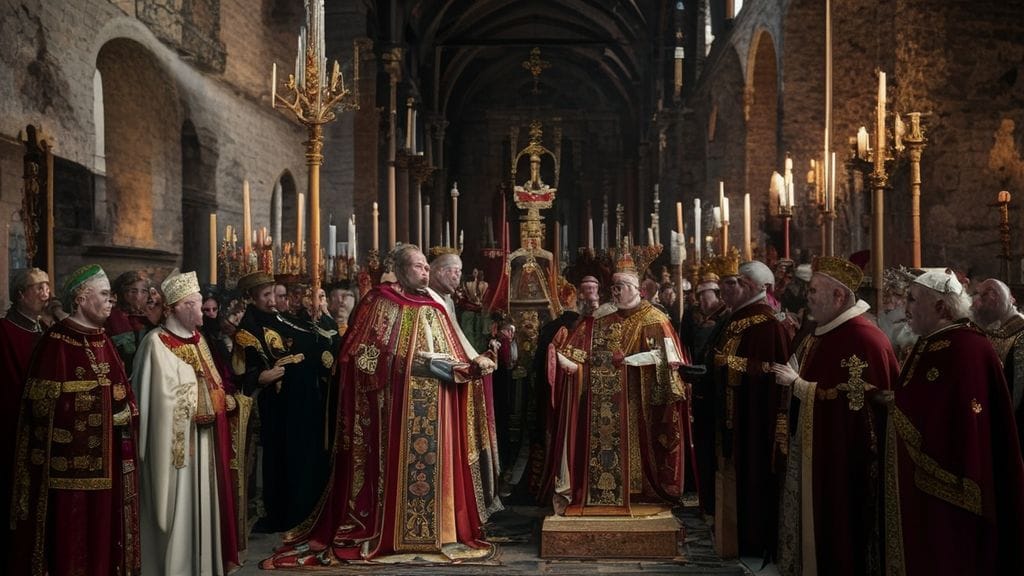
The moment when lucius iii becomes pope is not complete until it is enacted in ritual form: acceptance of the election, the formal enthronement, the bestowal of papal insignia. While specific details of Lucius III’s coronation are not comprehensively described in surviving sources, the general pattern of twelfth-century papal inaugurations allows us to reconstruct the atmosphere. The ceremony, likely centered on the Lateran—the traditional papal cathedral—unfolded in a carefully choreographed sequence, full of vestments, processions, and liturgical chants that echoed among marble columns and gilded mosaics.
Clad first in the simple vestments of a bishop, Lucius would be led before the altar, where prayers invoked the guidance of the Holy Spirit and the intercession of saints Peter and Paul, the twin pillars of Roman apostolic authority. The Fisherman’s Ring lay in the future; in Lucius’s day, the symbols of power were the pallium on his shoulders, the ferula (staff) in his hand, and above all the tiara or papal crown—at that time probably a single circlet, not yet the triple crown of later ages. As he received these signs, the gathered cardinals, clergy, and invited nobles would acclaim him in solemn chant: Vivat papa Lucius!
Yet behind the formal joy lingered unresolved tensions. Many Romans resented the papal court’s fiscal exactions and judicial privileges within the city; some had sympathies for the communal movement that wanted a more autonomous civic government. They might watch the procession with a mixture of fascination and cold calculation, estimating whether this old man could bend Rome to his will or whether, as with earlier popes, disputes would soon erupt into violence. Even within the papal entourage, there were doubts. Would Lucius’s age make him too cautious, too slow to respond to crises? Would his legalistic approach suffocate the more charismatic elements of papal leadership?
Still, the sensory power of the ritual cannot be underestimated. Candles flickered, incense curled upward in white-veiled columns, the choir sang the ancient hymns that bound the present to centuries of tradition. At some crucial point, the Gospel book was held open before Lucius, and he was reminded of his duty to uphold the faith and discipline of the Church. According to later custom, a piece of tow or flax might be burned before the pope’s eyes while a master of ceremonies murmured, “Sic transit gloria mundi”—“Thus passes the glory of the world”—a symbolic warning against pride. Whether this formula had already taken precise shape by 1181 is uncertain, but the sentiment certainly pervaded the ceremony. On that day, when lucius iii becomes pope, he is simultaneously exalted above all other bishops and reminded of his frailty and mortality.
Outside the churches, festive processions mingled with more ordinary life. Children tried to glimpse the new pontiff through the legs of armed guards; older citizens recalled the inaugurations of previous popes, measuring the present against the past. Foreign envoys noted the details, ready to send reports back to their masters. One can imagine a German envoy, quietly calculating how this new pope might interact with Frederick Barbarossa, or a Lombard representative assessing whether Lucius might favor the Italian cities’ hard-won liberties. For all its solemnity, the coronation was not only a liturgical act. It was a public signal to the world that the papal throne was once again occupied and that a new chapter in the long and uneasy history of medieval Christendom had begun.
A Pope Between Empires and Cities: Lucius III and the German Question
When lucius iii becomes pope, one problem looms larger than almost all others: the relationship with the German emperor, Frederick Barbarossa. The peace negotiated in Venice in 1177 had officially ended the schism that had torn the Church apart, with Barbarossa recognizing Alexander III as the legitimate pope and abandoning his support for antipopes. Yet the deeper question of how imperial authority and papal sovereignty were to coexist remained unresolved. Barbarossa still viewed himself as the supreme secular ruler of Christendom, entitled to considerable influence in Italian affairs. The papacy, having survived his onslaught, was determined to maintain its independence and its claims over episcopal appointments and ecclesiastical jurisdictions.
Lucius III inherited a delicate balance. He lacked Alexander’s long experience in directly resisting Barbarossa, but he shared the same basic conviction about papal primacy. Early in his pontificate, Lucius had to decide whether to continue Alexander’s relatively cautious rapprochement or to test the limits of the emperor’s cooperation. Initially, both sides maintained a wary politeness. Barbarossa had his own concerns: rebellious princes in Germany, tensions with the Lombard cities, and dynastic ambitions that required papal goodwill, particularly when it came to legitimizing marriages or sanctioning territorial arrangements. Lucius, for his part, knew that open conflict with the emperor could be disastrous, especially given his tenuous control over Rome itself.
Nevertheless, friction soon surfaced. One key issue was the appointment and investiture of bishops within the empire. Although the formal investiture controversy had been largely settled by the Concordat of Worms in 1122, practical disputes persisted. Cathedral chapters, local princes, and the emperor all had stakes in who became bishop in powerful sees like Cologne or Mainz. Lucius insisted on the Church’s rights to confirm episcopal elections and to resist overt imperial interference. Barbarossa, conversely, saw loyal bishops as crucial pillars of his authority. More subtly, the emperor desired a papacy that would support his broader program of imperial renewal, while Lucius was wary of any alliance that might compromise spiritual independence.
As the 1180s progressed, Lucius and Barbarossa would find themselves circling each other like cautious adversaries tethered by necessity. Lucius needed the emperor’s support—or at least his neutrality—in dealing with the Roman commune and with recalcitrant Italian nobles. Barbarossa needed the pope’s moral authority to legitimize his interventions in both Germany and Italy. Yet every gesture of cooperation was shadowed by suspicion. The memory of earlier antipopes and excommunications haunted both Curia and imperial court, a reminder of how easily things could unravel.
Some chroniclers, such as the imperial-friendly Otto of Freising and later continuators, painted papal resistance as obstinate and politically motivated, while papal partisans emphasized the emperor’s overreach. Modern historians, parsing these biased sources, see in Lucius’s policy a mixture of pragmatism and principle. He sought not open war with Barbarossa but a careful defense of ecclesiastical rights, even when that meant refusing certain imperial demands. The dance would eventually lead them to Verona, where pope and emperor would meet in person—a meeting that would reveal just how far apart their visions of Christendom truly were.
Rome in Turmoil: Commune, Nobles, and a Homeless Papacy
While the imperial question tugged at one side of his pontificate, the city of Rome itself gnawed at the other. When lucius iii becomes pope, he does so in a city that no longer simply bows to papal rule. For decades, Rome had been experimenting with communal government, inspired by the same urban energies that had propelled city republics across northern and central Italy. The Roman commune, driven by powerful families, merchants, and civic leaders, sought to reclaim an ancient identity as the sovereign city once capital of the empire. Popes, in their view, might be honored spiritual leaders, but they were not to dominate the daily political and judicial life of Romans.
This experiment in self-governance repeatedly clashed with papal claims. The commune appointed its own officials—senators or consuls—who often took charge of city defense, taxation, and local law. Roman nobles, too, pursued their own agendas, fortifying towers and palaces, aligning now with the papacy, now with the commune, now with external powers like the emperor or the Norman kingdom in southern Italy. The result was a volatile mosaic of alliances. Popes sometimes found themselves negotiating hard for the mere right to reside safely in their own city.
Lucius III, already advanced in years and without a strong military base, was poorly positioned to impose his will by force. Instead, he had to navigate a maze of negotiations, promises, and occasional retreats. Reports suggest that tensions with the Roman commune deteriorated to such an extent that Lucius ultimately found it untenable to remain in the city for long. The Lateran, theoretically the pope’s majestic home, felt more and more like a fortress under siege. The spectacle of the Vicar of Christ forced to take refuge in other cities—Tusculum, Anagni, and later Verona—was a powerful symbol of how fragile papal temporal power remained in the late twelfth century.
For ordinary Romans, these struggles were not mere abstractions. A shift in control over tolls and markets could mean higher prices or safer trade. A new alliance might provoke skirmishes in the streets or bring in foreign troops. When lucius iii becomes pope and later leaves Rome, he takes with him not only the Curia but also jobs, courts, and sources of income attached to the papal presence. Pilgrims might follow him elsewhere, but many would still come to Rome for its relics and shrines, leaving local priests and civic leaders to fill the gap in authority.
The Roman question was more than a local squabble; it symbolized a broader frontier between ecclesiastical and communal power in medieval Italy. Lucius’s inability to permanently tame the city foreshadowed later papal exiles and conflicts. In a grim irony, the successor of Saint Peter, whose martyrdom had sanctified Rome, now found himself semi-exiled from that same city by its own citizens. It underscored the contradictory nature of the medieval papacy: spiritually universal yet materially precarious, endowed with immense symbolic authority yet often scrambling for stable ground.
The Shadow of Heresy: Waldensians, Cathars, and the Fear of a Fractured Christendom
Among the most pressing concerns pressing upon Lucius III was the spread of what Church authorities increasingly categorized as “heresies.” When lucius iii becomes pope, he steps into a religious world in which divergent teachings and new spiritual movements had begun to attract followers across regions as diverse as Lombardy, Languedoc, and the Rhineland. For centuries, the Church had dealt with doctrinal deviations, from Arianism to local forms of dualism. But the twelfth century brought something new: heresies entangled with social criticism, urban lay piety, and networks that cut across traditional feudal and diocesan lines.
The Waldensians, followers of the wealthy merchant Peter Waldo of Lyon, exemplified this change. Renouncing riches, Waldo and his companions embraced apostolic poverty and preaching in the vernacular. At first, their zeal appealed to many clerics who themselves longed for a purer Church. But tensions arose when Waldensian preachers defied episcopal control, proclaimed doctrines without authorization, and implicitly condemned the wealth and worldliness of the established clergy. Condemned at the Third Lateran Council under Alexander III, they did not disappear; instead, they spread quietly across Europe, adapting to local circumstances.
Even more alarming to many bishops were the Cathars and related dualist groups, especially strong in southern France and parts of northern Italy. Their teachings, as described in hostile Catholic sources, challenged the Church’s sacramental system and sometimes the very goodness of the material world. Whether all the beliefs attributed to them are accurate remains a subject of heated scholarly debate, but what matters for our story is the perception at the time: these people were seen as a direct threat to Christian unity, capable of luring entire communities away from orthodox practice. In regions like Languedoc, Cathar sympathies among nobles and townsfolk alike created an atmosphere of religious ambiguity that deeply unsettled Church leaders.
Lucius III’s own training as a canon lawyer inclined him to see these movements through a juridical lens. Rather than relying solely on preaching or ad hoc condemnations, he believed in building a coherent legal framework for dealing with heresy. This approach would culminate in the famous decretal “Ad abolendam,” issued in 1184 in concert with Emperor Frederick Barbarossa. But even before that document, Lucius’s correspondence and decisions reveal a pattern: local bishops were urged to investigate suspected heretics, to coordinate with secular authorities, and to ensure that those stubbornly persisting in condemned beliefs faced appropriate sanctions.
There is something deeply human in this anxiety. Leaders like Lucius lived in a world where religious unity was not just a theological ideal; it was the glue that held societies together. To imagine entire villages quietly rejecting the sacraments, or lay preachers traveling without episcopal oversight, felt like watching cracks spread across the very foundation of Christendom. For the modern observer, who may sympathize with the spiritual aspirations of some of these movements, it is easy to condemn the repression that followed. Yet to understand why lucius iii becomes pope and then moves decisively against heresy, we must grasp how desperately he and his contemporaries feared disorder in both faith and society.
Lucius III and Frederick Barbarossa: An Uneasy Dance of Power
By the early 1180s, the relationship between Lucius III and Frederick Barbarossa had grown increasingly complex. On paper, they shared common interests: upholding order, suppressing heresy, and maintaining the fragile peace forged after decades of schism. In reality, their visions for how this order should be structured diverged sharply. Lucius believed in the primacy of spiritual authority, with the emperor serving as a secular arm to enforce just laws. Barbarossa, steeped in the political theology of imperial renovatio, saw the emperor as God’s chief lay representative, with the papacy occupying a crucial but not supreme role.
The most dramatic embodiment of this tension unfolded in Verona, where Lucius took refuge after finding Rome inhospitable. There, in 1184, pope and emperor met in person. The meeting promised much: a unified front against heresy, a chance to clarify notoriously fuzzy territorial and jurisdictional claims, perhaps even an opportunity to heal lingering mistrust. Yet contemporary accounts, such as those preserved by chroniclers in both camps, suggest that the atmosphere was strained. Barbarossa expected certain concessions, such as papal recognition of imperial rights in appointing bishops in specific contested regions. Lucius, wary of opening the door to renewed lay investiture, hesitated.
At Verona, the two men did reach one landmark agreement: the promulgation of “Ad abolendam,” a joint assault on heresy. This decretal, in which lucius iii becomes pope most visible as a jurist rather than a diplomat, established mechanisms by which bishops and secular rulers were to cooperate in rooting out heretical groups. In a sense, it formalized the alliance between throne and altar in the policing of belief. Yet behind this moment of cooperation lurked unresolved grievances. Lucius did not grant all that Barbarossa wanted, and the emperor, in turn, offered limited support in resolving the papacy’s difficulties with Rome and with certain Italian nobles.
For Lucius, the meeting demonstrated both the necessity and the danger of relying on imperial power. It was one thing to enlist the emperor’s aid against heretics; it was another to concede that bishops, abbots, and Italian cities might be dragged more deeply into the imperial orbit. For Barbarossa, dealing with an elderly pope who refused to bend on key issues was a reminder that the papacy could not easily be turned into a pliant tool of empire. Their relationship remained an uneasy dance, each partner needing the other yet resisting the other’s lead.
Historian Walter Ullmann once remarked that medieval political thought is essentially about the “vertical” relationship of authority descending from God through pope, emperor, and lesser rulers. In the years after lucius iii becomes pope, that vertical line became blurred. Who stood closer to God in temporal matters, pope or emperor? Verona did not answer the question; it merely delayed the final reckoning. Within a generation, new crises—most famously the conflict between Pope Innocent III and Barbarossa’s successors—would push this struggle to even sharper extremes. In this sense, the restrained clashes of Lucius and Barbarossa are a prelude, a quieter movement before the crescendo of thirteenth-century papal monarchy.
The Decretal “Ad abolendam”: Law, Faith, and the Birth of a Repressive Apparatus
Among all the acts of Lucius III’s pontificate, none has drawn more attention from historians than the decretal “Ad abolendam diversarum haeresium pravitatem” (“For the abolition of the depravity of various heresies”), issued in 1184, most likely at Verona. It is here that lucius iii becomes pope not just as a figure of ceremonial or diplomacy, but as a decisive architect of Church law. The document, issued jointly with Emperor Frederick Barbarossa, set out a systematic framework for identifying, judging, and punishing heretics. Its impact echoed far beyond Lucius’s own life, influencing later inquisitorial practices and the Church’s long-term strategy for maintaining doctrinal conformity.
“Ad abolendam” did not create persecution from nothing; earlier councils and popes had condemned specific groups and urged cooperation between ecclesiastical and secular authorities. What it did, however, was to weave these strands into a more coherent pattern. The decretal enumerated various heretical movements by name—Waldensians, Cathars, Humiliati, and others—and mandated that bishops regularly investigate their territories for signs of unorthodox belief. Those found guilty and refusing to recant were to be excommunicated and handed over to the secular arm, which was instructed to apply appropriate temporal penalties. Landowners who knowingly sheltered heretics faced confiscation of their property; civic officials who failed to act could be removed from office.
The logic of the document reveals Lucius’s canonical mind. It is less a fiery denunciation than a legal instrument, full of definitions, procedures, and specified sanctions. Faith, in this vision, must be defended not only in sermons and debates but also in courts and charters. A modern reader may recoil at the apparatus of repression taking shape here—the close cooperation of Church and secular power in surveilling belief, the explicit call for civic punishment of religious deviation. But to Lucius and his contemporaries, “Ad abolendam” represented an act of pastoral care on a grand scale: by eliminating heresy, they believed they were protecting souls and preserving the unity of Christ’s body.
One twelfth-century chronicler, describing the spirit of such measures, wrote that “the wolves have crept into the Lord’s flock disguised in sheep’s clothing, and if the shepherds do not act, they will devour many” (a sentiment recorded in various forms in ecclesiastical polemics of the age). Lucius, an aging shepherd, took this metaphor seriously. In his mind, gentle persuasion had its place, but when wolves persisted, the rod of law had to be wielded. The cooperation with Barbarossa in promulgating the decretal was thus not merely political expediency; it was a public demonstration that both pope and emperor recognized a shared duty to guard orthodoxy.
In retrospect, “Ad abolendam” can be seen as laying important foundations for the later medieval inquisitions, though the institutionalized tribunals commonly associated with the term would not fully emerge until the thirteenth century. Lucius did not yet envision roaming teams of inquisitors with standardized procedures, but he did envision a Church in which bishops took systematic, proactive measures against heterodoxy, backed by secular enforcement. When lucius iii becomes pope, he inherits a scattered set of tools; by 1184, he has forged them into a sharper instrument. The long-term consequences—episodes of persecution, social fragmentation, and hardened boundaries between “orthodox” and “heretical” identities—were not those he foresaw, but they grew in part from the seeds he planted.
Life Around the Throne: Cardinals, Courtiers, and Ordinary Believers
Amid the lofty decrees and geopolitical struggles, it is easy to forget that the papacy in Lucius III’s time was also a daily, lived environment. When lucius iii becomes pope, he is not alone at the summit; around him sprawl a complex curial world of cardinals, secretaries, scribes, chaplains, and servants. Some were brilliant theologians or jurists, others ambitious courtiers, still others humble clerics who copied documents or tended altars. Together they formed what one might call the “papal microcosm,” a small city within the broader cities in which the pope resided.
The College of Cardinals, Lucius’s immediate advisory body, included men of varying backgrounds—Italians from powerful families, clerics from France and Germany, and a few from further afield. They debated issues of doctrine and policy, sat in judgment over cases appealed from distant dioceses, and helped draft letters to kings and bishops. Some were loyal allies of Lucius; others had their own agendas or favored different approaches to the emperor or the Roman commune. The older ones had known Ubaldo as a colleague for decades and now had to learn to obey him as pope. Capturing this transformation, we might imagine the shifting tone of conversations in the corridors: a familiar figure suddenly addressed as “Sanctitas Vestra” instead of by his given name.
Behind these dignitaries stood the machinery of administration. Notaries recorded papal privileges; messengers carried sealed letters across mountains and seas; liturgists planned ceremonies; financial officers tracked revenues from papal estates and fees. These tasks gave Lucius the means to project his authority outward: a bishop in Spain or a monastery in Germany might experience “Rome” primarily as a parchment bearing Lucius’s seal and a few carefully chosen words. In this sense, when lucius iii becomes pope, his authority is at once bodily—invested in an aging man who tires easily—and textual, dispersed in documents that travel where he cannot.
For ordinary believers, the impact of his election varied widely. In Verona, where Lucius eventually settled, local people would have seen more of the papal court—its processions, its liturgies, the influx of petitioners and visitors. They might attend a Mass celebrated by the pope on major feasts, or catch a glimpse of him blessing the crowd. Elsewhere, peasants and townsfolk might know only that “a new pope named Lucius” sat in Saint Peter’s place. Still, even distant communities could feel the ripple effects of decisions taken in his court: a new bishop appointed, a monastery placed under papal protection, a local lord excommunicated. Stories about the pope filtered through sermons and gossip, reshaped in the telling, sometimes embellished into near-legend.
This human dimension reminds us that the papacy, for all its structural power, was lived by fallible people in daily routines. Lucius needed meals, rest, and medical care; cardinals jockeyed for influence or worried about their own dioceses; scribes made errors in copying texts that might have major consequences for distant litigants. In the interplay between high ideals and mundane realities, the pontificate of Lucius III unfolded, as did every other. It is here, perhaps, that his age and temperament left a particular mark: favoring stability over reform, law over innovation, he sought to keep the machinery running smoothly in a world that often seemed intent on breaking it apart.
Beyond Rome: Lucius III and the Italian Cities in Revolt
The story of Lucius III cannot be confined to Rome and Verona. When lucius iii becomes pope, he must also reckon with the broader Italian landscape, where cities had become powerful political actors in their own right. The Lombard League, formed originally to resist Barbarossa’s attempts to assert control over communal freedoms, continued to shape northern Italian politics throughout Lucius’s pontificate. Cities like Milan, Cremona, and Piacenza balanced their own interests against those of the emperor and the pope, sometimes seeking papal endorsement for their privileges, sometimes using imperial support to counter local enemies.
Lucius inherited from Alexander III a generally sympathetic view of the Lombard communes, which had stood as useful allies against imperial overreach. Yet the pope’s position was more ambiguous than that of a simple partisan. On the one hand, he appreciated cities that defended the liberty of the Church and opposed the emperor when he pressed too hard. On the other hand, he was wary of urban movements that might also challenge episcopal authority or encroach upon ecclesiastical jurisdictions and properties. In some cases, communal councils claimed the right to approve or influence the appointment of bishops, or to regulate church lands within their territories. For a pope like Lucius, steeped in canonical notions of hierarchical order, such claims posed serious problems.
His responses varied. In some situations, Lucius confirmed communal privileges, seeing them as a bulwark against imperial dominance or local tyranny. In others, he sided with bishops or abbots in disputes over property or jurisdiction, using papal authority to curb overambitious cities. The result was a patchwork of alliances that could shift quickly. A city that one year praised the pope as a defender of liberty might the next complain bitterly that he favored their rivals. This fluidity reflects the complex reality behind the neat lines of papal bulls and city charters.
Beneath the political maneuvers lay profound social changes. The rise of merchant classes, guilds, and professional lawyers transformed the fabric of Italian urban society. These groups often pursued rationalized systems of law and accountability that paralleled, and sometimes competed with, ecclesiastical legal structures. The very canonists who flocked to the papal court, like Lucius himself in his youth, had their counterparts in communal courts applying Roman and local statutes. When lucius iii becomes pope and later issues “Ad abolendam,” he speaks as one champion of legal order among many, seeking to assert the priority of canon law in a crowded field.
His efforts met with mixed success. Some cities embraced papally endorsed measures against heresy, seeing them as opportunities to demonstrate orthodoxy and loyalty. Others resented Church interference in what they saw as local matters, especially when influential citizens came under suspicion. The seeds of later conflicts—like those that would flare during the Albigensian Crusade or the struggles between Guelphs and Ghibellines—were already present. Lucius, perhaps, sensed their presence but lacked either the lifespan or the means to fully address them. He could only respond to immediate crises, patching over deep fissures with bulls and compromises.
Across the Mediterranean: Crusader States, Islam, and the Distant Holy Land
While Lucius III’s pontificate is not primarily associated with major crusading events, the Holy Land remained a constant concern. When lucius iii becomes pope, the memory of the earlier crusades still hung heavy in Christian consciousness. The First Crusade’s victories and the subsequent consolidation of the Latin Kingdom of Jerusalem had long been woven into sermons, chronicles, and liturgical commemorations. Yet by the 1180s, the situation in the Levant was precarious. Internal divisions among the crusader nobility and the growing power of Saladin, who united Egypt and Syria, threatened the survival of the fragile Christian enclaves along the eastern Mediterranean coast.
Lucius followed these developments through reports carried by envoys, bishops, and military leaders. The papal chancery received pleas for support: money, men, and moral backing. While he lacked the energy and perhaps the political leeway to launch a new grand crusade from scratch, Lucius continued the policies of his predecessors by encouraging aid for the Holy Land, granting indulgences to those who contributed to its defense, and maintaining communication with local patriarchs and rulers. He also had to manage the presence of crusader envoys in his own itinerant court, men who brought with them tales of distant sieges, fragile truces, and looming dangers.
At this point, the Latin East still stood, but barely. Within a few years of Lucius’s death, the catastrophe of Hattin (1187) and the fall of Jerusalem would shock Europe into launching the Third Crusade, involving figures like Richard the Lionheart and Barbarossa himself. In that sense, Lucius’s pontificate occupies a brief calm before the storm, when the problems of the Holy Land were acute but had not yet erupted into full crisis. It is tempting to imagine him, already frail, listening as messengers described Saladin’s maneuvers and the disunity among the Franks, sensing that another great convulsion was near but knowing he would likely not live to see it.
Contacts with the Eastern Christian world also continued under Lucius. Relations between Rome and Constantinople remained strained after the mutual excommunications of 1054 and subsequent disputes, but diplomatic and ecclesiastical exchanges still took place. Lucius, like other popes of his era, occasionally addressed matters involving the Byzantine Empire and Eastern patriarchates, though these were not the core of his pontificate. Yet the very existence of a Christian world divided between Latin and Greek traditions complicated the rhetoric of a unified Christendom that underpinned his policies against heresy.
From a broader Mediterranean perspective, Lucius governed during a period of dynamic cultural and economic exchange. Italian merchants from cities like Genoa, Pisa, and Venice plied the sea lanes, trading with Muslim and Byzantine ports, carrying news and ideas as well as goods. The Church’s official stance toward Islam remained one of opposition, framing Muslims as both military and spiritual foes. At the same time, practical accommodations and truces were common in the Levant. Lucius’s Rome—or rather his Verona-based court—was indirectly linked to this wider world through legal disputes over crusader lands, donations to Eastern churches, and the flow of pilgrims. When lucius iii becomes pope, he becomes, however distant, one of the highest authorities in a network that stretched from English villages to the walls of Jerusalem.
An Aging Pontiff: Piety, Personality, and Daily Life of Lucius III
By the time lucius iii becomes pope, he is already an old man, and age shapes every aspect of his pontificate. Contemporary sources do not provide a rich psychological portrait, but from scattered remarks and the pattern of his decisions, a picture emerges. Lucius appears as cautious, serious, and deeply committed to the legal-disciplinary side of Church governance. He lacked the dramatic flair of some predecessors and successors; no grand visions of a new crusade or sweeping institutional overhauls are tied to his name. Instead, he appears as a man intent on holding ground, on maintaining continuity amid storms.
His personal piety likely followed the patterns of learned clergy of his generation: daily recitation of the Divine Office, celebration of Mass when health permitted, regular confession and spiritual counsel with trusted confessors. Surrounded by relics and liturgical splendor, he would also have been keenly aware of his mortal fragility. Chronic illness or the general infirmities of age must have affected his schedule. There were surely days when his hands trembled as he attempted to sign documents, or when he delegated more tasks to his cardinals and officials. The very fact that lucius iii becomes pope at this stage of life meant that his pontificate was never expected to be long; his role was to steady the ship, not to chart a radically new journey.
Descriptions from friendly chroniclers emphasize his virtues: moderation, justice, and concern for Church discipline. They portray him as a man of the law, not in a cold or petty sense, but in the belief that clear norms protect the weak and restrain the powerful. One can imagine him presiding over sessions of the papal court, listening as advocates presented cases ranging from monastic disputes to contested episcopal elections. Afterward, he would retire with a few trusted advisors to weigh the arguments. His decisions, recorded in neat Latin on parchment, would travel outward, shaping outcomes in places he had never seen.
Emotionally, Lucius seems to have been reserved. There are no famous episodes of public weeping, ecstatic visions, or dramatic gestures associated with his name. Yet silence does not mean absence of feeling. He lived through the rise and fall of popes, the brutality of imperial campaigns in Italy, the hardships of papal exile. He had seen colleagues die, cities burned, and treaties broken. It is hard to imagine that such experiences left him untouched. Perhaps his turn to law and order was, in part, a response to this chaos—a way of imposing some measure of predictability on a world that could so easily slip into violence.
In the evenings, after the last business of the day, Lucius might have retreated to a private chapel or chamber with a few books: a Psalter, the Gospels, perhaps a copy of Gratian’s Decretum or a collection of earlier papal decretals. The flickering light of oil lamps or candles would cast shadows on the walls as he read or listened to a cleric reading aloud. Outside, the city—whether Rome, Verona, or another temporary home—throbbed with noises: dogs barking, people quarreling, carts rolling over cobblestones. Inside, the aging pope tried to hold together the visible Church, trusting that the invisible hand of God guided history even when human institutions faltered.
Verona Instead of Rome: Exile, Councils, and a Fading Hope
That lucius iii becomes pope in Rome but spends much of his pontificate away from it is one of the defining ironies of his reign. Verona, perched strategically in northern Italy, became his principal refuge. The city, with its Roman amphitheater, sturdy walls, and lively markets, was part of the Lombard League’s orbit but also attentive to imperial and papal overtures. For Lucius, Verona offered relative safety from the turbulence of the Roman commune and a location convenient for meeting with Frederick Barbarossa and other northern Italian powers.
In Verona, Lucius convened councils, received envoys, and issued many of the documents that would shape his legacy, including “Ad abolendam.” The city’s churches transformed into stages for high ecclesiastical drama. Bishops from across Italy and beyond traveled there, braving bandits, rough roads, and inclement weather to present their cases or attend synodal sessions. Local Veronese must have watched with a mixture of awe and pragmatism as the papal entourage reshaped their urban rhythms. Inns filled with foreign clerics; merchants profited from increased trade; yet tensions could flare over jurisdiction or taxation.
Exile, even a relatively comfortable one, weighed heavily on Lucius. The symbol of the pope is inseparable from Rome—the city of Peter’s martyrdom, the seat of the ancient empire, the heart of Latin Christendom. To reign from Verona was to constantly be reminded of what he lacked: direct control over his supposed capital, easy access to the great basilicas, and the immediate physical presence at the tombs of the apostles. Letters from Rome, carrying news of political changes, factional violence, or new maneuvers by the commune, must have provoked frustration and sorrow. Yet attempts to reclaim a secure foothold in the city foundered, blocked by intransigent urban leaders and the unwillingness of external allies to commit fully.
The pope’s meeting with Barbarossa in Verona, as discussed earlier, was one of the climactic scenes of this exile. Hopes that the emperor might intervene decisively in favor of papal authority in Rome were only partially realized. Barbarossa had his own calculations and hesitated to plunge into a conflict that might entangle him in new urban wars. Lucius, left to balance between Roman hostility and imperial ambivalence, saw his prospects for returning triumphantly to Rome diminish with each passing year. The longer he stayed in Verona, the more “normal” the abnormal became: the papal court adapted its routines to the new setting, institutional memory adjusted, and younger clerics grew up associating the papacy as much with the Adige River as with the Tiber.
Still, Verona was not a prison. Lucius continued to act as universal pastor, addressing issues far beyond Italy: disciplinary reforms, episcopal disputes, and international diplomacy. Yet the spatial dislocation symbolized a deeper theme of his pontificate: authority without full control, primacy without secure territory. It foreshadowed the later “Babylonian Captivity” of the papacy in Avignon in the fourteenth century, when popes again ruled from afar. In Lucius’s case, the exile ended not with a triumphant homecoming but with his death, leaving unresolved the very question that had driven him from Rome in the first place.
Death, Memory, and the Quiet Passing of a Pope
On 25 November 1185, in Verona, Pope Lucius III died. His passing, while noted with respect by contemporaries, did not provoke the kind of seismic shock that the deaths of more dramatic popes sometimes did. Yet for those who had known him as Ubaldo, as colleague and mentor, and for those who had grown used to his presence in Verona’s churches and streets, it marked the end of a distinct era. The man for whom lucius iii becomes pope had been a late-life transformation now returned to dust, leaving behind a body of documents, policies, and unresolved tensions.
The rituals that followed would have mirrored, in condensed form, the ceremony of his elevation. The body of the pope, vested in liturgical garments, was displayed for veneration, then interred—most likely in Verona’s cathedral or a nearby church, given his exile from Rome. Litanies were sung, cardinals and clergy kept vigil, and prayers for his soul rose like the incense that had so often accompanied his public acts. For a Church that emphasized continuity, the pope’s death was immediately linked to the urgent necessity of electing his successor. Mourning did not preclude calculation; indeed, the two often unfolded together.
Early assessments of Lucius’s pontificate were mixed. Some praised his steadfastness in defending orthodoxy and Church rights. Others, especially among those sympathetic to communal liberties or opposed to harsh measures against heresy, saw him as rigid or overly attached to legalism. Different chronicles, colored by local loyalties, portrayed him variously as a conscientious shepherd or as yet another figure in the long chain of power struggles between popes and secular rulers. No hagiographic cult developed around him; he was not widely venerated as a saint, nor did miracles become attached to his tomb. His memory remained largely confined to the realm of canon law and ecclesiastical history.
From a modern vantage point, his death marks the conclusion of a modest yet consequential pontificate. Lucius did not launch crusades or build imposing basilicas. He did not excommunicate emperors or preside over ecumenical councils of the scale of Lateran III. Instead, his legacy lies in quieter, but no less influential, domains: the consolidation of legal mechanisms against heresy, the navigation of papal authority in an age of communal and imperial challenges, and the maintenance of institutional continuity in the wake of Alexander III’s epochal reign. When lucius iii becomes pope in 1181, he steps into a role already defined by great conflicts; when he dies in 1185, he leaves these conflicts unresolved but somewhat reframed.
The College of Cardinals moved quickly to choose his successor, Urban III, thereby continuing the line of popes who would grapple with many of the same issues—imperial power, heresy, and Roman unrest. Lucius receded into the background, his name surviving mainly in legal collections, papal registers, and the brief mentions of chroniclers summarizing the late twelfth century. Yet in those texts, he persists as a symbol of a certain kind of papal governance: restrained, legalistic, wary of extremes, deeply conscious of the Church’s vulnerability. His quiet passing in Verona was, in many ways, an apt end for such a figure.
Long Shadows: How Lucius III Shaped the Medieval Church
Assessing the significance of Lucius III’s pontificate requires stepping back from the daily details and tracing the lines that extend from his years in office into the broader history of the medieval Church. At first glance, his reign might appear minor compared to those of giants like Gregory VII, Alexander III, or Innocent III. Yet the years between 1181 and 1185 were a hinge moment, and the ways in which lucius iii becomes pope and governs help define the transition from the age of imperial-papal confrontation to the more juridically structured world of the thirteenth century.
His most direct legacy lies in the legal sphere. “Ad abolendam” became a reference point for subsequent efforts to combat heresy, cited in later canonical collections and shaping the expectations of both bishops and secular rulers. It helped normalize the idea that orthodoxy was not only a spiritual matter but also a legal status, one that could be investigated, judged, and punished through codified procedures. This legalistic approach would underpin the rise of formal inquisitorial tribunals under later popes, including Gregory IX. While Lucius did not create the Inquisition in the classic sense, his policies provided part of its juridical scaffolding.
Beyond heresy, Lucius’s pontificate contributed to the ongoing centralization of papal authority, even as his exile from Rome underscored its limits. By continuing to assert papal primacy in episcopal appointments, judicial appeals, and disciplinary oversight, he reinforced the perception that the pope was the supreme court of Christendom. Bishops and abbots from distant lands increasingly turned to Rome (or Verona, temporarily) for confirmation, arbitration, and protection. The papacy’s reach was extending, even as its local roots in Rome remained contested. This paradox—universal influence rooted in precarious local power—would shape papal politics for centuries.
Lucius’s interactions with Frederick Barbarossa also left an imprint. Their uneasy cooperation and unresolved tensions illustrated both the potential and the limits of papal–imperial collaboration. Future popes could look back on Lucius’s example as a cautionary tale: alliance with emperors might bring short-term gains in suppressing heresy or managing Italian politics but at the cost of inviting imperial encroachment. Similarly, emperors could see that even an aged, relatively moderate pope would not simply rubber-stamp their ambitions. In this way, Lucius’s pontificate contributed to the long, winding path toward the more assertive papal monarchy of Innocent III and the more aggressive imperial claims of Frederick II.
Perhaps most intriguingly, Lucius embodies the tension between continuity and change. When lucius iii becomes pope, he does so as a man of the old reform movement: committed to clerical celibacy, papal independence, and canonical order. Yet he governs on the cusp of new realities: universities, sophisticated urban legal systems, lay spiritual movements, and increasingly global horizons as crusaders and merchants linked Europe to distant lands. His answer to these challenges was not radical innovation but a deepening of law and discipline. In that sense, he anticipated the “juridification” of the Church that would become so pronounced in the thirteenth century.
It is astonishing, isn’t it, how an apparently modest pontificate can cast such long shadows? Lucius did not seek fame; he sought stability. Yet by codifying measures against heresy and insisting on the Church’s legal prerogatives, he helped chart a path that would lead to both remarkable institutional coherence and to episodes of harsh repression. History rarely grants us unmixed legacies. Lucius III’s is no exception: he stands at the crossroads where pastoral care and coercive law meet, where the fear of fragmentation drives the creation of systems that could either protect or wound the flock.
Conclusion
On that September day in 1181, when lucius iii becomes pope in a restless, divided Rome, few could have predicted the full extent of his impact. His pontificate was short, his personality seemingly understated, his reign overshadowed by larger-than-life figures like Alexander III before him and Innocent III after. Yet within those four years, he confronted some of the central dilemmas of his age: how to balance papal authority with imperial power, how to live as the bishop of Rome while exiled from its streets, and how to preserve doctrinal unity in a world pulsing with new religious energies.
He responded to these dilemmas with the tools he knew best: law, discipline, cautious diplomacy. The phrase “lucius iii becomes pope” thus marks more than a ceremonial transition; it marks the arrival of a jurist at the helm of Christendom. His issuance of “Ad abolendam” crystallized a vision of Church and state working in tandem to police belief, a vision that would shape the medieval Church’s stance toward dissent for generations. His struggles with Frederick Barbarossa and the Roman commune revealed the persistent instability of papal temporal power, even as his exercise of jurisdiction across Europe reinforced the papacy’s spiritual primacy.
In human terms, Lucius’s story is one of late vocation to supreme office, of an old man called to carry a heavy burden in turbulent times. He did not end wars or reconcile all factions; nothing so dramatic crowns his record. Instead, he held a fragile world together just long enough for the next act in the drama of medieval Christendom to begin. His life invites reflection on the quieter forms of historical influence—those exerted through norms, courts, and everyday decisions rather than battlefield heroics or spectacular councils.
To trace his footsteps is to walk through a twelfth-century Europe alive with conflict and creativity: imperial armies crossing the Alps, city communes drafting statutes, scholars glossing canon law, heretical preachers speaking in marketplaces, and distant knights holding shaky fortresses in the Holy Land. At the center of this swirling scene, for a brief, intense moment, stands Lucius III, the elderly canonist from Lucca who, by becoming pope, helped guide the Church from one era into another. His legacy, woven into the fabric of medieval institutions and mentalities, reminds us that history often turns not only on great revolutions, but on the quiet, tenacious work of those who seek simply to preserve a fragile order.
FAQs
- Who was Lucius III before he became pope?
Before his election, Lucius III was known as Ubaldo Allucingoli, a cleric from Lucca who rose through the ranks of the Church to become Cardinal-Bishop of Ostia. He served under several popes as a respected canon lawyer and diplomat, gaining a reputation for moderation and legal expertise rather than dramatic reform or political grandstanding. - When and where did Lucius III become pope?
Lucius III was elected pope in Rome on 27 September 1181, shortly after the death of Pope Alexander III. Although he was chosen and initially installed in Rome, political conflicts with the Roman commune soon forced him to spend much of his pontificate outside the city. - Why is the phrase “lucius iii becomes pope” historically significant?
The moment when lucius iii becomes pope is significant because it marked a transition from the tumultuous age of open schism and investiture struggles to a more legalistic, institutionally consolidated Church. His election brought to the papal throne an elderly canonist whose key decisions—especially regarding heresy—would shape ecclesiastical law and practice for generations. - What was the decretal “Ad abolendam” and why did it matter?
“Ad abolendam” was a papal decretal issued in 1184 by Lucius III in concert with Emperor Frederick Barbarossa. It created a more systematic legal framework for identifying, judging, and punishing heretics, instructing bishops and secular authorities to cooperate closely. Historians see it as a foundational document in the development of later inquisitorial practices and in the Church’s long-term strategy against dissent. - How did Lucius III’s relationship with Emperor Frederick Barbarossa shape his pontificate?
Lucius III’s relationship with Frederick Barbarossa was marked by cautious cooperation and unresolved tension. They worked together at Verona to issue “Ad abolendam,” but disagreed on issues such as episcopal appointments and imperial influence in Italy. Their uneasy alliance illustrated both the necessity and the danger of papal–imperial collaboration in the late twelfth century. - Why did Lucius III spend much of his pontificate in Verona instead of Rome?
Lucius III faced intense conflict with the Roman commune, which sought to assert civic autonomy against papal temporal power. Unable to secure a stable position in Rome, he relocated his court to Verona, where he found greater security and a strategic location for dealing with northern Italian politics and the emperor, even though this exile symbolized the fragility of papal control over its own city. - What was Lucius III’s stance on emerging heretical movements like the Waldensians and Cathars?
Lucius III viewed these movements as serious threats to the unity and orthodoxy of the Church. Drawing on his legal training, he favored a structured response that combined doctrinal condemnation with procedural mechanisms for investigation and punishment, culminating in the measures outlined in “Ad abolendam.” He regarded the suppression of heresy as both a spiritual necessity and a matter of maintaining social order. - How did Lucius III’s age influence his governance as pope?
Already elderly when elected, Lucius III approached governance with caution and a focus on stability. His age limited his ability to travel and launch ambitious new projects, steering him toward consolidating existing reforms, strengthening legal frameworks, and avoiding drastic shifts in policy. This helped ensure continuity after Alexander III but also meant his pontificate was more about preservation than innovation. - Did Lucius III play a major role in the Crusades?
Lucius III did not initiate a new major crusade, but he remained concerned about the situation in the Holy Land and supported efforts to aid the Crusader states. He granted indulgences, encouraged aid, and maintained contact with Eastern Christian leaders. His pontificate fell just before the dramatic events of Hattin and the Third Crusade, so he stands at the threshold of that new crusading wave rather than at its center. - How is Lucius III remembered in Church history today?
Today, Lucius III is remembered primarily for his legal contributions, especially “Ad abolendam,” and for his role in the evolving relationship between papacy, empire, and urban communes. He is not venerated as a saint, nor is he widely known among the general public, but historians see his pontificate as a key transitional moment that helped shape the more centralized and juridically sophisticated Church of the thirteenth century.
External Resource
Internal Link
Other Resources
- Encyclopaedia Britannica – general search for the exact subject
- Google Scholar – academic search for the exact subject
- Internet Archive – digital library search for the exact subject

