Table of Contents
- A Night on the Adriatic: Setting the Scene for War
- From Empire to Ruin: The Long Road to the Gothic War
- Belisarius, Narses, and Justinian’s Grand Design
- The Ostrogoths at Sea: Totila’s Bold Maritime Gamble
- Ravenna, Ancona, and the Lifeline Across the Waves
- Mustering the Fleet: The Eastern Roman Admirals Take Command
- Sena Gallica and the Geography of a Decisive Encounter
- The Eve of Battle: Fears, Prayers, and Quiet Preparations
- First Contact: The Fleets Sight Each Other on the Adriatic
- Ramming, Boarding, and Fire: The Struggle for the Sea
- Breaking the Gothic Line: Panic, Flight, and Shipwreck
- Aftermath on the Shore: Survivors, Captives, and Burning Hulks
- A Turn in the Gothic War: Strategy Transformed by a Naval Victory
- Totila’s Fate and the Waning Light of Gothic Italy
- Winners and Losers: Civilians, Soldiers, and the Cost of Empire
- Memory, Sources, and Silence: How We Know What We Know
- From Sena Gallica to the Middle Ages: Long Shadows Over the Adriatic
- Conclusion
- FAQs
- External Resource
- Internal Link
Article Summary: In the fading light of the sixth century, the battle of sena gallica unfolded as a dramatic naval clash that helped decide the fate of Italy and the ambitions of Emperor Justinian. This article traces the road to that confrontation, from the crumbling of the Western Roman Empire to the grinding campaigns of the Gothic War. We follow Roman generals, Gothic kings, sailors, and civilians as they are drawn into a struggle over sea lanes, ports, and the very idea of empire. The battle of sena gallica is explored not only as a military engagement but as a turning point in strategy, morale, and logistics, marking the moment when control of the Adriatic began to slip from the Ostrogoths. Along the way, we examine how chroniclers like Procopius wove the story into a broader narrative of restoration and destruction. The article also reconstructs the human experience of fear, hope, and loss aboard the ships that clashed off the Italian coast. By tracing the consequences of the battle of sena gallica across decades, we see how a single night of fighting rippled through politics, society, and memory. Ultimately, the battle of sena gallica becomes a window into the fragile nature of power in a late antique world that stood on the brink of the Middle Ages.
A Night on the Adriatic: Setting the Scene for War
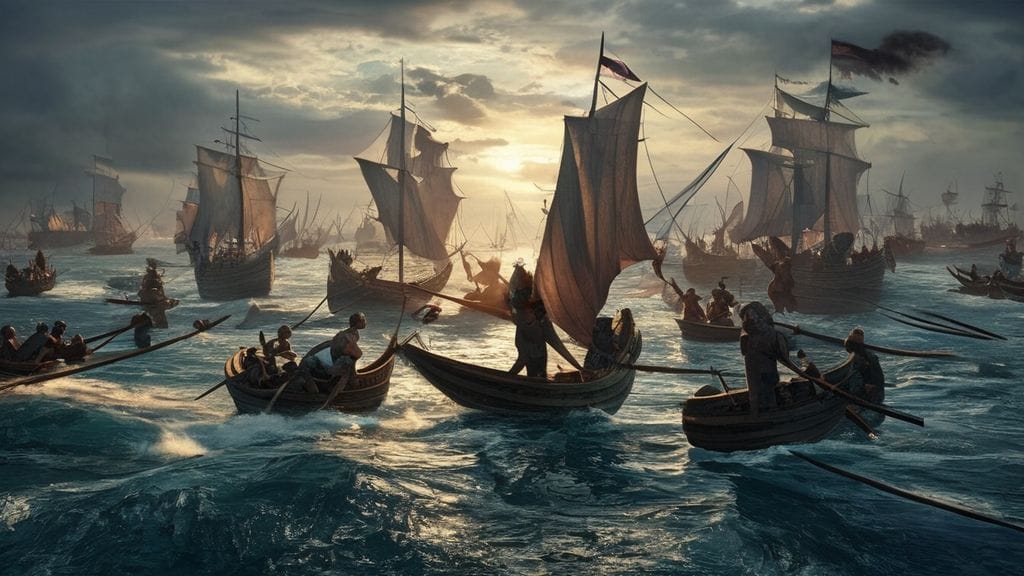
The sea was not silent that night. Even before the first oars dipped in unison, the Adriatic breathed and muttered against the hulls, a dark expanse broken by crests of blurred, ghostly foam. Lanterns winked from the decks of warships, their small yellow flames making halos on wet wood and glistening bronze. Somewhere out there, beyond the arc of one fleet’s vision, another line of ships waited—hostile, alert, and just as anxious. In the late summer or early autumn of 551, off the coast near the modest harbor town of Sena Gallica, the waters that had long linked Italy with the eastern Mediterranean were about to become a killing ground.
This was the setting of the battle of sena gallica, a pivotal moment in the long and exhausting conflict historians now call the Gothic War. The Adriatic, often imagined as a quiet flank of the Roman world, exploded into sudden significance when the Ostrogoths, the Germanic rulers of Italy, tried to wrench control of the sea from the Eastern Roman Empire. That night, rowers sat in tight-packed benches, hands raw from the oars, listening for shouted orders in languages that mixed Greek, Latin, and Gothic accents. Above them, soldiers tightened grips on spears and shields, their minds drifting back to families they might never see again. For them, this was less an imperial chess move and more a final throw of the dice.
To understand how this single naval clash could carry such weight, one must step back from the spray and the shouts and look at the longer arc of history that led those ships to meet. The battle of sena gallica did not spring out of nothing; it was the culmination of decades of failed compromises, shattered frontiers, and burning ambitions. Rome had fallen in the West, then risen again—at least in the dreams of an emperor on the Bosphorus who believed that one more war, one more campaign, might restore what had been lost. The sea, seemingly indifferent, had become the road on which that dream had to travel.
From Empire to Ruin: The Long Road to the Gothic War
A century before the battle, the idea that Roman forces would be fighting “barbarian” kings for control of Italy itself would have seemed like a nightmare—or a bad joke. Yet by the late fifth century, the Western Roman Empire had imploded under pressure from internal decay and external invasions. In 476, when the Germanic commander Odoacer deposed the last Western emperor, Romulus Augustulus, he sent the imperial regalia east to Constantinople. The gesture acknowledged a legal fiction: there was now only one Roman Empire, ruled from the East. But in practice, Italy became the domain of warlords.
Soon, a new power stepped into the vacuum. The Ostrogoths, led by their charismatic king Theoderic the Great, migrated into Italy with the approval—at least formally—of the Eastern emperor Zeno. Theoderic’s reign (493–526) brought a fragile order. He cultivated Roman elites, kept the Senate alive, and maintained the façade of imperial continuity. Streets were repaired, aqueducts restored, and for a brief generation Italy seemed to breathe again under what some scholars have called a “barbarian restoration.” Yet beneath this surface, tensions festered. Goths remained a military aristocracy, speaking a different language, following Arian Christianity rather than the Nicene orthodoxy dominant among the Romans. The arrangement depended heavily on personalities, on Theoderic’s ability to balance loyalties and keep both his warriors and his Roman officials in line.
When Theoderic died, the system unraveled. Succession struggles, religious disputes, and rising mistrust between Gothic and Roman elites destabilized Italy. On the far side of the Mediterranean, these cracks did not go unnoticed. In Constantinople, Emperor Justinian I, who ascended the throne in 527, watched with a patient, calculating eye. To him, the faltering Ostrogothic kingdom was both a threat and an opportunity. If the Goths became hostile, they might ally with the empire’s enemies; if they weakened, Italy might be reclaimed—at least in theory—for Rome and for Christendom according to Constantinople’s definition.
Thus the Gothic War, launched in 535, was not a sudden lunge but the product of decades of gradual decay and the ideological conviction of one emperor who believed God had chosen him to reunify the old Roman world. By the time ships closed in off Sena Gallica, this war had already dragged on for sixteen years, leaving cities ruined and populations traumatized. The battle of sena gallica was not the beginning of the story; it was the point at which a seemingly endless conflict edged toward a grim resolution.
Belisarius, Narses, and Justinian’s Grand Design
Behind the fleets that met off Italy’s eastern coast stood the shadow of a single man: Justinian I, ruler of the Eastern Roman Empire, seated in a gilded palace above the waters of the Bosphorus. He was a paradoxical figure—pious and ruthless, visionary and inflexible. His dream was nothing less than the restoration of the Roman Empire to its ancient borders: North Africa wrested from the Vandals, Spain partly recovered from the Visigoths, and Italy reclaimed from the Ostrogoths. The Gothic War was, in his eyes, a just cause, a holy endeavor to restore order and orthodoxy. But dreams, when imposed on the physical world, have a tendency to bleed.
Justinian’s armies were led at first by his most brilliant general, Belisarius, who had already achieved a astonishing victory over the Vandals in North Africa. With a relatively small expeditionary force, Belisarius landed in Sicily in 535 and then moved into mainland Italy. For a while, his genius seemed to bend fate itself: cities opened their gates, and even Rome fell into his hands. Yet war in Italy proved stubborn. The Ostrogoths, under kings like Witigis and later Totila, rallied. Sieges, counter-sieges, famine, and plague battered both sides.
As years passed, the burden of the war shifted to another commander: Narses, a eunuch and court official with an unassuming appearance but a razor-sharp strategic mind. Though Narses would eventually become central in the final campaigns on land, at sea other leaders came to the fore—naval commanders ordered to protect the fragile lifeline that ran from Constantinople through the Ionian and Adriatic seas to Italy’s besieged Byzantine-held enclaves. Justinian’s grand design depended on these watery arteries. Soldiers, grain, and gold all traveled by ship. If the Ostrogoths could seal off the sea, they might cut off the empire’s arm reaching into Italy. That was why, in 551, the battle of sena gallica mattered so deeply.
Every decision from the imperial court—every purse of gold released for shipbuilding, every promotion or recall—rippled outward until it touched the ordinary men who would row, fight, and bleed on the Adriatic. Orders written in careful Greek in Constantinople eventually became hoarse cries on darkened decks, torchlight gleaming on drawn swords. In that conversion from policy to peril, the emperor’s dreams collided with the harsh realities of distance, weather, and human fear.
The Ostrogoths at Sea: Totila’s Bold Maritime Gamble
By the late 540s, a new figure stood at the center of Gothic resistance: Totila, a young and energetic king whose very name came to embody the last great spasm of Ostrogothic power in Italy. Totila understood a brutal truth: he could not outmatch the Eastern Roman Empire in sheer resources. But he might outmaneuver it. Procopius, the contemporary historian and sometimes critic of Justinian, paints Totila as daring and charismatic, a commander who inspired loyalty not just through fear, but with a vision of a renewed Gothic rule.
One of Totila’s boldest decisions was to take the war to the sea. Traditionally, the Ostrogoths were a land power. Their strength lay in armored cavalry and warriors who excelled on fields, hills, and in the defense of fortified towns. The sea, on the other hand, had long been the empire’s realm, dotted with ports where Greek-speaking sailors and merchants had grown up reading the moods of wind and wave. Yet necessity is the mother of innovation. Totila saw that as long as the Byzantines controlled the sea lanes, they could reinforce and supply their garrisons almost at will. Italy would remain under constant pressure.
So the Ostrogothic king began building and seizing ships. He captured ports along the Tyrrhenian and Adriatic coasts, pressed local shipwrights into service, and recruited crews from coastal populations that knew the sea intimately. It was a gamble that combined intimidation and adaptation. Some Italians cooperated out of fear or opportunism; others, remembering older maritime traditions, sensed in Totila a chance to join the winning side. With these new fleets, Totila began harassing imperial shipping, raiding islands, and trying to choke off Rome and other strongholds still held by Justinian’s forces.
For a time, this maritime strategy worked surprisingly well. Supply convoys went missing. Imperial commanders complained of shortages. The war, already grinding and ruinous, threatened to tilt in the Goths’ favor. Yet to sustain such pressure, Totila needed to dominate key stretches of water—especially the Adriatic, whose long, narrow body formed a corridor between Byzantine bases in the Balkans and the eastern Italian coast. The king’s decision to commit a sizable fleet to confront the imperial navy off Sena Gallica was both courageous and desperate. In one decisive clash, he hoped to break the Roman hold on the sea.
Ravenna, Ancona, and the Lifeline Across the Waves
To visualize the stakes, imagine the coastline of the Adriatic in the mid-sixth century. On the western shore, Italy’s spine curved northward, dotted with ports—Ravenna, Rimini, Ancona, and smaller harbors like Sena Gallica. On the eastern side, across the water, lay Byzantine-held regions of Dalmatia and Greece, firmly tied to Constantinople. Ships launched from those provinces could cross to supply friendly cities in Italy, slipping along routes that had been used for centuries by merchants and soldiers.
Ravenna, the old imperial capital in the West, remained a prize of enormous symbolic and strategic importance. Surrounded by marshes and close to the sea, it was both a fortress and a gateway. Ancona, further south, served as another crucial node, a place where supplies and reinforcements from the East could be landed and then sent inland by road. Smaller harbors like Sena Gallica, though less famous, formed links in this logistical chain. Control of them meant control of docking points, repair yards, and safe havens from storms.
By 551, this network was under immense strain. Gothic forces had overrun much of the countryside. Many cities had changed hands multiple times. The Roman fleet, though still a formidable instrument, could not be everywhere at once. When an imperial ship left the safety of a fortified harbor, its crew knew that enemy raiders might lurk beyond the horizon. Every voyage carried risk; every barrel of grain and bale of arms that reached a garrison felt like a small miracle.
The battle of sena gallica became, in essence, a test of whether this fragile lifeline could survive. If the Ostrogoths shattered the Byzantine fleet here, they would open the door to further seizures of coastal towns, perhaps even cutting Ravenna and Ancona off entirely. The sea would cease to be a Roman highway and become a Gothic hunting ground. Conversely, if the empire prevailed, Totila’s daring maritime strategy might unravel, forcing him back to a war he was slowly losing on land. The Adriatic that evening was not just water between two coasts. It was the thin blue thread that held Justinian’s Italian gamble together.
Mustering the Fleet: The Eastern Roman Admirals Take Command
The Roman fleet that sailed to confront Totila’s ships did not emerge from nowhere. It was the product of imperial order, provincial resources, and the work of countless anonymous hands—shipwrights in dusty yards, rope-makers twisting fibers, smiths hammering bronze for rams and armor. The Eastern Roman navy was not the mighty force it would become in later centuries with its legendary “Greek fire,” but it was still an institution steeped in experience. From the Aegean to the Nile, its crews had escorted grain convoys, ferried troops, and fought pirates.
Commanders like the admirals sent to the Adriatic in 551 operated under enormous pressure. Chroniclers give us only fragments of their names and deeds, but we know that they were tasked with a clear priority: secure the sea lanes, relieve besieged garrisons, and, if possible, crush the Gothic fleet that had been terrorizing imperial shipping. They gathered squadrons of dromons and other types of warships—sleek, oared vessels built for ramming and boarding. Triangular sails could speed them along in favorable winds, but in battle it was the synchronized strokes of the rowers that made them nimble killers.
In mustering such a fleet, the empire drew on coastal communities that had lived with the sea for generations. Sailors from the Greek islands, mariners from Asia Minor, perhaps even veterans of earlier campaigns in North Africa and the Levant found themselves assigned to the Adriatic expedition. For many, Italy was a distant rumor, a land of ancient ruins and recent wars. Yet their lives would now be tied to its fate. As their ships hugged the eastern shore and then crossed the open water, one can imagine the mixture of emotions: routine professional focus, religious devotion expressed in whispered prayers to Christ, the Virgin, and the saints, and, beneath it all, an awareness that the fleet they were about to meet belonged to an enemy who had grown unexpectedly bold.
Intelligence, gathered from scouts, deserters, and coastal informants, indicated that Totila’s ships were active near the central stretch of the Italian coast. The choice to confront them near Sena Gallica suggests a deliberate attempt to catch them where escape routes were limited, and where the Byzantines could draw on nearby ports for support. Somewhere in those last briefings, the outlines of the coming battle were sketched: line up the ships, maintain cohesion, prevent the Goths from enveloping the flanks, and, if possible, break their formation with decisive ramming strikes. But as every sailor knew, plans drawn on maps often dissolved into chaos when hulls collided and men fought hand-to-hand over churning water.
Sena Gallica and the Geography of a Decisive Encounter
Sena Gallica—modern Senigallia—was no great metropolis. In the sixth century it was a modest settlement on Italy’s Adriatic shore, a place where fishermen knew the moods of the sea and farmers watched the horizon for sails that might bring goods or danger. Its harbor was functional rather than grand, a practical anchorage along the curve of the coast. Yet geography made it significant. The coastline here formed a gentle arc, offering some shelter from the open sea but not so much that fleets could vanish entirely from one another’s sight.
When historians speak of decisive battles, they often conjure images of massive armies clashing on wide plains. The battle of sena gallica, by contrast, hinged on angles of approach, wind direction, and the depth of coastal waters. Too close to shore, and larger ships might ground themselves on hidden sandbars. Too far out, and the battle could drift into more open waters where formations grew harder to maintain. A commander reading the waves and gauging distance from the faint line of land would have had to make swift choices: engage here, or try to lure the enemy elsewhere?
The Adriatic in this region can be fickle. While not as violent as some oceans, it can whip up treacherous winds and sudden squalls. On the day or night of the battle, conditions were evidently clear enough for the fleets to spot and maneuver against each other, but even a slight shift in wind could advantage one side’s ramming attempts. Narrowing the distance without exposing a flank was an art. In those cramped wooden hulls, men felt every change in the sea—a swell that lifted the prow, a trough that sent spray over the deck. Geography was not a static backdrop; it was an active participant.
Onshore, inhabitants of Sena Gallica and nearby settlements may have watched with a mix of dread and fascination. Some climbed hills or the rudimentary tower-structures near the coast, straining to make out the mass of dark shapes on the horizon, the tiny flickers of light from signal fires or torches. The sound must have come first: the distant beat of many oars, the faint clatter of arms carried over water. Before long, the Adriatic would roll corpses and debris to their shores, mute evidence of decisions made far above their station.
The Eve of Battle: Fears, Prayers, and Quiet Preparations
On the eve of the clash, whichever side anchored first would have taken steps to prepare. On Roman decks, officers walked among their men, checking weapons, inspecting the securing of masts and rigging, and reminding captains of the battle plan. Tense jokes flickered among the crews, an age-old response to the knowledge that the next day might be their last. A handful of veterans, hardened by years of campaigns, probably sat quietly, sharpening blades or staring out at the dark water, lost in memory.
Religion was never far from mind. Priests and chaplains, some in simple wool robes, others in more ornate vestments if a senior officer was present, offered blessings. Icons of Christ, the Virgin Mary, or popular saints might have been held aloft in the flickering light of lanterns as prayers for victory and safe return rose into the night air. The Eastern Roman world was steeped in Christian ritual, and war at sea was no exception. To fight under the emperor’s banner was, in theory, to fight under God’s watchful eye.
On the Gothic side, the mood was different but no less solemn. The Ostrogoths, though often portrayed as outsiders, had long interacted with the Roman world. Many had converted to forms of Christianity, though diverging from Byzantine orthodoxy. Their crews were a patchwork of Gothic warriors and Italian sailors, some devout, others more concerned with luck, omens, and the whispers of old pagan stories. Totila’s officers, aware that their men were less accustomed to naval warfare, would have taken time to reassure them, emphasizing the justice of their cause: they were defending their Italian home against an emperor who ruled from afar.
In both fleets, practical preparations continued well into the night. Amphorae of water and wine were secured, as were bags of hard bread and salted meat for the coming hours of exertion. Oil was checked for lamps and perhaps for use as an incendiary, though the famous “Greek fire” of later centuries had not yet been developed. Marines tested the weight of their shields, tightened leather straps, and rehearsed the boarding maneuvers they would attempt once the ships locked together. Below deck, rowers tried to sleep on cramped benches, lulled and unnerved by the creaking of timber and the slap of waves against the hull.
But this was only the beginning. The real test awaited with the dawn—or with whatever moment the admirals chose to commit their forces. In those brief hours before impact, the men on both sides lingered in the fragile space between dread and resolve.
First Contact: The Fleets Sight Each Other on the Adriatic
The moment of sighting must have come with a ripple of urgency. Perhaps a lookout atop a mast, squinting against the glare of the sky off the water, spotted the faint line of masts to the south or north. A shout rang down the rigging. Officers turned, scanning the horizon. There they were: the enemy fleet, a dark mass resolving slowly into individual hulls, sails, and the rhythmic flashing of oars.
On the Roman side, trumpets or horns would have sounded, summoning captains to receive final orders. Signal flags or lanterns flashed instructions across the formation, aligning rows of ships into a coherent line of battle. The admirals would have sought to keep their vessels in close support, minimizing gaps that the Goths might exploit. Each ship had its place: some designated for the initial ramming assault, others held back to exploit openings or rescue allies in distress.
The Gothic captains, less experienced in formal naval tactics but no strangers to combat, responded in kind. They adjusted their approach, perhaps hoping to close quickly and turn the battle into a series of messy boarding actions where their ferocity in hand-to-hand fighting could offset the Romans’ superior seamanship. Their ships, likely fewer in number and less uniform in design, would nonetheless have been formidable platforms once grappling hooks were thrown and warriors could leap across the gap.
As the distance shrank, the low, rhythmic chant of the rowers grew louder, a human engine driving wood and bronze toward violence. Above deck, archers readied bows, and javelin-men hefted their weapons. The wind carried the smell of salt and pitch, but also the faint metallic tang of anxiety—the cold sweat of men about to risk everything. It’s astonishing, isn’t it, how quickly the serene surface of the sea can turn into a theater of war?
At last, the fleets came within effective missile range. A few probing shots—arrows, perhaps a javelin hurled with more bravado than hope—marked the true beginning of the battle of sena gallica. Soon, the Adriatic would echo with something far harsher than the wash of waves: the screams of the wounded, the crack of splintering timbers, and the shouted commands of officers struggling to impose order on chaos.
Ramming, Boarding, and Fire: The Struggle for the Sea
Ancient and late antique naval battles were, at their core, brutal collisions of wood, metal, and flesh. The ships were not distant gun platforms; they were battering rams and assault bridges. As the two lines converged off Sena Gallica, Roman captains aimed their bronze-sheathed prows at the vulnerable flanks of Gothic vessels. A well-executed ram could pierce the hull below the waterline, flooding a ship and sending it slowly or suddenly to the bottom. Yet ramming was a high-risk maneuver; misjudged, it could leave the attacker entangled or expose a flank to counterattack.
Contemporary sources suggest that the Romans held a tactical edge. Their crews had trained for years in coordinated oar-work, enabling sudden bursts of speed, feints, and rapid turns. They might surge forward, then veer sharply at the last moment to smash into an enemy at an oblique angle. Meanwhile, archers and slingers on deck poured missiles into the Gothic ships, trying to thin their ranks before boarding. Procopius, writing of similar Byzantine naval encounters, notes how “the air grew dark with arrows” and the surface of the water became “strewn with corpses and wreckage” (Procopius, Wars).
The Goths responded with their own strengths. Their warriors, once close enough, were ferocious in melee combat. As ships locked together—whether by choice or accident—grappling hooks flew. Men shouted, pulled, and braced as they dragged enemy decks within leaping distance. Wooden planks were thrown across the narrowing gaps. Then came the decisive moments: shield raised, sword or spear in hand, a Gothic fighter would hurl himself across, trusting his comrades to follow.
On those collapsing front lines, identities blurred. A Greek-speaking marine from Asia Minor could find himself face-to-face with a blond-haired Gothic noble and an Italian sailor pressed into Gothic service. They would meet not as abstract representatives of empires and kingdoms, but as individuals fighting for survival. Shields clashed, blades rose and fell, and the deck grew slick with blood. Fallen men toppled overboard, some stunned into drowning, others weighed down by armor and sucked quickly into the silent depths.
Fire, too, played its part. Though the precise details at Sena Gallica are lost, burning projectiles or attempts to set enemy hulls ablaze were common in such battles. A single well-placed jar of flaming oil could turn a wooden deck into an inferno, forcing men to abandon positions or leap into the sea. Smoke would sting eyes and fill lungs, mingling with the salt spray and shouting to create a hellish atmosphere. In this suffocating chaos, commands became harder to hear. Discipline—always fragile in close combat—began to fray.
Yet gradually, patterns emerged. Here a Gothic ship, badly holed, listed and began to sink. There a Roman vessel, overconfident in pursuit, found itself surrounded and boarded. The outcome hinged on whether the Ostrogothic line could maintain cohesion long enough to exploit local successes, or whether the more practiced Roman formations would grind them down piece by piece. In the event, it was the Goths whose resistance began to crack.
Breaking the Gothic Line: Panic, Flight, and Shipwreck
No fleet, however brave, can withstand the tipping point forever. Once a critical number of ships are lost or disabled, fear spreads faster than any fire. At Sena Gallica, the evidence suggests that the Gothic formation eventually broke under the sustained pressure of the Roman assault. One by one, their vessels either fell to ramming strikes or were isolated and overwhelmed in boarding actions. A flagship disabled, a prominent captain killed, a section of the line collapsing—any of these could have triggered the cascade.
Imagine the moment from the perspective of a Gothic rower near the rear of the formation. He looks ahead between the shoulders of his comrades and sees friendly ships at odd angles, some half-submerged, others drifting without oars in the water. The disciplined beat of the drum that guided his strokes now competes with confused shouts: “We are cut off!” “They are behind us!” Smoke and confusion conceal the exact situation, but one fact becomes chillingly clear: the enemy is no longer neatly in front. They are everywhere.
Some Gothic captains, realizing that the battle was turning irrevocably against them, tried to disengage. Turning a heavily manned warship in the midst of combat was no simple maneuver. To present the stern or flank to a pursuing Roman ramming ship was to invite disaster. Yet staying meant probable destruction. The choice for flight was not purely cowardly; in warfare, preserving part of a force can be crucial for future resistance. But individually rational decisions can, collectively, produce rout.
As Gothic vessels attempted to flee, Roman captains pressed their advantage. They pursued, ramming and crippling those that lagged behind. Some fleeing ships likely collided with one another in their haste, tangling masts and crushing oars. Others, hugging the coast in a desperate attempt to reach safety, struck hidden shoals or ran aground on unfamiliar sandbars. The Adriatic, impartial until this point, joined the fray as a secondary enemy to the panicked.
For those on board the doomed Gothic ships, the end came in many forms. Some died fighting on burning decks; others leapt into the water, hoping to swim ashore, only to find their strength failing in armor-heavy clothes. A few, perhaps, clung to floating debris and were later picked up as captives by Roman boats combing the scene. The spectacle off Sena Gallica was as much a disaster tableau as a military victory: blackened hulls, floating timbers, and men struggling in the churning water while their foes watched, exhausted yet exultant.
By the time the fighting died down, the Gothic fleet was shattered. The Roman commanders had not merely survived; they had imposed a rout. The battle of sena gallica had turned decisively in the empire’s favor.
Aftermath on the Shore: Survivors, Captives, and Burning Hulks
When the clamor of combat faded, the Adriatic coast near Sena Gallica bore the scars of the encounter. Smoke from still-burning ships drifted landward, mingling with the salt haze. On the beaches and rocky outcrops, survivors staggered ashore—some Roman sailors from damaged but salvageable vessels, some Gothic fighters whose ships had sunk beneath them. Their first sensations were simple and primal: sand underfoot, the taste of water and blood, the dizzying relief of having survived when so many had not.
For locals, the day after the battle brought both opportunity and dread. Fishermen ventured out cautiously, their small boats weaving among the carcasses of warships and the detritus of battle: shattered oars, broken shields, torn sails. There were bodies too, some washed up on the shore, others bobbing grotesquely in the shallows. Families and communities, hardened by years of conflict but never truly numb, were confronted with the physical cost of decisions made in distant palaces and war councils.
Roman forces moved quickly to consolidate their victory. Patrol boats searched for any remaining Gothic vessels attempting to slip away. Captives—those who had surrendered or been pulled from the water—were gathered, bound, and questioned. Among them might have been Italian sailors forced into Gothic service, now pleading to be recognized as reluctant conscripts rather than enemies. Sorting loyalists from turncoats, cowards from coerced, was an inexact science. In the confusion, harsh judgments were sometimes made.
On the decks of battered but victorious Roman ships, priests offered thanksgiving prayers. The men, exhausted to the point of collapse, slumped beside their oars or leaned against the railings, watching the last Gothic hulks sink below the surface. Among the officers, a grim satisfaction prevailed. They knew what this victory meant: the Adriatic routes would be safer, at least for a time. Convoys could sail with greater confidence. The empire’s larger strategy in Italy had been granted a reprieve.
News traveled fast along the coast. Messengers galloped to Ravenna and Ancona, bearing word that the Gothic fleet had been destroyed. From there, couriers and dispatch vessels carried the story across the sea, to ports in Dalmatia and Greece, and ultimately to Constantinople itself. In the capital, Justinian and his court would have received the tidings with relief. The battle of sena gallica, though fought far from the marble colonnades of the Great Palace, had just reshaped the strategic map of the war.
A Turn in the Gothic War: Strategy Transformed by a Naval Victory
The destruction of Totila’s fleet off Sena Gallica was more than a tactical success; it was a turning point. Up to that moment, the Gothic king’s maritime strategy had posed a genuine threat to the Byzantine presence in Italy. His ships had raided coasts, intercepted supplies, and projected a sense of Gothic reach that extended beyond mere land wars. By losing much of this fleet in one battle, Totila forfeited a key instrument of pressure.
For the Eastern Roman Empire, the strategic implications were profound. With the Adriatic more firmly under their control, the Byzantines could reinforce and resupply their Italian beachheads with reduced risk. This allowed commanders like Narses to plan larger, more sustained campaigns inland without constantly fearing that their lines of communication would be severed. The sea, once contested, now leaned decisively in Rome’s favor again—or rather, in Constantinople’s.
In the months and years after the battle of sena gallica, imperial fleets continued to ferry troops and materials to Italy. Narses, assembling a diverse army of Byzantines, Germanic allies, and others, marched north and west, using secure ports as staging grounds. Cities previously on the brink of starvation received grain and reinforcements. Morale among loyalist Italian communities improved; they could now believe, with some justification, that the empire would not abandon them to Gothic reprisal.
On the Gothic side, the loss forced Totila to revert to a largely terrestrial war. Without naval power, his ability to besiege coastal cities or interdict supplies was sharply reduced. He remained a formidable commander, and the war was not instantly decided, but the momentum had shifted. As the historian J.B. Bury later observed, “The command of the sea was one of the conditions of the final triumph of Justinian’s arms in Italy.” The battle near Sena Gallica had helped secure that condition.
War, however, is not simply a matter of maps and movements. The victory resonated in subtler ways, too. Gothic envoys negotiating with potential allies found their king’s position weakened; rumors of the naval disaster traveled quickly. Within Italy, towns weighing whether to resist or submit could not ignore the fact that the empire had just demonstrated its capacity to strike a heavy blow. As so often in history, the perception of strength proved nearly as important as strength itself.
Totila’s Fate and the Waning Light of Gothic Italy
Totila did not give up after Sena Gallica. A commander of his energy and pride could not. He continued to fight, mounting campaigns that sometimes achieved startling local successes. Yet the structural disadvantage he had always faced grew more severe. Without command of the sea, and with the empire increasingly able to pour men and supplies into Italy, his cause took on the air of a doomed but fierce resistance.
In 552, Narses led a large imperial army into the Italian interior. At the battle of Busta Gallorum (or Taginae), he confronted Totila’s forces in a decisive land engagement. There, on a dusty battlefield rather than a rolling sea, the Gothic king met his end. Accounts describe him falling in combat, mortally wounded, and carried from the field as his army collapsed around him. The death of Totila, coming scarcely a year after the naval defeat off Sena Gallica, symbolized the rapid fading of Ostrogothic hopes.
After Totila, the Goths attempted to rally under new leadership—Teia and others—but their efforts were fragmented and increasingly desperate. The final battles, such as Mons Lactarius near Vesuvius, ended in further defeat. By the mid-550s, organized Gothic rule in Italy had effectively been destroyed. The kingdom Theoderic had built, and which Totila had tried so hard to defend and reform, was gone.
Looking back from this vantage point, the battle of sena gallica appears as part of the series of blows that shattered the Ostrogothic edifice. Each defeat narrowed Totila’s options, reduced his ability to maneuver, and ate away at the confidence of both his followers and the broader Italian populace. Had his fleet triumphed, might the war have dragged on longer, or even ended differently? Counterfactuals are perilous, but it is clear that without that fleet, Totila’s path to victory all but vanished.
The waning light of Gothic Italy cast long shadows. Its fall did not bring an immediate, stable peace under Byzantine rule. Instead, it opened the peninsula to new vulnerabilities, setting the stage for fresh invasions and power struggles. Yet in the story of the Goths themselves—a proud, brief chapter in Italian history—Sena Gallica stands as one of the moments when their fate tipped toward oblivion.
Winners and Losers: Civilians, Soldiers, and the Cost of Empire
It is tempting, when tracing grand strategies and battles, to speak of “victory” and “defeat” as if they were clear, universally meaningful categories. From the perspective of Justinian’s court, the battle of sena gallica was unquestionably a victory. The empire’s forces had destroyed a dangerous enemy fleet and secured vital sea lanes. In the dry language of official reports, the outcome would have been celebrated as proof of divine favor and imperial resolve.
But for the ordinary people caught in the war’s path, the ledger looked far more ambiguous. The civilians of coastal Italy, who saw the sea turn red and the beaches littered with corpses, might have struggled to feel triumphant. Every local harbor pressed into service for the imperial fleet had to divert labor and resources from fishing and trade. Every convoy escorted by warships drew on taxes, grain, and manpower collected from communities already strained by years of conflict. Even victory carried a heavy bill.
For soldiers and sailors, the calculus was similarly mixed. Survivors of the Roman fleet might earn a share of captured booty or the satisfaction of having fulfilled their duty, but they also carried the physical and psychological scars of combat. Some lost friends or family members in the engagement; others returned to find their homes changed or destroyed by other fronts of the war. The Gothic dead left behind widows, orphans, and kin who now faced uncertain futures under an enemy’s rule.
In a broader sense, the empire itself paid for victories like Sena Gallica with long-term exhaustion. Justinian’s campaigns across the Mediterranean—North Africa, Italy, parts of Spain—stretched the state’s finances and military apparatus to the breaking point. The very fleets and armies that won glory also consumed resources that might otherwise have been used to strengthen defenses closer to home. Not long after these conquests, the empire would face new threats on its eastern borders and internal turmoil that starkly revealed the limits of its power.
So who truly “won” at Sena Gallica? On the day itself, the answer was clear: the Eastern Roman Empire. But in the wider arc of history, the battle contributed to a process in which Italy was devastated, populations were displaced, and the dream of a fully restored Roman world proved illusionary. One might argue that no one fully won; some simply lost less than others, for a time.
Memory, Sources, and Silence: How We Know What We Know
Reconstructing the battle of sena gallica is an exercise in both discovery and humility. We do not possess a detailed, hour-by-hour account in the manner of some classical battles. Instead, we rely on brief references in sources like Procopius and later chroniclers, archaeological hints from coastal sites, and the careful inferences of modern historians. The gaps are as telling as the facts. They remind us that countless human experiences vanish unrecorded into the sea of time.
Procopius, Justinian’s court historian and sometimes his sharpest critic, wrote extensively about the Gothic War. His Wars offers invaluable context, though his focus often falls more on land campaigns, sieges, and famous figures like Belisarius and Totila. Naval battles, while mentioned, receive less narrative attention. Yet even in passing, Procopius makes clear that the struggle for Italy was as much about control of the sea as about fortifications and open fields. Later authors, such as Agathias, picked up the story, sometimes summarizing events like Sena Gallica in a few decisive sentences.
Modern scholars must navigate these texts carefully. Bias lurks everywhere. Procopius praised and condemned Justinian in different works—his secretive Anecdota paints the emperor in far darker hues than his official histories. Gothic figures, too, are at the mercy of perspectives shaped by Roman and Byzantine prejudices. Totila emerges as both a villain and a tragic, almost noble adversary, depending on the teller. When a source calls him “bold to the point of recklessness,” is that an objective assessment or a rhetorical flourish designed to heighten imperial glory?
Then there is the silence of those who did not write: the rowers, the marines, the fishermen of Sena Gallica, the women who waited on shore. Their stories surface only as shadows behind the events we can trace. Archaeological finds—anchors, shipwreck remnants, coastal fortifications—add texture but rarely allow us to pinpoint a specific engagement. In this sense, every narrative of the battle of sena gallica is partly an imaginative reconstruction, grounded in evidence but aware of its own limits.
Yet behind the celebrations of imperial chroniclers and the terse lines of modern summaries, a persistent truth remains: something crucial happened off that Adriatic coastline in 551. An Ostrogothic fleet was destroyed; a Roman one prevailed. The war’s balance shifted. If the details elude absolute certainty, the significance does not.
From Sena Gallica to the Middle Ages: Long Shadows Over the Adriatic
The immediate effects of the battle rippled outward through the 550s, but its deeper legacy unfolded over centuries. With the Ostrogoths crushed and Italy under nominal Byzantine control, Justinian seemed to have achieved his dream. The Mediterranean was, once again, ringed by provinces bearing the name and laws of Rome. But in reality, the empire that emerged from these wars was overstretched and vulnerable.
Within a few decades of Justinian’s death, new forces hammered at the borders. The Lombards invaded Italy from the north in 568, exploiting the weakened state of the peninsula. Byzantine control shrank to pockets—Ravenna, parts of the south, and scattered coastal enclaves. The dream of a unified Roman Mediterranean gave way to a more fragmented political landscape, one that historians later labeled the early Middle Ages.
The Adriatic, too, evolved. Byzantine naval power remained important, but it now contended with new players: Lombard dukes, local Italian potentates, Slavic raiders, and eventually the maritime city-states that would later dominate the region, such as Venice. The memory of battles like Sena Gallica faded into the background, overshadowed by fresher conflicts. Yet the underlying lesson persisted: whoever controlled the sea lanes controlled much of the peninsula’s fate.
In a sense, the battle of sena gallica sits at a hinge point between worlds. It belongs to late antiquity, that ambiguous era when the Roman Empire still claimed to be what it had always been, even as its realities were changing. But it also prefigures medieval dynamics—contests over trade routes, coastal fortresses, and maritime supremacy. The Adriatic would see many more fleets and many more battles. Sena Gallica was one of the early markers of a long, turbulent history.
Today, standing on the beaches near modern Senigallia, one might see nothing to suggest that a decisive naval battle once unfolded just offshore. Children play in the surf; tourists stroll along promenades. The sea is once again a place of leisure and commerce rather than war. Yet beneath the waves, somewhere in the sediments and silt, small traces may remain—iron nails, fragments of amphorae, corroded fittings. They are the quiet, material echoes of a night when empires and kingdoms wagered their futures on the shifting surface of the Adriatic.
Conclusion
The battle of sena gallica, fought off a modest Italian harbor in 551, was one of those deceptively small events that tilt the course of history. On the surface, it was a clash of ships and men, driven by the immediate imperatives of war: destroy the enemy’s fleet, secure the supply lines, survive the day. But beneath that, it represented the collision of larger forces—Justinian’s grand but draining project of imperial restoration, Totila’s daring effort to preserve a Gothic kingdom in Italy, and the enduring strategic importance of the sea as both highway and barrier.
By shattering the Ostrogothic navy, the Eastern Roman Empire won more than a tactical success. It reasserted control over the Adriatic, revived the lifeline sustaining its armies in Italy, and dealt a heavy psychological blow to an already embattled foe. The road from Sena Gallica led, within a year, to Totila’s death and the final collapse of organized Gothic resistance. Yet this victory, like so many in late antiquity, came at a price: devastated landscapes, exhausted populations, and an empire stretched perilously thin.
In the longer view, Sena Gallica illustrates the fragility of power. Justinian’s gains in Italy would soon be eroded by new invasions and internal strains. The Adriatic would pass under the influence of other powers, and the memory of this particular battle would largely recede into scholarly footnotes. Still, when we pause to examine it closely, the battle of sena gallica offers a vivid window into a world in transition—where Roman, Gothic, and emerging medieval realities collided on decks slick with sea spray and blood. The men who rowed and fought there could not have known how their actions would echo across centuries, but in that brief, violent encounter, the fate of Italy and the shape of the Mediterranean world were quietly, decisively altered.
FAQs
- What was the Battle of Sena Gallica?
The Battle of Sena Gallica was a naval engagement fought in 551 in the Adriatic Sea, off the coast of the town of Sena Gallica (modern Senigallia) in Italy. It pitted the fleet of the Eastern Roman Empire against a newly built Ostrogothic fleet under King Totila, during the later stages of the Gothic War (535–554). The Romans decisively defeated the Goths, destroying most of their ships and securing control of the Adriatic. - Why was the battle strategically important?
The battle was crucial because it determined control of the sea lanes between the Eastern Roman provinces and Italy. By winning at Sena Gallica, the empire ensured that it could continue to send troops, supplies, and money to its forces in Italy. This undermined Totila’s attempt to starve out Byzantine-held cities and shifted the strategic momentum of the Gothic War in Justinian’s favor. - Who were the main leaders involved?
On the Ostrogothic side, the key figure was King Totila, who had organized and deployed the fleet, though he may not have personally commanded every ship in the battle. On the Eastern Roman side, the fleet was led by imperial admirals operating under the broader strategic direction of Emperor Justinian and his generals, such as Narses, who later led the decisive land campaigns in Italy. - How did the Romans win the Battle of Sena Gallica?
The Romans prevailed through superior naval experience, better-coordinated formations, and effective use of ramming and boarding tactics. Their crews were more accustomed to large-scale naval maneuvers, while many Gothic fighters were stronger on land than at sea. Once the Gothic line began to break and individual ships tried to flee, the Romans exploited the disorder, pursuing and sinking or capturing many vessels. - What happened to Totila and the Ostrogothic Kingdom after the battle?
Although Totila continued to fight after Sena Gallica, the loss of his fleet weakened his position significantly. In 552, he faced the imperial general Narses at the Battle of Busta Gallorum and was killed in combat. After a few more failed attempts at resistance under new leaders, the Ostrogothic Kingdom in Italy collapsed, and the peninsula came under Byzantine control—at least temporarily. - How do historians know about the Battle of Sena Gallica?
Information about the battle comes primarily from late antique historians such as Procopius, who chronicled Justinian’s wars, and from later summaries by authors like Agathias. These literary sources provide the framework of events, while archaeological evidence and modern analysis of logistics and strategy help flesh out the context. However, many details of the battle’s exact tactics and chronology remain uncertain. - Did the battle have long-term consequences beyond the Gothic War?
In the immediate term, Sena Gallica helped secure Byzantine victory in the Gothic War and the temporary reconquest of Italy. In the longer term, it exemplified the central role of naval power in Mediterranean politics. Although Byzantine control in Italy later eroded, contests over the Adriatic continued to shape medieval history, with city-states, invading peoples, and empires all vying to dominate the same sea lanes the Romans and Goths once fought over.
External Resource
Internal Link
Other Resources
- Encyclopaedia Britannica – general search for the exact subject
- Google Scholar – academic search for the exact subject
- Internet Archive – digital library search for the exact subject

