Table of Contents
- From Ashes to Alliance: Europe in the Shadow of the Crescent
- Before Linz: The Long Road from Vienna’s Walls
- Linz in Winter: A City Waiting for History
- Habsburg Fear and Resolve: Leopold I’s Gamble
- The Papal Chessboard: Innocent XI and the Holy War of Diplomacy
- Venice Between Trade and Faith: The Maritime Power Joins the Crusade
- Forging the Pact: Negotiations, Suspicion, and the Birth of the Treaty
- The Night of 5 March 1684: Signatures in Wax, Echoes in History
- Articles of Faith and War: Inside the Text of the Holy League
- Trumpets and Silences: Immediate Reactions Across Europe
- Men, Money, and Gunpowder: Mobilizing for a New Crusade
- On the Edge of Empires: How the Balkans Felt the Shockwave
- Blood and Banners: The Holy League at War
- Rivals and Spectators: France, England, and the Wider European Game
- Lives in the Balance: Soldiers, Peasants, and the Cost of Holy War
- From Linz to Karlowitz: How the League Redrew the Map
- Faith, Memory, and Myth: The Holy League in European Imagination
- Historians and the Holy League: Changing Interpretations
- Echoes in the Modern World: Borders, Identities, and Old Frontiers
- Conclusion
- FAQs
- External Resource
- Internal Link
Article Summary: On 5 March 1684, in the quiet Austrian city of Linz, envoys of the Habsburg emperor, the Republic of Venice, and the papacy signed a treaty that would be remembered as the formation of the Holy League, an alliance born from fear, faith, and political necessity. This article follows Europe’s turbulent path from the siege of Vienna to that moment, revealing how religious fervor, dynastic ambition, and commercial interests intertwined. It explores the hidden corridors of diplomacy, the tense negotiations, and the emotional weight carried by those who believed they were fighting a last stand against the expanding Ottoman Empire. Through vivid narrative, it examines how the new coalition transformed the wars in Central and Eastern Europe and reshaped borders for centuries. The human cost—felt by soldiers in muddy trenches, peasants on ravaged lands, and refugees on the move—stands alongside the grand strategies drawn in candlelit chambers. By tracing the political, social, and cultural consequences of the formation of the Holy League, the article shows how a single treaty in Linz became a turning point in the balance of power between Christendom and the Ottoman world. Yet behind the banners and proclamations, it also uncovers quieter stories of skepticism, compromise, and the uneasy realities of “holy” warfare.
From Ashes to Alliance: Europe in the Shadow of the Crescent
On a cold March day in 1684, the Danube ran past Linz in its usual indifferent silence, but within the city’s walls men argued over the fate of empires. Candles sputtered over parchment, wax seals waited beside sharpened quills, and the air smelled of ink, damp wool, and impatience. The formation of the Holy League was not a romantic, sudden inspiration; it was the culmination of months of fear and calculation, and of years in which Europe had learned to live with the terrifying possibility that Vienna, and perhaps all of Central Europe, might fall to the Ottoman crescent.
To understand the gravity of that day in Linz, we must step back into a Europe still trembling from the thunder of Ottoman guns beneath the walls of Vienna in 1683. Only months separated that siege from the treaty discussions, and memory had not yet settled into legend. Survivors still talked about the acrid stench of gunpowder, the sight of miners’ tunnels collapsing, the cries of the wounded. The city’s salvation by a coalition army led by King Jan III Sobieski of Poland had been hailed in churches as a miracle. Yet even as bells rang in triumphant peals, careful observers knew that the Ottoman Empire was not broken, merely repulsed. The frontier from Hungary to the Balkans remained a jagged, bleeding wound.
It is within this atmosphere that the formation of the Holy League must be placed: not as a simple crusading gesture, but as an anxious reaction to a war that seemed far from over. Europe was a patchwork of rival states and competing dynasties. The Habsburgs, France under Louis XIV, the maritime powers like England and the Dutch Republic, and the papacy all moved in overlapping circles of alliance and enmity. That these forces could be partially aligned, however briefly, to a common cause against the Ottomans was nothing short of astonishing.
The men arriving in Linz in early 1684 carried these contradictions on their shoulders. They came as representatives of empires and republics, of religious ideals and commercial calculations. They also carried with them haunting questions: Could Christian Europe truly unite beyond sermons and fanfare? Would this alliance endure longer than the celebrations? And, perhaps most pressing of all, would it be enough to push back the Ottoman advance that had, for decades, seemed almost unstoppable?
Before Linz: The Long Road from Vienna’s Walls
The road to Linz began at Vienna, but its first stones were laid decades earlier, in a century marked by shifting frontiers and sullen truces. The Ottoman-Habsburg conflict was not a single war but a pattern, a breathing rhythm of advances, sieges, treaties, and renewed campaigns. Hungary, in particular, had suffered as the main battleground between the two powers: its fields turned into marching routes, its fortresses bargaining chips in peace negotiations.
By the mid-seventeenth century, the Ottoman Empire was no longer the inexorable juggernaut of earlier centuries, but it remained a formidable military power. Constantinople commanded armies that could still march tens of thousands strong, supported by a sophisticated logistical network. When Grand Vizier Kara Mustafa Pasha turned his attention toward Vienna, he was not acting from desperation but from what seemed a credible belief that another decisive victory in Central Europe was possible.
Vienna’s siege in 1683 was a drama that riveted the continent. As Ottoman trenches crept closer to the city walls, news spread along trade routes and ecclesiastical networks. In Rome, Pope Innocent XI received reports that sounded like dispatches from the end of an era. In Venice, merchants watched anxiously, aware that the fall of Vienna might redraw the entire commercial map of the Mediterranean and Central Europe. In Warsaw, King Sobieski gauged the danger to Poland-Lithuania and to his own prestige. In Paris, Louis XIV saw an opportunity: a distracted Emperor Leopold I might be easier to pressure on the western fronts.
The rescue of Vienna, achieved on 12 September 1683, has often been narrated as a powerful moment of Christian unity, with Sobieski’s cavalry charge down the Kahlenberg ridge etched into military legend. Yet unity at the battlefield did not automatically translate into long-term alliance. When the cathedral choirs finished singing Te Deum and the victorious commanders returned to their capitals, hard questions emerged. Who would continue the war, and at whose expense? Which state would bear the brunt of future Ottoman counterattacks? And what if, having bled to save Vienna, some powers now preferred to step back and let others shoulder the next campaigns?
Europe was war-weary. The Thirty Years’ War (1618–1648) still cast a long, traumatic shadow. Leaders remembered the devastation of Central Europe, the burned-out villages and depopulated regions. The formation of the Holy League, in this context, was a high-risk proposal: to reopen, and even intensify, warfare across one of the most fragile regions of the continent. For Emperor Leopold I, however, the alternative—another Ottoman thrust toward his capital—seemed far more dangerous.
Linz in Winter: A City Waiting for History
Linz in early 1684 was far from a glamorous stage. It was a working city on the Danube, a node on the empire’s arteries but not its heart. Snow lay in patches along the roofs, muddy streets bore the imprint of hooves and cartwheels, and the river traffic moved sluggishly under a gray sky. Yet it was precisely this quiet, slightly peripheral character that made Linz a suitable meeting place for sensitive negotiations.
Delegations arrived by carriage and riverboat, their coats lined with fur against the cold. Inns filled with foreign accents, and residents watched with a mix of curiosity and apprehension as guards in different uniforms took up positions near key buildings. The talk in taverns turned to rumors of great things: some claimed a new crusade was being planned, others suspected nothing more than another short-lived truce or coalition.
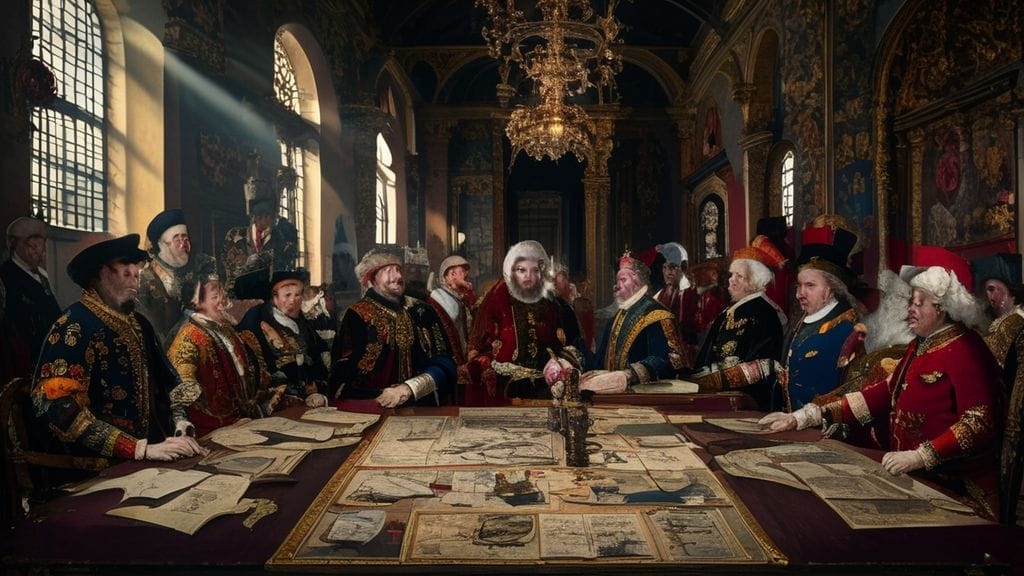
Inside the halls chosen for the discussions, the atmosphere was different. Time seemed to slow. Fireplaces struggled to warm large, drafty rooms hung with tapestries and the Habsburg double-headed eagle. At heavy tables, maps of Central Europe and the Balkans were unrolled and smoothed. Candles dripped wax on depictions of fortresses and river lines—Esztergom, Buda, Belgrade, the Sava, the Danube. Each place was both a dot of ink and a future graveyard.
The city’s ecclesiastical buildings, too, played their part. Masses were said for success in the negotiations; priests preached about the duty to oppose the “infidel.” But behind the pious rhetoric, some clergymen whispered worries about the cost. Many of their parishioners had sons already gone to fight, or feared conscription if this new alliance meant a prolonged campaign. Linz became a microcosm of Europe itself: hopeful, fearful, devout, skeptical—all at the same time.
The formation of the Holy League was discussed not only in grand chambers but also in narrow corridors and in quiet corners of courtyards, where envoys exchanged confidences away from formal records. It was here, as much as on parchment, that the future of the alliance was being shaped.
Habsburg Fear and Resolve: Leopold I’s Gamble
Emperor Leopold I of the Holy Roman Empire was not a man of spectacular charisma. Contemporary portraits show a pious, somewhat melancholic figure, with the distinctive Habsburg jaw and a contemplative gaze. But beneath the quiet exterior lay a stubborn determination. He understood, perhaps more clearly than most, that the future of his dynasty and of their Central European dominions hinged on whether the Ottomans could be driven back from the borders.
Leopold’s court in Vienna had only recently ceased to be a city under immediate threat. Even as celebratory masses honored the relief of the siege, the emperor’s advisors examined reports from Hungary and Croatia. They knew that Ottoman garrisons still held key fortresses, that raiding parties still probed into imperial lands, that the war could easily swing again. For Leopold, accepting anything less than a sustained, coordinated effort to push the Ottoman frontier back was unthinkable.
Yet his resources were limited. The Habsburg Monarchy was a composite structure, a tangle of territories with different diets, estates, and privileges. Raising troops and taxes required persuasion, negotiation, and sometimes coercion. War would strain these structures to their limits. If he acted alone, Leopold risked both military failure and domestic unrest. An alliance—especially one supported morally and financially by the papacy and militarily by other states—offered leverage he desperately needed.
Thus the emperor threw his weight behind the idea that would become the formation of the Holy League. His envoys in Linz were not free agents; they carried detailed instructions from Vienna, outlining red lines and acceptable compromises. Leopold wanted a binding commitment that would not simply collapse after a few campaigns. He also wanted recognized leadership for himself in the land war against the Ottomans, something that would reinforce his standing within the empire and abroad.
He was, however, acutely aware of the fragility of trust among European powers. France, under Louis XIV, loomed as both a Catholic monarch and an opportunistic rival, increasingly aggressive on the Rhine and in the Spanish Netherlands. The emperor needed to ensure that in allying with Venice and the papacy, he did not leave himself vulnerable to French pressure in the west. The diplomacy of Linz, therefore, was a balancing act between Ottoman danger and French ambition—two threats that weighed on the Habsburg imagination with almost equal force.
The Papal Chessboard: Innocent XI and the Holy War of Diplomacy
In Rome, Pope Innocent XI had watched the events of 1683 with a mixture of dread and opportunity. A man of austere piety and reforming zeal, he had long believed that the Christian princes of Europe were too busy tearing one another apart to see the looming threat from the East. The siege of Vienna seemed to confirm his worst fears—and yet its relief also confirmed his hope that, under the right pressure, they could act together.
The papacy, by the late seventeenth century, no longer commanded armies or material resources on the scale of earlier centuries. Its influence was moral, diplomatic, and financial. But it would be wrong to underestimate that influence. Papal nuncios moved quietly through courts, gathering information and spreading messages. Bishops echoed Rome’s concerns from their pulpits. And above all, the pope could dispense spiritual rewards—indulgences, blessings, the framing of a war as “holy”—that mattered deeply in an age when rulers still linked earthly success with divine favor.
Innocent XI became one of the prime architects behind the formation of the Holy League. He pressed Venice to commit more fully, urging them to see their maritime conflicts with the Ottomans as part of a larger Christian struggle. He encouraged Leopold I to seek not just a defensive posture but a coordinated offensive to push the Ottoman frontier back. He even tried, though with mixed success, to coax other Catholic powers into at least moral support, if not direct participation.
There was also a financial dimension. Rome offered subsidies drawn from ecclesiastical revenues to support military campaigns, particularly for the Habsburg war effort. These were not enormous sums by the standards of state budgets, but they helped tip the balance when treasuries were strained. In correspondence, the pope urged that money be used efficiently, not squandered: his letters reveal a man who, though hardly a general, understood that idle troops and unpaid regiments were a recipe for disaster.
At the same time, Innocent XI clashed repeatedly with Louis XIV of France, who resented papal interference and maintained his own ambiguous stance toward the Ottoman conflict. The pope’s insistence on prioritizing the eastern war often ran counter to the French king’s concern with dominating Western Europe. Thus, when the pope supported the formation of the Holy League at Linz, he was also implicitly challenging France’s attempt to set the agenda for Catholic Europe.
Venice Between Trade and Faith: The Maritime Power Joins the Crusade
If Leopold I represented the land frontier and Innocent XI the spiritual frontier, Venice embodied the maritime frontier of the struggle with the Ottomans. For centuries, the Most Serene Republic had balanced precariously between commerce and crusade, trading with Muslim powers even as it occasionally fought them in large-scale conflicts, such as the long and costly Cretan War over Candia (today’s Heraklion) which ended in 1669.
By 1684, Venetian leaders were painfully aware of the risks they faced in confronting the Ottomans alone. Their fleets could harass Ottoman shipping, their garrisons could defend key strongholds in the Adriatic and the Aegean, but the empire’s manpower and resources dwarfed those of Venice. Trade routes through the eastern Mediterranean had already suffered from decades of intermittent war. Venetian merchants, pragmatic as ever, wanted stability; yet they also understood that a permanently dominant Ottoman navy could squeeze their profits and narrow their opportunities.
Venice hesitated before committing to the formation of the Holy League. The republic’s governing council—its patrician families gathered in the Great Council and Senate—debated furiously. Some argued for caution: had the Ottomans not eventually proven willing to negotiate in previous conflicts? Would another crusading war erase decades of commercial networks painstakingly built in Levantine ports? Others spoke in more emotional terms, invoking the loss of Candia and the humiliation of prior defeats, insisting that only by seizing the moment, while the Ottomans were still reeling from Vienna, could Venice hope to restore its prestige.
Papal pressure and Habsburg diplomacy helped tip the scales. Venice’s representatives in Linz carried instructions to secure concrete commitments from Leopold and the papacy: aid in men, money, and coordinated military operations, especially in the Adriatic and Ionian seas, where Venice sought to expand or at least secure its holdings. When they finally agreed to join the alliance, it was not because they suddenly became idealistic crusaders, but because they calculated that this coalition offered the best chance to improve their strategic position against the Ottomans at a manageable cost.
Still, there was genuine religious fervor among parts of the Venetian elite and clergy. Public ceremonies in the city, announcing the participation in a new “holy league,” drew crowds. Processions wound through the streets, icons of saints were carried past glittering canals, and sermons described a united Christendom setting out once again to free oppressed Christians under Ottoman rule. Between the call of profit and the call of faith, Venice chose both.
Forging the Pact: Negotiations, Suspicion, and the Birth of the Treaty
The sessions in Linz where the alliance took shape were neither orderly nor harmonious. Each delegation arrived with its own anxieties and ambitions. Austrian envoys wanted assurances that Venice and the papacy would not abandon the war at the first sign of difficulty. Venetian representatives demanded concrete territorial goals in the Aegean and along the Dalmatian coast. Papal agents worked to keep the focus on a broader Christian cause, pressing for unity while carefully distributing the pope’s limited but symbolically potent subsidies.
Suspicion colored every conversation. What if the Habsburgs, having secured victory in Hungary, turned their new strength against other Catholic neighbors? Could Venice trust that imperial troops would come to their aid when Ottoman fleets threatened their islands? Would the pope keep the financial lifeline open if the war dragged on for years? Questions like these surfaced repeatedly, slowed discussions, and sometimes threatened to derail them.
The language of the draft treaty evolved through argument and compromise. Early versions were deemed too vague by some and too restrictive by others. The precise terms of mutual obligation—the number of troops to be fielded, the timing of campaigns, the sharing of spoils and territories—became the battlefield of diplomats. In some evenings, tempers frayed, voices rose, and interpreters struggled to keep pace with rapid-fire exchanges in Latin, Italian, and German.
Yet beneath the quarrels lay a shared recognition: the Ottomans would exploit every sign of division. News from the front made this vividly clear. Reports of skirmishes, of Ottoman attempts to reorganize in Hungary and the Balkans, arrived as the Linz talks dragged on. Each dispatch served as a stark reminder that while the envoys argued over words, soldiers bled on the frontier.
Gradually, a framework emerged that all parties could accept. The formation of the Holy League would bind them to a common struggle against the Ottoman Empire, with promises not to seek separate peace and to aid one another militarily. Venice’s maritime campaigns and the Habsburg land offensives would be coordinated, at least in theory, while papal support would sustain the spiritual and economic backbone of the coalition. The alliance would be officially portrayed as a defense of Christendom and a liberation effort for Christian subjects living under Ottoman rule—language designed to stir hearts across Europe.
The Night of 5 March 1684: Signatures in Wax, Echoes in History
On 5 March 1684, the waiting ended. The text had been revised, inscriptions corrected, seals prepared. That evening, in a chamber lit by clusters of candles whose light flickered on polished wood and faded frescoes, the representatives of the emperor, of Venice, and of the papacy assembled to give formal shape to what months of negotiation had crafted.
The air must have felt heavier than usual. Scribes stood ready, ink freshly poured into small wells. A thick silence preceded the beginning of the ceremony, broken only by the crackle of the fire in a large hearth. Outside, the city of Linz settled into its routine nighttime sounds—doors closing, distant barking of dogs, carts creaking along streets—largely unaware that the formation of the Holy League was about to be inscribed into European history.
One by one, the envoys approached the table. They read, or pretended to reread, the text before them, though by then every line was etched into their memory. Hands signed in a careful script; wax, melted over a candle, received the stamped impression of seals bearing coats of arms and symbols of authority. Each seal was both a pledge and a gamble.
In that room, the alliance seemed clear and solid. Yet even as the signatures dried, uncertainties hovered like shadows. Would soldiers in distant garrisons, peasants in scattered villages, merchants in Venetian harbors, and priests in mountain parishes accept and support this new “holy league”? Would the war, now certain to expand, end in triumph or exhaustion? None of the men at the table could know, but they had committed themselves and their states to the venture.
The ceremony ended, the parchment was carefully rolled and stored, copies would be dispatched to capitals, and soon the news would begin to spread. But this was only the beginning. What had been agreed in ink would have to be paid for in blood, gold, and time.
Articles of Faith and War: Inside the Text of the Holy League
The treaty signed at Linz was not a lyrical manifesto; it was a precise political instrument. Its clauses spelled out what lofty sermons only hinted at. The core principle was simple: the signatories pledged a united effort against the Ottoman Empire, renouncing separate peace treaties and committing to mutual assistance until the war’s aims were fulfilled.
One of the key components defined the military obligations. The Habsburg Monarchy undertook to lead large land armies into Hungary and neighboring territories, pressing hard against Ottoman fortresses and strongholds. Venice, in turn, promised substantial naval operations, harrying Ottoman transport and supply lines across the Adriatic and eastern Mediterranean, and supporting land actions where coastal opportunities allowed. The papacy, though not a military power in the same sense, committed funds and moral support, a promise that would translate into subsidies, indulgences, and a sustained propaganda effort.
Another sensitive aspect of the treaty concerned the division of future conquests. Venice wanted guarantees that if certain coastal or island territories were wrested from the Ottomans, they would fall under its sovereignty. The Habsburgs, focused on the Danube basin and the Carpathian frontier, sought recognition of their primacy in Hungary and Transylvania. The text reflected these understandings, though with enough ambiguity to leave room for later disputes.
Religious language pervaded the treaty. It portrayed the coalition as a defensive alliance of Christian powers against aggression and oppression, invoking the suffering of Christians living under Ottoman rule. This rhetoric was not merely ornamental; it helped mobilize public opinion and justified the enormous sacrifices that the coming campaigns would require. Priests and preachers across Catholic Europe could now point to a formal, papally blessed alliance and call their congregants to prayer, donation, and sometimes enlistment.
And yet, between the lines, one can sense the hard political calculations. The formation of the Holy League was meant to shift the strategic balance, to weaken the Ottomans in a way that no single European power, acting alone, could hope to achieve. In a letter often cited by historians, one diplomat remarked that “this league is made as much of fear as of faith”—a succinct acknowledgment that survival, as much as piety, drove the signatures at Linz.
Trumpets and Silences: Immediate Reactions Across Europe
News of the alliance’s birth spread unevenly. In Rome, the announcement was received with jubilation. Special masses were celebrated, and church bells rang. Papal publications framed the formation of the Holy League as a decisive turning point, a late but welcome answer to the long-standing call for unity against the Ottoman threat. In Venice, official proclamations were posted, and the city’s Piazza San Marco became the stage for choreographed celebrations—solemn processions, patriotic orations, and carefully staged displays of military readiness.
In Vienna and other Habsburg territories, the reaction was more complex. On one hand, the alliance promised that the empire would not stand alone; on the other, it signaled a long, grueling war ahead. Urban elites, who understood the strategic stakes, tended to support the move, albeit with cautious optimism. Rural populations, less informed about diplomatic nuances, often only saw the practical consequences: new levies, higher taxes, and increased requisitioning of supplies.
Elsewhere in Europe, the response ranged from muted approval to wary indifference. Catholic states with no direct frontier with the Ottomans offered congratulatory words but little concrete assistance. Protestant powers watched with a mixture of curiosity and suspicion. England and the Dutch Republic, concerned with their own maritime and commercial conflicts, were not inclined to pour resources into a mainly Catholic, papacy-backed project, though they understood that any weakening of the Ottoman Empire might eventually open new markets.
In France, Louis XIV maintained a careful distance. Officially, as a Catholic monarch, he could hardly denounce an alliance framed as a defense of Christendom. Unofficially, he had every reason to fear a stronger Habsburg presence in Central Europe, which would complicate his own expansionist designs on the Rhine frontier. French pamphlets and courtiers spoke laudably of the Christian princes fighting the “Turk,” but the king’s foreign policy prioritized his rivalry with the Habsburgs far more than solidarity within the Holy League.
The Ottoman court in Constantinople received the news with a mix of anger and grim recognition. It was not the first time Christian powers had attempted to unite, but the memory of the naval defeat at Lepanto in 1571, inflicted by an earlier holy league, still lingered. The new alliance threatened to rekindle that uncomfortable precedent. Ottoman chroniclers and officials debated the scale of the danger: some believed Europe remained too divided to pose a long-term existential threat, others warned that this time, the coalition might dig more deeply into the empire’s European holdings.
Men, Money, and Gunpowder: Mobilizing for a New Crusade
Once the celebratory echoes faded, the true challenge of the formation of the Holy League emerged: turning words on parchment into regiments in the field and ships at sea. This required a Herculean mobilization of resources—logistical, financial, and human—that stretched the capacities of all three main signatories.
In the Habsburg lands, military administrators fanned out across provinces to organize recruitment. Notices were posted, calling men to arms, appealing both to duty and to the promise of spoils. In practice, many soldiers were not volunteers but conscripts, drawn from villages that could ill afford to lose able-bodied laborers. Mustering grounds filled with new recruits, some motivated, others resigned. Weapons had to be produced and repaired, uniforms sewn, horses purchased or requisitioned. Grain and fodder had to be stockpiled along projected march routes toward the Hungarian frontier.
Pay was a constant problem. Armies marched on silver as much as on stomachs. Delays in pay could quickly lead to desertion, looting, or mutiny. The imperial treasury strained to keep up, even with papal subsidies and loans from bankers. War taxes were levied—sometimes framed as exceptional “Turkish taxes”—and estates grumbled at the burden. The cost of the formation of the Holy League, invisible in its neat clauses, now manifested in every extra coin demanded from subjects.
Venice faced its own version of the same ordeal. The republic had to outfit fleets, repair arsenals, and man galleys. Rowers, soldiers, and officers had to be recruited or reassigned. Naval warfare demanded not just ships but specialized infrastructure: timber for hulls, tar for sealing, cannon and powder, rope and canvas. The Venetian Arsenal worked at full capacity, its hammering and sawing a constant soundtrack to the republic’s entry into the new war. Merchants worried about disruptions to trade, but many also found opportunity in supplying the war effort.
Rome, too, mobilized in its own way. Preachers across Catholic Europe received instructions to frame the war as just and necessary, to encourage donations to support the troops, and to foster an atmosphere of spiritual solidarity. Special collections were taken in churches, and devotional literature extolled the virtues of those who fought against the “infidel.” It’s astonishing, isn’t it, how sermons and silver could become two sides of the same weapon?
On the Edge of Empires: How the Balkans Felt the Shockwave
While diplomats debated and rulers strategized, the people of the Balkans—the lands between Vienna and Constantinople—lived the concrete consequences of the formation of the Holy League. To them, alliances in distant cities meant more soldiers on the roads, more requisitions, more risk.
Many of these regions were ethnically and religiously mixed: Orthodox Christians, Catholics, Muslims, Jews, and others lived in shifting mosaics. Under Ottoman rule, Christians paid special taxes and faced legal limitations, yet they often had a degree of local autonomy, especially in rural communities. The arrival of a new Christian alliance promising “liberation” sounded different depending on whose ears heard it.
Some Christian groups, especially in border areas, saw the Holy League as a potential savior. They had endured the burdens of Ottoman administration and longed, or were encouraged to long, for a restoration of Christian rule. Habsburg and Venetian agents fanned these hopes, promising support, protection, and perhaps privileges in a future order. Priests and local notables were courted to encourage uprisings or at least sympathetic neutrality when League armies approached.
At the same time, many communities feared being caught between hammer and anvil. They remembered earlier wars in which villages had been burned by retreating and advancing armies alike. For Muslims living in border regions—sometimes descendants of settlers or converts from earlier centuries—the prospect of a Christian victory brought fears of reprisal, expulsion, or forced conversion. Some began to plan for flight deeper into Ottoman territory if the front line collapsed.
The formation of the Holy League thus sharpened existing tensions. It turned borderlands into potential powder kegs, where neighbors might suddenly find themselves defined as allies or enemies based on choices far beyond their control. The human geography of the region would bear scars from this period long after the soldiers had moved on.
Blood and Banners: The Holy League at War
Within a year of the treaty in Linz, the alliance was no longer an abstraction. Imperial armies moved into Hungary, engaging Ottoman forces in a series of sieges and battles that gradually wore down the sultan’s grip on the region. Cities and fortresses—Buda, Pécs, Esztergom—became familiar names in dispatches and sermons.
One of the most symbolic victories came with the recapture of Buda in 1686, after a brutal siege that involved not only Habsburg and German troops, but also contingents from various states moved by the cause or by their own interests. The city, which had been under Ottoman rule for over 140 years, became a potent emblem of the new offensive spirit of the Holy League. Yet its capture came at a terrible cost in lives and destruction. Surviving chronicles describe scenes of looting, killing, and reprisals that make clear how thin the veneer of “holy” war could be when confronted with the raw instincts of men in battle.
Venice fought its own intense campaigns, particularly in the Peloponnese (Morea), where it aimed to wrest control from the Ottomans. Venetian and allied troops captured several fortresses and towns, at times greeted as liberators by local Christians, at other times seen as just another occupying power. The republic’s fleets confronted Ottoman ships in hard-fought naval engagements that determined control of crucial sea lanes.
The Ottomans responded with attempts to reorganize and counterattack. New commanders were appointed; troops were shifted from other fronts. The war turned into a grinding contest of attrition. Both sides suffered from the same afflictions: disease in camps, supply shortages, desertion. Entire regions were devastated, crops left unharvested, villages abandoned. The Danube and Sava rivers carried not just trade but also the flotsam of war—burned timbers, dead animals, sometimes bodies.
Throughout this period, the formation of the Holy League continued to matter not just symbolically but practically. Without the combined pressure on land and sea, without papal financial support and the moral narrative of a united Christian front, it is doubtful that the campaigns could have been sustained at such intensity. One historian, reflecting on these years, has written that “Linz, more than Vienna, marked the moment when Europe decided not to merely survive, but to push back” (a paraphrased judgment found in modern scholarship on the conflict).
Rivals and Spectators: France, England, and the Wider European Game
While the Holy League fought in the east, the rest of Europe did not stand still. Louis XIV pursued his wars along the Rhine and against the Dutch, testing Habsburg defenses in the west. His unwillingness to join the League—indeed, his frequent diplomatic maneuvers to undermine Habsburg alliances—highlighted the fact that Europe’s conflicts could not be neatly divided into “Christian versus Muslim.” Catholic France wanted Ottoman weakness, but not Habsburg overstrength.
England and the Dutch Republic were preoccupied with their own priorities, including the struggle against French expansion and the turmoil that would culminate in the Glorious Revolution of 1688. They watched the eastern front with interest, occasionally celebrated Christian victories, but did little to fold themselves directly into the League’s operations. Their merchants, however, were keen observers of how shifting borders and war-induced disruptions might affect trade in the Mediterranean and the Levant.
In this broader context, the formation of the Holy League also served as a kind of moral capital for the Habsburgs and Venice. They could present themselves as the main defenders of Christendom, a role that bolstered their legitimacy and provided a counterweight to French pretensions. The papacy reinforced this narrative, praising League victories as God’s favor while often expressing veiled disappointment at those Catholic rulers who remained aloof.
Diplomatic correspondence from this era reveals a complex tapestry of calculations. States far from the front line wondered how a dramatically weakened Ottoman Empire might affect the European balance of power. Would Russia, still a looming factor to the northeast, eventually push into the vacuum? Would the Habsburg Monarchy become so dominant in Central Europe that it could no longer be contained? The echoes of Linz thus reached far beyond the Danube basin, shaping long-term strategic thinking across the continent.
Lives in the Balance: Soldiers, Peasants, and the Cost of Holy War
Behind every grand strategic move lay countless individual lives disrupted or destroyed. Soldiers of the Holy League—imperial infantrymen from Austrian villages, Croatian border warriors, Italian volunteers under Venetian banners, mercenaries from German principalities—endured freezing marches, relentless campaigning seasons, and deadly sieges. Disease often claimed more lives than combat; camp fevers, dysentery, and plague outbreaks could ravage regiments within weeks.
Letters from common soldiers, where they survive, tell a story less about crusading zeal and more about fatigue, fear, and longing for home. One Habsburg soldier, writing from a camp near Buda, lamented not the enemy but the endless mud, the poor rations, and the uncertainty over pay. “We are told that we fight for the faith,” he wrote, “but my thoughts are with my children and whether they have enough bread.” Such voices, though faint in the historical record, remind us that the formation of the Holy League was lived, at ground level, as hardship more than triumph.
For peasants in both Habsburg and Ottoman territories, the war meant requisitions of grain and livestock, billeting of troops, and the constant danger of raids. Fields went untilled, harvests were stolen or burned, and famine became a shadow companion to the war. Refugees fled front-line regions, sometimes moving deeper into imperial lands, sometimes seeking shelter in cities or monasteries. Local economies reeled under the strain, and traditional patterns of life were ruptured.
The religious dimension of the conflict could intensify brutality. Each side portrayed itself as fighting a just war, blessed by God. This rhetoric, while inspiring some, could also be used to justify atrocities against those labeled as enemies of the faith. Muslim communities caught on the wrong side of a shifting front faced massacres or forced displacement. Christian groups suspected of collaborating with the Ottomans could encounter harsh reprisals once League forces advanced. The war’s “holy” label did not soften its impact; if anything, it sometimes made it harsher.
From Linz to Karlowitz: How the League Redrew the Map
The war that followed the formation of the Holy League did not end quickly. Years of campaigning gradually shifted the front line east and south, as Habsburg armies took much of Hungary and Transylvania, while Venice secured parts of the Morea and other strategic points. Ottoman resistance was stubborn, but the cumulative effect of multiple defeats and internal strains weakened the empire’s hold on its European provinces.
By the late 1690s, exhaustion set in on all sides. The war had consumed enormous resources and lives, and broader European politics demanded attention. Negotiations eventually led to the Treaty of Karlowitz in 1699, a settlement that formally recognized many of the territorial changes wrought by the conflict. For the Habsburgs, this meant substantial gains in Hungary and neighboring territories; for Venice, a foothold in the Peloponnese and elsewhere. For the Ottomans, it marked the first major diplomatic acknowledgment of a significant territorial retreat in Europe.
In retrospect, historians often draw a line from Linz to Karlowitz, seeing the formation of the Holy League as the political and military engine that drove this transformation. Without a coordinated alliance, it is doubtful that the Habsburgs and Venice could have forced such far-reaching concessions. The balance of power in Central and Eastern Europe tilted decisively: the Habsburg Monarchy emerged as a major Central European empire, while the Ottoman presence beyond the Balkans shrank.
The treaty did not, of course, end all conflict. The Habsburgs would still face uprisings in newly acquired territories, and Venice’s gains would not endure indefinitely. But Karlowitz symbolized a broader shift. The psychological aura of Ottoman invincibility in Europe, already shaken at Vienna, was now decisively broken. Future European strategists would see the empire not as an unstoppable threat, but as a great power that could be contained and even rolled back.
In this sense, the echoes of that March day in Linz resounded well beyond the seventeenth century. Borders drawn and redrawn in the wake of the Holy League’s campaigns influenced the demographic and political patterns that would play out, often violently, in later centuries.
Faith, Memory, and Myth: The Holy League in European Imagination
As time passed, the events surrounding the formation of the Holy League began to drift from lived experience into collective memory, and from memory into myth. In Catholic regions, particularly in Habsburg lands and parts of Italy, the alliance’s victories were commemorated in church paintings, plaques, and annual celebrations. Saints and soldiers mingled in iconography—angels hovering above cavalry charges, the Virgin Mary watching over cannons and standards.
Vienna’s salvation in 1683 often overshadowed Linz in popular memory, yet the League itself became a recurring motif in sermons and patriotic narratives. It was evoked as proof that when Christian princes overcame their divisions, they could achieve great things. The papacy, looking back, cited the alliance as one of the notable successes of its role as mediator and spiritual leader in temporal conflicts.
In Venice, the story was more ambivalent. Initial enthusiasm and pride in victories gave way, over time, to recognition that the war had drained resources and that some territorial gains were temporary. Yet the image of Venetian galleys sailing under the cross against the crescent, of banners fluttering over captured fortresses, remained a part of the city’s self-image as a defender of Christendom and of its own independence.
Among Orthodox Christians in the Balkans, memory was mixed. Some saw the Holy League as a partial liberator from Ottoman rule; others remembered broken promises, heavy burdens under new rulers, or shifts from one distant overlord to another. Muslim communities, for their part, often preserved the period in oral histories as one of suffering and loss, reinforcing a sense of embattled identity on the European frontier of Islam.
Myth-making simplified the complexities of the formation of the Holy League. In popular tales, the motives became purer, the alliances smoother, the battles more clearly divided into good and evil. Yet the historical reality, as we have seen, remained more tangled. The League was born from fear, hope, rivalry, and faith all at once—a fact that only deep historical inquiry can fully reveal.
Historians and the Holy League: Changing Interpretations
Over the centuries, scholars have continually reinterpreted the significance of the formation of the Holy League. Early chroniclers, often writing from close to the events and within a strong confessional framework, emphasized divine providence and the moral clarity of Christian resistance. Later historians, especially in the nineteenth century, sometimes folded the League into nationalist narratives, portraying it as the forerunner of modern struggles for independence in Central and Eastern Europe.
Twentieth-century scholarship began to peel back these layers. Influenced by the rise of social and economic history, historians looked beyond battlefield maneuvers and diplomatic high politics. They examined tax records, village chronicles, and correspondence to understand how ordinary people experienced the war unleashed by the alliance. Some scholars argued that the League, while undoubtedly a turning point in the Ottoman-Habsburg conflict, should also be seen as part of a broader pattern of state-building and resource extraction in early modern Europe.
Others focused on the cultural contact zones created or reshaped by the conflict. They explored how Christian and Muslim communities along the frontier adapted, resisted, or accommodated the new realities imposed by shifting borders. The formation of the Holy League, in this view, was not only a military event but also a catalyst for changes in identity, memory, and intercommunal relations.
One widely cited modern historian has observed that “the Holy League of 1684 was as much a coalition of convenience as a crusade of conviction, though its participants rarely saw the distinction” (paraphrasing a sentiment common in contemporary works on the subject). This perspective underscores the dual nature of the alliance, bridging sincere religious motivation and cold political calculus.
Debates continue. Was the League primarily responsible for initiating the long Ottoman retreat from Central Europe, or did it merely accelerate processes already underway due to internal Ottoman challenges? To what extent did the alliance strengthen or weaken the participating states in the long term? And how should we weigh its religious rhetoric against its often brutal, very worldly consequences? These questions keep the history of Linz and its treaty alive in academic discourse.
Echoes in the Modern World: Borders, Identities, and Old Frontiers
The lines on today’s map of Europe still whisper of 1684 and its aftermath. Modern Hungary’s existence as a largely unified state, rather than a patchwork of Ottoman, Habsburg, and independent territories, owes much to the Habsburg advances made possible by the Holy League’s campaigns. The shifting of Ottoman influence back toward the Balkans laid foundations for later national movements among Serbs, Croats, Romanians, and others, whose territories had once been contested ground between empires.
Confessional divides in parts of Central and Southeastern Europe—where Catholic, Orthodox, and Muslim communities sometimes live in uneasy proximity—also bear the imprint of the seventeenth-century wars. The formation of the Holy League helped crystallize a mental map in which the Danube basin became a key frontier between “Europe” and the “Ottoman East,” a mental map that political actors and ideologues in later centuries would repeatedly invoke and manipulate.
In the modern era, with the benefit of distance but also the burden of new conflicts, historians and citizens alike wrestle with this legacy. On one hand, the alliance can be seen as a milestone in the long and often violent process by which European states secured their current territories. On the other, its framing as a religiously charged struggle has fed narratives of civilizational conflict that continue to influence public discourse.
Remembering the formation of the Holy League in all its complexity helps resist oversimplified stories. It reminds us that alliances are rarely purely virtuous or purely cynical, that “holy” wars leave behind very unholy suffering, and that moments of apparent unity often conceal deep fractures. Linz in 1684 was a crucible in which fear and hope were melted together into an alliance whose reverberations are still, subtly, with us.
Conclusion
The treaty signed in Linz on 5 March 1684 was, in appearance, just another piece of parchment inscribed by careful hands. Yet the formation of the Holy League it embodied became one of those rare diplomatic acts that genuinely altered the course of history. Born from the immediate terror of Vienna’s near fall and the longer anxiety of Ottoman expansion, the alliance crystallized a decision: Christian powers, however divided by rivalry, would make a concerted effort not only to survive but to push back.
We have traced the story from the siege-scarred landscapes of Central Europe to the candlelit halls of Linz, from papal antechambers to Venetian arsenals, from the quiet fears of peasants to the soaring rhetoric of preachers. Along the way, we have seen that this was no simple crusade. It was an intricate negotiation between faith and interest, piety and power. The Holy League’s campaigns brought both liberation and devastation, reconfigured borders, and reshaped identities in Hungary, the Balkans, and beyond.
In the end, the alliance helped usher in a new balance of power in Europe, marked by the Treaty of Karlowitz and the long retreat of Ottoman control in Central Europe. Yet it also left a more ambiguous inheritance: memories of holy war, myths of civilizational struggle, and frontiers that remained contested in hearts and minds long after they were inked on maps. To look back at Linz is to confront the enduring lesson that decisions taken in quiet rooms by a handful of men can unleash forces that transform the lives of millions, in ways they could scarcely predict.
FAQs
- What was the Holy League formed in 1684?
The Holy League formed in 1684 at Linz was a military and political alliance between the Habsburg Monarchy, the Republic of Venice, and the papacy, created to wage coordinated war against the Ottoman Empire after the siege of Vienna. It committed its members to mutual assistance, joint campaigns, and a pledge not to make separate peace with the Ottomans. - Why was the formation of the Holy League considered significant?
It was significant because it transformed scattered resistance into a sustained, coordinated offensive that shifted the balance of power in Central and Eastern Europe. The alliance enabled major territorial gains for the Habsburgs and Venice and marked a turning point in the long Ottoman-Habsburg rivalry, culminating in the Treaty of Karlowitz in 1699. - Who were the main powers in the Holy League of 1684?
The core members at its creation were the Holy Roman Emperor Leopold I (representing the Habsburg Monarchy), the Republic of Venice, and Pope Innocent XI as spiritual and financial sponsor. Other powers, such as Poland-Lithuania and later Russia, were involved in the broader anti-Ottoman coalition during the same period, but the Linz treaty specifically bound these three. - Was the Holy League primarily religious or political in nature?
It was both. The alliance was framed and experienced as a religiously motivated defense of Christendom, and the pope played a central role in promoting and supporting it. At the same time, each member pursued clear political and territorial interests—Habsburg expansion in Hungary, Venetian gains in the eastern Mediterranean—making the League a coalition of faith and realpolitik. - How did ordinary people experience the wars of the Holy League?
Most ordinary people—soldiers, peasants, townsfolk—experienced the war as hardship and danger rather than as a grand crusade. They faced conscription, heavy taxation, requisitioning of supplies, and the constant threat of raids, sieges, and displacement. While religious rhetoric was pervasive, daily life was shaped more by survival amid destruction. - What were the long-term consequences of the Holy League’s campaigns?
Long-term consequences included the Habsburg reconquest of most of Hungary and neighboring territories, Venetian control over parts of the Peloponnese (though not permanently), and a marked retreat of Ottoman power in Central Europe. These changes influenced later national movements, altered confessional and ethnic patterns in the region, and helped define a new geopolitical frontier between Europe and the Ottoman world. - How do historians today view the formation of the Holy League?
Modern historians tend to see it as a complex event where genuine religious conviction intersected with strategic calculation. They emphasize its role in state-building, frontier dynamics, and social disruption, rather than treating it purely as a heroic episode of “Christendom versus Islam.” Current scholarship also highlights the experiences of border populations and the ambiguities of “liberation” in contested regions.
External Resource
Internal Link
Other Resources
- Encyclopaedia Britannica – general search for the exact subject
- Google Scholar – academic search for the exact subject
- Internet Archive – digital library search for the exact subject

