Table of Contents
- A Distant Thunder over Late Roman Gaul
- The Crumbling Empire and the Kingdoms at Its Edges
- Who Was Riothamus? Shadows of a British King
- Euric and the Rising Storm of the Visigoths
- An Appeal from a Dying Empire
- Across the Sea: The British Crossing into Gaul
- Alliances, Letters, and Roman Betrayals
- On the Eve of Battle: Camps, Councils, and Omens
- When Riothamus Fights the Visigoths: The Clash Begins
- The Field of Déols: Blood, Dust, and Broken Shields
- Retreat to the Burgundians and the Vanishing King
- Ripples Across Gaul: Politics after the Defeat
- Life in the Shadow of War: Ordinary People of 470
- From Battle to Legend: Was Riothamus an Early Arthur?
- Historians, Sources, and the Slender Thread of Evidence
- The End of Roman Gaul and the Gothic Dawn
- Why This Forgotten Battle Still Matters
- Conclusion
- FAQs
- External Resource
- Internal Link
Article Summary: In the year 470, as the Western Roman Empire staggered towards collapse, a little-known British king named Riothamus led his warriors across the sea to fight in defense of Gaul. This article reconstructs the world in which riothamus fights the visigoths under King Euric, exploring the shattered political landscape, the uneasy alliances, and the desperate hopes pinned on one last intervention from across the Channel. We follow Riothamus from the mists of post-Roman Britain to the battlefields near Déols, where his outnumbered forces clashed with disciplined Visigothic armies at the edge of a dying order. Drawing on rare and fragile sources, we examine how a campaign that began as a Roman-backed coalition became a tragic story of betrayal and defeat. Yet behind the military maneuvers and diplomatic letters, we also glimpse the lives of soldiers, refugees, merchants, and villagers swept up in the conflict. The narrative then turns to the afterlife of the event, asking whether this moment when riothamus fights the visigoths helped seed later legends of King Arthur. Finally, we reflect on why this obscure frontier war matters, showing how it illuminates the violent birth of medieval Europe and the transformation of Roman Gaul into Gothic realms.
A Distant Thunder over Late Roman Gaul
In the waning years of the Western Roman Empire, thunder often came not from storms but from the tramp of marching feet and the crack of splintering shields. Around 470, on the fractured frontiers of Gaul, one such echo of thunder carried a name that has almost vanished from popular memory: Riothamus. In a time when emperors were made and unmade by soldiers, when provincial cities negotiated directly with barbarian kings for survival, a leader from the mist-bound island of Britain crossed the Channel with his warband. Riothamus fights the Visigoths—so the later chronicles will summarize, briefly, almost casually. Yet hidden behind those few words is a world of fear, ambition, and fading imperial light.
Picture Gaul in that year. The Roman roads still striate the countryside like old scars. Town walls, once symbols of civic pride, now serve as desperate ramparts against cavalry raids. Latin inscriptions fade on public buildings whose roofs leak and whose statues have been toppled or melted for coin. Tax collectors still travel with stamped tablets and imperial edicts, but outside the town gates, authority is more often carried on a spear point or negotiated in hastily arranged councils beneath cathedral apses. In this landscape, where Roman power is both everywhere and nowhere, a call for aid is sent across the sea—to a British king whose very title, “rex Britannorum,” sounds like something out of legend.
When riothamus fights the visigoths in this crumbling borderland of Gaul, he steps into a drama already at its brutal climax. The Visigothic king Euric is expanding from his base in southwestern Gaul, casting a long and dark shadow over the remaining Roman provinces. The emperor in Italy is weak, his generals faction-ridden, his coffers drained. Still, the old imperial reflex persists: call in allied kings, federate new troops, gather one last coalition to repel the latest threat, just as emperors had done for centuries from the Rhine to the Danube. That ancient reflex, however, is now operating in a world of fewer choices and mounting desperation.
As the British sails appear off the Gallic coast and Riothamus’s men disembark—horse hooves slipping on unfamiliar beaches, spear points glinting in the pale light—few of them can know they are entering a struggle that will shape not only their own fate but the map of post-Roman Europe. Fewer still can guess that, fifteen hundred years later, scholars will argue over those fleeting words, riothamus fights the visigoths, asking whether somewhere behind this shadowy king stands the first faint outline of Arthur, the once and future hero of Britain. But this was only the beginning…
The Crumbling Empire and the Kingdoms at Its Edges
To understand why a British ruler would ever cross into Gaul to fight the Visigoths, one must step back and look at the greater disintegration of the Western Roman Empire. By 470, the imperial apparatus in the West is a thin husk stretched over a patchwork of new kingdoms. Rome itself is no longer a functioning capital in any meaningful sense; the real centres of power are courts in Ravenna, Milan, or wherever the latest magister militum, the strongman-general, chooses to lodge his staff and treasury.
The map of Gaul—once the proud grouping of Roman provinces like Lugdunensis, Aquitania, and Belgica—is now a mosaic. To the northeast, along the Rhine, Frankish warlords expand from their riverine strongholds, sometimes allies, sometimes raiders. In the southeast, the Burgundians have carved out a kingdom centered on Lyon and Geneva, officially foederati of Rome yet very much sovereign in practice. In the southwest, the Visigoths dominate from Toulouse, pressing north and east like a tide. Only a central band of territory, stretching roughly from the Loire to the Rhône, still answers more-or-less to imperial officials, governed in the name of distant emperors whose edicts arrive late, if at all.
This is not the sudden “fall” so often imagined in popular retellings but a long, grinding, almost weary transformation. Urban life continues; bishops still preside over councils; aristocrats still cultivate estates and patronage networks. Yet the horizon has changed. Where once a governor might fear an imperial audit or a palace intrigue, he now fears a Visigothic cavalry raid or a Burgundian incursion. The empire’s famed legions have long been replaced by small units of comitatenses and local militias, padded out by barbarian federates who owe as much loyalty to their own kings as to the emperor.
In this environment, political calculation becomes a survival art. Roman elites in Gaul must weigh whether to cling to the imperial center in Italy, bet on the rising power of the Visigoths, or negotiate with neighboring kings like the Franks and Burgundians. Imperial envoys move from court to court, bearing promises and threats; bishops write letters trying to secure terms; provincial leaders sit at long wooden tables lit by flickering oil lamps, tracing borders with their fingers as they ponder which overlord to recognize.
Somewhere in this complex web, the idea arises: call on Britain. Once a Roman province, then abandoned—or at least left to fend for itself—Britain is now a distant but not forgotten land of Latin-speaking clerics, Romano-British aristocrats, and war-leaders battling their own troubles. A British monarch could still be seen as a natural ally of Rome, bound by old ties of culture and faith. And so, as Visigothic pressure builds in Gaul and the imperial center looks for fresh allies, a path opens for a man like Riothamus to step onto the continental stage.
Who Was Riothamus? Shadows of a British King
Riothamus appears in our sources like a figure wreathed in fog, glimpsed only at a distance and for a moment. The late Roman historian and diplomat Sidonius Apollinaris writes of him in a letter, calling him “Riothamus, king of the Britons.” Jordanes, a sixth-century Gothic historian, alludes to his campaign against Euric. That is almost all. From these droplets of text, historians have labored to reconstruct a life, a kingdom, and a war.
What might “king of the Britons” have meant in 470? Britain by then was a fractured land. The Roman legions had been withdrawn decades earlier; imperial officials were gone or had merged into local aristocracy. Power rested with local warlords, petty kings, and councils of Romano-British nobles defending walled towns and hillforts against Saxon and Pictish raiders. To be “king of the Britons” could mean a high king presiding over several smaller rulers, or the dominant leader of a particular region whose influence radiated outward through alliances and pledges.
The name “Riothamus” itself has been interpreted as Celtic, possibly meaning “great king” or “highest king” (from *Rigotamos*). If so, it may be less a personal name and more a title—something akin to “High King.” This has fed the romantic notion that Riothamus was a pan-British leader, recognized across wide swaths of the island. Yet the truth may be more modest. He could have been a powerful ruler in western or southern Britain whose prominence, at least in the eyes of Gaulish observers, justified the lofty designation “king of the Britons.”
Imagine him, then: a man raised in the halls of Romano-British villas, where mosaic floors still depict mythological scenes and Latin prayers echo under tiled roofs, but whose adult life is spent in timber fortresses, overseeing musters and negotiating with fractious nobles. He would have spoken Latin, perhaps fluently, able to read letters from Gaul; he would have been familiar with Roman military organization but reliant on a very different, more personal form of kingship—oaths, gifts, and kinship ties binding his followers to him.
The decision to sail to Gaul was no minor gesture. It meant leaving Britain at a moment when Saxon incursions and internal rivalries already stretched resources thin. For Riothamus to do so suggests he saw not only obligation but opportunity. An alliance with the Roman authorities in Gaul might bring prestige, wealth in the form of subsidies or land grants, and perhaps Roman support against his enemies back home. If riothamus fights the visigoths on behalf of Rome and prevails, he might emerge as a trans-Channel power, a king with one foot in Britain and one in the fading but still potent Roman world of Gaul.
There is also the enduring question of legend. Some modern scholars, most famously Geoffrey Ashe, have proposed that Riothamus lies behind the figure of King Arthur. The parallels are suggestive: a British leader, active around the late fifth century, fighting overseas on the Continent, betrayed by erstwhile allies, and disappearing mysteriously after defeat. In Geoffrey of Monmouth’s twelfth-century “History of the Kings of Britain,” Arthur campaigns in Gaul and is betrayed by his own men; Ashe saw in this a distorted memory of the real episode when riothamus fights the visigoths and is abandoned by Roman support. The hypothesis remains controversial, but it has sufficed to ensure that this otherwise obscure king continues to haunt the margins of both history and myth.
Euric and the Rising Storm of the Visigoths
If Riothamus is a figure seen through mist, King Euric of the Visigoths stands in somewhat sharper relief. He was a formidable ruler who understood that the weakness of Rome offered him an unprecedented chance to build a durable kingdom. The Visigoths had been foederati of the empire, settled in Aquitaine and parts of Gaul since the early fifth century. Under earlier kings, they had alternated between loyal service to Rome and open rebellion. Euric, who came to power around 466, had little interest in playing the role of subordinate ally.
Euric was both warrior and legislator, known for codifying Gothic law and for his relentless expansion. From his base in Toulouse, he pushed his borders. To the north, he eyed the Loire valley; to the east, the Rhône corridor and the fluctuating Burgundian frontier; to the south, the Pyrenees and Hispania. Each campaign was calculated, exploiting Roman disunity and timing attacks to coincide with internal crises in Italy. In the words of one contemporary, he “seized Gaul as though it were the property of none.”
Under Euric, the Visigothic army honed its reputation as a highly effective cavalry force. Armed with long swords and spears, protected by shields and sometimes lamellar armor, Visigothic soldiers combined Roman battlefield discipline with Germanic ferocity. Many had served as federate troops in imperial armies; they knew Roman tactics, siege methods, and logistics. Now they put that knowledge to use for their own king, not for an emperor in Ravenna or Rome.
For Roman provincials, Euric’s advance was terrifying and strangely familiar. They had grown up with tales of Alaric’s sack of Rome earlier in the century, of Hunnic raids, of Gothic troops appearing as both saviors and destroyers. Now the Visigoths were not transient raiders but builders of a new state. Bishops wrote letters pleading for protection, sometimes to imperial authorities, sometimes directly to Euric or rival kings. Local nobles calculated whether to resist, to flee, or to open their gates and negotiate their entry into this burgeoning Gothic order.
By around 470, Euric’s ambitions intersected fatally with what remained of Roman Gaul. The imperial government, anxious about his growing power, sought to hem him in with allies. The Burgundians were one pillar of this strategy. The other, more surprising one, would be the British—a role filled by Riothamus and his seaborne warriors. It’s astonishing, isn’t it? A Gothic king in Toulouse, a Roman emperor in Italy, a British monarch across the sea, all drawn into a conflict over the battered provinces of Gaul. In this triangulation of power, the stage is set for the moment when riothamus fights the visigoths in pitched battle.
An Appeal from a Dying Empire
The Western Roman Empire in the late 460s and early 470s was not yet extinguished, but its pulse was faint. Emperors were raised and cast down by competing generals—Ricimer, then Gundobad, then others who wielded the real power behind the throne. The emperor around this time, Anthemius, had been placed on the throne by the Eastern court at Constantinople in a final effort to salvage the West. His grand campaigns, including a massive but disastrous expedition against the Vandals in North Africa, drained resources that could have been used to stabilize Gaul and Italy themselves.
As Visigothic incursions intensified, imperial strategists in Ravenna and Gaul saw the necessity of enlisting regional allies. Written appeals, now lost, likely traveled between courts. We know from Sidonius Apollinaris that correspondence existed between Gaulish bishops, imperial officials, and foreign kings. One of these channels must have reached Britain, bearing a message of both desperation and opportunity.
What did that message promise? Perhaps formal recognition of Riothamus as a legitimate client king of Rome, with titles and honors. Perhaps land in Gaul for his followers, carved out of territory wrested from Gothic control. Perhaps subsidies in gold and grain, along with the backing of Roman prestige. For a British ruler grappling with his own enemies at home, these would be powerful incentives. To fight under the aegis of Rome still carried immense symbolic weight; to stand as Rome’s champion in Gaul might elevate Riothamus above his British rivals.
There was also the Christian dimension. By 470, both Romano-Britons and Romans in Gaul were firmly Christian, and the Visigoths, though also Christians, adhered to Arian theology, which Nicene bishops denounced as heresy. A campaign framed as the defense of Catholic communities in Gaul against Arian Goths could be presented as a holy duty, a just war in the language of the time. Bishops might have urged Riothamus to see himself as a protector of the faithful, a role that later hagiographers would readily ascribe to heroic princes.
And so the decision was made. Riothamus accepted the call. He would muster his warriors, load ships with horses and supplies, and sail for Gaul. In that choice, we see not only a political calculation but a poignant faith in institutions that were near collapse. The empire that summoned him was dying, but its ability to inspire loyalty and sacrifice remained formidable. In answering that call, Riothamus stepped into the role of a Roman ally at the very moment that such allies were beginning to shape, and sometimes supplant, the imperial world they had once merely served.
Across the Sea: The British Crossing into Gaul
The Channel crossing that brought Riothamus and his men to Gaul must have been both routine and momentous. Routine because trade and migration between Britain and the continent had continued even after the formal end of Roman administration. Wool, grain, slaves, wine, and luxury goods still passed over those narrow waters. Momentous because this time the ships held an army, not merchants—a force estimated by one source at around 12,000 men, though such figures are often more symbolic than precise.
Visualize the embarkation. On a windy shore in southern Britain—perhaps in what is now Devon or Dorset—troops gather. They are not uniformed legions but a motley host of Romano-British cavalry, infantry drawn from town militias and rural retainers, perhaps even some Irish or Saxon mercenaries bound by pay rather than kin. Many wear partial armor—mail shirts for the wealthy, leather and padded garments for others—carrying oval or round shields painted with bright patterns. Their weapons are spears, short swords, and long-slung throwing darts. Among them ride minor nobles, each commanding their own small following, all ultimately sworn to Riothamus.
The ships themselves are sturdy wooden vessels, perhaps adapted Roman designs: broad-hulled transports with square sails, capable of carrying men, horses, and supplies. As they push off into the choppy gray sea, the coastline shrinks behind them. Some of the men have never left Britain; for them the voyage is both frightening and exhilarating. They are bound for Gaul, a land they know only by reputation—of rich cities, vineyards, and, now, of Gothic raiders.
The crossing would have taken a day or two in good conditions, longer in rough seas. Below deck, horses whinny nervously; above, men huddle against the wind, passing flasks and muttering prayers in Latin and British dialects. Officers walk the decks, checking lashings, ensuring the cargo remains secure. Somewhere aboard, perhaps in the stern cabin of the flagship, Riothamus pores over letters from his Roman contacts: instructions where to land, where to rendezvous with Gallic allies, which cities still fly the imperial standard and which have gone over to Euric.
On the far shore, the arrival of these ships would have caused a stir. Fishermen and harbor officials watch as unfamiliar banners appear on the horizon. Soon the harbor fills with the creak of rigging and the shouts of men disembarking. Horses are led gingerly down ramps; carts laden with spears, shields, and grain roll onto Gallic soil. Representatives of local authorities—perhaps a Roman dux, perhaps a bishop—wait at the edge of the quay to greet Riothamus. Hands are clasped, formal speeches made. For a brief moment, it must have felt as if the old world were rallying, that a British king and Roman officials together could still alter the balance of power in Gaul.
Alliances, Letters, and Roman Betrayals
The campaign of Riothamus in Gaul did not unfold in isolation; it was embedded in a dense web of alliances and intrigues. Sidonius Apollinaris, bishop of Clermont and one of our key witnesses, writes of Riothamus and the political maneuvers of this time. His letters hint at both hope and trepidation as Gaulish communities sought any means to resist Visigothic expansion.
Upon landing, Riothamus likely coordinated with imperial agents and local leaders in central Gaul, perhaps near the Loire valley. The plan, as reconstructed by historians, seems to have been for Riothamus’s British forces to link up with Roman and Gallo-Roman troops and possibly with Burgundian contingents. Together they would confront Euric’s army, halting its northward push and reasserting Roman authority in the contested provinces.
But as often in this period, plans drawn on parchment unraveled on the march. Communications were slow, and loyalties were fluid. Some cities that had pledged support to Rome reconsidered when Visigothic scouts appeared on the horizon. Others, like Clermont, held out heroically under bishops like Sidonius, only to find themselves isolated. Imperial authorities in Italy, distracted by their own crises, provided less aid than promised—less gold, fewer reinforcements.
Most crucially, there are indications that Riothamus was betrayed by those who were supposed to support him. Jordanes later remarks that he “was betrayed by Arvandus, the prefect of Gaul.” Arvandus had been the praetorian prefect—the highest civil administrator in Gaul—yet he appears to have engaged in secret negotiations with Euric, perhaps encouraging the Visigothic king to seize more Gallic territory and even suggesting that the Britons be partitioned between Goths and Burgundians. When this duplicity came to light, Arvandus was recalled to Rome and tried for treason, a trial recorded by Sidonius with barely concealed horror.
Imagine the impact of such treachery on the ground. Riothamus marches inland, believing Roman prefects and local garrisons stand behind him, only to find that roads are not secured, supplies are scarce, and Visigothic forces know his movements suspiciously well. Promised reinforcements fail to appear. Burgundian assistance is delayed or withheld. What should have been a coordinated strike becomes an exposed advance.
This pattern—of Roman factions undercutting each other even as external threats loom—recurs throughout the final decades of the Western Empire. In the case where riothamus fights the visigoths, it proves fatal. Betrayed by Arvandus’s double-dealing and by the empire’s inability to present a united front, the British king will soon face Euric in battle not as one component of a grand coalition, but as a relatively isolated force, caught between the Loire and the advancing Gothic host.
On the Eve of Battle: Camps, Councils, and Omens
The night before a decisive battle is always thick with unspoken fears. Somewhere near the town of Déols, close to the river Indre in central Gaul, the camp of Riothamus’s army settles into uneasy quiet. Tents and makeshift shelters dot the fields; fires flicker beneath a sky wavering between cloud and stars. Horses stand tethered, snorting in the dark. The air smells of smoke, sweat, and oiled iron.
Word has spread through the ranks: Euric and his Visigothic host are near, marching hard, their scouts already skirmishing with British outriders. The river, once a reassuring barrier, now feels like a trap; the British and their allies are hemmed against it, outnumbered and uncertain of support. Riothamus walks the perimeter with his officers, exchanging clipped words, checking that sentries are posted, that supplies are ready, that no one has slipped away into the night.
In the center of the camp, a war council convenes beneath a canvas awning. Present are Riothamus’s senior captains, a few Gallic liaisons—perhaps a Roman tribune, perhaps a local magnate from nearby Bourges—and one or two clerics, their simple robes incongruous amid chain mail and helmets. A rough map of the terrain is spread out, weighted with stones to keep it from fluttering in the breeze. They discuss where the ground is firm enough for cavalry, where the riverbank could anchor a flank, where Visigothic infantry might mass.
The British king has hard choices to make. Should he entrench and force Euric to attack an anchored position, or should he attempt a surprise strike at dawn, hoping to catch the Goths while they deploy? His advisors argue. Some favor an aggressive assault—after all, riothamus fights the visigoths with the momentum of recent marches and cannot easily retreat across a river under Gothic pressure. Others counsel caution and the construction of field fortifications, ditches, and stakes.
Outside the tent, common soldiers deal with their own calculations. They tend to their weapons, sharpening blades on whetstones, checking spearheads for cracks. They recount past battles in Britain—against Saxon shore-raiders, Pictish warbands, or rival British kings—trying to reassure themselves that Goths are only men, that Visigothic cavalry cannot be much worse than the raiders they have already faced. Yet the rumors are grim: tales of disciplined Gothic charges, of cities taken by storm, of fields littered with bodies.
Religious rites mingle with military preparations. A priest celebrates a late-evening mass in a makeshift chapel—perhaps a former granary or a commandeered hall—praying for divine favor. Some soldiers cross themselves fervently; others mutter quiet invocations in older, more local forms. In one corner of the camp, a seer or veteran might claim to read omens in the flight of birds or the shape of the clouds. Every army, after all, seeks reassurance in whichever traditions it trusts.
When Riothamus retires to his own tent, likely long after midnight, he knows sleep will be shallow. Tomorrow—or the next day at the latest—he must stake everything on a single confrontation. If he wins, he may roll back Visigothic advance and secure his fame in both Britain and Gaul. If he loses, the enterprise collapses; his men may be slaughtered, scattered, or forced into service under foreign lords. On that fragile balance, the future of Roman Gaul and the memory of this obscure British king both depend.
When Riothamus Fights the Visigoths: The Clash Begins
Dawn creeps over the fields near Déols with a chill that seeps into bone. Mist rises from the river Indre, curling around the low ground like ghostly fingers. Trumpets or horns sound in the British camp; men arise, bleary-eyed but galvanized by the knowledge that this is the day. Armor is strapped on, helmets buckled, shields slung. A quick, sparse meal—bread, dried meat, a gulp of watered wine—is all that stands between them and battle.
Across the field, the Visigothic army assembles with practiced efficiency. Standards bearing Gothic symbols rise above well-ordered ranks. Cavalry units, the core of Euric’s strength, wheel into position on the flanks, mounted warriors checking their stirrups, adjusting saddles. Infantry form tight formations, shields overlapping, spears bristling like the quills of a hedgehog. Drums or war chants echo faintly through the mist, mingling with the snorts of horses and the distinctive clatter of armor.
As the sun’s first rays burn away some of the fog, the two forces slowly come into view of each other. Riothamus positions his men with care. On one flank, he anchors his line on the river, hoping to prevent a Gothic encirclement. His infantry form a dense center, shields locked, spears ready to receive the Gothic charge. On his wings, he arrays what cavalry he has—British and perhaps some Gallic contingents—knowing they are fewer and perhaps less heavily armored than Euric’s famed horsemen.
Before the lines fully close, there is still time for a last appeal. A bishop or priest may step forward to bless the troops, invoking the protection of God against the Arian Goths. Riothamus himself perhaps rides along the front, exchanging words with his captains, shouting encouragement to the men. He reminds them of why they have come: to honor their oaths, to defend Christian communities, to win glory and reward. His voice rises over the clamor: this is the day when riothamus fights the visigoths, when British courage will be tested against Gothic steel.
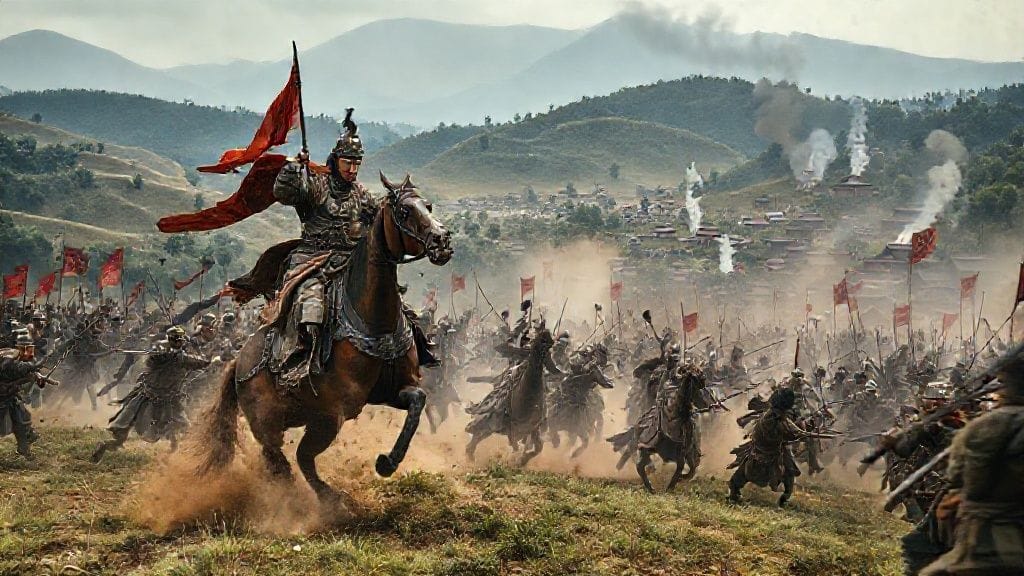
The opening clash is brutal. Arrows and javelins arc through the air, falling into dense formations with sickening thuds. Then the first wave of Visigothic cavalry charges, hooves pounding, lances leveled. They crash into the British line; shields shudder, men are thrown backward, horses rear and fall. For a moment, the line buckles—but does not quite break. British infantry, hardened by years of local warfare, stand their ground, bracing spear shafts and pushing back with grim determination.
Riothamus seizes the moment, ordering his own mounted troops to countercharge where the Gothic riders are most entangled. On that section of the field, the fighting devolves into a swirling melee of swords and axes, horses panicking, men grappling in close quarters. Dust rises; cries of pain and battle-shouts mingle; the distinction between planned maneuver and instinctive survival begins to blur.
Yet the Goths, well-led and numerous, regroup swiftly. Fresh cavalry detachments wheel around toward the British flanks. Euric or his commanders, observing from a vantage point, spot weaknesses in the British deployment—gaps forming, units overextended. Trumpet calls signal a new wave of coordinated attacks, grinding ever more pressure into the overmatched British and Gallic line. What had begun as a test of courage is slowly turning into a test of endurance that favors the larger, better-supplied army.
The Field of Déols: Blood, Dust, and Broken Shields
As the hours wear on, the battle near Déols becomes a scene of escalating horror. The sun is higher now, burning off any remaining morning mist, exposing every stumble, every wound, every body falling to the trampled earth. The once-orderly lines are ragged; standards are broken or captured; officers shout themselves hoarse trying to re-form units under relentless Visigothic onslaughts.
We can imagine the ground itself as an active participant in the carnage. The soil churns into mud under thousands of feet and hooves, slick with blood. Discarded weapons and shattered shields litter the field, turning each step into a hazard. Horses, when they fall, pin men beneath them; comrades must choose whether to pause amid flying spears to attempt a rescue. Bodies pile up where the fighting is fiercest, small mounds of the slain acting as grim monuments to each clash.
In the center, British infantry likely bear the brunt of the struggle. They fight shield-to-shield, pushing back at Gothic pressure, lunging with spears in the tight spaces between overlapping shields. The air rings with the clang of metal on metal, the crunch of bone, the guttural exhalations of men who suddenly find themselves wounded, their strength ebbing out onto the field. For some, training takes over; for others, fear does. In pockets where morale falters, units begin to give ground, step by step, their cohesion fraying like old cloth.
Riothamus rides where the danger is greatest, trying to shore up faltering sections of the line, committing reserves where possible. One can picture him caked in dust and sweat, his cloak torn, his horse lathered and bleeding from minor wounds. Around him ride his personal retainers, forming a living shield against arrows and sudden enemy thrusts. He has no illusion now about the stakes; if this line breaks entirely, there will be no orderly withdrawal, only rout and massacre.
On the Gothic side, Euric’s officers press their advantage. Fresh units are fed into the fight at crucial points; cavalry are used to exploit any gap or wavering formation. The Visigoths have likely brought siege-hardened troops, men accustomed to storming city walls, now turned to the open-field killing of their opponents. They also know that time is on their side: the longer the fighting continues, the more the smaller British-led force will exhaust itself.
At some point—perhaps by midday, perhaps later—the tipping point is reached. A crucial segment of the British or Gallic front collapses under sustained cavalry charges. The break begins as a partial retreat, then becomes a rush, and finally a rout. Once a few units turn their backs and try to flee, panic spreads. The cohesive line that had for hours resisted the Goths disintegrates into clusters of men running, fighting piecemeal, or simply standing in stunned paralysis.
The Visigothic cavalry now unleash their deadliest capacity: pursuit. They ride down fleeing soldiers, cutting them down from behind. The field of Déols extends beyond its initial confines, as the battle dissolves into a broad zone of slaughter stretching toward the river and across the countryside. Men try to swim the Indre in armor; many sink. Others attempt to hide in thickets or abandoned farmsteads, only to be ferreted out or left, trembling, to await whatever peace the victors might impose.
Somewhere amid this chaos, Riothamus is wounded. Our sources are silent on the details, but they agree that he does not die on the field. Perhaps his horse is struck, throwing him; perhaps he takes a lance to the side or an arrow that punches through a weak point in his armor. His retainers rally around him, forming a tight ring of shields and swords, buying time as the main body of his army shatters. To stay is to court certain death or capture; to retreat is to abandon the field—and with it, the dreams that had brought Britain to Gaul.
Thus the defining moment when riothamus fights the visigoths ends not in triumphant victory but in brutal defeat. The field of Déols, once an anonymous patch of central Gaul, becomes one of those countless, largely forgotten places where empires breathe their last and new powers confirm their ascendance. For the men who survive, years later, the name will still conjure the terrible memory of friends lost, of hooves pounding behind them, of a king bleeding as they dragged him from the press of enemy blades.
Retreat to the Burgundians and the Vanishing King
In the aftermath of the disaster near Déols, Riothamus and a remnant of his forces flee eastward, seeking refuge with the Burgundians. The choice is both practical and political. The Burgundian kingdom, centered around Lyon and Geneva, is officially an ally of Rome, though it pursues its own interests. Its rulers have a long-standing rivalry with the Visigoths and may be willing to shelter those who have just fought Euric, if only as a gesture of defiance.
The retreat is harrowing. Wounded, likely suffering from fever and blood loss, Riothamus must be transported on horseback or by cart, jostling painfully along rough tracks. His followers, reduced in number and shaken by defeat, must guard against Visigothic pursuit and the hostility of local populations who fear reprisal for harboring these beaten strangers. Food is scarce; armor and weapons have been lost or damaged; the psychological blow of defeat weighs heavily.
At some point, perhaps near the frontier of the Burgundian realm, envoys are dispatched. They ride ahead to negotiate safe passage and asylum. Burgundian leaders, always alert to opportunities, weigh their options: they can gain prestige by protecting a Roman ally and a foreign king, or they can avoid provoking Euric by turning Riothamus away. The sources suggest that Riothamus did indeed find refuge among the Burgundians, but then he vanishes from the historical record.
What became of him? One possibility is that he died soon after, his wounds proving mortal. The courts and chroniclers of the age might not have bothered to record the quiet passing of a defeated foreign king. Another possibility is that he recovered and remained in Burgundian territory for a time, perhaps even returning to Britain later, his continental ambitions crushed. If so, no surviving British sources mention his homecoming. A third, more romantic, suggestion is that his disappearance fed into later British legends of a great king who did not truly die but went overseas, destined to return in an hour of need.
For the men who followed him, the end of the campaign meant difficult choices. Some may have stayed in Burgundian lands, entering service under new lords, their British origin slowly fading into the general mixture of populations in Gaul. Others might have attempted the dangerous journey back to the Channel coast, hoping to find a ship home. A few, perhaps, drifted into Visigothic territory as prisoners or displaced persons, eventually settling in the very realm they had come to resist.
With Riothamus’s withdrawal, any lingering hope of a British-led revival of Roman power in Gaul evaporated. The emperor and his ministers in Italy, if they still bothered to think of the British campaign, likely regarded it as yet another failed attempt in a long series of improvisations. For Euric, by contrast, the defeat and dispersal of Riothamus’s force was a confirmation that no external savior would halt his advance. The path was now clearer than ever for the Visigoths to carve out a durable kingdom in Gaul and beyond.
Ripples Across Gaul: Politics after the Defeat
The consequences of Riothamus’s defeat extended beyond the immediate loss of men and materiel. Politically, it sent a chilling message to those Gallic communities still clinging to the idea of imperial protection. If even when riothamus fights the visigoths with a substantial British army, bolstered by Roman contacts and the theoretical support of Burgundians, the result is catastrophic defeat, then what realistic hope remained for resisting Euric’s expansion?
In city after city, calculations shifted. Local elites, already wavering between loyalty to distant emperors and accommodation with nearby Gothic power, now had a stark example of the empire’s inability to marshal effective military aid. Some bishops and nobles sought terms with Euric, trading formal submission for guarantees of religious freedom or preservation of property. Others fled north or east, seeking positions in remaining Roman or allied territories. The old network of Roman administration in Gaul—already frayed—began to tear apart more rapidly.
For the imperial court in Italy, the failure of the British intervention was one more blow to its crumbling credibility. The trial and condemnation of Arvandus, the traitorous prefect, may have been an attempt to show that treason would not be tolerated, but the gesture was hollow. Punishing one official did nothing to restore the empire’s capacity to project force or manage alliances effectively. Within a few years, the Western Empire itself would vanish, its last emperor deposed in 476 by the Germanic general Odoacer. In that broader collapse, the story of Riothamus risked becoming a mere footnote.
For the Visigoths, conversely, the battle near Déols and the dispersal of Riothamus’s forces were part of a broader pattern of consolidation. Euric’s campaigns in the 470s extended his control over much of southern Gaul and into Hispania. His kingdom, with Toulouse as a centerpiece, emerged as one of the most powerful post-Roman states in the West. From there, Visigothic influence would shape regional politics, law, and culture for centuries, even after their capital eventually shifted to Toledo.
The Burgundians, too, benefited indirectly. By accepting—or even merely tolerating—Riothamus’s presence after the battle, they positioned themselves as an alternative to Gothic dominance. This did not make them benevolent saviors; they pursued their own territorial ambitions. But their realm became a haven and a new power center for former Roman elites displaced from central and southeastern Gaul. The political map that would eventually become medieval France and western Switzerland was, in part, drawn in the aftermath of defeats like that of Riothamus.
Life in the Shadow of War: Ordinary People of 470
While chronicles focus on kings, bishops, and battles, the war in which Riothamus fought touched the lives of countless ordinary people across Gaul and Britain. Imagine a farmer near Déols, tending his fields in the spring of 470. He has heard rumors: a British king has landed; Gothic scouts have been seen on the roads; imperial tax collectors are demanding grain to supply some new campaign. His concerns are immediate—weather, harvest, family—yet he cannot ignore the approaching storm.
As the British army marches through, requisitioning food, fodder, and shelter, villages along the route feel both fear and opportunity. Some villagers welcome the soldiers, hoping they will protect them from Goths; others hide their valuables and livestock, knowing that any army, even a friendly one, can strip a settlement bare. Children stare wide-eyed at unfamiliar accents and colorful shields. Local priests try to frame events in divine terms: God is testing them, or perhaps sending deliverance in the person of this foreign king allied with Rome.
In the towns, merchants must decide which coin they will trust. Do they deal more with Roman officials issuing edicts stamped with the emperor’s name, or with Gothic envoys who promise protection in exchange for loyalty? Some traders hedge their bets, keeping one ledger for imperial customs officers and another for Visigothic collectors. Others choose sides and hope they have guessed correctly about who will be in charge next year, or even next month.
Refugees stream along the roads: families from villages burned in earlier skirmishes, clerics carrying precious relics and liturgical books, minor nobility whose estates lie too close to the front lines. Among them might be a handful of Britons who had settled in Gaul generations earlier, now watching their adopted homeland convulse once more. The appearance of Riothamus and his army might briefly stir in them a sense of connection—voices from across the sea speaking an ancestral tongue in the markets and churches of Gaul.
In Britain, too, the departure of Riothamus’s host leaves an imprint. Communities that had sent sons, husbands, or leaders across the Channel now wait for news that may never come. A village elder withdraws into silence upon hearing that the British king was defeated; a young warrior, left behind due to injury or bad luck, wrestles with survivor’s guilt and the urge to cross over on his own someday. Local enemies—Saxon warbands along the eastern coasts, rival British kings—may seize the moment to raid or settle scores, knowing that a significant portion of Riothamus’s fighting strength is gone.
In all these lives, the clash where riothamus fights the visigoths is not a grand strategic episode but a series of disruptions—crops trampled, kin lost, allegiances renegotiated, prayers whispered in darkened churches or at the edges of fields. The large, impersonal forces of imperial collapse and barbarian kingdom-building manifest themselves as very personal crises. The story of Riothamus thus reminds us that the “end of Roman Gaul” was not simply a change of administrative labels but a profound reshaping of everyday existence.
From Battle to Legend: Was Riothamus an Early Arthur?
Among modern readers, perhaps the most tantalizing aspect of Riothamus’s story is its possible connection to the legend of King Arthur. The suggestion, advanced notably by historian Geoffrey Ashe, is that the historical nucleus of Arthur may, in part, derive from the memory of Riothamus—this British king who led an army to Gaul and was ultimately betrayed and defeated.
The parallels are certainly intriguing. Medieval Arthurian tradition, especially in Geoffrey of Monmouth’s influential “History of the Kings of Britain,” portrays Arthur as a ruler whose power extends across the Channel, conducting campaigns in Gaul and even challenging the Roman Empire itself. In Geoffrey’s account, Arthur is betrayed by his own relative Mordred while overseas, forcing him to return and fight a final, fatal battle. Meanwhile, the historical record shows that riothamus fights the visigoths in Gaul, is allegedly betrayed by the Roman official Arvandus, and disappears after retreating to Burgundian territory. The thematic resonance—overseas campaigns, betrayal, a wounded or vanished king—is hard to ignore.
Yet caution is necessary. Centuries separate Riothamus from the flowering of Arthurian romance literature. In that span, stories morph, merge, and accumulate new details. Arthur may be a composite figure, drawing on multiple historical and mythic traditions: late Roman military leaders in Britain; local warlords who resisted Saxon expansion; Celtic heroic archetypes; and, possibly, the faint echo of Riothamus’s ill-fated Gallic campaign.
Still, the idea that Riothamus’s defeat could have left a cultural memory is plausible. British communities, grieving the loss of men and perhaps of a king who never returned, could have preserved stories of his valor and his betrayal. Over generations, as new crises emerged—Saxon invasions, internal strife—these tales might have been reshaped, casting the remembered leader as a timeless defender of Britain. When later writers like Geoffrey of Monmouth sought to craft a grand national myth, such fragments would have been irresistible material.
Some scholars highlight specific details. Riothamus’s name, possibly meaning “highest king,” is conceptually similar to the role Arthur occupies in later texts: an over-king above lesser rulers. His alliance with Rome and campaign in Gaul mirror Geoffrey’s narrative of Arthur’s continental ambitions. Even his mysterious disappearance dovetails with Arthur’s legendary departure to Avalon, alive but hidden. As Ashe wrote, “If we are looking for a British king whose career could, by distortion and elaboration, prefigure Arthur’s, Riothamus is an obvious candidate.”
Others remain skeptical, pointing out the fragmentary nature of the evidence and warning against forcing the sparse record of Riothamus to align with much later literary motifs. They argue that the Arthurian legend is far too rich and complex to be traced back to any single historical individual. Perhaps, they suggest, it is more accurate to say that Riothamus is one of several late Roman or sub-Roman figures whose feats and failures swirled together into the mythic vortex that eventually produced Arthur.
Whether or not Riothamus stands behind Arthur, his story demonstrates how quickly human deeds can pass from history into legend—and from there into symbolism. The battle where riothamus fights the visigoths may have begun as a concrete, bloody struggle for control of Gaul, but in memory it also becomes a template: the brave but doomed stand of a western king against overwhelming forces, betrayed by those he trusted. It is no wonder that such a template found fertile ground in the medieval imagination.
Historians, Sources, and the Slender Thread of Evidence
Reconstructing the campaign of Riothamus and his battle against the Visigoths is a delicate exercise in historical craftsmanship. Our sources are few, scattered, and colored by the perspectives and agendas of their authors. Chief among them is Sidonius Apollinaris, the Gallo-Roman aristocrat turned bishop of Clermont, whose letters and poems offer invaluable glimpses of life and politics in fifth-century Gaul. In one letter, Sidonius refers to “Riothamus, king of the Britons,” acknowledging his role as an ally in the struggle against Euric.
Another important witness is Jordanes, a sixth-century Gothic historian who, in his work “Getica,” briefly mentions Riothamus’s defeat by Euric near the Loire. Jordanes writes decades after the events, relying on earlier sources such as Cassiodorus, and his account is both terse and oriented toward highlighting Gothic achievements. Nevertheless, his reference confirms that riothamus fights the visigoths in a significant engagement and that his defeat was remembered in Gothic circles as a noteworthy victory for Euric.
Legal and administrative texts, such as the acts of Arvandus’s trial, offer another window. Sidonius reports that Arvandus, the former praetorian prefect, had written to Euric advising him to attack “the Britons situated between the Loire and the ocean” and to join with the Burgundians in partitioning Gaul. This incriminating letter shows not only the depth of Roman factionalism but also how central Riothamus’s British contingent was to the strategic picture in Gaul at the time. Their presence was important enough that an ambitious official plotted to sacrifice them in a bid to curry favor with Euric.
Beyond these textual fragments, archaeology provides context rather than direct testimony. Excavations in central Gaul reveal patterns of destruction, fortification, and population movement around the late fifth century. Coin hoards buried and never retrieved speak of times of insecurity. Shifts in pottery styles, burial practices, and rural settlement patterns reflect the gradual transformation from Roman to post-Roman societies. While no spade has yet turned up an inscription saying “Here riothamus fights the visigoths,” the material record supports the notion of intense conflict and reorganization in precisely the zones where our written sources place the campaign.
The scarcity of evidence has not deterred historians from constructing narratives. Some emphasize the continuity of Roman administration and see Riothamus as one of several federate leaders enlisted in last-ditch imperial efforts. Others stress the autonomy and local initiative of figures like Riothamus, positioning them as early medieval warlords operating within, but not controlled by, the imperial framework. Debates over the scale of his army, the exact location of the battle, and the extent of his alliance with Burgundians and Romans continue in scholarly journals and monographs.
This multiplicity of interpretations is not a weakness but a feature of late antique studies. It reminds us that history, especially for periods of sparse documentation, is an ongoing conversation rather than a closed book. The slender thread of evidence about Riothamus forces us to read carefully, to weigh possible biases, to acknowledge uncertainty. It also allows room for creative but disciplined conjecture, for exploring how one man’s campaign might intersect with the grander narrative of an empire in decline and new kingdoms on the rise.
The End of Roman Gaul and the Gothic Dawn
The decade that followed Riothamus’s failed intervention saw the final erosion of Roman power in Gaul. By the early 470s, Euric had seized control of much of southern Gaul, including key cities such as Arles and Marseille. The imperial administration, already battered, retreated further, its authority reduced to a few enclaves and, increasingly, to the realm of legal fiction. Bishops and local aristocrats who had once proudly borne Roman titles now found themselves negotiating with Gothic kings for the preservation of their privileges and the protection of their congregations.
In 476, the Western Roman Empire formally came to an end when Odoacer deposed the last emperor, Romulus Augustulus, in Italy. In a sense, Gaul had already moved beyond Rome by then. The political vacuum left by imperial retreat had been filled by a constellation of successor states: the Visigothic kingdom in the southwest, the Burgundian realm in the southeast, the nascent Frankish kingdom in the north. Each of these polities combined Roman administrative practices with Germanic traditions, Catholic Christianity with elements of older belief systems, Latin culture with vernacular languages.
In this emerging post-Roman world, the defeat where riothamus fights the visigoths takes on retrospective significance. It marks a moment when a different outcome was at least imaginable. Had Riothamus, with firm Roman backing and more reliable allies, managed to halt Euric’s advance, the map of Gaul might have looked different for a time. Perhaps a stronger Roman rump state could have survived in central Gaul, delaying or altering the formation of the Gothic kingdom. Perhaps British-Gallic ties would have deepened, creating a more enduring trans-Channel polity.
But history moved in another direction. The Visigoths entrenched their presence, adapting Roman law and administration while retaining their distinct identity. Over the next century, they would shift their center of gravity from Gaul to Hispania, creating the kingdom of Toledo that would endure until the early eighth-century Muslim conquest. The Burgundians, too, would solidify their power before eventually falling under Frankish domination. The Franks themselves, under Clovis and his successors, would expand dramatically, absorbing much of Gaul and laying the foundations for medieval France.
Roman Gaul thus did not vanish overnight; it transformed. Latin remained the language of law, liturgy, and high culture, gradually evolving into the Romance tongues. Roman urban frameworks—roads, city walls, public buildings—continued to shape settlement patterns. Yet the political and military authority that had once emanated from emperors now rested with kings named Euric, Gundobad, and Clovis. In that transition, battles like the one near Déols served as brutal punctuation marks, signaling that the old order was no longer capable of defending its frontiers without catastrophic failure.
Why This Forgotten Battle Still Matters
At first glance, the episode in which Riothamus leads his Britons into Gaul to fight Euric’s Visigoths may seem like a minor footnote in the grand sweep of history. It lacks the drama of Rome’s sack in 410, the notoriety of Attila’s campaigns, or the neat finality of 476. Yet a closer look reveals that this obscure frontier war illuminates key features of the transition from antiquity to the Middle Ages.
First, it highlights the enduring pull of the Roman idea. Even when imperial institutions were enfeebled, the concept of Rome as the arbiter of legitimacy and a focus of loyalty remained real enough to summon a British king and thousands of his warriors across the sea. The fact that riothamus fights the visigoths under Roman auspices, despite the empire’s manifest decline, shows how deeply embedded Roman authority was in the mental world of late antique leaders.
Second, the campaign illustrates the fluidity of identity and allegiance in this period. Riothamus was at once a British king, a Roman ally, and a Christian war leader. His foes, the Visigoths, were both heirs of Roman military traditions and “barbarians” in Roman discourse, simultaneously internal and external to the old imperial system. Burgundians offered refuge while also pursuing their own expansion. Local Gallic elites shifted loyalties as circumstances required. The neat binaries of Roman versus barbarian, us versus them, dissolve upon closer inspection.
Third, the story foregrounds the role of contingency and betrayal. The outcome of the campaign was shaped not only by battlefield prowess but by the duplicity of figures like Arvandus and the chronic inability of the imperial government to coordinate its allies. A few different decisions—firmer support from Italy, a more reliable prefect, more timely Burgundian intervention—might have altered the course of events. That they did not is a reminder that historical processes, even those as large as the “fall of Rome,” can hinge on the flawed judgments and divided loyalties of individuals.
Finally, Riothamus’s venture speaks to the persistence of memory and the making of legend. The bare historical facts—that a British ruler campaigned in Gaul, fought the Visigoths, was betrayed, and disappeared—have proven fertile ground for later imagination, perhaps feeding into the Arthurian tradition. Whether or not Riothamus was “Arthur,” his story exemplifies how human beings transform traumatic events into narratives of heroism, betrayal, and loss, and how those narratives, once set in motion, can travel far beyond their original context.
To revisit the moment when riothamus fights the visigoths is, therefore, to peer into a crucible where Roman, British, and Gothic worlds collided; where empire gave way to kingdom; where history and myth began to intertwine. In the churned earth near Déols, under the hooves of Visigothic cavalry and the battered shields of British infantry, a new Europe was taking shape—one that still bears, in its languages, its borders, and its legends, the imprint of that forgotten clash.
Conclusion
When we trace the faint, broken line of evidence that leads us to Riothamus, we encounter more than a lost British king; we encounter an entire world in transition. His decision to answer Rome’s call, to lead an army across the sea, and to stand against Euric’s Visigoths in the fields of central Gaul encapsulates the hopes and contradictions of the late fifth century. This was a time when the forms of empire persisted—titles, ceremonies, diplomatic letters—even as their substance eroded under the pressure of ambitious kings and local necessities.
The episode in which riothamus fights the visigoths reveals the overlapping identities that defined the age: Roman and barbarian, Christian and “heretic,” provincial and royal, islander and continental. It shows how alliances were forged and broken, how the failure of imperial leadership could turn potential victories into catastrophic defeats, and how the fate of thousands could be determined in a few hours of bloody combat on a relatively anonymous patch of land.
In the end, Riothamus disappears from our sources, swallowed by the Burgundian frontier or by death itself. Yet the consequences of his failed campaign reverberate. The Visigothic kingdom surges forward, the remaining Roman presence in Gaul withers, and the political mosaic that will become medieval Western Europe takes clearer shape. At the same time, the memory—however distorted—of a British king who fought valiantly abroad and was betrayed may have seeped into the deep cultural soil that later gave birth to Arthurian legend.
Our knowledge of these events will always be partial, reliant on a handful of texts and the interpretive skill of historians. But that very fragility invites us to approach the past with humility and imagination. Riothamus stands as a reminder that behind every simple chronological entry—“Riothamus fights the Visigoths, Gaul | 470”—lies a complex human drama: of ambitions and fears, of loyalty and treachery, of ordinary lives disrupted by the clash of armies and the collapse of empires.
FAQs
- Who was Riothamus?
Riothamus was a fifth-century British ruler described by the contemporary writer Sidonius Apollinaris as “king of the Britons.” He appears to have been a powerful monarch or high king in post-Roman Britain who led an expeditionary force into Gaul around 470 to support the Western Roman Empire against the expanding Visigothic kingdom of King Euric. - Why did Riothamus fight the Visigoths in Gaul?
Riothamus fought the Visigoths as part of an alliance with the Western Roman authorities and Gallo-Roman elites who were trying to halt Visigothic expansion in Gaul. The empire, under severe pressure, sought external allies and called on Riothamus to bring troops from Britain. In return, he likely hoped for Roman recognition, material rewards, and stronger trans-Channel influence. - Where did the battle between Riothamus and the Visigoths take place?
The main engagement is believed to have occurred near the town of Déols, close to the river Indre in central Gaul. Jordanes indicates that Riothamus was defeated by Euric “near the Loire,” and modern historians generally link this statement to a battle in the Déols region, where the geography fits the described circumstances of the campaign. - What was the outcome when Riothamus fought the Visigoths?
The battle ended in a decisive defeat for Riothamus and his British-led army. Outnumbered and undermined by inadequate Roman support and political betrayal, his forces were broken in the field, and he was wounded. Riothamus subsequently retreated eastward, seeking refuge with the Burgundians, and disappears from the historical record after this point. - How was Riothamus betrayed?
According to Sidonius Apollinaris, the Roman official Arvandus, praetorian prefect of Gaul, corresponded secretly with King Euric, encouraging him to attack the Britons in Gaul and to divide the region with the Burgundians. This act of treason undercut Riothamus’s strategic position, leaving him exposed and without the promised level of Roman support, contributing to his defeat. - Is Riothamus connected to the legend of King Arthur?
Some modern scholars, notably Geoffrey Ashe, have suggested that Riothamus may be an important historical source for the Arthurian legend. Parallels include a British king active around the late fifth century, leading campaigns in Gaul, suffering betrayal, and vanishing after defeat. However, this identification remains speculative, and many historians argue that Arthur, if historical, is likely a composite figure drawn from multiple leaders, including but not limited to Riothamus. - How many troops did Riothamus bring to Gaul?
One later source suggests that Riothamus led around 12,000 men, but ancient troop numbers are often exaggerated or symbolic. While the exact size of his force is uncertain, it was clearly large enough to be viewed as a significant component of the anti-Visigothic coalition, yet ultimately too small and too poorly supported to match Euric’s army in a decisive battle. - What happened to Riothamus after the defeat?
After being wounded in battle, Riothamus fled eastward with a remnant of his troops and reportedly took refuge with the Burgundians. Beyond this, the sources fall silent. He may have died of his wounds, remained in exile, or possibly returned to Britain. The lack of further mentions has encouraged theories about his transformation into legendary figures, but historically his fate remains unknown. - Why is the battle of Riothamus against the Visigoths important?
The battle is significant because it encapsulates the final struggles of the Western Roman Empire to retain control of Gaul, the emergence of powerful successor kingdoms like the Visigothic realm, and the active role of post-Roman Britain in continental affairs. It also illustrates the era’s complex web of alliances and betrayals, showing how the collapse of imperial authority was shaped by both external pressures and internal disunity. - Which primary sources mention Riothamus?
The main primary sources that mention Riothamus are the letters of Sidonius Apollinaris, a Gallo-Roman bishop and writer, and the “Getica” of Jordanes, a sixth-century historian of the Goths. Sidonius provides evidence of Riothamus’s status and alliances, while Jordanes records his defeat by King Euric near the Loire. Additional context comes from references to the treason trial of Arvandus and broader accounts of Visigothic expansion.
External Resource
Internal Link
Other Resources
- Encyclopaedia Britannica – general search for the exact subject
- Google Scholar – academic search for the exact subject
- Internet Archive – digital library search for the exact subject