Table of Contents
- A City On Edge: Paris Before the New King
- The Long Road to 1594: From Religious War to Weariness
- Henry of Navarre Becomes Henry IV: A Crown in Doubt
- “Paris Is Well Worth a Mass”: Conversion and Calculated Grace
- Sieges, Famines, and Broken Oaths: The Capital Pays the Price
- Conspiracies in the Shadows: The Catholic League and Spain
- Whispers of Surrender: How Paris Grew Tired of Heroic Misery
- The Secret Keys of the City: Negotiations with Governor Brissac
- Dawn of 22 March 1594: When Henry IV Enters Paris
- A King on Horseback: Procession Through a Suspicious Capital
- Bread, Pardon, and Politics: Winning the Hearts of Parisians
- The Pope, Spain, and the Great Reversal of Alliances
- Rebuilding a Torn Kingdom: From Civil War to Royal Authority
- From Streets to Council Chambers: Social and Economic Consequences
- Shaping Memory: How Historians and Artists Retold the Entry
- The Human Faces of 1594: Voices in the Crowd
- A Turning Point for Europe: Diplomacy After the Entry
- From “Good King Henry” to Assassination: The Long Shadow of 1594
- Why This Moment Still Matters: Legacy of a Reconciled Monarchy
- Conclusion
- FAQs
- External Resource
- Internal Link
Article Summary: On 22 March 1594, after decades of religious war and political chaos, henry iv enters paris and transforms not only a civil conflict, but the very idea of French kingship. This article follows the long road that led to that cold spring morning, from the rise of the Catholic League to Henry’s controversial conversion to Catholicism. We explore how the city of Paris, starved by siege and torn by fanaticism, slowly turned from heroic resistance to quiet exhaustion, preparing the ground for reconciliation. Through narrative scenes and documentary-style analysis, we see how henry iv enters paris not as a triumphant conqueror, but as a careful negotiator who offers pardon and bread rather than vengeance. The piece looks at the international dimension of the event, examining Spain, the papacy, and neighboring powers watching anxiously as henry iv enters paris and consolidates his authority. It also uncovers the human stories behind the chronicle—governors, merchants, priests, and ordinary women and men who woke to find a new king riding through their streets. By following what happens after henry iv enters paris, we trace the rebuilding of royal authority, the gradual healing of religious fractures, and the birth of the “Good King Henry” legend. In the end, the article argues that the day henry iv enters paris stands as one of the great turning points in European state formation and in the long, painful art of learning to live together after civil war.
A City On Edge: Paris Before the New King
In the final years of the sixteenth century, Paris was less a city than a wound that refused to heal. Its walls, once symbols of pride and defense, had become instruments of self-imprisonment. Food trickled in under cover of darkness, rumors spread more quickly than bread, and sermons thundered louder than cannon. The streets that would one day cheer as Henry IV entered the capital had, only months earlier, echoed with cries of “No heretic king!” and “Long live the League!” The population had shrunk through famine, disease, and exodus; those who remained were not simply Parisians, but survivors of a moral and physical siege that had lasted for years.
By early 1594, the people of Paris had been fed on heroism and hunger for too long. The Catholic League’s militant preachers told them they were defending the true faith against a heretical king, the Huguenot Henry of Navarre, now crowned Henry IV of France. Their sacrifice, they said, would be written in heaven. Yet stomachs do not respond to theology, and neither do exhausted soldiers. The great families of the League, once so confident, had begun to quarrel and to calculate. Some still dreamed of a Spanish prince or another Catholic candidate for the throne. Others, more realistic or more cynical, understood that the kingdom could not endure much longer without a king who ruled in Paris. The city was visibly fraying: markets were thin, guilds were weakened, and the university trembled between pride and fear.
It was into this fragile, tense capital that the drama of 22 March 1594 would unfold. When henry iv enters paris that morning, he walks onto a stage that has been set by nearly four decades of the French Wars of Religion. The barricades of 1588, the assassinations of the Guise brothers, the murder of Henry III, and the relentless propaganda of the League had taught Parisians that power could be seized in the streets as much as in palaces. Every alleyway held memories of uprisings; every church had heard fiery sermons against heresy and royal “betrayal.” The question in 1594 was no longer simply who would wear the crown, but what it meant to be king in a city that had learned to resist and defy.
This was a Paris of contrasts: proud stone churches with crumbling roofs; noble houses half-ruined by war; river quays where the lifeblood of trade now trickled instead of surged. Refugees from the provinces huddled along the Seine, telling stories of burned villages and shifting loyalties. Armed patrols passed them by, alert to spies and deserters. Above them all loomed the idea of the king—abstract, contested, distorted. Some imagined Henry IV as a wolf in Catholic clothing, others as a necessary evil; a very few, reading the political winds early, saw in him the possibility of peace. But the mood was brittle. A single misstep, a badly chosen word, could still set off riots. When henry iv enters paris, he must do so not simply as a conqueror, but as a man stepping into a room full of gunpowder with a single candle in his hand.
The Long Road to 1594: From Religious War to Weariness
The story of that March morning begins decades earlier, in the first outbreaks of violence between Catholics and Protestants in France. Since the 1560s, the country had been convulsed by a series of religious civil wars so frequent and bloody that chroniclers numbered them like acts of a gruesome play. Massacres in the countryside, pitched battles between noble factions, assassinations ordered in the name of God—these were the milestones on the long road to 1594. The most infamous of all, the Saint Bartholomew’s Day Massacre of 1572, sent tremors through Europe; in Paris alone, thousands of Huguenots were killed, many of them thrown into the Seine. Henry of Navarre, then a young Protestant prince, narrowly escaped death by a forced conversion and clever dissimulation at court.
The wars had a rhythm that became horribly familiar: a peace treaty signed with solemn oaths, guarantees of freedom of worship in selected towns, and promises of amnesty; followed, within months or years, by new grievances, fresh conspiracies, and renewed fighting. Each cycle deepened hatreds, hardened identities, and impoverished entire regions. Soldiers turned into bandits between campaigns, and peasants, crushed by taxes and plunder, cursed both king and noble alike. The crown tried to present itself as the arbiter above the religious factions, yet its own weakness fed the very divisions it aimed to contain. Monarchs needed loyal armies, and armies required money, which in turn demanded taxes that demanded authority the crown no longer fully possessed.
By the late 1580s, this cycle of violence and fragile peace had produced a new, more radical force: the Catholic League. Its leaders, especially the powerful Guise family, claimed to be defenders of the true faith against Protestant heresy and royal complicity. They mobilized not just noble clients, but urban militias, university theologians, and popular preachers. Paris became the beating heart of this movement. When King Henry III tried to reassert royal authority, Paris rose against him in 1588 in the famous “Day of the Barricades,” an urban revolution that forced the king to flee his own capital. Royal power had rarely seemed so fragile—and royal presence in Paris so indispensable.
All of this violence carved deep wounds into the body of the kingdom, but it also carved something more subtle: fatigue. By the early 1590s, generations had grown up knowing little but war. Land left untilled, roads unsafe, families scattered—these were not abstract problems but daily realities. The word “France” itself seemed fragile, pulled apart by competing loyalties to religion, region, and faction. It is in this context of exhaustion that the significance of henry iv enters paris becomes clear: by 1594, many French subjects did not dream of a perfect king or perfect church, but simply of an end.
Henry of Navarre Becomes Henry IV: A Crown in Doubt
Henry of Navarre was an unlikely candidate to reunify such a shattered realm. Born in 1553 in Pau, in the Pyrenean foothills, he was raised in a milieu steeped in Calvinist rigor and Gascon pride. His mother, Jeanne d’Albret, queen of Navarre, was a determined Protestant reformer, and Henry’s early education taught him that Catholicism was not only mistaken but dangerous. Yet from his youth, Henry showed a knack for survival in a world where religion could be as much a flag of convenience as a creed of the heart. Court life in Paris, forced conversions, and political marriages trained him in the art of compromise.
His path to the French throne was as bloody as it was improbable. As a cadet branch of the ruling Valois line died out, the succession crisis sharpened. The last Valois king, Henry III, childless and embattled, faced rebellion from the Catholic League, who deemed any Protestant successor intolerable. Under the principle of hereditary right, however, Henry of Navarre, though a Calvinist, stood next in line. The League tried to block him by pushing forward alternative claimants, including Spanish-backed options. But when Henry III was assassinated in 1589 by a fanatical monk, the legal crown—if not the physical one—fell on Henry of Navarre’s head. He became Henry IV by right, but not yet in reality. Paris, and with it the surreal notion of a Catholic kingdom with a Protestant king, remained out of reach.
From 1589 to 1594, Henry waged a war not only of armies but of perceptions. To many Catholics, he was a heretic who could not lawfully rule. To many Protestants, he was a champion of their cause, a king whose personal faith might finally secure them lasting protection. Henry himself was a man of appetites and pragmatism, capable of bravery in battle and charm in conversation. He won victories at Arques and Ivry, where he famously charged into combat beneath a white plume, calling out that those who loved him should follow his banner. Yet even these victories fought under a Protestant king’s colors could not fully subdue a capital that had become the fortress of Catholic intransigence. To reign in France, Henry understood, he had to reign in Paris.
The crown on Henry’s head therefore rested on fragile foundations. Legalists insisted that dynastic right mattered more than confession; League propagandists answered that no heretic could sit on Saint Louis’s throne. European powers watched the struggle closely. Spain, defender of militant Catholicism and fearful of a strong, reunited France, poured money and men into the League’s efforts. The papacy hesitated, torn between doctrinal rigor and the need to avoid making France a satellite of Spain. In this unstable theater, every gesture Henry made—every proclamation, every treaty offer, every whispered negotiation with Catholic nobles—was a step in a dangerous dance. The act that would change everything was not a victory in the field, but a personal decision that many saw as betrayal and others as genius.
“Paris Is Well Worth a Mass”: Conversion and Calculated Grace
In 1593, Henry played his boldest card. Facing the reality that he could not take Paris by force without ruining the very kingdom he hoped to rule, he publicly declared his intention to convert to Catholicism. The traditional phrase later attributed to him—“Paris is well worth a mass”—may be apocryphal, but it encapsulates the mixture of cynicism and pragmatism that his enemies claimed to see in his decision. Yet the conversion itself was conducted with ceremonial gravity. On 25 July 1593, in the Basilica of Saint-Denis, Henry abjured Calvinism and was received into the Catholic Church. It was an act as much theatrical as spiritual, a liturgy performed for the eyes of France and of Europe.
Reactions were swift and divided. Many Protestants felt abandoned, betrayed by the man they had followed through years of hardship. Some Huguenot leaders grumbled that their king had sacrificed true religion on the altar of ambition. A few even broke with him, seeking new guarantees by other means. Among Catholics, the response was equally complicated. Hardened Leaguers refused to believe the conversion sincere, denouncing it as a cynical stroke. Yet more moderate Catholics, fatigued by war and wary of Spanish encroachment, saw in Henry’s baptism into Catholicism a way out of the deadlock. They could now accept him without, in their minds, betraying the Church, while still asserting the independence of the French crown.
The conversion did not instantly dissolve opposition, but it transformed the field of play. The League lost its most powerful rallying cry—resistance to a heretic king. Now they had to portray themselves not as defenders of true faith against heresy but as opponents of a Catholic monarch recognized by many French bishops. That required more nuance, and nuance is often harder to pitch to hungry crowds than simple certainties. As one contemporary chronicler wrote, half admiring and half cynical, “The King changed his religion, and with it changed the hearts of men” (a sentiment echoed in later histories of the Wars of Religion).
From this moment on, the story of henry iv enters paris becomes possible. The act of conversion did not merely open the cathedral doors; it opened channels of negotiation, quiet conversations between royal envoys and League governors. It allowed moderate preachers to argue that obedience to a Catholic king was now a Christian duty. It gave Parisian elites—magistrates, guild leaders, merchants—the political cover they needed to contemplate switching sides without entirely losing face. This was the genius of the move: it turned the question from “Can a heretic rule?” to “How much longer can we endure chaos?” Henry had not yet stepped through the gates of Paris, but he had already begun to step into its conscience.
Sieges, Famines, and Broken Oaths: The Capital Pays the Price
To understand the mood in Paris as Henry approached in 1594, one must remember what the city had already endured. The siege of 1590, in particular, left scars that could still be felt years later. Henry, then still a Protestant king besieging a Catholic capital, had tried to force Paris into submission by cutting off its supplies. The League, for its part, turned this into a drama of martyrdom, preaching that starving for the faith was more glorious than living with a heretic monarch. The result was a catastrophe. Contemporary accounts speak of people eating dogs, rats, even leather. Some letters speak in veiled language of far darker acts, as hunger stripped away social norms.
Memories of that siege lingered in 1594 like a bad taste. They colored every rumor, every whisper of Henry’s intentions. Many Parisians had lost family members during those months—children who withered away, fathers who died defending the walls, mothers who bartered the last of their possessions for a few handfuls of grain. The word “navarrais” still conjured images of enemy soldiers, bombardments, and cruel blockades. It is one of the paradoxes of the event that when henry iv enters paris, welcomed (cautiously) as a king of peace, he returned as the former besieger of the city, the man whose armies had once ringed its walls.
The League had also made promises it could not keep. It had vowed to maintain supplies, yet failed. It had promised foreign support, especially from Spain, yet that support came bound to Spanish interests that made some French patriots uneasy. The more radical among the Leaguers, those who spoke with revolutionary fervor of the people’s rights against tyrants, frightened the more conservative elites of the capital. Merchants and magistrates, who had initially backed the League out of piety and prudence, now wondered whether they had unleashed forces that might devour them as well.
This combination of traumatic memories and mounting disillusionment formed the psychological backdrop to Henry’s approach. The streets bore silent testimony to broken oaths: churches damaged in previous uprisings, houses confiscated and redistributed, neighbors who would no longer speak to each other. Yet there was also a more immediate discomfort: even without formal siege, supplies were precarious, trade still hampered by war, and taxation heavy. The public mood was not one of joy at the prospect of a new king, but of longing for relief. This is why, when henry iv enters paris in March 1594, his most potent symbol is not the sword, but bread and the promise of normal life restored.
Conspiracies in the Shadows: The Catholic League and Spain
Officially, the Catholic League in Paris claimed to act in defense of the Catholic faith and the liberties of the kingdom. Unofficially, it had become entangled in a web of foreign interests, personal ambitions, and factional rivalries. Spain, under Philip II, viewed the French chaos as both a danger and an opportunity. A strong, unified France could threaten Spanish hegemony in Europe. A fractured, docile, or client France, however, could be turned into a buffer. Spanish gold flowed into League coffers, Spanish troops appeared on French soil, and Spanish diplomats whispered in the ears of League leaders.
This foreign presence helped sustain Paris in defiance, but it also bred suspicion. Many Parisians, while ardently Catholic, were also fiercely French. They did not wish to exchange one form of domination for another. The idea that Spain might place its own candidate on the French throne—most notably the Infanta Isabella—circulated in pamphlets and rumors. For League hardliners, this was a glorious prospect: a fully Catholic monarchy aligned with the greatest Catholic power of the age. For others, it smacked of national humiliation. The longer the war dragged on, the more this tension grew. Could Paris resist Henry IV indefinitely without becoming, in effect, a Spanish outpost?
Inside the city, conspiracies flourished. Some plotted to tighten bonds with Spain; others schemed to open the gates to Henry. The governor of Paris, Charles de Cossé, count of Brissac, was at the center of many of these shadow plays. Publicly, he remained a servant of the League. Privately, he weighed his options, speaking in cautious tones with royal envoys who promised him rewards and security under Henry’s rule. Priests debated theology in pulpits, but in back rooms nobles weighed pensions, honors, and offices. The language was still that of religion, yet the grammar had become resolutely political.
Spanish agents understood the stakes of henry iv enters paris very clearly. If the king were to take the capital, much of the League’s legitimacy would crumble overnight. They therefore tried up to the last moment to stiffen resistance, promising more troops, more money, more miracles. Yet the fatigue of the city, the ambiguities of French patriotism, and Henry’s conversion to Catholicism had undermined their cause. In the race between Spanish gold and French exhaustion, it was not the gold that would win.
Whispers of Surrender: How Paris Grew Tired of Heroic Misery
By the winter of 1593–1594, the mood in Paris had subtly shifted. The sermons were still fiery; the posters still denounced Henry as false and dangerous; the processions still marched with banners and relics. But in the markets, in guild halls, and in households, people began to ask quieter questions. How much longer could they endure? What did loyalty to the League truly mean if it led only to further hunger and uncertainty? The city, which had once thundered with collective will, now murmured with private doubts.
Merchants were among the first to feel the pinch of endless conflict. Trade routes disrupted by war meant fewer goods, higher prices, and unstable income. Many who had prospered in earlier decades now scraped by, watching their fortunes erode with each passing year. Artisans, dependent on these merchants, faced the same pressures. Magistrates, whose authority rested on a functioning legal and economic system, saw their dignity questioned when they could not keep basic order. In their view, whatever religious principles had inspired the Catholic League, the movement had started to devour the foundations of civic life itself.
Rumors of Henry’s leniency elsewhere in the kingdom circulated among them. Towns that had opened their gates to the king were said to have been treated with moderation. There were stories of Henry speaking familiarly with common soldiers, forgiving former enemies, and prioritizing the restoration of trade and agriculture. Some of these stories were embellished; others, though, came from reliable witnesses. They painted a portrait not of a vengeful conqueror but of a king eager to have subjects rather than ruins. Those who had suffered most from war listened carefully. It’s astonishing, isn’t it, how quickly hearts can tilt when daily bread is at stake?
Within key institutions—the Parlement of Paris, the municipal authorities, the powerful guilds—moderate voices began to speak more loudly, if still cautiously. They argued that accepting Henry IV, now a Catholic, was not a betrayal of faith but a step toward saving the city and the realm. For them, the Latin formula “salus populi suprema lex”—the safety of the people is the highest law—began to outweigh the League’s rhetoric of total resistance. And behind closed doors, some asked a more subversive question still: perhaps Providence itself was speaking through the conversion of the king and the exhaustion of his subjects, calling them to peace.
Yet fear remained. Opening the gates too soon might invite Spanish retaliation or internal vengeance from diehard Leaguers. Waiting too long, however, might mean watching the city sink further into poverty and despair. It was in this atmosphere of hesitant calculation that henry iv enters paris moved from being a distant prospect to an imminent possibility. The city did not so much surrender as sigh; the decision for peace came less as a shout of joy than as a tired exhalation from a chest long constricted.
The Secret Keys of the City: Negotiations with Governor Brissac
Among the many hands that shaped the events of 22 March, few were more important than that of Charles de Cossé, count of Brissac. Appointed governor of Paris by the League, Brissac was a battle-hardened noble whose loyalty, like that of many in his rank, lay as much with his own family’s interests as with any abstract cause. Over months, royal agents approached him with discretely worded offers: offices, pensions, the king’s favor, and perhaps most importantly, guarantees of safety for himself and his men should the city change sides.
The negotiations unfolded in layers of secrecy. Letters were carried by trusted messengers, encoded or written in cautious language bristling with euphemism. Meetings took place in private houses under the pretext of social visits. Each side tested the other’s sincerity. Henry needed to know that Brissac truly controlled enough of the city’s garrison to make an entry possible. Brissac, in turn, needed assurance that Henry would keep his word once inside, that there would be no wholesale purge of League supporters that could cost him his life and honor. In this tense diplomatic game, personal trust mattered as much as written promises.
Gradually, an understanding emerged. Brissac would, at the right moment, ensure that key gates were in the hands of captains willing to side with the king—or at least not to resist him. Henry, for his part, would promise amnesty and maintain the privileges of the city, sparing it the ravages of a violent assault. The plot was not entirely airtight; there were still Leaguers who might resist, Spanish allies who would be furious, and fanatics who might attempt desperate acts. But the critical weight of power in the city had shifted. As one later historian observed, “Paris changed sides not by storm, but by conversation” (a judgment that captures the essence of this intricate political ballet).
By March 1594, the secret plans had ripened. Brissac and his allies waited only for the right hour, when the king would be close enough to act swiftly, yet the city still calm enough not to erupt into chaos. It was like waiting for the right moment in a risky surgery: too soon or too late, and the patient might die. The night before henry iv enters paris, few of these men likely slept peacefully. They were about to gamble not just with their own lives, but with the fate of a capital, a kingdom, and in some sense, the Catholic cause they had once proclaimed so loudly.
Dawn of 22 March 1594: When Henry IV Enters Paris
In the pale, chilled light of early morning on 22 March 1594, the decisive moment arrived. Henry had advanced with a small but reliable force, not a huge army of conquest but a compact core of loyal troops sufficient to secure key positions if the gates were opened. It was a calculated risk; if Brissac’s promises failed, the king would be dangerously exposed, far from overwhelming reinforcements. But the entire strategy of the entry was based on trust and surprise rather than brute force.
As dawn broke, certain gates of Paris, notably the Porte Neuve and neighboring entries, were manned by captains already won over to the king’s cause or at least ready to stand aside. Brissac’s men moved quietly, replacing doubtful guards with more trustworthy ones or simply ensuring that orders to resist were delayed. The city, waking slowly, still believed itself under League control. Markets began to stir, church bells tolled for early masses, and in houses across the city, people rose to another day of uncertain routine.
Then, almost as if emerging from the mist, Henry’s vanguard reached the designated gates. Signals were exchanged; doors that might have been barred instead swung open. There was no thunderous artillery, no battering of walls—only the creak of hinges and the shuffle of boots. When henry iv enters paris, he does so almost quietly, riding at the head of his men, wearing a breastplate and the white scarf that had become his emblem. Those who saw him first might have thought it a trick of the light: the man they had long been taught to hate, crossing the threshold not as an invader but as a king reclaiming his capital.
Once inside, speed was essential. Henry’s troops moved to secure strategic points: the Louvre, the main crossroads, the arsenals. Brissac coordinated from within, sending orders and calming potential hotspots. There were shouts, hurried footfalls, a few skirmishes with diehard Leaguers who tried to raise resistance. But the hoped-for general uprising against the king did not materialize. Too many were taken by surprise; too many were already weary; too many key officers had decided that their future lay with Henry, not with lost causes.
By mid-morning, the reality was inescapable: henry iv enters paris had shifted from rumor to fact. Word spread from street to street—some hearing it as a shock, others with a sense of relief. “The King is here,” people said, sometimes in fear, sometimes with cautious curiosity. Outside certain houses, shutters were closed; in others, people peered through cracks, trying to catch a glimpse. Paris, which had once thrown up barricades against monarchs, now watched, almost incredulously, as a king walked in through doors someone had quietly chosen not to lock.
A King on Horseback: Procession Through a Suspicious Capital
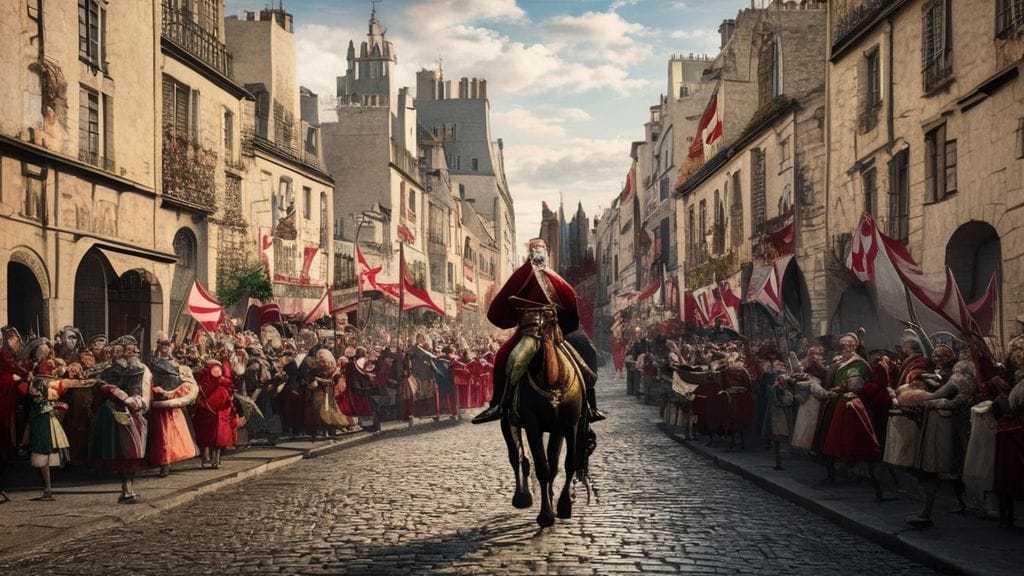
Once the key positions were secured and immediate danger of armed counterattack had ebbed, Henry turned to the symbolic work of the day: showing himself to his new subjects. The image of the king entering his capital was not merely a practical necessity; it was a ritual of power, a way of inscribing his presence into the memory of Paris. Mounted on horseback, accompanied by his officers and a modest escort, he rode through streets that blended silence, curiosity, and scattered acclamations.
Contemporary accounts vary in their details, but they agree on the basic atmosphere: this was not an explosion of joy like a long-expected coronation, nor a terror-stricken parade of a conqueror amid ruins. It was something more tense, more ambiguous. Some crowds shouted “Vive le Roi!” from doorways and windows, their enthusiasm real or at least convincingly performed. Others watched in sullen silence, lips pressed tight, the long years of League propaganda and suffering not yet forgotten. Children, less burdened by memory, pointed and whispered—the sight of a king in armor, after all, had its own fascination.
Henry understood the stage he was on. He made a point of bowing to the people, of doffing his hat, of smiling where he could. The man who had charmed soldiers in campfires and court ladies in silk-draped halls now turned his charm outward, to butchers, bakers, and widows leaning from windows. Here was the delicate art: to project firmness without harshness, authority without cruelty. When henry iv enters paris, he must be both lion and father, conqueror and reconciler. The slightest sign of revenge or contempt could have reignited resistance in a city that had so recently defied kings.
As he rode, Henry absorbed impressions as well as projecting them. He saw damaged houses, thin faces, churches that bore the scars of recent struggles. He had besieged this city before; now he saw in more detail the cost that siege and subsequent hardships had exacted. Perhaps this underlay the moderation he showed in the following days. For a king who would later be remembered as “Good King Henry,” close to the people, this first close encounter with his capital was a lesson as much as a triumph. The Paris he claimed that day was not an abstract jewel of the crown, but a wounded city that needed careful healing.
Bread, Pardon, and Politics: Winning the Hearts of Parisians
Taking Paris militarily was only the first half of the task; securing its loyalty was the second, and in many ways the more difficult one. Henry moved quickly to signal his intentions. One of his earliest acts was to proclaim a general amnesty for most of those who had supported the League. There would be no sweeping reprisals, no mass executions in the public squares. Certain hardliners and criminals could expect justice, but the rank and file, the ordinary citizens who had shouted League slogans and attended League processions, would not be hunted down. This was a calculated act of mercy aimed at transforming former enemies into subjects rather than martyrs.
Equally important was the restoration of supplies. Within days, arrangements were made to bring grain into the city, to reopen trade routes, and to reassure merchants that their goods would be protected. Markets, which had for years operated under the shadow of scarcity and fear, began to breathe again. The symbolic power of bread cannot be overstated. For a population that had known famine under the League’s heroic resistance, the sight of fuller stalls under Henry’s rule was a powerful argument in itself. It whispered that whatever his past, this king might indeed be better for their children than continued chaos.
Henry also reached out to the institutions that framed Parisian life. He confirmed the privileges of the city and the rights of the Parlement, carefully avoiding any impression that he sought to punish the capital for its earlier disobedience. He attended Mass publicly, emphasizing his newly embraced Catholic identity. He promised protection for the Church’s property and sought to reassure clergy who feared retaliation for their League activism. At the same time, he quietly made it known that he expected, henceforth, loyalty to the crown above all factional allegiances.
The political message was clear: the war could end here, in reconciliation, if the city accepted him fully. When henry iv enters paris under this banner of pardon and bread, he embodies a new model of monarchy—less absolutist in form, perhaps, than later Bourbon kings, but already rooted in the idea that the king’s strength flows from his ability to protect and feed his people. Over the months that followed, this policy of conciliation would be extended to other cities and former foes, culminating in broader edicts of pacification. For now, in March 1594, it was enough that Parisians began, cautiously, to imagine a future that did not involve gunfire at dawn.
The Pope, Spain, and the Great Reversal of Alliances
News that henry iv enters paris did not echo only through the streets of the French capital; it resounded across Europe. In Rome, in Madrid, in London, and in the courts of the German princes, diplomats scribbled hurried reports. The balance of power had shifted. A Catholic king, once Protestant, now controlled Paris and was rapidly consolidating his realm. For Spain and the hardline Catholics who had relied on League resistance, this was a bitter setback. For those wary of Spanish expansion, including some within the papal curia, it offered a chance to restore a powerful but independent France as a counterweight.
The papacy faced a dilemma that had been building for years. Could it recognize a monarch who had once been a leading Protestant figure, now claiming to have embraced Catholicism? To do so would be to accept the notion that royal legitimacy might at times trump confessional purity. To refuse, however, risked pushing France further into chaos and potentially into the arms of Protestant allies. After cautious negotiation, and following Henry’s clear gestures of Catholic piety, Pope Clement VIII moved toward reconciliation, eventually granting Henry absolution in 1595. This papal recognition was more than symbolic theology; it placed the seal of Rome on Henry’s rule, undercutting the last pockets of League resistance that claimed to fight for the Church’s honor.
Spain, by contrast, watched with dismay. Philip II had invested treasure and men in the League, hoping to shape France’s future in line with Spanish interests. The fall of Paris to Henry IV made it clear that those investments had not yielded the desired returns. And more alarmingly, a unified, Catholic, but fiercely independent France could once again assert itself along Spanish borders, in the Low Countries, and in Italy. In the years after 1594, tensions between the two kingdoms would flare into open war, but under new terms: no longer a war within France, but a conflict between two sovereign states.
Other powers adjusted their calculations accordingly. England, which had cautiously supported Henry when he was a Protestant challenger to Catholic dominance, now faced a different landscape. A Catholic Henry IV might be less inclined to maintain close ties with Elizabeth I’s Protestant court. Yet the broader logic of European balance still pushed London and Paris together against excessive Spanish power. Henry’s conversion thus did not simply reorder French politics; it reconfigured the diplomatic geometry of the continent. In this sense, the day henry iv enters paris marks not only a turning point in French civil strife but a hinge in European international relations.
Rebuilding a Torn Kingdom: From Civil War to Royal Authority
Having taken Paris, Henry IV faced the larger task of reknitting a kingdom that had been torn into rival confessional and political camps. The capital was both prize and tool in this endeavor. From Paris, he could project royal authority along the veins of administration, justice, and taxation that radiated outward. But power could not simply be decreed; it had to be rebuilt, almost parish by parish, province by province, in a realm where memories of betrayal and violence were still fresh.
Henry’s strategy combined firmness with pragmatism. Former rebels were often offered positions and honors, provided they pledged loyalty. Royal offices were used as instruments of reconciliation, binding once-hostile nobles to the crown. At the same time, Henry did not hesitate to use force where pockets of resistance persisted, particularly those that threatened to reignite large-scale war or invited foreign intervention. This dual approach—carrot and stick, pardon and punishment—gradually restored the sense that there was once again a single center of legitimate power in France.
Administrative reforms, though often overshadowed by more dramatic events, played a crucial role. Henry strengthened the machinery of tax collection, tried to bring more order to the chaotic finances of the realm, and relied increasingly on capable ministers such as Maximilien de Béthune, the future Duke of Sully. The goal was not only to fill the royal coffers but to stabilize life for ordinary people. Roads needed repair, bridges rebuilding, local officials supervising. Each such improvement, modest in itself, reinforced the idea that the king’s peace was preferable to the adventures of faction.
Religious coexistence, too, had to be managed. Protestants were a minority, but a significant and often strategically placed one. Henry, remembering his own years as a Huguenot, sought a solution that would allow them to live without provoking perpetual Catholic fury. The famous Edict of Nantes of 1598, which followed several years after henry iv enters paris, granted Protestants limited rights to worship and hold office while affirming Catholicism as the official religion. It was one of the earliest attempts in Europe to craft a framework of religious toleration within a still-confessional state. The road there began in part with Henry’s ability to speak as both former Protestant and current Catholic king, a dual identity that gave him unusual credibility—if also making him a target for extremists on both sides.
From Streets to Council Chambers: Social and Economic Consequences
The entry of Henry IV into Paris had ripple effects that reached far beyond palace intrigues. For the city’s inhabitants, the most immediate consequence was the gradual normalizing of daily life. Markets became more stable; taxes, though still heavy, were at least more predictable; the constant fear of siege or sudden street fighting receded. Craftsmen could plan their work with a little more confidence. Families began to think in terms of years rather than weeks or days. In a city that had lived for so long on the edge, this return to a more regular rhythm was itself a quiet revolution.
Social hierarchies, strained by years of war, also began to stabilize. During the height of the League’s power, radical elements had occasionally pushed against the entrenched privileges of nobles and magistrates. The language of “the people” and their rights had echoed in sermons and pamphlets. With the restoration of royal authority, much of this radicalism was rolled back. Yet the memory of having once defied the king left traces in urban political culture. Parisians would never entirely forget that they had forced monarchs to negotiate with them, that popular mobilization could reshape power. The events of 1594 did not erase the barricades of 1588 from memory.
Economically, the end of the League’s dominance and the king’s entry allowed Paris to regain its central role in French commerce and finance. Credit networks, badly shaken by the uncertainties of war, slowly strengthened. Provincial merchants again looked to the capital as a secure place to do business. This renewed flow of goods and money benefited not only the crown but also the city’s middle classes, who had suffered acutely during the years of siege and shortage. The labor market, too, shifted: soldiers and part-time militiamen gradually sought more peaceful employment, though not all succeeded in making that transition.
Yet behind the recovery lay inequalities. Those who had been able to profit from war—supplying armies, speculating on grain, or acquiring confiscated properties—often emerged from the crisis richer than before. The poor, by contrast, had few reserves and many debts. For them, the return of the king did not instantly alleviate suffering. It did, however, open the possibility of reform. Over time, Henry’s government launched projects to improve infrastructure and encourage agriculture, policies that in the long run would raise living standards for many. But on that March day when henry iv enters paris, the social ledger was still heavily marked in red ink: widows, orphans, ruined shopkeepers, and peasants driven from the land.
Shaping Memory: How Historians and Artists Retold the Entry
The event of 22 March 1594 did not remain a simple fact in the annals; it became a story, and stories can be told in many ways. Royal propaganda quickly seized on the image of the reconciler king. Engravings showed Henry welcomed into Paris by grateful citizens, banners waving, the city personified as a woman embracing her sovereign. Official histories emphasized his moderation, his clemency, and the almost providential nature of his triumph. In such tellings, the day henry iv enters paris appeared less as a negotiated power shift and more as a kind of miracle of unity.
Later generations of historians, writing under different regimes, would reinterpret the scene to suit their own concerns. Enlightenment writers admired Henry as a precursor to religious toleration and rational kingship, often highlighting his alleged quip that Paris was worth a Mass as a sign of his pragmatic, almost secular mindset. Nineteenth-century romantic historians, by contrast, painted the entry in more vivid emotional colors, focusing on the drama of a beloved monarch returning to save his people from fanaticism and foreign domination. Some, like the historian Jules Michelet, saw in Henry a figure of almost paternal warmth, the “Good King Henry” who cared for peasants and city-dwellers alike.
Artists, too, took up the theme. Paintings of the entry, produced centuries afterward, often blurred strict historical accuracy in favor of symbolic composition. Henry appears bathed in light; the crowds seem uniformly joyful; church towers frame the scene as if blessing it. Such images tell us more about the desires and ideologies of the times in which they were painted than about the actual mixed emotions of 1594. Still, they entered the public imagination, reinforcing the idea that this was a foundational moment of reconciliation in French history.
Modern scholarship, more critical and more attuned to the complexities of power, has sought to peel back some of these layers of legend. Archival research into municipal records, private letters, and foreign diplomatic reports has revealed the extent of behind-the-scenes negotiations, the role of figures like Brissac, and the persistence of resistance in some quarters long after the entry. Yet even as historians complicate the story, they rarely deny its importance. The day henry iv enters paris remains a hinge in narratives of state formation, religious conflict, and urban political culture. Memory, like power, is always in the process of being renegotiated.
The Human Faces of 1594: Voices in the Crowd
Behind the grand narratives of kings and governors stand the countless individuals whose lives were touched, in ways large and small, by the entry of Henry IV. Imagine, for a moment, a Parisian widow who had lost her husband during the siege of 1590. For her, the sight of the man once called the “heretic king” riding into the city now as its monarch might have stirred a bitter mix of grief, curiosity, and fragile hope. Would this king who had once starved her city now bring it food? Would he honor the memory of the dead, or dismiss them as obstinate rebels?
Consider a young apprentice, born in the late 1570s, who had known nothing but war and religious strife for as long as he could remember. The slogans of the League, the denunciations of Huguenots, the rumors of Spanish heroes and Protestant devils—all had been part of the air he breathed. On that March day, he might have pushed through a crowd to catch his first glimpse of a living king. The man on horseback did not match the monstrous caricatures of the pamphlets. He looked…tired, perhaps, but also alert, with eyes that seemed to meet those of his subjects. For many youths like him, henry iv enters paris may have marked the first time politics and power became visible not as abstractions but as living human presence.
There were also Protestants in Paris, some hidden, some living with more or less tolerance depending on the moment. For them, Henry’s entry as a Catholic king carried a special poignancy. They had once hoped to see him enthroned as a champion of their faith; now they had to place their trust in his promise of tolerance and recollection of past solidarity. Perhaps, listening from behind shutters or blending anonymously into the crowd, they measured every word he spoke, every gesture he made toward the Catholic clergy. Their security depended on his capacity to persuade the majority that mercy was wiser than vengeance.
Within the clergy and universities, reactions were equally varied. Some hardened partisans of the League felt deep humiliation, their years of fiery sermons now seemingly overturned by a few strokes of political pen and the opening of some city gates. Others, more moderate, may have secretly welcomed the change, relieved that their city and Church were spared further bloodshed. In the quiet of cloisters and libraries that evening, debates resumed with a new intensity: How did divine providence operate through such tangled human motives? Could a king’s conversion late in life be trusted? Such questions, whispered over manuscripts and breviaries, show that the drama of 1594 was also an intellectual and spiritual drama, not just a military or political one.
A Turning Point for Europe: Diplomacy After the Entry
From the perspective of neighboring states, the moment when henry iv enters paris marked the beginning of a different France. It was no longer a battlefield upon which others might fight their proxy wars with impunity; it was once again an actor capable of shaping events beyond its borders. Diplomats in London, Madrid, Rome, and Vienna recalibrated their expectations. What alliances would this newly stabilized France pursue? How would it position itself in the ongoing conflicts of the age, from the Dutch revolt to tensions in Italy and the Holy Roman Empire?
Henry moved cautiously but firmly to assert French interests. He negotiated peace where possible, fought where necessary, and always kept an eye on the delicate balance that prevented any single power from dominating the continent. The Franco-Spanish conflicts that unfolded in the years after 1594 were not merely the continuation of older rivalries but were framed by the new reality of a France no longer paralyzed by internal religious war. This gave Henry leverage in negotiations and made his support or opposition a critical factor in broader European disputes.
At the same time, the internal settlement he sought to build—culminating in the Edict of Nantes—offered a cautious example to other realms struggling with religious division. While few rushed to imitate it fully, the idea that a monarch might, for reasons of state, tolerate religious pluralism within his realms resonated beyond France. It suggested that the age of purely confessional politics might someday yield to more pragmatic forms of governance. Of course, that transformation would be slow and incomplete, but the seeds were there, sown in part by the choices of a king who had lived on both sides of the confessional divide.
Thus, the significance of henry iv enters paris radiated outward into the European order. It was both an end—the closure of a prolonged civil war—and a beginning—the emergence of a France capable of acting as a pillar in an increasingly complex diplomatic concert. The streets of Paris, trodden that day by horses’ hooves and anxious citizens, were also, in a sense, the stage upon which a new chapter of European statecraft began.
From “Good King Henry” to Assassination: The Long Shadow of 1594
In the years that followed his entry into Paris, Henry IV worked to fulfill the promise of that day’s moderation and reconciliation. His reign saw significant efforts to promote economic recovery, agricultural development, and infrastructural improvement. He famously advocated a kingdom in which every peasant would have “a chicken in the pot” on Sundays—a phrase often quoted, if not always precisely documented, to illustrate his concern for ordinary subjects. Over time, this image of the caring, down-to-earth monarch helped solidify the legend of “Good King Henry.”
Yet the legacy of religious conflict and political factionalism never fully vanished. Fanatics on both ends of the confessional spectrum viewed Henry with lingering suspicion or outright hatred. To some Catholics, his Protestant past could never be fully washed away; to some Protestants, his conversion was an unforgivable betrayal. Plots against his life surfaced periodically, shadows cast by the same forces he had tried to pacify. The scars left by decades of war were too deep to heal entirely within a single reign.
On 14 May 1610, the long shadow of those unresolved tensions fell decisively across Henry’s path. Ravaillac, a Catholic zealot convinced that the king’s policies betrayed the Church, attacked and killed him in his carriage on a Paris street. The man who had once ridden into the city as the herald of peace died within its walls, victim of the same mixture of faith and fanaticism that had shaped his youth. In a cruel symmetry, the capital that had once hesitated to accept him as king now mourned him as a symbol of stability and prosperity.
Henry’s assassination did not erase the significance of his entry into Paris sixteen years earlier; instead, it deepened it. The institutions and compromises he had established, especially the Edict of Nantes and the reassertion of royal authority, outlasted him—for a time. Later Bourbons would dismantle or alter some of these arrangements, leading eventually to new conflicts. But the idea that a French king could, by acts of political courage and personal compromise, bring a divided realm back from the brink remained a powerful part of his legacy. The day henry iv enters paris stands at the beginning of that legacy, a moment when possibility briefly outweighed the accumulated weight of hatred.
Why This Moment Still Matters: Legacy of a Reconciled Monarchy
Looking back across the centuries, the entry of Henry IV into Paris might seem like a distant episode in a remote past of royal processions and religious quarrels. Yet its themes resonate powerfully in later ages. At its heart, the story of henry iv enters paris is a story about how societies emerge from civil war, how enemies lay down their arms, and how political leaders navigate between principle and pragmatism in pursuit of peace. These are not questions confined to the sixteenth century; they recur wherever communities are riven by identity and belief.
The choices Henry made—converting for the sake of unity, offering amnesty where he might have exacted revenge, prioritizing food and stability over ideological purification—invite both admiration and debate. Was he a cynic who valued power above belief, or a statesman who recognized that without a functioning kingdom, all confessions would suffer? Historians have argued both sides, and perhaps the truth lies somewhere in the complex middle. What is undeniable is that his strategy worked, at least for a crucial period: France avoided the fate of permanent fragmentation that might easily have befallen it.
For the city of Paris, the memory of 22 March 1594 became part of a larger narrative of its relationship with royal power—sometimes rebellious, sometimes loyal, often ambivalent. The capital learned that it could both resist and ultimately reconcile with monarchs, that its own interests were deeply entwined with the stability of the crown. In later crises—the Fronde of the seventeenth century, the Revolution of 1789—these lessons would be remembered, consciously or not, as Parisians again weighed the risks and promises of defiance.
In a broader sense, the episode offers a historical case study of the costs and possibilities of compromise. Henry paid a personal price in the mistrust of former allies and the lingering suspicion of new ones. Yet by stepping across confessional boundaries, he helped open a space in which coexistence, however imperfect, could take root. In a world still haunted by sectarian conflict and polarized politics, the story of the day when henry iv enters paris, not as a conqueror bent on humiliation but as a reconciler seeking to heal, retains a powerful, if bittersweet, relevance.
Conclusion
On that cold March morning in 1594, when henry iv enters paris through gates opened more by fatigue and negotiation than by force of arms, a long and bloody chapter in French history began to close. The Wars of Religion had made the kingdom a battlefield of belief, shredded loyalties, and foreign manipulation. Henry’s path—from Protestant prince to Catholic king, from besieger of the capital to its reconciler—embodied the tangled choices that such conflicts impose on leaders and subjects alike. His decision to privilege unity over religious rigidity, to offer pardon where many expected vengeance, marked a decisive turn away from the logic of total war toward the fragile art of coexistence.
The consequences of that day stretched far beyond the walls of Paris. They helped restore royal authority, set France back on the path to becoming a major European power, and offered an early, if limited, model of religious toleration in an age of confessional absolutism. For Parisians, the immediate fruits were more humble but no less vital: bread on the table, safer streets, the end—at least for a time—of the constant fear of siege and riot. Yet the event also left enduring questions about the relationship between conscience and power, about the price of compromise, and about the ways in which cities and peoples remember moments of profound change.
Centuries later, historians sifting through letters, municipal records, and foreign dispatches still return to the day Henry crossed those thresholds. They find in it not a simple tale of triumph, but a layered drama of negotiation, weariness, hope, and calculation. The legend of the “Good King Henry” may soften edges and simplify motives, but beneath it lies a gritty reality: a king who knew that to rule is sometimes to bend, a city that learned that to survive is sometimes to yield. In the end, the memory of henry iv enters paris endures not because it was perfect, but because it was human—a moment when imperfect actors, driven by mixed motives, nonetheless managed to step back from the abyss and choose a different future.
FAQs
- When did Henry IV enter Paris and why was it significant?
Henry IV entered Paris on 22 March 1594. The event was significant because it effectively ended the dominance of the Catholic League in the capital, restored the French monarchy’s presence in its principal city after years of absence, and marked a decisive turning point in the French Wars of Religion. By taking Paris, Henry could finally act as a king in more than name, using the city’s political, economic, and symbolic weight to reunify the kingdom. - How did Henry IV manage to enter Paris without a major battle?
Henry IV’s entry was the result of careful negotiation and shifting loyalties rather than a direct military assault. The governor of Paris, Charles de Cossé, count of Brissac, secretly arranged for key city gates to be controlled by officers sympathetic to the king or willing to stand aside. At dawn on 22 March 1594, Henry approached with a relatively small but loyal force, the gates were opened, and his troops quickly secured strategic points inside the city before organized resistance could develop. - What role did Henry IV’s conversion to Catholicism play in the event?
Henry’s conversion to Catholicism in 1593 was crucial in making his entry into Paris possible. Before this, the Catholic League had justified its resistance by claiming that a Protestant could not legitimately sit on the French throne. Once Henry became Catholic, many moderate Catholics in Paris and across France could accept him without feeling they were betraying their faith. His conversion undermined the League’s rallying cry, eased negotiations with city elites, and allowed priests and theologians to frame obedience to him as a religious duty. - How did ordinary Parisians react when Henry IV entered the city?
Reactions among ordinary Parisians were mixed. Some greeted Henry with cries of “Vive le Roi!” while others watched in wary silence, shaped by years of League propaganda and memories of earlier sieges. Many people were simply exhausted by war and eager for stability and food. As Henry quickly moved to provide grain, proclaim amnesty, and show public devotion as a Catholic, acceptance gradually widened, even among those who had initially feared or opposed him. - Did Henry IV punish supporters of the Catholic League after taking Paris?
Overall, Henry adopted a policy of clemency rather than widespread punishment. He proclaimed a general amnesty for most former League supporters in Paris, aiming to transform them into loyal subjects instead of driving them into desperate resistance. While some leading extremists and violent offenders faced consequences, the majority of citizens and many former League officials were allowed to keep their positions or livelihoods, provided they recognized his authority. - What were the international consequences of Henry IV’s entry into Paris?
The event had major international implications. It strengthened Henry’s hand in securing papal absolution and recognition, which he received from Pope Clement VIII in 1595. It weakened Spain’s influence in French affairs, as the Catholic League lost its main stronghold and much of its legitimacy. A unified, Catholic, but independent France emerged once more as a significant player in European politics, reshaping alliances and contributing to the broader balance of power against Habsburg dominance. - How did the entry into Paris relate to the later Edict of Nantes?
Henry IV’s successful entry into Paris and the consolidation of his power were prerequisites for the later Edict of Nantes in 1598. Once he controlled the capital and much of the kingdom, he could negotiate from a position of strength to craft a settlement that granted limited rights and protections to Protestants while maintaining Catholicism as the state religion. The authority he gained on 22 March 1594 gave him the political capital needed to push through such an unprecedented compromise. - Is the phrase “Paris is well worth a mass” historically accurate?
The famous phrase “Paris is well worth a mass” is widely associated with Henry IV’s conversion to Catholicism, but historians debate whether he ever actually said it. It appears more as a later anecdote than as a documented quotation. Nevertheless, the saying captures the pragmatic spirit of his decision: the recognition that accepting Catholicism was the price of ruling a predominantly Catholic kingdom and gaining access to Paris, the essential heart of his realm. - How did Henry IV’s assassination affect the legacy of his entry into Paris?
Henry IV’s assassination in 1610 by the zealot Ravaillac cast a tragic light on his efforts at reconciliation. It showed that the hatreds of the Wars of Religion had not entirely vanished, even after years of relative peace and prosperity. Yet the structures and habits of royal authority that he had restored—rooted in part in his successful entry into Paris—proved resilient. His death turned him into a martyr of moderation in the eyes of many, reinforcing the view that his 1594 entry had been a foundational act of healing for France. - Why do historians still study and debate Henry IV’s entry into Paris?
Historians continue to study the event because it illuminates broader themes that remain relevant: the end of civil wars, the role of compromise in politics, the interplay of ideology and pragmatism, and the power of cities to shape national destinies. Archival research has revealed the complexity behind what older narratives portrayed as a straightforward triumph. Debates focus on issues such as Henry’s sincerity, the extent of popular support, and the long-term effects on French state formation. The day henry iv enters paris provides a rich case study for exploring how fragile peace can be built from the wreckage of religious and political conflict.
External Resource
Internal Link
Other Resources
- Encyclopaedia Britannica – general search for the exact subject
- Google Scholar – academic search for the exact subject
- Internet Archive – digital library search for the exact subject

