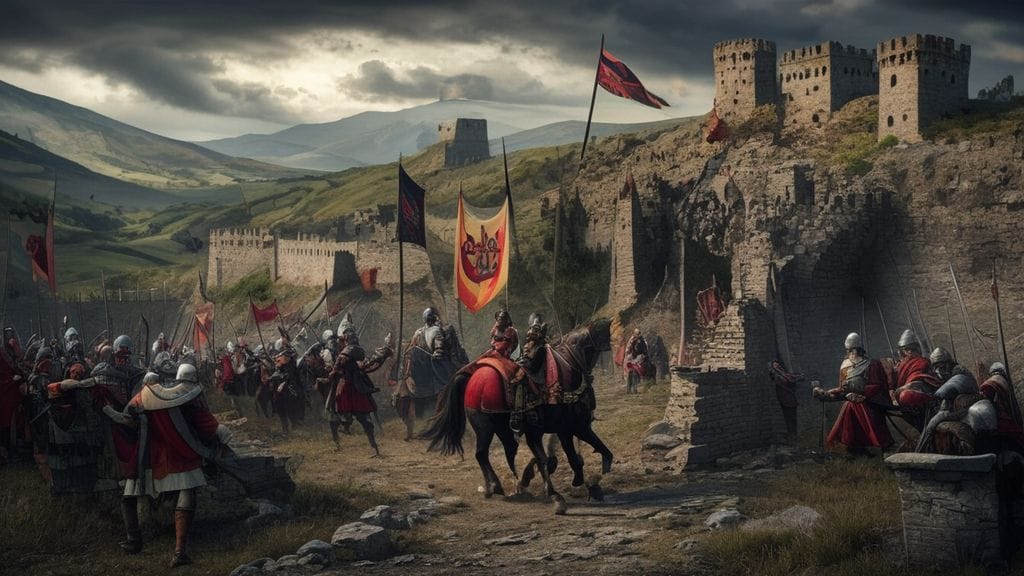
Table of Contents
- A Summer of Iron: Europe on the Eve of Invasion, 773
- From Pepin to Charlemagne: The Frankish Road to Italy
- A Crown in Peril: The Lombard Kingdom and Its Fragile Power
- The Pope Between Two Worlds: Rome’s Desperate Appeals
- When Charlemagne Invades Kingdom of the Lombards: The Decision for War
- Steel in the Passes: Crossing the Alps into Northern Italy
- The Siege of Pavia: Hunger, Fear, and Unyielding Walls
- Desperation and Intrigue: Desiderius, Carloman’s Sons, and the Broken Alliance
- Inside the Frankish Host: Knights, Camp Followers, and the Cost of War
- The Fall of a Crown: The Surrender of Desiderius and the End of Lombard Kingship
- From Conqueror to King: Charlemagne’s Rule over the Lombards
- Church, Land, and Oaths: How Conquest Reshaped Northern Italy
- Voices from Below: Peasants, Monks, and the Human Toll of Invasion
- Myth-Making in Real Time: Annals, Chronicles, and the Memory of 773–774
- From Pavia to Empire: How the Italian War Led to Charlemagne’s Coronation
- A Landscape Transformed: Cities, Roads, and Power after the Lombards
- What If the Lombards Had Won? Counterfactual Shadows on European History
- Echoes of Iron and Faith: The Legacy of the Frankish Invasion Today
- Conclusion
- FAQs
- External Resource
- Internal Link
Article Summary: In the summer of 773, the balance of power in Western Europe shifted when Charlemagne answered the pleas of a threatened pope and led his armies across the Alps into northern Italy. This article traces how political marriages, broken alliances, and papal diplomacy converged in a single decision: charlemagne invades kingdom of the lombards to unseat King Desiderius and secure Rome’s fragile independence. We move from the tense courts of Pavia and Aachen to the treacherous Alpine passes, then to the starving city of Pavia, where a kingdom slowly bled to death behind its own walls. Along the way, we explore the experience of common soldiers and peasants, the strategies of bishops and nobles, and the quiet calculations of a ruler who was already thinking beyond a single campaign. By examining chronicles, letters, and later legends, we see how this war became a foundational myth for both the papacy and the Carolingian dynasty. The invasion of 773–774 did more than topple a king: it created the first Frankish foothold in Italy and laid one of the necessary stones for the building of a future “Holy Roman Empire.” Yet behind the grand narrative lies a story of fear, famine, negotiation, and human fragility that still speaks to the making of power in medieval Europe.
A Summer of Iron: Europe on the Eve of Invasion, 773
In June of 773, the valleys of northern Italy were thick with the season’s first heat, and with it came a tension that could not yet be seen, only felt. Fields around Pavia and Verona shimmered under the sun, peasants bent over in labor, oblivious perhaps to the scale of the storm about to break over their heads. Yet in the fortified towns and echoing church naves, rumors moved faster than summer wind: the Franks were restless; the Pope was afraid; King Desiderius of the Lombards was hardening his rule. Within a year, the fate of the Lombard kingdom, and with it the destiny of Western Europe, would change when charlemagne invades kingdom of the lombards, pushing his banners over the Alps and into the long-contested plains of northern Italy.
At this moment, Europe was a mosaic of rival kingdoms, each one fragile in its own way. To the north and west lay the Frankish domains, recently united under a tall, ambitious king named Charles—whom later ages would call Charlemagne. To the south lay the old Roman dream, reduced to a cluster of cities and memories in the hands of the Papacy and the Byzantine Empire. Between them, holding the narrow bridge of northern Italy, stood the Lombards, a Germanic people who had carved out a kingdom on former Roman soil two centuries earlier. The confrontation that was coming was not merely a border skirmish or a trivial dynastic quarrel; it was a collision of different ways of imagining power, church, and kingship. When charlemagne invades kingdom of the lombards, he would not only fight for land; he would fight for the right to decide who guarded Rome, who crowned kings, and who spoke for God on earth.
Yet in that early summer, nothing was fated, nothing inevitable. In Pavia, Desiderius’s counselors weighed rumors against realities. In Rome, Pope Hadrian I (who would soon replace the dying Pope Stephen III) measured his words carefully in letters destined for the Frankish court. And in the north, at Aachen or in the moving camp that served as his throne, Charlemagne listened, questioned, calculated. The war that posterity would remember in simple terms—charlemagne invades kingdom of the lombards, defeats Desiderius, and becomes king of the Lombards—was in its origins a web of conflicting oaths, broken treaties, family grievances, and papal fears. As the days of 773 lengthened, the stage was quietly being set.
From Pepin to Charlemagne: The Frankish Road to Italy
To understand why Frankish banners would soon fly over Italian soil, one must step back to an earlier, equally dramatic rearrangement of power. Charlemagne’s father, Pepin the Short, had himself seized the Frankish throne from the last Merovingian king, Childeric III, in 751. That act of usurpation needed a blessing, and Pepin found it in Rome. The alliance between the Carolingians and the Papacy did not begin when charlemagne invades kingdom of the lombards; it had been carefully constructed, almost brick by brick, in the years when Charles was still a boy.
Pepin’s relationship with Rome led directly to war with the Lombards. The Lombard kings, strong in northern Italy, had pressed hard upon the territories of the Papacy in central Italy. The Byzantine Empire, theoretically the legal overlord of Rome, was weakened and distant. When Pope Zachary and later Pope Stephen II sought protection, they looked not to Constantinople but to the Frankish realm. Pepin answered the call, crossing the Alps twice, in 754 and 756, to force King Aistulf of the Lombards into submission. These campaigns ended with the so-called Donation of Pepin: lands taken from the Lombards were granted not back to Byzantium but to the Papacy itself. A new political entity, the Papal States, was born on parchment and defended by Frankish swords.
For the young Charlemagne, these events formed the political atmosphere in which he matured. He saw with his own eyes, or at least heard as intimate family lore, that Italian campaigns were not just matters of glory; they were instruments of God’s favor and papal gratitude. A Frankish king who defended Rome could count on moral authority and spiritual legitimacy that no Merovingian had ever fully possessed. The idea that a ruler might become, in effect, the armed guardian of the Church became part of the Carolingian identity. So when charlemagne invades kingdom of the lombards in 773, he was not acting in a vacuum; he was stepping into a role that his father had defined, extending a legacy that was already heavily freighted with expectation and promise.
But history moves through families as well as through institutions. Upon Pepin’s death in 768, the Frankish realm was divided between Charlemagne and his brother Carloman, as Frankish custom dictated. Italy became, in this division, a point of both opportunity and potential conflict. Rome still needed protection; the Lombards remained a looming threat; the papacy, ever anxious, watched the rivalry between the brothers with concern. It was into this uneasy inheritance that Charlemagne stepped when he became sole king in 771, after Carloman’s sudden death. Nearly everything that would happen when charlemagne invades kingdom of the lombards in 773–774 sprang from these earlier entanglements of blood, faith, and power.
A Crown in Peril: The Lombard Kingdom and Its Fragile Power
The Lombard kingdom that faced the Frankish onslaught in 773 was both formidable and fragile. Its capital, Pavia, had stone walls, trained warriors, and a royal court that knew the arts of diplomacy as well as those of war. Stretching across the plains of northern Italy and reaching into central and southern regions through dukes and subordinate rulers, Lombard power rested on a delicate balance between the king and local magnates. It was less a unified state than a federation of loyalties held together by oaths, fear, and opportunity.
Desiderius, the last Lombard king, had risen not from the old royal line but from the ranks of the dukes; he had been Duke of Tuscia before taking the crown in 756. He was, by all accounts, shrewd and determined. To strengthen his hand, he used one of the oldest political tools: marriage. He arranged for his daughter, commonly known as Desiderata by historians, to marry Charlemagne around 770, linking Lombard and Frankish fortunes. For a brief moment, it seemed as though the tension between the two kingdoms might soften into an alliance, or at least a wary partnership.
But Desiderius ruled a kingdom wedged uncomfortably between two great pressures: the Papacy to the south, desperate to secure and possibly expand its lands, and the Franks to the north, increasingly conscious of their role as defenders of Rome. Within Lombard Italy itself, dukes such as those of Spoleto and Benevento followed their own interests, sometimes ignoring royal commands. Any sign of weakness at Pavia could quickly trigger defections. Thus when charlemagne invades kingdom of the lombards, he is not striking at a monolithic giant but at a patchwork polity, one that might hold together heroically under siege—or crumble as its component parts sought safer, Frankish favor.
In the countryside, Lombard rule was experienced less in grand strategy than in taxes, military levies, and the presence of armed men at harvest time. Monasteries navigated between Lombard nobles and Roman popes, seeking charters that would guarantee their lands and immunities. Italian bishops, sometimes of Lombard stock, sometimes more deeply tied to Roman traditions, watched the sky darken with the approach of the Frankish storm and asked themselves a quiet, urgent question: which king’s name should they pray for in the Mass, and for how much longer?
The Pope Between Two Worlds: Rome’s Desperate Appeals
Rome in the 770s was not the triumphant, imperial city of old; it was a place in decline, its ancient monuments crumbling, its population shrunk, its defenses precarious. Yet spiritually, it remained a center of immense power. The bishop of Rome, the Pope, spoke not only for his city but increasingly for a Western Church that looked to him more than to distant Constantinople. The papacy’s physical vulnerability made its moral voice grow louder in proportion: a paradox at the heart of the story in which charlemagne invades kingdom of the lombards as the armed response to whispered prayers and inked petitions.
When Pope Stephen III first opposed the marriage alliance between Charlemagne and Desiderius, he did so because he feared the Lombard king’s influence and the merging of Frankish and Lombard interests. After Stephen’s death in 772, Pope Hadrian I inherited a dangerous situation. Desiderius pressured him aggressively, demanding recognition of certain claims and perhaps hoping to bend the Papacy more firmly under Lombard control. Meanwhile, the memory of Pepin’s earlier promises—the Donation of Pepin and the idea that the Franks were the protectors of Rome—remained vivid. Hadrian’s letters to Charlemagne, some of which survive, blend the language of spiritual fraternity with that of urgent political necessity.
He reminded the Frankish king of his father’s vows and of the special bond that linked the Frankish throne to the See of Peter. One famous letter, quoted in the Royal Frankish Annals, implores Charlemagne not to abandon the Church of God, “which your father of blessed memory restored from the hands of the Lombards.” In these pleas lay the moral framework that would later justify the fact that charlemagne invades kingdom of the lombards not as an aggressor, but as a liberator and defender of the Church. The Papacy, lacking armies of its own, wielded parchment and prayer as weapons, and in 773, these proved sharp enough to summon the most powerful warlord in the West across the mountains.
Rome’s situation was precarious in another way: it stood between Latin and Greek spheres of influence. The Byzantines still claimed a theoretical authority over Italy, and occasionally sent officials or troops. But their power had receded dramatically. Hadrian knew that if Rome was to survive as more than a nostalgic echo, it needed a partner strong enough to hold off both Lombard pressure and Byzantine ambitions, yet weak enough—or devout enough—to accept the Pope’s spiritual preeminence. Charlemagne, whose authority rested in part on the earlier papal blessing of his father’s usurpation, seemed the perfect candidate.
When Charlemagne Invades Kingdom of the Lombards: The Decision for War
The turning point came with a tangle of family politics and broken trust. After Carloman’s death in 771, his widow, Gerberga, fled with her young sons—claimants to a share of the Frankish throne—to the Lombard court at Pavia. Desiderius sheltered them, using their presence as a bargaining chip, perhaps dreaming of one day setting one of them on the Frankish throne in opposition to Charlemagne. At the same time, Charlemagne repudiated his Lombard wife, Desiderius’s daughter, and married a new queen, Hildegard of the Agilolfing family of Bavaria. For Desiderius, this was not merely an insult; it was a strategic blow.
The web of alliance unraveled rapidly. Now, Desiderius harbored a potential rival to Charlemagne and had lost the marital tie that had momentarily bound the two kingdoms together. When the Pope refused to anoint Carloman’s sons as Frankish kings, Desiderius applied fresh pressure on Rome, trying to force Hadrian’s hand. In response, the Pope doubled down on the Frankish alliance, writing openly to Charlemagne and, in effect, inviting Frankish intervention in Lombard affairs. The scene was set: a spurned father-in-law in Pavia, a fearful Pope in Rome, and an ambitious young king in the north.
It is within this high-stakes drama that charlemagne invades kingdom of the lombards ceases to be a simple military operation and becomes a charged act, almost theatrical in its implications. By choosing war, Charlemagne did several things at once. He signaled that he would tolerate no rival claimants to his throne protected by foreign kings. He demonstrated that he would uphold, more than his father ever had, the role of Frankish protector of Rome. And he reached for the rich prize of Italy itself: fertile lands, wealthy monasteries, ancient cities, and a strategic arc of territory that commanded the routes between the Alps and the Mediterranean.
The decision was not taken lightly. Campaigns across the Alps had cost Pepin dearly in men and resources. The passes were treacherous; supply lines long and uncertain. But Charlemagne, by the early 770s, had already shown that he valued calculated risk. His advisors likely presented him with the alternatives: tolerate Desiderius’s pressure on Rome and his sheltering of Carloman’s sons, or move decisively and reshape the political map. He chose the latter. When charlemagne invades kingdom of the lombards in 773, it is with the full understanding that this campaign would define not just his reign, but the future contours of Western Christendom.
Steel in the Passes: Crossing the Alps into Northern Italy
It is easy, from a distance of more than a millennium, to see the invasion of 773–774 as lines on a map, arrows pointing southward across the Alps. For the men who marched with Charlemagne, the campaign meant something more visceral: the harsh grind of hooves on rock, the thin air of the high passes, the ever-present danger of avalanche, ambush, or starvation. The sources suggest that Charlemagne divided his forces, sending contingents through different Alpine routes, perhaps to outflank Lombard defenses and to avoid congestion along a single path.
The Lombards, for their part, understood that the mountains could be their shield. Desiderius sought to block or at least slow the Frankish advance by occupying strategic spots, such as the passes near the Mont Cenis or Great St. Bernard. But the Frankish army, hardened by campaigns in Aquitaine and elsewhere, pressed on. Picture the procession: heavy cavalry leading, their mail coats creaking, followed by foot soldiers burdened with shields and spears, engineers carrying tools to build makeshift bridges or to clear landslides, and a long tail of wagons bearing food, weapons, and the bare essentials of a moving kingdom at war. Behind them trailed servants, merchants, smiths, and perhaps even priests carrying relics for protection.
Contemporary accounts hint at the drama of this crossing. The Royal Frankish Annals—a key source that offers the official Frankish perspective—depict Charlemagne as a deliberate, persistent commander who used the terrain rather than surrendered to it. One later tradition imagines him praying at high altars hastily set up amid the mountain winds, asking for God’s favor before driving his men onward. The reality was likely more prosaic yet no less intense: men slipping on ice, horses breaking legs, campfires struggling against cold night air. But day by day, the Franks descended on the Italian side. When charlemagne invades kingdom of the lombards in earnest, entering the plains from the Alpine passes, he brings with him not just steel and muscle, but the aura of a commander who has already bested nature itself.
As the Frankish host emerged from the mountains, Lombard outposts must have watched with a mixture of dread and astonishment. The barrier that had protected Italy since antiquity had once more been breached by a northern power. The scene evoked, consciously or not, the memory of earlier invasions—of Gothic and Lombard migrations, even of Hannibal’s elephants. Now, in 773, it was the turn of a new conqueror, one whose cross-marked banners carried both military and spiritual ambition.
The Siege of Pavia: Hunger, Fear, and Unyielding Walls
Once in the plains of northern Italy, Charlemagne moved swiftly, taking key points and pushing the Lombard forces back toward their heartland. Desiderius, understanding that he could not defeat the Franks in open battle, retreated into Pavia, the royal capital, trusting its walls to hold. Thus began one of the most consequential sieges in early medieval Europe. It is here, in the mud and misery before Pavia’s ramparts, that the phrase “charlemagne invades kingdom of the lombards” takes on its most human meaning: men waiting, starving, bargaining, dying, day after grinding day.
The siege lasted through the winter of 773–774, perhaps close to nine months. For the defenders, life became a narrowing circle. At first, there was defiance: Lombard warriors manning the towers, archers watching for any sign of a Frankish assault, women and children clinging to the belief that their king and their city were strong. But as the months passed, food grew scarce. Grain stores dwindled; animals were slaughtered; the people turned to whatever could be boiled and eaten. Disease, always lurking in cramped quarters, would have spread quickly. Contemporary chroniclers speak in general terms of hunger and suffering, but behind those phrases lie the cries of children at night and the helpless rage of fathers who could not feed them.
Outside the walls, the Frankish camp became a temporary city. Charlemagne established order, using his presence to maintain discipline among his troops. Raiding parties ranged through the countryside, collecting food and terrorizing nearby settlements that might aid Pavia. Monasteries nearby negotiated for their safety, offering provisions or oaths of loyalty. Winter in the Po Valley is cold and damp; the mud clings, the fog hangs low. One can imagine the king moving among his tents, talking with his nobles, hearing news from other parts of Italy—most notably from Verona, where his half-brother’s widow Gerberga and her sons had taken refuge, only to see their position crumble as the Frankish net tightened.
The siege was not a single dramatic clash but a slow crushing. Yet from time to time there must have been flares of violence: sorties from the city, attempts to burn siege works, duels of archers across the moat. The chroniclers, focused more on outcomes than details, tell us little about individual acts of heroism or cowardice. But we know enough from other sieges of the period to reconstruct the likely emotional landscape: nights broken by alarm bells, mornings greeted with dread, internal tensions as some of the city’s elite wondered if surrender might be wiser than starvation. As charlemagne invades kingdom of the lombards and clamps his army around Pavia, he is not merely eroding a wall; he is undermining an entire system of legitimacy.
Desperation and Intrigue: Desiderius, Carloman’s Sons, and the Broken Alliance
Within Pavia’s walls, King Desiderius confronted the collapse of the political architecture he had painstakingly built. His alliance with Charlemagne, sealed by his daughter’s marriage, lay in ruins. His attempt to use Carloman’s sons as pawns in a dynastic game had failed; Verona, where they had taken refuge, fell to Charlemagne’s forces, and the boys disappeared from the historical record. Whether they were quietly tonsured and sent to monasteries, or met a darker fate, remains uncertain. Their vanishing is one of the many human mysteries wrapped inside the broader narrative that charlemagne invades kingdom of the lombards and reshapes the political map.
Some sources hint at mounting tensions between Desiderius and his own nobles. A siege tests loyalty like fire. As months passed and news reached Pavia of Frankish successes elsewhere in Lombard territory, dukes and regional leaders might have started to hedge their bets. If Charlemagne offered them a continuation of their lands and titles under new overlordship, would they be wise to refuse? Moreover, the Church within Lombard lands was not wholly pro-Lombard. Certain bishops and abbots, remembering earlier Frankish interventions and papal promises, could have seen in Charlemagne a more reliable patron than their faltering king.
Desiderius’s personal character emerges only in scattered, often hostile anecdotes. Frankish sources portray him as obstinate, even cruel, to heighten Charlemagne’s image as righteous conqueror. One later chronicle even describes the fallen king sitting at a monastery gate, mocked by passersby, after being brought into captivity—an image as much symbolic as historical. Yet in Pavia during that terrible winter, he must have felt the crushing solitude of command. Every decision—to hold out or negotiate, to ration more severely or risk one last sortie—bore the weight of a kingdom’s destiny.
It is in these tangled, desperate months that we see the fissures in Lombard society widen. While Desiderius held Pavia, other Lombard centers began to negotiate with Charlemagne. Treviso, Verona, and other cities made their accommodations. By the time the walls of Pavia finally cracked, the kingdom beyond them had already largely passed into Frankish hands in all but name. The siege was, in effect, the drawn-out funeral of Lombard royal power.
Inside the Frankish Host: Knights, Camp Followers, and the Cost of War
When we say charlemagne invades kingdom of the lombards, our minds leap to kings and walls, to sieges and treaties. Yet an invasion is also made up of thousands of small, lived experiences: a young warrior’s first kill, a blacksmith’s bruised hands, a servant’s terror in a foreign land. The Frankish host that encircled Pavia was a complex organism, not just a military machine. At its core were the milites, the mounted warriors whose service was owed in return for landed benefices—early forms of the system that would later become full-blown feudalism. Around them clustered lighter-armed infantry, free peasants summoned to war, and specialists such as engineers and artisans.
Alongside the fighters traveled a shadow community: merchants selling cloth, salt, and wine; cooks and sutlers; women of various statuses—wives, concubines, camp followers—who washed clothes, tended fires, and sometimes nursed the wounded. Children, too, might have tagged along, especially if their fathers expected a long campaign. Life in the siege camp was a mixture of boredom and bursts of panic. Long stretches of time were spent repairing gear, drilling, gambling, exchanging stories about home. Then, without much warning, the alarm might sound, and men would rush to arms as a sortie from the walls threatened a section of the line.
We catch only rare glimpses of this human underside in the written sources. Yet archaeological evidence from other Carolingian-era sites suggests what the camp might have looked and smelled like: rows of leather tents, pits filled with animal bones and broken pottery, discarded arrowheads and rusted nails scattered in the soil. The spiritual dimension was omnipresent. Priests accompanied the army, celebrating mass, hearing confessions, and carrying relics believed to protect the host. Charlemagne himself is frequently presented as a ruler deeply attentive to religious ritual; one can imagine him attending a field mass at dawn, cloak drawn tight against the chill, while the smoke of sacrifice and incense mingled with the breath of warhorses.
The cost of the campaign was profound. Men died not only from battle but from disease and accident. Horses, essential to Frankish warfare, fell from exhaustion or injury and had to be replaced. Every spear, every helmet, represented the labor of artisans back in the Frankish heartlands. When charlemagne invades kingdom of the lombards, he does so by drawing deeply on the economic veins of his realm. The conquest of Italy promised rich rewards—land grants for loyal followers, tribute, and booty—but these came only after months of investment in blood and treasure.
The Fall of a Crown: The Surrender of Desiderius and the End of Lombard Kingship
By the spring of 774, the outcome was no longer in doubt. Pavia’s population was starving; the Lombard army too weak and isolated to break through the Frankish lines. News from beyond the walls was grim: cities had submitted, magnates had bent the knee, and the Pope in Rome openly celebrated Charlemagne as a providential defender. The moment came when resistance could no longer be justified as heroic; it became mere self-destruction. A choice had to be made: hold out to the last, with all the tragic glory but utter ruin that entailed, or surrender and hope for mercy.
According to the Royal Frankish Annals, Desiderius finally capitulated. The exact details are hazy, but the symbolism is clear. The king who had once negotiated with popes and Frankish rulers now emerged from his beleaguered capital to place himself and his crown in Charlemagne’s hands. One later tradition paints a vivid scene: Desiderius, proud and defiant even in defeat, is brought to Charlemagne, who orders him taken to a monastery in Francia, effectively removing him forever from the political stage. Whether or not the meeting took place exactly as described, the essence is correct: Lombard royal power was extinguished.
Charlemagne entered Pavia as conqueror, but his victory was carefully staged as something more than a simple triumph. He had, in his own mind and in the narratives crafted around him, acted as a legitimate punisher of oath-breakers and protector of the Church. When charlemagne invades kingdom of the lombards and forces the surrender of Desiderius, he claims not to be destroying a kingdom for his own gain, but restoring right order under God. This framing matters: it would shape how later generations understood not only this war, but the nature of Christian kingship itself.
With Desiderius removed and Lombard resistance broken, Charlemagne took a step that surprised some and shocked others: he did not abolish the Lombard kingship in name. Instead, he assumed its crown. In the aftermath of Pavia’s fall, he had himself proclaimed “Rex Langobardorum”—King of the Lombards—alongside his title as King of the Franks. In this gesture lay both pragmatism and symbolism. Pragmatic, because keeping the existing structures and titles made it easier to govern a diverse realm; symbolic, because it proclaimed that the line of Lombard kings had ended not in oblivion, but in absorption into a larger, Frankish-Carolingian order.
From Conqueror to King: Charlemagne’s Rule over the Lombards
Victory on the battlefield is one thing; ruling the conquered is another. After the surrender of Pavia, Charlemagne spent time in Italy reorganizing his new territories. He kept much of the Lombard administrative framework intact, working through dukes and counts, but gradually inserted Frankish officials and loyal men into key positions. The title “King of the Lombards” was not an empty flourish. It signaled to Lombard elites that their identity and offices would continue if they accepted the new king. This continuity helped avoid full-scale rebellion in the years immediately following the conquest.
In church matters, Charlemagne moved with equal care and ambition. He confirmed and, in some accounts, expanded the Donation of Pepin to the Papacy, granting lands and rights in central Italy while retaining overarching authority as secular overlord. The Pope, in turn, crowned him as king in Pavia or Rome (sources differ on the exact ceremonial details, but the bond is unmistakable). The narrative that charlemagne invades kingdom of the lombards at the Pope’s request, defeats a hostile king, and then restores and protects the Church became central to Carolingian propaganda.
Administration in northern Italy increasingly mirrored Carolingian practices elsewhere. Written capitularies—royal decrees—regulated everything from the duties of local officials to the protection of church property. Monasteries such as Bobbio and Nonantola found themselves under new patronage, sometimes benefiting from fresh endowments, sometimes losing autonomy to Frankish oversight. Bishops navigated these shifts, pledging loyalty to the new king while preserving as much local influence as possible. In charters and letters from the decades after 774, we see a growing entanglement of Lombard and Frankish aristocratic families through intermarriage and shared office-holding, a gradual weaving together of two once-separate elites.
Yet the conquest did not mean that northern Italy became simply “Frankish.” Lombard law continued to be recognized alongside Frankish and Roman law, especially in matters like inheritance and property. Charlemagne’s gift, and perhaps his genius, lay in managing diversity without immediately crushing it. He presented himself as a ruler over peoples, plural—a king of the Franks and the Lombards—anticipating the imperial title he would later receive. In this way, the moment when charlemagne invades kingdom of the lombards and claims their crown becomes a rehearsal for his later role as a ruler over a patchwork of ethnic and legal communities within an emerging European empire.
Church, Land, and Oaths: How Conquest Reshaped Northern Italy
Land was the true currency of power in the early Middle Ages, and the Frankish conquest of Lombard Italy triggered a vast redistribution. Lombard royal estates were taken into the royal fisc—the king’s direct property. Some of these lands were granted out to Frankish nobles as rewards for service in the campaign. Others were donated to churches and monasteries in a wave of piety mixed with calculated patronage. Each grant came with expectations: loyalty, prayers for the king’s soul, and sometimes military obligations.
For the Church, 774 and the years following were transformative. Not only did the Papacy see its territorial claims in central Italy more securely guaranteed; local Italian churches also found themselves drawn into the Carolingian reform program. Charlemagne supported councils that sought to standardize liturgy and discipline, pressing Italian clergy to align more closely with practices in Gaul and Germany. Monasteries were encouraged—or compelled—to adopt the Rule of Saint Benedict more rigorously, part of a wider attempt to make monastic life across his realms more uniform. A document such as the Capitulare Italicum shows the king issuing detailed instructions for officials in Italy, underscoring his intent to bind the region firmly into his governance.
At the heart of these changes lay the oath. When charlemagne invades kingdom of the lombards and takes their throne, he demands not only submission but sworn fidelity. Nobles, free men, and sometimes even communities as a whole took oaths to him, formalizing their place within the new order. These oaths were not mere formalities; in a world with limited written enforcement, a sworn pledge before God and witnesses was both a legal act and a spiritual bond. Breaking such an oath was a sin as well as a crime. The network of oaths emanating from Charlemagne and radiating through Italy stitched together what might otherwise have remained a merely occupied land.
Of course, these transformations generated winners and losers. Some Lombard families, quick to ally with the new regime, secured grants and positions, strengthening their status. Others saw their lands confiscated and their influence wane. Peasants experienced the changes more indirectly—as new lords, new demands for labor and rents, new legal expectations—but the underlying reality for them remained harsh: they farmed, they paid, they obeyed. Yet over time, the integration of northern Italy into a larger Carolingian space also meant access to new markets, the flow of silver coinage, and participation in long-distance trade routes that connected the Alps to the Mediterranean and beyond.
Voices from Below: Peasants, Monks, and the Human Toll of Invasion
History often remembers kings and battles more readily than the ordinary lives caught up in their wake. Still, if we look closely at charters, monastic cartularies, and occasional terse notes in chronicles, we can begin to glimpse the human toll of the moment when charlemagne invades kingdom of the lombards and imposes a new order. For peasants in the Po Valley, the years around 773–774 were likely marked by dislocation. Some fields were trampled by armies, harvests seized for sieges, livestock driven off. Families may have fled into forests or hills to escape marauding troops, leaving behind their homes and tools.
After the war, these people faced fresh demands. New lords—Frankish, Lombard, or churchly—asserted rights to rents and services. In some areas, the shift may have been almost invisible; a Lombard noble replaced by a Frankish one, but the dues remaining roughly the same. In others, especially where royal estates were redistributed, the entire structure of obligation could change. The emotional texture of these changes is harder to recover, but we can imagine both resentment and resignation. For a peasant plowing a field near Pavia in, say, 778, the name of the king—whether Desiderius or Charlemagne—might matter less than whether or not he could keep enough grain to feed his children.
Monasteries provide richer testimony. Many wrote or preserved documents in which they recorded the grants and immunities they received from Charlemagne. A charter to the monastery of Saint Denis, for example—though situated in Francia, not Italy—shows how carefully the king negotiated spiritual reciprocity: land for prayers. In Italy, similar documents reveal monasteries suddenly finding themselves under a new patron, one who urged them toward stricter observance while also protecting their rights. The Chronicon Farfense, the chronicle of the powerful abbey of Farfa in central Italy, includes accounts of dealings with Frankish rulers that hint at both opportunity and anxiety for monastic communities navigating the new political landscape.
We should also remember the captives and displaced persons of war. Some of Desiderius’s loyal followers were likely taken north into Francia, whether to serve new masters or to live in constrained exile. Others may have slipped away into obscurity, their names lost but their experiences echoing silently through the generations. For them, charlemagne invades kingdom of the lombards was not a grand step toward empire but a moment of personal catastrophe: the loss of a lord, a homeland, or a future that would now never come to pass.
Myth-Making in Real Time: Annals, Chronicles, and the Memory of 773–774
The story of how charlemagne invades kingdom of the lombards and topples Desiderius does not come to us unfiltered. It was shaped, almost immediately, by writers who had their own agendas and audiences. Chief among these were the authors of the Royal Frankish Annals, a series of year-by-year entries produced at Charlemagne’s court or under its influence. In the entry for 773–774, the annalist emphasizes Charlemagne’s piety, the Pope’s pleas, and Desiderius’s perfidy. The narrative is clear: God-fearing king responds to unjust aggression against the Church, crosses the Alps with divine assistance, and restores order by conquering a tyrant.
Later biographers took this framing and elaborated it. Einhard, writing his Vita Karoli Magni (Life of Charlemagne) in the early ninth century, offers a polished, almost classical portrait of the king. He mentions the Italian campaign, but with an economy of words that underscores its inevitability and justice. Charlemagne appears as a figure almost above ordinary politics, an instrument of God’s will. Over time, as the memory of the Lombard kingdom faded, the episode became one more stepping stone on the path to Charlemagne’s imperial coronation in 800.
Italian and papal sources contributed their own shades of meaning. Papal letters preserved in collections like the Codex Carolinus depict the Pope’s appeals and gratitude, reinforcing the idea of the Frankish king as defensor ecclesiae, defender of the Church. Some Lombard-leaning traditions, much more fragmentary, may have preserved a different image: that of a kingdom betrayed by its own elites and crushed beneath foreign hooves. Unfortunately for the historian seeking balance, the winning side takes better care of its archives.
Medieval chroniclers often blurred fact and moral interpretation. It is telling that later writers sometimes embellished the details of Desiderius’s humiliation—one twelfth-century account has Charlemagne forcing the former king to sit day after day at a monastery gate, greeting visitors, a living warning against pride. Whether such scenes ever occurred is less important than the function they served: to dramatize the message that resistance to God’s chosen ruler would lead to public disgrace. The event in which charlemagne invades kingdom of the lombards thus lives on not just as a historical episode, but as a moral tale repeatedly retold, reshaped, and reinscribed in Europe’s cultural memory.
From Pavia to Empire: How the Italian War Led to Charlemagne’s Coronation
When Charlemagne rode away from Pavia, now king of both Franks and Lombards, he carried more than a new title. He carried the template of a new kind of Western rulership. Controlling northern Italy gave him the strategic depth and symbolic capital necessary to claim a wider, almost Roman authority. The Pope in Rome, having seen his pleas answered and his enemies subdued, was now bound more closely than ever to the Frankish throne. This alliance would culminate, just over a quarter-century later, in one of the most famous moments of the Middle Ages: Charlemagne’s coronation as Emperor on Christmas Day, 800, in Saint Peter’s Basilica.
The road from 774 to 800 was not straight, but the conquest of Lombard Italy was a crucial early milestone. For one thing, it gave Charlemagne a direct foothold in the old heartlands of the Western Roman Empire. Ruling from Aachen, he could now claim authority over Gaul, much of Germany, and parts of Italy—a swath of territory evocative of ancient imperial maps. For another, it cemented his role as the armed arm of the Papacy. If the Pope was the spiritual heir of Peter, Charlemagne could present himself as the temporal heir of Constantine, the Christian emperor. The story that charlemagne invades kingdom of the lombards at the Pope’s behest laid the foundation for a political theology in which emperors and popes were partners—uneasy partners, as history would show, but bound in a shared project of Christian governance.
One could argue, as some historians have, that without the Italian conquest, the imperial coronation of 800 would have been politically unthinkable. A king confined to the north, with no stake in Rome’s immediate neighborhood, might have seemed an implausible heir to Roman authority. But a ruler who held both sides of the Alps, who had humbled a long-standing Italian kingdom, and who had proven his commitment to defending the Papacy, was another matter. Thus, when charlemagne invades kingdom of the lombards, he is not just settling a local score; he is paving the way, perhaps unconsciously, for the rebirth of a Western empire in his own person.
In this sense, the walls of Pavia echo faintly in the solemn chants of Christmas mass in 800. The starving citizens, the desperate negotiations, the final surrender of Desiderius—these form the prologue to the moment when a Frankish king, surrounded by Roman clergy and aristocrats, felt a crown placed on his head and heard himself acclaimed as “Emperor of the Romans.” The path from siege camp to imperial palace is long and winding, but it runs unmistakably through northern Italy in the years 773–774.
A Landscape Transformed: Cities, Roads, and Power after the Lombards
The Frankish conquest did more than change who wore the crown; it reshaped the very landscape of power in northern Italy. Cities like Pavia, Verona, and Milan, long attuned to Lombard royal authority, now had to recalibrate their relationships with a distant ruler in Aachen. The road networks that connected the Po Valley to the Alpine passes and to Rome gained new significance. Under Charlemagne and his successors, efforts were made—imperfectly, unevenly—to improve infrastructure, secure routes, and encourage trade. The empire was held together not only by oaths and laws, but by the movement of people, goods, and ideas along these arteries.
Charlemagne’s interest in learning and ecclesiastical reform had spatial consequences. Cathedral schools and monastic scriptoria in Italy became part of a broader Carolingian intellectual renaissance. Scholars traveled from Italy to the Frankish north and back. Latin texts were copied and corrected, liturgies harmonized, and doctrinal disputes addressed at councils held under royal auspices. The Italian territories, far from being a mere periphery, contributed significantly to the cultural vibrancy of the Carolingian world. It is striking to realize that the same generation that saw charlemagne invades kingdom of the lombards and the brutal realities of siege warfare also witnessed a renewed attention to grammar, theology, and the proper calculation of Easter.
Economically, the integration of Lombard Italy into the Carolingian orbit facilitated connections between northern markets and Mediterranean ports. Merchants could, at least in theory, rely on a more unified political framework to conduct their business. Of course, local tolls, banditry, and the patchiness of royal enforcement still posed challenges, but there was a greater sense of belonging to a larger polity. Coins bearing Charlemagne’s name circulated alongside or replaced earlier Lombard issues, making tangible the shift in sovereignty.
Over the longer term, however, this integration also set the stage for new forms of fragmentation. As Carolingian power weakened in the ninth century, the Italian territories became contested again—by local magnates, by new kings, and by external forces. Yet the memory of Charlemagne’s conquest persisted, providing a reference point for later rulers who sought to claim universal authority in Italy. The ghost of the moment when charlemagne invades kingdom of the lombards haunted every subsequent attempt to revive empire in the peninsula, from the Ottonians to the Hohenstaufen and beyond.
What If the Lombards Had Won? Counterfactual Shadows on European History
History unfolded as it did: charlemagne invades kingdom of the lombards, crosses the Alps, wins the siege of Pavia, and becomes king of the Lombards. But one of the most revealing ways to grasp the event’s importance is to imagine its opposite. What if Desiderius had managed to hold the passes more effectively, or if a harsh winter and supply failures had forced Charlemagne to retreat? What if Pavia had withstood the siege, maintaining a functioning Lombard kingdom into the ninth century?
In such a scenario, the Papacy’s position would have been sharply constrained. A strong Lombard monarchy neighboring Rome, having resisted Frankish intervention, would have held the upper hand in central Italian politics. The Pope might have been forced into a more uncomfortable accommodation, balancing between Lombard power on one side and a weakened, distant Frankish realm on the other. The moral authority of the Papacy as a chooser and maker of kings would likely have been diminished. Without the compelling story that charlemagne invades kingdom of the lombards at the Pope’s request and rescues the Church, later popes might have struggled to justify their own political interventions.
The idea of a revived Western empire centered on a Frankish ruler might never have taken root. An independent Lombard kingdom could have laid its own claim to Roman heritage, perhaps aligning more closely with the Byzantine Empire or developing its own hybrid form of Christian kingship. The map of medieval Europe might have featured three enduring great powers in the West: Francia, Lombard Italy, and a reconfigured Iberian or British polity, each with its own ecclesiastical-political logic.
Counterfactuals are, by nature, speculative. Yet they throw into relief the contingency of what actually happened. The fact that we speak of Charlemagne as “Emperor” and not Desiderius or his descendants; the fact that papal-imperial relations became a central axis of Western politics; the fact that northern Italy’s identity developed under Carolingian and later German imperial influence—all of these stem, in part, from the outcome of the campaign of 773–774. When charlemagne invades kingdom of the lombards and wins, a whole tree of alternative futures is cut down at the root.
Echoes of Iron and Faith: The Legacy of the Frankish Invasion Today
More than twelve centuries have passed since Frankish warhorses churned the earth outside Pavia’s walls, yet the echoes of that campaign still resonate. In the modern imagination, Charlemagne stands as a symbol of European unity and Christian kingship. The European Union once named an integration prize after him; statues of the king-emperor adorn city squares; his Aachen palace complex attracts visitors from around the world. The story that charlemagne invades kingdom of the lombards and forges a path toward empire is woven subtly into narratives about the origins of “Europe” as a historical project.
In Italy, the Lombard legacy endures in place names—Lombardy, of course, but also traces scattered across the peninsula in churches, legal traditions, and folklore. Archaeological digs reveal Lombard graves, jewelry, and weapons, reminding us that before they were the conquered “last kings,” the Lombards were builders and settlers who left an indelible mark on the land. Modern historians, reexamining sources once taken at face value, have sought to recover a more nuanced picture of Lombard society beyond the caricatures of Frankish propaganda. Works by scholars such as Walter Pohl, for instance, challenge older notions and invite us to see the Lombards as dynamic participants in the making of medieval Europe, not merely as footnotes to Charlemagne’s glory.
The relationship between spiritual authority and military power, so vividly on display when charlemagne invades kingdom of the lombards under papal encouragement, continues to raise questions in contemporary debates. How should religious leaders engage with secular might? What happens when appeals to faith legitimize acts of conquest? The siege of Pavia and the alliance between Charlemagne and the Pope offer a distant but instructive mirror to such concerns. As we read the annals and letters of the eighth century, we are reminded that the line between protection and domination has always been thin.
Ultimately, the event signaled in the terse phrase “Charlemagne invades the Kingdom of the Lombards, Northern Italy | 773-06” was not a mere episode in the annals of war. It was a pivot around which the trajectories of kingdoms, churches, and cultures turned. In the dust of Pavia’s streets, under the vaulted ceilings of Roman basilicas, in the cramped scriptoria of Italian and Frankish monasteries, a new story of Western power was being written—one whose chapters, in altered forms, continue to unfold today.
Conclusion
When we pull together the threads of this story—the anxious letters from Rome, the grim determination of Desiderius in Pavia, the weary march of Frankish soldiers over snow-bound passes—we see more than a victorious campaign. We see the making of a new political and spiritual order. The moment when charlemagne invades kingdom of the lombards crystallizes a shift in which kings did not simply rule by might, but by claiming to be guardians of the Church and heirs to a Roman past reimagined in Christian terms. The Lombard kingdom, once a formidable power in Italy, was absorbed into a wider Carolingian realm whose ambitions stretched across the Alps and toward an imperial horizon.
The human cost of that transformation—hunger in besieged cities, dislocated peasants, exiled nobles—should caution us against romanticizing the narrative. Yet we cannot ignore the creative energies unleashed in its wake: administrative innovation, legal reforms, cultural exchanges, and the slow knitting together of disparate regions into something like a shared European space. The siege of Pavia, the surrender of Desiderius, and the coronation of Charlemagne as king of the Lombards formed a chain of events that made later developments, including his imperial coronation in 800, not inevitable but conceivable.
To look back at 773–774 is to stand at a crossroads where different Europes were still possible. The path actually taken—shaped by ambition, fear, faith, and chance—left deep grooves in the continent’s history. In those grooves, later empires, city-states, and nation-states would run their own courses. The image of a tall Frankish king beneath Lombard walls, answering a pope’s call while reaching for his own designs, remains a powerful emblem of how power and belief entwine, and of how a single campaign can echo for centuries beyond the clash of swords and the crumbling of stones.
FAQs
- Why did Charlemagne invade the Kingdom of the Lombards?
Charlemagne invaded the Lombard kingdom in 773 primarily in response to papal appeals for protection against King Desiderius, who was pressuring Rome and supporting rival claimants to the Frankish throne. The invasion also served Charlemagne’s strategic interests, allowing him to neutralize a hostile neighbor, secure control of key Alpine routes, and claim rich Italian lands. Ideologically, it reinforced his image as defender of the Church, a role inherited from his father Pepin the Short. - How did Charlemagne cross the Alps to reach northern Italy?
Charlemagne divided his forces and used multiple Alpine passes, likely including routes near Mont Cenis and the Great St. Bernard, to avoid bottlenecks and outflank Lombard defenses. The crossing was arduous: soldiers and horses struggled with cold, altitude, and treacherous paths. Contemporary annals emphasize that the king’s persistence and careful planning enabled his army to emerge in the Po Valley in sufficient strength to begin the siege operations that followed. - What happened to King Desiderius after the fall of Pavia?
After a prolonged siege, Desiderius surrendered Pavia in 774 and was taken into Frankish custody. Frankish sources state that Charlemagne sent him to a monastery in Francia, where he spent the rest of his life in enforced retirement. While later chronicles embellish his humiliation with dramatic anecdotes, the essential point is that Desiderius was removed from power and never again played a role in high politics. - Did Charlemagne abolish the Lombard kingdom?
Charlemagne ended the independent Lombard royal line but did not abolish the title or the institutional framework. Instead, he had himself proclaimed “King of the Lombards” in addition to being King of the Franks. He retained many Lombard laws and offices, gradually integrating them into the Carolingian system. This approach eased the transition for local elites and helped stabilize Frankish rule in northern Italy. - How did the conquest of the Lombards affect the Papacy?
The Papacy emerged significantly strengthened. With Desiderius defeated, the immediate Lombard threat to Rome was removed, and the territorial grants first promised by Pepin were more securely upheld. The Pope gained a powerful protector in Charlemagne, who confirmed and sometimes expanded papal lands. This alliance laid the groundwork for the later imperial coronation of Charlemagne in 800 and for centuries of complex papal-imperial relations. - What sources describe Charlemagne’s invasion of the Lombard kingdom?
The main narrative comes from the Royal Frankish Annals, an official court chronicle, and from Einhard’s Life of Charlemagne, written in the early ninth century. Papal letters preserved in the Codex Carolinus also shed light on the political context and the Pope’s appeals. Later medieval chronicles, both Frankish and Italian, add details and legends, though these must be weighed carefully against the earlier, more contemporary accounts. - How did ordinary people in Italy experience the invasion?
For commoners, the invasion meant disrupted harvests, requisitioned supplies, and in some regions, direct violence as armies moved across the land. Those in and around Pavia suffered acutely from the long siege, with hunger and disease claiming many lives. After the conquest, peasants adapted to new lords and legal expectations, while some monasteries and churches gained privileges under Charlemagne’s patronage. Their experiences were varied, but generally marked by hardship alongside gradual adjustment to the new political order. - Did the conquest of the Lombards directly lead to Charlemagne’s imperial coronation?
Not directly, but it was a crucial step. The conquest gave Charlemagne control over northern Italy and solidified his role as protector of Rome, making him an increasingly plausible candidate for imperial status in the eyes of the Papacy. Without this Italian base and the powerful narrative that he had defended and restored the Church, his coronation as Emperor in 800 would have been far less likely.
External Resource
Internal Link
Other Resources
- Encyclopaedia Britannica – general search for the exact subject
- Google Scholar – academic search for the exact subject
- Internet Archive – digital library search for the exact subject

