Table of Contents
- A City on the Edge: Rome Before the Scandal
- A Boy on the Throne of Peter
- Sin, Scandal, and the Black Legend of Benedict IX
- The Reformers’ Dream and the Weight of Corruption
- Enter Giovanni Graziano: The Conscience of Rome
- Whispers of an Unthinkable Deal
- 1045: When Pope Benedict IX Sells the Papacy
- Gold, Promises, and the Price of the Fisherman’s Ring
- Gregory VI Ascends: Hope Woven into Compromise
- Voices of Outrage: Monks, Nobles, and the Common Faithful
- Empire Strikes Back: Henry III and the German Reckoning
- The Synod of Sutri: A Courtroom for Three Popes
- After the Fall: Benedict IX’s Vanishing Trail
- Gregory VI in Exile: A Reform Papacy That Never Was
- Simony, Reform, and the Long Shadow of 1045
- The Road to Hildebrand and the Gregorian Reform
- Memory, Myth, and the Making of a Cautionary Tale
- Why the Sale of the Papacy Still Matters Today
- Conclusion
- FAQs
- External Resource
- Internal Link
Article Summary: In the turbulent year 1045, Rome witnessed an event so shocking that it would echo through the centuries: pope benedict ix sells papacy to his godfather, the reform-minded priest Giovanni Graziano, who became Gregory VI. This article plunges into the streets, palaces, and churches of 11th-century Rome to understand how a teenage pope, born into a ruthless aristocratic clan, turned the highest office of Western Christendom into a negotiable asset. It follows the clash between decadence and reform, as Benedict’s scandals collided with a rising movement determined to cleanse the Church of simony and moral corruption. The narrative explores Gregory VI’s tormented decision to buy the papacy in the hope of saving it, and the fierce backlash that followed. We travel from the noble halls of the Tusculani to the imperial court of Henry III and the fateful Synod of Sutri, where the scandal of the sale was laid bare. Along the way, the article revisits how chroniclers, reformers, and later popes remembered and reinterpreted the moment when pope benedict ix sells papacy for gold and power. By weaving political drama with personal motives, it shows how this act helped ignite sweeping reforms that reshaped medieval Christendom. And in closing, it reflects on why the story of 1045 still matters in modern debates about spiritual authority, corruption, and the price of legitimacy.
A City on the Edge: Rome Before the Scandal
In the early decades of the eleventh century, Rome was less the serene spiritual capital of Christendom and more a battered prize passed between rival families. The marble ruins of the ancient empire still loomed over the city—broken columns, half-toppled arches, the ghostly arena of the Colosseum—but the glory they once represented had long since faded. In their place stood a Rome dominated by fortress-towers, narrow streets, and the iron grip of aristocratic clans who treated the papacy as their most valuable inheritance.
The most powerful among these families were the Crescentii and the Counts of Tusculum, who alternated in raising their sons, nephews, and cousins to the throne of Peter. The office of pope was less a sacrosanct calling than a lever with which they could pry open the treasuries of Christendom, guide imperial politics, and secure favors across the Italian peninsula. Armed retainers shadowed priests; cardinals were as much nobles as churchmen; and the gold of pilgrims arriving at Saint Peter’s was eyed greedily by those who considered the papal palace part of their ancestral estate.
Violence was never far away. Disputed elections often ended with street battles. Bands of armed supporters loyal to competing candidates would clash in the very shadow of basilicas. For ordinary Romans, the papacy was a distant, almost mythical institution—honored from afar, feared up close, and often seen as the plaything of men far above their station. To live in Rome was to live in the uneasy tension between the sacred and the profane, where the relics of saints lay within walking distance of dungeons and private strongholds.
Outside Rome, the wider Church struggled under similar pressures. Bishops were often selected by kings and princes, who saw important sees as political tools rather than spiritual appointments. Many clerics were married or kept concubines. The buying and selling of church offices—what would later be denounced fiercely as simony—had become almost routine. Donations mingled with bribes; ordinations followed negotiations. It is within this world, where spiritual authority was in constant danger of being reduced to coin and patronage, that the scandalous moment when pope benedict ix sells papacy would unfold.
Yet even in this bleak landscape there were signs of resistance. Monasteries inspired by the reforms of Cluny whispered of a purified Church, chaste and free from the grip of lay lords. Charters and letters from reform-minded abbots spoke of a radical vision: a clergy devoted solely to God, not to gold, and a papacy that would stand above the brutal fray of noble politics. Tension between this ideal and the harsh realities of Roman life grew year by year, a tension that would one day explode in the person of one extraordinary, infamous pope.
A Boy on the Throne of Peter
Into this combustible city was born a boy of the Tusculan line, probably around the year 1012 or 1014: Theophylactus, later known to history as Benedict IX. His father, Alberic III, Count of Tusculum, inherited not only lands and fortresses in the hills outside Rome, but a tradition of manipulating the papacy. Alberic’s relatives had already worn the papal tiara—Benedict VIII and John XIX among them—and it was understood within the family that Saint Peter’s throne was a hereditary stronghold as much as a spiritual seat.
Those who later tried to reconstruct Benedict’s childhood could not help but imagine the atmosphere that formed him: the echo of armor in stone hallways, the murmur of political schemes over wine, the casual presence of wealth wrested from church lands and pious donors. Young Theophylactus would have seen the pope not as a remote, holy father, but as an uncle, a cousin, perhaps even a frequent visitor to family banquets. To him, the papacy was tangible, familiar—something one might expect to inherit if fortune smiled.
When John XIX, his kinsman, died in 1032, the Tusculan clan moved with astonishing speed. Bypassing precedence, experience, and any pretense of canonical procedure, they pushed their teenage relative onto the chair of Peter. Theophylactus—still in the bloom of youth—became Pope Benedict IX. Chroniclers estimated he might have been as young as twelve, though some suspect he was closer to eighteen or twenty. Either way, he was dramatically younger than any pope before or since, a boy among wolves, crowned in a city that devoured the unprepared.
Contemporaries recognized that his election was less a spiritual calling than a dynastic maneuver. “He was made pope,” wrote one later chronicler, “through the power of his family, by the favor of the nobles, not by any merit of his own.” Yet the ceremonies in Saint Peter’s went on regardless. Priests intoned the liturgy, incense spiraled upward, and the trembling hands of a teenager were invested with the symbols of an office that claimed universal spiritual authority.
It is astonishing, isn’t it? The continuity of the Church, with its saints and martyrs, its learned fathers and venerable traditions, suddenly concentrated in a youth whose formation lay more in the intrigues of Roman noble life than in the cloistered peace of a monastery. From the start, his pontificate embodied the collision between an ideal of sanctity and the raw realities of power. That collision would, in time, lead to one of the most shocking decisions ever linked to the papal office: the day when pope benedict ix sells papacy for gold and for escape.
Sin, Scandal, and the Black Legend of Benedict IX
The years that followed Benedict IX’s election are swathed in a mixture of rumor, accusation, and grim anecdote. Later reformers painted his reign in almost unrelieved darkness, and as with any black legend, separating fact from exaggeration is difficult. But even allowing for hostile rhetoric, the portrait that emerges is damning.
Saint Peter Damian, a ferocious moralist and reformer writing not long after Benedict’s time, condemned him unequivocally. According to Damian and others, the young pope indulged in open debauchery: feasts, lovers, violence, even criminal conspiracies. One chronicler wrote that his life was “so vile, so foul, so execrable” that it could scarcely be described. Whether every accusation is literally true matters less than the clear consensus: Benedict was viewed by many contemporaries as gravely unworthy of the office he held.
Scandal clung to him both morally and politically. In Rome, rival families seethed at Tusculan dominance. They whispered that a boy pope, notorious for excess, was easy prey. Uprisings flared; at one point, Benedict was driven from the city, forced to rely on the military strength of his kinsmen to fight his way back. The papacy—theoretically the spiritual heart of Western Christendom—became the epicenter of urban street warfare.
Nor was the rest of Europe blind to this decay. Reports of a corrupt, adolescent pope, cavorting and conspiring in the Eternal City, filtered northward. Bishops complained; kings raised eyebrows. Pilgrims, long accustomed to tales of Rome’s harsh politics, now returned with darker stories: of papal courtiers flaunting wealth, of indulgences taken lightly, of a Church seemingly captive to youthful whims and noble greed.
Behind the lurid accusations lay a deeper crisis of legitimacy. How could the pope—supposed successor of Peter, vicar of Christ—be at once a symbol of holiness and a figure of such widespread contempt? The contradiction gnawed at the consciences of serious churchmen. In monasteries like Cluny, in cathedral chapters, and in reform-minded circles across Europe, Benedict IX’s pontificate became a rallying cry, a living proof of how desperately the Church needed cleansing. The stage was being set for a more radical transformation, one that would be born partly from the scandal of the moment when pope benedict ix sells papacy as if it were a family estate.
The Reformers’ Dream and the Weight of Corruption
Even as Benedict IX’s reputation darkened, another force was quietly gathering strength within the Church. For decades, reform currents had been rising from monastic communities determined to renew Christian life from the ground up. Among them, the abbey of Cluny in Burgundy exercised a profound influence, preaching the freedom of the Church from lay control, the celibacy of clergy, and the eradication of simony.
These reformers were no mere idealists scribbling in isolation. They maintained letter networks that spanned Europe, wrote treatises, and advised princes. They had powerful allies, including influential noble families who had grown weary of the moral chaos surrounding bishoprics and abbeys. For them, the office of the pope was crucial: if the papacy could be reformed, it could become the engine that pulled the entire Church toward higher standards of holiness and independence.
Yet while the dream soared, reality dragged it down. The very seat from which reform should have issued was ensnared in the old order’s worst habits. Simony—named after Simon Magus in the Acts of the Apostles, who tried to buy spiritual power with money—had become a widespread plague. Bishops and abbots owed their positions as much to payment and service to secular rulers as to any sign of divine calling. The sacraments themselves risked appearing as commodities when priests secured their stations through wealth rather than spiritual merit.
Benedict IX embodied these contradictions. Elevated by family power, stained by scandal, he seemed the living refutation of the ideals cherished by men like Peter Damian and other reformers. Their writings bristled with frustration and anger, yet also with a determination that something, sooner or later, had to snap. That snap would come through a man who knew Benedict well: his godfather, Giovanni Graziano.
Enter Giovanni Graziano: The Conscience of Rome
Giovanni Graziano was, in many ways, Benedict IX’s opposite. A respected priest of Rome, he held a reputation for integrity at a time when such reputations were rare among the city’s clergy. Sources describe him as a man of solid moral character, earnest in his desire to see the Church purified of its worst abuses. Politically cautious yet spiritually ambitious, he had watched Benedict’s chaotic pontificate with increasing alarm.
For Giovanni, the papacy was not simply another noble title. It was the key to reform, the only institution with the theoretical authority to challenge corrupt bishops and grasping lords across Christendom. A holy pope at the center of the Church could inspire renewal; a wayward one could drag the entire body into disrepute. And here in Rome, the spectacle of a youth notorious for misconduct, wielding the staff of Peter, seemed to mock every ideal Giovanni cherished.
The relationship between the two men was complex. As Benedict’s godfather, Giovanni had stood over the boy’s baptismal font, promising—according to the ancient rites—to guide him in the faith. It is not hard to imagine his inward anguish as Benedict’s behavior became the talk of Rome. Every rumor of scandal, every street battle fought in the pope’s name, would have weighed on the conscience of a man who believed the Church to be the bride of Christ, sullied and shamed before the world.
Giovanni was not alone in his dismay. Other reform-minded clerics in Rome and beyond looked to him as a figure of reliability in a sea of intrigue. In private conversations—perhaps over modest meals in Roman houses, perhaps during hushed walks near the basilicas—they debated what could be done. Could Benedict be persuaded to change? Could he be pressured into abdication? Could some alliance with foreign powers, perhaps the German king, be forged to restore dignity to Saint Peter’s throne?
None of the options were simple. Any challenge to Benedict risked plunging Rome into civil war. The Tusculan family would not willingly surrender their grip on the papacy, and rival aristocrats might seize the opportunity for bloody revenge. It was into this tangled web of ethics, politics, and family loyalty that the unthinkable idea slowly emerged: if moral persuasion failed, might money succeed where prayer and argument could not?
Whispers of an Unthinkable Deal
The sources do not give us a play-by-play account of how the idea first arose, but scattered clues and later narratives allow us to imagine the atmosphere. Somewhere within the circles of Roman clergy and nobility, someone must have asked the forbidden question: if the papacy could be seized by force, subverted by intrigue, why could it not also be transferred by purchase? The question itself was a kind of blasphemy—yet, given the everyday traffic of simony in other offices, it did not seem utterly alien.
Giovanni Graziano, torn between his hatred of simony and his desperation to rescue the Church, found himself drawn into this moral labyrinth. If Benedict would not abandon his office out of conscience, perhaps he would leave for the right price. Money, after all, spoke loudly in Rome. The Tusculani had invested treasure in winning the papacy; perhaps they could be satisfied with treasure in relinquishing it.
Conversations, no doubt, unfolded behind closed doors. Trusted intermediaries might have approached Benedict, testing his mood. Was he weary of the burdens of office? Was he tempted by dreams of a quieter, freer life away from the relentless expectations of Christendom? Rumors circulated that Benedict wished to marry—a shocking desire for a pope bound, at least in theory, to celibacy. If true, it suggested that he himself felt trapped by a role he had accepted more as a family inheritance than a spiritual calling.
In this context, the notion that pope benedict ix sells papacy becomes less a random outrage and more the grim logic of a broken system. If the papacy had been treated as property for generations, passed among clans, defended by swords, and adorned with gold, why would it be inconceivable to transfer it for a sum of money? Yet for Giovanni, the cost was not merely financial. To participate in such a transaction was to stain himself with the very sin—simony—that reformers denounced as a mortal wound in the body of the Church.
But this was only the beginning of his moral torment. If he refused to act, Benedict might continue his scandalous reign, dragging the Church further into disrepute and delaying all hope of reform. If he accepted the unthinkable and essentially bought the papacy, he might, in his own mind, liberate the office from corruption and use its power to heal the Church. Could an evil means be justified by a holy end? That question, thorny and unresolved, lies at the heart of the moment when pope benedict ix sells papacy to his own godfather.
1045: When Pope Benedict IX Sells the Papacy
By 1045, the tension between Benedict IX and the city of Rome had reached a breaking point. He had already been driven out and restored more than once. Insurrections smoldered. The Tusculan grip on the papacy, once ironclad, began to feel more fragile. It was in this atmosphere of exhaustion and danger that the decisive meeting took place.
Later accounts, such as those preserved in the writings of Bonizo of Sutri, give us a stark summary: Benedict, wishing to marry and weary of the burdens of office, agreed to resign the papacy in return for a substantial payment from Giovanni Graziano. The story has the ring of tragic inevitability. A pope, tired of the role he had never sought with a pure heart, bartered away the highest office of Christendom as a man might sell land or a title. Giovanni, driven by the hope of reform, supplied the money—a sum large enough to placate both Benedict and the Tusculani faction behind him.
Details of the transaction are murky. We do not know where it occurred, what words were spoken, or how many witnesses were present. But we can imagine the scene: perhaps in a dim chamber in Rome, heavy with the scent of oil lamps, gold or promissory notes laid out between the men. Benedict, still young but already hardened by power, weighing his options; Giovanni, older, shoulders stooped under a burden that was at once financial, moral, and spiritual.
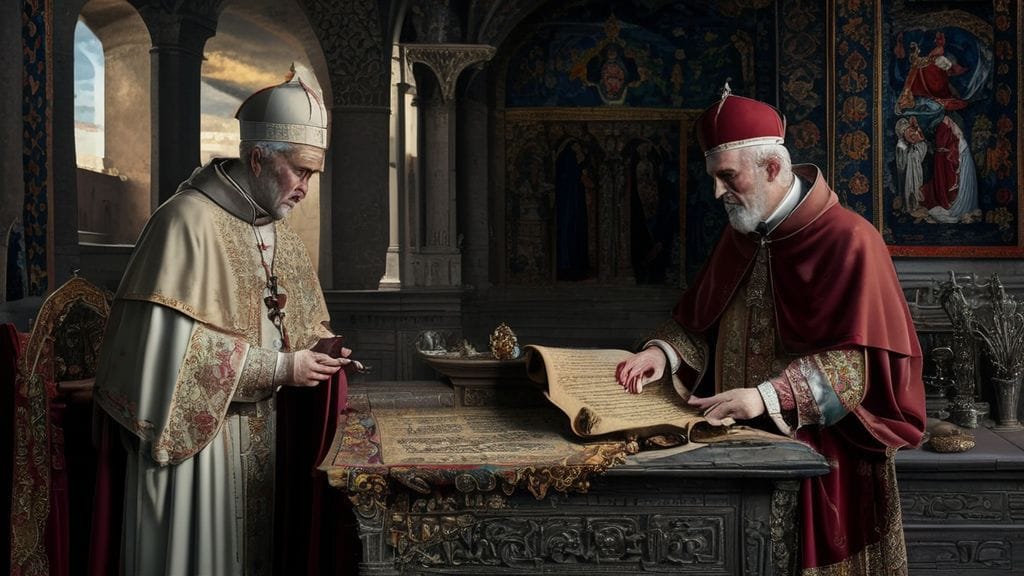
And then the decision. Benedict agreed to lay down the papal office; Giovanni agreed to take it up, convinced—or trying to convince himself—that this compromised act could become the first step toward a purified Church. Pope benedict ix sells papacy: the phrase captures the cold transaction, but not the tumult within the hearts of those involved, nor the shock that would ripple outward as the news spread.
In a sense, the deal only made visible what had long been true. Power in Rome was transactional; sacred offices had often been treated as prizes; money had always greased the wheels of politics. Yet because this involved the papacy itself, the sale cut deeper, piercing the very idea that spiritual authority flowed freely from God. It was as if the Church’s beating heart had been auctioned off. The act would haunt the memories of reformers and historians alike, a moment in which the contradictions of the age were laid brutally bare.
Gold, Promises, and the Price of the Fisherman’s Ring
How much was the papacy worth in 1045? The sources do not agree on a precise figure, and some do not name one at all. But all concur that the sum was significant—enough to satisfy Benedict and his influential backers, enough to shake Giovanni’s resources. In a society where wealth was often measured more in land and feudal obligations than in coin, gathering such a payment would have required extensive support and financial networks.
We must imagine more than bags of gold changing hands. There would have been promises: perhaps guarantees of future income from church lands, assurances of protection for Tusculan allies, subtle understandings that Benedict would not be left destitute. The transaction, though morally shocking, was likely framed in the language of “compensation” and “settlement,” an attempt to cast an unspeakable act in the cloak of legal respectability.
This combination of money and political assurance suggests that the sale was not a simple, private bargain but a broader negotiation involving factions in Rome. Giovanni, by agreeing to pay, also took on the risk of alienating reformers who would see his act as simony in its most blatant form. He had to hope that his later actions as pope would justify his compromised path to the throne.
One modern historian, echoing the judgment of medieval critics, has famously summarized the event as a “traffic in the papacy” (tráfic de la papauté), underlining just how commercialized the spiritual office had become. The Fisherman’s Ring—the symbol of papal power—may not have been literally sold across a table, but in essence, the authority it represented had been weighed, priced, and exchanged.
Yet behind the scandal lay a revealing irony. Those who later condemned simony with such passion would point again and again to this episode as the darkest possible example. And in doing so, they transformed it into a moral lesson for the ages: a story of how even a well-intentioned man like Gregory VI compromised himself by participating in the sale, and how that compromise nearly ruined his hopes of reform. The moment when pope benedict ix sells papacy was not only a financial transaction; it was a tragic parable about the dangers of believing that holiness could ever be bought to correct corruption.
Gregory VI Ascends: Hope Woven into Compromise
Once the agreement was in place and Benedict IX withdrew, Giovanni Graziano emerged from the shadows as the new claimant to the papal throne. He took the name Gregory VI, linking himself to earlier popes who had struggled, in their own ways, to assert papal independence. To many in Rome, and especially among reform circles, his elevation initially seemed like a deliverance. At last, they thought, a man of integrity, known for his piety, would sit upon the seat of Peter.
The ceremonies of his enthronement would have followed the familiar pattern: processions, chants, the solemn investiture with pallium and staff. Crowds might have gathered in Saint Peter’s and around the Lateran, measuring this new pope with the curious, hope-tinged gaze of a population long abused by papal politics. Gregory’s supporters spoke of a dawning era of reform, in which the scandals of Benedict IX would be washed away in a tide of discipline and moral renewal.
Gregory himself seems to have believed in this mission. Contemporary sources and later accounts agree that he sincerely desired to cleanse the Church and end the trade in spiritual offices. He surrounded himself with advisors sympathetic to reform ideals. Among them was a man who would later change the course of papal history: Hildebrand, the future Gregory VII, who as a young cleric learned painful lessons from the compromised pontificate of his mentor.
Yet from the very beginning, Gregory VI’s authority rested on an unstable foundation. Many knew—or soon learned—how he had attained the papacy. Even if they respected his personal virtue, they could not ignore that his claim was tangled in the sin of simony. How could a pope denounce the buying and selling of church offices when his own ascension was made possible because pope benedict ix sells papacy for money?
This inner contradiction haunted Gregory’s reign. He walked a narrow line, trying to act as a reformer while defending himself against charges that he had corrupted the papacy at its root. His letters and actions hint at a man striving earnestly to do good, even as the circumstances of his election undermined his moral authority. Shadows lengthened over his short pontificate, and beyond Rome, powerful eyes were turning toward the troubled city—eyes that would not look kindly on such ambiguity.
Voices of Outrage: Monks, Nobles, and the Common Faithful
News of the sale spread quickly. Chroniclers, who often learned of events through letters, travelers, and ecclesiastical networks, began to murmur. In monasteries, where the hunger for reform burned hottest, outraged conversations erupted. Abbot and monk alike wrestled with bitter disappointment: just when it seemed that the papacy might fall into the hands of a virtuous man, it did so through an act that epitomized the very corruption they fought.
Peter Damian, never one to temper his words, later described the transaction as a sacrilegious sale of the Holy Spirit’s gift. To him, and to many like him, it was unthinkable that the grace associated with the papal office could be traded in such a way. If such a precedent stood unchallenged, what would be left of the Church’s claim to be a spiritual, not a mercenary, institution?
Among the lay nobility, reactions were mixed. Some saw in Gregory VI a more reliable and stabilizing force than Benedict IX and therefore tolerated—even appreciated—the means by which he had gained office. Others, especially those aligned with rival Roman factions, seized on the scandal as a weapon. They could denounce Gregory as a simoniac usurper while conveniently forgetting their own involvement in similar practices at the episcopal level.
For ordinary believers, the implications were both distant and deeply personal. Most peasants and townspeople in far-flung regions heard of papal politics only in rough outline, if at all. Yet the idea that the pope—Christ’s vicar—had in effect bought his office might filter down through sermons colored by local opinion, through gossip shared by returning pilgrims, through the disgruntled talk of low-ranking clergy. Faith in the integrity of the Church’s leadership, always fragile, suffered another blow.
Yet behind the celebrations of Gregory’s supporters and the denunciations of his critics, something new was forming: a widespread, shared sense that such abuses could not continue indefinitely. The sale of the papacy became a symbol of a larger disease, a sign that drastic steps were needed to save the Church’s soul. The scandal did not merely darken Gregory VI’s reputation; it pushed the entire reform movement toward a harsher, more radical stance against any hint of simony—an intensity that would soon shake thrones as well as altars.
Empire Strikes Back: Henry III and the German Reckoning
While Rome stewed in its own turmoil, events far to the north were preparing to crash upon the city like a tidal wave. In the German lands, King Henry III had grown increasingly uneasy with the chaos at the heart of Christendom. As a deeply pious ruler—by the standards of his age—he believed that the stability of his realm and the moral authority of Christian kingship depended on a credible, respectable papacy.
By the mid-1040s, the situation had become intolerable. Rome faced not just one pope, but effectively three contenders. Benedict IX, though he had sold the papacy and withdrawn, still lurked on the margins, not entirely resigned to obscurity. Gregory VI sat on the throne, his claim tainted by simony. A third figure, Sylvester III—backed by rival Roman nobles—had also, for a time, claimed the papal mantle. The spectacle of multiple popes, each with dubious legitimacy, threatened to reduce the Church’s moral authority to ashes.
Henry III decided to act. In 1046, the young king marched south toward Italy at the head of an army, ostensibly to receive imperial coronation but also to straighten out the papal mess. His intervention was not purely spiritual. A strong, reform-minded pope, beholden to him for support, could help Henry consolidate his own power and counterbalance the unruly German magnates under him. Yet he clothed his intentions in the language of piety and reform, and many churchmen welcomed his advance.
As Henry approached, the Roman factions understood that the game had changed. No longer were they merely battling each other for control of the papacy. They would now have to justify their claims before a king who saw himself as the guardian of Christian order. For Gregory VI, who had hoped to use the papacy as a tool of reform, this would be a moment of truth—a reckoning not just for him personally, but for the entire notion that a compromised path to office could be redeemed by virtuous rule afterward.
The Synod of Sutri: A Courtroom for Three Popes
In December 1046, in the small town of Sutri, north of Rome, a remarkable assembly convened: the Synod of Sutri. Here, under the watchful eye of King Henry III, the Church would place its own leadership on trial. Bishops gathered, courtiers hovered, armed men stood ready outside. Inside, in an atmosphere thick with tension and expectation, the fates of three popes would be decided.
Benedict IX did not initially appear, perhaps calculating that absence would preserve his dwindling claim. Sylvester III, whose brief, faction-backed reign had already been widely questioned, faced charges of illegitimate election. But the most crucial testimony centered on Gregory VI, the man who had come to Sutri hoping, perhaps, for confirmation and support, and instead found himself under the harsh light of accusation.
The charges were blunt: Gregory was accused of simony, of acquiring the papal office through money. It was, of course, the very act whereby pope benedict ix sells papacy to him that lay at the heart of the case. Witnesses and documents likely attested to the transaction. Gregory did not deny that a payment had been made. Instead, he argued motive: he had paid not to corrupt the Church, but to rescue it from a corrupt pope.
His defense, poignant and sincere, could not erase the canonical reality. Buying a spiritual office was forbidden. Intentions, however noble, did not exempt him from the law as it was then understood. The bishops, some of whom were themselves tainted by lesser acts of simony, nonetheless knew that to excuse Gregory would be to open the door to endless abuses. They deliberated under the silent pressure of Henry’s presence, aware that the king wanted a decisive resolution.
The synod ultimately declared Gregory VI guilty of simony and thus unfit to continue as pope. Sylvester III’s claim was dismissed as illegal. Benedict IX, in absentia, was also condemned. In one sweeping act, the assembly deposed all three contenders, clearing the way for Henry to sponsor a new candidate: Suidger of Bamberg, who would become Clement II. The papacy, briefly, fell under the firm direction of the German crown.
In the austere judgments pronounced at Sutri, the sale of the papacy in 1045 was enshrined in Church memory as a canonical crime of the highest order. The fact that Gregory VI had hoped to use his bought office for good did not save him; rather, it became a tragic illustration of how entangled noble motives could become in a corrupt system. The courtroom atmosphere of Sutri turned the phrase “pope benedict ix sells papacy” from a whispered scandal into a formal indictment recorded in the annals of ecclesiastical law.
After the Fall: Benedict IX’s Vanishing Trail
What became of Benedict IX after his downfall is a matter of tantalizing fragments and legend. Deposed in principle at Sutri, he did not simply vanish overnight. At various points in the late 1040s, he seems to have reappeared, attempting once more to assert control over Rome. For a brief period, after the death of Clement II, he may even have regained the papal throne, supported by remnants of the Tusculan faction.
Yet these last flickers of power were short-lived. The tide had turned too strongly against him. The presence of Henry III’s appointees, the growing strength of reform elements in the Church, and Benedict’s own battered reputation made any stable comeback unlikely. He faded gradually from the spotlight, his name increasingly mentioned not as a current ruler but as a cautionary example in sermons and polemical texts.
Later stories claim that he died in obscurity, perhaps having repented in a monastery, perhaps dying violently, perhaps simply withering away on his family lands. None of these tales can be firmly verified. What is clear is that Benedict IX, once a boy who wore the papal tiara, ended his days far from the center of power he had inherited and abused.
His legacy, however, did not fade so easily. Medieval chroniclers and later historians alike would return to his story—his youth, his scandals, and, above all, the moment when pope benedict ix sells papacy—when they wished to illustrate the depths of corruption from which the Church had to be saved. Benedict became less a fully rounded human being in these accounts than a symbol, a dark mirror in which the Church could see the worst possibilities of its own worldliness.
In that sense, his vanishing trail out of history is appropriate. As a living man, he disappeared into rumor. As a figure of memory, he grew larger, more monstrous, more emblematic. For those who later orchestrated sweeping reforms, it was not necessary to know his precise fate. It was enough to know what he had come to stand for.
Gregory VI in Exile: A Reform Papacy That Never Was
If Benedict IX’s afterlife in memory was one of infamy, Gregory VI’s was one of tragic respect. Condemned at Sutri, he accepted the synod’s judgment, laying down the office he had acquired at such great cost. Unlike Benedict, he did not attempt to claw his way back to the throne. Instead, he departed into exile, accompanied by a small but devoted circle, including the young Hildebrand.
The image of Gregory VI leaving Rome, humiliated but not broken, is one of the most moving in this story. Here was a man who, whatever his misjudgments, had genuinely longed to reform the Church. He had been willing to stain his hands with gold, believing that he could wash away the stain with righteous governance. Now, stripped of his title, he retreated into the margins of Christendom, bearing the heavy knowledge that his moral compromise had doomed his papacy.
In exile, Gregory continued to inspire those around him. Hildebrand, observing his former master’s fate, absorbed a hard lesson: that the ends, however holy, could not justify simoniacal means. Years later, when Hildebrand himself ascended to the papacy as Gregory VII, he would lead the charge against simony and lay investiture with an almost fiery zeal. It is no stretch to say that the experience of watching Gregory VI fall because pope benedict ix sells papacy into his hands helped shape one of the most influential reformers in Church history.
Gregory VI likely died in obscurity, perhaps around 1047 or 1048, far from the city whose spiritual destiny he had once hoped to reshape. Yet his memory, especially in reform circles, was more nuanced than Benedict’s. Some saw him as a good man ensnared in a corrupt system, others as a cautionary example of how even reformers could lose their way. Either way, his brief, compromised pontificate became a key chapter in the narrative that reformers used to justify more severe measures in the decades to come.
Simony, Reform, and the Long Shadow of 1045
The sale of the papacy in 1045 did not occur in a vacuum, nor did its effects end with the depositions at Sutri. Instead, it cast a long, dark shadow over the entire eleventh century. Reformers seized upon the event as the ultimate symbol of why simony had to be extirpated at all costs. If the highest office in the Church could be bought, what hope was there for the purity of lower ranks?
As a result, anti-simony legislation gained renewed vigor. Councils and synods across Europe condemned the practice with increasing severity. Priests ordained by simoniac bishops were scrutinized; bishops who had bought their way into office were pressured to resign or do public penance. The idea gradually took hold that any hint of financial exchange attached to spiritual office threatened the very sacramental structure of the Church.
In sermons and treatises, the story of how pope benedict ix sells papacy became a horrifying example, cited alongside biblical teachings. One might imagine preachers in cathedral pulpits invoking the scene: the young pope laying down his office for gold, the reformer paying with trembling hands, the subsequent downfall at Sutri. In such retellings, the tale became a moral drama illustrating the incompatible nature of sacred gifts and worldly profit.
Historians have noted that the trauma of this period helped pave the way for what is known as the Gregorian Reform—a broad movement later personified in Gregory VII but rooted in the experiences and crises of the mid-eleventh century. The Church, jolted by the spectacle of its own leadership bought and sold, began to insist with unprecedented force on its independence from lay powers, on the celibacy of clergy, and on the absolute prohibition of simony. The scandal of 1045, thus, did not simply blacken reputations; it propelled a transformation that would reshape Western Christendom.
The Road to Hildebrand and the Gregorian Reform
Among those who carried the memory of 1045 most vividly was Hildebrand, the clerk who had followed Gregory VI into exile and would, decades later, emerge as Pope Gregory VII. Born of humble origins but possessed of fierce conviction, Hildebrand absorbed from his mentor both a love of reform and a deep awareness of the hazards of compromise.
When he rose to influence within the Roman Curia, and eventually to the papacy in 1073, Hildebrand brought with him an uncompromising stance: never again should worldly money or secular power dictate the choice of pope. His fierce struggle with Emperor Henry IV in the Investiture Controversy—famous for the scene at Canossa in 1077—sprang from the same root conviction that had been seared into him by the spectacle of pope benedict ix sells papacy and the downfall of Gregory VI.
Gregory VII’s program of reform insisted that the Church must be free: free from lay investiture, free from the buying and selling of offices, free from the marital entanglements of priests. He advanced bold claims about papal authority, including the right to depose emperors, that shocked many contemporaries but were grounded in the belief that only a morally independent papacy could guide Christendom. In his worldview, the simoniacal sale of the papacy was an unforgivable betrayal of Christ’s intent for his Church.
Not all agreed with Gregory VII’s radicalism. Many secular rulers, especially in the German Empire, saw his claims as an assault on their traditional rights. Resistance was fierce; wars broke out; anathemas flew. Yet even his opponents had to grapple with the legitimacy crisis created by the earlier scandals. The push for reform was not the whim of a single pope, but a response to decades of abuses epitomized by events like those of 1045–1046.
In this sense, the road from Benedict IX to Gregory VII is not merely a sequence of papal names but a story of how crisis can generate renewal. The moment when pope benedict ix sells papacy, shocking and sacrilegious as it seemed, became a negative model—a picture of what must never happen again—that fueled the imagination and determination of reformers for generations.
Memory, Myth, and the Making of a Cautionary Tale
Over the centuries, the story of Benedict IX and Gregory VI slowly hardened into legend. Medieval chroniclers, never shy about embellishing to make a moral point, sometimes exaggerated Benedict’s sins or simplified the complex motives of Gregory. Later writers, drawing on these sources, turned the narrative into a near-allegorical drama: the wicked, debauched youth selling the sacred office; the well-meaning but compromised reformer buying what should only be given by God.
Modern historians, sifting through these accounts, have tried to recover a more nuanced picture. They recognize that Benedict, though undoubtedly scandalous, was also a product of his environment, where noble birth and power often mattered more than personal virtue. They see in Gregory a tragic figure, a man who chose what he believed to be the lesser evil, only to be destroyed by it. Yet the power of the cautionary tale remains.
One scholar notes that the episode became a kind of “negative founding myth” for later reformers: a vivid, almost cinematic memory of how bad things had become before the Gregorian Reform. By rehearsing the story of how pope benedict ix sells papacy and is later deposed, preachers and writers reinforced the idea that strict laws against simony and lay control were not merely optional ideals but necessary bulwarks against catastrophe.
It is telling that even in eras when the Church itself slipped again into corruption, the story of Benedict IX continued to function as a benchmark of disgrace. Renaissance critics of papal luxury, for example, could look back to the eleventh century and say, in effect, “We have been here before. We know how dark it can get.” In doing so, they drew strength from a long memory of scandal-transformed-into-reform, even if the cycle of sin and renewal never fully ceased.
Why the Sale of the Papacy Still Matters Today
It might be tempting to treat the episode of 1045 as a curiosity of medieval history, safely cordoned off from present concerns. The world of armored counts, simoniac bishops, and teenage popes seems distant from our own. Yet the deeper issues exposed when pope benedict ix sells papacy to Gregory VI still resonate in contemporary debates about religious authority, corruption, and legitimacy.
At its core, the scandal forces us to ask whether spiritual power can ever be disentangled from worldly structures. Money, influence, political alliances—these have always shaped religious institutions, not only in the Catholic Church but across traditions. The story of Benedict and Gregory dramatizes what happens when that entanglement becomes too blatant, when the appearance of holiness is openly subordinated to financial transaction.
Moreover, the moral dilemma faced by Gregory VI has not lost its sting. Can compromised means ever be justified by noble ends in religious reform? Is it permissible to bend or break rules in order to rescue a faith community from corrupt leadership? Modern reformers, whether within churches or other moral institutions, grapple with similar questions when they consider alliances, strategies, or pragmatic concessions to flawed powers.
The story also underscores how deeply legitimacy depends on perception. Gregory VI may have been, in many respects, a better man than Benedict IX. Yet because he ascended through a tainted process, his ability to lead was crippled from the start. Institutions work not merely on the basis of formal rules but on trust—trust that those who hold authority have received it in ways that accord with shared values. Once that trust is fractured, as it was when the papacy appeared on the auction block, it can take generations to rebuild.
Finally, the events of 1045 remind us that reform is rarely born out of calm reflection. It is often forged in the fire of scandal. The Gregorian Reform, with all its far-reaching consequences, was in part a response to the shame and shock that followed the sale of the papacy. Our own efforts to improve institutions—religious, political, or otherwise—often arise the same way: out of the determination that “never again” should such abuses be tolerated.
Conclusion
In the tangled history of the medieval papacy, few episodes are as startling or as revealing as the moment in 1045 when pope benedict ix sells papacy to his godfather, Giovanni Graziano. What at first glance appears as a singular outrage—a pope trading the keys of Peter for gold—emerges, on closer inspection, as the logical endpoint of a system in which noble families treated the Church’s highest office as their hereditary prize. Benedict IX, thrust into power as a youth, embodied the excesses of that system. Gregory VI, striving to redeem it, became enmeshed in its corrupt logic.
Their fates, decided publicly at the Synod of Sutri under the watchful eye of Henry III, marked a turning point. All three papal claimants were swept aside to make way for a new order of imperial-sponsored popes, and in the shock that followed, reformers found the moral urgency to demand sweeping changes. From the ashes of this scandal would rise the fierce idealism of the Gregorian Reform, the insistence that no spiritual office could ever again be bought, sold, or handed over by secular rulers as if it were a fief.
Yet the human drama should not be lost beneath the broader narrative. Benedict IX, however flawed, was a man formed by his time and family, not a monster from nowhere. Gregory VI, however compromised, was a priest who believed that he could rescue the papacy by taking upon himself a sin he had long denounced. Their intertwined stories warn us that individuals are rarely simply heroes or villains; they are agents moving within structures that both constrain and tempt them.
As we look back across nearly a thousand years, the sale of the papacy remains unsettling precisely because it reveals how fragile spiritual authority can be when entangled with worldly ambition. It invites us to ask, in every age, how institutions that claim a moral mission can guard against the seduction of power and wealth. And it suggests that even the darkest scandals can, in time, provoke renewal, if they compel a community to reckon honestly with what it has become and what it must never again be.
FAQs
- Did Pope Benedict IX really sell the papacy?
Yes. While details vary among sources, medieval chroniclers and later historians broadly agree that Benedict IX accepted a substantial payment from Giovanni Graziano, who then became Pope Gregory VI. This transaction, in which pope benedict ix sells papacy to his godfather, is widely regarded as a clear case of simony at the highest level of the Church. - Why did Benedict IX agree to sell his office?
Sources suggest multiple motives. Benedict IX was reportedly tired of the burdens and dangers of the papal office and may have desired a more private life, possibly even marriage. Facing political opposition and unrest in Rome, he likely saw financial compensation as a way to exit honorably—at least in his own eyes—while satisfying his powerful family’s interests. - Was Gregory VI a corrupt pope because he bought the papacy?
Gregory VI is generally viewed by historians as personally pious and genuinely committed to reform. However, he did participate in a simoniacal transaction to obtain the papacy, which canon law condemned. The Synod of Sutri judged that, regardless of his intentions, the act of purchasing the office rendered his pontificate illegitimate, leading to his forced resignation. - What was the Synod of Sutri, and why was it important?
The Synod of Sutri, held in December 1046 under King Henry III, was a church council convened to resolve the chaos of multiple papal claimants. It deposed Benedict IX, Gregory VI, and Sylvester III, clearing the way for the election of Clement II. The synod publicly condemned the sale of the papacy and marked a key step toward the later eleventh-century reforms against simony and lay control of the Church. - How did this scandal influence later Church reform?
The scandal surrounding the sale of the papacy became a powerful symbol for reformers. It demonstrated how deeply simony and noble interference had corrupted the Church’s leadership. The shock helped propel the Gregorian Reform movement, which sought to free the papacy from secular control, enforce clerical celibacy, and eradicate simony at all levels of church life. - What role did Henry III play in resolving the crisis?
Henry III, the German king (later Holy Roman Emperor), marched into Italy and used his authority to stabilize the papal situation. At Sutri, he oversaw the deposition of the rival popes and then supported the election of Clement II, an ally from his own realm. While his intervention helped end the immediate chaos, it also highlighted the ongoing tension between imperial influence and papal independence. - Who was Hildebrand, and how was he connected to these events?
Hildebrand was a young cleric who served Gregory VI and accompanied him into exile after the Synod of Sutri. Witnessing his mentor’s fall deeply shaped Hildebrand’s views on simony and papal authority. Decades later, as Pope Gregory VII, he led the Gregorian Reform, fiercely opposing secular control over church appointments and insisting that spiritual offices could never be bought or sold. - Is Benedict IX considered the worst pope in history?
Benedict IX is often listed among the most notorious popes due to accusations of moral depravity, political intrigue, and his involvement in selling the papacy. However, judgments about the “worst” pope are inherently subjective and shaped by the perspectives of chroniclers and later historians. He remains, nevertheless, a prime symbol of medieval papal corruption. - What exactly is simony, and why was it such a serious issue?
Simony is the buying or selling of spiritual offices or sacraments, named after Simon Magus in the New Testament, who tried to purchase spiritual power from the apostles. The Church denounced it as a grave sin because it treated divine grace and sacred responsibilities as commodities. The case in which pope benedict ix sells papacy is considered one of the most extreme examples, making reform against simony an urgent priority. - Does the Catholic Church today recognize the legitimacy of Gregory VI and Benedict IX?
The official papal lists include both Benedict IX and Gregory VI as legitimate popes, despite the controversies and later condemnations surrounding their elections and actions. Church historiography acknowledges the scandals but maintains continuity in the line of succession from Saint Peter, while also using these episodes as reminders of the need for ongoing reform and vigilance.
External Resource
Internal Link
Other Resources
- Encyclopaedia Britannica – general search for the exact subject
- Google Scholar – academic search for the exact subject
- Internet Archive – digital library search for the exact subject

