Table of Contents
- A Line of Wire Between Two Cities
- America on the Eve of a Signal
- Samuel Morse’s Long Road to a Simple Idea
- Skeptics, Congress, and the Fight for Funding
- Laying the Washington–Baltimore Telegraph Line
- Alfred Vail and the Crafting of the Code
- The Morning of May 24, 1844
- “What Hath God Wrought”: The First Telegraph Message
- From Shock to Wonder: Immediate Reactions
- Rewiring Politics: Speed, News, and Power in Washington
- Commerce, Markets, and the Birth of Real-Time Information
- Telegraphy and the Human Imagination
- Expansion: From a Single Line to a Continental Web
- War, Wires, and the Struggle for Control
- The Social Costs: Monopolies, Labor, and Disconnected Hands
- Echoes Across the Ocean: Global Telegraphy and Empire
- From Dots and Dashes to Digital Pulses
- Memory, Myth, and the Meaning of the First Telegraph Message
- Conclusion
- FAQs
- External Resource
- Internal Link
Article Summary: On May 24, 1844, between Washington D.C. and Baltimore, a short biblical phrase—“What hath God wrought”—became the first telegraph message to travel along an experimental wire, collapsing time and space for human communication. This article traces how decades of scientific tinkering, financial struggle, and stubborn imagination converged on that single moment. It follows Samuel Morse, Alfred Vail, and the skeptical politicians who unwittingly funded a revolution, then examines how the telegraph rapidly reshaped politics, markets, and war. From newspaper offices to battlefield tents, the first telegraph message echoed through American life, turning distance from a barrier into a technical problem to be solved. The narrative expands outward, showing how similar wires soon bound continents and empires together, while raising new questions about control, inequality, and surveillance. Along the way, it connects the dots from the earliest electric pulses to our present world of instant digital communication. Ultimately, it argues that the first telegraph message was less a quaint technological milestone than the opening line of our modern, wired civilization.
A Line of Wire Between Two Cities
On a spring morning in 1844, a quiet drama unfolded between Washington D.C. and Baltimore. There was no cannon fire, no cheering crowds, no visible monument being raised. There was only a thin, almost unremarkable strand of wire, strung along poles and buried in trenches, cutting across fields and farms between the capital and a bustling port city. Yet along that wire, something world-changing was about to happen. Words—human thought itself—would soon race faster than any horse, faster than any ship, faster than even the wind could carry a shouted voice. That day, when the first telegraph message clicked into life and crossed the thirty-eight miles between Washington and Baltimore, the world quietly crossed a threshold it could never return from.
To many in Washington, the experiment was a curiosity, another odd scheme proposed to Congress by a man with more enthusiasm than money. To farmers near the line, the construction had looked suspicious, even unnerving: what sort of power flowed through these wires? Children watched as workers hammered poles into the soil, stringing metal lines toward a future they could not imagine. A few newspaper editors in the capital sensed that something interesting might be happening, but even they did not fully grasp what was at stake. No one yet understood that the first telegraph message would make distance a negotiable inconvenience rather than a crushing fact of nature.
Inside the U.S. Capitol that morning, the atmosphere was charged in a different way. Samuel F. B. Morse, a portrait painter turned inventor, had spent years dreaming of this day, bouncing between hope and ruin. Now he sat near a telegraph key, the strange brass instrument that transformed hand movements into electric pulses. In Baltimore, Alfred Vail, his collaborator and brilliant mechanic, watched a similar device, poised to receive whatever Morse might dare to send. Between them lay not only thirty-eight miles of copper wire, but also centuries of human longing—to overcome distance, to know sooner, to act faster, to feel less helpless before time and space. The first telegraph message would not merely carry a phrase; it would carry the weight of that longing.
America on the Eve of a Signal
To understand the electricity of that day, one must step back into the America of the 1840s. The United States was a young, restless nation, stretching westward with a mixture of confidence and violence. Steamboats plied the rivers; railroads, still in their infancy, stitched together key cities with iron tracks. The pace of life was quickening, but information—news, orders, prices, personal letters—still moved at the speed of muscle and wind. A letter from Washington to Baltimore could arrive in a day or two; to New York, it might take several days; to the western frontier, weeks or months. Delays were assumed to be part of reality itself.
Newspapers relied on stagecoaches, horseback riders, and coastal ships to bring them news. Editors in Washington would often learn of a European crisis days after their counterparts in New York, depending on where a ship had landed. Merchants and bankers faced similar uncertainties. A crop failure in one region, a change in tariffs, or a distant bank failure could ruin fortunes simply because the news arrived too late for anyone to act. Elections were held, but complete results took days or weeks to filter back to the capital. In this world, a rumor could travel faster than the truth.
Socially and politically, the country stood on a knife’s edge. The debate over slavery deepened with each new state and territory. Industrialization was accelerating in the Northeast, drawing workers into crowded cities, even as much of the population remained rural and tied to the rhythms of the land. Religious revivals, reform movements, and utopian experiments all jostled for influence. It was an era both intensely local—centered on town, church, family—and increasingly national, as people began to imagine themselves as part of a larger American story. What the nation lacked was a nervous system, a swift way to carry messages from one part of the body to another.
Against this backdrop, the notion that information might someday travel at the speed of lightning belonged half to science and half to dream. Yet scientists in Europe and America had already been experimenting with electricity for decades. Benjamin Franklin’s kite experiment had captured imaginations nearly a century earlier. By the 1830s, researchers understood enough about electric current to make it flow along wires. The question was whether anyone could harness that knowledge to carry language itself—words, numbers, orders—across significant distances, reliably, and in a form that people could actually use. Many tried. Few believed it truly possible. Fewer still thought governments or investors would ever pay for such a system.
Samuel Morse’s Long Road to a Simple Idea
Samuel Finley Breese Morse did not begin his career as a scientist or engineer. He was a painter, trained in the fine arts, who spent years in Europe studying under great masters. His early reputation rested not on wires and magnets but on canvases filled with careful brushstrokes and solemn faces. In the 1820s and 1830s, Morse painted portraits of wealthy patrons, politicians, and members of the elite. Yet the life of a painter was precarious. Commissions dried up, patrons changed tastes, and financial security always seemed just out of reach. Beneath his artistic ambition lay a gnawing unease about money and recognition.
The turning point, often told with a dramatic inevitability in later biographies, came during an ocean voyage in 1832. Morse sailed from Europe back to the United States on the packet ship Sully. Onboard, he fell into conversation with Charles Jackson, a physician who had studied chemistry and electricity. Jackson described recent experiments with electromagnetism and the possibilities of sending electric signals over wires. Somewhere in these conversations, something sparked in Morse’s mind. If electricity could travel almost instantaneously along a wire, he wondered, why could it not carry coded information? Why couldn’t one create a system where the presence or absence of current, arranged in patterns, could stand for letters and words?
Morse was not the first to imagine an electric telegraph; others in Europe had tinkered with such concepts. But he approached the problem with an artist’s eye for simplicity and a struggling man’s hunger for a breakthrough. Back in the United States, between painting commissions, he began sketching crude designs for a device that would use an electromagnet to move a marker, recording signals on a strip of paper. The key insight came when he realized that he did not need separate wires for each letter or symbol—the approach some European experimenters had taken. Instead, he could create a code, a language of short and long pulses, that could be sent over a single wire.
These were early days, filled more with notebooks and dreams than with working models. Morse was no laboratory-trained scientist; he relied on trial and error, on friends with technical knowledge, and on raw intuition. He was also deeply religious, and saw no contradiction between scientific progress and divine providence. The idea that he might someday send meaningful signals over long distances using electricity took root in his imagination, feeding on his desire for stability and fame. If this worked, it would change not only his life but the way the world moved information. Still, years would pass before the first telegraph message would click across those thirty-eight miles to Baltimore.
Skeptics, Congress, and the Fight for Funding
Turning an idea into a working machine is one challenge. Turning a working machine into a funded network that reshapes a nation is another matter entirely. In the 1830s and early 1840s, the halls of Congress in Washington D.C. were not kind to inventors bearing grand schemes. Legislators were inundated with proposals—from new kinds of plows to speculative canals and railroads—each promising prosperity if only the federal government would shoulder some of the cost. By the time Morse began lobbying for support for his electric telegraph, he faced a wall of skepticism built by years of disappointment and fraud.
Morse nonetheless believed that the United States government, not private investors, should fund the first experimental line, demonstrating the feasibility of his invention. He had little money of his own, and private capital remained wary. Even if his device worked on a tabletop, would it function over miles of rough terrain? Would storms disrupt the current? Would the cost of wire and labor ever be repaid? These were practical questions, and in an era famous for its cautious approach to federal spending, they were enough to stall many a proposal.
It took a combination of persistence, political allies, and sheer luck to keep Morse’s dream alive. He secured the support of influential figures such as Francis Ormand Jonathan Smith, a former congressman from Maine who became his political partner and promoter. Demonstrations of the telegraph to small groups of legislators produced gasps of surprise. Some lawmakers saw military value: a way to send messages quickly between forts or along the coast. Others worried quietly that such speed might unsettle the existing order, making ordinary citizens too well-informed, too fast.
In 1843, with war rumors abroad and domestic politics in flux, Morse’s petition for support finally came to a decisive vote. He requested $30,000 to build an experimental telegraph line between Washington and Baltimore, a sum that struck some as preposterous for what they considered a risky toy. Debate dragged on. Memories of wasted subsidies and failed initiatives weighed heavily. Then, almost as if fate were intervening, the appropriation for Morse’s line passed in the closing hours of the congressional session, reportedly by a narrow margin. The money was granted. The skeptics muttered. And Morse, suddenly funded, was now obligated to turn lines on paper into wires on poles—fast.
Laying the Washington–Baltimore Telegraph Line
With congressional funds in hand, Morse and his associates confronted the brutal details of construction. The plan was simple in outline: build a telegraph line from Washington D.C. to Baltimore, roughly following the route of the Baltimore and Ohio Railroad. In practice, nothing was simple. Crews had to secure permissions, buy materials, and choose between experimental methods for insulating and carrying the wire. At first, Morse favored burying wires in underground pipes, believing this would protect them from weather and vandalism. Miles of pipes were ordered, trenches dug, and wires laid beneath the soil.
The underground system failed almost immediately. Moisture seeped in; insulation proved inadequate; signals weakened or vanished. What had looked promising in theory became a tangle of frustration in the field. In the sweltering heat and unpredictable rains of the Mid-Atlantic, buried wires were an invitation to disaster. Morse and his team quickly pivoted to the alternative: stringing wires aboveground on wooden poles, exposed to air but accessible for repairs. This too drew suspicion. Farmers grumbled about ugly poles marring the landscape, and rumors spread that the wires might somehow steal power from the sky, spoiling crops or frightening livestock.
Yet pole by pole, the line moved forward. Work crews hammered and climbed, unspooling copper wire across the countryside. Children followed, watching the strange new skeleton of a future they barely understood. Travelers on the railroad gazed out at the parallel line of poles, some scoffing, others curious. In Washington and Baltimore, telegraph equipment was installed in modest rooms—hardly the sort of grand laboratories one might imagine at the birth of a new era. The devices themselves looked unassuming: a key to tap out signals, an electromagnet, and a register to record incoming messages on narrow strips of paper.
By early 1844, enough of the line was functioning to allow tests over partial distances. The team encountered endless problems: broken connections, unexpected resistance, mechanical flaws. Yet slowly, with each repair and adjustment, the line grew more reliable. Somewhere between the Capitol and Baltimore, the abstract dream of instantaneous communication began to solidify into a working system. Still, no public demonstration had yet stunned the nation. The line awaited its moment, the instant when the first telegraph message would prove beyond doubt that thought itself could leap from city to city in a heartbeat.
Alfred Vail and the Crafting of the Code
While Samuel Morse has become the name most associated with the telegraph, he did not work alone. Among his crucial collaborators was Alfred Vail, the son of an ironworks owner from New Jersey and a man gifted with mechanical insight and patience. When Vail first saw Morse’s early telegraph apparatus in 1837, it was clumsy and incomplete. He recognized its potential and proposed a partnership: his family’s resources and his own engineering talent in exchange for a share in whatever resulted.
Vail’s contribution went far beyond financing. He refined the machinery, making it smaller, more reliable, and more suitable for real-world use. Perhaps most importantly, he helped shape the system of encoding language into electric pulses. The idea of sending distinct patterns of signals to represent letters was Morse’s, but the practical details of the code—the combinations of short and long signals, the assignment of patterns to specific letters—evolved through experimentation by both men. Together, they produced what became known as Morse code, a system elegant enough that a trained operator could send and receive messages swiftly and accurately.
In its early form, the system used a register that marked incoming signals as dots and dashes on paper. Soon, operators realized they could simply listen to the clicks made by the device and recognize the patterns by ear, greatly speeding up communication. The code gave the telegraph its power. The wires did not carry voices or images; they carried patterns of presence and absence, of short and long impulses. These abstractions, translated by human skill into letters and sentences, turned raw electricity into news, orders, stock prices, declarations of love and war.
When the time came for the first telegraph message to be sent between Washington and Baltimore, Alfred Vail was ready. He would sit at the receiving end in Baltimore, his ears and eyes tuned to catch each signal from Morse in the capital. The partnership between inventor and mechanic, between visionary and practical builder, would be tested in a single phrase. In the history of technology, such collaborators are often pushed to the margins of memory. Yet without Vail’s work on the code and the instruments, the first telegraph message might have remained a laboratory curiosity rather than a turning point in global communication.
The Morning of May 24, 1844
May 24, 1844, dawned like any other day in Washington. The city was humid, the air already heavy by mid-morning. Politicians, clerks, and lobbyists hurried through the halls of power, preoccupied with familiar concerns—bills to be passed, favors to be asked, alliances to be formed. Few of them realized that history would remember this specific date not for any speech or law, but for a handful of electric pulses sent along a wire between Washington and Baltimore.
Inside the United States Capitol, in a room arranged for the demonstration, Samuel Morse set up his telegraph apparatus. He was nervous, though he maintained a calm exterior. Years of effort and humiliation—rejected petitions, constant financial stress, mocking comments from doubters—hung over him. If the system failed now, before curious officials and witnesses, it might never recover. Success, on the other hand, could secure his place in history and perhaps his financial future. The fate of an entire technology seemed to rest in the steadiness of his hand.
In Baltimore, at the Mount Clare station of the Baltimore and Ohio Railroad, Alfred Vail prepared the receiving apparatus. The line had been tested, but everything was still fragile. A broken connection, a loose wire, a sudden storm might disrupt the demonstration at the worst possible moment. Vail’s role was less public than Morse’s, but no less critical. He would be the first person to see the fully formed first telegraph message arrive—if it arrived at all.
Those gathered in Washington to witness the experiment represented a cross-section of mid-19th-century power and curiosity. There were congressmen and government officials, some enthusiastic, others merely polite. There were a few journalists, ever on the lookout for novelty. Among them, crucially, was a young woman named Annie Ellsworth, the daughter of the Commissioner of Patents. Annie, familiar with Morse and his long struggle, had been asked to select the words that would serve as the inaugural message. Her choice would give the first telegraph message a moral and spiritual weight that still lingers in historical memory.
“What Hath God Wrought”: The First Telegraph Message
The phrase that Annie Ellsworth chose came from the Bible, specifically Numbers 23:23: “What hath God wrought.” In the King James rendering, the words carried both wonder and humility—a sense that what humans achieved still rested within the mysterious purposes of a higher power. As Morse took his place at the key in Washington, he wrote the words onto the sending tape, ready to translate them into the language of dots and dashes that he and Vail had created.
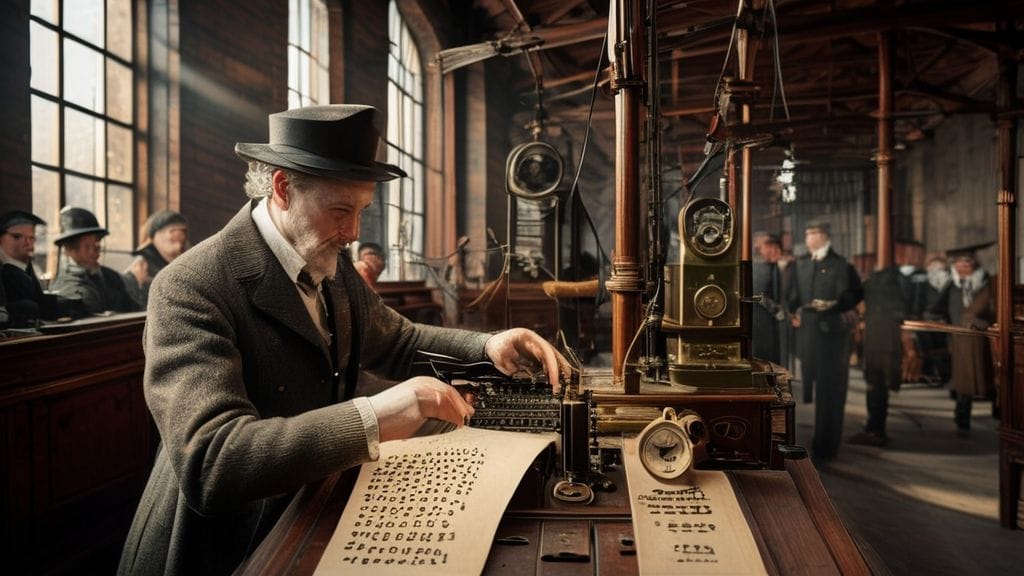
He began to tap. Each motion of his hand closed an electric circuit, sending a brief pulse of current racing along the wire toward Baltimore. Short taps produced dots; longer presses produced dashes. In a room miles away, Vail watched and listened as the electromagnet in his device responded, marking the arriving signals on a moving strip of paper. What to bystanders looked like mere mechanical clicking was, in fact, language in an unfamiliar dialect, the first telegraph message crossing the gap between two cities at a speed no messenger had ever matched.
The room in Washington grew quiet as Morse worked, concentrating on each character. Telegraphy in that era was not yet the rapid stream it would later become; sending even a short sentence required careful attention. Still, to those who understood what they were witnessing, the significance of the moment pressed in. For the first time in human history, a fully encoded message in an electric telegraph system, destined for public demonstration and political scrutiny, was traveling over a government-funded line between two major American cities.
In Baltimore, Vail deciphered the marks and signaled back that the message had been received correctly. “What hath God wrought” had successfully traversed the Washington–Baltimore line. The first telegraph message had not been a boastful claim or a technical report. It was instead a sentence that framed the event as something almost beyond human comprehension. One congressman present later recalled the sense of awe that swept through the room as the realization sank in that this was not a trick, not stage magic, but a repeatable, reliable act of communication at near-instant speed. As one 19th-century commentator later wrote, “The telegraph annihilates distance, and with it, in some degree, time.”
It is astonishing, isn’t it? A simple, ten-word sentence, transmitted in coded pulses along a wire, quietly redefined what it meant to be far away. Within those few words, the first telegraph message carried the moral weight of the age—its religiosity, its sense of manifest destiny, its mix of humility and hubris. It declared, in effect, that something extraordinary had taken place, yet placed the credit in divine hands. Historians have since debated precisely how to interpret that gesture. Was it sincere piety? A strategic appeal to a religious public? Or both at once? Whatever the motive, the phrase stuck. Generations later, when people speak of the first telegraph message, they still recall that biblical line, as if no other words could have better fit the moment.
From Shock to Wonder: Immediate Reactions
In the hours and days that followed, the demonstration of the Washington–Baltimore telegraph line sent ripples of astonishment through political and journalistic circles. Newspapers in Washington, Baltimore, and beyond reported on the event with a mix of technical curiosity and breathless wonder. Here was a machine, they told their readers, that could cause words to appear almost instantly in a city miles away. Some writers cast it as a new triumph of American ingenuity; others used explicitly religious language, echoing the first telegraph message itself, speaking of providence and divine favor.
Even within Congress, where skepticism had nearly killed the project, the tone shifted. Some legislators who had voted against the funding now privately admitted their misjudgment. The telegraph could no longer be dismissed as an impractical fantasy. If it could connect Washington and Baltimore, why not Washington and Philadelphia? Why not Washington and New York? The imagination of expansion took hold almost immediately. For a nation that had already come to see westward expansion as its destiny, the notion of building out networks of wire to accompany the advancing railroads seemed both logical and thrilling.
Of course, not everyone greeted the new technology with unalloyed joy. A few observers worried about its effects on traditional ways of life. What would become of stagecoach drivers and express riders if messages no longer needed their services? Would the speed of news unsettle markets, ruin small merchants, or incite panics? Moralists wondered whether such rapid communication might spread scandal and vice as quickly as truth and enlightenment. “Who shall direct the course of such a power?” asked one contemporary critic, quoted in a later history of telegraphy. Even fascination was tinged with unease.
Yet the sense of wonder dominated. The phrase “annihilation of distance,” which appeared in several mid-century accounts, captured the popular mood. The Washington–Baltimore line quickly became a symbol—proof that the once-impossible was now possible. The first telegraph message transformed Morse from a struggling, near-destitute inventor into a public figure, though financial stability and adequate recognition would remain complicated for him. For Alfred Vail, the success confirmed his role in a profound technological shift, even if posterity would often relegate his name to the footnotes.
Rewiring Politics: Speed, News, and Power in Washington
The impact of the telegraph on American politics became apparent almost immediately. Washington was a city built on delay. Information moved slowly in and out; that slowness structured how power operated. Senators and representatives relied on the lag between events in their home states and their knowledge of them. Presidents had time—sometimes too much time—to respond to international crises. Journalists depended on dispatches brought by physical messengers, which could be intercepted, misdirected, or simply late. The first telegraph message, and the wires that followed, began eroding this architecture of slowness.
Within a few years, telegraph offices in Washington were carrying dispatches about congressional debates, election returns, and diplomatic developments at speeds that would once have been unimaginable. Newspapers seized the opportunity, creating a new style of political reporting that emphasized timeliness and live reaction. Editors could now learn of a key vote in the Senate almost as soon as it happened and rush the news into print for readers hundreds of miles away. Citizens, for their part, experienced politics less as a series of delayed reports and more as an unfolding national drama.
The relationship between the capital and the rest of the country tightened. Governors could communicate with federal officials quickly during crises; distant state legislatures could coordinate strategies with allies in Washington. At the same time, the new speed exposed politicians to rapid scrutiny. Statements made in the heat of debate could reach constituents almost at once, before there was time to soften or explain them. This fostered both accountability and anxiety. A careless remark that might once have faded before reaching the hinterlands could now be immortalized in telegraphic summaries.
Diplomacy, too, underwent quiet revolution. Foreign governments began to see the advantages of telegraphic communication with their representatives in Washington. Though international cables would take longer to develop, even the beginnings of telegraphic exchange reshaped expectations. Crises that might once have unfolded over weeks could now intensify over days. As one later historian observed, “The telegraph did not merely carry news of events; it altered the tempo at which events themselves unfolded.” The first telegraph message from Washington to Baltimore was a local act with global political implications.
Commerce, Markets, and the Birth of Real-Time Information
If politics felt the first shudder of change, commerce soon experienced an earthquake. The telegraph struck at the heart of how markets had always worked: the uneven, delayed flow of information. Before its arrival, a merchant in Baltimore weighing whether to buy or sell goods often did so based on stale information about prices in New York or Philadelphia. Grain might be cheap in one city and high in another simply because news had not yet traveled. Speculators made fortunes by exploiting these lags.
With telegraph lines extending outward from the Washington–Baltimore corridor, this pattern began to change. Markets started receiving price quotes multiple times a day. Railroads coordinated schedules more effectively, reducing waste and increasing capacity. Insurance companies gained quicker knowledge of ship arrivals and accidents. The concept of “real-time” information, though not named as such, emerged as a practical reality. A banker in one city could learn of a distant bank failure in time to take defensive measures. A trader could react to crop reports almost as soon as they were compiled.
In short order, telegraph offices became nerve centers of economic life. Men—and they were mostly men—crowded into these rooms to send and receive terse, high-stakes messages. The very style of business writing changed: no longer leisurely letters with formal salutations, but compressed bursts of instruction and inquiry. Lists of abbreviations and conventions grew up to save time and money, since telegraph companies charged by the word or character. Over time, stock exchanges and commodity markets came to depend on telegraphic feeds, a development that anticipated the even faster electronic trading of later centuries.
The first telegraph message, religiously framed as “What hath God wrought,” thus had a deeply secular legacy in the world of capital. It heralded an age in which being first to know—a price, a rumor, a decision—could mean the difference between profit and loss on a scale larger than ever before. Information became more obviously a commodity, something that could be bought, sold, hoarded, and weaponized. The telegraph turned invisible threads of knowledge into visible lines of wire crisscrossing the landscape, embedding economic power into the physical geography of the United States.
Telegraphy and the Human Imagination
Beyond politics and markets, the telegraph reached into subtler regions of human experience: imagination, emotion, even spirituality. People struggled to articulate what it felt like to live in a world where words could leap across space almost instantaneously. Poets compared telegraph lines to veins in a vast body, carrying the lifeblood of thought. Ministers preached sermons likening the invisible currents in the wires to the unseen movements of the Holy Spirit. Scientific lecturers traveled from town to town, demonstrating telegraphic principles to fascinated audiences and assuring them that no sorcery was involved—only natural laws, properly understood.
Ordinary people, encountering the telegraph for the first time, often responded with a mix of skepticism and wonder. Some rural communities saw the poles and wires as signs of encroaching modernity, alien to the rhythms of the farm. Others embraced them as links to the wider world. Letters began to include references to recent telegraphic news—an election result, a disaster, a royal birth abroad—showing how quickly the new medium entered everyday conversation. The first telegraph message itself became a story people retold, with a tinge of legend, as if they understood that it marked the beginning of something greater than anyone could yet describe.
There were also more intimate uses. Families separated by illness, work, or migration could now send urgent messages in emergencies. News of death or recovery could arrive in hours rather than days. This brought a kind of mercy, but also a new immediacy to grief and anxiety. To wait, knowing that a telegraph could arrive at any moment bearing life-altering news, was a very different experience from waiting for a letter whose arrival might be delayed by storms or breakdowns. The telegraph accelerated not only commerce and governance, but also feeling.
Writers of fiction quickly seized on the possibilities. Telegraph operators appeared as characters in stories and novels, mysterious figures who lived at the intersection of public and private spheres, privy to secrets but bound by professional codes of silence. Tales circulated—some true, many embellished—of operators who pieced together tragic love stories or financial conspiracies from the bits of messages they saw. In this way, the first telegraph message opened not only a technical path but a cultural one, inspiring new metaphors and new narratives about connection and isolation.
Expansion: From a Single Line to a Continental Web
Once the Washington–Baltimore line had proven its worth, expansion followed with relentless logic. Private companies, often licensing Morse’s patents, began constructing lines linking major cities in the Northeast and, soon after, the Midwest. By the early 1850s, a traveler could move westward from the Atlantic coast and watch telegraph poles marching alongside the railroad tracks, twin symbols of a nation in motion. What had begun with the first telegraph message on a single experimental route now grew into a network spanning thousands of miles.
The construction process was grueling. Crews faced harsh weather, difficult terrain, and occasional hostility from local populations. In some regions, Native American communities saw telegraph lines as further intrusion into their lands, another tool of an expanding settler state. Storms toppled poles; lightning struck wires; sabotage and theft occasionally disrupted service. Yet the lines kept growing. New companies formed, merged, and competed, racing to claim profitable routes. By 1861, a telegraph line finally linked the Eastern United States with California, achieving a long-sought dream of coast-to-coast communication.
That transcontinental line, often celebrated in the same breath as the later transcontinental railroad, had immediate political significance. It tightened federal control over the West, allowing Washington to communicate directly with officials and military commanders in distant territories. It also dealt a symbolic, if less immediately practical, blow to older routes like the Pony Express, which quickly became obsolete. The same nation that had once measured distance in weeks of travel on horseback could now carry the essence of a letter from one ocean to another in minutes.
Even as expansion brought undeniable benefits, it also concentrated power. Telegraph corporations became major players in the American economy, their decisions influencing which towns thrived and which languished in relative isolation. Communities left off key trunk lines found themselves at an informational disadvantage, reinforcing existing inequalities. The first telegraph message had promised, in its solemn biblical tone, a kind of providential wonder; the reality that followed was more complicated, a mix of opportunity and exclusion shaped by commercial priorities and political calculation.
War, Wires, and the Struggle for Control
The Civil War would test the telegraph’s capabilities as nothing else could. By 1861, just seventeen years after the first telegraph message between Washington and Baltimore, the United States found itself split in two. Both the Union and the Confederacy quickly grasped that controlling telegraph lines meant controlling the flow of military intelligence and political command. Wires became strategic targets, to be seized, cut, tapped, or hastily repaired under fire.
President Abraham Lincoln, deeply interested in technology, spent many hours in the War Department telegraph office in Washington, reading dispatches from the front and sending instructions to his generals. The room and its operators formed an invisible bridge between the White House and distant battlefields. As one operator later recalled in his memoirs, Lincoln would pace the floor late into the night, waiting for news of battles, his face lit by the weak glow of gas lamps and the intermittent clicking of incoming messages. Decisions affecting thousands of lives were informed by those staccato reports, reduced to the language of Morse code.
The telegraph allowed for a new kind of centralized command, but also introduced new forms of confusion. Messages could be delayed by damaged lines, misinterpreted by inexperienced operators, or garbled in transmission. Encryption became a vital concern: if the enemy intercepted a telegraph, the results could be disastrous. Both sides developed ciphers and codes layered atop Morse’s system of dots and dashes, adding another level of abstraction between events and the reports that described them.
For soldiers at the front and civilians at home, the telegraph transformed the emotional geography of war. News of victories and defeats reached cities far from the fighting at unprecedented speed, triggering sudden swings in morale and political sentiment. Families waiting for word of loved ones experienced the telegraph office as both a source of hope and dread. A single message, often brutally concise, could confirm a death, a wound, or a narrow escape. The medium that had once carried the first telegraph message of pious wonder now bore the stark vocabulary of mass conflict.
The Social Costs: Monopolies, Labor, and Disconnected Hands
As the telegraph industry matured after the Civil War, its social complexities deepened. In the United States, companies consolidated into powerful entities, most notably Western Union, which came to dominate long-distance telegraphic communication. With dominance came the ability to set prices, choose routes, and, at times, influence the flow of information itself. Critics warned that the concentration of control over communication in a few private hands was dangerous to democracy.
Telegraph workers—operators, linemen, clerks—became a distinct occupational group, with their own cultures and struggles. Operators required skill and training; many took pride in their ability to send and receive messages with speed and accuracy. Women entered the telegraph workforce in significant numbers, especially in urban offices, gaining access to wages and a form of professional life that, while limited, exceeded what many other sectors allowed them. Yet pay was often modest, hours long, and job security fragile. Labor disputes and attempts at unionization emerged, revealing that the wires binding the nation also bound thousands of individuals to demanding schedules and repetitive tasks.
Telegraphy’s very design separated mental and manual labor. Messages drafted in ornate offices traveled across landscapes strung with wires maintained by men who climbed poles in storms or trudged through snow to find a broken span. The public rarely saw this work except when a line failed. In this sense, the romantic aura of the first telegraph message obscured the everyday realities of keeping the system running. Behind each burst of news that appeared in a newspaper or crossed an office desk lay a chain of human effort, often poorly paid and hidden from view.
The political power of telegraph corporations came under increasing scrutiny by the late 19th century. Some reformers argued for government control or stricter regulation, fearing that private telegraph and, later, telephone companies could skew public debate or favor certain businesses. The debates foreshadowed modern concerns about media monopolies and information giants. In the long shadow of “What hath God wrought,” Americans wrestled with the question of what they themselves had wrought by allowing so much communicative power to cluster in so few institutions.
Echoes Across the Ocean: Global Telegraphy and Empire
The implications of Morse’s invention did not stop at America’s borders. European nations quickly recognized the strategic potential of telegraphy, and by the mid-19th century, international projects were underway to lay submarine cables across seas and oceans. In 1858, after immense technical struggle, the first transatlantic telegraph cable briefly connected Europe and North America, enabling messages to pass between London and New York in minutes rather than weeks. Though that initial cable soon failed, a more durable connection was established in the 1860s. The world’s major economic and political centers were now bound together by what some called a “nervous system of civilization.”
Empires seized on this nervous system to tighten their grip over far-flung territories. The British, in particular, built extensive telegraph networks across India, Africa, and parts of Asia, ensuring that colonial administrators could receive instructions from London with unprecedented speed. This allowed for more rapid response to uprisings, economic shocks, or diplomatic shifts, reinforcing imperial control. As one British statesman remarked—boastingly quoted in a late-19th-century parliamentary debate—telegraphy gave the empire “a single will, however distant its limbs.”
Yet the global telegraph network also facilitated new forms of international collaboration and awareness. News of natural disasters, scientific discoveries, and cultural events traveled quickly between continents. Financial markets in New York, London, and Paris became more tightly synchronized, for better or worse. Peace activists and reformers used the telegraph to coordinate campaigns and share strategies, demonstrating that the same wires that served empires could also nourish transnational solidarities.
In this global context, the first telegraph message between Washington and Baltimore looks both modest and momentous. Modest, because the distance it traversed now seems small compared to ocean-spanning cables. Momentous, because it marked the first time a government-funded, public demonstration of electric telegraphy succeeded in a way that captured political and popular imagination. From that initial line, an entire world-spanning web of communication would grow, one whose consequences we still live with today.
From Dots and Dashes to Digital Pulses
The direct use of Morse code over wires has largely faded, replaced first by more advanced telegraph systems, then by telephones, radio, television, and ultimately the internet. Yet the underlying idea that the first telegraph message embodied—encoding information into discrete signals that travel along a medium—remains at the heart of modern communication. Today, instead of hand-tapped dots and dashes, we rely on streams of binary digits, ones and zeros, pulsing along fiber-optic cables and through wireless networks. The continuity is striking. What has changed is not the concept of digital signaling, but its speed, capacity, and reach.
In many ways, the world of the 21st century looks like the logical extension of what began between Washington and Baltimore in 1844. We live in an environment of constant, almost overwhelming connectivity. Messages cross the globe in milliseconds; video calls bridge continents with little delay. Yet the emotional and social questions that followed the first telegraph message still haunt us. Does faster communication bring us closer together, or does it expose us to more conflict and misunderstanding? Who controls the networks through which our words and images travel? How do societies cope when the pace of information outstrips the capacity of institutions and individuals to process it?
Historians and media theorists often draw a line from the telegraph to the internet, noting how each new leap in communication sparks both utopian dreams and dystopian fears. When Morse demonstrated his system, some believed it would spread enlightenment and peace by making nations better informed about one another. Others feared it would accelerate the machinery of war and domination. Similar hopes and fears greeted radio, television, and the web. The pattern suggests that the tension lies not in the wires themselves, but in the ways humans choose to use them.
Looking back, one can see the first telegraph message as an early moment in the broader history of digitization—the conversion of experience into coded signals. Just as Morse and Vail reduced letters to patterns of short and long pulses, our devices today reduce sound, image, and text to digital code. The scale has changed; the principle endures. In this light, the distance between a humble telegraph key in the U.S. Capitol and a modern smartphone in someone’s hand feels shorter than it appears.
Memory, Myth, and the Meaning of the First Telegraph Message
Over time, historical events often acquire a sheen of inevitability. The first telegraph message, sent on May 24, 1844, now feels like a scene destined to appear in textbooks: Morse at the key, Vail at the receiver, Annie Ellsworth’s words bridging the gap. But lived history is never so tidy. Morse almost failed to secure funding; the underground wires almost doomed the experiment; rival inventors in Europe and America might have claimed the landmark instead. The story we tell now is partly a product of what survived in documents, and partly the result of how later generations chose to remember.
“What hath God wrought” has become one of those phrases that seem perfectly matched to their moment, not least because they can be read in many ways. To some, the words highlight human humility before the scale of technological change. To others, they underscore the hubris of claiming divine sanction for inventions that would later be used to wage war and intensify exploitation. The ambiguity makes the phrase powerful. It invites reflection not only on what God—or history, or fate—has wrought, but on what we ourselves have done with the tools we create.
In the United States, the story of the first telegraph message has often been folded into a broader narrative of national ingenuity and progress. Schoolchildren learned to associate Morse with Franklin and Edison, placing him in a lineage of heroic inventors. Only more recently have historians emphasized the collaborative nature of his achievement, highlighting figures like Alfred Vail and the many unnamed workers who built and maintained the lines. This shift mirrors a larger trend in historical writing: from celebrating lone geniuses to examining systems, communities, and infrastructures.
Citation-based scholarship has also nuanced our understanding. For example, historian David Hochfelder, in his study of the American telegraph industry, argues that while the telegraph promised a more democratic flow of information, it quickly “became enmeshed in corporate capitalism, serving the interests of business and government more than the general public.” Likewise, in his classic work “The Victorian Internet,” Tom Standage draws detailed parallels between 19th-century telegraph networks and today’s internet, suggesting that the cultural and social shocks of each era share surprising similarities. These perspectives remind us that the first telegraph message was not a simple triumph, but the opening act in a long, contested history.
In the end, what gives that inaugural transmission its enduring resonance is not only what it accomplished technically, but what it symbolizes: a turning point when humanity began to sever the ancient chains between communication and physical movement. After May 24, 1844, being far away no longer meant being unreachable. The psychic landscape of distance was permanently altered. The line between Washington and Baltimore has long since been replaced and rerouted, yet in our collective memory, the wire is still there, humming softly with the words that inaugurated a new era.
Conclusion
On that day in 1844, when the first telegraph message ran from Washington D.C. to Baltimore, the world did not change all at once. No thunderclap announced a new age; the streets remained as dusty, the horses as slow, the sailing ships as dependent on the wind as before. Yet beneath the ordinary surface, something fundamental had shifted. For the first time, human beings had a practical tool for sending meaningful messages across distance at the speed of electricity. The long rule of geography over communication had been broken, and the consequences would unfold over decades and centuries.
From those first carefully tapped dots and dashes grew networks that reshaped politics, war, business, and everyday life. The telegraph brought capitals and frontiers into closer alignment, fed stock exchanges with rapid data, carried both news and rumor, and bound empires together even as it offered new avenues for resistance and reform. It generated new kinds of work, new forms of inequality, and new questions about who should control the tools that shape how we know the world. The first telegraph message, framed in words of reverent wonder, has thus come to stand for both the promise and the peril of technological change.
We can trace a clear line from that moment in the U.S. Capitol to the present, when digital pulses move invisibly around the globe, carrying voices, images, and texts with a speed that would have taken Morse’s breath away. The challenges we face—information overload, monopolistic control of communication infrastructure, the emotional strain of constant connectivity—are, in some sense, descendants of the questions first posed by the telegraph. What have we wrought, indeed, when our tools for overcoming distance also amplify our capacities for conflict, surveillance, and distraction?
Yet it would be a mistake to remember the first telegraph message only as the prologue to modern anxiety. It was also an expression of human curiosity and ingenuity, of the desire to reach across gaps—to know, to share, to respond. The same wires that carried war orders also carried news of peace; the same code that transmitted market data also conveyed words of love, concern, and hope. In honoring the moment when “What hath God wrought” first traveled from Washington to Baltimore, we honor the complexity of our own relationship with technology: our ability to shape it, to be shaped by it, and to continually renegotiate what it means to be connected in a world where distance is no longer destiny.
FAQs
- What exactly was the first telegraph message sent between Washington D.C. and Baltimore?
The first telegraph message sent over the Washington–Baltimore line on May 24, 1844, was the biblical phrase “What hath God wrought,” taken from Numbers 23:23 in the King James Bible. It was chosen by Annie Ellsworth, the daughter of the Commissioner of Patents, and transmitted by Samuel Morse from the U.S. Capitol to Alfred Vail in Baltimore. - Why was the Washington–Baltimore line chosen for the first telegraph experiment?
This route was funded by a $30,000 appropriation from the U.S. Congress as an experimental project to test the viability of Morse’s telegraph system. Washington was the political center of the United States, and Baltimore was a major commercial hub connected by railroad, making the corridor both symbolically and practically important. - Did Samuel Morse invent the telegraph alone?
No. While Morse played a central role in conceptualizing and promoting the telegraph, he relied heavily on collaborators such as Alfred Vail, who refined the machinery and helped develop the encoding system known as Morse code. Many other scientists and inventors in Europe and America also worked on telegraphic ideas; Morse’s achievement lay in creating a practical, scalable system and securing public funding and recognition in the United States. - How long was the distance covered by the first telegraph message?
The Washington–Baltimore telegraph line spanned approximately thirty-eight miles (about sixty-one kilometers). Though modest by today’s standards, it was a significant technical achievement in 1844 and demonstrated that electric signals could reliably carry coded information over substantial distances. - What were the immediate practical effects of the telegraph after 1844?
In the years following the first telegraph message, telegraph lines rapidly expanded between major cities. The technology transformed news reporting, financial markets, and political communication by dramatically reducing the time needed to transmit information. Stock prices, election results, and war news could now be shared within hours instead of days or weeks. - How did the telegraph influence the American Civil War?
The telegraph gave commanders and political leaders, especially in the Union, the ability to coordinate strategy over long distances and receive rapid reports from the front. President Abraham Lincoln made extensive use of the War Department’s telegraph office in Washington. Telegraph lines became strategic assets to be built, guarded, cut, or tapped, and encrypted telegraphic communication emerged as a crucial military practice. - Is Morse code still used today?
While traditional landline Morse telegraphy has largely disappeared, Morse code persists in some specialized contexts, such as amateur radio and certain training environments. More broadly, the underlying principle of encoding information into discrete signals inspired later digital communication methods, even if the specific patterns of dots and dashes are no longer central to everyday technology. - How did the telegraph contribute to globalization?
International telegraph cables, especially transatlantic and undersea lines, enabled near-instant communication between continents by the late 19th century. This connected financial markets, sped up diplomatic correspondence, and allowed empires like Britain to manage distant colonies more tightly. It also fostered new forms of international cooperation, such as coordinated responses to crises and faster exchange of scientific and cultural information. - What is the connection between the telegraph and the internet?
Both the telegraph and the internet rely on encoding information into signals that travel through physical media—wires, cables, or radio waves. The telegraph pioneered the idea of digital signaling, where discrete units (dots and dashes) represent text. Modern digital systems use binary code (ones and zeros) in much the same spirit, albeit with vastly greater speed and complexity. Culturally, both technologies sparked intense debates about privacy, monopolies, and how fast communication reshapes society. - Why does the first telegraph message still matter today?
The first telegraph message symbolizes the moment when humans began to free communication from the constraints of physical travel, inaugurating an era in which distance became less decisive in shaping relationships, markets, and politics. Many of the opportunities and problems we associate with our hyper-connected world—instant news, global financial flows, information overload—can be traced back to that initial triumph between Washington and Baltimore. Remembering it helps us see our present technologies not as sudden miracles, but as chapters in a long, ongoing story.
External Resource
Internal Link
Other Resources
- Encyclopaedia Britannica – general search for the exact subject
- Google Scholar – academic search for the exact subject
- Internet Archive – digital library search for the exact subject