Table of Contents
- A besieged town in a broken kingdom
- France in fragments: the long shadow of Agincourt
- Montargis before the storm: a crossroads worth fighting for
- Captains of a ruined realm: La Hire, Xaintrailles, and the Armagnac cause
- The English net tightens: how the siege of Montargis began
- Inside the walls: hunger, fear, and stubborn hope
- Cannon, ditches, and wooden towers: the machinery of siege
- A daring plan: French relief forces take shape
- The river as a weapon: the famous flood of Montargis
- Clash at the barricades: the relief of 5 September 1427
- Voices from the battlefield: chroniclers, rumors, and memory
- From minor victory to major symbol: what Montargis meant to France
- Montargis and Joan of Arc: foreshadowing the rise of the Maid
- Winners, losers, and the human cost of a ‘small’ siege
- Faith, oaths, and treason: the politics beneath the walls
- After the banners left: rebuilding a scarred town
- How historians read Montargis today
- Conclusion
- FAQs
- External Resource
- Internal Link
Article Summary: In the autumn of 1427, as the Hundred Years’ War dragged France toward apparent collapse, the siege of montargis became a small but electrifying turning point. An English and Burgundian army tried to strangle a stubborn little town on the Loing River, expecting another easy triumph over a fractured kingdom. Instead, French captains La Hire and Jean de Xaintrailles orchestrated a daring relief operation that turned river, mud, and local terrain into lethal allies. The siege of montargis ended not just with a military setback for the English, but with a rare, shining victory for Charles VII’s battered supporters. Chroniclers would celebrate the ruse of flooding the enemy camp as a symbol of French ingenuity and resilience, foreshadowing the later miracles associated with Joan of Arc. In the wider war, the siege of montargis showed that English power was not invincible, and that even a modest town could shift morale across a kingdom. Though often overshadowed by larger battles, the relief of Montargis on 5 September 1427 still speaks to the courage of ordinary townspeople and soldiers who chose defiance over surrender.
A besieged town in a broken kingdom
The story of the relief of Montargis on 5 September 1427 begins not with drums and banners, but with the weary silence of a kingdom that believed itself already half-lost. The siege of montargis unfolded at a moment when France seemed to many of its own people like a ghost of a once-mighty realm, carved up by enemies, betrayed by allies, and haunted by the madness of its king. Montargis itself was no Paris, no Orléans, no Rouen—just a modest town in the Gâtinais, nestled along the twisting Loing River, surrounded by woods, marshes, and narrow roads. Yet in that fragile year, this town would become the stage for a rare French triumph, one whose echoes would carry far beyond its humble walls.
Imagine the first reports that reached Montargis: rumors of English and Burgundian forces gathering, of artillery and supply trains on the move, of banners bearing the leopards of England and the cross of Burgundy approaching from the north. By the early 1420s, such rumors were nothing new. But this time, the people of Montargis understood that they were not merely in the path of an army; they were the target. They had chosen, in a time when loyalty was often a luxury, to stand with the dauphin Charles—the disinherited prince whom his enemies mocked as the “King of Bourges”—against the Anglo-Burgundian regime that claimed France in the name of the infant Henry VI.
Outside their walls lay a countryside burned and looted repeatedly over decades; inside, they had only their old ramparts, their narrow streets, and their faith that some French relief would come before starvation or bombardment decided their fate. The siege of montargis would test that faith brutally. For months, the town would stand almost alone, facing professional English soldiers hardened by years of campaigning, and Burgundian allies who knew the land nearly as well as the townsfolk themselves. The kingdom was broken, but Montargis refused to be.
France in fragments: the long shadow of Agincourt
To understand why the siege of Montargis mattered, one must step back more than a decade, to a cold October day in 1415. The slaughter at Agincourt did more than annihilate a French army; it shattered the prestige of the Valois monarchy and opened the door to a political catastrophe. Henry V of England, already a formidable commander, emerged from that muddy battlefield as the master of northern France. In the years that followed, he picked apart French defenses like a patient butcher dressing a carcass.
Rouen fell in 1419, starving behind its walls until the citizens ate cats and rats. The French court itself was deeply divided between the Armagnac faction, loyal to the royal family of Charles VI, and the Burgundians, who had once been allies but were now bitter enemies after the assassination of John the Fearless on the bridge at Montereau in 1419. The Burgundians soon allied with Henry V, providing local support, political legitimacy, and access to key cities. The result was the infamous Treaty of Troyes in 1420, in which the deranged Charles VI, under Burgundian pressure, declared Henry V his heir and effectively disinherited his own son, the dauphin Charles.
By 1427, France was a jigsaw puzzle of loyalties. Paris, Normandy, and much of northern France obeyed English governors and Burgundian dukes. The Loire valley and the south turned toward the dauphin Charles, living in relative exile at Bourges. In many towns, allegiances were uncertain, shifting with the arrival of the nearest army. The French crown’s authority, once unquestioned, now competed with rival claims and foreign banners. In this fractured land, every castle, bridge, and town became a potential prize, and Montargis was no exception.
The siege of montargis would unfold in the shadow of this chaos, at a time when few believed the Armagnac cause could truly recover. The English had not yet suffered the humiliations that would come at the hands of Joan of Arc; they were still, in the eyes of many Europeans, the likely inheritors of the French throne. Yet even in such darkness, pockets of resistance endured—towns like Montargis that refused to bow, captains who refused to defect, and peasants who, despite everything, still dared to hope that France might be saved.
Montargis before the storm: a crossroads worth fighting for
On a map of medieval France, Montargis might seem modest, a speck amid much larger names. But strategic value often lies in crossroads and rivers more than in pomp and ceremony. Montargis sat where roads from Orléans, Sens, and Paris met, controlling routes that threaded through the Gâtinais toward the Loire. The town was ringed by walls strengthened over generations, with towers that watched over the winding course of the Loing and its small tributaries. Bridges, mills, and ditches turned the surrounding landscape into a complicated network of water and earth—defenses that would soon prove decisive.
Before the siege, Montargis was known more for trade than for war. Wood from the nearby forests, grain from local fields, and goods from Orléans and beyond found their way into its markets. Bakers, tanners, millers, and craftsmen filled its narrow lanes. Yet in the early 1420s, war became an everyday presence. Refugees from ravaged villages sought shelter behind the walls. Armed patrols replaced peaceful processions outside the gates. Messengers from Bourges and Orléans arrived more frequently, bearing royal seals that still claimed authority even as English proclamations circulated in nearby towns.
Politically, Montargis was firmly in the Armagnac camp, loyal to Charles VII despite the legal fiction of Troyes. Its castle and its governing elite understood that to change sides would perhaps bring temporary safety but at the cost of honor and trust. This loyalty made the town a thorn in the side of the Anglo-Burgundian regime. For English commanders, a French-held Montargis was a nuisance on their communication lines, a potential threat to convoys and garrisons. For Burgundian leaders, it was a reminder that not all of the region had accepted their authority. For Charles VII, Montargis was a precious foothold in a region otherwise dominated by his enemies.
When news came that an English-led force was marching on the town, there was fear, of course—but also a determination that Montargis would not fall cheaply. The elders, priests, and militia captains of the town began at once to gather supplies, strengthen gates, and plan for the worst. The siege of montargis was not a surprise lightning strike; it was the culmination of years of mounting tension, in which everyone knew, sooner or later, that someone would try to extinguish this stubborn outpost of loyalty.
Captains of a ruined realm: La Hire, Xaintrailles, and the Armagnac cause
Every siege has its cast of characters, and Montargis was no exception. Among the French captains whose names would become inseparable from the relief of the town were Étienne de Vignolles—better known as La Hire—and Jean de Xaintrailles. These were not polished court nobles, preening in silks and spouting Latin. They were hardened men of war, shaped by years of brutal campaigning, ambushes, and sudden reversals of fortune.
La Hire, a Gascon by origin, was famous for his ferocity and blunt speech. Chroniclers tell of a captain who prayed to God “as a man speaks to a comrade,” asking simply that the Lord do for him what he would do if he were God and La Hire were His knight. Whether this anecdote is embroidered or true, it captures the image contemporaries had of him: a soldier who combined raw courage with an unvarnished piety, loyal to Charles VII when others wavered. Jean de Xaintrailles, likewise, was a veteran of many skirmishes, adept at rapid movement and surprise attacks, leading bands of men-at-arms and archers through a landscape that had become a chessboard of ruined villages and contested roads.
In the Armagnac camp, there were few illusions. They knew that, taken overall, they were weaker than the Anglo-Burgundian alliance. Their resources were limited, their king’s authority contested, their strongholds scattered. But they had captains who knew how to fight with what they had, who understood the power of local terrain and swift action. La Hire and Xaintrailles belonged to this breed. When word reached them that Montargis was under serious threat, they understood instantly that the town could not be allowed to fall—not simply for moral reasons, but for the practical survival of the Armagnac position in the Loire region.
Behind these captains stood Charles VII himself, still more a prince of promise than a king in fact. In his court at Bourges, advisers debated strategy, finances, and diplomacy. Could they afford to send troops to relieve yet another threatened town? Could they risk alienating local lords by not responding? The decision to support Montargis, and to entrust the operation to men like La Hire and Xaintrailles, was a small but telling choice: in a time of scarcity, every commitment was a statement of what truly mattered.
The English net tightens: how the siege of Montargis began
The army that descended on Montargis in 1427 was not the massive host of Agincourt fame, but it was composed of disciplined professionals—English soldiers, Burgundian contingents, and allied troops used to campaigning in hostile territory. Contemporary sources differ on the exact strength of the besieging force, but it was clearly superior in numbers and equipment to the garrison inside the town. Its commanders knew the pattern well: surround, isolate, bombard, and starve.
The English had strong reasons to act. By then they controlled much of northern France, but the Loire frontier remained unstable. Towns like Montargis, loyal to Charles VII, threatened their communication routes, harassed convoys, and provided havens for Armagnac raiders. Bringing Montargis to heel would help secure the approaches toward Orléans and further tighten the pressure on Charles’s remaining domains. It would also send a message to other wavering towns: resistance would be punished, and isolated garrisons could not rely on timely help.
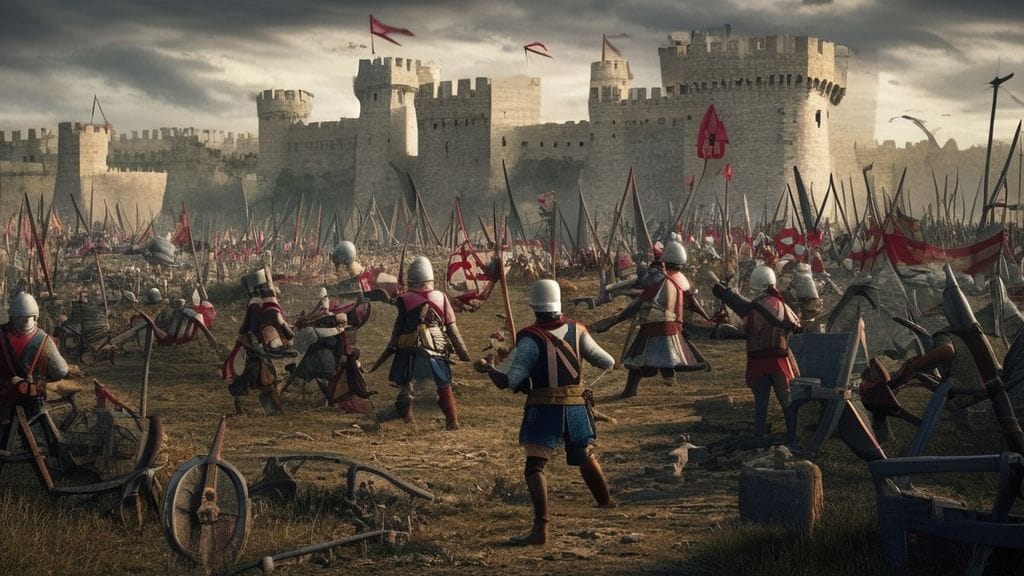
As the besieging army approached, it began the patient work of encirclement. Camps were laid out, ditches dug, artillery positioned to batter the walls. Earthworks sprang up like scars around the town, while mounted patrols cut off any movement in or out. Watchfires appeared at night, a ring of flickering lights reminding those inside that escape was impossible. Such sights had become familiar in the Hundred Years’ War; townspeople knew what they meant. Unless relief came, the noose would tighten day by day.
The first skirmishes around the walls tested both sides. English and Burgundian archers probed the defenses, loosing arrows at any head that appeared above the parapets. French crossbowmen and arquebusiers—where they were available—answered in kind. For the defenders, the priority was time: every day they held out was another day for La Hire, Xaintrailles, and the royal council at Bourges to organize a relief force. For the attackers, speed was valuable but not essential. They believed they could wait. They had supplies, artillery, and experience on their side. It was only a matter of when, not if, Montargis would be theirs—or so they thought.
Inside the walls: hunger, fear, and stubborn hope
Behind the battlements, daily life slowly transformed into a rhythm of endurance. The bells that once called people to trade or worship now rang alarms when a new battery opened fire or when sappers approached the ditch. Food, always a concern in any medieval town, became a precious resource. Livestock were counted, grain stores inventoried, wells inspected. The town’s leaders knew that morale depended as much on bread as on courage.
Women, children, and the elderly did not merely hide; they worked. They carried stones, fetched water under fire, prepared makeshift bandages, and helped to repair damage to the walls. Priests moved among the fearful, offering absolution and blessings, sometimes raising relics atop the ramparts in the belief that divine favor might turn aside enemy missiles. At night, the town listened: to the thud of shovels as the besiegers dug closer, to the mocking calls from enemy soldiers, to the distant croak of frogs in the marshes that reminded them of the landscape beyond their trapped world.
The siege of montargis was as much psychological as physical. People whispered of other towns that had fallen—Rouen, Compiègne, countless castles that had surrendered or been taken by storm. Would Montargis share their fate? Yet the fact that they stood openly with Charles VII also gave them a sense of purpose. They were not merely defending their homes; they were defending the idea that France still had a native king, still possessed a heart that beat south of the Loire.
Messages did sometimes slip through the English net, carried by daring riders or local guides who knew secret paths through woods and marshes. Each scrap of news from the outside—of Armagnac successes, of promises of relief—became precious. So did the name of La Hire, which circulated like a talisman: “La Hire is coming. Xaintrailles is gathering men. The king has not forgotten us.” Whether every detail was true mattered less than the hope those names conjured. Hope turned fear into stubbornness, and stubbornness would prove to be Montargis’s most vital weapon.
Cannon, ditches, and wooden towers: the machinery of siege
By the 1420s, siege warfare in France had entered a brutal, transitional age. The bow and the lance still ruled the battlefield, but gunpowder artillery had begun to redraw the possibilities of attack and defense. At Montargis, the besieging forces deployed bombards and smaller cannon to batter the walls, though these early pieces were clumsy, slow to reload, and as dangerous to their operators as to their targets. Still, each thunderous shot that slammed into stone or timber shook the town’s nerve, even when the damage was limited.
Alongside artillery, the English and Burgundians employed older tools perfected over centuries: siege towers, ladders, mantlets—portable wooden shields on wheels—and elaborate sets of trenches and ditches. They attempted to advance their lines closer to the walls under cover of earthworks, hoping to reach a point where miners could tunnel beneath the ramparts, collapsing them through carefully set fires. The defenders responded with countermines, listening for the sound of picks underground and then digging toward them, sometimes leading to eerie hand-to-hand battles in narrow, stifling tunnels lit only by tallow candles.
Outside the main ring of fortifications, the besiegers erected their own semi-permanent world: cookfires, tents, crude chapels, storage huts, even makeshift palisades to protect against sorties from the town. Life in such camps was harsh, subject to sudden rainstorms, disease, and constant tension. Yet the besieging forces at Montargis had one significant advantage: they controlled most of the surrounding countryside, allowing them to bring in supplies with relative ease.
The town’s defenders, staring out from their battlements, would have seen this grim machinery of siege unfold day after day. Platforms appeared, then earthworks thickened, then new ditches cut off approaches that might have been used by a relief force. The siege of montargis was not a static ring; it was an evolving, tightening apparatus, shaping the ground as much as the defenders sought to exploit it. But in that very reshaping lay the seeds of the French counterstroke, for the besiegers could not alter the one element that made Montargis unique: its waters.
A daring plan: French relief forces take shape
While the English and Burgundians worked to clap iron around Montargis, La Hire and Jean de Xaintrailles labored in the shadows of politics and logistics. Raising a relief force in 1427 was not as simple as unfurling a royal standard. They had to negotiate with local lords, convince cautious towns to provide men or money, and balance this operation against other urgent needs along the Loire front. Every man-at-arms sent to Montargis was one less available elsewhere. But the strategic argument was compelling: if Montargis fell, the English grip would tighten dangerously near Orléans and the approaches to the heart of Charles VII’s territories.
The plan that emerged did not rely on overwhelming numbers. The French could not match the besieging force man for man. Instead, they chose cunning, speed, and the intimate knowledge of the terrain that came from fighting for years in this patchwork of rivers and marshes. They would approach the town not as a lumbering host, but as a swift striking arm, coordinated with the garrison inside the walls.
Here, crucially, the natural features around Montargis became central. The Loing River, with its branches, canals, and millraces, presented both obstacle and opportunity. Local men knew how these waterways behaved in flood, which meadows vanished under water after heavy rain, where bridges and fords could be controlled or destroyed. La Hire and Xaintrailles listened to these men. Out of their conversations emerged a bold idea: to transform the water itself into a weapon against the besiegers.
The relief force gathered gradually, an amalgam of seasoned soldiers, local auxiliaries, and perhaps even volunteers drawn by the prospect of loot or the simple desire to strike back at the English. It was not a glorious army on parade; it was lean, purposeful, and slightly desperate. The date was set. Correspondence with the garrison inside Montargis had been established. When the French attack came, it would have to be coordinated with action from the town itself, leveraging every advantage of surprise and terrain. If they failed, Montargis would likely be doomed. If they succeeded, a new chapter might begin.
The river as a weapon: the famous flood of Montargis
Among the many episodes of the Hundred Years’ War, few are as strikingly imaginative as the use of water during the siege of montargis. Chroniclers describe how the French turned the very landscape into an ally, flooding parts of the besiegers’ camp and wreaking havoc among their siege works. The precise details vary from source to source—some emphasize the opening of sluices, others the deliberate breaching of mills or dams—but the broad picture is consistent: the defenders and the relief force used local hydraulics with devastating effect.
Montargis and its surroundings were threaded with waterways: the main course of the Loing, smaller channels, millraces driving the wheels of flour mills, and ditches that both drained fields and defended approaches. Over years, locals had learned to control these waters for agriculture and defense. Gates could be opened or closed to raise or lower levels, redirecting flow through artificial channels. La Hire, Xaintrailles, and the town’s leaders realized that if they timed these manipulations carefully with the arrival of the relief force, they could transform the ground beneath the besiegers into a treacherous, sucking mire.
On the chosen day, as the French troops advanced toward the encircled town, orders were given within Montargis to alter the course of water. Mill sluices were opened at key moments. Dikes were weakened or broken. What had been firm ground for the besiegers suddenly became boggy, channels swelling, ditches overflowing. Baggage wagons sank to their axles; artillery pieces mired in mud could no longer be moved quickly. The well-ordered geometry of the siege works dissolved as soldiers scrambled to keep their feet and protect their equipment.
One can imagine the shock in the besieging camp, where routine had dulled the sense of danger. Men who had stood confidently on dry banks now found themselves knee-deep in water, their fires extinguished, their trenches collapsing. Timber palisades buckled as the earth beneath them turned to liquid. Horses panicked, neighing wildly as they slipped and fell. In the confusion, the French relief force struck. The river had become a conspirator, and its betrayal shattered the rhythm of the siege.
Clash at the barricades: the relief of 5 September 1427
The decisive day of the relief, 5 September 1427, arrived with the kind of tension that seems to thicken the air itself. For weeks, the besiegers had believed themselves close to victory; for weeks, the defenders had lived with dread and anticipation. Now, as horns and shouts rose on the horizon, both sides understood that a turning point had come. The French relief force under La Hire and Xaintrailles advanced, banners snapping in the breeze, their men determined to punch a hole through the ring of steel around Montargis.
The coordination between town and relief army was critical. As the flooding began to disrupt the besiegers’ positions, the garrison in Montargis launched sorties from their gates, attacking weakened segments of the siege works. From within, they struck at hastily abandoned trenches, set fire to palisades, and targeted groups of enemy soldiers struggling in the mud. From without, La Hire’s men drove into the disordered camp, knowing they had only a narrow window before the English and Burgundians could regroup.
Combat in such conditions was brutal and chaotic. Arrows hissed through damp air; men-at-arms slogged forward in waterlogged boots; fallen horses blocked narrow paths. Yet the French, energized by the sudden reversal of fortune, pressed their advantage. The besiegers, taken off guard by the flood and the coordinated attack, could not maintain a coherent line. Units that might have stood firm on solid ground now found their flanks exposed, their retreat routes threatened by swelling channels and collapsing earthworks.
Accounts of the day report significant losses among the besieging troops, with many killed, captured, or driven to rout. Some sources emphasize the capture of supplies and artillery, a material gain that mattered greatly to the resource-strapped Armagnacs. Others dwell on the symbolic spectacle of English and Burgundian forces fleeing before a smaller, more agile French force—an image that had been rare in the years since Agincourt. By evening, the siege of montargis was effectively broken. The besiegers, recognizing the untenable position of their camp and the risk of being cut off entirely, withdrew in disorder, abandoning their attempt to starve the town into submission.
Inside Montargis, the mood shifted from gnawing fear to stunned elation. Bells pealed from church towers. Families who had prepared themselves for starvation or massacre now embraced in the streets. The names La Hire and Xaintrailles were no longer just distant rumors; they were saviors whose gambit had paid off in spectacular fashion. The town had survived. More than that, it had helped inflict a rare and searing defeat on the English.
Voices from the battlefield: chroniclers, rumors, and memory
The story of Montargis comes down to us through the pens of chroniclers, each with their own loyalties, perspectives, and agendas. One of the most important is Jean de Wavrin, a Burgundian chronicler who, though sympathetic to the Anglo-Burgundian cause, could not ignore French successes. He describes the French ruse with the waters and admits, with evident reluctance, the disorder and losses inflicted on the besieging army. Such testimony, coming from the “other side,” gives weight to the narrative of cunning and surprise.
Another key source is the anonymous Journal du siège d’Orléans, written a few years later around another famous siege. Though focused mainly on Orléans and Joan of Arc, it glances back to earlier episodes like Montargis to trace a pattern of what the writer saw as providential French recoveries. There, the siege of montargis is remembered less for its technical details than for its moral: that God had not abandoned France, and that brave captains could still humble the invader. As one passage paraphrased by later historians notes, “In those days, before the Maid, there had already been signs that the English might be overthrown.”
Local memory in Montargis itself preserved the story in more intimate ways. Tales were told of specific families who had held sections of the wall, of miraculous escapes from collapsing houses hit by bombardment, of drowned enemy soldiers in suddenly swollen ditches. Children grew up hearing how their town had outwitted the English, how the river and mills they passed daily had once served as instruments of salvation.
It’s astonishing, isn’t it, how quickly rumor hardens into legend? Within a generation, the very real engineering and tactical decisions behind the flooding could be reframed as an almost magical intervention. Water that had been guided by sluices and dikes became, in some retellings, a flood sent by divine favor. The truth lies somewhere between: human ingenuity working with the grain of nature, seizing a fleeting chance in a war that offered few.
From minor victory to major symbol: what Montargis meant to France
Measured purely in territorial terms, the relief of Montargis did not redraw the map of France. No great province changed hands; no king was captured; no treaty was signed in its aftermath. Yet to reduce history to cartographic shifts is to miss the deeper currents that move peoples and states. The siege of montargis mattered because it chipped away at an aura of English invincibility and breathed life into a demoralized cause.
For years, the narrative of the war had been brutally simple: English armies win; French armies lose. From Agincourt to the fall of Rouen, from the Treaty of Troyes to the capture of key towns, the English had set the pace. Montargis disrupted that rhythm. Here was a well-organized Anglo-Burgundian force, equipped with artillery, experienced in siegecraft, thrown back in confusion by a smaller French army using brains and local advantage instead of sheer brawn. The psychological impact on both sides was significant.
In the Armagnac camp, the victory was seized upon as proof that resistance could still be rewarded. It offered Charles VII something he desperately needed: a success story to counter the steady drumbeat of defeat. In war councils, supporters could now argue, “We drove them from Montargis; we can drive them from other places as well.” The moral argument mattered in winning over wavering nobles, urban elites, and even foreign observers. When the balance of power is uncertain, reputation is a weapon.
For the English and Burgundians, Montargis was an irritation, a reminder that their grip was not absolute. It did not send their empire in France crashing down—but it sowed seeds of doubt. If small towns like Montargis could resist successfully, what might happen when larger, better-prepared positions came under similar attack? The memory of the flooded camp and the hasty withdrawal would linger in the minds of commanders, making them wary of overconfidence in future operations.
Modern historians often refer to Montargis as a “local” or “tactical” victory, but this should not blind us to its symbolic weight. In a war where symbolism was increasingly important—where legitimacy, prophecy, and morale would soon circle around figures like Joan of Arc—the tale of a town saved by daring French captains and a weaponized river had a power beyond its modest scale.
Montargis and Joan of Arc: foreshadowing the rise of the Maid
Just a few years after the siege of montargis, the war’s narrative would become inseparable from one astonishing figure: Joan of Arc. Her arrival at the dauphin’s court in 1429 and her role in lifting the siege of Orléans transformed the psychological landscape of the conflict. Yet in many ways, Montargis anticipated some of the themes that would cluster around Joan: surprise victories, the upending of English confidence, and the sense that divine favor might yet return to France.
When Joan rode to relieve Orléans, she encountered many of the same captains who had cut their teeth in earlier actions like Montargis—La Hire and Xaintrailles among them. These men knew that English armies could be beaten because they had seen it done. The experience at Montargis gave them a living memory of success to draw upon when assessing Joan’s audacious plans. When she urged bold assaults and promised victory in the name of God, they were not listening in a vacuum. They had already seen the tide turn once, if only briefly, on the Loing.
Moreover, the way the story of Montargis was told—that clever use of local conditions, that near-miraculous flooding of the enemy camp—primed French audiences to accept narratives in which Providence, working through human agents, would bring deliverance. If God could assist in drowning the invader in mud and water at Montargis, why could He not send a humble peasant girl to lead princes and captains to victory? In this sense, Montargis helped to prepare the mental and emotional ground for Joan’s later triumphs.
One historian, pondering this continuity, wrote that “Montargis was like the first flicker of a candle in a long night, which would later flare into full flame at Orléans and Reims.” That image captures the connection well. The siege of montargis did not decide the war, but it was part of an emerging pattern of French resilience and invention that would eventually undo the gains the English had fought so hard to achieve.
Winners, losers, and the human cost of a ‘small’ siege
Amid the banners and stratagems, it is easy to forget the ordinary people caught in the storm. The relief of Montargis spared its inhabitants the worst horrors of a town taken by assault: mass killings, rapes, looting, and the destruction of property. In that sense, they were the clear winners of 5 September 1427. Yet even a “successful” defense came at a steep price. Houses had been damaged or destroyed by bombardment. Fields outside the walls, trampled by armies and disrupted by flooding, would not yield their full harvest. Livestock had been consumed during the siege, leaving families with fewer animals to breed or sell.
The besieging army also paid in blood. Soldiers who had survived campaigns from Normandy to the Île-de-France perished miserably in muddy ditches or under the blows of French swords during the chaotic retreat. Their bodies, stripped of armor and valuables, might lie unburied for days, swelling in the late-summer heat. Camp followers—cooks, laundresses, sutlers—who had traveled with the army, hoping to eke out a living at its margins, found themselves suddenly abandoned, their fragile world collapsing along with the siege lines.
Psychologically, the siege etched scars on all involved. Children in Montargis who had grown up to the sound of bombardments and alarm bells might flinch at loud noises for the rest of their lives. Veterans of the relief force carried both pride and trauma: pride at having dealt a blow to the enemy, trauma at memories of comrades mutilated or drowned in the very waters they had unleashed. War in the fifteenth century, as in any era, was a grinder of flesh and spirit.
Yet behind the celebrations after the relief, there was also a sober recognition of fragility. Townspeople knew that victory today did not guarantee safety tomorrow. Another army could come, perhaps larger, perhaps less easily deceived. They had won a reprieve, not a permanent deliverance. This knowledge lent their rejoicing a certain intensity, as though they were drinking in hope quickly before the cup might be dashed away again.
Faith, oaths, and treason: the politics beneath the walls
Wars are not fought only with steel and water; they are also contests of loyalty. During the siege of montargis, the town’s greatest strength may have been less its walls than its refusal to shift allegiance. In an era when many cities and lords changed sides to suit immediate advantage, Montargis held to the cause of Charles VII even as English fortunes appeared ascendant. This fidelity mattered politically. It allowed Charles’s propagandists and chroniclers to highlight the town as a model of good French behavior in contrast to what they presented as the treachery of Burgundian defectors.
Within the besieging camp, questions of loyalty and motive were more complex than a simple opposition of ‘English’ and ‘French.’ Burgundian captains fought alongside English commanders, bound by treaties and the personal ambitions of their duke. Some soldiers in English pay were Gascons or other French-speaking subjects who had taken service where they could find it. In a conflict that had long since blurred the boundaries of nationality, the banners that flew above the camps did not always reflect the birthplaces or private loyalties of the men beneath them.
Yet at Montargis, the political narrative would be sharpened into something clearer: heroic French loyalists repulsing foreign invaders and their collaborators. From the perspective of Charles VII’s supporters, the successful defense vindicated steadfastness. From the English point of view, the refusal of towns like Montargis to recognize the Treaty of Troyes remained a stubborn obstacle, an affront to what they saw as legally affirmed sovereignty. Behind every stone of the walls lay a tangle of oaths—to kings, dukes, and local communities—that no single battle could untie.
Faith intertwined with these loyalties. Sermons in Montargis during and after the siege framed the town’s survival as a sign of divine favor on the “true” king, Charles VII. In the enemy camp, chaplains might have offered their own interpretations, perhaps blaming the setback on insufficient piety or moral failings. Both sides viewed their cause as righteous, their leaders as legitimate. Montargis thus became one more altar on which the competing claims of kings were symbolically tested.
After the banners left: rebuilding a scarred town
When the last enemy soldiers disappeared beyond the horizon and the clatter of departing wagons faded, Montargis was left with silence—and work. Victory had not spared it from damage. Walls needed repairing; gates needed strengthening. Houses along the most exposed sectors of the fortifications bore the marks of shot and fire. Some families who had sought refuge in cellars or churches now emerged to find their homes partially collapsed, their possessions looted by soldiers or ruined by falling masonry.
The town council, along with representatives of Charles VII, faced the immediate task of reconstruction. Emergency measures taken during the siege—requisitioning of food, commandeering of animals and tools, billeting of soldiers—had to be untangled. Compensation, where possible, needed to be arranged. In a money-poor economy, this might take the form of tax remissions, grants of market privileges, or exemptions from certain feudal dues. The king, keenly aware of the political value of loyal towns, likely offered some symbolic gestures of gratitude, even if his treasury was too strained to be generous.
Daily life, though, had to resume. Bakers lit their ovens; millers examined their wheels and channels, some of which had been deliberately tampered with to flood the enemy. Priests offered masses of thanksgiving for deliverance. Children, who had come to know the siege lines as an invisible but ever-present boundary, slowly reconquered the fields and paths around the town, turning former battlegrounds into playgrounds. The psychological frontier between “inside” and “outside” softened once more.
But the memory of the siege lingered in the built environment. Strengthened walls, new ditches, and reinforced towers testified to hard lessons learned. Montargis knew that the war was not over; it might yet find itself on the front line again. For years afterward, townsfolk would measure time as before or after the siege, mapping their lives around that pivotal season of fear and deliverance.
How historians read Montargis today
In modern histories of the Hundred Years’ War, the siege of montargis often appears as a stepping stone—a smaller episode noted briefly between grander spectacles like Agincourt, Orléans, or Castillon. Yet scholars who look closely at the 1420s have increasingly recognized its significance as part of a broader pattern of French adaptation and resilience. Montargis is a textbook example of how local knowledge, flexible command, and the clever exploitation of terrain could offset disadvantages in numbers and equipment.
Military historians point to the operation as an early illustration of what might be called “operational art” in a medieval context: the integration of relief forces, garrison action, and environmental engineering into a coordinated blow. It was not simply a head-on clash. Instead, it combined intelligence-gathering, timing, and a keen understanding of hydraulic systems that had been built for peaceful purposes—mills and irrigation—now repurposed for war. As one modern scholar has observed, “What gunpowder promised, water at Montargis briefly achieved: the sudden collapse of carefully prepared defenses.”
Social historians, meanwhile, are drawn to the way Montargis illuminates civilian experience in wartime: the decisions of town councils, the endurance of populations under siege, the role of rumor and hope in sustaining resistance. The fact that a relatively small community could withstand a determined Anglo-Burgundian assault and emerge intact challenges lazy assumptions about medieval towns as passive victims of war.
There remains debate about the exact scale of the forces involved, the precise sequence of the flooding maneuver, and the internal politics of the town during the siege. Sources are partial, partisan, and sometimes contradictory. Yet this, too, is part of Montargis’s fascination. It sits at the crossroads of memory and myth, where the solid outlines of a real tactical success are overlaid by stories of providence and heroism that would later infuse the cult of Joan of Arc. For anyone tracing the fragile thread by which France pulled itself back from the brink in the early fifteenth century, Montargis is a knot that cannot be ignored.
Conclusion
The relief of Montargis on 5 September 1427 was, in the eyes of contemporaries, a sharp flash of light in a decade of shadows. The town that might easily have disappeared into the long list of places conquered by English arms instead carved its name into the chronicle of resistance. Through the courage of its inhabitants, the tactical ingenuity of captains like La Hire and Jean de Xaintrailles, and the clever exploitation of the Loing and its waters, the siege of montargis was transformed from a likely tragedy into an unexpected triumph.
Its strategic consequences were modest but real: English prestige suffered a bruise, French morale gained a welcome boost, and Charles VII acquired one more story to prove that his cause was not doomed. More importantly, Montargis helped reorient the psychological map of the war. It showed that, even before Joan of Arc, the Armagnac side could achieve victories that confounded expectations and undermined the narrative of English inevitability.
On the human level, the siege left scars and memories that would be carried for generations: the hunger of the blockade, the thunder of bombardment, the sudden rush of water through broken sluices, the exultation as the besiegers fled. In those memories, we glimpse not only the horror of medieval warfare but also the stubborn capacity of ordinary people to endure, improvise, and hope. Montargis stands as a reminder that history is not shaped solely by great capitals and royal palaces. Sometimes it is decided, or at least redirected, in small towns clinging to their walls beside a river—and daring to believe that the tide can turn.
FAQs
- What was the siege of Montargis?
The siege of Montargis was a military campaign in 1427 during the Hundred Years’ War, in which English and Burgundian forces attempted to capture the French-held town of Montargis in the Gâtinais region. The town, loyal to Charles VII, was surrounded and subjected to bombardment and blockade until a French relief force under La Hire and Jean de Xaintrailles broke the siege on 5 September 1427. - Why was Montargis strategically important?
Montargis sat at a key crossroads controlling routes between Paris, Sens, and the Loire valley, making it valuable for communications and logistics. Holding the town allowed Charles VII’s supporters to threaten English supply lines and maintain a foothold in a region otherwise under strong Anglo-Burgundian influence. - How did the French manage to relieve the town?
The French relief, led by captains La Hire and Jean de Xaintrailles, relied on speed, coordination with the garrison, and ingenious use of local waterways. By manipulating sluices, mills, and dikes on the Loing and its channels, they flooded parts of the besiegers’ camp, sowing confusion and immobilizing equipment before launching a coordinated attack from outside and inside the town. - Who were La Hire and Jean de Xaintrailles?
La Hire (Étienne de Vignolles) and Jean de Xaintrailles were experienced French captains loyal to Charles VII. Both were veterans of many campaigns in the Loire region and were later closely associated with Joan of Arc. At Montargis, their leadership and tactical creativity were central to the successful relief of the town. - What role did water and flooding play in the siege?
Water was decisive. The defenders and relief force used the local hydraulic system—rivers, canals, and millraces—to deliberately flood sections of the besieging camp. This unexpected inundation turned firm ground into mud, trapped artillery and wagons, and disrupted siege works, enabling the French to attack a disorganized enemy and break the blockade. - How did the siege of Montargis affect the Hundred Years’ War?
While it did not immediately change the territorial balance, the relief of Montargis undermined English prestige and bolstered French morale at a critical time. It demonstrated that English-led forces could be defeated and foreshadowed later French successes, including the lifting of the siege of Orléans under Joan of Arc. - Is the siege connected to Joan of Arc’s later victories?
Indirectly, yes. Several captains who fought at Montargis, including La Hire and Xaintrailles, later served with Joan of Arc. Their experience of successful resistance at Montargis made them more receptive to bold offensives and helped shape the tactical culture that would support Joan’s campaigns in 1429. - What sources describe the siege of Montargis?
The siege is mentioned in several fifteenth-century chronicles, including works by Jean de Wavrin and later references in the Journal du siège d’Orléans. These accounts, though partisan and sometimes inconsistent in detail, agree on the key features: the English-led siege, the French relief, and the strategic flooding of the besiegers’ camp. - What happened to Montargis after the siege?
After the siege was broken, Montargis remained in French hands and continued to serve as a loyal town in Charles VII’s territories. The inhabitants faced the task of repairing war damage and rebuilding their economy, but the successful defense strengthened local identity and pride. The town’s later history unfolded in a kingdom gradually recovering from the long war. - Why is the siege of Montargis less famous than battles like Agincourt or Orléans?
Montargis involved smaller forces and did not produce sweeping political changes or iconic figures like Joan of Arc, so it tends to receive less attention in popular histories. However, specialists view it as an important example of French adaptation and resilience during a critical phase of the Hundred Years’ War, and as a precursor to the more famous reversals that followed.
External Resource
Internal Link
Other Resources
- Encyclopaedia Britannica – general search for the exact subject
- Google Scholar – academic search for the exact subject
- Internet Archive – digital library search for the exact subject

