Table of Contents
- A January Morning in Madrid: The Day a Continent Was Redrawn
- Empires in Collision: Iberian Rivals and the Long Shadow of Tordesillas
- Gold, Missions, and Frontiers: The Stakes in the South American Interior
- Negotiators in Velvet and Ink: The People Behind the Treaty
- Inside the Treaties: From Tordesillas to Lisbon and at Last to Madrid
- The Treaty of Madrid 1750: Articles, Clauses, and a New Map of Brazil
- Drawing Lines Across Lives: The Guarani, the Missions, and Forced Exchange
- Reactions in the Courts of Lisbon and Madrid: Triumph, Doubt, and Fear
- On the Ground in South America: Surveyors, Soldiers, and Silent Forests
- The Guarani War: When Paper Borders Turned to Blood
- Jesuits in the Crossfire: Defenders, Suspects, and the Road to Expulsion
- Commerce, Smuggling, and Empire: Economic Ripples of the Treaty
- A Treaty Undone: The 1761 Revocation and the Return to Uncertainty
- From Imperial Decree to National Frontier: Long-Term Consequences in Brazil and Spain
- Memory, Maps, and Myths: How Historians Read the Treaty of Madrid Today
- Conclusion
- FAQs
- External Resource
- Internal Link
Article Summary: On 13 January 1750, the treaty of madrid 1750 was signed in the Spanish capital, quietly reshaping the destiny of South America and redefining the rivalry between Spain and Portugal. This article follows the drama from the first papal bulls and the Treaty of Tordesillas to the careful, sometimes cynical negotiations inside the palaces of Madrid. It explores the ambitions of the Braganza monarchy in Lisbon, the anxieties of the Spanish Bourbons, and the lives of Jesuit missionaries and Guarani communities who suddenly found themselves exchanged like pieces on an imperial chessboard. Moving through the text of the treaty clause by clause, we see how geography, cartography, and the principle of “uti possidetis” became instruments of power. Yet behind diplomatic language lay human stories of resistance, particularly in the missions of the Río de la Plata and the brutal Guarani War that followed. We trace how the treaty of madrid 1750 was first hailed as a masterpiece of reason and compromise, only to be revoked a decade later amid suspicion and bloodshed. Finally, the article reflects on how this agreement still shapes the borders of modern Brazil and neighboring states, and why historians today see the treaty of madrid 1750 as a turning point in both imperial policy and the everyday life of the continent’s inhabitants.
A January Morning in Madrid: The Day a Continent Was Redrawn
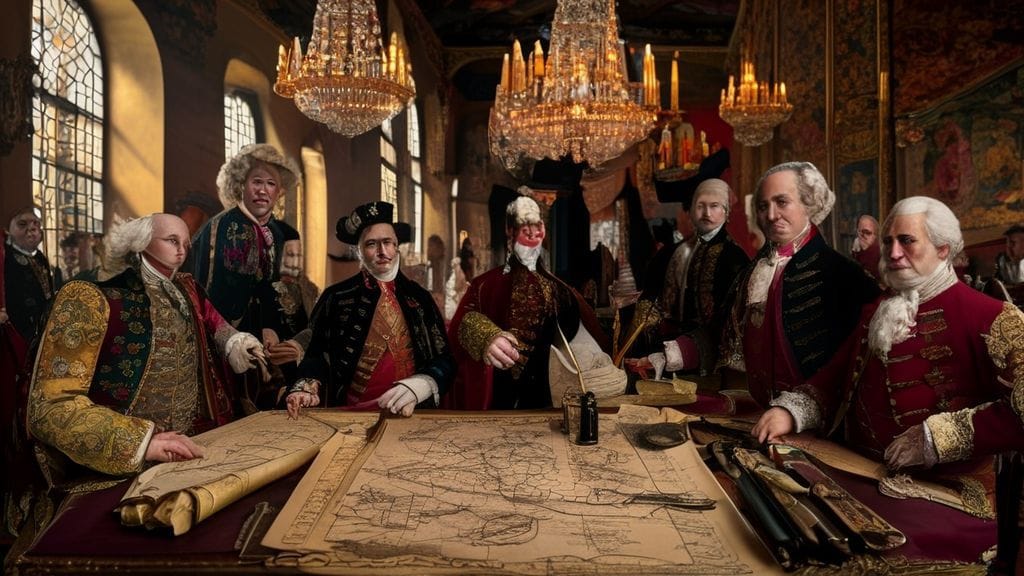
On a cold January morning in 1750, the streets of Madrid were still slick with night frost when carriages began to roll toward the royal palace. The sky above the city was a pale, wintry blue, but inside the palace corridors, heavy tapestries muffled the sounds of footsteps and whispered conversations. Courtiers moved like shadows, their embroidered coats flashing briefly in the light of candelabra. Beyond these echoing hallways, in a room thick with ink, parchment, and the subtle scent of sealing wax, the fate of a vast and distant continent awaited a few firm strokes of a pen.
It was 13 January 1750, and most of the men present had never seen the lands they were about to divide and exchange. To them, the interior of South America was a patchwork of half-known rivers and uncertain mountain ranges, colored with fading inks on maps that did not always agree with one another. Yet the decisions they would take that day would reconfigure villages and missions, gold fields and cattle ranges, and the lives of tens of thousands of Indigenous people and colonists who had never heard of Madrid, Lisbon, or even Europe.
The treaty laid out on the polished table was the culmination of years of negotiation and decades of conflict. Known in history as the treaty of madrid 1750, it was meant to revise arrangements dating all the way back to the fifteenth century, when the Pope had first tried to divide the non-European world between the rival Iberian crowns. That old line, the famous meridian of Tordesillas, had been drawn on a globe at a time when no one in Europe truly knew the width of the Atlantic or the shape of the continents that lay beyond it. The world had since grown larger—terrifyingly larger—yet the old line still haunted every discussion between Spanish and Portuguese diplomats.
Today, they promised themselves, the uncertainties would be swept away. Today, they would stop arguing about invisible meridians and instead deal with realities: who occupied which lands, who had built which forts, who had founded which villages. They would trade territory for territory, river for river, settlement for settlement, so that both crowns could govern what they truly possessed. In one sense, it sounded rational, enlightened even. But on that January day in Madrid, none of the men in powdered wigs and velvet coats could hear the voices that were absent from the room: the Guarani leaders in the missions, the settlers along the Brazilian frontier, the Jesuit priests who had spent years building communities in the heart of a contested wilderness.
The doors closed; the discussions quieted; quills were dipped in ink. Somewhere in the city, bells tolled the hour, their sounds slipping over rooftops and down narrow streets. In the palace, signatures began to flow across parchment—elegant, deliberate, claiming and ceding territories thousands of kilometers away. The treaty of madrid 1750 was born, almost silently, beneath the painted ceilings of Spain’s capital. No cannons were fired, no crowds gathered. Yet with every loop and flourish of a pen, frontiers shifted, loyalties were reordered, and the map of South America was irreversibly transformed.
But this was only the beginning. The ink had barely dried when men on horseback and ships at sea began the long work of carrying this distant decision to the forests and plains of Brazil and the Río de la Plata. There, beyond the knowledge of most who had signed the document, the paper border would have to be made real—with chains and measuring rods, with negotiators and soldiers, and, ultimately, with blood.
Empires in Collision: Iberian Rivals and the Long Shadow of Tordesillas
To understand why the treaty of madrid 1750 mattered so profoundly, one must return centuries earlier, to an age when the world was being carved up in the minds of European monarchs and churchmen. In the late fifteenth century, Portugal and Spain—then still the crowns of Portugal and Castile-Aragon—stood at the forefront of seaborne expansion. Voyages down the coast of Africa and across the Atlantic posed a troubling question: who would own the lands and seas that lay beyond Europe’s sight?
The Pope, as both spiritual arbiter and political broker, sought to provide an answer. Through a series of papal bulls, particularly “Inter caetera” in 1493, the non-Christian world was notionally divided between the two powers by an imaginary meridian. The following year, in 1494, the Treaty of Tordesillas adjusted that line. It would run from pole to pole, some 370 leagues west of the Cape Verde Islands, granting Castile the lands to the west (most of what would become Spanish America) and Portugal those to the east (Africa, Asia, and, as it turned out, Brazil’s bulging Atlantic coast).
On paper, the solution was neat. In reality, it rested on a fragile foundation: Europeans did not yet know the exact size of the globe or the full extent of the newly contacted continents. The line of Tordesillas crossed ocean and unknown territory, leaving future generations to argue about where, precisely, it lay in the lands of South America. Moreover, the treaty spoke nothing of the Pacific or the lands that might be reached by sailing west to Asia, questions that would soon spark further quarrels.
For centuries, however, the principle held. Spain claimed dominion over much of the Americas, while Portugal consolidated its presence in Brazil’s coastal regions and slowly pushed inward, drawn by sugar, gold, and later by cattle and timber. The two empires were dynastic neighbors on the Iberian Peninsula and uneasy partners in global conquest. Their relationship swung between periods of alliance, such as the Iberian Union (1580–1640) when both crowns were held by the Spanish Habsburgs, and sharp competition after Portugal’s restoration of independence under the Braganzas.
By the eighteenth century, both monarchies had transformed. Spain was now ruled by the Bourbon dynasty, intent on centralizing power and reforming colonial administration. Portugal, under King João V and then José I, had grown rich from Brazilian gold but was increasingly anxious about protecting those riches from foreign rivals. The old, abstract vocabulary of Tordesillas no longer satisfied either side. Spanish officials complained of relentless Portuguese encroachments in the interior, especially in the Amazon basin and the far south. Portuguese authorities, for their part, argued that they were merely occupying lands that nature and labor had already assigned them. As the Portuguese jurist Alexandre de Gusmão would later insist, what mattered was not invisible lines drawn in Rome or Tordesillas, but the concrete fact of “effective occupation.”
It’s astonishing, isn’t it? A decision taken by popes and monarchs in the fifteenth century still cast a shadow over diplomacy in the mid-eighteenth century. Each new discovery—each river traced more accurately on a map, each mining camp founded in a remote valley—threatened to upset the delicate balance. Tensions simmered in the borderlands: settlers feuded, smugglers crossed back and forth, and Indigenous communities found themselves caught between flags they had not chosen. Formal war between Spain and Portugal was rare, but the frontier was a place of constant small-scale conflict and shifting alliances.
By the 1740s, both courts realized that uncertainty itself had become dangerous. A Europe wracked by great-power struggles—the War of the Spanish Succession, the War of Jenkins’ Ear, and other conflicts—left little room for Iberian powers to waste strength on ambiguous frontiers in the New World. The time had come, they believed, to revisit the arrangements inherited from Tordesillas and to put the relationship between their South American domains on a clearer, more modern footing. The stage was set for the discussions that would lead to the treaty of madrid 1750.
Gold, Missions, and Frontiers: The Stakes in the South American Interior
When the diplomats gathered in Madrid to negotiate, they were far from arguing over empty wilderness. Beneath the abstract talk of meridians and principles lay very tangible stakes: gold-bearing mountains, fertile plains for cattle, access to great rivers, and the fragile communities that had taken root there. The seventeenth and early eighteenth centuries had seen Portuguese and Spanish subjects push deep into the interior of South America, creating a reality that no fifteenth-century pope could have foreseen.
In Brazil, bands of Portuguese and Luso-Brazilian adventurers known as bandeirantes had marched into the unknown in search of Indigenous captives and mineral wealth. Their incursions, often violent, broke across the notional Tordesillas line, driving toward the west and south. This expansion accelerated dramatically when gold was discovered in Minas Gerais in the late seventeenth century. Towns sprang up, population surged, and the crown in Lisbon grew wealthy on Brazilian gold, even as it worried about defending these riches from both European and colonial rivals.
Farther south, in the region of the Río de la Plata and the Uruguay-Paraná river systems, another, very different kind of frontier society took shape. There, the Society of Jesus—Jesuit missionaries operating under Spanish authority—established a network of missions, or reducciones, among the Guarani people. These missions, both admired and feared, created self-governing Christian communities where Indigenous inhabitants spoke their own language, cultivated land collectively, and organized militias to protect themselves from slave raiders. To Spanish officials, they offered a way to keep a foothold in remote regions. To many Portuguese colonists, they were an obstacle to the expansion of their own slave-based economy.
Between these zones lay rolling plains, forests, and river valleys claimed by both empires, patrolled by small garrisons, roamed by cattle and wild horses. The towns were few—Colonia do Sacramento, founded by Portugal in 1680 opposite Buenos Aires; frontier posts in Mato Grosso and Goiás; distant forts near the Amazon. But the land itself was coveted, for strategic and economic reasons. Whoever controlled the internal river systems would dominate trade routes from the Atlantic deep into the continent. Whoever secured the southern plains would gain pasture, hides, and, eventually, room for vast cattle ranches.
And then there were the people who already lived there. The Guarani in the missions, the many other Indigenous nations scattered across the interior, the Afro-descendant communities who had fled slavery and formed quilombos in Brazil—all of them moved, worked, and fought across landscapes that Madrid and Lisbon wished to fix with neat lines on a map. Yet at the heart of Spanish-Portuguese negotiations was a principle that paid them little heed: lands would be exchanged in such a way as to rationalize imperial control, not to protect Indigenous sovereignty.
By the 1740s, conflicts in these regions had become too frequent to ignore. Portugal’s insistence on keeping Colonia do Sacramento enraged Spanish officials, who viewed it as a smuggling center siphoning silver and hides out of the Río de la Plata. Portuguese advances in the Amazon and far west threatened to isolate Spanish possessions in Peru and Upper Peru. On the other hand, Spain’s desire to contain Brazilian expansion clashed with the reality that thousands of Portuguese speakers, miners, ranchers, and enslaved Africans already lived well beyond any plausible reading of the old Tordesillas line.
Thus, the stakes of the future treaty were not just lines on a chart. They included gold from Minas Gerais, silver and cattle from the Río de la Plata region, the survival or destruction of Jesuit missions, and the autonomy of Indigenous groups who had, for generations, played Spanish and Portuguese interests against one another. Every article in the treaty of madrid 1750 would have an echo in these distant, contested lands.
Negotiators in Velvet and Ink: The People Behind the Treaty
Great treaties are often presented as acts of state, impersonal and inevitable. Yet behind the treaty of madrid 1750 stood very real individuals—princes, ministers, diplomats—each with their own calculations, anxieties, and hopes. Their personal rivalries and intellectual influences left clear fingerprints on the final document.
In Lisbon, Portugal’s policy was strongly shaped by King João V, who reigned until 1750, and by his minister and advisor Alexandre de Gusmão. João V’s obsession with regal splendor was funded heavily by Brazilian gold, making the protection of the colony’s frontiers a matter not just of prestige but of financial survival. Gusmão, born in Brazil and deeply familiar with its geography and frontier society, emerged as an ardent proponent of the principle that would guide Portuguese negotiation: uti possidetis, “as you possess.” In essence, he argued that effective occupation—actual settlement and control—should override ancient theoretical lines.
In Madrid, the Bourbon monarchy under Ferdinand VI sought to consolidate its empire after the turbulence of earlier wars. The Spanish crown wanted to secure clear boundaries to prevent further encroachments while also eliminating Portuguese footholds that threatened its monopoly over silver and trade. Diplomatic exchanges with Portugal had dragged on for years, but by the late 1740s, both sides felt pressure to achieve a definitive agreement. Spanish ministers, including José de Carvajal, looked to negotiations not only as a matter of territorial integrity but as an expression of Bourbon reformist rationality.
Between these courts moved the negotiators themselves, pen in hand. Alexandre de Gusmão’s role on the Portuguese side was pivotal. Although not always present in Madrid, his memoranda and strategic vision shaped Portugal’s firm line: accept the relinquishing of Colonia do Sacramento, if necessary, in exchange for vast tracts of interior that Portuguese settlers already occupied. Portuguese diplomats emphasized the hard facts on the ground—Brazilian towns, forts, and parishes—inviting their Spanish counterparts to acknowledge reality rather than cling to outdated charts.
Spanish negotiators brought their own expertise, poring over maps and reports from colonial officials, Jesuit missionaries, and military officers. Yet they were under no illusion that Spain could simply roll back centuries of Portuguese expansion by decree. In some regions, especially in the Amazon basin and Mato Grosso, Spain’s presence was thin. The Spanish strategy, therefore, was more selective: concede in areas where effective power was lost, while insisting on redressing especially glaring infringements, such as Colonia do Sacramento.
It was a battle of information as much as of wills. Cartographers were consulted, missionaries’ testimonies read, and long-forgotten royal orders exhumed from archives. At times the discussions took on an almost scholarly flavor, with references to previous treaties like the 1529 Treaty of Zaragoza or the 1715 agreements, and to the writings of jurists like Hugo Grotius. Yet behind this learned veneer lay the familiar tug of imperial rivalry and economic interest.
In the candlelit rooms where the treaty of madrid 1750 took shape, the personal skill of the negotiators mattered immensely. Gusmão’s ability to weave together legal doctrine and frontier realities impressed even some Spanish observers. Spanish ministers, in turn, were determined not to appear weak in the face of Portuguese demands. Every concession had to be balanced by a gain, every cession of land justified to the Council of the Indies and to colonial elites who would read the final text with suspicion.
When the day came to sign, the faces around the table were composed, but few doubted that they were stepping into uncertain territory. The ink they laid down would have to be defended not by them, but by unidentified officers and explorers who would one day trudge through swamps and jungles to plant markers along distant rivers. Still, as the quills scratched and wax seals were pressed, there was a sense of accomplishment. The old quarrels of Tordesillas would, at last, be replaced by what they believed was a modern, rational definition of empire.
Inside the Treaties: From Tordesillas to Lisbon and at Last to Madrid
The treaty of madrid 1750 did not emerge in a vacuum. It was the latest act in a long legal drama, one in which previous treaties and adjustments had tried—and failed—to bring clarity to Iberian claims in the New World. To see how bold Madrid’s provisions were, one must trace the path that led up to them.
The Treaty of Tordesillas had set a crude division but left unanswered where the line would fall in lands not yet charted. As geographic knowledge expanded, disputes multiplied. The Treaty of Zaragoza in 1529 attempted to complement Tordesillas by addressing the division on the opposite side of the globe, near the Moluccas in Asia. But again, the problem of measurement lingered. The Earth’s true size and the exact position of islands and coasts remained subjects of heated debate, with Portuguese and Spanish pilots offering competing calculations.
In the Americas, matters became more complicated as colonization took root. Over time, a patchwork of bilateral accords and ad hoc understandings emerged. Temporary agreements about settlement rights along certain rivers or in particular coastal enclaves tried to keep the peace. The 1681 Treaty of Lisbon, for example, addressed the fate of Colonia do Sacramento after its first seizure by Spanish forces, only for the issue to flare up again when the Portuguese returned. Later, in the early eighteenth century, further negotiations sought to regulate the status of frontier settlements and to bar mutual encroachment, but these remained largely ineffective.
Amid these partial measures, a deeper shift was taking place. European legal thought about sovereignty and territory evolved, influenced by natural law theorists and the practical experiences of empire. Rather than resting claims solely on papal bulls and abstract lines, states increasingly cited effective control, economic use, and treaties between sovereigns. This is where Alexandre de Gusmão’s arguments gained traction: he situated Portugal’s case within this more modern framework, contending that possession and settlement carried greater weight than archaic demarcations.
By the mid-eighteenth century, both Spain and Portugal recognized that the old regime of overlapping and ambiguous rights was unsustainable. Smuggling thrived in the gray zones between jurisdictions; border skirmishes risked escalating into wider conflict; and the sheer logistical burden of administering uncertain frontiers strained colonial bureaucracies. Madrid and Lisbon each wanted a unified, coherent legal basis for their territorial claims—one that could withstand challenge not only from each other but, increasingly, from other European powers eyeing opportunities in South America.
Thus, when envoys met in Madrid, they did so with the clear intention of replacing centuries of patchwork with a single, comprehensive settlement. The treaty of madrid 1750 would do more than shuffle ownership of particular towns; it would introduce a new organizing principle for the colonial map of South America. It would say, in effect, that the age of Tordesillas was over, and that Europe’s New World empires must now be drawn according to where their people actually lived, traded, and governed.
Of course, reality is never so clean. Even as the treaty invoked this new logic, it also carried vestiges of older claims and careful diplomatic fictions designed to save face. Yet its ambition—its attempt to re-found Iberian spheres of influence in the Americas on a modern basis—marked a significant milestone in international law and imperial policy, one that contemporary observers and later historians alike have recognized. As one twentieth-century historian would write, “The Treaty of Madrid was less the end of a quarrel than the beginning of a new concept of empire,” a judgment that echoes in scholarly debates to this day.
The Treaty of Madrid 1750: Articles, Clauses, and a New Map of Brazil
When contemporaries spoke of the treaty of madrid 1750 as a turning point, they were thinking not just of lofty principles but of its concrete, carefully worded clauses. Each article translated diplomatic bargains into actionable instructions: which lands would be ceded, which occupied, which evacuated, and how all this was to be verified on the ground.
At the heart of the treaty lay a bold assertion: the line of Tordesillas was effectively obsolete. Instead, boundaries would be determined largely by the principle of uti possidetis. In practice, this meant acknowledging that the Portuguese sphere extended far beyond the old meridian, incorporating large parts of what are now western and northern Brazil. Rivers such as the Rio Negro, Madeira, and Guaporé became reference points, as did mountain ranges and other natural features. The treaty delineated the frontier in a long, sinuous line, stitched together from descriptions of rivers and watersheds that diplomats hoped matched reality on the ground.
One of the most striking provisions concerned the exchange of specific territories. Portugal agreed to cede Colonia do Sacramento—an enclave that had been a thorn in Spain’s side for decades—in exchange for Spanish recognition of Portuguese claims deep in the interior. The Luso-Brazilian frontier would extend westward, legitimizing Portuguese presence in regions where mining, ranching, and trading networks were already entrenched. To Spanish eyes, this trade-off offered a way to close a conduit of smuggling in the Río de la Plata and to strengthen control over the approach to Buenos Aires.
In the south, however, the treaty’s language took on a more ominous cast, at least from the perspective of those who inhabited the land. The so-called “Seven Peoples of the Missions”—a chain of Jesuit-run Guarani reductions situated east of the Uruguay River—were to be transferred from Spanish to Portuguese sovereignty. Their Guarani inhabitants were ordered to abandon their established towns and relocate west of the new frontier, leaving their homes, churches, and fields behind. In return, Portugal would relinquish other contested areas, theoretically balancing the ledger.
To give these provisions teeth, the treaty laid out mechanisms for implementation. Joint commissions of Spanish and Portuguese officials were to be dispatched to the frontier to survey the land, plant boundary markers, and oversee the transfer of authority. The language is meticulous, almost clinical, in its attention to procedures: how to handle disputes about particular locations, how to determine which river branch was intended in ambiguous cases, how to document acceptance of the new lines by local authorities.
Yet behind these meticulous details loomed a larger transformation. The territory that would one day be called Brazil now stretched in a broad arc from the Atlantic deep into the continent, its westward bulge no longer merely a fact of encroachment but a recognized reality in international law. Spanish America, for its part, gained clearer control in the Río de la Plata and Chilean-Patagonian regions, at least on paper. The old, theoretically neat division between a Portuguese “east” and Spanish “west” gave way to a far more irregular but more accurate partition.
It is important to note that the treaty of madrid 1750 also reflected emerging scientific ambitions. The involvement of cartographers and surveyors signaled an era in which states believed they could know and fix their territories with precision. The treaty assumed that geography could be captured in text and that local topography would obediently match diplomatic description. In reality, of course, rivers changed course, maps were flawed, and the very act of surveying could become contentious.
Still, when the signatories added their seals to the document, they believed they had produced a coherent, enforceable blueprint for peace between the Iberian empires in South America. The treaty’s articles were dense, its prose careful, but the vision was sweeping: an end to ancient ambiguity, a new map for a new age of imperial governance. That this vision would soon collide with resistance and violence on the frontier was not yet fully apparent in the tranquil chambers of Madrid.
Drawing Lines Across Lives: The Guarani, the Missions, and Forced Exchange
No single provision of the treaty of madrid 1750 would prove more explosive than the transfer of the seven Guarani missions east of the Uruguay River. On parchment, it was a simple exchange: Portugal would gain these mission territories; Spain would secure other advantages elsewhere. But for the approximately 30,000 Guarani men, women, and children who lived in these reductions, the clause meant the erasure of decades of labor and community-building.
The Jesuit missions had developed over the seventeenth and early eighteenth centuries into complex societies. The Guarani there had adopted Christianity but retained much of their language and certain cultural practices. They cultivated fields, raised cattle, produced crafts, and organized vibrant musical and religious life. Mission militias, trained and armed, had repelled slave raiders in earlier decades. In many ways, these communities stood as buffer zones between Spanish and Portuguese settlements and as laboratories of a particular Jesuit vision of Christian-Indigenous coexistence.
Now they were to be uprooted. The treaty stipulated that the Guarani inhabitants must leave their homes and cross to the Spanish side of the new border within a specified period. Their churches, houses, orchards, and herds would fall under Portuguese jurisdiction. To Lisbon and Madrid, this was a technical matter, a necessary adjustment of sovereignty. To the Guarani and their Jesuit shepherds, it felt like an arbitrary dismantling of a world.
When royal orders and news of the treaty reached the missions, responses varied but soon coalesced into rejection. Guarani leaders asked a simple, devastating question: why should they abandon lands their ancestors had worked and sanctified, only to start anew in unexplored zones, under conditions they did not trust? They had not signed any treaty; no envoy had consulted them. To them, the faraway act of January 13 seemed like an imposition devoid of legitimacy.
Jesuit missionaries found themselves in a painful position. As loyal subjects of the Spanish crown, they were bound to obey royal decrees. As spiritual guides and protectors of the Guarani communities, they were deeply troubled by the order. Some argued for compliance, hoping to negotiate better conditions during the relocation. Others sympathized with Guarani resistance, sharing their doubts about Portuguese intentions, especially regarding enslavement and forced labor.
Yet behind the moral debate lay a stark reality: neither Lisbon nor Madrid had any serious mechanisms to incorporate Indigenous voices into their decision-making. The treaty of madrid 1750 treated missions as objects of barter, their populations as passive components that could be shifted from one sovereign to another. The Guarani, however, refused this role. They would soon attempt to assert their agency in the most direct and dangerous way possible—by taking up arms.
In this sense, the treaty became a test of imperial authority: could two European crowns impose a border that their own Indigenous allies and subjects rejected? The answer, as events in the Río de la Plata would soon show, was not straightforward. The Guarani missions became the flashpoint where abstract diplomacy met lived reality, and where the ink of January 13 would be rewritten in blood.
Reactions in the Courts of Lisbon and Madrid: Triumph, Doubt, and Fear
News of the treaty’s signing spread slowly outward from Madrid, first through diplomatic channels and then through the carefully managed public spheres of Lisbon and Madrid. In both capitals, the initial reaction among ministers and court insiders was one of cautious satisfaction. Centuries of quarrels, they believed, had at last been resolved—not completely, perhaps, but sufficiently to usher in a new era of stability.
In Lisbon, courtiers aligned with Alexandre de Gusmão saw the agreement as a major victory. At long last, the realities of Brazilian expansion had been recognized by Spain. Portugal’s legal hold over Minas Gerais and the vast hinterlands to the west and north seemed more secure. The relief was tangible: anxious talk of Spanish attempts to roll back Portuguese advances diminished, replaced by optimistic projections of continued growth in mining and agriculture. The loss of Colonia do Sacramento stung, but many argued that it had long been an exposed, costly possession, constantly at risk from Spanish attack.
At the same time, there were murmurs of concern. Some Portuguese elites, especially those with mercantile interests in the Río de la Plata, lamented the surrender of such a strategic outpost. They feared that, without Colonia, Portugal’s smuggling networks would suffer and Spanish customs policies would tighten. For them, the treaty of madrid 1750 felt less like a clear triumph and more like a calculated gamble.
In Madrid, the mood was perhaps more openly positive. Spanish ministers emphasized to the king and to key stakeholders that the troublesome Portuguese enclave across from Buenos Aires would now be removed. They hailed the treaty as a demonstration of Bourbon firmness and diplomatic skill. The court’s own sense of reformist enlightenment—an ambition to rationalize administration and promote economic modernization—found in the treaty an emblematic success: the replacement of medieval lines with a realistic map shaped by science and reason.
Yet behind closed doors, doubts lingered. Some advisers worried that too much had been conceded in the interior. Could Spain truly afford to recognize such a vast Portuguese Brazil? Would this not weaken its long-term position in the continent, especially if other European powers, like Britain or France, sought to challenge its own frontiers? Others voiced concern about the practicability of implementing the agreement. The idea of dispatching joint commissions into remote tropical forests and rugged highlands seemed, to put it mildly, optimistic.
Outside the narrow circle of ministers, reactions were slower and more diffuse. Colonial officials in Buenos Aires, Rio de Janeiro, and other administrative centers awaited detailed instructions. Missionaries and frontier commanders, hearing rumors of territorial swaps, tried to guess whether their jurisdictions would change. Among ordinary urban dwellers in Iberian cities, the treaty caused little stir. It was one more piece of distant news from the New World, overshadowed by court intrigues, religious festivals, and the day-to-day concerns of life.
Nonetheless, a sense of having turned a page did permeate the upper echelons of both courts. A chronic dispute, stretching back to the age of caravels and papal bulls, now had, at least on paper, a definitive resolution. That the treaty of madrid 1750 would soon face serious challenges—on the ground and in the halls of power—was still obscured by the glow of diplomatic accomplishment.
On the Ground in South America: Surveyors, Soldiers, and Silent Forests
Once the royal seals were set and the quills laid aside, the true work of the treaty of madrid 1750 began—not in Madrid or Lisbon, but in the dense forests, wide rivers, and windswept plains of South America. The paper border, meticulously drafted, had to be translated into physical markers on a terrain that was often poorly known even to local authorities.
Joint commissions were assembled, composed of Spanish and Portuguese officers, engineers, cartographers, and support staff. Their task was both technical and political: to identify the rivers and landmarks named in the treaty, to agree where precisely a boundary marker should be placed, and to do so without provoking local unrest. They carried instruments—compasses, astrolabes, chains for measuring distance—as well as armed escorts to protect them from potential attacks by hostile groups or rival colonial factions.
Their journeys were long and arduous. They navigated swollen rivers in fragile boats, hacked paths through undergrowth, and crossed mountains under extremes of heat and cold. Disease was a constant threat; so were food shortages and disagreements among the commissioners themselves. What had seemed clear in the polished phrases of the treaty often became murky when confronted with the messy complexity of actual geography. Was that stream before them really the branch of the river mentioned in Article X? Did the watershed lie to the east or west of the ridge they were scaling?
Moreover, every decision they made had ramifications for the people who lived nearby. Settlers, Indigenous communities, and mission residents watched nervously as these strangers in foreign uniforms arrived with measuring tools and documents bearing royal signatures. To many, the commissioners were harbingers of change, perhaps of dispossession. Some local officials tried to influence the surveys, pressing for boundaries that favored their own towns or estates. Others resisted any alteration, fearing that inclusion under a different crown would disrupt their privileges and patterns of trade.
In this uncertain environment, the presence of armed escorts could quickly turn negotiations into confrontations. Spanish and Portuguese soldiers—often poorly paid, sometimes resentful—accompanied the surveyors not only against external threats but also as a reminder of imperial power. When disputes arose over a particular line or marker, the temptation to settle them by force was never very far away. The frontier, always a fragile zone, became even more volatile as the work of implementation proceeded.
Still, progress was made in some regions. Boundary markers were erected, maps updated, and reports sent back across the ocean. The commissions did contribute to a more precise understanding of South American geography, leaving behind a legacy of observations and sketches that historians and geographers still study today. But in the southern mission region, where the Guarani prepared to resist relocation, the presence of these teams of surveyors and soldiers would help ignite a far more dramatic and tragic chapter.
The Guarani War: When Paper Borders Turned to Blood
The Guarani rejection of relocation from the seven missions east of the Uruguay River did not remain merely a refusal voiced in village councils. As Spanish and Portuguese officials moved to enforce the treaty’s terms, tension escalated into open conflict. Between 1753 and 1756, the region descended into what is now known as the Guarani War—a grim testament to how a diplomatic agreement can, when imposed without consent, ignite fierce resistance.
Guarani leaders, including the charismatic Sepé Tiaraju, emerged as spokesmen and organizers of the opposition. They argued that their people had shed blood to defend those lands against slave raiders and enemy incursions; now, they were told to abandon them at the stroke of a European pen. Sepé’s reported cry—“This land has owners!”—captured the essence of their defiance. These were not passive subjects but communities asserting a sense of territorial belonging that neither Lisbon nor Madrid had anticipated.
At first, some Spanish officials hesitated. They had long relied on the Guarani militias as allies against Portuguese slave raiders and rival powers. Forcing them out felt both morally dubious and strategically risky. Portuguese commanders, for their part, eyed the missions with a mixture of desire and suspicion, aware of the Guarani militias’ discipline and Jesuit influence. Yet the logic of the treaty of madrid 1750 pushed both sides toward a hard line: to preserve the credibility of the agreement, the missions had to be vacated.
Attempts at negotiation failed. The Guarani fortified their communities, prepared defenses, and appealed—through the Jesuits and some sympathetic officials—for a reconsideration of the decree. But the machinery of empire had little room for Indigenous vetoes. Joint Spanish-Portuguese forces were eventually assembled to enforce the treaty. It was a bitter irony: former enemies now fought side by side, not against each other, but against their own Christian Indigenous allies.
The campaign was harsh and uneven. European troops struggled with the terrain and with supply issues, while the Guarani used intimate knowledge of the land to mount ambushes and defensive stands. Nonetheless, disparities in weaponry and resources told in the end. Key battles, such as those at Caiboaté in 1756, ended in bloody defeat for the Guarani. Sepé Tiaraju himself was killed, and many of his followers perished in combat or fled into the forests.
Reports of the war shocked observers in Europe and the Americas who cared to pay attention. Jesuit chroniclers and later historians would portray the conflict as a tragic collision between imperial reason of state and the rights of Indigenous communities. One Jesuit account lamented that “the peace of princes became the ruin of their most faithful vassals,” a searing indictment of a treaty that had, in theory, sought to avoid war between crowns but had instead provoked war against their subjects.
In the aftermath, the missions were devastated. Some were eventually repopulated under Portuguese authority, others declined. The Guarani who survived saw their autonomy sharply curtailed, their experiment in semi-independent mission life broken. The Guarani War left scars not only on the land but on the moral reputation of both Spain and Portugal, fueling debates about the nature of empire, the rights of Indigenous Christians, and the role of the Jesuits.
Most crucially, the war exposed the gap between the elegant prose of the treaty of madrid 1750 and its human consequences. It forced statesmen and theologians alike to confront an uncomfortable truth: lines drawn in distant capitals could destroy communities that had, in their own way, been loyal pillars of their empires.
Jesuits in the Crossfire: Defenders, Suspects, and the Road to Expulsion
If the Guarani missions suffered in the wake of the treaty, so too did the Society of Jesus. Jesuits had long been both valued and distrusted by Iberian monarchies. Their missions in remote frontiers helped extend imperial religious influence, but their relative autonomy and wealth aroused jealousy among secular clergy and royal ministers. The crisis unleashed by the treaty of madrid 1750 would deepen these tensions and push the Jesuits closer to their eventual expulsion from both Portuguese and Spanish realms.
During the Guarani War, Jesuit missionaries were accused by some officials of fomenting resistance, of encouraging the Guarani to defy royal orders. The reality was more complex. While many Jesuits sympathized with Guarani grievances, they were divided over how far to support armed opposition. Some tried to mediate, urging compliance while negotiating better terms; others were accused—sometimes with little evidence—of inciting rebellion. In the fevered atmosphere of frontier conflict, such accusations gained political weight.
In Lisbon, the rising star of Sebastião José de Carvalho e Melo—later the Marquis of Pombal—viewed the Jesuits with suspicion, seeing them as obstacles to royal absolutism and economic modernization. The events in the missions offered a pretext to strengthen the crown’s hand. If Jesuits were resisting a treaty duly signed by sovereign powers, then they could be painted as disloyal, perhaps even as agents of a “state within a state.” In Spain, similar currents of suspicion toward the Society began to swell, though with different timing and dynamics.
The fallout from the mission crisis thus fed into broader reformist agendas. Pombal in Portugal moved aggressively to curtail Jesuit influence in Brazil and in the metropole, eventually expelling the order from Portuguese domains in 1759. In Spain, the final expulsion would come later, in 1767, under Charles III. While the treaty of madrid 1750 was not the sole cause of these events, it contributed to the climate in which the Society’s political position deteriorated. The image of Jesuits as protectors of Indigenous autonomy, however nuanced in reality, clashed sharply with the centralizing ambitions of Bourbon and Braganza reformers.
At the same time, Jesuit writings about the Guarani missions and the war circulated, sometimes clandestinely, shaping European perceptions of colonial rule. Accounts emphasizing the suffering of the Guarani and the destruction of the reductions challenged triumphalist narratives of imperial order. Some Enlightenment thinkers, critical of clerical power but sympathetic to the rights of Indigenous peoples, drew on Jesuit testimonies to denounce the brutality of colonial expansion. A later historian would observe that “the fall of the missions exposed not only the weakness of Jesuit power but the moral bankruptcy of the treaties that condemned them.”
In this way, the treaty of madrid 1750 became entangled not just in the redrawing of borders, but in a broader transformation of imperial ideology. The role of missionary orders, the nature of sovereignty on the frontier, and the balance between spiritual and temporal power all came under renewed scrutiny. The Jesuits found themselves in the crossfire, both literally in the missions and figuratively in court politics, their fortunes sinking as the new, more secular conceptions of empire gained ground.
Commerce, Smuggling, and Empire: Economic Ripples of the Treaty
Beneath the high politics and tragic wars, the treaty of madrid 1750 also reshaped the economic fabric of South America. Trade routes shifted, smuggling patterns adjusted, and the flow of gold, silver, hides, and other commodities responded to the new legal geography.
The cession of Colonia do Sacramento to Spain was particularly significant in this regard. For decades, the enclave had served as a porous gateway for goods to slip in and out of the Río de la Plata region, undermining Spanish mercantilist controls. Portuguese and British merchants had exploited its position, trading in silver, textiles, and slaves, often in defiance of official regulations. With the treaty’s implementation, Spain hoped to clamp down on such “illicit” commerce, redirecting flows through licensed ports like Buenos Aires and strengthening its fiscal grip.
In practice, smuggling did not disappear—it never does—but it had to adapt. Without a legal Portuguese foothold across from Buenos Aires, contraband networks became more clandestine and complex, relying on smaller, less conspicuous landing points and on intermediaries across the region. Some merchants lost heavily; others reinvented their operations. The treaty’s promise of neat economic management, like its promise of neat borders, met with the messy realities of human ingenuity and local complicity.
In Brazil’s interior, however, the stabilization—or at least formal recognition—of Portuguese claims encouraged further economic expansion. Cattle ranching spread into newly secured plains, while mining remained a major driver of wealth. Portuguese authorities, armed with the legal backing of the treaty, felt more confident in investing in frontier defenses, roads, and administrative structures. The consolidation of Brazilian territory, in a sense, laid foundations for the colony’s eventual emergence as a unified nation-state.
For Indigenous communities and mission populations, the economic consequences were often grim. Displacement disrupted agricultural cycles; new authorities imposed different tribute and labor demands; access to markets shifted. The Guarani who survived the war faced not only political subjugation but economic marginalization. Other Indigenous groups found themselves increasingly pressed by expanding ranches and plantations that now operated under clearer legal protection.
At the macro level, the treaty of madrid 1750 reflected a broader eighteenth-century trend: the attempt by European states to rationalize their colonial economies, to extract revenue more efficiently, and to suppress “informal” trade that bypassed royal coffers. The Iberian empires, influenced by Enlightenment ideas and by competition with more dynamic powers like Britain, sought to modernize their mercantilist systems. Redefining borders was one piece of this puzzle, aimed at aligning legal jurisdiction with the real circuits of commerce.
Yet even as the treaty advanced these goals, it inadvertently highlighted the limits of state power. Smugglers, local elites, and communities on the margins found ways to exploit ambiguities and to navigate the shifting landscape in their own interest. In this domain, as in others, Madrid’s attempt to impose order produced new forms of disorder and adaptation, revealing once again that imperial designs are always mediated by those who live under them.
A Treaty Undone: The 1761 Revocation and the Return to Uncertainty
For all its ambitions, the treaty of madrid 1750 did not enjoy a long, tranquil life. Barely a decade after its grand signing, the agreement was effectively undone. In 1761, the Treaty of El Pardo formally revoked many of Madrid’s provisions, plunging Iberian frontier arrangements back into ambiguity and reopening questions that the statesmen of 1750 had believed settled.
Several factors drove this reversal. The difficulties of implementing the treaty, particularly in the mission region, weighed heavily. The Guarani War and the political fallout surrounding it convinced many in both courts that the costs of enforcing certain clauses were too high. The intricate mechanisms envisioned for boundary commissions had proven cumbersome, slow, and prone to dispute. Reports filtering back to the capitals painted a picture of confusion and conflict, not of the orderly rationalization that ministers had promised.
International circumstances also shifted. The outbreak of the Seven Years’ War (1756–1763), a global conflict involving Britain, France, and other powers, altered strategic calculations. Alliances realigned; colonial theaters from North America to India erupted in violence. In this turbulent context, the precise Iberian border in South America seemed, at least to some policymakers, less urgent than broader geopolitical concerns. Revisiting the 1750 settlement offered room for tactical maneuvering in the chessboard of great-power politics.
Within Spain, critics of the treaty had never been fully silenced. Some argued that it had conceded too much to Portugal, particularly in the interior. They saw the vast, newly recognized Brazilian territory as a symbol of Spanish weakness and of the failure of previous administrations to uphold traditional claims. The problems in the mission region and the ambiguous reports from boundary commissions gave these critics ammunition to press for a reconsideration.
Thus, the Treaty of El Pardo sought to reset the relationship. It annulled key aspects of the 1750 agreement, seeking, in theory, to return to the status quo ante. In practice, however, it was impossible simply to rewind history. Portuguese settlers had not retreated from the lands they occupied; Spanish and Portuguese authorities on the ground had already adjusted their practices to the new legal framework; Indigenous communities had suffered displacement and war. The revocation, instead of truly restoring the past, created a new layer of uncertainty.
Nevertheless, even in its formal demise, the treaty of madrid 1750 continued to exert influence. Many of its underlying principles, particularly the recognition of effective occupation and the rough outline of Brazilian territorial claims, would echo in later negotiations and treaties, notably the 1777 Treaty of San Ildefonso. In a sense, Madrid’s attempt to redefine the map could not be fully undone; it had already shaped expectations, practices, and geopolitical realities.
This brief lifespan, from 1750 to 1761, gives the treaty a paradoxical character in history: at once ephemeral and foundational. Officially revoked, it nonetheless marked a turning point in how Spain and Portugal—and, later, the independent nations that emerged from their empires—thought about borders, sovereignty, and the link between legal texts and lived geography.
From Imperial Decree to National Frontier: Long-Term Consequences in Brazil and Spain
Looking back from the vantage point of the nineteenth and twentieth centuries, it becomes clear that the treaty of madrid 1750 helped lay down patterns that would outlast the very empires that signed it. When Spanish American colonies and Brazil moved toward independence, they inherited—not papal lines from the fifteenth century—but the tangled, negotiated frontiers that treaties like Madrid had attempted to codify.
In Brazil, the broad territorial shape recognized in 1750 became the backbone of the future nation’s borders. Although details would be further adjusted through later treaties with Spain and with independent neighbors such as Bolivia, Paraguay, and Argentina, the idea of a large, continental Brazil stretching far west of the original Tordesillas line had been effectively entrenched. Brazilian statesmen in the imperial and republican eras could point to historical agreements, including Madrid, to justify their claims.
For the Spanish-American successor states, the legacy was more complex. The disintegration of the Spanish Empire in the Americas left a mosaic of new republics, each trying to define its boundaries. Many disputes—between Bolivia and Brazil, between Argentina and Brazil, between Paraguay and its neighbors—were, in part, the heirs of earlier Iberian negotiations. The notion of uti possidetis, which the treaty of madrid 1750 had already invoked implicitly, returned in the nineteenth century as a guiding principle: new states would, as much as possible, keep the administrative borders they had as colonies.
This legal continuity, however, masked deep historical scars. Indigenous communities, already displaced and marginalized during the colonial era, found themselves once again largely excluded from the drawing of national frontiers. The Guarani, whose resistance had been crushed in the mid-eighteenth century, would later see their traditional territories subdivided among Brazil, Paraguay, Argentina, and Uruguay. The long shadow of Madrid’s decisions fell over them not only as colonial subjects but as citizens—or, more often, as marginalized inhabitants—of new republics.
In Spain and Portugal themselves, the memory of the treaty faded more quickly from public consciousness, overshadowed by domestic reforms, wars, and the eventual loss or transformation of their overseas empires. Yet for historians and legal scholars, it remained a key case study in the evolution of international law and colonial policy. Its attempt to marry legal doctrine with geographic reality, its recourse to joint commissions and scientific surveying, and its dramatic failure in the mission region all made it a compelling object of reflection.
Modern borders rarely tell their stories openly. A river demarcates two nations; a remote marker stands in a field; a line on a satellite map passes silently over forests and towns. But embedded in many of these demarcations, especially in South America, are the debates, compromises, and violences that surrounded the treaty of madrid 1750. The choices made in 1750—about which rivers mattered, which communities were movable, which economic interests deserved protection—helped shape how later generations would imagine the very idea of a frontier.
Memory, Maps, and Myths: How Historians Read the Treaty of Madrid Today
Today, the treaty of madrid 1750 sits at an intersection of several strands of historical inquiry: diplomatic history, legal history, Indigenous studies, and the history of cartography. Scholars no longer view it merely as a tidy diplomatic triumph or failure, but as a window into the complexities of empire and the human cost of state-making.
One line of interpretation emphasizes the treaty as a milestone in the shift from medieval to modern conceptions of international order. By sidelining papal bulls and embracing principles like effective occupation and natural frontiers, the treaty anticipated later developments in international law. Historians point to the detailed boundary articles, the reliance on joint commissions, and the appeal to geography as evidence of an emerging “scientific” approach to territorial questions. In this reading, Madrid exemplifies the eighteenth-century’s faith in reason, measurement, and codification.
Another perspective focuses on the treaty’s role in Brazilian territorial formation. Brazilian historians have long noted that Alexander de Gusmão’s success in having Portuguese claims recognized provided a kind of legal charter for the future nation’s continental dimensions. The image of Brazil as a vast, unified landmass owes much to the diplomatic work culminated in 1750, even if subsequent treaties modified specific sections of the frontier. As one Brazilian scholar has put it, “Without Madrid, Brazil might have been a coastal strip; with it, Brazil became a continent.”
Yet in recent decades, increasing attention has turned to the voices and experiences of those most affected by the treaty but least heard in its making: the Indigenous peoples, mission communities, and enslaved and free Afro-descendant populations of the borderlands. Studies of the Guarani War, of Jesuit correspondence, and of local archival records reveal a more intimate story—a story of fear, negotiation, religious devotion, and political imagination that does not fit neatly into diplomatic categories. The missions, once romanticized in some narratives as utopias or vilified as instruments of control, now appear as complex, contested spaces where Guarani agency was real but constrained.
There is also a cultural memory of the treaty, particularly in regions once part of the disputed zones. Folk songs, regional histories, and local commemorations in parts of southern Brazil, Uruguay, Paraguay, and Argentina sometimes reference the mission era, Sepé Tiaraju, and the wars that followed. These memories often frame the treaty of madrid 1750 not as a distant diplomatic event but as the moment when “they decided our fate without us,” an enduring critique of external control that resonates with contemporary debates about land rights and sovereignty.
Maps form another crucial lens. Comparing pre- and post-1750 maps reveals how cartography both followed and shaped political decisions. Borders that had once been vague strokes gradually sharpened, rivers acquired standardized names, and the outline of Brazil swelled westward. Digital projects today overlay historical treaty lines on modern satellite imagery, inviting students and the broader public to visualize the long-term impact of what might otherwise seem an abstract agreement.
In all these interpretations, one theme recurs: the tension between the treaty’s rhetoric of clarity and the messy, often violent reality of its implementation. Historians now see the treaty of madrid 1750 not as a clean break between eras, but as a moment when ambitious legal and scientific ideals collided with entrenched interests and human communities. It embodies both the Enlightenment’s confidence in order and its blind spots when it came to those outside Europe’s corridors of power.
Conclusion
On that cold January day in 1750, as the ink dried in a quiet room in Madrid, few of the signatories could have fully grasped the sweeping consequences of what they had just done. The treaty of madrid 1750 sought to solve a centuries-old puzzle with the tools of its age: legal reasoning, cartographic knowledge, diplomatic compromise. It replaced the distant meridian of Tordesillas with a more intricate, ostensibly more realistic frontier, aiming to align imperial maps with imperial footprints on the ground.
In many respects, it succeeded. It entrenched the territorial expansion of Brazil, laid down principles that would shape later treaties, and moved Iberian empires toward a more modern understanding of sovereignty. It exemplified the Enlightenment’s belief that reason and measurement could tame the chaos of the world, even in the vast, little-known interior of South America. But its shadow side was equally profound. By treating missions and their inhabitants as tokens to be exchanged, it contributed directly to the Guarani War and the devastation of communities that had been allies and subjects of the crowns. It deepened suspicions toward the Jesuits and helped set the stage for their expulsion, reshaping the religious and social landscape of the Americas.
Ultimately, the treaty’s short formal life contrasts sharply with its long afterlife. Revoked in 1761, it nonetheless left an imprint on maps, on legal doctrines, and on the memories of those whose worlds it upended. Today’s South American borders, and the national imaginaries built around them, cannot be fully understood without reference to the decisions taken that January in Madrid. In the dense prose of its articles, one can still hear the distant echo of rivers flowing through forests, of Guarani voices refusing to leave their homes, and of the quiet determination of states to inscribe their will upon the land.
If history is, in part, the story of how lines are drawn and lives are affected by them, then the treaty of madrid 1750 stands as a stark illustration. It reminds us that every border on a map has a history, often written not only in ink but in struggle and loss—and that the work of understanding those histories is essential to grasping the world we inhabit today.
FAQs
- What was the Treaty of Madrid 1750?
The Treaty of Madrid 1750 was a diplomatic agreement between Spain and Portugal, signed on 13 January 1750 in Madrid, that sought to redefine their colonial borders in South America. It effectively replaced the old Tordesillas meridian with boundaries based largely on effective occupation and natural features like rivers and mountain ranges. - Why was the Treaty of Madrid 1750 important for Brazil?
The treaty was crucial for Brazil because it recognized Portuguese control over vast interior regions that Portuguese and Luso-Brazilian settlers had already occupied. This recognition helped establish the broad territorial shape of modern Brazil, extending far beyond the original limits implied by the Treaty of Tordesillas. - How did the Treaty of Madrid affect the Guarani missions?
The treaty ordered the transfer of seven Jesuit-run Guarani missions east of the Uruguay River from Spanish to Portuguese sovereignty and required the Guarani inhabitants to relocate westward. The Guarani resisted this forced move, leading to the Guarani War (1753–1756), in which joint Spanish-Portuguese forces eventually defeated them, causing great loss of life and the disruption of mission communities. - What role did Jesuits play in the events surrounding the Treaty?
Jesuits administered many of the missions affected by the treaty, particularly in the Río de la Plata region. They tried to protect Guarani interests and sometimes mediated between Indigenous leaders and colonial authorities, but were accused by some officials of encouraging resistance to relocation. The controversy surrounding the missions contributed to growing suspicion of the Society of Jesus and formed part of the context for their later expulsion from Portuguese and Spanish territories. - Why was the Treaty of Madrid 1750 later revoked?
The treaty was effectively revoked by the Treaty of El Pardo in 1761 due to the difficulties of implementation, the violence of the Guarani War, and shifting geopolitical priorities during the Seven Years’ War. Critics in Spain also argued that Madrid had conceded too much territory to Portugal. Although officially annulled, many of its principles and territorial recognitions continued to influence later negotiations. - Did the Treaty of Madrid 1750 immediately end all border disputes?
No. While it was intended to provide a definitive settlement, the treaty’s implementation was uneven, and many ambiguities remained. Joint boundary commissions struggled with the realities of the terrain, and local conflicts persisted. Later treaties, such as the Treaty of San Ildefonso in 1777, were needed to further clarify and adjust borders. - How do historians view the Treaty of Madrid today?
Historians see the treaty as a pivotal moment in the evolution of imperial frontiers and international law. It is praised for introducing more modern, realistic criteria for borders but criticized for its disregard of Indigenous rights and for the violence it helped unleash, particularly in the Guarani missions. Many scholars treat it as a case study in how Enlightenment ideals of reason and order could coexist with, and even facilitate, colonial exploitation. - What principle of international law is most associated with the Treaty of Madrid 1750?
The principle most closely associated with the treaty is uti possidetis, meaning “as you possess.” This doctrine emphasizes effective occupation—actual control and settlement—over abstract historical claims when determining sovereignty, and it would later influence border-making in independent Latin American states.
External Resource
Internal Link
Other Resources
- Encyclopaedia Britannica – general search for the exact subject
- Google Scholar – academic search for the exact subject
- Internet Archive – digital library search for the exact subject

