Table of Contents
- A Night That Changed Two Continents
- Gallipoli Before the Storm: A Byzantine Frontier World
- The Rise of the Ottomans and Their Gaze Across the Sea
- Earth Tremors and Crumbling Walls: The Earthquake of 1354
- Orhan’s Calculations: Politics, Civil War, and Opportunity
- Süleyman Pasha Crosses the Water: The First Ottoman Footstep in Europe
- The Silent Descent on Gallipoli: March 2, 1354
- Inside the Fallen City: Fear, Bargains, and New Masters
- Fortress of Two Worlds: Turning Gallipoli into an Ottoman Bridgehead
- Refugees, Converts, and Fighters: The Human Tide into Gallipoli
- Shock in Constantinople: Byzantine Reactions and Despair
- Venice, Genoa, and the Western Gaze on a Changing Strait
- From Beachhead to Empire: How Gallipoli Opened the Balkans
- Memory, Myth, and the Earthquake of Fate
- Echoes Through the Centuries: Gallipoli’s Long Shadow
- Conclusion
- FAQs
- External Resource
- Internal Link
Article Summary: On the cold night of March 2, 1354, a frontier town on the Gallipoli peninsula slipped from Byzantine hands into those of a rising Anatolian power, marking the beginning of a transformation that would reshape southeastern Europe. This article follows the ottoman capture of gallipoli as both an episode of sudden opportunism and the outcome of deeper political fractures, climatic disaster, and military ambition. We descend into the cracked streets after the earthquake that shattered the city’s walls, watch Ottoman soldiers crossing the waters of the Dardanelles, and listen to the anguish and calculations inside a Byzantine Empire already torn by civil wars. From there, we trace how Gallipoli became a bridgehead into Europe, a staging ground for Ottoman expansion into Thrace, Macedonia, and beyond. Along the way, we encounter refugees, mercenaries, merchants, monks, and sailors whose lives were upended in the wake of this conquest. The article interweaves storytelling and analysis to show how a single coastal fortress became the hinge between medieval and early modern histories of the region. Above all, it argues that the ottoman capture of gallipoli was not just a military episode, but a turning point in the balance between Christian and Muslim powers in the eastern Mediterranean. And yet behind the maps and campaigns lie human stories of fear, adaptation, and the stubborn search for security in a world that was violently shifting beneath people’s feet.
A Night That Changed Two Continents
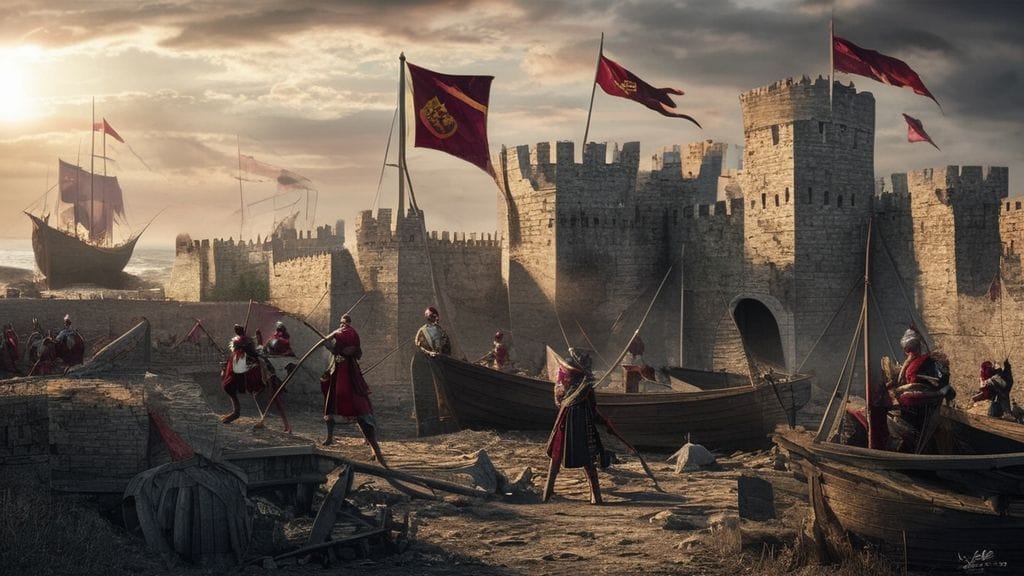
In the early hours before dawn on March 2, 1354, the narrow waters of the Dardanelles were dark and deceptively calm. No chronicler notes the color of the sky, nor the exact strength of the wind, yet one can imagine the creak of oars and the murmur of low voices as small boats slipped quietly across the strait. To the north, on the Gallipoli peninsula, a city that had once shielded the approach to Constantinople lay broken and bruised. Its walls, long thought impregnable, were split and sagging. Houses leaned at strange angles. Many people had already fled. Others huddled in houses and churches whose foundations they no longer trusted. This was the setting for the ottoman capture of gallipoli—a conquest often reduced to a footnote in lists of battles, but which in truth would help set the direction of Balkan history for centuries.
The soldiers who crossed that night served a dynasty barely a century old—the house of Osman, rising from the turbulent frontier of northwestern Anatolia. Their leader in Europe was Süleyman Pasha, son of Sultan Orhan, a commander with a clear eye for opportunity and a readiness to turn disaster to his advantage. If the night was quiet, it would not remain so for long. When the first Ottoman detachments reached the shattered city, there was no epic clash on the walls, no heroic last stand in the streets. The fight, such as it was, was brief and unbalanced. It was the aftermath that would echo, the implications of an Anatolian power entrenching itself on the European shore. This was more than a raid: it was a lodgment, a promise that the Ottomans had come to stay.
Gallipoli had seen armies before. For generations, it had been a gateway, a maritime hinge between Europe and Asia, used by emperors and invaders alike. But on that March night, something different was happening. The city was not just being occupied by a foreign garrison; it was becoming the nucleus of a new world the Ottomans imagined for themselves—an empire straddling two continents. The ottoman capture of gallipoli thus stands as a moment when tectonic plates of power shifted subtly yet decisively. No grand proclamation announced the change. No heralds rode out to inform the courts of Europe. Yet by the time word spread, the facts on the ground were already hardening into a new reality.
It is astonishing, isn’t it, how quietly world-changing events can begin? There were no cheering crowds in Constantinople, only alarm and disbelief. In village churches of Thrace, priests would hear rumors that “Turks” had crossed the water, that they were taking over abandoned fortresses and empty houses, that they were bringing their families with them. On the other side, in Anatolian towns like Bursa or İznik, the news would be greeted with pride: the warriors of Osman had set their banner in Rumeli, the land of the Romans—Europe. The ottoman capture of gallipoli was celebrated in some stories as a divinely granted victory, a gift following the chaos of an earthquake that had “softened” the city. In others, it was condemned as little more than opportunistic occupation of a wounded town.
This article moves backwards and forwards around that night—tracing the deeper history of Gallipoli, the rise of the Ottomans, the Byzantine civil wars that opened cracks in the imperial armor, and the earthquake that quite literally brought the walls down. But it also moves outward in space and time, following the paths of peasants who fled, soldiers who stayed, merchants who recalculated their routes, and politicians who realized too late what had been lost. Because the conquest of this single city would become a bridge, not just for troops but for cultural flows, migrations, and new balances of faith and power.
Gallipoli Before the Storm: A Byzantine Frontier World
Long before Ottoman banners flew over its towers, Gallipoli—known as Kallipolis in Greek, meaning “beautiful city”—had guarded one of the most strategically vital stretches of water in the world. The peninsula juts into the Dardanelles (the ancient Hellespont), the narrow sea-lane linking the Aegean to the Sea of Marmara and, beyond, to Constantinople and the Black Sea. Control of Gallipoli meant control of passage: of fleets, of grain convoys from the Black Sea, of pilgrim ships, of war galleys bristling with soldiers and siege engines. Byzantine emperors had fortified the city precisely for this reason. Gallipoli was a shield, but also a gate that could be opened or closed as imperial interests demanded.
By the fourteenth century, this “beautiful city” wore the weariness of a long frontier life. Its population was a patchwork: Greek-speaking farmers and artisans, soldiers from various corners of the empire, Italian merchants from Venice and Genoa watching the traffic and trading in grain, wine, and fish. Armenians, Slavs, and other peoples of the Balkans passed through its harbor, sometimes as free traders, sometimes as bound captives. Monasteries dotted the surrounding hills, and the sound of bells carried inland with the wind. Yet the city was never purely peaceful. Garrison life meant patrols, drills, and the constant expectation that someone—from the north, west, or east—might one day test the defenses.
Byzantium itself was no longer the serene empire of old. It had shrunk, hemmed in by new powers. In Anatolia, the Turks had carved out emirates from once-Byzantine lands, and among them, the Ottomans were becoming steadily more dangerous. In the Balkans, local rulers grew bolder, less willing to take orders from distant Constantinople. Internal tensions were rising as well. The fourteenth century brought devastating civil wars between rival imperial factions, draining the treasury and weakening defenses along the frontiers. Gallipoli felt the tremors of this political earthquake long before the ground actually shook in 1354.
Yet daily life in Gallipoli still followed familiar rhythms. Fishermen set their nets at dawn. Farmers brought olives, grain, and wine into the city to trade. Shipwrights repaired hulls in the harbor, while sailors swapped stories in taverns lit by oil lamps. In the barracks, soldiers played dice and complained about late pay. Children grew up listening to tales of the days when the empire had been stronger, when Roman fleets had ruled these waters unchallenged. They might have heard warnings about distant “Turks” across the water, but such threats felt abstract—stories from another side of the sea.
This was the world that would be brutally interrupted first by nature, then by man. The ottoman capture of gallipoli is often framed as the decisive blow, but the city had already been under subtle siege from larger forces: imperial decline, fraying alliances, and an overstretched defense system that could not be everywhere at once. Gallipoli’s fate was bound up with the weakness of Constantinople as much as with the strength of Bursa. Its walls symbolized an old order, and those walls were about to crack.
The Rise of the Ottomans and Their Gaze Across the Sea
To understand why Gallipoli mattered so much to a rising Anatolian dynasty, one must look east, across the Dardanelles, to the rugged landscapes of Bithynia and the frontier beyliks of northwestern Anatolia. The Ottomans began there as a small principality under Osman I in the late thirteenth century, one of several Turkish polities born from the collapse of Seljuk and Byzantine authority in the region. For decades, they were just one more competitor among many, raiding, allying, and expanding village by village, fortress by fortress. Yet they possessed something that others lacked: a fortunate geography and a flexible, frontier-hardened identity.
Under Osman’s son, Orhan (r. c. 1324–1362), the dynasty transformed from a loose confederation of warriors into a more organized state. The capture of key cities such as Bursa and İznik (Nicaea) turned the Ottomans into serious players. They adopted Byzantine administrative practices where useful, married into Byzantine factions when advantageous, and welcomed not only Turkish-speaking ghazis (holy warriors) but also disaffected Christians who sought employment or protection. The front lines between religions and cultures were porous. Many of the men who would, in time, cross the Dardanelles had grown up fighting “Romans” (Byzantines) on one day and serving them on another, depending on the logic of local politics.
From the Ottoman side of the water, Gallipoli and the shores of Thrace were a tantalizing sight. Europe was not an abstract notion but a visible, reachable horizon. Ottoman leaders were aware of the weakness spreading through the Byzantine state. They knew about civil wars in Constantinople, about unpaid garrisons and restless populations in the Balkans. The Ottoman appetite for expansion was sharpened not just by religious zeal but by practical concerns: control of trade routes, access to new sources of revenue and manpower, and the prestige of capturing places that had once belonged to the powerful “Roman” emperors.
Orhan’s son, Süleyman Pasha, emerges in the sources as the key figure in the first Ottoman ventures into Europe. Later Ottoman chronicles would cast him in quasi-legendary light: a bold commander, a man of faith and daring, willing to risk crossing the sea with a relatively small force to test the European frontier. Some stories insist that Süleyman had dreamt of conquest in Rumeli (the Ottoman name for their European territories) long before opportunity concretely presented itself. Whether or not such dreams are literal, the strategic logic was undeniable. If the Ottomans were to become more than a regional Anatolian power, they had to look beyond the shores of Asia. The ottoman capture of gallipoli would be the first great step in that direction.
What made this possible was not just military ambition but also a keen sense of timing. The Ottomans did not launch a full-scale amphibious invasion against an intact fortress. They waited, watched, and listened. When Byzantine politics plunged into chaos and nature itself struck Gallipoli, the moment arrived. In this way, the story of Ottoman rise is inseparable from Byzantine decline; each move forward for one side mirrored a step backward for the other. The waters of the Dardanelles, once a barrier, became a bridge.
Earth Tremors and Crumbling Walls: The Earthquake of 1354
The chronicle of Nikephoros Gregoras, a Byzantine historian writing in the mid-fourteenth century, contains a chilling passage about an earthquake that shook the region in the winter of 1354. He describes walls cracking, houses collapsing, and terrified people fleeing cities that had suddenly become death traps. Whether Gregoras wrote with dramatic flourish or sober observation, his words convey how fragile human fortifications appeared when the earth itself rebelled. Gallipoli was among the places hardest hit. Its walls, already old, suffered grievous damage. Towers that had withstood sieges crumbled without an enemy touching them.
Modern seismologists, reading back through medieval accounts, believe a significant seismic event struck the northern Aegean in early 1354, impacting cities along the Sea of Marmara and the Dardanelles. For the people of Gallipoli, this was not an academic question. They would have felt the ground rolling, heard the cracking of timber beams, and smelled the dust rising from shattered stone. Some died in their sleep, others in frantic attempts to escape. Churches and fortifications, symbols of divine and imperial protection, split open like egg shells. After the first shocks came aftershocks, each one eroding confidence further. Many residents chose to abandon the city, at least temporarily, seeking safety in the countryside or in more stable towns.
The earthquake did more than damage buildings; it destroyed morale and undermined the idea that Gallipoli was a secure fortress. Garrison discipline frayed as soldiers worried about their families. Commanders faced impossible choices: remain in a shattered city with broken defenses and frightened men, or pull back and regroup elsewhere. The Byzantine government, already scraping for resources due to ongoing civil strife, was in no position to rapidly repair the city’s fortifications. The result was a dangerously exposed stronghold on one of the empire’s most vital maritime chokepoints.
This is where the story of the ottoman capture of gallipoli tangles intimately with the forces of nature. It is tempting to imagine history as a sequence of human decisions—kings, generals, treaties, betrayals. Yet here, an earthquake swung open a gate that armies had failed to breach for generations. Later Ottoman narratives would sometimes present the quake almost as a divine sign, a providential opening that allowed the faithful to advance. Byzantine sources, conversely, might see it as punishment, or at least as a cruel twist of fate in an already dire time. For ordinary people, it was simply terror: the realization that not even the thickest stone could guarantee safety.
Word of the earthquake crossed the water. Ottoman scouts and informants learned of the damage to Gallipoli’s walls and the exodus of its inhabitants. In Bursa and the Ottoman-controlled territories of northwestern Anatolia, strategists began to talk about a possibility that had previously been too risky: establishing a permanent bridgehead in Europe. The idea was no longer absurd. A city that had once required a full-scale siege might now be taken with limited force, provided they moved quickly, before the Byzantines could muster the resources to rebuild.
Orhan’s Calculations: Politics, Civil War, and Opportunity
While the ground was still settling in Gallipoli, the political ground in Constantinople had already been shaking for years. The Byzantine Empire of the mid-fourteenth century was exhausted by internal conflict. A long and bitter civil war between John VI Kantakouzenos and the regency for the young John V Palaiologos had split the empire, pitting factions of nobles, churchmen, and mercenaries against each other. Both sides, desperate for allies, had turned to foreign powers—Serbians, Bulgarians, and crucially, the Ottomans themselves.
Orhan, the Ottoman ruler, proved especially adept at exploiting this chaos. He aligned at different times with Kantakouzenos, receiving in return not only political recognition but also marriage ties; Orhan married Kantakouzenos’s daughter Theodora, binding the Ottoman court to the Byzantine imperial family. This relationship gave the Ottomans intimate knowledge of Byzantine vulnerabilities. It also normalized Ottoman presence in European conflicts. Ottoman troops, initially brought in as allies to one Byzantine faction, learned the terrain, the roads, the fortresses. They saw firsthand the weaknesses of their nominal partners.
By 1354, Kantakouzenos’s position was deteriorating, and the empire was drained. Orhan, observing carefully, understood that Byzantine capacity to respond to new threats was limited at best. An earthquake-damaged Gallipoli was not just a military opportunity; it was a political one. If the Ottomans could seize and hold the city, it would be hard for any beleaguered emperor in Constantinople to force them out without alienating them entirely or launching a major campaign the empire could hardly afford.
The decision to seize Gallipoli was thus not merely a gamble by frontier commanders; it appears to have been part of a broader strategic shift. The Ottomans were already pushing into Thrace in a looser sense—raids, small garrisons, alliances with local lords. But until then, they lacked a secure port and fortress firmly under their own control on the European side. Gallipoli, cracked but not yet claimed by others, presented itself as a perfect candidate. Orhan gave his son Süleyman the green light.
The internal dynamics of Byzantine politics also limited the empire’s ability to protest or reverse what was about to happen. Any strong response risked provoking further Ottoman intervention in the civil wars or losing what remained of their influence over this dangerously powerful ally. When one reads later accounts of the ottoman capture of gallipoli, there is often a note of bitter irony: a city critical to imperial defense fell not in a glorious stand against an invading host, but amid the confusion of earthquake and civil war, while those who might have defended it were embroiled in quarrels over succession and regency.
Süleyman Pasha Crosses the Water: The First Ottoman Footstep in Europe
The image of Süleyman Pasha leading his men across the Dardanelles has been retold in many forms. Some later Ottoman chroniclers, such as Aşıkpaşazade, embellish the tale with dramatic details—how Süleyman loaded his men into small boats at night, how they landed first at a minor point on the coast, then pushed toward larger settlements like Gallipoli. What matters more than the precise choreography is the intent: the Ottomans were no longer just raiding across the water; they were crossing with the explicit aim of staying.
The logistics of this crossing were demanding but not impossible. Ottoman beys had access to local maritime expertise—Greek and Turkish sailors who knew these waters well. The distance between Anatolia and the Gallipoli peninsula at its narrowest crossing points is small enough to be navigated in hours in suitable weather. Weapons, supplies, and horses would have been ferried over in stages. The operation was not a full-scale invasion in the modern sense, but a carefully calculated insertion of enough force to seize and secure a lightly defended, damaged fortress.
The soldiers in Süleyman’s retinue were a mixture of hardened frontier warriors, men accustomed to fighting in rugged Anatolian conditions, and newly recruited volunteers eager for spoils and land. Some were driven by religious ideals, seeing the advance into Rumeli as part of a broader holy struggle. Others were motivated by the prospect of farms, villages, and towns to control on the other side of the sea. The promise that captured lands in Europe could be distributed among veterans was a powerful incentive—the seeds of what would later become the timar system of land grants in the Ottoman Empire.
As the boats cut through the dark water, the men inside them could likely see, even at a distance, the broken silhouette of Gallipoli’s walls against the sky. The earthquake had turned the city into a wounded animal. For Süleyman, the task was to move swiftly enough that the Byzantines could not patch their defenses or reinforce the garrison in time. The ottoman capture of gallipoli depended on this speed, on the synchronization of natural disaster, political paralysis, and military initiative.
No stirring speeches survive from that crossing, though later storytellers would surely have imagined Süleyman addressing his men, promising them victory and reward. In reality, the operation probably unfolded with the tense efficiency of experienced raiders: quiet commands, oars dipping in rhythm, scouts landing first to check for immediate resistance. The transition from water to land is always the most vulnerable phase in such an operation. Once the Ottomans were ashore in sufficient numbers, however, Gallipoli stood little chance.
The Silent Descent on Gallipoli: March 2, 1354
Sources do not give us a blow-by-blow account of what transpired inside Gallipoli on March 2, 1354. We have no detailed battlefield report, no list of casualties. What we have are fragments: references to an Ottoman seizure of the city following the earthquake, notes on its abandoned or evacuated state, hints of brief resistance in some quarters. From these shards, historians reconstruct a likely scenario. It was not a grand siege, but a swift occupation of a city too injured and demoralized to mount a serious defense.
Imagine the streets: dusty, cracked, still bearing the scars of recent tremors. Some buildings lie in rubble piles; others are strangely skewed, their upper stories threatening to collapse. Many residents have left, taking what valuables they could carry. Others remain—not out of courage, but out of necessity. The poor, the elderly, the infirm have fewer options in times of sudden disaster. The garrison, undermanned and uncertain, must decide quickly how to respond when news arrives that Turkish forces have been spotted approaching or even entering through gaps in the walls.
The raiders who had once come by sea to Gallipoli’s gates now moved with the confidence of a conquering force. They could bypass ruined towers, step through breaches where stone had split, scale half-fallen sections of wall. There may have been skirmishes in some streets as isolated groups of defenders tried to hold out. But without intact fortifications or a unified command, such resistance would have been disjointed and ultimately futile. The political leadership in Constantinople was too far away, too distracted, and too short on resources to intervene in time.
Within hours, perhaps within a day, Ottoman control of Gallipoli was effectively complete. Banners bearing the crescent replaced imperial eagles on surviving towers. Patrols moved through the streets, securing key points: the harbor, the main gates, storage houses. Those inhabitants who stayed faced a new reality. Some were killed in the initial confusion; others were spared, especially those whose skills or cooperation might be useful to the new masters. Churches were not immediately all converted into mosques—that process, where it happened, unfolded more gradually—but the spiritual landscape had undeniably shifted.
The ottoman capture of gallipoli thus unfolded less as a climactic battle than as the final act in a chain of misfortunes and strategic moves. Earthquake, civil war, imperial neglect, and frontier opportunism all converged in these shattered streets. Later observers might regret the lack of a heroic last stand, but for the people living through it, survival mattered more than legend. Their city had fallen in near-silence, and yet the consequences would roar across decades and borders.
Inside the Fallen City: Fear, Bargains, and New Masters
Conquest is not only about flags and fortresses. It is also, and perhaps more fundamentally, about people waking up to find that the rules of their world have changed overnight. Inside Gallipoli, the immediate aftermath of the Ottoman takeover would have been marked by fear, frantic negotiation, and swift adaptation. The first priority for any conquering force is to secure control: disarm potential foes, identify local leaders, and establish a rough order that favors compliance over chaos.
Families huddled in damaged homes listening for footsteps outside, wondering if they would be spared or forced out. Priests debated whether to stay or flee, whether to negotiate with the new authorities or retreat to monasteries inland. Some local notables—landowners, merchants, ship captains—quickly sought audiences with Ottoman commanders. They offered knowledge of the city, pledges of cooperation, or even supplies in exchange for safety guarantees. Such bargains rarely protected everyone, but they could blunt the worst excesses of sack and slaughter.
Süleyman and his officers had a clear interest in stabilizing Gallipoli quickly. Unlike raiders content with loot and departure, they intended to keep the city as a permanent base. This meant preserving its harbor facilities, its warehouses, and as much of its population as could be made loyal or at least manageable. Some properties were confiscated and redistributed to Ottoman soldiers or officials. Others were left in the hands of local owners under new conditions, perhaps with increased taxes or obligations. Over time, more Muslim families would be settled in the city and surrounding countryside, changing the demographic balance.
One can imagine moments of human encounter in this period: an Ottoman officer speaking through an interpreter with a Greek merchant about grain shipments; a Turkish soldier trading a captured icon to a local artisan for warm clothing; a frightened child watching men with unfamiliar accents pray facing a different direction than her family did. These interactions, shaped by power and fear, also began weaving the threads of a new, mixed society. The ottoman capture of gallipoli did not instantly erase the city’s Byzantine past. It layered a new order over old foundations, creating a frontier town where languages, faiths, and loyalties would jostle uneasily for generations.
Not all stories ended in compromise. Some inhabitants were expelled, especially if deemed politically unreliable or economically expendable. Others fled voluntarily, joining a growing refugee diaspora in Thrace and the Aegean islands. News of what had happened in Gallipoli—of those killed, those spared, those who bargained their way into uneasy accommodation—spread through rumor and tale, shaping how other communities would respond when Ottoman forces appeared near their walls.
Fortress of Two Worlds: Turning Gallipoli into an Ottoman Bridgehead
Seizing Gallipoli was only the first step. Holding it, fortifying it, and turning it into a springboard for further expansion required sustained effort. The Ottomans moved quickly to repair what the earthquake and hasty conquest had broken. Stone by stone, they shored up damaged walls, rebuilt towers, and adapted Byzantine defenses to their own tactical needs. Engineers from Anatolia worked alongside captured or co-opted local builders. The harbor, essential to communication with the Asian shore, became a focal point of construction and organization.
Gallipoli’s new role went beyond that of a mere garrison town. It was the first major Ottoman base in Europe, a place where Asian and European trajectories literally met. Ottoman administrators set up systems for provisioning the garrison, collecting taxes from nearby villages, and regulating trade through the port. The city’s location allowed the Ottomans to monitor, and in time influence, shipping through the Dardanelles. As one modern historian has noted, control of Gallipoli turned the Ottomans from “land-bound warriors of the Anatolian frontier into players in a wider Mediterranean world.”
Militarily, Gallipoli became a staging ground. From its quays, troops could be ferried rapidly across the strait, shuttling between Anatolia and Europe as campaigns demanded. Raids into Thrace and Macedonia could now be supplied and reinforced far more easily than if the Ottomans had to cross the sea anew each time. The city’s capture also sent a message to regional rulers—Serbian kings, Bulgarian tsars, and Latin lords—that the Ottomans were now a permanent presence in the Balkans, not just occasional raiders passing through.
The ottoman capture of gallipoli thus marks the transition from opportunistic frontier raiding to a more systematic imperial presence in southeastern Europe. The city’s transformation into an Ottoman bridgehead was not just a matter of rebuilding walls; it required fostering a population willing to live, trade, and raise families under Ottoman rule. Soldiers were given grants of land nearby, rooting them in the landscape. Craftsmen from Anatolia were encouraged to settle, bringing skills in textile production, metalwork, and other trades. Over time, the call to prayer would ring out alongside church bells, two soundscapes overlapping in the same streets.
Gallipoli’s identity as “fortress of two worlds” made it a place of nerves and opportunity. To some, it was a bulwark of Islam advanced into Christian lands. To others, it was a place to make money off the traffic between continents. For the Ottomans, it was an anchor, a secure foothold from which they could begin the slow, inexorable process of extending their authority deeper into the Balkans.
Refugees, Converts, and Fighters: The Human Tide into Gallipoli
As the Ottomans consolidated control, Gallipoli became a magnet for various groups of people, each drawn by different forces. Some were soldiers and their families, migrating from Anatolia with the promise of land and opportunity in Rumeli. Others were refugees from conflict zones elsewhere—Turkish, Greek, or Slavic families who saw in Ottoman rule either a refuge from rival lords or simply a new reality to which they must adapt. The city’s population, once predominantly Greek Orthodox, began to shift toward a more mixed composition.
The Ottoman state encouraged certain kinds of movement. Warriors who had distinguished themselves in campaigns were rewarded with plots of land near Gallipoli, anchoring them to the frontier. These men, often of semi-nomadic background, were pushed gently toward a more settled life as provincial cavalrymen, responsible for both local security and readiness for wider campaigns. Their presence, in turn, altered the linguistic and cultural landscape. Turkish speech became more common in markets and streets. New religious institutions appeared: masjids and, eventually, larger mosques and tekkes (Sufi lodges).
At the same time, not all Christian inhabitants left. Many chose to remain under Ottoman rule, either because they lacked the means to move or because they quickly recognized that life could continue, albeit under changed conditions. The Ottomans, like many conquerors, often preferred to keep productive populations in place, so long as they paid taxes and did not revolt. In some families, this period marked the beginning of complex, layered identities. A Greek-speaking farmer might pay taxes to an Ottoman sipahi while still attending church; his son might serve as an auxiliary in Ottoman campaigns, while his cousin emigrated to Venetian-held islands.
Conversion to Islam added another layer to this tapestry. While forced conversions were not systematic policy at this stage, social and economic incentives nudged some individuals toward embracing the faith of the new rulers. A promising young man could find opportunities in the Ottoman military-administrative system if he converted. Others, inspired by Sufi preachers or seeking a sense of belonging in the new order, changed religious affiliation more gradually. The ottoman capture of gallipoli thus set in motion demographic and cultural shifts that would, over decades and centuries, reshape the character of the entire region.
There were also fighters of more ambiguous status: mercenaries, adventurers, and exiled nobles from other Balkan lands who saw in Gallipoli and its Ottoman garrison a source of employment and alliance. The frontier was porous. Men who had once fought for Byzantine commanders now fought alongside Ottoman forces, or vice versa, sometimes switching sides more than once. In this fluid world, loyalty often followed land and pay rather than abstract notions of nation or creed. Gallipoli, straddling the watery border between continents, became a laboratory for such shifting allegiances.
Shock in Constantinople: Byzantine Reactions and Despair
News of Gallipoli’s fall hit Constantinople like a second earthquake. The capital had long relied on the peninsula’s fortresses as buffers against incursions from Anatolia. To learn that one of the key strongholds had not only been occupied but was being rebuilt and settled by Ottomans was a devastating psychological and strategic blow. The imperial court, divided between factions and suffering from the long aftershocks of civil war, struggled to agree on a coherent response.
Some voices urged immediate military action: a campaign to retake Gallipoli before the Ottomans could fully entrench themselves. But dreams of counterattack had to contend with harsh realities. The imperial treasury was nearly empty. The navy, once the terror of the Mediterranean, had been neglected to the point where it could no longer guarantee control of the sea-lanes, let alone challenge determined Turkish crossings. The army was fragmented, with many troops loyal more to individual magnates than to the emperor himself. In such conditions, even forming a relief force was a daunting task.
Political calculations further hamstrung the response. Any major confrontation with the Ottomans risked provoking them into even deeper involvement in Byzantine internal politics. Some in the court still saw Orhan and his successors as potential allies against rival Christian powers or internal enemies. To antagonize them over Gallipoli might, in this twisted logic, be more dangerous than accepting the loss. The very fact that such arguments could be seriously entertained speaks volumes about the depth of Byzantine weakness at this time.
For ordinary Byzantines, the fall of Gallipoli confirmed dire suspicions: that the empire was in terminal decline, that its leaders were either incapable or unwilling to defend its borders. Chroniclers wrote in tones of lamentation. One can imagine sermons in Constantinople’s churches warning of divine punishment, calling for repentance, or imploring the faithful to stand firm in the face of advancing “infidels.” Yet behind the piety lay fear and confusion. The ottoman capture of gallipoli made clear that the Ottomans were no longer distant raiders; they were now neighbors on European soil.
This shock reverberated beyond the capital. In Thrace and along the routes leading toward Constantinople, local communities recalibrated their expectations. Some began to hedge their bets, seeking friendly terms with Ottoman commanders even as they nominally remained under Byzantine rule. Others hardened their defenses, anticipating that their towns might be next. In the palaces of the imperial city, rulers debated treaties and pleas for Western aid. But the initiative was slipping, increasingly, into Ottoman hands.
Venice, Genoa, and the Western Gaze on a Changing Strait
The conquest of Gallipoli also caught the attention of powers beyond Byzantium. Italian maritime republics, above all Venice and Genoa, had long maintained strong interests in the Dardanelles and the routes to the Black Sea. Their merchants and fleets depended on secure passage for grain, furs, and other goods. Any change in control of key ports was watched closely. When word reached them that the Ottomans had taken over Gallipoli and seemed intent on keeping it, alarm bells rang in chancelleries along the Adriatic and the Ligurian coasts.
Yet the Western response was complicated by rivalries and competing priorities. Venice and Genoa were often at odds with each other, their merchant fleets clashing in distant harbors and even within the waters of the Byzantine Empire itself. Both had, at different times, treated Byzantine weakness as an opportunity to extract commercial concessions. Now they faced a new question: would Ottoman control of Gallipoli threaten their interests more than it threatened each other?
In theory, a unified Christian front might have tried to coordinate a response: a fleet sailing to the Dardanelles to pressure or dislodge the new masters of Gallipoli, or at least to negotiate favorable trading terms. In practice, such unity was elusive. Western Europe, too, had its own conflicts—the Hundred Years’ War, papal schisms, and other entanglements. The plight of a distant peninsula, recently rocked by earthquake and annexed by a comparatively small Anatolian power, did not strike many leaders as an immediate, existential priority.
Over time, Venetian and Genoese merchants adapted, as merchants so often do. They continued to ply their routes, now paying closer attention to Ottoman policies and perhaps negotiating new arrangements directly with Ottoman authorities in Gallipoli. The city’s new rulers, eager for customs revenue and access to the wider Mediterranean economy, had no desire to shut down trade entirely. Instead, they sought to redirect its flows to their own advantage. The ottoman capture of gallipoli thus signaled to Italians and other Westerners not only a shift in political power but the emergence of a new player in the regional commercial game.
This period laid early groundwork for later centuries, when European diplomats and merchants would negotiate directly with the Sublime Porte in Istanbul, balancing fear of Ottoman military power with recognition of mutual economic interdependence. Gallipoli, in the mid-fourteenth century, was among the first places where this new pattern began to take shape, even if contemporaries did not yet grasp its full significance.
From Beachhead to Empire: How Gallipoli Opened the Balkans
If the seizure of Gallipoli was a hinge, the door it opened swung wide into the Balkans. In the years following 1354, Ottoman forces used their new base to probe deeper into Thrace and beyond. Towns and fortresses fell, some after sieges, others through negotiated surrenders or internal betrayals. The pattern that would later characterize Ottoman expansion—military advance combined with pragmatic accommodation of local elites—began to crystallize in these campaigns.
Gallipoli’s strategic location allowed the Ottomans to move troops back and forth between their Asian and European domains with unprecedented speed. When resistance stiffened in one theater, reinforcements could be drawn from the other. This flexibility made them formidable adversaries for Balkan rulers whose own territories were often geographically fragmented and politically divided. Over the next decades, key cities like Adrianople (Edirne) would fall under Ottoman control, culminating in the establishment of Edirne as the new Ottoman capital in Europe. Gallipoli had been the first foothold; Edirne became the main seat of power on the continent.
Historians debate how inevitable this expansion was. Some argue that, even without the ottoman capture of gallipoli, Ottoman advance into Europe might have occurred eventually through other crossings or alliances. Others emphasize just how crucial the city was as a secure logistical base. One influential scholar, Halil İnalcık, highlighted the role of Gallipoli as “the stepping-stone which allowed the Ottomans to transform from a regional Anatolian power into a transcontinental empire.” Without that stepping-stone, the pace and pattern of conquest may have been very different.
For the peoples of the Balkans—Greeks, Bulgarians, Serbs, Albanians, Vlachs—the consequences were profound. Over time, Ottoman rule brought new administrative structures, tax regimes, and legal frameworks, as well as new opportunities for social mobility within the imperial system. Some local nobles retained lands as Ottoman vassals, integrating themselves into the hierarchy. Others resisted and were swept aside. Peasant communities negotiated the daily realities of empire: paying taxes, serving in local militias, appearing before Ottoman courts when disputes arose.
Gallipoli’s role in this broader transformation remained symbolically potent. It was remembered in later narratives as the “first bite” of Europe taken by the Ottomans, the initial breach through which the flood of conquest entered. Even as the frontier moved ever farther westward, the peninsula retained its importance as a link back to Anatolia and, eventually, to the imperial capital of Istanbul. The city that had once guarded the gateway to the Bosporus now guarded the route between the two halves of a growing empire.
Memory, Myth, and the Earthquake of Fate
Over generations, the story of Gallipoli’s fall was told and retold on both sides of the cultural divide. In Ottoman chronicles, it often appeared as a moment of providential opportunity—a gift from God that allowed the faithful to advance into lands that had long been in “infidel” hands. The earthquake that shattered the city’s walls became, in this narrative, a sign of divine favor. Some accounts describe dreams or omens that supposedly preceded Süleyman Pasha’s crossing, reinforcing the idea that history itself was bending toward Ottoman ascendancy.
Byzantine and later Greek traditions remembered the event with bitterness and sorrow. The image of a city broken by an earthquake and then snapped up by a watchful enemy encapsulated for many the tragic trajectory of the empire in its last centuries. Here was a once-great power so entangled in civil strife and weakened by misfortune that it could not even properly defend a key fortress after nature had struck it down. The ottoman capture of gallipoli thus became emblematic of decline—an episode invoked by some writers as a warning about the dangers of internal division and complacency.
Myths formed around individual figures as well. Süleyman Pasha, who died not long after the conquest in a riding accident, was sometimes remembered in Ottoman lore as a kind of martyr of early expansion, his premature death adding a tragic note to the triumph. Local legends on the peninsula spoke of hidden treasures, of churches converted to mosques and then back again, of ghostly bells heard on stormy nights. Such stories, half-remembered and embroidered with time, kept the memory of 1354 alive even when few could recite precise dates or political details.
One of the striking features of this memory is how it blends human agency with natural disaster. The earthquake is rarely forgotten in accounts of the conquest. It serves as a reminder that historical turning points often depend on contingencies beyond anyone’s control. If the tremors had been weaker, if the walls had held, if more of Gallipoli’s defenders had stayed, perhaps the Ottomans would have found the city a more formidable target. Perhaps they would have waited, or attacked elsewhere. Instead, the earth’s sudden violence opened a path that ambitious leaders were quick to follow.
For modern historians, these layers of memory and myth present both a challenge and a window. By sifting through chronicles, letters, and later stories, scholars attempt to distinguish fact from embellishment, to reconstruct what likely happened in those crucial weeks and months. At the same time, the stories themselves—however inaccurate in detail—reveal how people across centuries have tried to make sense of a moment when an old world cracked and a new one forced its way in.
Echoes Through the Centuries: Gallipoli’s Long Shadow
The events of March 2, 1354 did not end with the consolidation of Ottoman rule on the peninsula. They cast a long shadow, one that stretched across later centuries and even into modern times. Gallipoli remained strategically important throughout the Ottoman era, serving as a key naval base and a checkpoint on the routes to and from the imperial capital. Fortifications were expanded, artillery emplacements added when gunpowder weaponry became central to warfare, and the harbor continued to bustle with military and commercial traffic.
Centuries later, during the First World War, Gallipoli would once again become a crucible of conflict when Allied forces launched a massive campaign to force the Dardanelles and knock the Ottoman Empire out of the war. The landscape that had witnessed the ottoman capture of gallipoli in the fourteenth century now saw trenches, machine guns, and amphibious landings on an unprecedented scale. For Turks, Australians, New Zealanders, and others involved, Gallipoli became a symbol of sacrifice, national identity, and the tragic futility of war. The peninsula’s hills and coves filled with the graves of young men from distant lands.
This later chapter does not erase the earlier one; rather, it layers new memories onto an already dense historical palimpsest. When modern visitors walk through the cemeteries and memorials of the First World War, few realize that the ground beneath their feet was once the site of another epochal crossing, that of Süleyman Pasha and his men in 1354. The strategic logic, however, is eerily similar: control of these narrow waters means influence far beyond their immediate shores.
In contemporary Turkey and the broader region, the fourteenth-century conquest is less famous internationally than the Gallipoli campaign of 1915, but it remains quietly foundational. It marks the beginning of Ottoman Europe, the first firm step in a presence that would last until the nineteenth and early twentieth centuries in some areas. Cities from Thessaloniki to Sarajevo, from Skopje to Belgrade, would bear the imprint of an empire whose European story began in earnest with the seizure of that damaged fortress on the Dardanelles.
At the same time, the story resonates today as a reminder of how environmental shocks—earthquakes, plagues, climatic shifts—interact with political and military forces. The fourteenth century was an era of crisis across Eurasia: the Black Death, the Little Ice Age’s onset, social upheavals. Against that backdrop, the ottoman capture of gallipoli appears as one piece in a mosaic of transformations that collectively ushered in a different world. Empires rose and fell, faiths and languages mixed and clashed, but the underlying lesson persists: that the boundaries between “Europe” and “Asia,” between “Christian” and “Muslim” worlds, have always been more porous and fragile than later nationalistic stories might suggest.
Gallipoli, in this perspective, is not just a battlefield or a fortress; it is a symbol of connection and conflict, of the ways in which seas and straits can unite as much as they divide. From the moment Ottoman oars first sliced its dark waters in 1354, the peninsula became a stage on which the dramas of empires, identities, and survival would be played out again and again.
Conclusion
The capture of Gallipoli by Ottoman forces on March 2, 1354 was an event in which chance and calculation intersected with devastating effect. A city already shaken by an earthquake and hollowed out by imperial neglect found itself suddenly under new rule, its broken walls no match for a determined army crossing a narrow strait. The ottoman capture of gallipoli was more than a localized episode in a distant corner of a weakening empire; it was the first solid anchor of a new power on the European shore, a bridgehead from which the Ottomans would eventually transform the political and cultural landscape of the Balkans.
By tracing this story from the pre-conquest life of Gallipoli through the shock of the earthquake, the maneuvers of Orhan and Süleyman, and the gradual consolidation of Ottoman control, we see how historical turning points are rarely the result of a single cause. Natural disaster, civil war, demographic shifts, and strategic ambition all played their part. For the people of Gallipoli—soldiers, merchants, peasants, priests, and refugees—the change meant fear, loss, adaptation, and, for some, new opportunities under a different flag.
The aftermath radiated outward. In Constantinople, the fall of Gallipoli deepened a sense of vulnerability and despair. In Italian maritime cities, it signaled the rise of a new player on the stage of Mediterranean politics. Across the Balkans, it foreshadowed the gradual but relentless expansion of Ottoman authority. Over the centuries, Gallipoli’s strategic and symbolic importance persisted, culminating in its bloody reappearance in global consciousness during the First World War.
Ultimately, the story of 1354 reminds us that the borders we often take for granted—between continents, religions, or empires—are contingent, contested, and subject to the unpredictable interplay of earth and human will. On that March night, when small boats slipped quietly across the Dardanelles and entered a city whose walls had already begun to crumble, few could have imagined the vast changes that would follow. Yet in those shadows lay the outlines of a new world, one in which the Ottomans would be a central force and Gallipoli, the battered fortress between seas, would forever be remembered as their first true step into Europe.
FAQs
- What was the ottoman capture of gallipoli?
The ottoman capture of gallipoli refers to the seizure of the city and fortress of Gallipoli on the Gallipoli peninsula by Ottoman forces under Süleyman Pasha, son of Sultan Orhan, on March 2, 1354. The conquest followed a devastating earthquake that had severely damaged the city’s defenses and led many inhabitants to flee, creating an opportunity for a relatively small Ottoman force to occupy and fortify the site. - Why was Gallipoli so important strategically?
Gallipoli controlled access to the Dardanelles, the narrow strait linking the Aegean Sea to the Sea of Marmara and, ultimately, to Constantinople and the Black Sea. Holding Gallipoli allowed the Ottomans to move troops between Asia and Europe efficiently, monitor and influence maritime trade, and use the city as a bridgehead for further expansion into Thrace and the wider Balkans. - How did the earthquake contribute to the Ottoman conquest?
The earthquake of early 1354 severely damaged Gallipoli’s walls, towers, and buildings, undermining both its physical defenses and the morale of its population and garrison. Many residents fled, the remaining soldiers were disorganized, and the Byzantine government lacked the resources to repair and reinforce the city quickly. This created a rare window in which the Ottomans could seize a major fortress with relatively limited resistance. - What role did Byzantine civil wars play in the loss of Gallipoli?
Byzantine civil wars in the mid-fourteenth century drained the empire’s resources, fractured its leadership, and led rival factions to invite foreign powers, including the Ottomans, into their conflicts. This weakened frontier defenses and made it difficult for Constantinople to respond decisively when Gallipoli was damaged and then occupied. Political paralysis and fear of antagonizing the Ottomans further hindered any attempt to retake the city. - Did the inhabitants of Gallipoli resist the Ottomans?
Evidence suggests that while there may have been limited local resistance, there was no large-scale, organized defense comparable to a traditional siege. The combination of earthquake damage, partial evacuation, and low morale meant that the Ottoman forces, once ashore and in sufficient numbers, could secure the city relatively quickly. Some inhabitants negotiated for their safety, others fled, and many adapted to Ottoman rule over time. - How did the conquest of Gallipoli affect Ottoman expansion into Europe?
The conquest gave the Ottomans their first secure base in Europe, enabling them to launch and sustain campaigns deeper into Thrace and the Balkans. Troops could be shuttled across the Dardanelles with greater ease, and the city’s harbor provided logistical support for extended operations. Within a few decades, this foothold helped pave the way for the capture of key cities like Adrianople (Edirne) and the consolidation of a lasting Ottoman presence in southeastern Europe. - What was the reaction of Western powers such as Venice and Genoa?
Venice and Genoa, both heavily invested in trade through the Dardanelles and the Black Sea, viewed the Ottoman seizure of Gallipoli with concern. However, their response was tempered by their own rivalries and broader European conflicts. Rather than mounting a unified military intervention, they largely adapted to the new situation, negotiating commercial arrangements with Ottoman authorities while continuing to compete with each other. - Is there a connection between the 1354 conquest and the First World War battles at Gallipoli?
The two events are separated by nearly six centuries and unfolded in very different technological and political contexts, but they share the same geography and underlying strategic logic. In both cases, control of the Gallipoli peninsula and the Dardanelles was crucial for projecting power, maintaining supply lines, and influencing the fate of empires. The First World War campaign can be seen as a distant echo of the earlier struggles over this vital strait.
External Resource
Internal Link
Other Resources
- Encyclopaedia Britannica – general search for the exact subject
- Google Scholar – academic search for the exact subject
- Internet Archive – digital library search for the exact subject

