Table of Contents
- A Winter’s Night in London: The Last Hours of Christopher Wren
- From Country Parson’s Son to Architect of a Capital
- Fire, Ruin, and Opportunity: Wren in the Ashes of 1666
- Raising the Dome: St Paul’s Cathedral and a City Reborn
- Scientist, Courtier, Architect: The Many Lives of Christopher Wren
- Old Age in a Changing City: Wren in the Early Eighteenth Century
- February 1723: Illness, Weakness, and the Approach of the End
- The Night of 25 February 1723: A Quiet Death in London
- Shock, Sorrow, and Ceremony: London Learns of Wren’s Passing
- Entombed Beneath the Dome: Funeral Rites and Memorial Inscriptions
- “If You Seek His Monument, Look Around You”: Legend and Memory
- Architecture After Wren: Students, Rivals, and Heirs
- London’s Social Fabric and the Spaces Wren Left Behind
- From Criticism to Canonization: Changing Views of Wren’s Legacy
- Silhouettes in the Smoke: Anecdotes and Voices from 1723
- The Death of Christopher Wren in the Long Story of London
- Conclusion
- FAQs
- External Resource
- Internal Link
Article Summary: In late February 1723, as winter clung stubbornly to London’s streets, the death of Christopher Wren closed a chapter not only in one man’s life, but in the architectural and intellectual story of an entire nation. This article follows the arc of his journey from a clergyman’s son and precocious scholar to the mastermind who reshaped London after the Great Fire of 1666, and then lingers over his final days and the quiet moment of his passing. We explore how the death of Christopher Wren was perceived by contemporaries, how it rippled through the Royal Society, the court, and the ordinary Londoners who worshipped in his churches. Yet behind the public mourning, we also examine the tensions, rivalries, and changing tastes that had already begun to push his style aside before he died. Through narrative scenes, historical context, and eyewitness recollections, we trace how his burial beneath the great dome of St Paul’s transformed his end into a powerful symbol of a city reborn from ashes. But this was only the beginning of his afterlife in memory, as generations of architects, historians, and citizens wrestled with his mixed legacy. The death of Christopher Wren, far from being a mere date in the calendar, becomes here a lens through which to view the ambitions, fears, and transformations of early modern London.
A Winter’s Night in London: The Last Hours of Christopher Wren
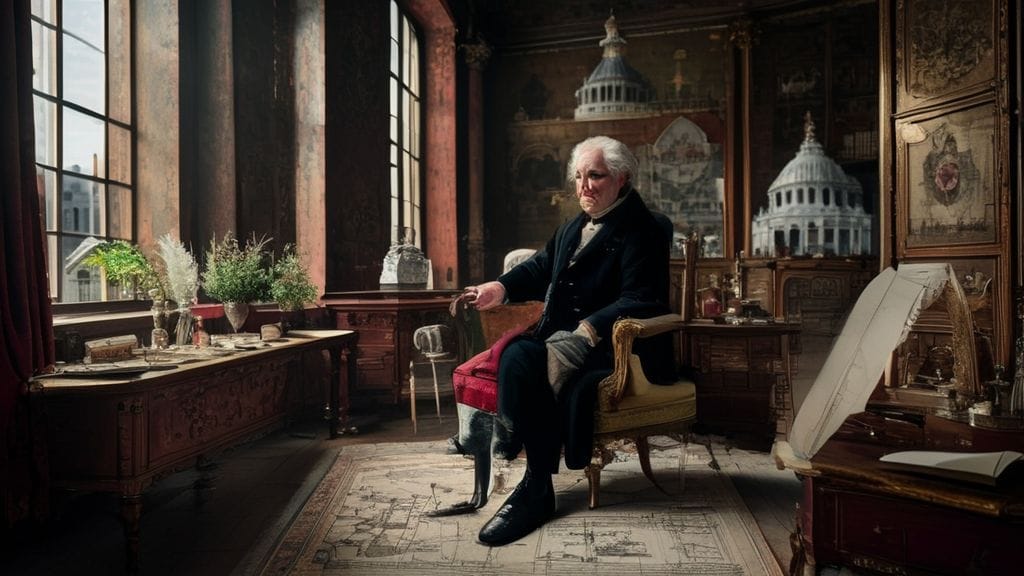
On the evening of 25 February 1723, London lay under a hard, lingering winter. Frost clung to the eaves of townhouses, and smoke from countless hearths draped the city in a low, grey haze. Carriages rattled along uneven cobbles, their lamps throwing brief arcs of light across the darkness. In one quiet house, removed from the thunder of commerce and the bustle of court, an elderly man—small of frame, stooped, his hair now nearly white—lay resting after what his attendants believed would be just another day of fatigue. Few in the streets could have guessed that this unassuming house sheltered the mind that had given their city its defining silhouette.
The death of Christopher Wren would come without public spectacle, without the drama of last words uttered to a crowd of witnesses. Instead, it unfolded in silence, in a private chamber warmed by a dwindling fire. According to later family recollection, Wren, now in his ninety-first year by modern reckoning (or his ninety-second, if we follow older calculations), had struggled with recurrent sickness through the winter. On that particular evening, his servants helped him to bed. He complained of exhaustion, of a heaviness in his limbs, and closed his eyes “merely to rest.” No vigil was organized; his household had learned to respect these spells of weakness. But as the hours crept on and the city outside settled into the deep quiet of the night, that rest slipped into something deeper, something final.
It is astonishing, isn’t it, that a man whose work towered above London’s skyline should die in a room so ordinary? No ringing of cathedral bells marked the exact moment of his passing; no heralds announced it in the streets. And yet, in another sense, the city itself was his monument: the rhythm of steeples rising above lanes and markets, the great dome of St Paul’s dominating the ridge above the river, the measured classical facades of public buildings that had become part of the mental map of every Londoner. When his breathing finally stilled in the small hours of 25 February (Old Style), the city beyond his window remained unaware that its quiet guardian had departed.
The death of Christopher Wren is often stated in bare terms—“He died on 25 February 1723, in London”—but stripped of context, the date becomes almost meaningless. To grasp the human weight of that winter night, we must first understand the long path he had travelled to reach it: from a sickly child playing under the vaulted ceilings of collegiate chapels to the aging “Surveyor-General” living, by then, in partial retirement. Only with that journey in view does the stillness of his final hours take on its full depth of meaning. His death, far from a sudden interruption, was the last line in a carefully drawn architectural plan: a life structured around order, proportion, and the pursuit of lasting forms in a world of impermanence.
From Country Parson’s Son to Architect of a Capital
Long before the death of Christopher Wren, even before his name became synonymous with London’s skyline, there was a boy in Wiltshire, born in 1632 into a world riven by religious tension and impending civil war. His father, Christopher Wren the elder, served as a clergyman, eventually Dean of Windsor; his mother, Mary Cox, died when he was still young. The boy grew up amid the stones and shadows of ecclesiastical architecture, absorbing unconsciously the language of arches, vaults, and sacred space even as he busied himself with curious mechanical toys and mathematical puzzles. He was frail, often ill; some later accounts speak of “constant infirmities,” suggesting perhaps asthma or another chronic weakness. That fragility pushed him inward, into thought and experiment, rather than outward into the rough-and-tumble of boyish games.
By his teens, Wren had already shown a flair for invention. Stories circulated of him building sundials, drawing up sketches of machines, and crafting ingenious devices that delighted family friends and visiting dignitaries. In 1649, the year of Charles I’s execution, Wren entered Wadham College, Oxford, at a time when the university had become an uneasy refuge for learning amid political upheaval. There he fell into the orbit of a group of natural philosophers who would later form the core of the Royal Society. Gifted in geometry, astronomy, and anatomy, Wren produced treatises on the motion of comets and the structure of muscles. Architecture, at this point, had not yet claimed him; he was a scientist first, an architect only in embryo.
But the seeds were there. The same eye that could trace the ellipse of a planetary orbit could also grasp the sweep of a dome’s curve. The same mind that analyzed the forces in a tendon could calculate the stresses in an arch. In the shadows of Oxford’s cloisters, Wren began drawing, experimenting with perspective, and absorbing the classical vocabulary that had filtered into England through translations of Vitruvius and the writings of Italian masters like Palladio. By the 1650s, as the Commonwealth negotiated its uneasy peace, Wren’s circle of acquaintances widened: theologians, mathematicians, and courtly exiles passed through his world, bringing with them news of European art and engineering.
His first documented steps toward architecture came not in the form of grand cathedrals but modest projects: designs for temporary structures, improvements to existing college buildings, proposals for church restorations. These early efforts, while significant, did not hint at the colossal role he would soon play. Yet in retrospect, they reveal the convergence of his scientific precision and artistic ambition. In each drawing one senses a question: how might proportion, light, and form bring order to human experience? That question would reach its fullest answer not in Oxford’s quadrangles, but in a city nearly obliterated by fire.
Fire, Ruin, and Opportunity: Wren in the Ashes of 1666
The London that Wren would rebuild died in a storm of flame days and nights long before the death of Christopher Wren himself. On 2 September 1666, a bakery in Pudding Lane gave birth to a conflagration that consumed nearly four-fifths of the medieval city over the next four days. Heat twisted lead roofing into rivers; flames leapt from house to house, driven by wind and fed by close-packed timber. By the time the fire burned itself out, over 13,000 houses and some 87 churches, including the old St Paul’s Cathedral, lay in ruins. Londoners walked through streets of smoldering debris, where the outlines of familiar lanes were buried under ash and rubble.
For Wren, then in his mid-thirties and already recognized as a talented scholar and designer, the Great Fire presented tragedy mixed with possibility. Just days before the disaster, he had submitted a plan to repair the aging St Paul’s, whose Gothic structure had suffered from centuries of patchwork maintenance. The fire rendered such repairs moot. Wren hurried to survey the devastation, sketchbook in hand, pacing through the blackened heart of the city. In the chaotic weeks that followed, he drafted bold schemes for a new London: wide boulevards and rational grids, piazzas, and axial vistas reminiscent of Rome and Paris.
These visionary plans—too ambitious for a city desperate to rebuild quickly on existing property lines—never materialized in full. Commerce, legal disputes, and the stubborn inertia of custom conspired against radical transformation. Yet from that moment on, Wren became indispensable. Appointed Surveyor of the King’s Works and later Surveyor-General, he was charged with overseeing the reconstruction of the City’s churches and key public buildings. Here his mathematical rigor and classical tastes found their true field of action. Over the next decades he would design or oversee the building of more than fifty churches, along with monumental projects such as the new St Paul’s Cathedral, the Royal Hospital at Chelsea, and parts of Greenwich Hospital.
Out of the charred skeleton of old London, a new city began to rise, its skyline pricked with elegant spires rather than squat medieval towers. Wren’s designs stitched together the scarred urban fabric, each church tailored to its awkward plot, each steeple a unique experiment in proportion, ornament, and silhouette. To walk through London in the final decades of the seventeenth century was to inhabit a work in progress—a city that was a living laboratory of his imagination. The man who would die quietly in 1723 had by then placed his hand on nearly every significant building of the restored capital. The fire had turned an Oxford savant into the shaper of a metropolis.
Raising the Dome: St Paul’s Cathedral and a City Reborn
If the death of Christopher Wren invites us to ponder his legacy, no single building speaks more loudly for that legacy than the great dome of St Paul’s Cathedral. After the Great Fire, the medieval St Paul’s stood as a blackened shell, its central tower cracked and unstable. There was debate at first: should the old structure be patched and partially reused, or should a new cathedral rise from its footprint? Wren argued forcefully for a complete rebuilding. This was not just an aesthetic preference; he envisioned a church that would symbolize the restored monarchy, the resilience of Anglicanism, and the rebirth of London itself.
Negotiations were long and often bitter. Committees fretted about cost, style, and theology. The original designs Wren submitted—one of them cruciform, another more centrally planned—underwent endless revisions. Parliament and the cathedral chapter demanded changes, while Wren maneuvered diplomatically, combining compliance with quiet ingenuity. In one famous episode, he presented what has come to be known as the “Warrant Design,” which satisfied official requirements, while privately developing an alternative scheme closer to his true vision. As construction advanced, he took advantage of the practical necessities of building to steer the project towards that vision.
Work began in the early 1670s, and the process would occupy Wren, on and off, for nearly four decades. The cathedral became a workplace for hundreds of masons, carpenters, sculptors, and laborers. Stone was hauled along the Thames; cranes swung above the rising walls. Year by year, the silhouette of the new St Paul’s emerged from the forest of scaffolding. Its design married classical forms—Corinthian columns, pediments, and a strong, rational geometry—with a dramatic vertical emphasis. At its crown, the great dome, triple-shelled and ingeniously engineered, would be unlike anything else in England.
Contemporaries watched the slowly growing structure with a mixture of awe and impatience. Fires, wars, and economic crises periodically threatened funding. Yet Wren persisted, climbing scaffolds well into his elder years, inspecting stonework with an eye that missed nothing. By 1710, he saw Queen Anne place the final stone of the lantern atop the dome. It was a moment of personal and national symbolism: an aging architect who had survived multiple reigns and political eras, standing beneath the completed silhouette that would define London’s skyline for centuries.
When the death of Christopher Wren finally came in 1723, it was this building that converted his passing into myth. Buried beneath the cathedral’s vast interior, his body rested in the very structure whose completion had crowned his life’s work. The Latin inscription later placed nearby—“Lector, si monumentum requiris, circumspice” (“Reader, if you seek his monument, look around you”)—would fuse his identity permanently with the city’s renewal after fire. Standing under the dome today, one can almost imagine the quiet of that winter night in 1723 folding back across time, connecting his final breath with the vast stillness of the cathedral interior.
Scientist, Courtier, Architect: The Many Lives of Christopher Wren
By the time the death of Christopher Wren entered the record books, he was already far more than “just” an architect. To reduce him to that label is to flatten a remarkably multi-faceted life. In his younger years, he had been one of the most promising natural philosophers in England, corresponding with leading thinkers on astronomy, physiology, and mechanics. He was appointed the first Savilian Professor of Astronomy at Oxford in 1661, delivering lectures that probed the motions of celestial bodies and the nature of the cosmos. Legend has it that Isaac Newton would later remark, with a mixture of admiration and calculation, that if Wren had not devoted himself to architecture, he might have anticipated some of Newton’s own discoveries.
Wren’s scientific work extended well beyond the stars. He experimented with air pumps, studied the impact of explosions, and applied geometrical principles to anatomy. Early minutes of the Royal Society—the learned body formally chartered in 1662, where he served as one of the early Fellows and later as president—record his demonstrations of models, instruments, and anatomical diagrams. In one meeting, he described injecting colored wax into the blood vessels of animals to trace their circulation; in another, he presented new designs for building structures more resistant to collapse. The boundary between science and architecture was porous for him. Every wall, arch, and dome became a problem in applied mathematics, every church an experiment in how human beings respond emotionally to proportion, light, and scale.
At court, Wren navigated the shifting politics of Restoration and post-Restoration England. He served Charles II, James II, William III, and Queen Anne, adapting to different temperaments and agendas. Under Charles II, eager to show that the monarchy could lead the rebuilding of the city, Wren’s talents were showered with commissions. Under William and Mary, with their Dutch tastes and Protestant sensibilities, he had to negotiate competing aesthetic and religious demands. He was knighted in 1673, a recognition of his status not merely as a skilled draughtsman but as a servant of the Crown.
Yet the courtly life was never entirely comfortable for him. He was no flamboyant intriguer. Reserved by temperament, more at home with compasses and plans than with gossip, Wren often let his buildings speak for him. Even so, the networks he maintained—patrons, colleagues, and family allies—were crucial to the survival of his projects. Without such ties, the grand rebuilding of London might easily have been derailed by factional jealousy or fiscal panic. That he kept his position across multiple reigns testifies to a quiet political skill, a knack for staying useful and avoiding open conflict.
No account of his many lives would be complete without mention of his personal tragedies. Wren married twice, first to Faith Coghill, who died young, and later to Jane Fitzwilliam, who also predeceased him. He buried children as well, including a beloved daughter. These sorrows shadowed his middle years, even as his public achievements multiplied. It would be tempting—but perhaps too easy—to link the serenity and order of his architectural designs to a desire for stability amid personal loss. Yet, reading between the lines of the records, one senses that the measured grandeur of his churches and public buildings provided a framework within which grief could be contained, given shape, and perhaps transcended.
Old Age in a Changing City: Wren in the Early Eighteenth Century
By the turn of the eighteenth century, the man who had once prowled scaffolds with almost boyish energy had become an elder statesman of architecture. His hair thinned, his gait slowed, and the city he had helped to rebuild continued to change around him in ways he could not fully control. After 1700, new artistic currents—most notably the arrival of Continental baroque in more exuberant forms and, soon enough, the stirrings of what would become Georgian classicism—began to challenge the style that bore his name. Younger architects, including some of his own former assistants and pupils, proposed bolder ornament or stricter classicism, as tastes oscillated between exuberance and austerity.
Wren, however, remained formally in his office as Surveyor of the King’s Works until 1718. He still attended to matters of state building, though increasingly such duties fell to subordinates. His son, Christopher Wren the younger, and his trusted assistant Nicholas Hawksmoor, absorbed more of the day-to-day burden. At times, Wren’s decisions met resistance from committees that now felt more confident in expressing doubts. Criticisms accumulated quietly: whispers that he was too slow, too conservative, perhaps past his prime. In a letter from 1712, the dramatist and essayist Joseph Addison could praise Wren’s achievements while also hinting that London must look forward, not backward, in architectural ambition.
The political climate shifted as well. The death of Queen Anne in 1714 and the accession of George I initiated a new Hanoverian era, with different favorites at court and different priorities in public works. In 1718, Wren was effectively dismissed from his position as Surveyor. No formal disgrace attended this removal, but it stung. He was awarded a pension and allowed a dignified retirement, yet the message was clear: the state no longer needed his daily supervision. The city he had spent his life designing was now in the hands of others.
Still, his last years were not empty. He visited St Paul’s frequently, traveling by coach to sit within the building he had conceived in his youth and pursued into old age. According to one oft-repeated anecdote, he would be assisted out of his carriage and helped up the steps, where he would stand, cane in hand, gazing up at the dome. Seeing cracks repaired, stones cleaned, and worshippers flowing in and out, he might have felt both satisfaction and distance. The cathedral, like the city itself, had taken on a life beyond his control. He was no longer its maker, but one of its many inhabitants, albeit a uniquely invested one.
In these twilight years, the eventual death of Christopher Wren must have become an increasingly familiar thought to him. He had outlived many of his contemporaries, seen fashions change, and watched generations of Londoners grow up under the spires he had set upon the skyline. Each passing winter could have been his last. And yet, by all accounts, he remained mentally sharp, capable of conversation, review, and reflection. It was as if his life, like one of his buildings, had entered a phase of maintenance rather than construction: inspections, small adjustments, and the slow settling of a structure into its final form.
February 1723: Illness, Weakness, and the Approach of the End
When winter came in 1722–1723, it arrived with the usual inconveniences that Londoners knew too well: icy streets, smoky air from fireplaces burning low-quality coal, and a rising tide of seasonal illnesses. For an elderly man in his nineties, even a minor respiratory infection could prove fatal. The private records that survive—letters, later biographies, and family recollections—do not provide a detailed medical chart of Christopher Wren’s final weeks, but they do hint at a steady encroachment of frailty. He withdrew more and more from public life, spending his days between his modest London residence and occasional visits to his daughter’s home.
His servants and family noticed that he tired easily. Climbing stairs demanded effort; reading and writing required more frequent pauses. He would rest in an armchair by the fire, perhaps going over old drawings or listening to the sounds of the city outside. Carriages passing, church bells tolling, vendors calling in the streets—these noises were the environmental music of the metropolis he had shaped. For Wren, they must have formed a strange chorus of memory. Each sound was tied, however faintly, to some phase of his career: the hammering of builders on a distant site, a bell from a church he had reconstructed, the murmur of a crowd gathered before a public building.
By mid-February, his health had clearly worsened. A chill settled in his bones; appetite waned. He was no stranger to illness and had endured many episodes of weakness in earlier decades, but age now stripped him of the reserves that might once have carried him through. Those near him likely sensed that they were approaching a boundary. One can imagine whispered conferences in adjoining rooms—servants discussing whether to summon a physician, relatives weighing the necessity of preparing for the worst. In an age before antibiotics and modern diagnostics, medicine had limited tools, especially for the very old. Rest, warmth, and prayer often seemed the best that could be offered.
Reports suggest that in the days just before 25 February, he spent more time in bed. At moments he was lucid and conversational; at others he drifted into long, heavy sleeps. The winter light that crept across his chamber would have been thin and cold. Perhaps he thought of the many windows he had designed to admit light into dark interiors—clerestories and lanterns, oculi and high, arched openings. The geometry of illumination had always fascinated him: how to guide the sun’s rays into spaces of worship or assembly so that they lifted the spirits of those within. Now the problem was personal and poignant: how much more light would he see, and for how long?
The Night of 25 February 1723: A Quiet Death in London
And so we return to that specific night: 25 February 1723, in London. Accounts agree that Christopher Wren did not die in agony, nor in chaos, but in a kind of exhausted peace. After an ordinary day of weakness and rest, he was helped to bed by his servant—some say by a family member. There were no dramatic last speeches, no public statements. He complained that he felt “very ill,” or, in another version, that he was “extreme tired,” and lay down to sleep. Those around him expected, or at least hoped, that he would wake with improved strength, as he had on previous occasions.
Instead, his breathing slowed, deepened, and gradually grew shallower. London’s noises receded into the night. Outside, the February cold held the city in its grip: shop shutters closed, taverns thinning out as patrons made their way home, watchmen calling the hours. Within the house, the fire crackled softly, shadows flickering on the walls. The old man who had survived the Great Plague, the Great Fire, multiple political revolutions, and the long labor of rebuilding a metropolis now faced the one inevitability that no architectural stratagem could delay.
Some later narratives, written with a taste for pious closure, imagine him whispering a prayer or commending his soul to God, but such scenes are more literary than documentary. The plain fact is that the death of Christopher Wren, for all its historical weight, was most likely marked by simple physiological failure: a heart too tired to keep beating, lungs too weak to keep drawing breath. He slipped away in the small hours, with perhaps only one or two attendants nearby, unaware at first that this sleep was different from all the others.
When they realized he had gone—perhaps by the stillness of his chest, the cooling of his hands, the absence of any response—the scene must have been bewilderingly quiet. No one rushed in from the street; no bells rang. A servant, obeying the conventions of the time, would have drawn the curtains, covered mirrors if any stood in the chamber, and notified the family. Word would spread through the house: “Sir Christopher is dead.” In that private moment, grief belonged first to the few, not to the many.
Yet even at that instant, the conditions for public remembrance were already in place. This was no obscure craftsman passing unnoticed into obscurity. Within hours, perhaps by the next day, the news would slip into the circles of court, the Royal Society, and the clergy. The city that slept while he died would soon be awakened to his absence.
Shock, Sorrow, and Ceremony: London Learns of Wren’s Passing
The spread of news in early eighteenth-century London was a curious mixture of speed and slowness. There were no telegraphs, of course, no newspapers filled with instant obituaries; yet in the compact, gossipy world of the capital’s elite, word could travel quickly. A messenger’s ride, a cluster of conversations at coffeehouses near the Royal Exchange, a murmur in the corridors of Whitehall—within days, and perhaps within hours, those who mattered in Wren’s professional universe would have heard that he was gone.
The initial reactions were likely varied. Among courtiers who remembered the long decades of palace projects, there may have been a sober acknowledgment: “He lived long, and served well.” In the Royal Society, whose minute-books had once recorded his brilliant experiments, Fellows might have exchanged recollections of the younger Wren: the precise mathematical diagrams, the ingenious anatomical demonstrations. For the clergy of London, many of whom served in churches he had rebuilt, news of the death of Christopher Wren would have felt more tangible. They preached within his walls every week; they rang his bells; they climbed his pulpits. Their sorrow, while not overwhelming the city, would have been grounded in daily familiarity.
Newspapers and pamphlets did note his passing, though often in brief, formulaic tones. Obituary writing as we know it today was still in its infancy. Yet Wren’s name was by then recognized beyond specialist circles. Writers and visitors had long singled out St Paul’s Cathedral as a marvel of the restored nation. Foreign travelers knew of the “magnificent English architect” responsible for London’s post-fire churches. The simple announcement of his death, even in a few lines, thus evoked a web of associations for readers: the Great Fire; the dome rising above the city; the sense of England as both ancient and modern.
Alongside public response came the more intimate rituals of mourning. His family arranged for the care of his body, following the expectations of his rank and era. There would have been washing and preparation, perhaps a viewing in a closed circle of relatives and close friends. Wren’s long service to Crown and Church ensured that he would not be buried in anonymity. Discussions must have begun quickly about the location and form of his funeral. It did not take long for a consensus to emerge: the architect who had given London its modern cathedral should rest within that very building.
Yet behind the ceremonial decisions lay quieter human emotions. His son had lost a father; his surviving relatives had lost the living thread connecting them to a past now receding rapidly: the Civil War, the Restoration, the Great Fire. To them, as to us, his life spanned what seemed like multiple historical ages. The stillness of his absence in a household accustomed to his presence would have been the most immediate and painful sign of his death. Public ritual would come soon enough, but grief begins in small rooms.
Entombed Beneath the Dome: Funeral Rites and Memorial Inscriptions
Funeral customs in early eighteenth-century England blended religious solemnity with displays of rank and reputation. For a figure of Wren’s stature, the choice of resting place mattered as much as the words spoken over his coffin. It was decided that he would be interred in the crypt of St Paul’s Cathedral, the building that had defined his career and that, thanks to his long life, he had actually lived to see completed. This was not an automatic privilege; it signaled an acknowledgment, by both Church and Crown, that his life’s work merited a place among the great.
The day of the funeral would have drawn a select congregation. Clergy, fellow architects, members of the Royal Society, and court representatives would have walked beneath the high vaults and the sweeping curve of the dome, following the coffin down into the lower depths of the cathedral. There, in the cool half-light of the crypt, stone and shadow embraced the remains of the man who had once stood on scaffolds far above. Candles flickered; Latin prayers were read; the Anglican liturgy for the dead framed his passing in the language of sin, redemption, and hope of resurrection.
We do not possess a complete, verbatim record of every word spoken that day, but we know its outcome: a modest grave, not ostentatious, accompanied eventually by a legendary inscription. It reads, in Latin: “Subtus conditur hujus ecclesiae et urbis conditor Christopherus Wren; qui vixit annos ultra nonaginta, non sibi sed bono publico. Lector, si monumentum requiris, circumspice.” In English: “Here in its foundations lies the architect of this church and city, Christopher Wren; who lived to a ripe age, not for himself but for the public good. Reader, if you seek his monument, look around you.”
This text, composed by his son, distilled the meaning of his life and death into a single powerful injunction. The monument was not the stone slab underfoot, but the entire building above and, by extension, the city beyond its walls. In this sense, the death of Christopher Wren became inseparable from a particular way of thinking about public works and legacy. His life’s value was to be measured not by wealth hoarded or titles amassed, but by the enduring structures he left for others to use: churches, hospitals, halls, and institutions.
As soil and stone closed over the coffin, the congregation slowly dispersed, climbing back up into the light of the nave. The dome soared above them, appearing perhaps even more immense now that the man who had calculated its curvature rested far below. Stepping out into the London air, they reentered a city that was, in a sense, his biography in stone. The funeral did not merely close a chapter; it sealed the bond between an individual life and an urban landscape.
“If You Seek His Monument, Look Around You”: Legend and Memory
In the years immediately following the death of Christopher Wren, that Latin phrase at his grave began its journey from private epitaph to public legend. Visitors made their way into the crypt, peered at the inscription, and then craned their necks to gaze upward, obeying the instruction to “look around.” Guidebooks quoted the line; travelers repeated it in letters home. Over time, it became one of the most famous epitaphs in the English-speaking world, encapsulating the idea that an architect’s true monument lies in the buildings inhabited by living people.
This was more than a clever turn of phrase. It suggested a particular relationship between memory and space. Whereas military heroes might be remembered through statues and battle honors, and writers through books and portraits, Wren was to be remembered through the shaping of everyday environments. Each time a Londoner walked past a Wren church steeple, each time a congregation gathered for worship under his ceilings, they were unwitting participants in his ongoing memorial. The city itself became a living archive of his presence.
Yet legend also simplifies. To speak only of Wren as the benevolent architect of the city is to gloss over the complexities of his career: the controversies over design choices, the compromises forced by committees, the occasional missteps. Still, the posthumous narrative coalesced quickly around certain themes: his modest personal life, his service to public good, his scientific brilliance turned to architectural genius, his longevity. Eighteenth-century writers, such as the antiquarian John Ward, emphasized these qualities, presenting Wren as an exemplar of rational, virtuous, Protestant England.
His image, like his buildings, became part of national identity. Engravings and painted portraits circulated, often depicting him holding a plan of St Paul’s or standing before the cathedral. These images froze him in time, forever the dignified, wigged gentleman-architect, even though, in reality, he had also been a frail child, a grieving widower, and a weary old man. The death of Christopher Wren, therefore, initiated not only mourning but myth-making. The man receded; the symbol grew.
Still, not everyone succumbed entirely to hagiography. Some critics, particularly in the later eighteenth century, found Wren’s style too heavy, too eclectic, insufficiently pure in its classicism. Their voices, however, did little to dent his iconic status as the rebuilder of London. Legend had taken root, anchored in stone and steel, buttressed by rituals at St Paul’s and casual references in popular discourse. To say “Wren” in England was, increasingly, to invoke not only a person, but a story about how a nation recovered from catastrophe.
Architecture After Wren: Students, Rivals, and Heirs
No architect truly controls what happens to their style after their death. The death of Christopher Wren in 1723 left a younger generation of designers, builders, and patrons to wrestle with the standards he had set. Some sought to continue along his path; others intentionally defined themselves against it. Among his closest professional heirs were Nicholas Hawksmoor and John Vanbrugh, both of whom had worked under him and absorbed aspects of his approach, while also pushing toward more dramatic baroque effects in projects such as Blenheim Palace and the churches of Christ Church, Spitalfields, and St Mary Woolnoth.
In the years after Wren’s passing, the English baroque entered an intriguing phase of transition. On one hand, there was a desire to maintain the noble gravitas that his churches exemplified: balanced façades, well-proportioned towers, and interiors organized by clear geometries. On the other, new patrons increasingly favored a lighter, more playful classicism, drawing on Palladian models. Figures like Colen Campbell and Lord Burlington promoted a return to what they viewed as the purer principles of ancient Rome filtered through Andrea Palladio’s treatises. In their writings and buildings, Wren’s work was sometimes subtly marginalized, described as an important but transitional moment on the way to a more refined taste.
Yet even those who critiqued him could not entirely escape his influence. The very idea that London might be understood as a coherent architectural project, that public buildings should express civic order and national identity, owed much to Wren’s example. His organizational methods—careful surveying, standardized construction procedures, attention to site-specific conditions—became part of the professional toolkit for architects and engineers. Moreover, the success of St Paul’s as an emblem of the city set a precedent for monumental urban focal points that later planners would emulate.
As the eighteenth century advanced, Wren’s buildings aged in place. Some were altered, others demolished as the city’s needs changed. But enough remained, especially in the City of London, to keep him visually present in daily life. Young architects walked past his churches on their way to sites and offices, observing the subtleties of his steeples and the way he handled awkward corners and tight lots. Even when they rejected aspects of his style, they did so in dialogue with it.
In this sense, the death of Christopher Wren did not mark a clean break. His architectural DNA persisted, woven into the training of students, the arguments of theorists, and the expectations of patrons. His heirs, both literal and professional, inhabited a world he had done much to define, even as they reshaped it according to new fashions and ideas.
London’s Social Fabric and the Spaces Wren Left Behind
To understand the human consequences of Wren’s death, we must look not only at the circle of architects and intellectuals, but at the broader social fabric of London that his buildings helped to organize. Every church he designed or rebuilt after the Great Fire was not simply an object on the skyline; it was a social node, a place where births were recorded, marriages celebrated, and deaths mourned. Parish churches served as centers of poor relief, education, and communal decision-making. When the man who had structured so many of these spaces died, he left behind a network of institutions whose daily functions continued regardless of his absence, yet were shaped by his choices of plan, size, and location.
In markets and alleys, the visual rhythm of his church towers provided orientation in a dense and often confusing urban maze. A merchant might say, “Meet me near St Mary-le-Bow,” or “I live by St Bride’s,” and these references implicitly invoked Wren’s presence. His spires rose above the clutter of roofs, chimneys, and warehouse attics, offering wayfinding cues but also a subtle sense of order: a reminder that amid the chaos of trade and traffic, there were structures dedicated to something beyond everyday commerce.
Hospitals and charitable institutions he designed, such as the Royal Hospital at Chelsea, also had profound social impact. These buildings created spaces for the care of veterans and the poor, embedding ideas of duty and philanthropy in stone. Their orderly layouts—courtyards, colonnades, refectories—were not merely aesthetic; they regulated daily life, encouraging routines of work, rest, and worship. When Wren died, the administrators and inmates of these institutions did not immediately feel a practical loss; the buildings remained. But over time, the absence of their original designer meant that modifications, repairs, and expansions had to be handled by others, sometimes with less sensitivity to the original logic.
In a city that, by the 1720s, may have contained some 600,000 inhabitants, most people did not know or care about the day-to-day activities of the aged architect. Yet they lived in the world he helped frame. His death, recorded in parish registers and announced in periodicals, was one of many deaths that winter. But because of who he was, it gained symbolic weight: a sign that the generation of the Restoration and the Great Fire was finally departing the stage. For younger Londoners, who had never known the medieval city and had grown up entirely within the rebuilt metropolis, his passing might have been their first conscious encounter with the mortality of the people behind their familiar surroundings.
Thus, the spaces Wren left behind functioned as bridges across time. The churches and hospitals, the cathedral and public buildings, linked the living with the dead, the present with the moment of post-fire reconstruction. Every peal of bells, every Sunday sermon, every daily gathering in a hospital courtyard continued the life of structures whose creator now lay silent beneath the stones of St Paul’s.
From Criticism to Canonization: Changing Views of Wren’s Legacy
If we trace the centuries after the death of Christopher Wren, we find a fascinating oscillation in how he was viewed. In the immediate eighteenth century, his reputation remained solid but not untouchable. Some critics argued that his preference for domes and classical ornament strayed too far from what they considered proper English restraint. Others thought his churches, particularly some of the City spires, too idiosyncratic. Yet his name always carried weight, invoked as a benchmark even when challenged.
The nineteenth century brought a new set of challenges. The Gothic Revival, championed by figures such as Augustus Welby Pugin and later John Ruskin, celebrated medieval pointed-arch architecture as morally superior to classical forms. In this climate, Wren’s great dome and his baroque-inflected churches sometimes met with suspicion. Gothic revivalists lamented the loss of the old St Paul’s and other medieval structures, seeing in Wren’s work an imposition of foreign, Continental aesthetics. Ruskin, in “The Stones of Venice,” would famously argue for the moral and spiritual richness of Gothic over what he perceived as the cold rationality of classical design.
And yet even as these critiques gathered force, the public attachment to St Paul’s Cathedral deepened. As the nineteenth century unfolded—with its rapid industrialization, imperial expansion, and social upheaval—St Paul’s became a stage for national rites: thanksgiving services, commemorations, and memorials for military victories and disasters alike. The building’s dome became a visual shorthand for London in engravings, paintings, and, later, photographs. Whenever people gathered beneath that dome for moments of collective emotion, they were, knowingly or not, participating in the ongoing canonization of Wren.
By the twentieth century, especially after the Second World War, his legacy gained a near-sacred aura. During the Blitz, images of St Paul’s dome standing miraculously intact amid a sea of smoke and destruction became iconic, representing London’s resilience. Winston Churchill and ordinary citizens alike saw the survival of Wren’s cathedral as a symbolic victory. In that context, the architect’s long-ago death seemed almost irrelevant; his presence felt startlingly immediate in the photographs and stories that circulated worldwide.
Modern historians have worked to recover a more nuanced view, acknowledging both his genius and his compromises. They study his notebooks, analyze the political intricacies of his commissions, and trace the contributions of assistants whose names were long overshadowed by his. Yet, on balance, the trajectory is clear: from admired practitioner, through periods of contestation, to an almost unassailable place in the architectural canon. The death of Christopher Wren, once a quiet event in a small London room, has come to mark the conclusion of life whose reputation would only grow larger with each passing century.
Silhouettes in the Smoke: Anecdotes and Voices from 1723
History rarely preserves the whispers of ordinary people, but a few anecdotes bring the atmosphere surrounding Wren’s death into sharper relief. One oft-retold story describes an elderly Wren visiting St Paul’s in his final years, as mentioned earlier, and being helped from his coach by a verger. Standing back to see the whole façade, he is said to have remarked softly, “I give my Lord thanks that I have been spared to finish this great work.” Whether the quote is verbatim or embellished by later tellers, it captures a plausible inner feeling: gratitude mixed with weariness.
Another anecdote, preserved in later biographical sketches, concerns a mason who had worked on several of Wren’s churches. Upon hearing of his death, this craftsman reportedly said, “Then London has lost her master, and we our guide.” In that simple line lies an entire world of workshop hierarchy, respect, and dependence. Wren’s directions had shaped not only stones but livelihoods. His death changed the distribution of authority on building sites across the city.
In a letter from 1723, the antiquary William Stukeley noted Wren’s passing with a tone of restrained admiration: “Sir Christopher Wren is lately dead, that great architect and virtuoso, who has left behind him a work of rebuilding this city, which, I believe, will make his name remembered as long as the world shall last.” Stukeley, whose own interests ranged from Roman ruins to druidic monuments, instinctively placed Wren in a long continuum of builders and makers, seeing in his churches the same kind of enduring imprint that ancient temples left upon landscapes.
One can imagine, too, the conversations in London’s coffeehouses—those bustling hubs of news and opinion. In the smoky air of Jonathan’s or Garraway’s, merchants and writers might have debated how future generations would judge the man now lying in St Paul’s crypt. Some perhaps grumbled about cost overruns and taxes; others praised the dignity his buildings gave to the city. The historian Edward Chamberlayne, whose work chronicled London’s institutions, might have raised a cup in Wren’s memory, noting the alignment between his own descriptive labors and Wren’s constructive ones.
These scattered voices, half-hidden in the archival haze, surround the death of Christopher Wren with a chorus of perceptions: reverent, practical, speculative. They remind us that great lives are never experienced as abstractions in their own time. They are known instead through fleeting encounters, half-remembered remarks, and the everyday presence or absence of a person in specific spaces. When that presence vanishes, people reach for stories—anecdotes that make the loss intelligible. Wren’s death was no exception; it generated narratives that would be retold, reshaped, and folded into the larger myth of London’s rebirth.
The Death of Christopher Wren in the Long Story of London
Set against the vast timeline of London’s history, the death of Christopher Wren might seem like a single, small point: 1723, late winter, a private house, a quiet end. Yet when integrated into the city’s broader story, that point becomes a hinge between epochs. Wren’s life began under the early Stuart monarchy, witnessed the Civil War, the execution of Charles I, the Commonwealth, the Restoration, the Great Fire, the Glorious Revolution, and the advent of the Hanoverian dynasty. His death marked the passing of a living memory of pre-fire London and the crucible in which the modern city was forged.
In the centuries before his birth, London grew organically, constrained by medieval patterns and local habit. After his maturity, the city’s growth increasingly bore the imprint of planned interventions: realigned streets, rational façades, and monumental public buildings meant to express imperial and national ambitions. Wren was not the sole agent of this transformation, but he was its most visible and enduring symbol. When he died, the city did not suddenly change course, but the generation that followed had to grapple with a London already deeply structured by his decisions.
The metaphor of the city as a palimpsest—a manuscript written and overwritten across time—fits particularly well here. Before the Great Fire, layers of Roman, Anglo-Saxon, medieval, and Tudor London lay inscribed in its streets and buildings. The fire blurred and erased many of those layers. Wren’s post-fire work inscribed a new text across the old, using the vocabulary of classical architecture and baroque form. His death, in turn, allowed subsequent writers of the city’s ongoing script—architects, planners, speculators—to treat his layer as a given, something to be preserved, modified, or, in some cases, scraped away.
Thus, the death of Christopher Wren is more than a biographical endpoint; it is an urban turning point. After 1723, debates about London’s future increasingly took his buildings as starting points, whether revered masterpieces or problematic precedents. The railway age, the Victorian boom, the motorized twentieth century, and the postwar rebuilding all had to decide what to do with Wren’s churches and his cathedral. Some survived intact; others were bombed, rebuilt, or demolished. Through it all, his ghost, in a sense, remained present, haunting city councils, preservation societies, and the imaginations of millions who saw his dome rise above streets he never lived to see.
To stand in London today, with the skyline punctuated by glass towers and cranes, is to occupy a world far beyond anything Wren could have imagined on that February night in 1723. And yet, walk a few steps off the main arteries of the City, and you find one of his small churches tucked into a corner, its stone softened by centuries, its tower still elegantly composed against the sky. Enter St Paul’s, and the continuity is overwhelming: the same vast interior, the same encompassing dome, the same inscription over his grave. Time has moved on, but the line connecting his death to the living city remains unbroken.
Conclusion
The life and death of Christopher Wren form a narrative that is inseparable from the story of London itself. Born into a kingdom riven by conflict and spiritual anxiety, he rose through intellect, skill, and circumstance to become the orchestrator of its capital’s most dramatic physical transformation. The Great Fire provided the tragic canvas; Wren, with his unique fusion of scientific reasoning and artistic imagination, supplied the designs that would redefine the urban landscape. Over decades, he watched his churches and institutions materialize out of plans and scaffolds, culminating in the completion of St Paul’s Cathedral, where he would eventually be laid to rest.
His death in 1723 was quiet, almost anti-climactic, especially when set against the noise and spectacle of the world he had helped to rebuild. No crowds thronged the streets that night; no instant flood of printed tributes overwhelmed the city. Instead, an old man grew tired, lay down, and did not wake. Yet within that simplicity lies a profound historical resonance. The death of Christopher Wren closed the career of a figure whose buildings would outlive him by centuries, offering subsequent generations spaces in which to pray, to heal, to learn, and to remember.
In the aftermath, his son’s epitaph—“If you seek his monument, look around you”—reframed the meaning of architectural legacy. It invited each visitor to St Paul’s, and by extension each inhabitant of London, to see the city as a living memorial, not just to one man, but to the capacity of human beings to shape their environments in response to disaster and hope. As architectural tastes shifted and historical judgments evolved, his reputation waxed and waned, but the essential truth remained: much of what we recognize as the “face” of early modern London bears his imprint.
Standing today beneath the dome that shelters his grave, we can feel the convergence of past and present, of fragile human lives and enduring stone. The date—25 February 1723—becomes more than an entry in a chronicle; it becomes the moment when one man’s breath stopped, but his vision continued to structure the air and light of a great city. Wren’s death, in the end, reminds us that cities are built by mortal hands yet reach toward a kind of immortality, carrying forward the intentions, compromises, and dreams of those who shaped them long after the shapers themselves have vanished into the quiet of history.
FAQs
- When did Christopher Wren die, and how old was he?
Christopher Wren died in London on 25 February 1723 (Old Style calendar). He was over ninety years old, having been born in 1632, which made him one of the longest-lived major figures of his era. - How did Christopher Wren die?
Sources describe his death as a peaceful one brought on by old age and chronic infirmity. After a period of worsening weakness during the winter, he reportedly went to bed complaining of fatigue and died quietly in his sleep. - Where is Christopher Wren buried?
Christopher Wren is buried in the crypt of St Paul’s Cathedral in London, the great building he designed after the Great Fire of 1666. A modest grave and a Latin epitaph near his resting place direct visitors to look at the cathedral itself as his true monument. - What is the meaning of Wren’s famous epitaph?
His Latin epitaph concludes with the line, “Lector, si monumentum requiris, circumspice,” meaning “Reader, if you seek his monument, look around you.” It suggests that Wren’s real memorial lies not in a statue or elaborate tomb, but in the cathedral and cityscape he helped to shape. - How did Wren’s death affect architecture in London?
Wren’s death marked the end of the first great phase of post-fire reconstruction, but his influence continued through his students and successors, such as Nicholas Hawksmoor. While newer styles like Palladian classicism gained prominence, architects continued to engage with Wren’s buildings, either by emulating aspects of them or defining their own work in contrast. - Was Christopher Wren famous in his own lifetime?
Yes. By the time of his death, Wren was widely known as the architect of St Paul’s Cathedral and the leading figure in London’s rebuilding after the Great Fire. He was also recognized as a distinguished scientist and a Fellow (and later president) of the Royal Society. - Did Christopher Wren live to see St Paul’s Cathedral completed?
He did. The main structure and dome of St Paul’s were essentially finished by 1710, when Wren was in his late seventies. He continued to visit and oversee aspects of the cathedral for years afterward, taking great satisfaction in seeing his most ambitious project realized. - Are all of Wren’s churches still standing today?
No. Many of Wren’s churches have been altered, damaged, or demolished over the centuries due to urban redevelopment, war damage, and changing parish needs. However, a significant number still survive in and around the City of London, and they remain central to his architectural legacy. - What else, besides architecture, was Wren known for?
Before and alongside his architectural career, Wren was a prominent scientist and mathematician. He made important contributions to astronomy, physics, and anatomy, and he was one of the key early figures of the Royal Society, where he conducted and presented numerous experiments. - Why is the death of Christopher Wren historically important?
His death symbolizes the passing of a generation that rebuilt London after one of its greatest disasters. It marks the end of a life that connected the pre-fire medieval city with the emerging modern metropolis, and it invites reflection on how individual creativity can leave a permanent mark on the shared spaces of everyday life.
External Resource
Internal Link
Other Resources
- Encyclopaedia Britannica – general search for the exact subject
- Google Scholar – academic search for the exact subject
- Internet Archive – digital library search for the exact subject