Table of Contents
- A Winter in Berlin: Gathering Around an Imperial Table
- Europe Before Berlin: The Road to a Scramble
- Summoning the Powers: Bismarck’s Invitations and Motives
- The Men in the Room: Delegates, Ambitions, and Hidden Maps
- Drafting Empire: How the Berlin Conference General Act Took Shape
- Paper Empire: The Clauses That Redrew a Continent
- Free Trade, Free Navigation, and Unfree People
- Lines on Maps, Lives on the Ground: Africa Without Africans
- Congo as Testing Ground: Leopold II and the General Act
- From Berlin to the Bush: Resistance, Violence, and Early Rebellions
- Missionaries, Merchants, and Soldiers: Agents of the New Order
- Reordering Societies: Borders, Ethnicities, and Invented “Tribes”
- Echoes in European Capitals: Public Opinion and Imperial Justifications
- Law Without Justice: The General Act in International Legal History
- World Wars and Waning Empires: The Long Unraveling of Berlin’s Design
- Decolonization and the Ghost of 1885
- Memory, Monuments, and the Struggle Over Historical Responsibility
- Conclusion
- FAQs
- External Resource
- Internal Link
Article Summary: On 26 February 1885, in the heart of the German Empire, diplomats gathered to sign what became known as the berlin conference general act, a document that sought to regulate European rivalry in Africa while ignoring the people who lived there. This article follows the drama of that winter in Berlin, from the overcrowded chancelleries and smoke-filled salons to the silent absence of any African voice at the negotiating table. It traces the political and economic tensions that led to the conference, the shaping of the berlin conference general act itself, and the sweeping provisions that legalized conquest under the language of “civilization” and “free trade.” Moving from the halls of power to the African interior, it shows how those pages of legal text became acts of violence, dispossession, and resistance. The narrative then examines how the general act influenced international law, empire-building, and later conflicts, including the world wars and the struggles for decolonization. Finally, it reflects on how the berlin conference general act still haunts contemporary borders, politics, and memories, and how historians, activists, and communities continue to debate responsibility and repair.
A Winter in Berlin: Gathering Around an Imperial Table
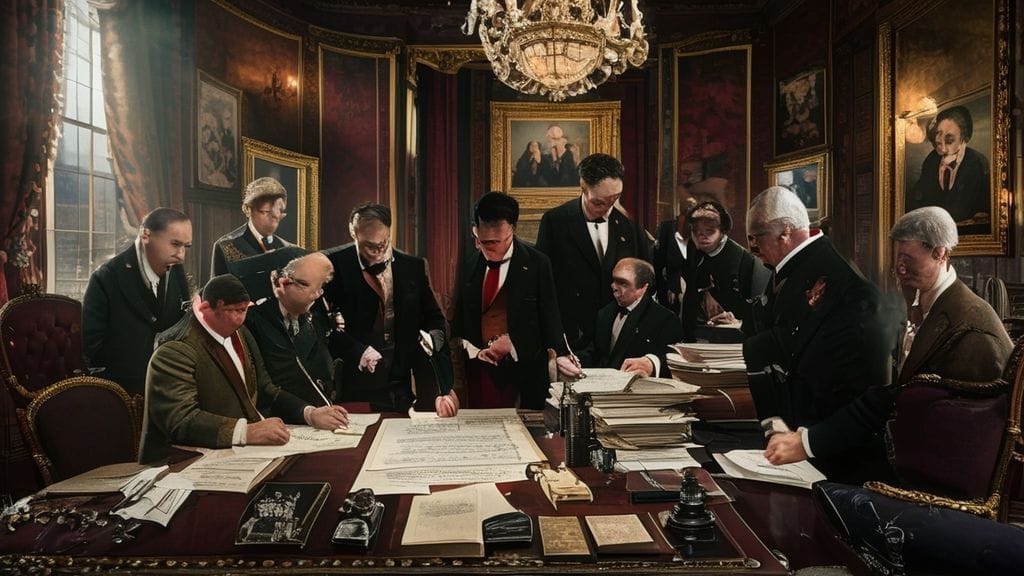
In the winter of 1884–1885, Berlin was a city draped in coal-smoke and ambition. Snow clung to the eaves of the Reich Chancellery on Wilhelmstrasse, where a cluster of carriages and sleighs—some bearing French tricolors, others Union Jacks or the Stars and Stripes—waited in the frosted street. Inside, in corridors warmed by coal stoves and lit by gas lamps, servants moved briskly, polishing silver trays, carrying telegrams, and hanging the heavy coats of men who believed they were redesigning the future of the world. On certain mornings, one might have seen the towering figure of Otto von Bismarck, the Iron Chancellor, walking slowly into the conference chamber, his expression a mixture of boredom and razor-honed calculation. It was here, in this room of dark wood panels and green baize-covered tables, that the Berlin Conference would culminate in the signing of the berlin conference general act on 26 February 1885.
The atmosphere was deceptively polite. There was no roaring crowd outside, no banners, no open threats between the powers. Instead, there were maps—long, unrolled, half-finished maps of the African continent. Colored pencils and inks marked coastal enclaves claimed by Portugal, trading posts turned protectorates by Britain, slender river claims sketched by the French, and the amorphous, audacious ambitions of King Leopold II of Belgium in the Congo basin. The men leaning over those maps were not warriors but diplomats and statesmen, yet the lines they debated would summon armies, police forces, and concessionary companies in the decades to come. They spoke of navigation rights, commerce, and humanitarianism, but in their wake followed forced labor, dismembered communities, and the hard geometry of colonial borders.
Berlin’s cafés and salons hummed with gossip about the conference. Journalists speculated about a “partition of Africa,” though few grasped how complete and ruthless that partition would become. The city’s ordinary residents were mostly spectators to a drama staged in languages they did not speak, about territories they could not imagine. Still, they sensed that something momentous was taking place: additional patrols in certain quarters, the increased presence of foreign uniforms, and the whispered tales from officials who claimed Europe was on the verge of a new era. What almost no one in Berlin did, during those cold months, was ask how children in the Congo, in the Niger delta, or along the Zambezi might be affected by decisions taken in this distant, winter-bound capital.
And yet, this was only the beginning. The conference, convened ostensibly to ease tensions and regulate free trade in the Congo and along the Niger, quickly expanded into a forum for codifying the rules of imperial expansion. The berlin conference general act would become, in many ways, the founding charter of the so-called “Scramble for Africa.” Its clauses on “effective occupation,” free navigation, and the suppression of the slave trade provided a diplomatic grammar for conquest dressed up as law and morality. As snow silently fell over Berlin on the day the ink dried, nearly an entire continent slid further into the shadow of European empires.
Europe Before Berlin: The Road to a Scramble
To understand why the Berlin Conference took place at all, we have to step back from that winter and return to a Europe that was at once triumphant and deeply insecure. By the 1870s, the great powers of the continent had weathered revolutions, wars of unification, and industrial upheavals that transformed their economies and societies. Britain ruled a sprawling empire stretching from India to parts of southern Africa; France had lost the Franco-Prussian War but clung to the dream of imperial glory; Germany, newly unified under Prussian dominance, sought international recognition commensurate with its growing industrial might; Belgium and Portugal, smaller but ambitious, looked outward in search of prestige and profit.
Before the 1880s, European presence in Africa was uneven and largely coastal. The British controlled the Cape Colony and a growing web of West African trading posts; the French had footholds in Algeria, Senegal, and along parts of the Atlantic; the Portuguese clung to Angola and Mozambique, often more in name than in effective control. Inland, African polities—kingdoms, empires, and confederations—exercised authority every bit as complex as their European counterparts: the Asante Empire in West Africa, the Sokoto Caliphate in the Sahel, the Buganda Kingdom in East Africa, and many others. These societies traded with Europeans, often on negotiated terms, and were far from the empty spaces that European maps implied.
Yet by the late nineteenth century, a series of overlapping pressures began to push Europe toward a new phase of expansion. Industrial capitalism demanded secure markets for manufactured goods and dependable sources of raw materials such as rubber, palm oil, and minerals. Banks sought profitable investments abroad, and shipping companies lobbied for new ports and coaling stations. Missionary societies, infused with evangelical zeal, pressed governments to “open” Africa to Christianization, wrapping spiritual aims in the language of civilization. Meanwhile, the abolition of the transatlantic slave trade created both a moral vocabulary and a geopolitical opportunity: so-called humanitarian intervention could legitimate military incursions.
Strategic rivalries exacerbated these motives. Britain worried that French moves towards the upper Niger and the Sahara might threaten routes to India. France sought compensatory overseas territories after its humiliation by Prussia. Germany, rapidly industrializing, feared exclusion from “the partition of the world” if it did not act. As Chancellor Bismarck famously remarked in another context, he preferred to be a “landlord” in global politics rather than a tenant: to host negotiations rather than to be subject to them. Africa, with its vast hinterlands and poorly defined European spheres of influence, looked increasingly like both an opportunity and a danger—an arena where rivalries might spiral into war if left unregulated.
By the early 1880s, a series of confrontations signaled that the old informal arrangements were breaking down. French moves in West and Central Africa collided with British commercial interests; Portuguese ambitions to link Angola and Mozambique alarmed rivals; and most dramatically, the personal project of Belgium’s King Leopold II in the Congo River basin—cloaked in the rhetoric of scientific exploration and anti-slavery campaigns—threatened to upset the balance between France, Britain, and Portugal. It was in this context of competition, suspicion, and nervous calculation that the idea of a conference emerged, promising order amid the disorder of the scramble.
Summoning the Powers: Bismarck’s Invitations and Motives
Otto von Bismarck was not, by temperament, an imperial enthusiast. He once scoffed that all the fuss about colonies was “not worth the bones of a single Pomeranian grenadier.” His priorities lay in securing Germany’s fragile unification, maintaining a balance of power in Europe, and preventing coalitions that might threaten the new Reich. Yet he was also a master strategist who understood that, at times, symbols and stages were as important as territory. Hosting a conference on Africa offered him precisely such a stage.
In 1884, amid rising disputes especially over the Congo and Niger basins, Bismarck moved to position himself as mediator. Through a flurry of diplomatic notes, he invited the major maritime and colonial powers—Britain, France, Portugal, Belgium, the Netherlands, Italy, Spain—as well as the United States, Russia, Austria-Hungary, Sweden-Norway, Denmark, and the Ottoman Empire. German colonial acquisitions on the African coasts of present-day Namibia, Cameroon, and Tanzania had just been proclaimed, signaling that Germany was now a colonial player. Yet Bismarck framed the initiative not as a German land grab, but as a disinterested effort to resolve “questions raised by the Congo basin” in an orderly fashion.
Behind this formal language lay multiple calculations. First, by convening the conference in Berlin, Bismarck ensured that Germany would appear as the central diplomatic clearinghouse of Europe, reinforcing its new status as a great power. Second, he could use African questions to divert attention from more dangerous European disputes, particularly those involving France and Russia. Third, by facilitating an arrangement acceptable to Britain and France over the Congo and Niger, he might prevent colonial tensions from spilling back into continental conflict. Finally, hosting the meeting gave him leverage over the ambitions of King Leopold II, whose Congo schemes might either destabilize or serve German interests, depending on how they were contained.
The invitations were couched in the reassuring vocabulary of free trade and humanitarianism. Bismarck proposed discussions on three major themes: freedom of commerce in the Congo basin, freedom of navigation on the Congo and Niger rivers, and rules for future “occupations” of African coasts. The word “partition” rarely appeared in official documents; instead, the language suggested a technical, almost bureaucratic adjustment of overlapping interests. But everyone involved knew that the stakes were far higher. When envoys received their summons to Berlin, they recognized that the meeting might define who could claim what, and under what conditions, in the last large region of the globe not yet fully incorporated into the European imperial system.
It is astonishing, isn’t it? No African state, ruler, or representative was invited. This omission was not accidental but fundamental. For the powers that would sit around Bismarck’s table, Africa was a space of negotiation, not a set of negotiating partners. Sovereignty belonged to European capitals. The populations who would live and die under the regimes created by the berlin conference general act were abstracted into categories: “natives,” “tribes,” “peoples,” seldom given names, voices, or rights. With the invitations sent and accepted, the stage was set for a conference in which the fate of millions would be debated without their knowledge, much less their consent.
The Men in the Room: Delegates, Ambitions, and Hidden Maps
When the delegates assembled in Berlin in November 1884, they brought with them not only credentials and instructions, but also the weight of their nations’ ambitions. Bismarck, presiding with an air of grave neutrality, opened the session in the Reich Chancellery with a speech that promised orderly cooperation. He stood beneath crystal chandeliers that glittered over heavy drapes and a large central table. Around him sat men whose names would shape the geography of future textbooks: Lord Granville’s emissaries for Britain, Jules Ferry’s representatives for France, Alphonse de Courcel for France at various points, Baron Lambermont and others for Belgium, and a host of lesser envoys from other powers.
The composition of the delegations revealed the balance of power. Britain, still the leading naval and commercial empire, approached the conference with a mixture of confidence and caution. Its prime interests lay in securing freedom of navigation on key river routes and protecting commercial privileges without being drawn into costly territorial commitments inland. France sought recognition of its expanding spheres in West and Central Africa, eager to compensate for losses in Europe with gains overseas. Portugal, much older as an imperial power but comparatively weaker, cherished historic claims along parts of the African coast and dreamed of a vast transcontinental domain linking Angola and Mozambique. Belgium’s King Leopold II, though not a great power ruler, wielded disproportionate influence through his well-orchestrated campaign to present the International Association of the Congo as a neutral, philanthropic entity.
Maps, both official and private, were the silent protagonists in the room. On some versions, interior Africa was a patchwork of vague shapes and incomplete river systems, reflecting the limits of European geographical knowledge. On others, prepared by explorers such as Henry Morton Stanley or by missionary societies, more detailed outlines of the Congo’s labyrinthine waterways or the Niger’s meandering course appeared. Over these maps, delegates traced lines that were often speculative, pinning future sovereignty on unverified geography. According to the historian Thomas Pakenham, one British official later remarked that they were “drawing lines in Africa upon maps where no white man’s foot had ever trod,” a line that captures the chilling abstraction of the process.
Personalities mattered too. Leopold’s agents argued tirelessly that his Congo Free State would serve as a humanitarian buffer against Arab slave traders and rival European adventurers, all while guaranteeing free trade for all nations. French diplomats, tired from their struggles in Tonkin and North Africa, insisted on formal recognition of their sphere along the Congo’s northern bank and beyond. British representatives, mindful of domestic skepticism about imperial overreach, sought concessions on trade and navigation rather than vast tracts of land they might have to administer. Bismarck and his foreign secretary, Count Herbert von Bismarck, listened, prodded, and occasionally intervened with proposals designed less to shape Africa than to keep the European powers talking in Berlin rather than fighting elsewhere.
There were also absences that haunted the room. No sultan from Zanzibar, no envoys from the Sokoto Caliphate, no delegates of the Asantehene or the Ethiopian emperor. African rulers who had longstanding diplomatic relations with European states—some of them with written treaties, envoys exchanged, and gifts given—were now relegated to the margins of consideration. Their lands were discussed in the conditional mood, as territories that could be “brought under” influence or “placed within” a sphere. In this way, even before the first draft of the berlin conference general act was circulated, the conversation had already rendered African sovereignty something provisional, negotiable, and ultimately disposable.
Drafting Empire: How the Berlin Conference General Act Took Shape
The berlin conference general act did not emerge in a single stroke. It was the product of weeks of sessions, sub-committees, and backroom negotiations. Bismarck’s aim was to produce a multilateral agreement that would satisfy enough of each power’s demands to prevent immediate conflict, while keeping Germany at the center of the diplomatic web. To achieve this, he and his advisers broke down the question into what seemed manageable components: commercial freedom, river navigation, and the technicalities of occupation.
The first drafts focused on the Congo basin. Building on positions advanced by Leopold’s agents and supported by some British commercial interests, the draft text proposed that the region be opened to free trade for all signatories. Customs duties would be limited; tariffs for basic goods would be kept low or nonexistent for a period of years. At the same time, the act would recognize an authority—eventually identified with Leopold’s Congo Free State—that would administer the territory. This delicate balance sought to reconcile Britain’s desire for commercial freedom with Leopold’s hunger for political control, wrapped in a shared rhetoric of anti-slavery and civilizing mission.
Parallel discussions addressed freedom of navigation on the Congo and Niger rivers. Rivers had long been arteries of commerce and conquest, and the conference’s language echoed earlier treaties about the Danube in Europe. The idea was to declare both rivers open to merchant vessels of all nations, regardless of who controlled the surrounding territories. This was presented as a triumph of liberal economics and international cooperation: watercourses would not be monopolized by a single flag. Yet in practice, as would soon become clear, the political power that controlled the banks, ports, and police of the river zones could heavily influence who actually benefited.
The most far-reaching, and in some respects most insidious, sections concerned the conditions under which new “occupations” of African coasts and interiors would be recognized by other powers. Here, the drafters introduced the famous notion of “effective occupation.” Gone were the days when a fleeting discovery or a flag-raising on a deserted beach could guarantee a claim. Instead, the act proposed that, to be respected by others, a colonial claim had to be backed by some tangible display of authority: administrative structures, policing forces, the establishment of governance over local populations. On paper, this appeared like a sober legal principle, meant to avoid speculative claims and phantom empires. In reality, it provided a powerful incentivization for rapid, sometimes violent imposition of control over African societies, in order to meet the threshold of “effectiveness.”
Drafting the clauses also required navigating ideological terrain. Slavery and the slave trade had become anathema in official European discourse, even as forced labor under new names loomed on the horizon. Thus, the berlin conference general act contained ringing denunciations of the African slave trade and solemn commitments to its suppression. These words offered a moral halo for imperial expansion. They allowed European leaders to present conquest not as plunder but as a grim necessity to eradicate a barbarous practice. Yet nowhere did the document provide mechanisms to prevent the replacement of chattel slavery with systems of coerced labor, taxation in kind, or brutal concessions to private companies. As later critics would note, the act created a legal frame within which unfree labor could flourish so long as it did not bear the wrong name.
By January 1885, as telegrams flew between Berlin and European capitals, the broad contours of the act were settled. Delegates haggled over wording, added or subtracted phrases, and sought bilateral understandings beneath the cover of multilateral language. When at last the final text was ready for signature, it embodied the tensions, compromises, and blind spots of the conference: a document that spoke the language of law and cooperation while laying the groundwork for one of history’s most intense episodes of colonial expansion.
Paper Empire: The Clauses That Redrew a Continent
On 26 February 1885, the berlin conference general act was signed by the assembled powers, its ink flowing across parchment like fresh borders. The act comprised several key sections that, taken together, shaped the framework of the Scramble for Africa. Each clause, written in the measured tones of diplomacy, hid within it explosive potential.
First, the act established the Congo basin as a zone of free trade. In theory, no signatory power could claim exclusive commercial rights there, and customs duties on imports were to be either abolished or strictly limited for a set period. This provision catered to Britain’s commercial interests and offered smaller powers a foothold in the anticipated trade boom. However, the act simultaneously recognized the authority of the Congo Free State—Leopold’s creation—over vast swaths of territory, subject mainly to the requirement that it honor the commercial freedoms promised. The contradiction between free trade principles and sovereign control would soon become apparent as Leopold’s regime carved out “state domains” and concessionary territories where African labor and produce were ruthlessly exploited.
Second, the act codified freedom of navigation on the Congo and Niger rivers. These waterways would be open to ships of all nations, subject to regulations intended to ensure safety and order. The text echoed earlier international river regimes in Europe, signaling a transposition of European legal norms to the African continent. For British merchants and French companies alike, this was a victory of sorts. Yet again, control over key ports, customs posts, and security apparatuses often allowed the dominant power in a given river stretch to tilt the playing field in its favor, blunting the universalist promise of the clauses.
The third and perhaps most consequential pillar of the act addressed future European annexations and “protectorates” on the African coast and, by extension, inland territories. It declared that powers taking possession of such areas, or assuming a protectorate, must notify the other signatories. More importantly, it linked the validity of such claims to the principle of “effective occupation.” The text required that a power demonstrate the presence of an authority capable of policing the territory and securing conditions for commerce and, ostensibly, the protection of natives. In practice, this vague criterion would become a race to plant outposts, sign coerced treaties with local leaders, and deploy soldiers or police, all to prove to rival Europeans that a claim was not merely a line on a map but backed by force.
Fourth, the act contained solemn declarations about the suppression of the slave trade and the improvement of the moral and material conditions of African populations. Signatory states pledged to “watch over the preservation of the native races” and to encourage missionary, scientific, and philanthropic endeavors. These phrases supplied the moral alibi of empire. They allowed European leaders to portray themselves as guardians and tutors, even as they dismantled existing political entities and imposed systems of taxation and labor that bore a striking resemblance to the regimes they claimed to replace. As historian Alice Conklin has observed in another colonial context, the “civilizing mission” became both a justification and a discipline, demanding that brutality be framed as education and expropriation as development.
Finally, the act established procedures for arbitration and conflict resolution among the powers themselves. If disputes arose over boundaries or interpretations of the act, they could, in theory, be resolved through diplomatic channels and mutual consultations rather than war. In this sense, the document was as much about preserving European peace as about governing African territories. It sought to insulate Europe from the explosive consequences of its own expansionism by shifting the battlefield to African soil and African bodies.
Read today, the berlin conference general act may appear bloodless, a compilation of articles, sections, and signatures. But behind each clause stood gunboats on distant rivers, military expeditions across savannas, and tax collectors enforcing new obligations in mountain villages. The act did not invent European imperialism in Africa, but it accelerated and systematized it. It turned competing adventurers and traders into agents of internationally sanctioned states, and it converted local conflicts into pieces of a greater geopolitical puzzle whose edges had been drawn in Berlin.
Free Trade, Free Navigation, and Unfree People
Few ideas were as celebrated in the rhetoric of the Berlin Conference as freedom: freedom of commerce, freedom of navigation, freedom from the slave trade. In the language of the day, these freedoms were synonymous with progress. Statesmen spoke of “opening” Africa, as though the continent had been a locked chest waiting for the key of European initiative. Yet for many of the people who lived along the Congo, Niger, or in the hinterlands soon claimed under the general act, the new regime introduced restrictions more suffocating than anything they had yet known.
Consider the Congo basin, ostensibly a free-trade zone. In practice, Leopold’s administration quickly declared vast regions to be “domaine privé” of the state or granted concessions to private companies who had to meet stringent profit quotas. African communities were forced to gather rubber, ivory, and other forest products under penalty of violence. The chicotte—the cruel hippopotamus-hide whip—became a symbol of this unfreedom, as did hostage-taking and the burning of villages that failed to meet imposed quotas. Rubber, a commodity feeding European industries, was harvested at the price of shattered families and mutilated bodies. Yet, on paper, the area was one of the most “free” commercial zones in the world.
On the Niger, too, the story was ambivalent. British chartered companies, operating under the banner of the Royal Niger Company, secured treaties—often signed under duress or misrepresentation—with local rulers along the river. These agreements, later presented as proof of effective occupation, opened the way for monopoly control over trade. Goods from rival European nations were discouraged or excluded, local producers found themselves locked into disadvantageous terms, and existing networks of commerce were disrupted. The river might have been open by international law, but it flowed between banks increasingly patrolled by forces determined to extract maximum advantage.
The anti-slavery clauses of the berlin conference general act offer another example of this bitter irony. The conference participants, sensitive to the moral climate of their societies, pledged to suppress the African slave trade, especially the routes that carried captives toward the Indian Ocean and the Middle East. Naval patrols were indeed increased; some caravans were intercepted. Yet the energy devoted to this effort often paled beside the drive to secure labor for plantations, mines, and infrastructure projects. Systems of compulsory labor, head taxes payable only in cash, and punitive campaigns against “recalcitrant” villages created conditions in which Africans were compelled to work under harsh conditions for the benefit of colonial authorities and companies. As one British critic of imperial policy in East Africa would later lament, the line between slavery and forced labor could be perilously thin, even as officials congratulated themselves on their humanitarian achievements.
“We have abolished the trade in men,” a French colonial administrator allegedly boasted around the turn of the century, “only to replace it with a trade in their time and strength.” The quote, whether apocryphal or not, captures the transformation that the general act helped accelerate: from chattel slavery to an imperial labor regime framed as free but experienced by many as deeply coercive. It shows how, in the wake of Berlin, the language of liberty could coexist with practices of domination, and how the structure of “free” navigation and “free” trade could rest on profoundly unfree foundations.
Lines on Maps, Lives on the Ground: Africa Without Africans
In Berlin, borders were abstractions. Delegates drew or imagined them along rivers they had never seen and mountain ranges they could barely locate. They spoke of “spheres of influence,” “hinterlands,” and “protectorates” as if these were vacant geometries waiting to be inscribed. But on the ground in Africa, these lines cut through fields, grazing lands, trade routes, and spiritual geographies that had been woven together over centuries.
In West Africa, for instance, the lines separating French from British spheres frequently ignored existing political and economic networks. The partition of the lands inhabited by the Ewe, Hausa, or Mandé-speaking peoples created new frontiers where there had been fluid zones of interaction. Market towns that had long traded across broad regions suddenly found themselves situated at the edge of two imperial regimes, subject to tariffs, passport controls, or rival tax collectors. Families whose kinship stretched across distances that Europeans barely recognized were told they now lived in separate colonies, under different laws and flags. The Berlin conference general act had not specified detailed boundaries, but its procedures for recognizing claims and protectorates gave legal cover to subsequent bilateral agreements that carved the continent more finely.
In the Horn of Africa and the Sahel, partition lines sliced through religious and cultural ecologies. The boundaries between French West Africa, British Sudan, and Italian or later Ethiopian domains disrupted pilgrim routes, camel caravans, and alliances. Nomadic groups, accustomed to seasonal movements across deserts and savannas, suddenly faced the imposition of fixed borders backed by armed force. For these communities, the concept of sovereignty as defined in Berlin—territorial, rigid, and exclusive—was both alien and violently transformative.
Central and Southern Africa witnessed similar fractures. The arbitrary straight lines that would later demarcate, for example, the borders of modern Zambia, Namibia, or the Central African Republic paid little heed to the distribution of languages, clans, or political entities. In many areas, European agents signed treaties with one leader and then treated them as licenses over a wide region whose inhabitants had never been consulted. Internal African rivalries were magnified or manipulated, as colonial administrators played chiefs against kings, or favored certain ethnic groups in order to secure easier rule. What had been dynamic, negotiable boundaries turned into frontiers guarded by soldiers and border posts.
It is important to remember that Africans did not passively accept these transformations. They negotiated, resisted, adapted, and sometimes exploited the new borders to their own ends. Some rulers attempted to leverage rival European powers against one another to preserve autonomy. Others moved their capitals, shifted their alliances, or engaged in diplomatic campaigns of their own, sending letters and emissaries to European courts. Yet the asymmetry of power was profound. When push came to shove, the maps drawn in Berlin and revised in European capitals were backed by machine guns, artillery, and the technological edge of industrial warfare. The human cost of turning cartographic lines into political realities would be measured in lives lost in battles, in famines induced by disrupted agriculture, and in communities scattered by forced relocations.
Congo as Testing Ground: Leopold II and the General Act
No territory better illustrates the consequences of the berlin conference general act than the Congo Free State, the vast personal fiefdom carved out by King Leopold II. Leopold had prepared meticulously for the conference. Through the International African Association and its successor organizations, he commissioned explorations under Henry Morton Stanley, established a network of outposts along the Congo River, and gathered treaties—often signed under dubious circumstances—from local leaders. At the same time, he orchestrated a public relations campaign in Europe, presenting himself as a philanthropist dedicated to bringing civilization and anti-slavery enforcement to Central Africa.
At Berlin, Leopold’s envoys argued that the International Association of the Congo was a neutral body devoted to scientific and humanitarian goals. They lobbied for recognition of its authority over lands in the Congo basin, promising to uphold free trade commitments and suppress the slave trade. Their strategy succeeded brilliantly. The other powers, eager to avoid direct clashes in the region and content to secure commercial access, accepted the fiction of a benevolent, quasi-international Congo state under Leopold’s personal control. The general act, by recognizing this entity and embedding principles favorable to its claims, became the legal foundation for one of the most notorious colonial regimes in history.
Once formal recognition was secured, Leopold’s Congo Free State accelerated its transformation from a diplomatic construct into a brutal extractive machine. Rubber became the central prize. Villages were ordered to deliver quotas of wild rubber; failure to meet these targets often resulted in whippings, hostage-taking, or the destruction of homes and crops. The infamous mutilations—hands cut off to prove bullets had not been wasted, as documented by missionaries and later reformers—etched themselves into the moral conscience of Europe. The supposed humanitarian guardian of the Congo presided over what some historians, such as Adam Hochschild, have argued amounted to a death toll in the millions through direct violence, disease, and famine.
The irony is stark: the same act that proclaimed the “preservation of native races” helped enable Leopold’s near-total power over the Congo’s inhabitants. International oversight was minimal; the other powers, having secured their commercial clauses, had little incentive to interfere so long as formal principles were not egregiously violated in diplomatic terms. It took years of dedicated campaigning—by figures like the British consul Roger Casement and activist E.D. Morel, who painstakingly documented atrocities and organized public outrage—to force Belgium and other states to confront what was being done in the name of civilization. By 1908, the scandal had become so grave that the Belgian state annexed the Congo Free State, ending Leopold’s personal rule but not the broader structures of colonial exploitation.
The Congo episode stands as a grim case study of how the berlin conference general act’s abstractions could crystallize into violence. Principles of free trade and anti-slavery, when detached from meaningful accountability and African participation, became tools in the hands of an autocrat whose real goals were profit and prestige. It also showed that the legal order created in Berlin did not simply regulate preexisting imperial behavior; it actively channeled and magnified it, offering a cloak of legitimacy that was difficult to pierce.
From Berlin to the Bush: Resistance, Violence, and Early Rebellions
The signing of the berlin conference general act did not instantly transform Africa, but within a few years, the rhythm of life in many regions quickened and darkened. European powers, anxious to convert their paper claims into effective occupation, dispatched military expeditions, established forts, and concluded—often imposed—treaties with local leaders. With each new outpost or flag-raising ceremony, the potential for misunderstanding and resistance increased.
In West Africa, the Asante Empire confronted repeated British incursions, culminating in wars that reshaped the political map of the Gold Coast. Farther east, in what would become German East Africa, the imposition of taxes and labor demands contributed to the Maji Maji rebellion of 1905–1907, an uprising that saw diverse groups united by the belief that sacred water (maji) could turn bullets into water. German forces responded with scorched earth tactics, leading to widespread famine and the deaths of an estimated 200,000 or more Africans. Though the rebellion took place two decades after Berlin, the underlying dynamic was clear: the drive for effective occupation and resource extraction, facilitated by the legitimacy conferred in 1885, provoked desperate resistance.
Southern Africa, too, felt the tremors. In the lands that would become Zimbabwe, the First Chimurenga of 1896–1897 erupted against the British South Africa Company’s encroachments, which were in part justified by the legal environment crafted post-Berlin. The company’s charter and claims rested on a mixture of treaties and imperial sanction, embedded in the broader logic of recognized occupation. African fighters, armed with spears and limited firearms, faced Maxim guns and disciplined columns. The eventual suppression of the revolt involved executions, land seizures, and the entrenchment of settler privileges that would shape the region for generations.
Resistance was not always openly military. In many areas, villagers slowed their labor, deserted forced recruitment drives, or moved across new borders to evade taxes. Religious movements emerged that promised spiritual protection or prophesied the end of white rule. Some leaders played colonial administrators against one another, seeking better terms or temporary reprieves. Yet the asymmetry remained stark. When European powers debated violations of the berlin conference general act, it was rarely African grievances that occupied diplomatic correspondence. Instead, they fretted over whether one European rival had expanded too aggressively at the expense of another, or whether trade clauses were being honored.
Violence also took subtler forms. The spread of new diseases, introduced or exacerbated by colonial troop movements and labor migrations, cut through communities already weakened by exploitation. Famine followed in the wake of forced cash-crop cultivation that displaced subsistence farming. The social fabric frayed, as traditional authorities were undermined or co-opted, and younger men were drawn into colonial armies or work gangs. Each story of rebellion and repression can be traced, in part, to the political architecture erected in Berlin, where African well-being had been presented as a goal but rarely treated as a priority.
Missionaries, Merchants, and Soldiers: Agents of the New Order
On the ground, the abstract provisions of the berlin conference general act were carried out not by the men who signed it, but by the missionaries, merchants, and soldiers who fanned out across the continent. They were the human instruments through which legal and diplomatic language became lived experience. Many of them believed sincerely in the noble purposes invoked in Berlin; others were motivated primarily by profit or career advancement. Together, they formed the vanguard of a new imperial order.
Missionaries arrived with Bibles, printing presses, and, sometimes, paternalistic conviction. They established mission stations, schools, and clinics, learning local languages even as they condemned certain customs as pagan or barbarous. In some cases, they acted as intermediaries, translating treaties or facilitating introductions between African leaders and colonial authorities. Their presence often softened the initial reception of European power, presenting it in the guise of education and healing. Yet missionary reports, letters, and petitions could also expose abuses. In the Congo, for example, it was often missionaries who first documented and denounced atrocities, providing crucial evidence for later reform campaigns. As historian Jean Stengers has noted, the missionary voice was deeply ambivalent—at once a collaborator in and a critic of the colonial project.
Merchants and concessionary companies pursued economic opportunities encouraged by the act’s emphasis on free trade and resource exploitation. In West Africa, trading houses expanded operations along the Niger and other rivers, leveraging colonial protection to secure favorable terms. In Central Africa, concession companies in the Congo and neighboring territories extracted rubber, timber, and minerals under contracts that gave them quasi-sovereign powers. Armed with company charters and sometimes their own private militias, they blurred the line between commercial enterprise and state violence. Profit margins dictated labor policies far more than any moral obligations enshrined in the general act’s lofty preambles.
Soldiers—whether regular troops, colonial police, or locally recruited askaris—enforced the order. They built forts, marched into resistant regions, and imposed disarmament policies. Many were African themselves, drawn into service by coercion, pay, or the promise of status. Wearing uniforms and bearing European weapons, they often found themselves caught between loyalty to their commanders and ties to local communities. Warfare changed as well: the superior firepower of European artillery and machine guns, combined with new tactics and logistical support, overwhelmed many African armies, even those that fought bravely and skillfully. Battles like Adowa in 1896, where Ethiopian forces defeated an Italian invasion, were exceptional precisely because they bucked the general pattern.
All three groups were enmeshed in a web of power that extended back to Berlin. Missionaries relied on colonial protection; merchants leveraged the legal guarantees of the act; soldiers enforced claims conceived in distant chancelleries. Yet within this web, there was also friction and dissent. Some missionaries condemned the merchants’ greed; some officers balked at orders they deemed excessive; some traders complained that idealistic policies undermined profitability. The system born of the berlin conference general act was not a monolith, but a contested, evolving assemblage of actors whose interactions produced outcomes often darker than any single participant had intended or, at least publicly, acknowledged.
Reordering Societies: Borders, Ethnicities, and Invented “Tribes”
Colonial rule, structured and legitimized by the Berlin framework, did more than change who commanded armies or collected taxes. It reshaped the very categories through which people understood themselves and others. Administrators, eager to simplify governance, began to classify populations into “tribes,” “races,” and “ethnic groups,” often freezing fluid identities into rigid boxes. These categories were codified in censuses, land laws, and pass systems, their seemingly bureaucratic neutrality masking deep political implications.
In many areas, European officials relied on certain local intermediaries—chiefs, headmen, or elders—whom they deemed “traditional authorities.” Sometimes these figures had long-standing legitimacy; in other cases, they were appointed or empowered by colonial decrees. The system of indirect rule that emerged, especially in British colonies, presented itself as respectful of indigenous institutions. In reality, it frequently distorted those institutions, enhancing the power of some individuals at the expense of others and channeling authority through structures that were ultimately answerable to the colonial state. Boundaries that had once been negotiated between clans or kingdoms became administrative lines on colonial maps, enforced by law and, when necessary, by force.
The invention or reification of ethnic categories had lasting consequences. In places like Rwanda and Burundi, colonial scholars and administrators elaborated racialized myths about Tutsi and Hutu, drawing on dubious theories of Hamitic origins to justify differential treatment. In Nigeria, the classification of Hausa, Igbo, Yoruba, and countless smaller groups into a patchwork of “tribes” shaped political representation and resource allocation. The colonial obsession with categorization, influenced by contemporary European sciences of race and culture, turned flexible social identities into hardened political ones. As the anthropologist Mahmood Mamdani has argued, the colonial state’s bifurcation of “citizens” and “subjects,” often along ethnic lines, laid seeds for later conflicts.
Land tenure systems were transformed as well. Communal land, managed through customary practices, was often declared “waste” or “unoccupied” if not cultivated in ways recognized by European law, and thus open to appropriation. New regulations defined who could own land, who could rent it, and under what conditions. In settler colonies like Kenya, South Africa, or parts of Southern Rhodesia (Zimbabwe), large tracts were set aside for white settlers, displacing African communities into reserves or “native” areas. The logic of effective occupation, initiated in Berlin, translated into a hierarchy of belonging and exclusion, with far-reaching social and economic ramifications.
Yet even as colonial authorities tried to fix identities and territories, African societies continued to adapt, resist, and reinterpret. People moved into urban centers, forming new communities that cut across “tribal” lines. Christian and Muslim congregations, labor unions, and educated elites developed identities rooted in religion, class, or shared political aspirations rather than strictly in ethnicity. The new social order was thus a complex mosaic of imposition and agency, constraint and creativity—an intricate legacy of the system the berlin conference general act had helped set in motion.
Echoes in European Capitals: Public Opinion and Imperial Justifications
While African landscapes and societies were being transformed under the shadow of Berlin, European publics gradually awakened to the realities of empire. Newspapers, illustrated magazines, and travelogues carried images and stories from the colonies into Parisian cafés, London drawing rooms, Berlin beer halls, and Brussels boulevards. Explorers and military officers published memoirs glorifying their exploits, while missionaries and reformers circulated more disturbing accounts of cruelty and exploitation.
Public opinion was far from unanimous. In some quarters, imperialism was celebrated. School textbooks extolled the civilizing mission, teaching children that their nation was bringing light to the “Dark Continent.” Colonial exhibitions in cities like Paris, Brussels, and London displayed African artifacts, “native villages,” and even live human exhibits, presenting empire as a spectacle of exoticism and progress. Politicians invoked colonial achievements to rally patriotic pride or distract from domestic troubles. The berlin conference general act, with its language of free trade and humanitarianism, was cited as evidence that the imperial order was lawful and benevolent.
Simultaneously, a current of criticism emerged. Socialists, some liberal politicians, religious leaders, and a handful of conservative skeptics questioned the moral and economic basis of empire. They pointed to scandals like the Congo atrocities as proof that the system was rotten at its core, not just in isolated abuses. Pamphlets, parliamentary debates, and public meetings called for investigations and reforms. “What is the value of your civilization,” one critic asked in a French journal, “if it must be carried on the points of bayonets and built upon the suffering of those you claim to save?” This question, echoing through editorials and speeches, exposed the tension between the ideals proclaimed in Berlin and the realities unfolding in Africa.
Economic debates also intensified. Some argued that colonies were an unprofitable burden, requiring military expenditure and administrative costs that outweighed their returns. Others insisted that access to raw materials and markets justified the investment. The general act played a role in these discussions: its free-trade provisions were praised by business interests but criticized by protectionists; its mechanisms to avoid inter-European conflict were welcomed by those wary of another great war but derided by nationalists eager for more assertive expansion.
Over time, the contradictions became harder to ignore. The same Europe that prided itself on constitutional government, individual rights, and the rule of law ruled millions of colonial subjects without representation, often by decree. The formative role of the berlin conference general act in establishing this dual moral and legal regime was not always explicitly acknowledged, but it lurked in the background of arguments about Europe’s global responsibilities—and its hypocrisies.
Law Without Justice: The General Act in International Legal History
From the standpoint of international law, the berlin conference general act occupies a paradoxical place. On one hand, it is hailed by some legal historians as an early example of multilateral treaty-making on a global scale, anticipating later international regimes governing rivers, trade, and humanitarian norms. On the other hand, it stands as a stark illustration of how law can be mobilized in the service of domination, cloaking asymmetrical power relations in the aura of legitimacy.
The act helped normalize the idea that a group of powerful states could sit together and regulate the affairs of territories and peoples that were not represented at the table. In this sense, it foreshadowed later conferences and mandates in which great powers distributed responsibilities over colonized or “underdeveloped” regions. The League of Nations’ mandates system after World War I, for example, bore more than a passing resemblance to the logic of tutelage embedded in Berlin: advanced nations were to guide others toward some notional future of self-government, all while maintaining control over their resources and geopolitical placement.
Moreover, the principle of effective occupation—though applied unevenly and interpreted variably—became a cornerstone of arguments about territorial sovereignty. It pushed international law away from purely symbolic claims and toward a conception of statehood grounded in administrative structures and coercive capacity. While this development might appear, in the abstract, as a rational evolution of legal doctrine, in the colonial context it incentivized violent pacification campaigns designed to demonstrate “control” over populations that had never consented to the authority now enforced upon them.
Legal scholars have debated whether the berlin conference general act represented a step forward or backward in the history of international norms. Some see in its anti-slavery clauses and its river navigation provisions the seeds of more universal rights and cooperative mechanisms. Others argue that these elements were largely instrumental, serving to sweeten a fundamentally inequitable deal. The absence of African legal subjects in the treaty’s construction is telling. They appear as objects of protection, targets of missionary work, or factors in calculations of labor supply, but never as bearers of rights capable of limiting what the signatory powers might do.
In recent decades, scholars from Africa and the global South have pushed for a reevaluation of such treaties. They argue that the international legal order built in the nineteenth century, with the berlin conference general act as one of its pillars, encoded a hierarchy of civilizations and races that persisted well into the twentieth century and beyond. As Antony Anghie has contended in his influential work on imperialism and international law, concepts like sovereignty and development were often defined in ways that excluded or subordinated non-European peoples, making law a vehicle of empire rather than a constraint upon it.
This critique does not mean that law is futile or that all international agreements are mere fig leaves for power. Rather, it challenges us to see documents like the general act in their full historical complexity: as achievements of diplomatic craft, embodiments of prevailing ideas, and instruments of profound injustice. They remind us that legality and legitimacy are not synonymous, and that the presence of signatures and seals does not guarantee that justice has been served.
World Wars and Waning Empires: The Long Unraveling of Berlin’s Design
The system consolidated at Berlin did not remain static. Over the decades that followed, it was buffeted by crises, reconfigurations, and eventually by two world wars that would shatter Europe’s self-confidence and its hold over distant territories. Yet even as empires faltered, the structures they had built—and the borders they had drawn—proved stubbornly resilient.
World War I turned many African colonies into battlegrounds and resource pools for European armies. Troops were recruited—or conscripted—from across the continent to fight in European trenches or campaigns in East Africa, the Middle East, and elsewhere. The very powers that had pledged peace among themselves in Berlin now unleashed industrial warfare on a scale previously unimaginable. The African front was, in part, a struggle over colonies legitimized by the berlin conference general act. German possessions in Africa were invaded and eventually redistributed as League of Nations mandates to Britain, France, Belgium, and South Africa, under the rhetoric of “sacred trust of civilization.” The language changed; the paternalism did not.
Between the wars, colonial administrations sought to consolidate their rule. Roads, railways, and ports were expanded; cash-crop economies deepened; urban centers grew. In some regions, new colonial policies experimented with “development”—a term that would loom ever larger in the postwar era. Yet the fundamental power relations remained those established in the late nineteenth century: European metropoles directing the political and economic life of African subjects who lacked meaningful representation. The general act’s commercial and political logic—open trade for the powers, controlled populations for the colonies—continued under new institutional guises.
World War II dealt another blow. Again, African soldiers fought and died for empires, this time against fascist powers whose racial ideologies laid bare the contradictions of European claims to moral superiority. The war accelerated economic and social changes already underway: workers in colonial industries gained experience in organizing; veterans returned with new perspectives and grievances; educated African elites, who had absorbed European political ideas, began to ask why the principles of self-determination espoused for Europe did not apply to them.
By the late 1940s and 1950s, the push for decolonization intensified. Nationalist movements, often rooted in urban centers but drawing on rural support, demanded independence. Leaders like Kwame Nkrumah in Ghana, Jomo Kenyatta in Kenya, and Patrice Lumumba in the Congo articulated visions of self-rule that directly challenged the paternalistic frameworks born of Berlin. They criticized not only the economic exploitation of colonialism but also the psychological and cultural hierarchies it had imposed. As these movements gained strength, the edifice of empire began to crack.
Yet even as flags changed and new anthems were sung, the borders devised under the long shadow of the berlin conference general act largely remained. The Organization of African Unity, founded in 1963, embraced the principle of respect for inherited borders, fearing that any attempt to redraw them would unleash endless conflict. Thus, the political map created through a combination of Berlin and subsequent colonial treaties survived into the era of independence, bringing with it unresolved tensions and mismatches between territorial states and the communities they encompassed.
Decolonization and the Ghost of 1885
The wave of decolonization that swept across Africa in the mid-twentieth century represented both a repudiation and a continuation of the world imagined in Berlin. Independence movements rejected external rule and the racial hierarchies that underpinned it, insisting on the right of Africans to govern themselves and to reclaim control over their resources. Yet they inherited states whose legal and territorial foundations bore the unmistakable imprint of the berlin conference general act and the colonial systems it had authorized.
New governments faced daunting challenges. Economies had been structured around the export of a few primary commodities—cocoa, coffee, rubber, copper, oil—leaving them vulnerable to fluctuating world prices. Infrastructure had been designed to funnel resources to ports rather than to integrate national territories. Administrative systems were often centralized and authoritarian, reflecting colonial priorities more than participatory governance. Under these conditions, the task of turning colonial constructs into viable, inclusive nations was immense.
Many leaders recognized the gravity of this inheritance. In speeches and writings, they invoked the need to undo the psychological and structural legacies of colonialism. Nkrumah spoke of “neo-colonialism,” a system in which formal independence masked ongoing economic dependence and political manipulation. Frantz Fanon, the Martinican psychiatrist who worked in Algeria, wrote in “The Wretched of the Earth” about the deep scars left by colonial violence and the challenges of building new societies without replicating old forms of domination. Though not always referencing Berlin by name, these thinkers grappled with its enduring consequences.
Conflicts in the postcolonial era often bore the traces of the earlier partition. Civil wars in Nigeria, Sudan, Angola, and the Congo, among others, were shaped by ethnic, regional, and resource cleavages that had been intensified, if not created, by colonial rule. External interventions—by former colonial powers, Cold War superpowers, or multinational corporations—compounded internal divisions. Borders conceived in European chancelleries remained the lines along which many of these struggles unfolded.
At the same time, African intellectuals, artists, and activists sought to reclaim narratives silenced or distorted since 1885. Historical research illuminated the richness of precolonial African civilizations and exposed the violence of conquest; literature and film explored the complexities of identity in societies layered with indigenous, colonial, and global influences. Memory work—through museums, memorials, and community storytelling—began to challenge the celebratory accounts of empire that had long dominated European representations of the Berlin era.
The ghost of 1885 thus lingers not only in borders and laws but also in ongoing debates about historical justice, reparations, and global inequality. The world that emerged from the berlin conference general act has been profoundly altered by decolonization and globalization, yet its underlying hierarchies have proven tenacious. To reckon with this legacy requires more than condemnation; it demands a careful understanding of how a winter conference in Berlin became woven into the fabric of everyday life from Lagos to Lubumbashi, from Dakar to Dar es Salaam.
Memory, Monuments, and the Struggle Over Historical Responsibility
In recent decades, questions about how to remember the Berlin Conference have moved from academic seminars into public squares and political arenas. Statues of colonial figures, street names honoring imperial administrators, and museum collections filled with African artifacts collected during the colonial period have all come under scrutiny. The city of Berlin itself, once the stage for the signing of the general act, has begun to confront its role in this global story.
Some monuments have been contested or removed. Debates over whether to rename streets bearing the names of figures associated with German colonialism—such as Carl Peters, whose actions in East Africa were marked by brutality—have highlighted the link between urban landscapes and historical memory. Activists and scholars have called for plaques, exhibitions, and educational programs that explain the significance of the conference and its consequences. The Humboldt Forum and other cultural institutions have faced pointed questions about the provenance of African artifacts, many of which entered European collections in the wake of military campaigns and coercive “acquisitions” made easier by the framework of dominance inaugurated in 1885.
In former colonial countries, memory is equally contested. Some independence monuments present a clear narrative of resistance and triumph, depicting the fall of colonial rule as a decisive break with the past. Others are more ambivalent, acknowledging both the suffering inflicted and the complex legacies of language, religion, and institutional forms left behind. Commemorations of anti-colonial heroes, preservation of sites of atrocities, and public history projects all contribute to a richer understanding of how the berlin conference general act reverberated through time.
Calls for reparations—financial, symbolic, or both—have gained momentum. Advocates argue that the wealth extracted from Africa during the colonial period, structured and legitimized by legal instruments like the general act, contributed significantly to European development while leaving lasting damage in colonized societies. Some proposals focus on debt cancellation, increased development aid, or targeted investments in education and health. Others emphasize the return of cultural treasures, official apologies, or truth commissions that would document and acknowledge historical wrongs.
Not surprisingly, these initiatives face resistance. Governments in former colonial powers worry about legal precedents, political backlash, or the practical difficulties of quantifying historical harm. Some argue that too much time has passed, that contemporary generations should not be held accountable for decisions made in the nineteenth century. Yet as scholars of transitional justice have pointed out, societies routinely grapple with long-past injustices—slavery, genocides, forced displacements—when they shape present-day inequalities and identities. The berlin conference general act is not just an old treaty gathering dust in archives; it is a symbol and a mechanism of a world order whose effects are still felt.
In this context, the work of historians takes on a public dimension. By reconstructing the debates, intentions, and consequences of the conference, they help societies move beyond myth—whether of benign civilizing missions or of entirely inevitable outcomes—and toward a more nuanced reckoning. As one historian wrote, reflecting on Berlin’s legacy, “We owe the dead and the living an honest account of how our maps came to be, and at what cost.” The struggle over memory is thus also a struggle over responsibility and the kind of future that can be imagined after such an inheritance.
Conclusion
On that February day in 1885, when the delegates dipped their pens into ink and pressed them to the pages of the berlin conference general act, few could have foreseen the full scope of what they were setting in motion. They sought, above all, to bring order to imperial rivalry, to harmonize commercial interests, and to wrap expansion in the cloak of humanitarianism. They did not meet Africans as equals, nor did they imagine that the people whose lands they were partitioning might one day write their own histories of that moment. And yet, the decisions taken in that Berlin winter have echoed through more than a century of upheaval, struggle, and reinvention.
The act helped transform Africa from a mosaic of largely autonomous polities, many deeply engaged with global trade on their own terms, into a continent subdivided by distant powers. It provided legal and moral scaffolding for a rush of conquest whose human cost cannot be captured by statistics alone: communities dislocated, cultures disrupted, bodies subjected to forced labor and violence. At the same time, it shaped the international legal order, reinforcing patterns of decision-making that excluded those most affected by its outcomes.
Yet history did not end with Berlin. Africans resisted, adapted, and ultimately overthrew the colonial regimes that the general act had midwifed. They claimed the language of rights and self-determination for themselves, turning the universalist rhetoric once used to justify empire into a tool against it. The borders and institutions inherited from the colonial era pose enduring challenges, but they are also the terrain on which new forms of solidarity, creativity, and political experimentation have taken root.
To revisit the berlin conference general act today is not merely to condemn a distant gathering of diplomats. It is to confront the ways in which legality can serve injustice, how noble phrases can coexist with violent realities, and how decisions taken in elite circles can shape the lives of millions who have no voice in them. It is also to recognize the capacity of those affected to contest, reinterpret, and ultimately transform the orders imposed upon them. The story of Berlin is therefore not just a story of domination but also a prelude to struggles for freedom whose outcomes continue to unfold.
FAQs
- What was the Berlin Conference General Act?
The Berlin Conference General Act was the multilateral treaty signed on 26 February 1885 by European powers and the United States at the end of the Berlin Conference. It established principles for free trade in the Congo basin, freedom of navigation on the Congo and Niger rivers, and rules for future colonial “occupations” in Africa, especially the requirement of “effective occupation” to validate territorial claims. - Why was the Berlin Conference convened?
The conference was convened primarily to manage growing rivalries among European powers in Africa, particularly over the Congo and Niger regions. Chancellor Otto von Bismarck of Germany invited the powers to Berlin to prevent colonial disputes from escalating into a European war and to secure a diplomatic framework for expansion, trade, and navigation. - Did any African representatives participate in the Berlin Conference?
No African states, rulers, or representatives were invited to participate in the Berlin Conference. The decisions were made entirely by European powers (and the United States), who discussed African territories as objects of negotiation rather than recognizing African polities as sovereign partners. - What is meant by “effective occupation” in the General Act?
“Effective occupation” was the principle that a colonial claim would be recognized by other powers only if the claimant demonstrated actual administrative control and the ability to maintain order in the territory. In practice, this encouraged rapid military and administrative expansion into African interiors, as powers rushed to prove their presence and authority on the ground. - How did the General Act affect the Congo?
The act effectively recognized King Leopold II’s authority over the Congo Free State, under the guise of a philanthropic, neutral entity, while guaranteeing free trade for all signatories in the region. This legal recognition allowed Leopold to build a brutal regime of forced labor and resource extraction, particularly in the rubber trade, which led to widespread atrocities and millions of deaths. - Was the Berlin Conference responsible for all African borders today?
The Berlin Conference did not draw all of Africa’s modern borders in detail, but it established the legal and diplomatic framework for partition. Subsequent bilateral treaties between colonial powers, operating under the principles and procedures set out in the general act, refined and fixed most of the borders that later became the boundaries of independent African states. - Did the General Act abolish slavery in Africa?
The berlin conference general act contained strong language condemning the African slave trade and committing signatories to its suppression. However, it did not abolish all forms of unfree labor, and in many colonies systems of forced labor, taxation, and coercive recruitment emerged that, while not legally defined as slavery, were experienced by many Africans as deeply oppressive. - How did the Berlin Conference influence international law?
The conference and its general act contributed to the development of multilateral treaty-making and the concept of effective occupation in international law. However, it also entrenched a hierarchy in which powerful states could decide the fate of territories without local representation, illustrating how international law could legitimize empire rather than restrain it. - What role did the United States play in the Berlin Conference?
The United States participated in the conference and signed the general act, largely out of interest in securing commercial opportunities and supporting principles of free trade and navigation. It did not seek African colonies at that time but endorsed the general framework that facilitated European expansion. - How is the legacy of the Berlin Conference viewed today?
Today, the legacy of the Berlin Conference is widely criticized for its role in legitimizing the partition of Africa without African consent and enabling decades of colonial exploitation. Scholars, activists, and policymakers debate its long-term impacts on borders, governance, economic structures, and racial hierarchies, and some call for reparations or other forms of historical redress.
External Resource
Internal Link
Other Resources
- Encyclopaedia Britannica – general search for the exact subject
- Google Scholar – academic search for the exact subject
- Internet Archive – digital library search for the exact subject