Table of Contents
- Ravenna in 666: A City Between Empires and Ambitions
- Pope Vitalian: A Pontiff in an Age of Shadows
- Archbishop Maurus: The Proud Shepherd of Ravenna
- A Church in Pieces: Rome, Constantinople, and the Long Schism
- From Loyalty to Defiance: How Ravenna Claimed Its Autonomy
- A Letter, a Threat, a Turning Point: The Road to Excommunication
- The Year 666: Fear, Symbolism, and Political Calculation
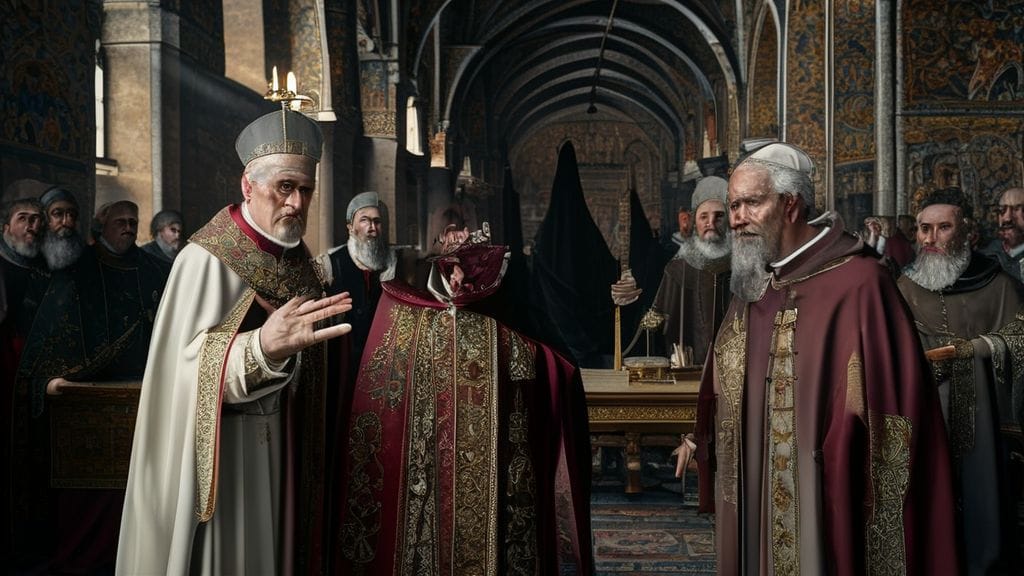
- When Pope Vitalian Excommunicates Archbishop Maurus: The Drama Unfolds
- Imperial Interference: The Emperor’s Hand in the Ravenna Affair
- Priests, Monks, and Merchants: How Ordinary People Lived the Conflict
- Liturgies, Letters, and Anathemas: The Weapons of a Spiritual War
- Ravenna’s Short-Lived Independence: From Triumph to Isolation
- Rome’s Authority Tested: What the Excommunication Revealed
- Historians, Chronicles, and Silences: Reconstructing What Truly Happened
- Echoes Through Centuries: The Legacy of Vitalian and Maurus
- Conclusion
- FAQs
- External Resource
- Internal Link
Article Summary: In the turbulent year 666, when rumors of the “number of the Beast” unsettled Christian imagination, a very real conflict erupted between Rome and Ravenna as pope vitalian excommunicates archbishop maurus for refusing to acknowledge papal supremacy. This article explores the political landscape of Italy under Byzantine rule, the personalities of Pope Vitalian and Archbishop Maurus, and the fragile balance between imperial power and ecclesiastical authority. Moving through letters, edicts, and the tense liturgical life of Ravenna, it shows how a single act of excommunication became a symbol of a wider struggle over who truly led the Western Church. The narrative follows the dramatic moment when pope vitalian excommunicates archbishop maurus and then traces the social and spiritual consequences for clergy, monks, and common believers. It also looks at how Constantinople attempted to use Ravenna as a counterweight to Rome, and why that strategy ultimately faltered. By combining storytelling with historical analysis, the article shows why the episode in which pope vitalian excommunicates archbishop maurus still matters to our understanding of medieval church-state relations. Finally, it reflects on how later chroniclers, especially in Ravenna and Rome, remembered—sometimes distorted—this confrontation between a determined pope and a defiant archbishop.
Ravenna in 666: A City Between Empires and Ambitions
On a cool morning in the year 666, the mosaics of Ravenna glittered in the pale Adriatic light. Gold tesserae flickered like distant stars across the walls of churches built in better days, when emperors still dreamed of reuniting the Roman world. Yet beneath those shimmering saints and angels, unease crackled through the streets. There were whispers in the markets, murmurs in the basilicas, a sense that something decisive was about to happen—something that would test allegiances, unsettle consciences, and redefine where authority truly rested in Christendom.
Ravenna was no ordinary city. Once the capital of the Western Roman Empire, later the seat of the Ostrogothic kings, and now the residence of the Byzantine exarch, it stood at the crossroads of power. Marshes and lagoons wrapped it in a natural moat, while canals drew ships and traders to its sheltered harbors. Greek-speaking imperial officials walked the same streets as Latin clergy and local Italian nobles. In the grand churches—San Vitale, Sant’Apollinare in Classe, and others—the art still spoke the language of Constantinople: solemn, frontal figures, tentatively stepping out of eternity onto the walls.
But this was only the beginning of the story. For while Ravenna boasted imperial patronage, Rome retained something far less tangible yet more powerful in the long run: the aura of apostolic tradition. The bishop of Rome, successor of Peter, did not possess armies, but he held a moral and spiritual authority rooted in centuries of memory. The tension between these two poles—Ravenna the imperial stronghold and Rome the spiritual capital—had simmered quietly for decades. In 666, it burst into open conflict, crystallized in a single dramatic moment when pope vitalian excommunicates archbishop maurus.
The citizens of Ravenna would have felt that tension in daily life. Taxes flowed toward Constantinople; relics and pilgrims gravitated toward Rome. Bishops traveled to synods, envoys carried letters, and travelers brought news of distant quarrels: of doctrinal disputes over Christ’s will, of emperors who tried to dictate theology, of popes struggling not to be reduced to imperial officials. In the middle of this tangle stood the archbishop of Ravenna, a proud prelate whose see had long enjoyed special privileges and whose ambitions now pressed against the invisible boundary set by Rome.
Beyond the city walls, Italy was a patchwork. In the north and interior lands, Lombard dukes ruled their own kingdoms and principalities, often hostile to the empire and suspicious of Rome. Along the coasts and in key cities like Ravenna and Naples, the Byzantine administration clung to its territories, defending them with limited troops and fragile diplomacy. The pope, technically a subject of the emperor in Constantinople, maneuvered cautiously between Lombard sword and imperial decree. It is astonishing, isn’t it, how often spiritual authority had to navigate around steel?
In this world, every gesture could be a signal—every title, every liturgical formula, every protocol in church ceremonies. Who was named first in prayers: the emperor, the pope, or the local bishop? Who ordained whom? Who confirmed the election of a metropolitan? The answers were never purely ceremonial; they were coded messages about power. The conflict that would culminate when pope vitalian excommunicates archbishop maurus took shape precisely in these subtle, seemingly “technical” church questions that hid very human ambitions.
By 666, Ravenna’s archbishops had accumulated quasi-patriarchal status in Italy’s northeast. They enjoyed exemptions, controlled nearby bishops, and were accustomed to dealing directly with Constantinople. Many in Ravenna had started to believe that their church stood almost on the same level as Rome. The exarch, the emperor’s representative, quietly encouraged this view. A strong, semi-autonomous archbishopric in Ravenna could help counterbalance Rome’s spiritual influence and keep the pope more tightly bound to imperial policy.
The people of Ravenna, from wealthy landowners to humble boatmen, moved through this charged atmosphere. They attended Mass, listened to sermons, and heard fragments of news: that the pope in Rome had taken a firm stand; that their own archbishop was resisting; that letters had been exchanged in tones that were anything but cordial. Somewhere between streets of damp stone and incense-filled naves, an invisible line was being drawn. Soon, everyone would know exactly where that line lay, as Rome prepared the most serious spiritual sanction at its disposal.
Pope Vitalian: A Pontiff in an Age of Shadows
Pope Vitalian did not inherit an easy world. Elected in 657, he stepped into the papal office barely two decades after the death of Gregory the Great, whose towering legacy set a high bar for any successor. Yet Vitalian, though less famous, governed during a time when every papal decision could inflame tensions between East and West. His pontificate unfolded under the shadow of doctrinal controversy, political fragility, and the ever-present question: how far could the bishop of Rome push against imperial wishes without risking disaster?
Vitalian’s personality is only faintly visible through the haze of early medieval sources. He is not a pope of grand gestures and thunderous sermons in our surviving records. Instead, he appears as a careful, sometimes cautious, yet fundamentally determined pastor of the Roman Church. He was willing to compromise tactically, but when core principles of papal authority were at stake, he did not yield. The episode in which pope vitalian excommunicates archbishop maurus shows precisely this blend of diplomacy and resolve.
Before the Ravenna conflict, Vitalian had already been entangled in one of the most explosive issues of his age: the Monothelite controversy. The emperors in Constantinople, seeking theological formulas to reunify a divided empire, promoted the idea that Christ had only one will (a doctrine later condemned). Popes and Eastern patriarchs argued bitterly over this teaching. Vitalian, unlike some of his predecessors, tried to avoid direct confrontation with Emperor Constans II, at least at first. He sought a balance: affirming orthodox doctrine as he understood it, yet maintaining outward respect for imperial power.
When Constans II himself came to Italy and even visited Rome in 663, Vitalian received him with honors, leading a grand procession to welcome the emperor into the city. It was a startling moment: the emperor, almost a stranger in the West, standing in the ancient capital beside the bishop who carried the spiritual weight of the Latin Church. On the surface, it was a display of harmony. Yet behind the celebrations, there lurked the unsolved questions of doctrinal authority and ecclesiastical independence. To what extent could the pope be seen as a loyal subject without becoming a mere official of the empire?
Vitalian’s relationship with Constans II offers a clue to his later actions. The pope was no revolutionary; he did not dream of open rebellion against imperial structures. But he also understood that Rome’s influence rested on more than pleasing emperors. If the pope failed to defend his jurisdiction over bishops in Italy—especially metropolitan sees like Ravenna—then the long, patient work by which Rome had become the recognized head of the Western Church would begin to unravel.
This is why the episode in which pope vitalian excommunicates archbishop maurus cannot be reduced to a personal quarrel. For Vitalian, it was part of a larger pattern: defending the prerogatives of the Roman see in the face of both imperial policies and local ambitions. He knew that Constantinople was experimenting with Ravenna as a counterweight, and he recognized that allowing the archbishop there to claim virtual independence would invite other regions to do the same.
Yet Vitalian did not immediately reach for the harshest weapon in his arsenal. Excommunication, particularly of an archbishop, was a grave step. Medieval churchmen were acutely aware that cutting someone off from communion with the Church was not simply a disciplinary measure; it was a spiritual and communal death sentence of sorts, a formal declaration that a soul stood outside the visible unity of Christ’s body. A careful, legalistic man like Vitalian would have exhausted lesser measures first—letters of correction, appeals to tradition, attempts at quiet negotiation.
The Liber Pontificalis, the collection of papal biographies compiled in the following centuries, gives us a glimpse, though a partisan one, of how Rome saw Vitalian’s role. It praises him as a defender of Roman primacy and notes his efforts to maintain discipline over distant churches. In one of its terse, often formulaic entries, one senses a particular pride when it reaches the part of the tale in which pope vitalian excommunicates archbishop maurus, as though this act crystallized his character: patient, but unbending when it mattered.
If we imagine Vitalian at prayer in the Lateran, candles flickering in the dimness, the smell of wax and incense in the air, we might picture a man measuring the cost of his choices. Excommunication risked provoking not only Maurus and Ravenna, but also the imperial officials who supported the archbishop. And yet doing nothing would allow a dangerous precedent to harden into custom: a metropolitan who no longer recognized the pope as his superior. Between these two perils, Vitalian chose the narrower, more perilous path that still preserved the principle he believed entrusted to him by Peter himself.
Archbishop Maurus: The Proud Shepherd of Ravenna
If Vitalian was shaped by the weight of Rome’s traditions, Archbishop Maurus was molded by Ravenna’s unique position at the hinge of empire. The sources do not offer a detailed psychological portrait, but his actions speak loudly: Maurus was no timid or acquiescent prelate. He stood at the head of a powerful archdiocese, one surrounded by the symbols of imperial prestige. In his city, mosaics portrayed emperors and empresses placing offerings at the altar. The exarch’s palace loomed nearby. The archbishop of Ravenna could almost pretend that he too was an imperial figure in ecclesiastical garb.
For decades before Maurus, his predecessors had accumulated rights and exemptions. Ravenna’s clergy reported that certain bishops in their region answered primarily to their archbishop, not to Rome. They boasted of special privileges granted by emperors or older popes—documents whose precise terms and authenticity are hard for historians to verify but whose impact on local pride is unmistakable. Maurus inherited this tradition, and under him, the latent claim hardened into open assertion: Ravenna, he argued, should be autocephalous—effectively self-governing in church matters, owing Rome respect but not legal subordination.
To understand Maurus, one must see him standing between two powers. To his east lay Constantinople, remote but dazzling, a center of theological debate and political intrigue. To his south lay Rome, closer geographically, yet symbolically representing a different axis of authority, rooted more in apostolic lineage than imperial might. It is easy to imagine Maurus cultivating ties with imperial envoys, hosting them in his residence, listening as they hinted that both emperor and exarch would smile upon a Ravenna that shook off Roman restraints.
There is no evidence that Maurus was a doctrinal rebel. His conflict with Vitalian was not born from heresy. Rather, it was juridical, almost constitutional: Who had the right to confirm his elections, to hear appeals from his clergy, to intervene in disputes among the bishops under his sway? At stake, beneath the legal phrases, was personal stature. If Maurus could claim near-equal status with the pope—if he could present himself as something akin to a patriarch for the northern Italian churches—his name would echo through councils and chronicles as a maker of history, not a forgotten intermediary.
Modern scholars like Thomas Noble and Jeffrey Richards, analyzing the fragmentary evidence, have noted that Ravenna’s push for autonomy fits neatly into the broader pattern of Byzantine attempts to decentralize Western ecclesiastical power. One historian has styled Maurus as “the archbishop who tried to become the second Rome” (a paraphrase, but evocative of scholarly assessments). While such titles risk exaggeration, they capture the ambition we see when pope vitalian excommunicates archbishop maurus: this was not a minor bishop being disciplined but a regional heavyweight testing the boundaries of Roman reach.
In pastoral terms, Maurus guided a flock that was cosmopolitan by early medieval standards. Greek merchants, Latin landholders, dockworkers, and former Gothic families all moved through Ravenna. The archbishop presided over liturgies that fused Eastern and Western elements—a Latin rite under the gaze of Byzantine-style imagery. He consecrated clergy, oversaw charity, and sat in judgment over local disputes. To many citizens, he was the face of the Church more visibly than the far-off bishop of Rome.
So when word began to spread that Rome was challenging Maurus’s legal claims, the issue would have felt personal to the Ravenna clergy. It was their archbishop, their city, their rights that seemed under threat. Maurus, to retain their loyalty, could not appear weak. Each letter from Rome that questioned his privileges would have stung his pride and stiffened his resolve. Each hint from Constantinople that the emperor looked kindly upon Ravenna’s independence would have encouraged him to press on.
We do not have Maurus’s own words preserved intact, but we can infer their tenor from Rome’s responses. This was not a man backing down politely after a single reprimand. The sequence that leads to the moment when pope vitalian excommunicates archbishop maurus suggests prolonged resistance, a refusal to submit even in the face of mounting spiritual pressure. Maurus chose confrontation over compromise. In doing so, he wagered not only his own standing but the unity of the church in northern Italy.
A Church in Pieces: Rome, Constantinople, and the Long Schism
To grasp the full gravity of the Ravenna conflict, one must look beyond Italy to the wider map of Christendom in the seventh century. The old Mediterranean unity of the Roman Empire had fractured. In the East, the Byzantine Empire clung to its provinces in Anatolia and the Balkans while losing vast swathes of Syria, Palestine, and Egypt to the new Arab Muslim powers. Trade routes shifted, tax revenues dwindled, and emperors searched for ways to shore up internal coherence. One of their methods was to seek religious formulas that could bring together doctrines long in conflict.
This was the backdrop to the Monothelite controversy, in which Constantinople’s theologians proposed that Christ had a single divine-human will as a compromise between previous positions. Many Eastern bishops signed on; others hesitated. Rome, bound by its own tradition and wary of imperial theology, resisted. The tension between papal and imperial influence in doctrine already strained relations. When the emperor looked at the Latin West, he did not see a unified, obedient church but a complex network of bishops and regions that might or might not follow Rome’s lead.
In this atmosphere, giving more autonomy to certain key sees could seem attractive. Ravenna, as the imperial capital in Italy, was an obvious candidate. If its archbishop could be elevated quasi-formally into an independent head of churches, directly linked to Constantinople, imperial policy would gain a powerful foothold in the West that bypassed Roman mediation. It is in this context that the conflict culminating when pope vitalian excommunicates archbishop maurus must be situated: as part of a longer contest over whether the pope’s primacy was merely honorific or practically binding.
Centuries later, at the time of the great schism of 1054 between Rome and Constantinople, historians would look back on episodes like this as early tremors along a fault line that eventually split fully open. One medieval chronicler, writing from the vantage point of a later century, remarked that “the seeds of discord were planted whenever bishops sought honors apart from the apostolic see” (a paraphrased sentiment reflecting the mindset of Roman ecclesiastical historiography). Ravenna’s defiance was one such seed.
Yet the situation in 666 was far from a simple East-versus-West showdown. Within Italy itself, power was splintered. The Lombards, partly pagan, partly Arian or Catholic depending on region and ruler, occupied large territories. Rome lived under perpetual threat from them, while simultaneously depending on Lombard rulers for pragmatic truces. The exarch in Ravenna devoted much of his energy to military and fiscal survival. For both the pope and the archbishop, local politics often mattered more in the daily grind than abstract doctrinal debates in distant Constantinople.
Still, ecclesiastical jurisdiction mattered profoundly because it controlled how authority flowed through this fragmented landscape. If Rome confirmed metropolitans, then bishops scattered across Italy felt tied to the pope. If, instead, they could appeal to Ravenna or directly to Constantinople, Rome’s influence weakened. The contest was as much about lines on an administrative map as about souls. But to men like Vitalian, those lines were sacred, because they preserved the structure believed to have been willed by Christ through the apostles.
When pope vitalian excommunicates archbishop maurus, then, he is not simply reacting to a local annoyance. He is defending a model of the Church in which the Roman see acts as the keystone of unity in the West. Conversely, when Maurus resists, he is not merely a stubborn prelate but a participant—willing or not—in a broader imperial experiment to remodel ecclesiastical allegiances. The clash in Ravenna is thus a local eruption of a continental fault line stretching from Italy to the Bosporus.
From Loyalty to Defiance: How Ravenna Claimed Its Autonomy
The transition from a loyal, if privileged, archbishopric to a defiant, quasi-independent see did not happen overnight. For decades, Ravenna’s bishops had cultivated a delicate dance with Rome. They accepted consecration or pallia from the pope, attended councils, and invoked Roman authority when it suited them. At the same time, they highlighted special charters, privileges, and imperial rescripts granting them autonomy. A pattern emerged: deference in rhetoric, boldness in practice.
Under Maurus, that caution began to fade. Several cases suggest that Ravenna started claiming the right to ordain and depose bishops in nearby cities without seeking papal confirmation. Appeals that should have gone to Rome were handled locally. Disputes that once would have involved the pope now ended at Maurus’s tribunal. Each such case, on its own, might have been dismissed in Rome as a minor overreach. But taken together, they formed a worrying mosaic of independence.
At the heart of the controversy lay the question: Did the archbishop of Ravenna need to swear obedience to the pope and seek his confirmation, or could he rely solely on imperial recognition? Maurus, bolstered by his city’s status and likely by the exarch’s support, leaned toward the latter. He appears to have acted as though his office came more directly from the emperor and his own local election than from Rome’s approval. For Vitalian, this amounted to a quiet but unmistakable renunciation of papal jurisdiction.
Letters—few of which survive in full—began to cross the Adriatic and the Italian peninsula. Rome wrote to rebuke; Ravenna wrote to justify. Imperial officials may have added their own messages, scolding the pope for daring to challenge an archbishop so closely tied to the Byzantine state apparatus. Each scribe’s pen stroke was a small act of war in a conflict fought with parchment instead of swords. Yet behind those letters lay a very real fear on both sides: fear in Rome that its authority might crumble; fear in Ravenna that submitting now would lock the city into permanent subordination.
Ravenna’s clergy were not monolithic. Some, raised in the tradition of Roman primacy, surely murmured worries about opposing the pope. Others, more closely linked to the exarch’s household or to local noble families, urged Maurus to stand firm. To them, the archbishop’s defiance was tied to the city’s status, its prestige, even its political autonomy. If Rome won this battle, might it next claim more taxes, more intervention, more say over appointments in Ravenna’s churches and monasteries?
The stage was thus set. When pope vitalian excommunicates archbishop maurus, he is not acting in a vacuum; he is responding to a long build-up of lesser confrontations. In a sense, both men found themselves trapped by the logic of their positions. Vitalian could not easily back down without signaling to all of Italy that Rome’s decrees could be safely ignored. Maurus, once he had staked his reputation on independence, could scarcely reverse course without looking weak in front of both emperor and clergy.
A Letter, a Threat, a Turning Point: The Road to Excommunication
The decisive moment came not with a shout but with the arrival of a letter. We have lost the original text, but echoes of it remain in later summaries. A papal envoy, perhaps a cleric in plain but dignified robes, would have entered Ravenna carrying the document sealed with lead—the bull that carried Vitalian’s will. In it, the pope likely recounted past attempts at correction, invoked ancient canons affirming Rome’s primacy, and issued a stark ultimatum: submit to Roman jurisdiction, or face the gravest spiritual sanction.
One can imagine that document being read aloud to Maurus in a chamber near one of Ravenna’s great churches. Candles flickered; a few trusted advisors stood nearby. The language would have been formal, heavy with references to councils and predecessors. But beneath the ornate Latin beat a simple message: the time for ambiguity was over. Rome demanded a clear answer. The pope, guardian of unity, was prepared to draw a line.
Maurus, by this point, likely believed that the emperor and exarch would support him, at least silently. Perhaps he even had in hand documents from Constantinople granting him certain prerogatives—rescripts which he could hold up as a shield against papal claims. To yield now would be to disappoint not only his own clergy but also his powerful patrons. There may have been voices in the room urging caution, reminding him of the horror attached to excommunication. Yet the balance of his council tilted toward resistance.
The sources suggest that Maurus did not merely ignore the papal letter; he responded with defiance. Whether he wrote back explicitly denying the pope’s right to judge him, or whether his answer came through deeds—continuing his autonomous actions despite warning—is unclear. What we do know is that in Rome, Vitalian received news that Maurus remained unyielding. The pope, who had delayed and negotiated as long as he thought possible, now prepared to act.
In canonical tradition, excommunication required clear cause and, often, the public proclamation of the sentence. Vitalian would have consulted with his advisors and with leading Roman clergy. Some may have cautioned him that such a blow would deepen the rift; others argued that not acting would encourage further rebellion. Eventually the decision crystallized into a solemn decree. When pope vitalian excommunicates archbishop maurus, he does so in the name of protecting the unity and order of the Church, even at the cost of scandal.
The formula would have been stark. Maurus, by name, was declared cut off from communion with the Roman Church, and, by implication, from the universal Church in so far as Rome understood itself to represent its unity. Perhaps the decree was read in a synod in Rome, with bishops present as witnesses. Perhaps copies were dispatched to other Italian sees, instructing them not to recognize Maurus’s authority and to refrain from concelebrating with him or acknowledging his acts.
News traveled slowly in the seventh century, but it traveled. Before long, messengers reached Ravenna with the astonishing announcement: their archbishop had been anathematized by the successor of Peter. The phrase pope vitalian excommunicates archbishop maurus must have circulated, if not verbatim, then in essence, carried by frightened clerics and eager gossipers. The faithful of Ravenna now faced a painful question: Was their spiritual father now outside the fold?
The Year 666: Fear, Symbolism, and Political Calculation
That this drama unfolded in the year 666 has not escaped the attention of later historians and storytellers. For medieval Christians, steeped in the imagery of the Book of Revelation, the number carried ominous overtones. While it is uncertain to what extent contemporaries linked the Ravenna conflict directly to apocalyptic fears, one can easily imagine preachers in outlying villages noting the coincidence. The year of the “number of the Beast” had brought not universal catastrophe but a scandal within the Church itself: a pope and an archbishop at war.
In modern scholarship, the date 666 is more symbolic than causative. Vitalian did not excommunicate Maurus because of any numerical superstition. Yet, taken in a broader sense, the year fits the atmosphere of turmoil. The Arab conquests were reshaping the eastern Mediterranean; imperial revenues were collapsing; plague and famine haunted many regions. Against this dark background, the Church was supposed to be a beacon of stability. Instead, it seemed caught in its own internal struggles, arguing over wills in Christ and jurisdictions on earth.
Politically, the excommunication was a calculated risk. Vitalian knew that striking at Maurus could anger Constans II and the exarch. Yet he may have judged that the emperor, already overburdened by wars, would not risk a major rupture with Rome over a single archbishop. If the papal decree succeeded in isolating Maurus, other bishops in Italy might rally more firmly around the pope, strengthening Rome’s hand in future doctrinal and disciplinary disputes.
For Maurus, the year 666 became the moment when his ambitions collided with the limits of papal tolerance. His stance, once a bold vision of Ravenna’s autonomy, now looked to many like dangerous pride. Excommunication did not only affect him personally; it cast a shadow over every sacrament he celebrated, every ordination he performed. Doubts crept in: Were his masses valid? Were his confirmations secure? Even if theology insisted that sacraments performed by an excommunicated but validly ordained bishop retained their effectiveness, ordinary believers rarely made such fine distinctions.
Yet behind the theological nuance, the politics remained blunt. The exarch now had to decide whether to back an excommunicated prelate publicly or to push Maurus toward some sort of accommodation. The emperor, hearing of the affair, might have weighed whether Ravenna’s autonomy was worth a prolonged quarrel with Rome. The delicate web of alliances, fears, and calculations spun tighter around both pope and archbishop as the year 666 passed, charged with meaning by both scripture and circumstance.
When Pope Vitalian Excommunicates Archbishop Maurus: The Drama Unfolds
Imagine the scene in Ravenna when the decree was first read aloud. In one of the city’s basilicas, perhaps after the Gospel had been proclaimed, a deacon or visiting cleric stepped forward, unrolled a parchment, and began to read the words of the bishop of Rome. The congregation, accustomed to the sonorous rhythms of liturgy, suddenly heard phrases of judgment and separation. Maurus’s name, spoken clearly, was joined to terms like “anathema” and “cut off from communion.”
The impact would have rippled outward. Some priests, loyal to Rome in their hearts, might have hesitated to celebrate Mass under Maurus’s direction. Monks, whose communities often depended on papal charters for privileges and protection, would have whispered nervously about the future. Laypeople, less versed in canon law but deeply sensitive to the notion of being outside the Church, wondered whether attending their own cathedral placed their souls at risk.
The phrase “pope vitalian excommunicates archbishop maurus” encapsulates not only a juridical act but a profound emotional shock. To be excommunicated was to be named a breaker of unity, a rebel not merely against a man but against the mystical body of Christ as understood by Rome. Maurus, who had perhaps imagined that imperial backing would shield him, now confronted the spiritual loneliness of a man officially declared outside the Church’s embrace.
Yet Maurus did not instantly crumble. Evidence suggests that he continued to exercise authority in Ravenna for some time, relying on local support and the practical difficulty of enforcing excommunication in a world with slow communication and limited policing capacity. The exarch might have forbidden any attempt by Roman envoys to depose him physically. In this sense, the decree had to do its work more through conscience and long-term pressure than through immediate coercion.
Rome, for its part, made sure that other bishops were informed. Vitalian needed to prevent any illusion that Maurus’s case was a private quarrel. By broadcasting the excommunication, he turned the archbishop into a cautionary example. Any bishop tempted to follow Ravenna’s path understood now that the price would not only be a papal rebuke but full exclusion from the communion that bound the Western Church together. This was how the sentence, repeated in letters and homilies—pope vitalian excommunicates archbishop maurus—became a kind of grim proverb about the consequences of defying Rome.
Emotionally, the episode must have cut deeply on both sides. Vitalian, who saw himself as a shepherd, had chosen to cast one of his fellow shepherds out of the flock. Maurus, who believed he was defending his city’s rights, now heard his name associated with terms used for heretics and schismatics. Their followers took sides, their reputations were reshaped, and the story of their clash would echo long after their deaths, interpreted and reinterpreted by later generations searching for the roots of ecclesiastical order and disorder.
Imperial Interference: The Emperor’s Hand in the Ravenna Affair
It would be naive to imagine that this high drama played out without imperial eyes watching. Constans II, ruling from Constantinople, was preoccupied with wars on multiple fronts, but he did not ignore Italy. The exarch in Ravenna, acting as his representative, constantly reported on local developments. The emperor’s earlier visit to Rome in 663 had already shown his willingness to intervene personally in Western affairs when necessary.
Whether Constans directly ordered Maurus to resist Rome, or whether he merely created an atmosphere that encouraged such resistance, is difficult to determine from our surviving sources. Some later accounts, colored by Roman sympathies, imply that the emperor and exarch were pleased to see Ravenna claim autonomy. The archbishop’s defiance, after all, aligned neatly with imperial interest in curbing papal independence. At minimum, imperial authorities refrained from forcing Maurus to submit, thus passively supporting his stance.
On the other hand, Constans II had practical limits. He needed Rome as a partner in maintaining some semblance of order in Italy. Openly siding against the pope too aggressively could drive Rome closer to the Lombards or spark wider resistance among Latin bishops. Thus, imperial policy likely oscillated between encouragement and caution. The emperor might have hoped that the conflict would weaken Rome without fully shattering relations.
This half-hearted support left Maurus in a precarious position. He could not be sure how far imperial troops would go to defend him if Rome attempted to depose him physically. He may have read imperial silence as permission when it was, in fact, a calculation. Meanwhile, Vitalian knew that excommunication was one of the few tools he possessed that did not require imperial enforcement. In this way, the clash between pope and archbishop also revealed the fault lines in the emperor’s control over Western ecclesiastical affairs.
Later ecclesiastical historians often present the story as a morality play: Rome as the defender of true order, Ravenna as the wayward child lured by imperial flatteries. Yet from a political angle, it also reveals the complexity of seventh-century power. No single authority—neither emperor, nor pope, nor archbishop—could simply impose its will everywhere. They had to negotiate, improvise, and, when necessary, escalate. The episode where pope vitalian excommunicates archbishop maurus is one of those moments when negotiation failed and escalation became inevitable.
Priests, Monks, and Merchants: How Ordinary People Lived the Conflict
High-level church politics can easily appear abstract, but for those living in Ravenna and Rome, the excommunication had concrete consequences. For parish priests in Ravenna, the situation was agonizing. Their direct superior was now branded by Rome as outside communion. Should they continue to obey him, performing sacraments under his authority, or should they distance themselves, risking the loss of their parishes, perhaps even their safety?
Monks faced similar dilemmas. Many monasteries held charters granted by popes, confirming their lands and privileges. They depended on Rome not only spiritually but economically. At the same time, their daily worship was often tied to the local bishop, who might visit to consecrate altars or ordain new priests. A community openly refusing to recognize Maurus risked conflict with Ravenna’s secular authorities and neighbors loyal to the archbishop. Caught between their conscience and their context, these men prayed for a resolution that would not tear apart their fragile communities.
Merchants and artisans, less invested in canon law, nonetheless felt the effects in more indirect ways. Conflicts between city and pope could disrupt pilgrimage traffic, reducing the number of visitors who brought offerings and business. Some routes that once funneled pilgrims from the north through Ravenna on their way to Rome might shift as travelers avoided contested territories. Rumors about excommunication and schism, however distorted, could deter trade with more pious or anxious regions.
Meanwhile in Rome, the faithful heard of the drama in Ravenna as yet another sign that the Church was under strain. Preachers might have invoked the story in homilies, warning against pride and rebellion. Some Roman families had relatives in Ravenna, and letters would have carried worried questions back and forth: Did their kin still attend church under the excommunicated archbishop? Had Rome sent any envoys to negotiate? The story of how pope vitalian excommunicates archbishop maurus became dinner-table conversation as well as theological debate.
The emotional tone among ordinary believers likely oscillated between confusion and resignation. The seventh century was already an age of anxiety—plagues, wars, and crop failures were all too common. In such a context, disputes over episcopal authority could seem both distant and deeply unsettling. If bishops themselves could not agree on who held legitimate power, what did that mean for the salvation of souls entrusted to them? The Church, which preached unity, seemed riven by internal fractures.
Liturgies, Letters, and Anathemas: The Weapons of a Spiritual War
Unlike secular princes, church leaders could not easily resort to arms against one another. Their battleground was instead the realm of ritual, words, and symbols. In the Ravenna affair, these tools were wielded with calculated intensity. Liturgies became statements of allegiance; the recitation or omission of a name could signify where a community stood in the conflict.
In the Roman canon of the Mass, local bishops could be named, and the pope’s name, of course, carried special weight. In Ravenna, clergy had to decide: Would they name Vitalian in their prayers, acknowledging his role as visible head of the Western Church, while their own archbishop stood under his excommunication? Would they alter the formula, perhaps emphasizing Maurus’s role while downplaying Rome? Each variation, however small, was a coded declaration.
Letters, too, acted as weapons. Rome dispatched missives to other Italian bishops, reiterating that Maurus stood under sentence. Bishops loyal to Vitalian replied with assurances of obedience, sometimes repeating the story in their own correspondence so that the phrase pope vitalian excommunicates archbishop maurus traveled across diocesan boundaries like a dark refrain. In some cases, councils might have been convened regionally to reaffirm allegiance to Rome and to warn any who might imitate Ravenna’s defiance.
Anathemas—the formal curses pronounced against those deemed heretical or schismatic—could be read in public assemblies. Though we lack a verbatim record of such a ceremony against Maurus, the logic of the age suggests that the excommunication, at least in Rome, was publicly proclaimed in a formal setting. The words, heavy with biblical allusion, served as both judicial sentence and liturgical lament. They reminded listeners that unity was not a mere administrative convenience but a spiritual obligation.
In this sense, the conflict was as much performative as it was juridical. Each side staged its legitimacy. Maurus held solemn liturgies in Ravenna’s splendid churches, standing beneath mosaics that linked his city to the grandeur of Constantinople. Vitalian presided over the rituals of the Lateran and Saint Peter’s, surrounded by the tombs of the apostles and martyrs. Both claimed continuity with tradition; both sought to embody the true Church. The fact that one stood under formal excommunication did not automatically erase his local authority, but it did change the meaning of his gestures in the broader Christian world.
Ravenna’s Short-Lived Independence: From Triumph to Isolation
For a time, Maurus’s stance may have felt like a triumph in Ravenna. The city had asserted itself against Rome and, at least locally, held its ground. The exarch did not depose the archbishop; imperial troops did not march to enforce the papal sentence. Life, on the surface, continued. Liturgies were celebrated, baptisms performed, trade persisted. To an unwary observer, it might have seemed that the excommunication had failed to bite.
But the real cost unfolded more slowly, like a subtle sickness. Other bishops in Italy grew wary of too close an association with Ravenna. Monasteries looking for papal protection avoided entanglement with an excommunicated see. Over time, the network of alliances and mutual recognition that sustained Maurus’s regional authority thinned. What had begun as an assertion of independence increasingly resembled isolation. The story in which pope vitalian excommunicates archbishop maurus thus became a quiet warning whispered among bishops: autonomy could veer into abandonment.
After Maurus’s death, Ravenna’s church leaders reconsidered their position. Gradually, the city’s archbishops moved back toward a more conventional relationship with Rome. Later popes, while never forgetting the affront, were pragmatic enough to welcome reconciliation. The empire itself was changing, and Ravenna’s strategic value diminished as Byzantine control over Italy eroded. In such a shifting landscape, it made less and less sense for Ravenna to maintain a lonely defiance.
By the eighth century, the autonomy that Maurus had fought for existed mostly as a memory, contested in documents and stories. Rome reasserted its primacy more firmly, even as new powers—Frankish kings, Lombard dukes, and finally the Carolingian emperors—reshaped Western politics. Ravenna remained an important see, but not the rival patriarchate it had once tried to become. The bold act that had once electrified Christendom—when pope vitalian excommunicates archbishop maurus—hardened into a cautionary footnote in the broader saga of papal centralization.
Rome’s Authority Tested: What the Excommunication Revealed
From Rome’s perspective, the confrontation with Maurus was both a test and a demonstration of its authority. On the one hand, the difficulty of enforcing the excommunication in practical terms exposed the limits of papal power in the mid-seventh century. Vitalian could declare an archbishop outside communion, but he could not simply replace him or send troops to ensure obedience. The pope still depended heavily on imperial structures and the goodwill of local authorities.
On the other hand, the very act of excommunication reaffirmed a crucial principle: that the pope claimed, and was increasingly recognized as holding, ultimate appellate jurisdiction over bishops in the West. By naming Maurus publicly as a rebel against Roman authority, Vitalian made clear that defiance would not be treated as a mere local eccentricity. The moral and symbolic weight of the decree helped to shape expectations among bishops for generations: they could argue with Rome, but outright rejection of its authority carried a spiritual price.
In later centuries, papal jurists would look back on episodes like this to construct a legal and historical case for Roman primacy. Collections of canon law, such as the Decretum of Gratian in the twelfth century, would cite earlier conflicts to show that popes had long asserted the right to discipline metropolitans who overstepped their bounds. The narrative in which pope vitalian excommunicates archbishop maurus became part of a chain of precedents, used to bolster arguments in debates far removed from the marshes of seventh-century Ravenna.
Thus, while Maurus’s defiance revealed the practical constraints on papal power, Vitalian’s response helped to consolidate the idea that Rome’s authority was both ancient and active. The tension between these two truths—symbolic strength and practical limitation—would define much of medieval church history. Popes continued to issue decrees that could not always be enforced, yet over time, the moral consensus around their primacy grew stronger. In that slow, uneven process, the events of 666 in Ravenna played their small but significant part.
Historians, Chronicles, and Silences: Reconstructing What Truly Happened
Our knowledge of the conflict between Vitalian and Maurus comes from a scattered and biased set of sources. The Liber Pontificalis, compiled in Rome, presents the story firmly from the papal point of view. It emphasizes the pope’s defense of discipline and portrays Maurus’s autonomy as unjustified. Ravenna’s own records, where they survive, are more reticent; later local traditions sometimes portrayed their archbishops as defenders of legitimate privileges rather than rebels.
Modern historians must navigate these partial, sometimes contradictory testimonies. They compare papal biographies with conciliar records, imperial rescripts, and archaeological evidence from Ravenna’s churches. The historian Jeffrey Richards has called the seventh century “a time of thin documentation and thick speculation,” a wry acknowledgment of how much must be inferred rather than directly observed. Even so, a broadly coherent picture emerges: a proud archbishop, encouraged by imperial support, pushed his autonomy too far, and Rome replied with excommunication to defend its claimed universal jurisdiction.
Silences in the record are as telling as the words we do possess. We rarely hear the voices of ordinary priests or lay believers. We have no verbatim transcript of the letter in which pope vitalian excommunicates archbishop maurus, only mentions of it in later summaries. We lack personal correspondence that might reveal Maurus’s inner doubts or Vitalian’s anguish. The human dimension must be reconstructed from context and analogy rather than from diaries or confessions.
Yet this very incompleteness invites careful imagination. By comparing the Ravenna episode with better-documented later conflicts—such as the Investiture Controversy of the eleventh century—historians can sketch likely patterns of negotiation, resistance, and reconciliation. The specifics differ, but the dynamics of power, conscience, and institutional identity recur. In that sense, the story of Vitalian and Maurus is both deeply rooted in its time and strangely timeless, a vignette of what happens when competing visions of authority collide within a religious community.
Echoes Through Centuries: The Legacy of Vitalian and Maurus
In the centuries that followed, neither Vitalian nor Maurus became the stuff of grand legends. Vitalian appears in papal lists and chronicles, a moderately important pope overshadowed by figures like Gregory the Great and later reformers. Maurus recedes even more quickly into the background, his name remembered mainly in the context of Ravenna’s brief bid for ecclesiastical independence. And yet, in the subtle architecture of church history, their clash left a small but durable mark.
When later generations debated Roman primacy, the story of how pope vitalian excommunicates archbishop maurus served as an early example of papal willingness to confront metropolitans aligned with imperial interests. It demonstrated that Rome’s vision of its own authority extended beyond doctrinal teaching into the messy realm of jurisdiction and discipline. For canonists arguing in favor of strong papal oversight, the case was a useful precedent; for critics of papal power, it was an example of centralization at the expense of local autonomy.
Ravenna, for its part, never entirely forgot its brief experiment with near-independence. Its magnificent mosaics remained to testify to a time when the city stood at the crossroads of empire and church. Pilgrims walking through San Vitale or Sant’Apollinare in Classe centuries later would not have known the details of Maurus’s quarrel, but they sensed that this had once been a place where grand ambitions stirred. In subtle ways, the memory of that ambition colored how Ravenna’s churchmen thought of their own dignity, even after formal submission to Rome had been restored.
Perhaps the most enduring legacy, however, lies not in institutional memory but in the cautionary tale that emerges from this episode. Ambition, even when clothed in legal arguments and historical charters, can fracture communities if it hardens into defiance. Authority, even when exercised with conviction, can wound when it resorts to punitive measures. The drama that unfolded when pope vitalian excommunicates archbishop maurus reminds us that ecclesiastical history is not merely a chronicle of offices and decrees but a story of human beings—proud, fearful, hopeful—wrestling with questions of power and conscience.
In this, Vitalian and Maurus are strangely modern. Their world was filled with rituals and symbols unfamiliar to us, but the tensions they embodied are recognizable: center versus periphery, tradition versus innovation, unity versus local identity. Their legacy lies in the questions they leave us as much as in the answers they tried to impose.
Conclusion
The conflict in 666, when pope vitalian excommunicates archbishop maurus, may at first appear to be a narrow ecclesiastical quarrel, a footnote in the long annals of papal history. Yet as we pull back the curtain of time, the event reveals itself as a vivid intersection of personalities, politics, and principles. In Ravenna’s basilicas and Rome’s halls, a drama unfolded that illuminated the fragile balance between imperial influence and papal authority at a moment when the very shape of Christendom was in flux.
We have followed the story from the marsh-bound splendor of Ravenna to the cautious, burdened court of Pope Vitalian, exploring how an ambitious archbishop, encouraged by his city’s imperial connections, pushed for autonomy that Rome could not accept. We have watched as letters turned into threats and finally into the stark sentence of excommunication. Along the way, we have glimpsed how the dispute affected ordinary priests, monks, and laypeople, who saw their spiritual world shaken by a high-level clash far beyond their control.
Historically, the excommunication failed to produce an instant, decisive victory for Rome; Maurus retained local control for a time, and only over generations did Ravenna’s independence fade into memory. Yet symbolically, the episode strengthened the emerging sense that the pope claimed a universal jurisdiction in the West, one that could reach even into cities backed by emperors. In this sense, the story in which pope vitalian excommunicates archbishop maurus forms part of the slow, uneven consolidation of papal primacy that would shape medieval Europe.
At the human level, the drama reminds us that institutions are made of people whose convictions, ambitions, and fears infuse official acts with emotional weight. Excommunication was not a mere legal tool; it was an act that cut to the heart of identity and belonging. Maurus’s defiance and Vitalian’s firmness each carried a cost. The conflict’s resolution—partial, ambiguous, stretched over time—reflects the messy reality of history, where few stories end with neat finality.
Today, as churches and communities still struggle with questions of authority, autonomy, and unity, the events at Ravenna in 666 remain unexpectedly relevant. They show how quickly legal arguments can become existential struggles, how political calculations intertwine with spiritual ideals, and how, even in the most hierarchical of institutions, power must always contend with conscience. In telling this story, we recover not only a lost chapter of early medieval history but also a mirror in which to examine our own conflicts over who leads, who follows, and on what terms true unity can be built.
FAQs
- Who was Pope Vitalian?
Pope Vitalian was the bishop of Rome from 657 to 672, a period marked by doctrinal disputes with the Byzantine Empire and political instability in Italy. He is best known for trying to balance loyalty to the emperor with defense of Roman ecclesiastical prerogatives, and for the episode in which he excommunicated Archbishop Maurus of Ravenna over questions of jurisdiction. - Who was Archbishop Maurus of Ravenna?
Archbishop Maurus led the church of Ravenna in the mid-seventh century, overseeing a prestigious see closely linked to the Byzantine imperial administration. He sought to assert greater autonomy for Ravenna, claiming rights and privileges that challenged Rome’s authority, which ultimately led to his excommunication by Pope Vitalian. - Why did Pope Vitalian excommunicate Archbishop Maurus?
Pope Vitalian excommunicated Archbishop Maurus because Maurus refused to acknowledge the pope’s jurisdiction over him and his suffragan bishops, effectively claiming near-independence for the see of Ravenna. After repeated attempts at correction failed, Vitalian used excommunication to defend the principle of Roman primacy in the West. - What role did the Byzantine Empire play in the conflict?
The Byzantine Empire, ruling parts of Italy through the exarchate of Ravenna, favored a strong, semi-autonomous archbishopric there as a counterweight to Rome. Imperial support, or at least tolerance, encouraged Maurus to assert his independence, while limiting Pope Vitalian’s practical ability to enforce his decisions beyond spiritual sanctions. - Did the excommunication immediately remove Maurus from office?
No. Excommunication cut Maurus off from communion with Rome but did not automatically remove his local control, especially since the exarch and imperial authorities did not move against him. He continued to function as archbishop in Ravenna for some time, though increasingly isolated within the wider church. - How did the people of Ravenna react to Maurus’s excommunication?
Reactions likely varied. Some clergy and monks, loyal to Rome, were deeply troubled and considered distancing themselves from Maurus, while others, tied to local interests and imperial favor, supported him. Ordinary laypeople mostly experienced confusion and anxiety, uncertain about the spiritual implications of following an excommunicated archbishop. - Did Ravenna remain independent from Rome after Maurus?
No. Although Ravenna enjoyed a period of de facto autonomy, over the next decades and centuries its archbishops gradually returned to a more conventional relationship of obedience to Rome. The city remained influential but never achieved the fully independent, patriarchal status Maurus had effectively sought. - How do historians know about this conflict?
Historians rely on sources such as the Liber Pontificalis (a collection of papal biographies), scattered conciliar records, and later chronicles from both Rome and Ravenna. These texts are incomplete and biased, so scholars cross-check them and interpret them cautiously to reconstruct the events surrounding the excommunication. - Was this conflict connected to broader church schisms?
Indirectly, yes. The Ravenna affair unfolded against the backdrop of the Monothelite controversy and long-standing tensions between Rome and Constantinople over doctrine and authority. While it did not itself cause a major schism, it formed part of the broader pattern of East–West friction that would eventually culminate in deeper divisions centuries later. - Why does the year 666 matter in this story?
The excommunication took place in 666, a year symbolically charged for Christians aware of the “number of the Beast” in the Book of Revelation. Although this number did not directly cause the conflict, the coincidence highlights the atmosphere of anxiety and upheaval in which the dispute between Vitalian and Maurus unfolded.
External Resource
Internal Link
Other Resources
- Encyclopaedia Britannica – general search for the exact subject
- Google Scholar – academic search for the exact subject
- Internet Archive – digital library search for the exact subject

