Table of Contents
- A River of Borders: Setting the Stage on the Danube in 369
- Empires under Strain: Rome, the Goths, and a Fractured World
- From Raids to Campaigns: The Road to Confrontation
- Valens and Athanaric: Two Leaders, Two Worlds
- Crossing the Danube: War on the Misty Frontier
- Fire in the Forests: The Campaigns of 367–369
- Weariness and Calculation: Why Both Sides Sought Peace
- On the Mid-River Raft: Staging the Roman–Gothic Encounter
- Words over Water: The Negotiation of the Peace Treaty
- Terms of an Uneasy Truce: Trade, Borders, and Hostages
- Soldiers, Settlers, and Supplicants: Human Stories behind the Treaty
- Echoes through the Provinces: Political and Social Consequences
- A Frontier Reimagined: The Danube after 369
- Fault Lines in the Peace: Famine, Pressure, and Restless Warriors
- From 369 to 378: How a Treaty Led toward Adrianople
- Chroniclers, Myths, and Memories: How History Remembers the Pact
- Power, Fear, and Diplomacy: Interpreting the Roman–Gothic Peace
- Legacies on the River: The Treaty’s Long Shadow over Europe
- Conclusion
- FAQs
- External Resource
- Internal Link
Article Summary: In the late fourth century, as winter mist clung to the Danube, Roman officials and Gothic leaders met upon a wooden platform moored between two worlds to seal what we now call the roman goths peace treaty 369. This article recreates that charged moment, tracing the long road of war, fear, and necessity that drove Emperor Valens and the Gothic judge Athanaric toward negotiation. It explores how the treaty redrew local power, regulated trade, and sought to freeze a volatile frontier, even as hunger, migration, and imperial overconfidence quietly undermined its promises. Moving through battles in the forests, tense diplomatic rituals on the river, and the lives of common soldiers and villagers, it shows how the agreement became both a respite and a prelude to disaster. The narrative follows the fragile calm that settled on the Danubian provinces after 369, then unravels the pressures that led to the Gothic crisis of 376 and the catastrophe at Adrianople. Along the way, it reflects on how ancient writers remembered the pact, and how modern historians debate whether the roman goths peace treaty 369 was a triumph of frontier management or a tragic missed chance. In the end, the treaty emerges as a vivid case study in imperial diplomacy: an ambitious attempt to control a moving frontier and a restless people with words written over water.
A River of Borders: Setting the Stage on the Danube in 369
The morning mist on the Danube in the year 369 would have smelled of damp wood, cold iron, and smoke from the Roman watchtowers that dotted the southern bank. To the south lay the provinces of Moesia and Thrace, fields scarred by earlier raids yet still green with promise. To the north stretched a different world: the lands of the Goths, a patchwork of villages, forests, and steppe, crisscrossed by old migration routes and newer ambitions. Between them, the river itself—broad, dangerous, and restless—served as Rome’s living wall, a shifting, unpredictable frontier that no stone fortification could fully tame.
By then, this segment of the limes, the defensive line, had seen centuries of tension. Roman engineers had raised fortresses along the riverbank, and legions had patrolled the waters in sturdy boats. Yet the Danube did not simply divide two worlds; it connected them. Merchants ferried cloth, wine, and olive oil northward, while furs, slaves, and livestock moved south. News and rumors flowed with them. On its currents traveled stories of emperors and usurpers, of harsh winters and lean harvests, of warlords across the steppe and bishops in distant cities debating the nature of Christ.
Into this world stepped the protagonists of the roman goths peace treaty 369: the Eastern Roman emperor Valens, wary and determined, and Athanaric, a Gothic judge of the Thervingi, proud guardian of his people’s autonomy. Their meeting would not take place in any Roman basilica or Gothic hall. Instead, it would be staged upon a wooden platform fastened in the middle of the Danube—a symbolic no-man’s-land, floating between empire and barbarians, between old patterns of enmity and the fragile hope of a new arrangement.
This was no mere ceremony. It was the culmination of a grueling border war fought in forests and across rivers, a conflict that had exhausted both sides. It was also an experiment in control: an attempt by Rome to stabilize an increasingly volatile frontier not simply by the sword, but with treaty clauses, trade regulations, and diplomatic theater. Yet beneath the surface calm of that mid-river parley, deeper tensions swirled—hunger in Gothic villages, imperial pride in Roman headquarters, and the unpredictable movements of distant peoples who were beginning to press from beyond the Gothic horizon.
Empires under Strain: Rome, the Goths, and a Fractured World
To understand why the Danube in 369 became the stage for an unprecedented peace, one must first grasp how fragile both worlds had become. The Roman Empire of the late fourth century was no longer the swaggering conqueror of earlier centuries. It remained immense and formidable, but its power was stretched thin, its politics fractious. After the death of Emperor Constantine, the empire had fractured among his heirs and their successors, and by the time Valens came to power as Eastern Augustus in 364, the Danubian frontier was only one of several burning concerns.
Valens ruled from Constantinople, the glittering “New Rome” perched on the Bosporus, but his gaze was constantly pulled in competing directions. To the east, the Persian Sasanian Empire loomed, unpredictable and dangerous. To the west, his brother Valentinian I fought to keep the Rhine frontier intact. Inside the empire, religious tensions simmered as Nicene and Arian Christians denounced one another in sermons and synods. Valens himself favored Arianism, adding theological controversy to the burdens already resting on his shoulders.
Facing Rome across the Danube were not a single, unified “Gothic nation,” but multiple groups—Thervingi closer to the river, and Greuthungi further east—each led by warlords, judges, or kings whose authority blended tradition, charisma, and military success. Their society was shifting under pressures that few could fully see. Trade with Rome had grown, bringing not just goods but Roman coins, weapons, and ideas into Gothic lands. Some Goths had served as mercenaries in Roman armies, returning home with trophies and tales of imperial power. Christian missionaries, notably Ulfilas, had already translated parts of the Bible into Gothic, sown seeds that would later flower into distinct Gothic forms of Christianity.
Yet this growing entanglement did not erase Gothic independence. Their authority structures remained local, their laws unwritten but deeply ingrained. To men like Athanaric, who upheld traditional customs and opposed the spread of Roman-influenced Christianity, Rome was both trading partner and existential threat. Its luxuries tempted his people; its ideology threatened to reshape them. As the historian Ammianus Marcellinus, a contemporary observer who served as a Roman officer, would later hint, the Goths along the Danube were both familiar and alien—neighbors who dressed in Roman cloth but fought with their own fierce energy.
Against this backdrop, the roman goths peace treaty 369 did not arise from sudden goodwill. It emerged from a landscape of mutual suspicion: a Roman Empire anxious about porous borders and internal dissent, and Gothic leaders wary of being drawn into Rome’s gravitational pull. Both sides were haunted by recent conflicts. Both knew that the Danube frontier, if left to chance, could explode into violence that neither empire nor confederation could fully control.
From Raids to Campaigns: The Road to Confrontation
The peace of 369 stands at the far end of a long corridor of conflict. In the decades before the treaty, the Danube frontier had rarely known true quiet. Periodic raids by Gothic bands had struck Roman territory, seizing cattle, grain, and captives. Roman punitive expeditions had, in turn, crossed the river, burning villages, cutting down trees, and trying to teach harsh lessons about the cost of plundering imperial lands.
These were not yet full-scale wars of annihilation, but they carried a cumulative weight. Each incursion deepened hatred, each reprisal sowed seeds of revenge. Local Roman farmers along the Danube lived in a state of tense expectancy, sleeping with one ear open for the distant bark of alarm horns. In Gothic settlements north of the river, elders told stories of Roman cruelty and cunning, of distant emperors who sent their soldiers to take what they wanted and then vanished back behind their stone walls.
By the mid-360s, the pattern escalated. The twin pressures of Roman politics and Gothic factionalism brought matters to a head. For Valens, unrest on the Danube was not just a regional issue; it threatened his prestige as emperor. An Augustus who could not secure his frontier invited rebellion elsewhere. For Gothic leaders such as Athanaric, Roman attempts to dictate terms or interfere in internal Gothic disputes were intolerable. Honor and authority demanded resistance.
Skirmishes grew larger. A raid here, a counter-raid there, and then entire Roman detachments were ambushed in wooded ravines or at failing river crossings. The Danube, once a barrier, became a conduit for armed confrontation. As barbarian cavalry thundered across frozen fords in winter and Roman riverboats cut through spring currents, the stage was set for something more than mere border policing. War, in a more organized and relentless sense, was coming.
It’s astonishing, isn’t it, how quickly the tempo could rise along an ancient frontier? One season might pass with only minor incidents, and the next explode into campaigns that redrew local maps. This acceleration in the late 360s was one of those shifts. The roman goths peace treaty 369, from this angle, looks like an attempt to slam on the brakes of a runaway cart already careening downhill.
Valens and Athanaric: Two Leaders, Two Worlds
Behind treaties and campaigns stand people, and two figures loom over the events of 369: the emperor Valens and the Gothic judge Athanaric. Their biographies intersect only briefly, yet their differences illuminate why the peace that year was such a fragile achievement.
Valens was not born to the purple in the manner of old aristocratic emperors. He was a provincial soldier, raised in Pannonia, promoted partly through family ties—his brother Valentinian—and partly through competence in the imperial machine. When he became Eastern emperor in 364, he inherited constant wars on the frontiers and a deep religious fracture in the empire. He was no charismatic conqueror like Julius Caesar, nor a philosopher-king like Marcus Aurelius. Ammianus Marcellinus paints him as diligent but limited, brave in battle yet often swayed by bad advisers. His legitimacy rested on results: on taxes collected, barbarians repelled, revolts crushed.
Athanaric, by contrast, emerged from the unwritten traditions of the Gothic Thervingi. He bore no imperial diadem, but his authority as a iudex—judge—was crucial. He arbitrated disputes, led war-bands, and upheld what he saw as ancestral customs. Opposing the advance of Christianity among his people, Athanaric orchestrated persecutions of Gothic Christians, believing that the new faith was a vector for Roman influence. In doing so, he drew a hard line: to accept Roman beliefs and ways was, to him, to erode Gothic identity and autonomy.
When these two men thought of the Danube, they saw different things. For Valens, it was a line that must hold, a measure of his imperial standing. For Athanaric, it was a buffer that allowed his people to negotiate with Rome on relatively equal terms, trading when it suited them, raiding when necessary, resisting when pressured. Each carried his own sense of dignity to the negotiations that would culminate in the roman goths peace treaty 369. And each, in his own way, would go home unsatisfied.
Their encounter, staged on the mid-river raft, was not a dialogue between equals in legal terms—Rome did not recognize such equality—but it was a meeting of two powerful men whose decisions could move entire populations. Understanding their personalities, their fears, and their ambitions helps explain both the successes and the deep limitations of the treaty they would sign.
Crossing the Danube: War on the Misty Frontier
Before there could be peace, there had to be war. In the years immediately preceding 369, Valens resolved to impose order on the Gothic frontier through force. The Roman response to the escalating Gothic raids was no longer limited to local commanders; it became an imperial campaign. Troops were moved, supply lines organized, and messages dispatched from Constantinople to the Danubian headquarters with a simple, urgent mandate: push the Goths back, break their capacity to threaten the provinces, and reassert Roman dominance.
Crossing the Danube was always a gamble. In winter, ice made some passages easier but treacherous; in warmer months, currents could overturn boats and scatter carefully laid formations. Roman officers had to reckon not only with the technical challenge of moving thousands of soldiers and animals across the river, but also with the dangers that awaited them on the northern bank: deep forests, unfamiliar terrain, and Gothic warriors who knew every hill and hollow.
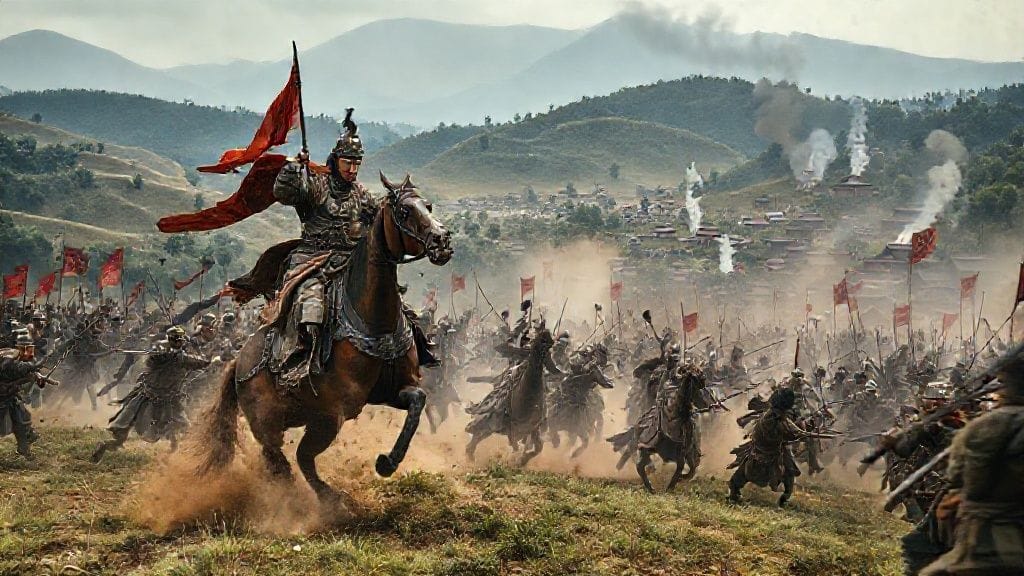
Contemporary sources like Ammianus relay that the initial Roman moves were bold. Bridgeheads were seized; temporary camps established. The legions formed in dense lines, shields locking together, while Gothic scouts hovered at the edges, studying their enemy’s movements. Clouds of mounted archers and light cavalry could appear suddenly, launch a javelin volley, and melt back into the trees. To Roman eyes accustomed to open-field battles, this style of war was unsettling, almost ghostly.
For the Goths, the arrival of a major Roman army on their soil was a shock and an insult. War bands gathered under various leaders, Athanaric among them, determined to resist the imperial incursion. But coordination was difficult. The Goths were not a centralized nation-state; they were a confederation with shifting alliances and rivalries. Some leaders may have counseled negotiation; others thirsted for vengeance. What they shared was a fury at seeing Roman standards waving beneath their sacred groves and over their burned-out farmsteads.
The campaigns that followed were fierce, confused, and costly. Skirmishes and pitched engagements blended into one another, producing no single decisive battle but a grinding erosion of strength on both sides. This erosion, as much as any lofty diplomatic vision, pushed the Romans and Goths toward the negotiating table that would eventually host the roman goths peace treaty 369.
Fire in the Forests: The Campaigns of 367–369
The years 367 to 369 formed a brutal arc of violence along the lower Danube. Roman chronicles, sparse as they are, hint at a series of campaigns that resembled a slow fire eating its way through Gothic lands. Each season brought new movements, new ambushes, and new losses.
Valens, seeking not only security but glory, personally took the field. An emperor in armor was a powerful symbol: to Roman soldiers, it signaled commitment; to the Goths, it underscored the seriousness of Rome’s intent. The army advanced northward, ravaging territories suspected of harboring hostile bands. Villages were burned, crops trampled, and—inevitably—non-combatants suffered. It was the cruel arithmetic of late Roman warfare: to break your enemy’s capacity to resist, you also undermined his ability to feed himself.
Gothic resistance adapted. Rather than risk open battles against Roman discipline and heavy infantry, Athanaric and other leaders favored harassment and carefully chosen engagements. A small Roman detachment could be lured into narrow valleys and cut down; stragglers were easy prey. Roman cavalry patrols, in turn, hunted Gothic raiders, trying to catch them before they disappeared with their plunder into the bush. The land itself became an accomplice to both sides: fog concealed movements, rivers swelled without warning, and thick woodland muffled the tramp of marching columns until it was nearly too late.
By the campaign’s second and third years, exhaustion set in. Supplies for the Roman army had to be dragged across long distances; disease nibbled at their ranks. The Goths, too, were paying a terrible price. Fields lay untended, storage pits emptied, and the dead accumulated in scattered graveyards. Already in these years, some Gothic families looked southward not with raider’s eyes but with the gaze of future refugees, wondering if Roman soil—and Roman law—could one day offer them safety from the chaos enveloping their homeland.
According to some reconstructions by modern historians such as Herwig Wolfram and Peter Heather, the cumulative effect of these campaigns was to shatter the immediate Gothic capacity to launch large-scale raids, but not to destroy their social fabric. The Goths survived; their leaders, bruised but unbroken, remained in place. Rome had won the campaigns—but not the war for lasting stability. That war would have to be fought on different terrain: the diplomatic stage of the roman goths peace treaty 369.
Weariness and Calculation: Why Both Sides Sought Peace
By 369, neither Rome nor the Goths could truly claim victory. They could count up conquered villages or slain warriors, but the ledger of costs outweighed the profits. It is here, in the shared weariness of prolonged conflict, that the logic of peace emerged.
For Valens, the Eastern emperor, the Danubian campaigns were just one theater in a sprawling imperial drama. The Persians in the east were never far from his mind; internal dissent, both political and theological, simmered. Continued war along the Danube meant more troops diverted to the frontier, more money spent on logistics, and more opportunities for disasters that could damage his reputation. A negotiated settlement, especially one that looked favorable on paper, promised to free his hands and polish his image as a bringer of order.
The Goths, for their part, faced a different but equally pressing calculus. Their lands had been scorched; their people exhausted. The balance of power among Gothic leaders was delicate, and prolonged war risked destabilizing their internal politics. Athanaric’s authority rested in part on his ability to defend Gothic autonomy and resist Roman encroachment. Continuing a war that no longer promised tangible gains could erode that authority. A peace treaty that preserved independence while reopening the flow of trade and tribute, however, could be presented as a triumph of leadership.
There were also broader, less visible forces at play. To the northeast and east, beyond the Greuthungi, new peoples—the Huns among them—were beginning to move. Their pressure on existing groups would soon become overwhelming, but already whispers and rumors must have filtered into Gothic councils. The world beyond the Danube was becoming more dangerous. In such a context, a stable relationship with the Roman Empire was an asset, not a liability.
Thus, by 369, the stage was set for a different kind of encounter. War had clarified limits; neither side could easily destroy the other. It was time, as both leadership circles realized, to test whether a carefully constructed peace could achieve what swords and torches could not. The roman goths peace treaty 369, born of weariness and calculation, would attempt to transform hostility into a managed coexistence—though its architects could not foresee how fleeting that transformation would prove to be.
On the Mid-River Raft: Staging the Roman–Gothic Encounter
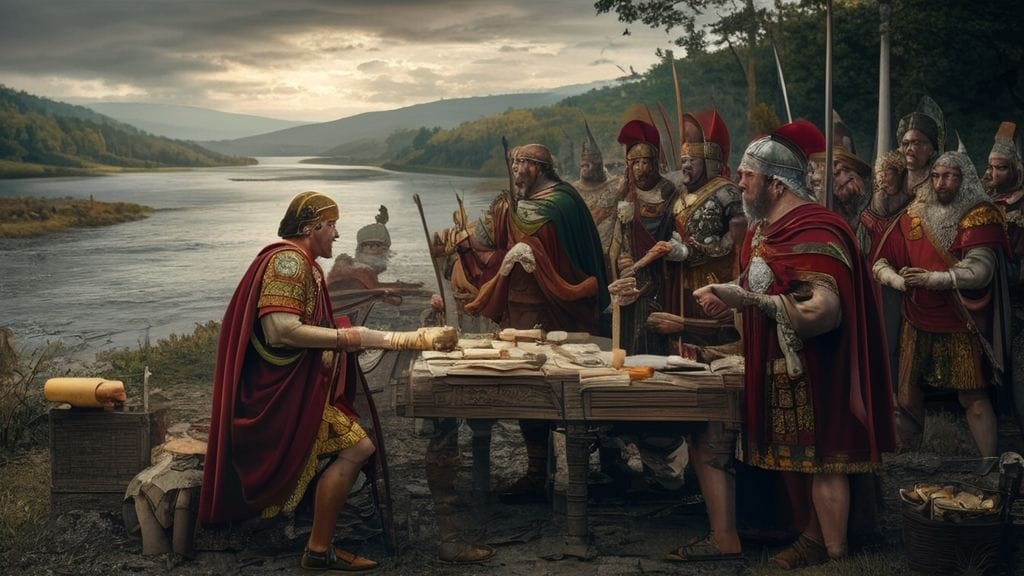
The meeting that produced the peace treaty between the Roman Empire and the Goths in 369 was more than a conversation; it was theater. The choice of location—a wooden platform anchored in the middle of the Danube—was deliberate. Neither bank, Roman nor Gothic, would host the encounter. Instead, the two delegations stepped out onto a constructed island, surrounded by water that symbolized the dangerous distance and the fragile connection between their worlds.
Imagine that scene. Roman engineers had likely overseen the building of the platform, driving pilings into the riverbed, securing planks, and ensuring that the structure could bear the weight of armed guards and dignitaries. Boats ferried each side’s representatives to the raft, careful to maintain symmetry. No party was to approach the other’s bank directly; mutual suspicion was still too strong. The river’s surface may have been choppy, the platform creaking with each wave—a constant reminder that even the ground beneath their feet was uncertain.
Valens did not necessarily appear in person on that floating stage; many scholars believe he delegated the intimate negotiations to high-ranking officers and envoys. Athanaric, however, was bound by a vow, according to later accounts, never to set foot on Roman soil. The raft allowed him to honor that commitment while still engaging in diplomacy. This detail, preserved in the memory of chroniclers, signals how much symbolism colored the encounter: even at the moment of potential reconciliation, both sides clung tightly to gestures of identity and independence.
The air would have been dense with ritual. Standards and banners fluttered above Roman armor; Gothic warriors stood in their distinctive dress, furs and metal gleaming, tall spears in hand. Interpreters shuttled words from Latin to Gothic and back again, smoothing over misunderstandings, perhaps also subtly shaping meanings. Gifts might have been exchanged—fine cloth, weapons, or jewelry—each item a token of goodwill and an instrument of persuasion.
Yet behind the ceremonies, tension crackled. Each delegation came armed, not only for self-defense but to project strength. A misinterpreted gesture, a sudden noise, even the accidental slip of a soldier’s hand to his sword could have turned the raft into a blood-soaked trap. That it did not happen speaks to the discipline on both sides and to the mutual recognition that the stakes were too high for theatrics to collapse into violence.
Words over Water: The Negotiation of the Peace Treaty
We do not possess a verbatim transcript of the discussions that unfolded on the Danube platform, but we can reconstruct their shape from the requirements of the moment and the hints left by later writers. At the heart of the roman goths peace treaty 369 lay a handful of essential questions: Where would the effective border lie? Under what conditions could Goths cross into Roman territory—and Romans into Gothic? How would trade, tribute, and security be handled in a way that both sides could publicly describe as a success?
The Romans likely opened with a stiff list of demands. They had, after all, invaded Gothic lands and claimed military superiority. They would insist on an end to raids, on the return of captives where possible, and on guarantees that Goths would not shelter Roman deserters or rebels. They may also have demanded hostages—noble Gothic youths sent to live at the imperial court, both as a sign of goodwill and as human collateral against future treachery.
Athanaric and his counselors, facing these demands, would push back to defend their autonomy. Guarantees of non-interference in internal Gothic matters were crucial. They might agree not to attack Roman territory, but they would be loath to accept any formulation implying subordination. The language of the treaty, as read aloud by interpreters and later inscribed in official records, would dance delicately around these issues, leaving the precise balance of power somewhat ambiguous, each side free to emphasize different clauses when recounting the treaty to its own people.
Trade formed another vital axis of negotiation. War had disrupted the flow of goods across the Danube, harming Gothic elites who had grown wealthy and influential through commerce with Rome. The treaty sought to restore and regularize this trade—but on terms controlled by the empire. Specific crossing points and markets were likely designated, perhaps fortified towns where Roman officials could watch and tax transactions. For the Goths, access to Roman grain, tools, and luxury items was a tangible benefit of peace. For Rome, regulated trade meant profit and influence.
One can picture pauses in the negotiations as interpreters conferred, as envoys stepped aside to consult with their leaders. A Roman officer might gesture toward the southern bank, where lines of legionaries stood at attention—a subtle reminder of force. A Gothic elder might indicate the northern forests, hinting at the countless warriors who could be summoned if Rome pushed too hard. Words, in such a setting, were not abstract; they were backed by the ever-present shadow of the armies on both shores.
Terms of an Uneasy Truce: Trade, Borders, and Hostages
When the discussions ended and the treaty was finally agreed, it solidified into a series of practical arrangements that would govern life along the Danube—for a time. Though the precise text is lost, scholars, drawing on Ammianus Marcellinus and other hints, broadly agree on its key components.
First, there was the formal recognition of a frontier. While the Danube itself remained the central line, the treaty likely clarified which fortresses and districts fell under Roman control and asserted that the Goths would remain beyond the river, not settling en masse inside imperial territory. This principle of spatial separation was crucial: Rome still clung to the ideal of a clear border, however porous reality might prove.
Second, the treaty repaired and reshaped commercial ties. Certain crossing points became official markets where Goths could sell goods and purchase Roman products under supervision. These regulated exchanges served many purposes at once: they enriched Roman tax collectors, tied Gothic elites more closely to Roman economic rhythms, and created semi-regular encounters between the two populations that could, in theory, foster familiarity as well as dependence. The roman goths peace treaty 369 was, in effect, as much an economic compact as a military one.
Third, security clauses addressed the most immediate concerns. Both sides pledged to refrain from hostile incursions. The Goths were to return, or at least cease to harbor, Roman captives. Rome, in turn, may have offered to restore certain hostages or properties, though at a clear advantage to itself. Border patrol protocols were likely delineated: how to handle accidental crossings, runaway slaves, or merchants who strayed outside authorized routes.
Finally, there was the matter of hostages. While no detailed list survives, it was common Roman practice to demand the sons of foreign leaders as guarantees of compliance. These young men would be brought to Constantinople or other major centers, where they would be educated in Roman ways, observe imperial ceremonies, and live under a gilded confinement. Their presence served as a reminder to their fathers that any breach of the treaty could have personal, not just political, consequences.
In all these arrangements, one can sense both the ambition and the anxiety of the late Roman state. The treaty sought to encapsulate the frontier in rules and obligations, as if carefully drafted clauses could bind a river whose currents were always shifting and peoples whose circumstances were changing faster than any scribe’s pen could move.
Soldiers, Settlers, and Supplicants: Human Stories behind the Treaty
Diplomacy is often told as a story of statesmen and clauses, but treaties live or die in the lives of ordinary people. The roman goths peace treaty 369 was no exception. Its signing reverberated through the camps of Roman soldiers, the huts of Gothic villagers, and the bustling markets along the Danube, altering daily routines and distant dreams alike.
In a Roman fortress like Durostorum or Novae, legionaries who had spent years bracing for sudden alarms now woke into a different rhythm. Patrols continued, of course, but their purpose subtly changed: less hunting for raiders, more monitoring merchants. A veteran who had lost friends in ambushes might greet the word “peace” with tight-lipped skepticism. Could Goths, whom he had been trained to fear and hate, really be trusted to keep their side of the bargain? Yet the quiet that slowly descended on the frontier also meant fewer chances to die in a fog-shrouded skirmish, fewer letters home that began with the dreaded phrase, “We regret to inform you…”
South of the river, peasant families in Moesia and Thrace cautiously returned to fields they had once abandoned. Children who had learned to associate the northern horizon with smoke and screams might, in time, know only the distant silhouettes of forests and hills. Market days revived, with traders bringing salt, pottery, and wine to river towns where Gothic customers appeared once more, this time under the watchful eyes of Roman overseers rather than at the head of raiding bands.
On the northern bank, the changes were no less profound. Gothic communities, depleted by war, now counted on renewed trade for survival. A woman whose husband had fallen in battle against Roman troops might watch as her brothers, sons, or new suitors paddled across to sell livestock or furs to the very people who had slain her loved ones. Resentment did not vanish with the stroke of a treaty; it lingered, quietly shaping how people spoke of Rome around hearth fires.
Some Goths, particularly those already drawn to Christianity and Roman culture, may have seen the peace as a chance. They imagined futures as foederati—federate soldiers—serving in imperial ranks, or as merchants carving out profitable niches along the frontier. Others, more wary or proud, regarded such visions as a betrayal of Gothic ways. The treaty, in this sense, deepened existing social divisions as much as it healed external ones.
Echoes through the Provinces: Political and Social Consequences
The signing of the peace reverberated up the chains of power and out across the provinces. For Valens, news of the successful conclusion of the roman goths peace treaty 369 was a political asset. He could present himself as the stabilizer of the Danube, the emperor who had pacified a restless frontier. The eastern half of the empire, at least on the northern border, now appeared secure. This freed him to focus on other matters: the perennial problem of Persia, and the intensifying religious conflicts within his own dominions.
At court in Constantinople, imperial officials and bishops would have debated the meaning of this stability. Some military men might argue for reducing troop numbers along the Danube to save costs, trusting the treaty to hold. Others, more cautious or more experienced, would urge that the Goths’ word was only as strong as their current needs—that one bad harvest or one ambitious warlord could turn neighbors back into enemies. In the senate halls of the city, each faction could twist the treaty to support its own policies.
On the Gothic side, Athanaric could boast that he had faced Rome and forced it to negotiate on terms that did not entail Gothic subjugation. He had not bent the knee in any Roman city; he had treated with the emperor’s envoys in a space that respected Gothic honor. This narrative strengthened his position against internal rivals, particularly those more open to Roman influence or Christian teaching. At least for a while, peace with Rome translated into political capital at home.
Yet there were contradictions embedded in this new order. Economic ties to Rome intensified the dependence of Gothic elites on the imperial economy. Local chieftains who controlled trade routes and market access became more powerful, potentially upsetting older balances within Gothic society. In the Roman provinces, landowners who profited from selling grain and goods to Gothic customers gained leverage as well. The Danube frontier was not just a military line; it was a socio-economic hinge on which fortunes could turn.
Socially, the treaty fostered more frequent but more regulated contact between Romans and Goths. Mixed marriages, the exchange of cultural practices, and even shared religious experiences became more common, especially in border towns. This blending worried hardliners on both sides. Traditionalist Goths feared the dilution of their customs; Roman elites complained that “barbarian” manners were seeping across the river along with foreign fashions and accents.
A Frontier Reimagined: The Danube after 369
In the years immediately following the treaty, the Danube frontier entered a period often described as “relative calm.” The phrase is telling: this was not peace in any modern, absolute sense, but a reduction in large-scale violence and a shift toward more predictable patterns of contact. Rome, through fortresses and officials, continued to project power along the river, while Gothic groups reorganized within their territories, dealing with the scars of war and the opportunities of renewed trade.
Frontier towns like Sirmium and Singidunum, further up the river, hummed with activity. Caravans from the interior provinces brought wares to be shipped northward; Gothic traders or their intermediaries ferried them beyond the imperial boundary. Along the docks and in the taverns, Latin mingled with Gothic and other tongues. Priests and bishops, sensing fertile ground for converts, traveled the frontier preaching to anyone who would listen—Roman soldiers, migrant laborers, and curious Goths alike.
The Roman administration, for its part, sought to codify and control this new reality. Regulations were written to define who could cross where, under what circumstances, bearing which goods. Passes might be issued; tolls collected. Local commanders tallied statistics—numbers of traders, volumes of grain, incidents along patrol routes—sending their reports back to regional governors. The frontier was becoming bureaucratized as well as militarized.
Yet beneath this surface order, the Danube remained what it had always been: a liminal space. Smugglers found ways around official posts, slipping goods and people across in the dead of night. Deserters from the Roman army sometimes disappeared into Gothic territory, trading their oaths to the emperor for a chance at freedom or a place in a foreign war-band. Conversely, Gothic youths, dissatisfied with life north of the river, might seek their fortunes in Roman service, enlisting as auxiliaries or guards.
The treaty had reimagined the frontier as a managed interface rather than a simple barrier. But the more interconnected the two sides became, the more fragile that management would prove when crises struck.
Fault Lines in the Peace: Famine, Pressure, and Restless Warriors
No treaty, however carefully crafted, can insulate a region from larger forces. In the decade after 369, the security that Valens and Athanaric had tried to create was slowly undermined by pressures none of their negotiators could fully foresee. Chief among these were environmental stress, demographic shifts, and the rise of new powers beyond the Gothic horizon.
Famine remained a constant threat in late antiquity. A few bad harvests in succession could devastate communities already weakened by previous wars. For the Goths, whose subsistence balanced precariously among farming, pastoralism, and raiding or trading, the failure of crops or the loss of herds could make the difference between rough sufficiency and starvation. In such conditions, treaties that limited free raiding into Roman territory could begin to feel like shackles rather than lifelines.
At the same time, pressure from the east intensified. The Huns, mounted warriors from the steppe, began to push westward with a ferocity that stunned contemporaries. Their movements forced other groups—Alans, then Greuthungi and Thervingi—into motion. What had been a somewhat stable mosaic of peoples north of the Danube became a swirling eddy of fear, flight, and conflict. The exact chronology of these movements is debated, but by the mid-370s, signs of mounting stress were unmistakable.
Within Gothic society, warriors who had grown up in the shadow of the roman goths peace treaty 369 found their ambitions constrained by its limits. Younger leaders, less scarred by direct fighting with Rome, might view the agreement as an outdated compromise their elders had made under duress. The balance of power between figures like Athanaric and more pro-Roman or opportunistic leaders such as Fritigern began to shift, introducing new fractures into Gothic politics.
Rome, for its part, grew complacent. The relative quiet after 369 encouraged some officials to see the Danube as “solved”—a frontier that no longer required sustained attention. Troops might be reassigned, fortifications neglected, and urgent warnings from frontier officers downplayed in imperial councils. It is in such atmospheres of overconfidence that sudden disasters so often brew.
From 369 to 378: How a Treaty Led toward Adrianople
A mere nine years after the peace of 369, the Roman Empire would suffer one of the worst defeats in its history at the Battle of Adrianople in 378. The path from the mid-river platform on the Danube to the fields outside that Thracian city was neither straight nor inevitable, but the earlier treaty formed an essential chapter in the story.
When the Huns advanced and Gothic groups found themselves squeezed between an implacable eastern enemy and the guarded banks of the Danube, many sought refuge within the Roman Empire. In 376, large numbers of Thervingi, led by Fritigern and others, approached the river and begged Valens for permission to cross and settle as federates. The emperor, remembering earlier arrangements and perhaps assuming that the framework of the roman goths peace treaty 369 could be adapted, agreed—on paper.
The reality was chaotic. Crossing points became scenes of desperation as Gothic families, with what possessions they could carry, crowded the banks, trying to secure space on boats or rafts. Roman administrators and officers, some corrupt, some simply overwhelmed, mishandled the influx. Food was scarce; promised supplies delayed or diverted. Tens of thousands of hungry newcomers—many of them armed—found themselves penned into makeshift camps in Thrace and Moesia, treated more as prisoners than allies.
The older treaty’s assumptions—that movements across the Danube could be controlled through limited, regulated crossings and that Gothic groups would remain outside the empire unless carefully invited in small numbers—were shattered. The scale of migration in 376 dwarfed anything the 369 negotiators had imagined. Once the Goths realized that Roman promises of food and land would not materialize as pledged, rebellion flared. Bands slipped away from the supervision of Roman officers, heading into the countryside, seizing what they needed to survive.
The ensuing Gothic War culminated in the catastrophic battle near Adrianople, where Valens, desperate for a decisive victory and perhaps eager to claim sole glory before his western counterpart could arrive, attacked a Gothic force and was disastrously defeated. The emperor himself perished, his body never definitively found. The army of the East was shredded, its core of experienced troops annihilated.
In retrospect, the peace treaty of 369 appears doubly tragic. It had shown that some form of stable arrangement between Rome and the Goths was possible, that coexistence along the Danube need not always mean open war. Yet it had also lulled imperial leaders into underestimating the scale and volatility of future crises. They remained wedded to a frontier model that could not accommodate mass migration, only managed trade and controlled, small-scale movements. When reality broke those boundaries, the empire was unprepared.
Chroniclers, Myths, and Memories: How History Remembers the Pact
Our knowledge of the roman goths peace treaty 369 comes to us through a narrow aperture of sources. Chief among them is Ammianus Marcellinus, often called the “last great Roman historian,” whose Latin narrative, though incomplete and biased, provides invaluable detail on the late fourth century. Ammianus, a former officer, wrote with a soldier’s eye for strategy and a moralist’s concern for the character of emperors. He praised bravery, condemned incompetence, and rarely missed a chance to highlight the ironies of fortune.
In his account, the campaigns of Valens against the Goths and the subsequent peace appear as part of a larger pattern of imperial engagement with barbarian neighbors. The raft meeting on the Danube, with Athanaric’s vow not to step on Roman soil, stands out as a vivid vignette—a fragment of diplomatic theater preserved because it illustrated both Gothic pride and Roman flexibility. Ammianus does not dwell on the social consequences of the treaty; his interests lie in high politics and military affairs. But his passing remarks have allowed later historians to reconstruct the outlines of the agreement.
Other sources, such as later ecclesiastical historians, mention the deeper context of Gothic Christianity and Athanaric’s persecutions, casting the treaty in a religious as well as political light. In their telling, the encounter between Rome and the Goths is entwined with the spread of Christian doctrine, internal church debates, and the martyrdom of Gothic converts who refused to sacrifice to traditional gods. The peace of 369 thus becomes, indirectly, part of a contested narrative about the triumph of Christianity within and beyond the empire.
Modern scholarship, drawing on archaeology, numismatics, and comparative analysis, has further complicated the picture. Excavations along the Danube frontier reveal shifts in settlement patterns and military installations after the treaty, confirming a relative stabilization. Studies of coin hoards suggest changing economic flows between Roman and Gothic territories. Historians such as Peter Heather and Michael Kulikowski debate how far the treaty represented genuine Roman control versus a temporary accommodation with a still-dangerous neighbor.
Myth, too, has played its role. In later medieval and early modern imaginations, the Goths became ancestors to various European peoples, wrapped in legends of heroic kings and noble savagery. The subtleties of a fourth-century peace treaty faded behind grander tales of falls and foundings, of Rome’s decline and “barbarian” kingdoms’ rise. Only in the careful work of modern historiography has the Danube platform of 369 emerged again as a crucial, if fragile, bridge between two worlds.
Power, Fear, and Diplomacy: Interpreting the Roman–Gothic Peace
What, then, should we make of the roman goths peace treaty 369? Was it a triumph of Roman statecraft, a cunning move by Gothic leaders, a mere armistice in a longer war, or something more complex still? The answer lies in recognizing that it was all of these at once—a snapshot of a relationship built on power, fear, and the improvisations of diplomacy.
From one angle, the treaty looks like a clear Roman success. Valens had invaded Gothic territory, inflicted damage, and emerged with an agreement that restored security to his provinces and reaffirmed the Danube as the empire’s northern boundary. He reasserted Roman authority and won time to address other crises. In this reading, Rome dictated terms from a position of strength; the Goths, hurt and harried, had little choice but to accept.
Yet from another angle, the Goths also secured important gains. They retained their independence; no Roman garrisons occupied their lands, no humiliating submission rituals took place in imperial cities. Trade with Rome, vital to the prestige and wealth of Gothic elites, resumed under a legal framework. Athanaric could claim that he had defended Gothic honor while extracting practical concessions. In this sense, the treaty was a mutual recognition: an acknowledgment that neither side could afford endless war.
The deeper lesson, perhaps, lies in what the treaty could not do. It could not stop the Huns. It could not prevent future famines or internal power struggles. It could not transform the structural reality that the Roman Empire and the Gothic groups were intertwined in ways that defied neat separation. By imagining the frontier as a line that could be frozen in place through clauses and ceremonies, the treaty revealed both the sophistication and the limits of late Roman diplomacy.
Diplomacy in late antiquity was an art of managing uncertainty with symbolic gestures and practical arrangements. The mid-river raft, the exchange of hostages, the careful wording of pledges—these were tools to buy time and shape behavior. They were not, and could not be, final solutions. In that sense, the peace of 369 stands as a poignant example of how empires try to choreograph a world that refuses to stay still.
Legacies on the River: The Treaty’s Long Shadow over Europe
The wooden platform on the Danube has long since rotted away, its timbers carried downstream and lost in the sediments of history. Yet the decisions made upon it cast a long shadow. The roman goths peace treaty 369 marked a moment when Rome and the Goths both recognized that their fates were entangled, and tried to manage that entanglement through law rather than slaughter. The failure of that effort, a decade later, did not erase its significance; it underscored its urgency.
In the centuries that followed, similar scenes would replay themselves in different forms. Medieval kings and steppe khans, early modern monarchs and frontier chieftains—all grappled with the challenge of negotiating with mobile, militarized neighbors beyond their borders. The Danube platform, in this broader story, becomes an early rehearsal for the diplomacy of later Europe: uneasy parley between settled states and mobile confederations, between tax-based empires and warrior societies whose power flowed from people rather than territory.
Within Gothic history, the treaty stands as a prelude to the transformation of the Goths from border confederations to kingdom-founders. In the fifth century, Gothic groups would play decisive roles in the making of post-Roman Europe, establishing realms in Italy and Spain, becoming, paradoxically, both the heirs and the gravediggers of the empire they had once faced across the Danube. The difficulties of 369, the misunderstandings and partial accommodations, foreshadowed the more permanent but always conditional settlements that later emerged inside the old Roman world.
Modern Europe, with its intricate web of borders, treaties, and supranational institutions, still lives with dilemmas not unlike those that confronted Valens and Athanaric. How does a powerful but anxious center relate to mobile populations at its edges? How do economic interdependence and cultural exchange coexist with desires for autonomy and control? The Danube peace of 369 does not offer easy answers, but it provides a stark, early case study of the stakes involved when empires and migrants, states and confederations, must choose between negotiation and war.
On a winter morning, if one stands on the banks of the Danube and listens to the water, it is possible—if only in imagination—to hear the echoes of that long-ago meeting: the creak of timbers, the murmur of interpreters, the clash of syllables from two languages seeking a common ground. The river flows on, but the human questions posed upon it in 369 remain with us.
Conclusion
The peace treaty between the Roman Empire and the Goths on the Danube in 369 was born from exhaustion, fear, and pragmatic calculation. It sought to halt a cycle of raids and reprisals that had scarred both banks of the river, replacing the unpredictable violence of frontier war with rules for trade, movement, and mutual restraint. On a wooden platform moored between worlds, Roman envoys and Gothic leaders tried to redraw their relationship in ink rather than blood.
For a brief moment, the roman goths peace treaty 369 succeeded. The provinces of Moesia and Thrace breathed easier; Gothic communities rebuilt; markets revived. Political leaders on both sides claimed credit. Yet the forces it tried to manage—migration, environmental stress, distant invasions, and internal factionalism—soon overflowed its bounds. Within a decade, mass Gothic migrations and Roman mismanagement would plunge the frontier into a deeper crisis, culminating in the disaster at Adrianople and reshaping the trajectory of the late Roman world.
Still, dismissing the treaty as a mere prelude to catastrophe would miss its larger meaning. It represents a moment when two very different societies recognized their mutual dependence and attempted, however imperfectly, to formalize coexistence. It reveals the sophistication of late Roman diplomacy, the pride and anxieties of Gothic leadership, and the complex human realities of a frontier that was never just a line on a map. In its ambitions and its limits, the Danube peace of 369 offers a vivid window into how empires confront the challenges of a changing world—and how even the most carefully crafted agreements rest on waters that can never entirely be stilled.
FAQs
- What was the roman goths peace treaty 369?
The roman goths peace treaty 369 was an agreement concluded between the Eastern Roman emperor Valens and the Gothic leader Athanaric on the Danube River, designed to end a series of brutal frontier campaigns. It reaffirmed the Danube as the primary boundary, regulated trade and crossings, and sought to prevent further raids and large-scale hostilities. - Where exactly was the treaty negotiated?
The negotiations took place on a specially constructed wooden platform or raft anchored in the middle of the Danube. This symbolic “neutral ground” allowed Gothic leaders like Athanaric, who had vowed never to set foot on Roman soil, to meet Roman envoys without violating their oaths, while also assuring both sides that neither was at the other’s mercy. - Who were the main figures involved in the treaty?
The key figures were Emperor Valens, ruler of the Eastern Roman Empire, and Athanaric, a leading judge and warlord of the Gothic Thervingi. While Valens may not have personally stood on the platform, his senior officials represented him in the talks. Athanaric’s role was central in expressing and defending Gothic interests. - What were the main terms of the peace agreement?
The treaty reaffirmed the Danube frontier, committed the Goths to end raids into Roman territory, and re-established regulated trade through designated crossing points and markets. It likely included provisions for the exchange or return of captives and may have involved the giving of hostages—noble Gothic youths sent to the Roman court—to guarantee compliance. - How did the treaty affect everyday life along the Danube?
For Roman soldiers and frontier villagers, the treaty brought a noticeable reduction in large-scale violence and a gradual return to more predictable routines. Market activity revived, and controlled exchanges with Gothic traders became part of daily life. For Gothic communities, renewed trade with Rome helped them recover from wartime devastation, though memories of suffering and mistrust remained strong. - Did the treaty permanently secure the Roman frontier?
No. While the agreement brought several years of relative stability, it could not withstand the larger forces reshaping the region, including the westward movement of the Huns and subsequent mass Gothic migrations. By 376, large Gothic groups crossed the Danube seeking refuge within the empire, and within two years the Roman army suffered a devastating defeat at Adrianople. - How do historians know about the treaty today?
Most of what we know comes from late Roman historians, particularly Ammianus Marcellinus, who described Valens’s Gothic campaigns and the encounter with Athanaric. Ecclesiastical writers and later chroniclers provide additional context, especially regarding Gothic Christianity. Modern scholars complement these texts with archaeological findings along the Danube to reconstruct the treaty’s impact. - Why is the treaty considered historically important?
The treaty is significant because it illustrates how the late Roman Empire tried to manage powerful neighboring peoples not simply through force but through structured diplomacy and economic integration. It highlights the complexity of Roman–Gothic relations and foreshadows the later transformation of the Goths from frontier confederations into kingdom-builders within the collapsing Western Roman world. - Did the treaty influence later Roman–barbarian agreements?
Yes, in the sense that it exemplified a pattern of using treaties to convert dangerous neighbors into regulated partners through trade, hostages, and formalized borders. Later foedus agreements with Goths and other groups followed similar principles, though the scale of migration and settlement in the later fourth and fifth centuries far exceeded what the 369 treaty was designed to handle. - What can the roman goths peace treaty 369 teach us today?
The treaty offers a historical case study in the challenges of managing volatile frontiers, mass movement of peoples, and deep cultural differences through negotiation rather than constant war. It shows both the potential and the limits of diplomacy when facing structural pressures like migration, economic dependency, and shifting geopolitical power—issues that continue to resonate in modern border politics.
External Resource
Internal Link
Other Resources
- Encyclopaedia Britannica – general search for the exact subject
- Google Scholar – academic search for the exact subject
- Internet Archive – digital library search for the exact subject