Table of Contents
- An Ocean Without End: The World Before Easter Island Entered European Maps
- A Dutch Republic of Merchants, Maps, and Faith
- Jakob Roggeveen: Lawyer, Theologian, Reluctant Explorer
- A Secret Commission and the Dream of Terra Australis
- Three Ships into the Void: Leaving the Netherlands for the Unknown
- Hunger, Empty Horizons, and Mutinous Thoughts in the Mid-Pacific
- Easter Sunday, 1722: When Lookouts Cried Land
- Jakob Roggeveen Discovers Easter Island: First Impressions from the Sea
- Coming Ashore Among Giants: The First Landing and the Moai
- Gifts, Misunderstandings, and Gunfire: A Fragile Encounter Turns Violent
- Faces in Stone, Voices in Silence: Interpreting Rapa Nui Society
- From Marginal Note to Maritime Sensation: Europe Reacts to the New Island
- Cartographers, Missionaries, and Empires: How a Tiny Island Reshaped the Map
- The Long Shadow of Contact: Disease, Collapse, and Cultural Survival
- Myths of Mystery Island: Reinventing Rapa Nui in the European Imagination
- Archaeologists Revisit the Land Roggeveen Saw
- Rapa Nui Voices: Reclaiming a History Framed by Discovery
- Chronicle of a Single Day: 5 April 1722 in Global Perspective
- Conclusion
- FAQs
- External Resource
- Internal Link
Article Summary: On 5 April 1722, a Dutch expedition under Jakob Roggeveen, driven by commercial ambition and curiosity about a hypothetical southern continent, stumbled upon a remote speck of land that Europe had never seen before. In this sprawling narrative, we follow how Jakob Roggeveen discovers Easter Island during a tense, hungry voyage across the Pacific and how that momentary contact altered both European maps and Rapa Nui history. The article tracks the political world of the Dutch Republic, Roggeveen’s unlikely path from lawyer and theologian to explorer, and the vivid drama of Easter Sunday when lookouts finally cried “Land!” We explore what Roggeveen and his crew actually witnessed—the towering moai, the seemingly treeless slopes, the wary but fascinated islanders—and how quickly misunderstanding led to violence. From there, we examine how the phrase “jakob roggeveen discovers easter island” was translated into maps, travelogues, and imperial agendas that would later envelop the island in waves of missionaries, whalers, and colonizers. Finally, we contrast European myths of a “mysterious” island with archaeological findings and Rapa Nui oral traditions, tracing how a single recorded encounter on an Easter morning echoed across centuries of scholarship, imagination, and cultural survival. Throughout, we return again and again to the moment when jakob roggeveen discovers easter island as a hinge between isolation and exposure, between a local past and a global gaze. In doing so, the article asks whose “discovery” this truly was, and what it means when one side writes almost all of the early record.
An Ocean Without End: The World Before Easter Island Entered European Maps
For centuries before any Dutch sail appeared on the horizon, the Pacific Ocean was, to European minds, mostly emptiness—an immense blue void marked by rumor, fragments of travelers’ tales, and the stubborn belief in a southern continent balancing the world. On maps in Amsterdam and Paris, this imagined Terra Australis stretched across the lower half of the globe like a ghostly promise. The central Pacific, far from the Americas’ coasts and the busy Manila galleon routes, remained a space of speculation. Yet this “void” was an illusion, born of European ignorance. Long before the moment when Jakob Roggeveen discovers Easter Island in the European record, Polynesian navigators had threaded the Pacific with routes invisible to western cartographers, guided not by compasses or astrolabes but by stars, swells, birds, and ancestral memory.
On many European globes made around 1700, the Pacific was a wide, pale wash with only a few known points: the outlines of New Guinea, the great curve of New Holland (Australia) to the west, and scattered island groups gleaned from Spanish and Dutch encounters. Somewhere in that emptiness, scholars and merchants thought, there must be land—rich, temperate, and ready for trade. Explorers like Abel Tasman had already shown that huge landmasses did indeed exist in the southern oceans; surely there were more. It is within this mental landscape of absence and desire that the story of Roggeveen’s voyage takes shape. Before his ships ever left the Netherlands, Easter Island was already “there” in a way: part of the European need to convert blank spaces into named places.
But at the same time, Rapa Nui—the island that would become “Easter Island”—was not at all empty. Its people had for centuries farmed its thin soils, carved its giant statues, fought over its scarce resources, and told stories that bound the land to the sky. They did not need Jakobus Roggeveen, commander of a Dutch flotilla, to make their home real. The fact that history often begins this story with the phrase “jakob roggeveen discovers easter island” tells us as much about whose voices prevailed in archives as it does about the actual events of 5 April 1722. What Europeans saw as a fresh entry in logbooks was, for the islanders, a sudden disturbance in an already ancient continuum.
Still, to understand how that disturbance came about, one must first return to the bustling, canal-laced cities of the Dutch Republic, where paper, ink, and profit shaped the urge to send ships into the unknown. The Pacific did not “call” to Roggeveen in the romantic sense; it beckoned through ledgers and theological debates, through the intersecting ambitions of merchants and missionaries. The oceanic void on the map was, above all, a business opportunity—and a spiritual frontier.
A Dutch Republic of Merchants, Maps, and Faith
In the early eighteenth century, the Dutch Republic was past its absolute golden peak but still a formidable maritime power. Amsterdam’s harbor forests of masts testified to a web of trade that reached from the Baltic to the Spice Islands. The Dutch East India Company (VOC) and the Dutch West India Company (WIC) were quasi-state powers, with their own armies, fleets, even fortresses. Profits from spices, sugar, and slaves—harsh wealth wrested from colonized lands and labor—funded universities, printing presses, and an astonishing efflorescence of mapmaking.
Map shops in Amsterdam were not quiet studios but lively centers of debate. Sailors came in to trace their former routes on parchment, scholars argued over the proper placement of coastlines, and entrepreneurs calculated new ventures. Yet even within this sophisticated cartographic culture, the Pacific remained hazy. Spanish secrecy about their Pacific routes, jealously guarded since the sixteenth century, meant that northern Europeans knew little beyond a few hard-won fragments. Dutch mariners had skirted parts of the region—Tasman around Van Diemen’s Land, for example—but vast stretches remained uncharted. It was in this atmosphere of partial knowledge that the idea of a new voyage took form, one that might finally pierce the veil of the central Pacific.
The Dutch Republic was also a realm of religious contention and experiment. Calvinism was dominant, but dissenting sects flourished in the cracks of official doctrine. Theologians debated predestination, the nature of grace, and the proper bounds of church authority. One of these theologians, Arend Roggeveen, would be crucial in shaping the later destiny of his son Jakob. Arend was more than a man of faith; he was a geographer of sorts, fascinated by the physical world that God had created. He poured over nautical charts, keeping up with the latest discoveries. It is no accident that in such a climate, where merchant capitalism, mapmaking, and restless theology intertwined, someone like Jakob Roggeveen could emerge—at once lawyer, scholar, and, eventually, explorer.
Yet behind this apparent abundance, there were anxieties. The VOC’s dominance in Asia faced challenges, the WIC struggled, and rivals like England and France nipped at Dutch heels. New routes, new markets, and new alliances were not luxuries; they were necessities in a competitive Atlantic and Indian Ocean world. A rumored southern continent might provide not only material riches but also strategic positioning, a new theater in which the Dutch could outmaneuver their competitors. When Jakob Roggeveen eventually sailed westward into the Pacific and toward the day when he would record that he, Jakob Roggeveen, discovers Easter Island, he carried with him the weight of this national anxiety—unspoken, but inscribed in every order he received and every chart he consulted.
Jakob Roggeveen: Lawyer, Theologian, Reluctant Explorer
Jakob Roggeveen did not fit the typical heroic mold of an age-of-discovery captain. Born in Middelburg in 1659, he came of age in a prosperous provincial center tied closely to maritime trade but also known for its intellectual ferment. As a young man, Roggeveen studied law at the University of Harderwijk and later pursued theology. He served for a time as a notary and then as a “Raadsheer” (councilor) for the Dutch East India Company in Batavia (now Jakarta), the beating administrative heart of Dutch Asia.
These experiences shaped him profoundly. In Batavia, he glimpsed the harsh realities behind the VOC’s tidy balance sheets: enslaved and coerced labor, sharp racial hierarchies, and the violent enforcement of monopoly. He also immersed himself in religious disputes, attracted to more liberal or heterodox interpretations of Calvinism. This would later cause him trouble. After he returned to the Netherlands, his authorship of controversial theological pamphlets led to accusations of heresy and eventually to a ban on their publication. The same man who would later command three ships into the Pacific was, for a time, locked in battles over doctrine and censorship at home.
By the time he approached his sixties, Roggeveen might have seemed an unlikely candidate for a grueling voyage of exploration. He was no young, dashing adventurer but a grizzled, opinionated intellectual with grievances against powerful institutions. Yet precisely this marginal status made him available for more radical projects. His father Arend had long nursed a scheme to search for Terra Australis, drawing up maps and proposals that went unrealized. When Arend died, those dreams passed to Jakob. Here was a different kind of inheritance, not of land or money but of an idea: that in the unmapped Pacific lay something grand, just waiting for a daring Dutch expedition.
There was vanity in this, of course. To lead a successful expedition would be to inscribe his name in the history of geography, to ensure that future generations would note that Jakob Roggeveen discovers Easter Island and, perhaps, much more besides. But the motives were more tangled than simple fame. There was a quasi-missionary zeal to redeem the world’s unknown corners for Protestant commerce and possibly even Protestant faith, a desire to show that God’s creation could be rationally described and economically exploited. And there was familial piety: a wish to fulfill his father’s unfulfilled plan, to turn Arend’s paper-bound dreams into wooden hulls cutting through real waves.
A Secret Commission and the Dream of Terra Australis
The idea of a southern continent was ancient, rooted in classical speculation that land in the north must be balanced by land in the south. By the eighteenth century, Terra Australis had become a tantalizing mixture of scientific hypothesis and wishful thinking. Some geographers dismissed it; others insisted there must be a massive landmass somewhere below known latitudes. It was this disputed idea that Roggeveen and his backers seized upon when planning a private expedition.
They could not count on the full, formal backing of the VOC, which was wary of ventures outside its core profit zones and protective of its monopolies. Instead, Roggeveen turned to the West India Company, whose principal sphere was the Atlantic but whose charter, cunningly interpreted, allowed for broader ventures. Negotiations were discreet, for any expedition that strayed into the VOC’s Asian domains risked legal and even military conflict. The commission that finally authorized Roggeveen’s voyage was therefore half-open, half-occluded: an official document overlaying a more private, speculative ambition.
The instructions he received were straightforward on paper: search for Terra Australis, seek out new islands and trade opportunities, avoid direct conflict with the VOC’s zones of control if possible. But the margins of those instructions were full of risk. If he succeeded in finding rich lands, he and his sponsors would gain glory and profit; if he intruded on VOC preserves, he might be branded a rogue or even a pirate. It is ironic that the voyage most remembered now because Jakob Roggeveen discovers Easter Island began under the sign of possible illegality in the eyes of his own countrymen.
Preparation for departure involved the usual mix of the practical and the hopeful. Three ships were fitted out: the Arend, the Thienhoven, and the Afrikaansche Galey, carrying around 244 men between them. Provisions included barrels of salted meat, casks of water, hardtack, beer, tools, trade goods, and weapons. They carried charts compiled from earlier Dutch voyages, as well as conjectural maps that sketched out where Terra Australis might lie. Roggeveen also brought along learned works about navigation and geography—as if books could keep chaos at bay once the masts were swallowed by the horizon.
The expedition’s secrecy extended even to its intended route. On 1 August 1721, the small flotilla slipped out of the Texel bound first for the Atlantic, with only a handful of high-ranking men fully aware of what lay ahead. In the long months between that departure and the Easter Sunday when Roggeveen would sight a lonely island in the mid-Pacific, there would be storms, deaths, mutiny scares, and growing doubt. Terra Australis might exist; it might not. But the ocean would not yield its secrets easily.
Three Ships into the Void: Leaving the Netherlands for the Unknown
The departure itself was almost routine in appearance: another West India Company voyage, another set of hulls departing the chilly waters of the North Sea for the promise—and peril—of warmer latitudes. Yet for those aboard, particularly the officers aware of the Pacific objective, there was a solemnity to the moment. Once the low coast of Holland sank from view, they were committing to a journey that might stretch over two years and from which many would not return.
The early legs resembled countless other Dutch voyages. The ships sailed southwest toward the Canary Islands, then farther down toward the Cape Verde archipelago, catching the northeast trades before entering the doldrums and, eventually, the southeast trades that would carry them around Cape Horn. Life aboard was cramped and stifling. The men slept in swaying hammocks or on planks, sharing space with rodents and the ever-present smell of tar, sweat, and salted meat. Daily routines were dictated by the bells: watches rotated, decks were scrubbed, sails trimmed, and food distributed with mechanical regularity.
Roggeveen maintained a dignified distance, but he was no aloof figurehead. He inspected the ships, checked the log, observed the crew’s discipline, and kept a wary eye on officers whose loyalty he could not fully trust. In his cabin, by dim lamplight, he wrote entries that balanced dry navigational data with glimpses of his inner thoughts. In one surviving account, later paraphrased in a contemporary edition of his voyage, the monotony of long stretches at sea combines with an almost mystical sense of traversing an unbounded world: “We go forward upon the waters as upon the very silence of God’s creation,” a later editor has him write, echoing his pious training.
Rounding Cape Horn proved grueling. The ships battled fierce storms, icy winds, and towering waves that threatened to snap masts and tear sails to shreds. Men were washed overboard; others succumbed to illness brought on by cold and exhaustion. The southern ocean, far from any sheltering land, hammered home a sobering truth: this was not a mere commercial venture but a passage through one of the planet’s most hostile theaters. Every mile gained westward would have to be paid for in human suffering. When, after weeks of struggle, they finally emerged into the calmer if still vast reaches of the Pacific, there must have been a collective sense of battered relief.
It was here, in this newly entered realm, that the expedition’s secret objective came to the fore. Charts were reexamined, estimates of longitude argued over. No one could be certain exactly where they were; the problem of finding longitude at sea, unsolved until the later eighteenth century, meant that their east-west position rested on dead reckoning—and hope. Nevertheless, Roggeveen pressed on, steering northwestward into waters that, on their charts, were more conjecture than fact. If Terra Australis loomed anywhere nearby, the ocean maintained its poker face.
Hunger, Empty Horizons, and Mutinous Thoughts in the Mid-Pacific
As the weeks in the mid-Pacific stretched on, the initial tension of the voyage settled into a heavier weariness. Rations shrank as the officers calculated how long supplies might last if no land was found soon. Fresh water grew stale and brackish. Scurvy, that perennial scourge of long ocean voyages, began to gnaw at the crew. Gums bled, old wounds reopened, teeth loosened in their sockets. The men scanned the horizon not only out of duty but out of desperate hope: a sight of land meant coconuts, fresh meat, maybe even friendly inhabitants willing to barter.
The Pacific did not oblige. Day after day, the lookout’s calls confirmed what everyone could see with their own eyes: water in all directions, broken only by the line where sea met sky. Under such conditions, rumor thrived. Some sailors whispered that their leaders had lost their way, that there was no southern continent, that they were being driven into a watery grave by a commander more interested in his own fame than their lives. Others grew suspicious of the carefully guarded maps and papers in Roggeveen’s cabin. Why so much secrecy, they wondered, if everything was going according to plan?
Roggeveen, for his part, must have felt the strain. Though his log remains formal, one senses in the terse remarks about provisions and crew discipline an undercurrent of concern. Terra Australis remained invisible; even smaller islands, known from Spanish accounts, proved elusive. Currents played tricks with their estimates; the stars were their only reliable friends. Yet he pushed westward still, calculating that the vast expanse before them must eventually yield something. He could not yet know that the first significant land they would encounter would be no sprawling southern continent but a single, isolated triangle of volcanic rock. Nor could he know that later generations would compress the complexity of their entire voyage into the tidy phrase that “jakob roggeveen discovers Easter Island.”
In early April 1722, the mood on board was approaching crisis. Provisions were dangerously low. The risk of open mutiny, while perhaps not imminent, had become a specter in officers’ conversations. Some urged turning north or south in search of more likely island groups; others counseled patience. It was at this fraught juncture that a small but decisive change in course—part navigation, part providence, part sheer luck—brought them onto a collision path with a lonely island awaiting an unwitting role in global history.
Easter Sunday, 1722: When Lookouts Cried Land
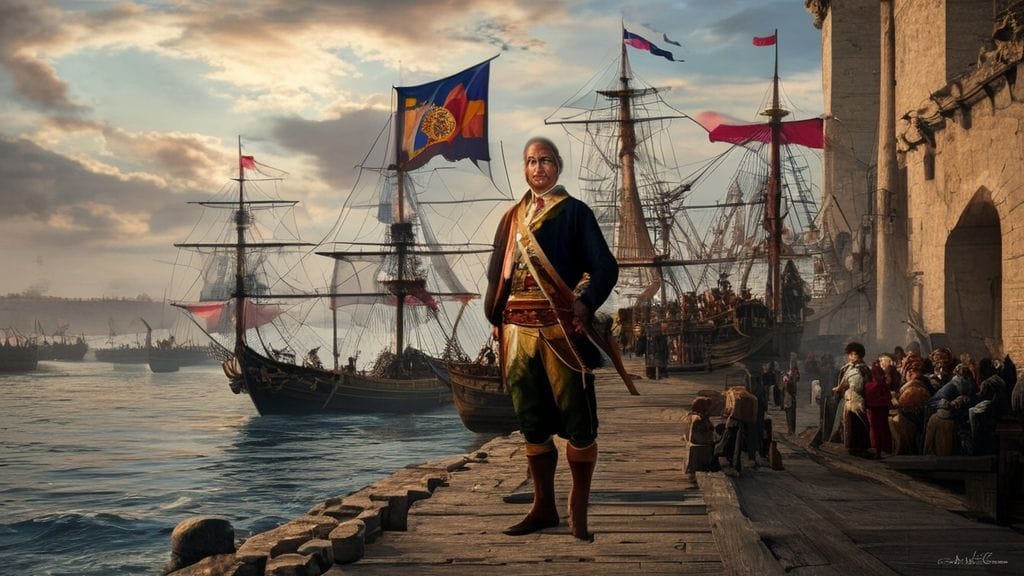
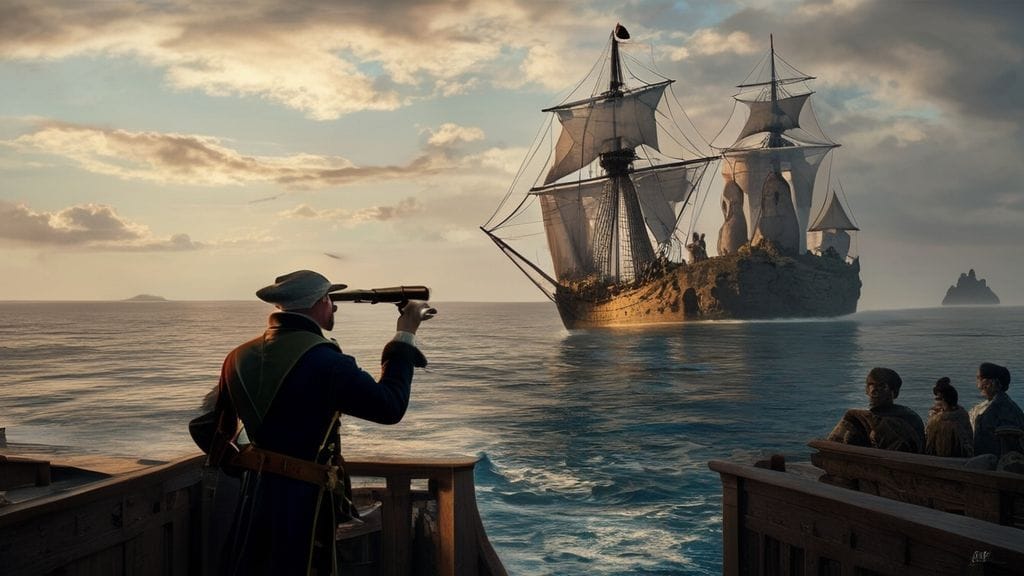
It was dawn on 5 April 1722, Easter Sunday in the Christian calendar, when the vigil atop the masts finally paid off. The eastern sky was bruised with the pink and gold of early light, the sea relatively calm. As the sun’s first rays swept the horizon, a lookout on one of the ships shouted the words that every sailor longed to hear: “Land! Land ahead!” In that instant, tension snapped into jubilation. Men scrambled onto the rigging to see for themselves, pointing, shouting, their voices hoarse with excitement.
At first, it was only a smudge—a dark, irregular line that might have been a cloud bank. But as the hours passed and the ships drew nearer, the shape resolved into a real island, rising from the Pacific like an apparition. Cliffs stood stark against the sky, their black and ochre surfaces catching the oblique light. Higher inland, gentle slopes hinted at plateaus, though from the distance, the island seemed strangely bare, lacking the lush, towering trees that sailors expected in the tropics. Even before they had a name for it, this landfall was already marked by its difference.
Roggeveen ordered a careful approach. Unknown shores were treacherous: reefs might lurk beneath deceptively calm waters, and the demeanor of any inhabitants was unpredictable. Still, he could not contain his sense of vindication. After months of doubt and privation, here was tangible land. Whatever else might be said later—that he had not found Terra Australis, that the island was small and seemingly poor—this much was undeniable: on this Easter morning, his expedition had added something new to Europe’s mental and literal map of the world.
In his log, Roggeveen noted the day’s significance. Because land had been sighted on Easter Sunday, he named it Paasch-Eyland—Easter Island. The naming was both a pious gesture and an act of symbolic possession. A Christian feast day, commemorating Christ’s resurrection, was pressed onto an island whose inhabitants had never heard the story of the Gospels. In that simple act of speech—“We have discovered a new island, and we call it Easter Island”—the asymmetry of power and narrative became clear. Henceforth, European accounts would anchor the island’s history not in the centuries during which Rapa Nui people had known and shaped it, but in the few hours when jakob roggeveen discovers Easter Island from the deck of a Dutch ship.
Yet this was only the beginning. From the decks, sailors peered through spyglasses at the coastline. They saw signs of human presence: small figures moving along the shore, clusters of huts, and, most startling of all, what appeared to be enormous stone figures standing immobile near the sea. To men whose experience with monumental sculpture was mostly church facades and civic statues back home, the sight of these eerily elongated faces staring out over the waves must have seemed almost supernatural. The island promised not just fresh water and vegetables but also mystery—and, perhaps, danger.
Jakob Roggeveen Discovers Easter Island: First Impressions from the Sea
As the three Dutch ships cautiously circled closer, Roggeveen and his officers attempted to read the shores the way one might read a new text. They noted the absence of tall trees with some surprise; this did not resemble the wooded isles they knew from Indonesia or the Caribbean. Instead, the island’s flanks appeared sparsely vegetated, with grasses and low shrubs clinging to weathered slopes. Smoke curled up in thin columns from scattered settlements, suggesting cooking fires rather than large-scale burning of forests. To Roggeveen’s eye, trained by years in Batavia and by European assumptions about “fertile” lands, Easter Island looked marginal, even poor.
Yet other details complicate that first impression. Through their spyglasses, the Dutch could discern that the inhabitants were not ragged castaways but robust, well-formed people, many of them nearly naked but adorned with ornaments. Canoes, though smaller and less numerous than those encountered in other parts of the Pacific, came tentatively out toward the anchored ships. The islanders gestured and shouted, their words unintelligible to the Dutch but their intent clear enough: curiosity mingled with wariness. This was no uninhabited scrap of rock; it was a living society confronted, suddenly, by alien vessels towering above its familiar sea.
We know much of this from later published accounts, based on Roggeveen’s original journal but filtered through editors’ choices. One such source, the eighteenth-century printed narrative often attributed to Carl Friedrich Behrens, an officer on the voyage, offers a vivid if biased window into these first impressions. It describes the islanders as “well-made people of a brownish color” and notes, with a mixture of awe and condescension, the gigantic stone statues ranged along the shore, their backs to the sea as if indifferent to the European intruders. “They seemed,” the account observes, “to keep solemn watch over the land.”
At this moment, when Jakob Roggeveen discovers Easter Island in the strict European sense—sees it, names it, commits it to writing—several layers of misunderstanding begin to cross. For Roggeveen, the island is an object, a point of landfall that might offer provisions and data. For the Rapa Nui, the appearance of three large masted ships is an unprecedented event, demanding rapid interpretation within their own cosmological and political frameworks. Are these vessels manifestations of ancestral spirits? Are they enemies, potential allies, omens of ecological change? The surviving Dutch sources do not tell us what the islanders thought; Rapa Nui oral traditions, recorded much later, suggest a mixture of fear, awe, and opportunism. What is clear is that the balance of power would quickly favor the newcomers, who brought firearms, steel, and diseases in their wake.
Nevertheless, the early hours were not immediately hostile. Signals of greeting—waving, calling out, displaying cloth or small gifts—were exchanged across the water. Roggeveen planned a landing, keen to secure fresh water and food, and perhaps to gather information about other nearby lands. He could not know that in the brief days that followed, the encounter would veer from hesitant friendliness to tragic bloodshed.
Coming Ashore Among Giants: The First Landing and the Moai
Landing on an unknown shore required choreography. Armed sailors climbed into boats, muskets and swords at the ready. Officers carried flags and trade goods: beads, small mirrors, pieces of cloth, iron tools. As the oars bit into the water and the distance to the beach shrank, the towering stone figures that had first caught the Dutchmen’s eyes loomed larger. These were the moai—colossal ancestral statues, some weighing more than 70 tons, carved from volcanic tuff and erected on stone platforms called ahu. Their long noses, heavy brows, and impassive mouths gave them an air of aloof authority.
For the Rapa Nui, the moai were embodiments of lineage power, guardians connecting the living to their ancestors. For Roggeveen’s sailors, they were baffling. “We found there huge statues of stone, representing the figure of a man, with long ears and crowned with a sort of hat,” one account notes, capturing the uneasy sense of encountering a sophisticated culture whose logic they could not immediately grasp. Some Dutch observers speculated that the islanders could not possibly have erected such giants themselves, revealing both their ignorance of Polynesian engineering and their racial prejudices.
The first meeting on land appears to have been hesitant but not chaotic. Islanders approached, some bearing gifts of chicken, bananas, or sugar cane; the Dutch offered trinkets in return. Attempts at communication involved gestures, mimed eating and drinking, and tentative laughter. The Europeans inspected the settlements, noting the low, elliptical stone houses partly dug into the ground, the cultivated fields of sweet potatoes, and small patches of banana and sugar cane. To their surprise, they found no large trees suitable for ship’s masts or for constructing sizable boats. This absence, later woven into tales of ecological collapse, struck them at once as peculiar.
Roggeveen ordered his men to respect the islanders’ possessions, at least in principle. But discipline in such settings was notoriously hard to maintain. Sailors, half maddened by months of scarcity, saw chickens, crops, and other goods as fair game. The Rapa Nui, for their part, evaluated these strangers through the lenses of local politics. Chiefs may have weighed whether alliance, trade, or intimidation offered the best path. In such a densely charged environment, it did not take much for suspicion to ignite.
As the Dutch moved among the moai, they tried to interpret them: were they gods, idols, or merely decorations? More than one man must have wondered whether these giants were in some way connected to the islanders’ apparent readiness to approach the strange newcomers. Did ancestral spirits approve of this contact, or warn against it? The Dutch could not read the semantic weight of the stone gazes, but they understood that they were intruders in a landscape saturated with meaning. Still, as the sun sank on that first day ashore, they may have congratulated themselves. They had landed, bartered, and begun to record their observations. For the moment, the phrase “jakob roggeveen discovers Easter Island” looked like the prelude to peaceful exchange.
Gifts, Misunderstandings, and Gunfire: A Fragile Encounter Turns Violent
But this was only the beginning. As often happened in early modern encounters, the fragile balance of curiosity and caution soon tipped toward violence. The exact sequence of events is disputed in the surviving accounts, but a general pattern emerges. Dutch sailors, emboldened by their weapons and desperate for provisions, pushed the limits of what the Rapa Nui were willing to tolerate. Chickens were seized without proper exchange, crops were trampled, and perhaps sacred sites or taboo boundaries were inadvertently crossed.
The islanders, initially restrained, responded by attempting to recover their property. Some tried stealth, slipping onto the ships at night or snatching goods and fleeing. Others confronted the sailors more openly. To the Dutch, such actions confirmed their prejudices about “thieving natives.” To the Rapa Nui, they were likely acts of self-defense in the face of arrogant intruders. Misread intentions piled up on both sides. Still, outright conflict might have been averted had there been more time and better leadership among the lower ranks.
Instead, fear and impatience ruled. At some point—accounts differ on whether it began with an attempted theft or an aggressive crowd—Dutch soldiers opened fire on groups of islanders. Muskets cracked, smoke drifted, and bodies fell. The Rapa Nui, armed mainly with stones, wooden clubs, and perhaps obsidian-tipped spears, could not match the lethal reach of firearms. Panic and fury swept the beach. Women and children fled inland; warriors tried in vain to mount a defense. The landing zone that had hours earlier been a site of tentative exchange became a killing ground.
Roggeveen, informed of the skirmish, later justified his men’s actions as necessary to maintain order. In one recorded commentary, he claims they fired only after being attacked, portraying the islanders as aggressors. Yet the casualty figures—dozens of Rapa Nui killed or wounded versus minimal Dutch injuries—tell another story. Firepower turned asymmetry of technology into asymmetry of narrative control. In the written record, the Dutch could frame the events as a minor clash during which they “disciplined” unruly islanders. For the Rapa Nui, the memory must have been one of shock: strangers from the sea who, when crossed, brought thunder and death from their strange metal tubes.
Tragic as it was, the violence did not entirely terminate contact. Some exchanges resumed, though under the shadow of fear. The Dutch still needed water and food; the Rapa Nui still sought to protect their resources and perhaps glean what benefits they could from the encounter. Yet the tone had changed irrevocably. The first European footprint on Rapa Nui soil was literally stained with blood. Later histories that repeat the neat phrase “jakob roggeveen discovers Easter Island” often glide too quickly past this moment, as if discovery were a neutral act. On that beach, it had consequences measured not in words but in corpses.
Faces in Stone, Voices in Silence: Interpreting Rapa Nui Society
Despite the brevity and violence of the encounter, Roggeveen’s expedition left behind invaluable, if biased, observations about Rapa Nui society in 1722. These notes, later combed by historians and anthropologists, provided a snapshot of the island at a particular moment—centuries after initial Polynesian settlement but decades before the devastating waves of disease and slave raids that would strike in the nineteenth century.
The Dutch described a population they estimated at several thousand, though their count was more guess than census. They noted that the people were lithe and strong, with elaborate hairstyles and some form of body paint or tattoos. Clothing was minimal, often limited to loincloths and capes made from plant fibers or bark. Social distinctions seemed marked by ornaments and by who could approach the visitors directly. Leaders, perhaps local chiefs or priests, engaged Roggeveen’s officers more boldly, while others hung back.
Agriculture, though constrained by the island’s thin soils and limited rainfall, appeared organized. Fields of sweet potatoes, taro, and sugar cane dotted the volcanic slopes; chickens were common, pigs absent. Fishing supplemented the diet, but the Dutch were surprised by the small size and limited number of canoes. This, combined with the absence of large trees, contributed to later theories that the society had once possessed a grand seafaring tradition and had somehow lost it, perhaps in the wake of overexploitation of forests. Though modern scholarship paints a more nuanced picture, these early glimpses fed the enduring image of Easter Island as a cautionary tale of ecological collapse.
Above all, the moai dominated Dutch attention. They counted dozens of these statues, some still upright on ahu near the shore, others toppled or half-buried. Their sheer scale implied sophisticated quarrying and transport techniques. Yet the Europeans saw no obvious machinery, no draft animals, no wheeled vehicles. How, they wondered, had “such savages” achieved this? Unable or unwilling to attribute complex engineering to a non-European people, some later writers speculated that the statues were relics of an earlier, more “civilized” race—a narrative pattern repeated across colonial contexts. The irony, of course, is that the Rapa Nui themselves had engineered these giants using ingenuity, coordination, and communal effort over centuries.
Roggeveen tried, within his own limited frame, to make sense of it all. He recorded the statues, the agriculture, the housing, and the apparent scarcity of wood. He did not yet know that his brief stay intersected with internal social and political transformations on the island—tensions between clans, shifting ritual practices, perhaps even competition over dwindling resources. The Rapa Nui voice in this encounter remained largely silent in the written record. Only generations later, when anthropologists listened to oral histories and archaeologists excavated the land, would a fuller picture begin to emerge.
From Marginal Note to Maritime Sensation: Europe Reacts to the New Island
After only a few days, Roggeveen decided to leave Easter Island behind. The island seemed unable to supply large stocks of fresh provisions, and he had not found the fertile gateway to Terra Australis he had hoped for. Nonetheless, he carried away charts, estimates of position, and notes that would prove significant once he returned to the world of European paper and ink. The immediate impact of his discovery would not be felt on the island itself, which slipped back into its own rhythms after the Dutch sails vanished, but in the drawing rooms and print shops thousands of miles away.
On returning to Dutch-controlled territories, Roggeveen’s position turned precarious. He had, in the eyes of the East India Company, intruded into their sphere of influence. His ships were seized, and he became embroiled in legal disputes. Yet even amid this bureaucratic struggle, news of his findings began to circulate. Manuscript copies of his log and of Behrens’s account reached geographers and natural philosophers curious about anything that might refine their understanding of the world. A small island, remote and apparently of little economic value, would not revolutionize trade. But it chipped away at the unknown, proving once again that the supposedly empty Pacific hid inhabited lands.
Maps soon began to include a tiny dot labeled “Paasch-Eyland” or “Isla de Pascua,” depending on the language. At first, its position was somewhat uncertain; later navigators would refine its coordinates. Travelogues and compilations of voyages added the story of how jakob roggeveen discovers Easter Island, often embellishing details to satisfy readers’ appetites for the exotic. Engravings of the moai, based on secondhand sketches, adorned the pages of these volumes, giving European audiences their first glimpses of the island’s enigmatic stone guardians.
The reaction in learned circles mixed curiosity with condescension. Some commentators fixated on the apparent paradox of an “uncivilized” people erecting monumental stone statues, using Easter Island as a puzzle piece in broader debates about human progress and the diffusion of culture. Others treated it as a geographical footnote, interesting but secondary to larger discoveries in the Pacific. Still, the island lodged itself in the European imagination in ways that would only grow over time. Its isolation, its statues, and the Easter naming combined to create an aura of strangeness that even dry geographical treatises could not entirely dispel.
Cartographers, Missionaries, and Empires: How a Tiny Island Reshaped the Map
With Roggeveen’s journey, the European map of the Pacific took a small but important step toward completion. The idea of a massive continuous Terra Australis eroded gradually as explorers like him, and later like Cook, filled in the blank spaces with island chains rather than continents. Easter Island, perched in a lonely corner of the ocean, served less as a new center than as a boundary marker, helping define the eastern limits of Polynesia in European thought.
Cartographers updated their globes and charts, sometimes exaggerating the island’s size or misplacing it slightly in latitude or longitude. As more ships ventured into the southern Pacific, they used Easter Island as a potential waypoint—though its small harbor and limited resources made it a less than ideal stopover. Nevertheless, its mere presence on the map changed navigational calculations. The Pacific was no longer quite as empty; there was a named, recorded point amid the great blue expanse.
Missionaries and imperial strategists also took note. In a world where religious and political expansion often marched in lockstep, any new land with human souls represented both an opportunity and a challenge. Catholic and Protestant missions in the Pacific had not yet reached their nineteenth-century intensity, but the seeds were sown in the travel accounts that circulated through Europe. Reports that the Rapa Nui worshiped idols—those stone moai—fueled the evangelical imagination. One could almost hear the unspoken subtext: here were souls in darkness, awaiting Christian light.
Empires, meanwhile, evaluated Easter Island within broader strategic frameworks. It had no safe, deep harbor; its remoteness from major trade routes limited its immediate value as a naval base. For these reasons, it did not attract the sort of rapid colonization that befell more accessible islands. Yet its position, roughly equidistant from the Chilean coast and Polynesia, would in time draw the interest of Spain and later Chile. The first step in that geopolitical story, however slow, was the simple act of inscription: the moment when jakob roggeveen discovers Easter Island and commits it to the space of imperial cartography.
Over the next century, sporadic European visits—by Spanish expeditions in the 1770s, by James Cook in 1774, among others—would refine and sometimes correct Roggeveen’s observations. But his place in the cartographic lineage remained secure. In many atlases, a small note by Easter Island’s name referenced the date and the discoverer, freezing the Easter morning of 1722 in cartographic time. The island’s own deep history, unwritten in European texts, waited in silence beneath that neat inscription.
The Long Shadow of Contact: Disease, Collapse, and Cultural Survival
Roggeveen’s brief visit did not immediately overturn Rapa Nui society. Unlike some later encounters, his ships did not linger for months or establish a permanent base. But contact, even short, could be deadly. The Dutch probably introduced pathogens—common European diseases like smallpox, influenza, or measles—that the island’s isolated population had never encountered. The epidemiological impact is hard to trace with precision, yet archaeological and oral evidence suggests that the eighteenth and nineteenth centuries brought severe demographic decline, much of it disease-driven.
At the same time, Easter Island was grappling with internal pressures. Research by scholars such as Jared Diamond popularized the idea that Rapa Nui experienced a dramatic ecological collapse before Europeans arrived, largely due to deforestation and overuse of resources. More recent work, however, nuances this picture, suggesting a more gradual transformation shaped by climate variability, introduced species like rats, and adaptive responses by the islanders themselves. In this light, European contact becomes one factor among many—but a uniquely disruptive one.
The real cataclysm came later, in the nineteenth century, when Peruvian slave raiders seized hundreds of Rapa Nui and carried them off to work in guano mines and plantations. Many died in captivity; those who returned brought smallpox, which spread viciously through the already diminished population. By the late 1800s, only a few hundred islanders remained. Missionaries imposed new religious and social structures, while foreign ranching interests fenced off large portions of the island for sheep. Cultural practices, including the carving and erection of moai, dwindled under this unrelenting pressure.
And yet, even under such assault, Rapa Nui identity survived. Oral histories, songs, and dances preserved fragmented memories of the past. The language persisted, though threatened, bridging generations. In this context, the moment when jakob roggeveen discovers Easter Island becomes part of a longer chain of contacts that collectively reshaped the islanders’ world. Roggeveen’s landing may not have destroyed Rapa Nui society, but it opened a door through which devastating forces would eventually flow.
Looking back from this vantage, one sees a tragic irony. What European narratives once portrayed as a triumphant discovery now reads as the first chapter in a story of vulnerability. An island that had sustained a complex culture in extreme isolation found itself suddenly enmeshed in global networks of disease, labor exploitation, and missionary control. Yet those same networks also carried the records that allow us today to reconstruct, however imperfectly, what that first encounter looked like from the Dutch side. The Rapa Nui perspective, more elusive, has had to be painstakingly recovered from oral tradition and archaeology.
Myths of Mystery Island: Reinventing Rapa Nui in the European Imagination
By the nineteenth and twentieth centuries, Easter Island had transformed in the European and later global imagination from a remote geographic curiosity into a symbol of mystery. Travel writers, scientists, and eventually filmmakers leaned heavily on the island’s isolation and its monumental statues to craft narratives of enigma and lost civilizations. Often, these stories said more about the storytellers’ anxieties and fantasies than about Rapa Nui itself.
One recurring motif was the notion of a vanished builder race. Because many moai had been toppled or partially buried by the time later Europeans arrived, and because missionaries discouraged traditional practices, some visitors concluded that the contemporary islanders could not be the descendants of the skilled sculptors who had raised the statues. This racist trope, echoing similar ideas about the pyramids of Egypt or the ruins of Great Zimbabwe, allowed outsiders to marvel at the moai while dismissing the agency of the living Rapa Nui people. Roggeveen’s early observation of a seeming mismatch between the island’s apparent poverty and the grandeur of its statues was reinterpreted through this colonial lens.
Another powerful myth, especially in environmental discourse, cast Easter Island as the ultimate parable of self-inflicted collapse. Writers like Diamond popularized the idea that the islanders had deforested their home to build and transport the moai, thereby undermining their own subsistence base. The image is haunting: a society so obsessed with erecting ever-larger statues that it destroyed the forests necessary for survival. While there is evidence of deforestation and social strain, later scholarship from researchers such as Terry Hunt and Carl Lipo has challenged the oversimplified morality tale. They argue that external factors, as well as Rapa Nui resilience, complicate the picture.
Still, the myth persists. Easter Island, in many popular accounts, stands as a mirror held up to modern industrial society: a tiny world overexploited to the point of ruin. The phrase “jakob roggeveen discovers Easter Island” rarely appears in such narratives, but it hovers in the background, marking the point when the island entered the Western archive and could be repurposed as allegory. It’s astonishing, isn’t it, how a brief and bloody encounter can be abstracted into a cautionary tale that often occludes the real suffering of the people involved.
Meanwhile, the Rapa Nui themselves, far from being silent relics of a vanished past, continued to adapt and resist. Twentieth-century political movements on the island pushed against Chilean state control, demanded land rights, and sought cultural recognition. Artists and intellectuals reclaimed the moai not as mute symbols but as living embodiments of ancestral continuity. The mystery, if one still wishes to speak of mystery, lies not in how “they” built the statues, but in how a small community has maintained identity and agency under centuries of external pressure.
Archaeologists Revisit the Land Roggeveen Saw
From the late nineteenth century onward, archaeologists and anthropologists arrived on Easter Island, tools and notebooks in hand, determined to make sense of the material traces that Roggeveen and his men had only glimpsed. They mapped ahu platforms, measured moai, excavated quarries, and sifted through midden heaps for clues about diet, technology, and population change. Their work, though not free of colonial assumptions, gradually restored depth and complexity to the island’s pre-contact past.
Excavations at Rano Raraku, the main quarry where most moai were carved, revealed hundreds of statues in various stages of completion. This suggested a bustling industrial enterprise at the height of the statue-building era, organized along clan lines. Studies of tool marks showed that stone picks made from harder volcanic rock had painstakingly chiseled the giant figures into shape. Transport theories evolved over time—from wooden rollers to sledges and, more recently, to the possibility that statues were “walked” upright using rope teams, as experimentally demonstrated by researchers like Hunt and Lipo.
Paleoenvironmental studies, including pollen analysis from lake sediments, provided a timeline for vegetation changes. They confirmed significant deforestation over centuries, but also indicated that palms and other trees declined gradually rather than vanishing overnight. The role of introduced rats in suppressing regrowth, by eating seeds, emerged as a key factor. These findings challenged simplistic narratives blaming the Rapa Nui alone for environmental degradation, instead highlighting a complex interplay of human choices, invasive species, and climatic variability.
Radiocarbon dating refined the chronology of settlement and statue construction, showing that Polynesian colonists likely arrived between 1200 and 1300 CE and that the most intense moai-building phase occurred in the following centuries. By the time jakob roggeveen discovers Easter Island in 1722, the statue tradition was already in decline, possibly overtaken by new religious and political movements such as the birdman cult centered on Orongo. Roggeveen’s encounter thus captured the island at a transitional moment—long after its foundational achievements, just before its catastrophic entanglement with global epidemics and slaving.
Modern scholars have also revisited Roggeveen’s own records, comparing his descriptions with archaeological data. Where he saw an apparently deforested landscape, they see the end point of a centuries-long ecological trajectory. Where he noted “idols” and “savages,” they infer intricate kinship systems, ritual hierarchies, and adaptive strategies. In a sense, archaeology acts as a counter-archive, speaking back to the incomplete narrative that began when Roggeveen’s pen scratched those first observations into his logbook.
Rapa Nui Voices: Reclaiming a History Framed by Discovery
For much of the time since 1722, the story of Easter Island has been told primarily by outsiders: Dutch, Spanish, British, Chilean, French, American. Even sympathetic scholars often centered their own questions rather than those of the islanders. In recent decades, however, Rapa Nui voices have increasingly insisted on their right to narrate their history—not as passive subjects of discovery, but as active historical agents.
Local historians, elders, and cultural activists draw on oral traditions that preserve genealogies, migration stories, and accounts of inter-clan conflicts. These narratives do not always align neatly with archaeological or European documentary evidence, but they offer indispensable perspectives on meaning. For instance, tales of Hotu Matu‘a, the founding ancestor-chief who supposedly led his people to the island, provide a framework for understanding land division and sacred geography. Stories about the moai emphasize their role as embodiments of mana, the spiritual force of ancestors, reinforcing the idea that the statues were not mere vanity projects but central to social cohesion.
In this reframed history, the moment when jakob roggeveen discovers Easter Island is not a beginning but an intrusion—an important event, yes, but one that arrives late in the story. Some Rapa Nui storytellers describe the first ships as frightening apparitions, likening their masts to forests and their billowing sails to clouds. Others focus on the violence that followed, remembering not “discovery” but the first time foreign weapons cut down islanders. The emphasis shifts from European triumph to indigenous trauma and resilience.
Contemporary Rapa Nui activism also highlights ongoing struggles over land and autonomy. Chile annexed the island in 1888, and for much of the twentieth century, islanders were confined to a small area while most of the land was leased to sheep ranching concerns. Protests, legal campaigns, and cultural initiatives in recent decades have sought to reclaim land and secure greater self-governance. In this context, history is not an abstract exercise but a tool for political assertion: to show continuous occupation, to document abuses, to claim rights rooted in ancestral presence.
Tourism, now a major economic force on the island, brings its own challenges and opportunities. Visitors arrive eager to see the moai, often with half-formed images in their minds shaped by the very myths discussed earlier. Rapa Nui guides and cultural organizations work to present a more grounded narrative, one that honors the ancestors while acknowledging the traumas of colonialism. Their task is delicate: to welcome foreigners while resisting the reduction of their home to a backdrop for photos and parables about environmental ruin.
Chronicle of a Single Day: 5 April 1722 in Global Perspective
What happens if we zoom back in on that single day—5 April 1722—when Roggeveen’s ships hove to off the coast of Easter Island, and place it within a broader global frame? In Europe, the War of the Quadruple Alliance had recently ended; diplomats were redrawing maps in the Mediterranean while the Dutch Republic navigated a world of shifting alliances. In Asia, the VOC maintained its rigid grip on the spice trade; in the Americas, enslaved Africans toiled on plantations that fed European markets. The same Dutch maritime system that sent Roggeveen into the Pacific was deeply entangled in slavery and exploitation elsewhere.
On that morning, as lookouts cried “Land!” and Roggeveen prepared to step into the role history would remember—jakob roggeveen discovers Easter Island—enslaved men, women, and children in Suriname or Curaçao labored under the lash. Ships carrying sugar, coffee, and textiles crossed the Atlantic, their movements tracked in tidy ledgers. In China, the Kangxi Emperor had died only a year earlier; the Yongzheng Emperor was consolidating his rule. The world was already deeply interconnected, though the connections were uneven, skewed by power, violence, and trade.
Seen from this angle, the “discovery” of Easter Island is not a discrete event but one node in a dense web of global processes: the expansion of European empires, the spread of Christianity, the acceleration of scientific inquiry, and the intensification of global capitalism. Roggeveen’s voyage, financed by merchant capital and framed by imperial competition, contributed to the same expanding geography that allowed for more efficient exploitation of distant lands and peoples. The island he named Paasch-Eyland would not, in the short term, become a major commercial hub, but its incorporation into European maps symbolized the steady annexation of the planet into an imagined totality of knowable, exploitable space.
For the Rapa Nui, the day likely held a different temporal weight. It may have been marked in songs or not at all; it may have merged with other memories of ships and strangers, as more visits followed in later decades. Yet even if the exact date blurred, the epochal sense of a before and after—before the arrival of iron and guns, after the first epidemics—took root. A single morning’s landfall became, retrospectively, a hinge between eras in island memory, just as it became a neat milestone in European history books.
History, in the end, is not only what happened but how we choose to frame what happened. To say “on 5 April 1722, Jakob Roggeveen discovers Easter Island” is to center one perspective, one archive, one name. To tell the fuller story, we must hold multiple frames at once: the global and the local, the written and the oral, the triumphant and the tragic.
Conclusion
Jakob Roggeveen set out from the Netherlands in 1721 chasing a dream of Terra Australis, a southern continent that might enrich his sponsors and secure his own place in history. What he found instead, on Easter Sunday 1722, was a small, windswept island already long inhabited—a place of carved giants and careful agriculture, of internal tensions and deep-rooted cosmologies. In that moment when jakob roggeveen discovers Easter Island for European cartography, two historical trajectories intersected: the expansion of maritime empires into the Pacific and the precarious endurance of a Polynesian society at the very edge of the inhabited world.
The encounter was brief, fraught, and bloody. Misunderstandings escalated into violence; muskets tore into unprotected bodies; the first written description of Rapa Nui came into being alongside the first recorded massacre of its people by Europeans. Yet the legacy of that landfall rippled outward for centuries. European maps incorporated Easter Island, missionaries and imperial planners took note, and later travelers layered new myths atop Roggeveen’s initial observations. The island became, in foreign imaginations, a symbol of mystery and, later, a canvas for modern anxieties about environmental collapse.
Modern archaeology and Rapa Nui scholarship have complicated this inherited story, revealing a society that was neither simple victim nor simple villain in its own environmental history. They show a people who engineered remarkable monuments, adapted to a harsh landscape, and struggled through internal and external crises alike. Contemporary Rapa Nui voices, in turn, challenge the very framing of “discovery,” insisting on their own deep time and ongoing presence. From their vantage, Roggeveen’s arrival is less a heroic beginning than one more chapter in a long saga of resilience under pressure.
To retell this history responsibly is to hold all these layers together. It is to acknowledge the drama of the Dutch voyage—the months of hunger and fear before Easter landfall—without romanticizing the asymmetry of power that followed. It is to read Roggeveen’s log alongside the scarred landscape of Rapa Nui and the songs and memories of its descendants. And it is to recognize that the phrase “jakob roggeveen discovers Easter Island,” so tidy on the page, conceals as much as it reveals about who gets to define beginnings and whose worlds are deemed worthy of record.
FAQs
- Who was Jakob Roggeveen?
Jakob Roggeveen was a Dutch lawyer, theologian, and explorer born in 1659 in Middelburg, in the Dutch Republic. After serving in the Dutch East India Company’s administration in Batavia and engaging in controversial theological debates at home, he led a privately backed West India Company expedition in 1721–1722 to search for the hypothesized southern continent, Terra Australis. During this voyage, he became the first European commander to record a visit to Easter Island. - When and how did Jakob Roggeveen discover Easter Island?
Roggeveen sighted Easter Island on 5 April 1722, which happened to be Easter Sunday in the Christian calendar. After months crossing the Pacific in search of Terra Australis, his ships’ lookouts spotted land at dawn. Approaching cautiously, he named the island Paasch-Eyland (Easter Island) in honor of the feast day and recorded the encounter in his log, thus creating the moment often summarized as “jakob roggeveen discovers Easter Island.” - What did Roggeveen and his crew observe on Easter Island?
They reported a sparsely wooded volcanic island inhabited by several thousand people organized in villages, with fields of sweet potatoes, bananas, and sugar cane and many chickens. The most striking features, however, were the gigantic stone statues—the moai—mounted on stone platforms (ahu) near the shore. Roggeveen’s men described the islanders as strong and well-proportioned and were puzzled by how such a seemingly resource-poor island could support the construction and transport of such colossal monuments. - Did violence occur during Roggeveen’s visit?
Yes. Initial contact involved trading and cautious curiosity, but misunderstandings and disputes over property quickly escalated. Dutch sailors, desperate for provisions, took goods without proper exchange, and Rapa Nui islanders tried to recover their belongings. At some point, Dutch soldiers opened fire on islanders, killing and wounding dozens. The Dutch later framed this as self-defense, but the lopsided casualties reflect the technological imbalance created by firearms. - How accurate were Roggeveen’s accounts of Rapa Nui society?
Roggeveen’s descriptions are invaluable as the earliest written European observations of Easter Island, but they are filtered through his cultural biases and the limited duration of his stay. He misinterpreted religious practices as “idolatry,” underestimated local engineering skills, and likely misunderstood social hierarchies. Archaeological research and Rapa Nui oral traditions have since complicated and corrected many of his assumptions, while still confirming key details about agriculture, housing, and the presence of numerous moai. - What impact did Roggeveen’s discovery have on European geography and exploration?
The voyage contributed to the gradual erosion of the Terra Australis myth by showing that the central Pacific contained islands rather than a massive southern continent. Easter Island began appearing on European maps soon after, serving as a small but important fixed point in the Pacific. Roggeveen’s reports also helped stimulate later voyages by Spanish, British, and other explorers who further mapped the region and refined its geographic understanding. - How did contact with Europeans affect Easter Island and the Rapa Nui people?
Roggeveen’s brief visit likely introduced new diseases, but the most devastating impacts came later with repeated visits, missionary activity, and especially nineteenth-century Peruvian slave raids and epidemics that reduced the Rapa Nui population to a few hundred. Much land was turned over to sheep ranching under foreign control, traditional practices were suppressed, and social structures were deeply disrupted. Despite this, Rapa Nui culture and identity endured and have seen significant revival in recent decades. - Is it accurate to say Jakob Roggeveen “discovered” Easter Island?
It is accurate only from a narrow Eurocentric perspective, meaning that he was the first known European to record and publish a description of the island. The Rapa Nui people had inhabited and known their homeland for centuries before 1722, with their own names, maps, and histories. Many scholars and Rapa Nui descendants therefore treat “discovery” as a problematic term, preferring to speak of first recorded European contact rather than discovery. - Why is Easter Island often used as an example of environmental collapse?
Easter Island has been portrayed, especially since the late twentieth century, as a cautionary tale of a society that overexploited its resources—cutting down all its trees, undermining its agriculture, and collapsing into warfare and starvation. While deforestation and social strain did occur, recent research suggests a more complex story involving gradual ecological change, introduced species, and resilience. European contact and later colonial exploitation also played major roles in the island’s demographic and cultural crises. - How do Rapa Nui people today view Roggeveen’s arrival and its legacy?
Views vary, but many Rapa Nui see Roggeveen’s arrival as an intrusion that opened the door to subsequent waves of exploitation, disease, and cultural suppression. At the same time, some recognize that his accounts, however biased, preserve early information about their ancestors. Contemporary Rapa Nui activists and scholars work to reclaim control over their history, emphasizing indigenous perspectives and resilience while challenging romanticized or overly tragic depictions crafted by outsiders.
External Resource
Internal Link
Other Resources
- Encyclopaedia Britannica – general search for the exact subject
- Google Scholar – academic search for the exact subject
- Internet Archive – digital library search for the exact subject